

ASTM D8520/D8520M-23
(Specification)Standard Specification for Iodotrifluoromethane (CF3I)
General Information
- Abstract
SCOPE
1.1 This specification covers requirements for iodotrifluoromethane (CF3I, CAS No. 2314-97-8) as an agent for fire suppression. This specification is not intended for large-scale commercial usage.
1.2 This specification does not address fire-fighting equipment or hardware that uses CF3I or the conditions of using such equipment (for example, portable extinguishers, fixed fire suppression systems, explosion inerting systems, and so forth).
1.3 This specification does not address the storage or transportation of CF3I. The storage, handling, and transportation issues may be addressed in future ASTM specifications.
1.4 CF3I has been found to be a cardiac sensitizer with a no observed adverse effect level (NOAEL) of 0.2 %. Therefore, sampling and other procedures should be performed only in areas with effective mechanical ventilation. Long-term exposures should be avoided pending the development of appropriate exposure standards.
1.5 Units—The values stated in either SI units or inch-pound units are to be regarded separately as standard. The values stated in each system may not be exact equivalents; therefore, each system shall be used independently of the other. Combining values from the two systems may result in non-conformance with the standard.
1.6 The following precautionary statement pertains only to the test method portion of this specification: This standard does not purport to address all of the safety concerns, if any, associated with its use. It is the responsibility of the user of this standard to establish appropriate safety, health, and environmental practices and determine the applicability of regulatory limitations prior to use.
1.7 This international standard was developed in accordance with internationally recognized principles on standardization established in the Decision on Principles for the Development of International Standards, Guides and Recommendations issued by the World Trade Organization Technical Barriers to Trade (TBT) Committee.
- Status
- Published
- Publication Date
- 30-Nov-2023
- Technical Committee
- D26 - Halogenated Organic Solvents and Fire Extinguishing Agents
- Drafting Committee
- D26.09 - Fire Extinguishing Agents
Overview
ASTM D8520/D8520M-23: Standard Specification for Iodotrifluoromethane (CF₃I) establishes the quality requirements for iodotrifluoromethane (CF₃I, CAS No. 2314-97-8) when used as a fire suppression agent. This international ASTM standard ensures that CF₃I meets strict criteria for purity and contaminants, supporting its safe and effective application in specialized fire suppression systems. The specification applies primarily to laboratory and small-scale usage and does not address equipment, storage, or transportation procedures for CF₃I. All tests and handling should be performed with consideration for safety, health, and environmental practices due to potential sensitivities and hazards.
Key Topics
- Purity Standards: The specification sets the minimum CF₃I purity at 99.6% by mass, with strict maximum limits for acidity, water content, nonvolatile residue, fluoride ion, and iodide ion. The appearance should be colorless to slightly pink, and no suspended particulates are allowed.
- Testing Methods: Includes identity verification, gas chromatography-mass spectrometry (GC-MS), Karl Fischer water determination, ion-selective electrode measurement, and ion chromatography for analyzing composition and contaminants.
- Sampling and Handling: Defines guidelines for safe sampling, including using pressure-rated stainless steel sampling cylinders and thorough cleaning and purging protocols. It cautions against using sample vessels not rated for the pressure of liquid CF₃I.
- Safety Statement: Notes that CF₃I is a cardiac sensitizer, recommending procedures only in areas with efficient mechanical ventilation and highlights the need for appropriate protective measures.
- Packaging and Marking: Specifies requirements for compliant shipping cylinders and clear labeling, supporting traceability and regulatory adherence.
Applications
- Fire Suppression: CF₃I is used for specialized fire-fighting scenarios, such as in aircraft, data centers, and critical infrastructure where clean agents are necessary to avoid damage to sensitive equipment. The standard ensures that the extinguishing agent meets high-quality thresholds, supporting effective, reliable performance.
- Research and Development: Laboratories and manufacturers employ ASTM D8520/D8520M-23 to certify CF₃I samples, ensuring consistency in material supply for prototype systems or new fire suppression products.
- Compliance and Quality Control: Producers and users of CF₃I rely on the standard for acceptance criteria, underpinning procurement contracts and demonstrating regulatory compliance in safety-critical applications.
Related Standards
- ASTM D5632/D5632M – Specification for Bromotrifluoromethane (Halon 1301), another halogenated fire suppressing agent, often referenced for comparative quality and testing approaches.
- 49 CFR 178.42 – U.S. Department of Transportation (DOT) standard for seamless steel cylinders, relevant for CF₃I storage and transportation vessels.
- ISO 5789 – Specifies methods for determining non-volatile residue in industrial halogenated hydrocarbons.
- MIL-STD 1188 – Outlines commercial packaging requirements for supplies and equipment, which may intersect with CF₃I shipping needs.
Practical Value
Adopting ASTM D8520/D8520M-23 guarantees a high-quality fire suppressant agent, supporting consistent protection in mission-critical environments. By following this standard, organizations reduce risks associated with impurities while ensuring safety and performance. The document’s requirements facilitate global interoperability, supply chain confidence, and conformance to international trade agreements, making it a cornerstone for CF₃I acceptance worldwide.
Keywords: ASTM D8520, CF₃I specification, iodotrifluoromethane standard, fire suppression agent, clean agent, fire protection, purity testing, halogenated hydrocarbon, fire safety compliance, laboratory chemical standards.
Frequently Asked Questions
ASTM D8520/D8520M-23 is a technical specification published by ASTM International. Its full title is "Standard Specification for Iodotrifluoromethane (CF<inf>3</inf>I)". This standard covers: SCOPE 1.1 This specification covers requirements for iodotrifluoromethane (CF3I, CAS No. 2314-97-8) as an agent for fire suppression. This specification is not intended for large-scale commercial usage. 1.2 This specification does not address fire-fighting equipment or hardware that uses CF3I or the conditions of using such equipment (for example, portable extinguishers, fixed fire suppression systems, explosion inerting systems, and so forth). 1.3 This specification does not address the storage or transportation of CF3I. The storage, handling, and transportation issues may be addressed in future ASTM specifications. 1.4 CF3I has been found to be a cardiac sensitizer with a no observed adverse effect level (NOAEL) of 0.2 %. Therefore, sampling and other procedures should be performed only in areas with effective mechanical ventilation. Long-term exposures should be avoided pending the development of appropriate exposure standards. 1.5 Units—The values stated in either SI units or inch-pound units are to be regarded separately as standard. The values stated in each system may not be exact equivalents; therefore, each system shall be used independently of the other. Combining values from the two systems may result in non-conformance with the standard. 1.6 The following precautionary statement pertains only to the test method portion of this specification: This standard does not purport to address all of the safety concerns, if any, associated with its use. It is the responsibility of the user of this standard to establish appropriate safety, health, and environmental practices and determine the applicability of regulatory limitations prior to use. 1.7 This international standard was developed in accordance with internationally recognized principles on standardization established in the Decision on Principles for the Development of International Standards, Guides and Recommendations issued by the World Trade Organization Technical Barriers to Trade (TBT) Committee.
SCOPE 1.1 This specification covers requirements for iodotrifluoromethane (CF3I, CAS No. 2314-97-8) as an agent for fire suppression. This specification is not intended for large-scale commercial usage. 1.2 This specification does not address fire-fighting equipment or hardware that uses CF3I or the conditions of using such equipment (for example, portable extinguishers, fixed fire suppression systems, explosion inerting systems, and so forth). 1.3 This specification does not address the storage or transportation of CF3I. The storage, handling, and transportation issues may be addressed in future ASTM specifications. 1.4 CF3I has been found to be a cardiac sensitizer with a no observed adverse effect level (NOAEL) of 0.2 %. Therefore, sampling and other procedures should be performed only in areas with effective mechanical ventilation. Long-term exposures should be avoided pending the development of appropriate exposure standards. 1.5 Units—The values stated in either SI units or inch-pound units are to be regarded separately as standard. The values stated in each system may not be exact equivalents; therefore, each system shall be used independently of the other. Combining values from the two systems may result in non-conformance with the standard. 1.6 The following precautionary statement pertains only to the test method portion of this specification: This standard does not purport to address all of the safety concerns, if any, associated with its use. It is the responsibility of the user of this standard to establish appropriate safety, health, and environmental practices and determine the applicability of regulatory limitations prior to use. 1.7 This international standard was developed in accordance with internationally recognized principles on standardization established in the Decision on Principles for the Development of International Standards, Guides and Recommendations issued by the World Trade Organization Technical Barriers to Trade (TBT) Committee.
ASTM D8520/D8520M-23 is available in PDF format for immediate download after purchase. The document can be added to your cart and obtained through the secure checkout process. Digital delivery ensures instant access to the complete standard document.
Standards Content (Sample)
This international standard was developed in accordance with internationally recognized principles on standardization established in the Decision on Principles for the
Development of International Standards, Guides and Recommendations issued by the World Trade Organization Technical Barriers to Trade (TBT) Committee.
Designation: D8520/D8520M − 23
Standard Specification for
Iodotrifluoromethane (CF I)
This standard is issued under the fixed designation D8520/D8520M; the number immediately following the designation indicates the
year of original adoption or, in the case of revision, the year of last revision. A number in parentheses indicates the year of last
reapproval. A superscript epsilon (´) indicates an editorial change since the last revision or reapproval.
1. Scope mendations issued by the World Trade Organization Technical
Barriers to Trade (TBT) Committee.
1.1 This specification covers requirements for iodotrifluo-
romethane (CF I, CAS No. 2314-97-8) as an agent for fire
2. Referenced Documents
suppression. This specification is not intended for large-scale
2.1 ASTM Standards:
commercial usage.
D5632/D5632M Specification for Halon 1301, Bromotrif-
1.2 This specification does not address fire-fighting equip-
luoromethane (CF Br)
ment or hardware that uses CF I or the conditions of using such
2.2 Federal Standards:
equipment (for example, portable extinguishers, fixed fire
49 CFR 178.42 Specification 3E seamless steel cylinders
suppression systems, explosion inerting systems, and so forth).
(DOT-3E1800)
1.3 This specification does not address the storage or
MIL-STD 1188 Commercial Packaging of Supplies and
transportation of CF I. The storage, handling, and transporta-
Equipment
tion issues may be addressed in future ASTM specifications.
2.3 ISO Standards:
1.4 CF I has been found to be a cardiac sensitizer with a no
ISO 5789 Chlorinated Hydrocarbons for Industrial Use—
observed adverse effect level (NOAEL) of 0.2 %. Therefore,
Determination of Non-Volatile Residue
sampling and other procedures should be performed only in
areas with effective mechanical ventilation. Long-term expo-
3. Material Requirements
sures should be avoided pending the development of appropri-
3.1 Iodotrifluoromethane (CF I) shall conform to the re-
ate exposure standards.
quirements prescribed in Table 1 when tested by the appropri-
1.5 Units—The values stated in either SI units or inch-
ate method(s) listed in the Test Methods section.
pound units are to be regarded separately as standard. The
3.2 By agreement between the purchaser and the supplier,
values stated in each system may not be exact equivalents;
further analysis may be required and limits established for
therefore, each system shall be used independently of the other.
elements or compounds not specified in Table 1.
Combining values from the two systems may result in non-
conformance with the standard.
4. Sampling
1.6 The following precautionary statement pertains only to
4.1 Vessel:
the test method portion of this specification: This standard does
4.1.1 Warning—A liquid sample of CF3I should not be
not purport to address all of the safety concerns, if any,
taken via typical National Exposure Research Laboratory
associated with its use. It is the responsibility of the user of this
(NERL) TO-15 Canisters. Traditional canisters such as
standard to establish appropriate safety, health, and environ-
Summa, Silonite™ , and others typically used for TO-15
mental practices and determine the applicability of regulatory
sampling are not rated for greater than 275 kPa [~39 PSI] and
limitations prior to use.
should not be used for taking liquid samples of CF I.
1.7 This international standard was developed in accor-
dance with internationally recognized principles on standard-
ization established in the Decision on Principles for the
For referenced ASTM standards, visit the ASTM website, www.astm.org, or
Development of International Standards, Guides and Recom-
contact ASTM Customer Service at service@astm.org. For Annual Book of ASTM
Standards volume information, refer to the standard’s Document Summary page on
the ASTM website.
Available from the U.S. Government Printing Office, Superintendent of
This specification is under the jurisdiction of ASTM Committee D26 on Documents, 732 N. Capital St. NW, Washington, DC 20402-0001, www.ac-
Halogenated Organic Solvents and Fire Extinguishing Agents and is the direct cess.gpo.gov
responsibility of Subcommittee D26.09 on Fire Extinguishing Agents. Available from the American National Standards Institute, 25 W. 43rd St., 4th
Current edition approved Dec. 1, 2023. Published December 2023. DOI: Floor, New York, NY 10036.
10.1520/D8520_D8520M-23. Silonite™ is a registered trademark of Entech Instruments.
Copyright © ASTM International, 100 Barr Harbor Drive, PO Box C700, West Conshohocken, PA 19428-2959. United States
D8520/D8520M − 23
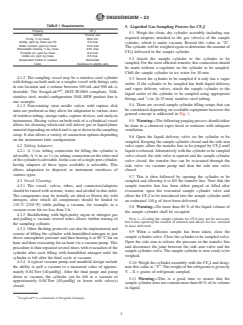
TABLE 1 Requirements
5. Liquefied Gas Sampling Process for CF I
Property CF I
5.1 Weigh the clean, dry cylinder assembly including any
Identity Passes test
required adapters attached to the gas valve(s) of the sample
Purity, % by mass 99.6 min
Acidity, ppm by mass (as HI) 3.0 max
cylinder, which is under vacuum. Record this value as “X”.
Water content, ppm by mass 10.0 max
The cylinder will be weighed again to determine the amount of
Nonvolatile residue, % by mass 0.01 max
CF I delivered to the sample cylinder.
Fluoride ion, ppm by mass 0.5 max
Iodide ion, ppm by mass 0.5 max
5.2 Attach the sample cylinder to the cylinder to be
Suspended matter or residue Nonvisible
Color Colorless to slightly pink sampled. For the most efficient transfer, this connection should
be made without a regulator on the cylinder to be sampled.
Chill the sample cylinder in ice water for 30 min.
4.1.2 The sampling vessel may be a stainless steel cylinder
5.3 Invert the cylinder to be sampled if it only has a vapor
with fittings on both ends or a simpler vessel with fittings only
outlet. If the cylinder to be sampled has both liquid delivery
in one location and a volume between 100 mL and 500 mL is
and vapor delivery valves, attach the sample cylinder to the
desirable. The SwageLok™ , DOT-3E1800 compliant, 304L
liquid outlet of the cylinder to be sampled using appropriate
stainless steel, model configuration 304L-HDF product line is
fittings and ⁄4 in. [6.35 mm] stainless steel tubing.
one example.
5.4 There are several sample cylinder filling setups that can
4.1.3 Non-rotating stem needle valves with rupture disk
be considered depending on available equipment however the
units are preferred as they allow for adaptation to various sizes
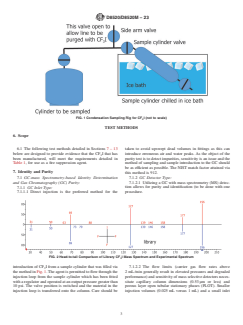
general concept is addressed in Fig. 1.
of stainless tubing, storage tanks, capture devices, and analysis
instruments. Having valves on both ends of a cylindrical vessel
5.5 Warning—The following purging process should either
allows for choosing which end will deliver gas or liquid phase be done in a chemical vapor hood or outdoors with adequate
material depending on which end is up or down in the sampling
ventilation.
setup. It also allows a variety of connection options depending
5.6 Open the liquid delivery valve on the cylinder to be
on the instrument inlet configuration.
sampled. Keeping the sample cylinder closed and the side arm
4.2 Tubing Adapters:
valve open, allow the transfer line to be purged by CF I until
4.2.1 A ⁄4 in. tubing connection for filling the cylinder is
liquid is released. Alternatively with the cylinder to be sampled
1 1
advisable. A ⁄8 in. or ⁄16 in. tubing connection on the other end
valve closed, the side valve is opened and the sample cylinder
of the cylinder is advisable. In the case of a single port cylinder,
valve closed, the transfer line can be evacuated through the
having adapters of these types available is advisable. This
side valve via vacuum pump and then the side arm valve
allows adaptation to dispersal or instrument interfaces of closed.
various types.
5.7 This is then followed by opening the cylinder to be
4.3 Vessel Cleaning: sampled and allowing it to fill the transfer line. Now that the
4.3.1 The vessel, valves, tubes, and connectors/adaptors
sample transfer line has been either purged or filled after
should be rinsed with acetone, water, and alcohol in that order. evacuation, open the evacuated sample cylinder valve and
The components may be initially air dried or blown dry with
allow the CF I to be introduced into the sample cylinder until
nitrogen, after which all components should be heated to an estimated 140 g of have been delivered.
110 °C [230 °F] while pulling a vacuum, for example, in a
5.8 Warning—No more than 60 % of the liquid volume of
vacuum oven for no less than 2 h.
the sample cylinder shall be occupied.
4.3.2 Backflushing with high-purity argon or nitrogen gas
NOTE 1—Cooling the sample cylinder for CF I may not be necessary
and pulling a vacuum several times allows further rinsing of
but it does speed up the transfer of material and allows for less variation
the sampling cylinder.
in mass delivered.
4.3.3 Other flushing protocols can also be implemented and
5.9 When a sufficient sample has been taken, close the
consist of filling the cylinder with humidified nitrogen to just
sample cylinder valve. Close the cylinder to be sampled valve.
above atmospheric pressure and then heating it at 80 °C for an
Open the side arm to release the pressure in the transfer line
hour and then evacuating for an hour via a vacuum pump. This
and disconnect the joint between the side arm valve and the
procedure is then repeated several times with evacuation of the
sample cylinder valve. The sample cylinder is now ready to be
cylinder after each filling with humidified nitrogen until the
weighed.
cylinder is left after the final cycle at vacuum.
4.3.4 A typical vacuum pump and manifold design include 5.10 Weigh the cylinder assembly with the CF I and desig-
the ability to pull a vacuum to a measured value of approxi-
nate this value as “Y”. The weight of the refrigerant is given by
mately 0.04 Torr [40 μmHg]. After the final purge and pump Y – X = grams of refrigerant sampled.
down to vacuum, the cylinder can be left at a vacuum of
5.11 Warning—This is a good time to ensure that the
approximately 0.04 Torr [40 μmHg] or lower with valve(s)
sample cylinder does not contain more than 60 % of its volume
closed.
in liquid.
SwageLok™ is a trademark of Swagelok Company.
D8520/D8520M − 23
FIG. 1 Condensation Sampling Rig for CF I (not to scale)
TEST METHODS
6. Scope
6.1 The following test methods detailed in Sections 7 – 13 taken to avoid upswept dead volumes in fittings as this can
below are designed to provide evidence that the CF I that has introduce erroneous air and water peaks. As the object of the
been manufactured, will meet the requirements detailed in purity test is to detect impurities, sensitivity is an issue and the
Table 1, for use as a fire suppression agent. method of sampling and sample introduction to the GC should
be as efficient as possible. The NIST match factor attained via
7. Identity and Purity
this method is 912.
7.1.2 GC Detector Type:
7.1 GC-mass Spectrometry-based Identity Determination
and Gas Chromatography (GC) Purity: 7.1.2.1 Utilizing a GC with mass spectrometry (MS) detec-
tion allows for purity and identification (to be done with one
7.1.1 GC Inlet Type:
7.1.1.1 Direct injection is the preferred method for the procedure.
FIG. 2 Head-to-tail Comparison of Library CF I Mass Spectrum and Experimental Spectrum
introduction of CF I from a sample cylinder that was filled via 7.1.2.2 The flow limits (carrier gas flow rates above
the method in Fig. 1. The agent is permitted to flow through the 2 mL ⁄min generally result in elevated pressures and degraded
injection loop from the sample cylinder which has been fitted performance) and sensitivity of mass selective detectors neces-
with a regulator and operated at an output pressure greater than sitate capillary column dimensions (0.53 μm or less) and
10 psi. The valve position is switched and the material in the porous layer open tubular stationary phases (PLOT). Smaller
injection loop is transferred onto the column. Care should be injection volumes (0.025 mL versus 1 mL) and a small inlet
D8520/D8520M − 23
split (5:1) are needed to prevent overloading of the stationary 8.2 Before capturing the sample, the pH of the solution must
phase and inlet pressure changes that can introduce artifacts in be adjusted. Solutions of 0.01 sulfuric acid in water and 0.01 N
the baseline. potassium hydroxide in methanol shall be used to adjust the
7.1.2.3 A sampling loop of 0.025 mL was filled with gas pH.
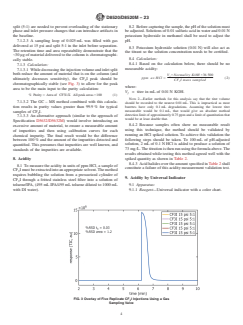
delivered at 15 psi and split 5:1 in the inlet before separation.
8.3 Potassium hydroxide solution (0.01 N) will also act as
The retention time and area repeatability demonstrate that the
the titrant so the solution concentration needs to be certified.
~30 μg of material delivered to the column is chromatographi-
8.4 Calculation:
cally stable.
8.4.1 Based on the calculation below, there should be no
7.1.3 Calculation:
measurable acidity:
7.1.3.1 While decreasing the injection volume and inlet split
both reduce the amount of material that is on the column (and
V × Normality KOH × 36 500
f
ppm as HCl 5 (2)
ultimately decreases sensitivity), the CF I peak should be
CF I mass sampled
chromatographically stable (see Fig. 3) to allow for the peak
where:
area to be the main input to the purity calculation:
V = titer in mL of 0.01 N KOH.
f
% Purity 5 Area of CF3I /Σ All peak areas × 100 (1)
NOTE 2—Earlier methods for this analysis say that the titer volume
7.1.3.2 The GC – MS method combined with this calcula-
should be recorded to the nearest 0.01 mL. This is impractical as most
tion results in purity values greater than 99.9 % for typical
burettes have only 0.1 mL degradations. Assuming the lowest titer
measurable would be 0.1 mL, that would give an absolute method
samples of CF I.
detection limit of approximately 0.75 ppm and a limit of quantitation that
7.1.3.3 An alternative approach (similar to the approach of
would be at least double that.
Specification D5632/D5632M) would involve introducing an
8.4.2 Because samples often show no measurable result
excessive amount of material, to ensure a measurable amount
using this technique, the method should be validated by
of impurities and then using calibration curves for each
running an HCl spiked solution. To achieve this validation the
chemical impurity. The final result would be the difference
following steps should be taken. To 100 mL of pH-adjusted
between 100 % and the amount of the impurities detected and
solution, 2 mL of 0.1 N HCl is added to produce a solution of
quantified. This presumes that impurities are well known, and
73 mg ⁄L. The titration is then run using the formula above. The
standards of the impurities are available.
results obtained while testing this method agreed well with the
spiked quantity as shown in Table 2.
8. Acidity
8.4.3 Acid halides over the amount specified in Table 2 shall
8.1 To measure the acidity in units of ppm HCl, a sample of
constitute a failure of this acidity measurement validat
...