

ASTM D6167-19
(Guide)Standard Guide for Conducting Borehole Geophysical Logging: Mechanical Caliper
General Information
- Abstract
SIGNIFICANCE AND USE
5.1 An appropriately developed, documented, and executed guide is essential for the proper collection and application of caliper logs. This guide is to be used in conjunction with Guide D5753.
5.2 The benefits of its use include the following: improving selection of caliper logging methods and equipment, caliper log quality and reliability, and usefulness of the caliper log data for subsequent display and interpretation.
5.3 This guide applies to commonly used caliper logging methods for geotechnical applications.
5.4 It is essential that personnel (see the Personnel section of Guide D5753) consult up-to-date textbooks and reports on the caliper technique, application, and interpretation methods.
SCOPE
1.1 This guide covers the general procedures necessary to conduct caliper logging of boreholes, wells, access tubes, caissons, or shafts (hereafter referred to as boreholes) as commonly applied to geologic, engineering, groundwater, and environmental (hereafter referred to as geotechnical) investigations. Caliper logging for mineral or petroleum exploration and development are excluded.
1.1.1 This guide offers an organized collection of information or a series of options and does not recommend a specific course of action. This document cannot replace education or experience and should be used in conjunction with professional judgment. Not all aspects of this guide may be applicable in all circumstances. This ASTM standard is not intended to represent or replace the standard of care by which the adequacy of a given professional service must be judged, nor should this document be applied without consideration of a project’s many unique aspects. The word “Standard” in the title of this document means only that the document has been approved through the ASTM consensus process.
1.2 This guide defines a caliper log as a record of borehole diameter with depth.
1.2.1 Caliper logs are essential in the interpretation of geophysical logs since geophysical results can be significantly affected by borehole diameter.
1.2.2 Caliper logs provide useful information for borehole completion and testing and are commonly used to assess borehole diameter, shape, roughness, and stability; calculate borehole volume; provide information on borehole construction; and delineate lithologic contacts, fractures, and solution cavities and other openings.
1.2.2.1 Borehole-diameter information is essential for calculation of volumetric rate from flowmeter logs.
1.2.2.2 Caliper logs are used to locate the optimum placement of inflatable packers for borehole testing. Inflatable packers can only form an effective seal within a specified range of borehole diameters, and can be damaged if they are set in rough or irregular parts of the borehole.
1.2.2.3 Caliper logs are used to estimate the volume of borehole completion material (cement, gravel, etc.) needed to fill the annular space between borehole and casing(s) or well screen.
1.2.2.4 Caliper logs may be applied to correlate lithology between boreholes based upon enlargements related to lithology. The measured borehole diameter may be significantly different than the drilled diameter because of plastic formations expanded into the borehole and friable formations enlarging the borehole. A series of caliper logs may also show increases or decreases in borehole diameter with time.
1.3 This guide is restricted to mechanically based devices with spring-loaded arms, which are the most common calipers used in caliper logging with geotechnical applications.
1.4 This guide provides an overview of caliper logging, including general procedures, specific documentation, calibration and standardization, and log quality and interpretation.
1.5 This guide is to be used in conjunction with Guide D5753.
1.6 This guide should not be used as a sole criterion for caliper logging and does not replace professional judgment. Caliper logging procedures should b...
- Status
- Published
- Publication Date
- 30-Apr-2019
- Technical Committee
- D18 - Soil and Rock
- Drafting Committee
- D18.01 - Surface and Subsurface Investigation
Overview
ASTM D6167-19: Standard Guide for Conducting Borehole Geophysical Logging: Mechanical Caliper provides essential guidance for performing caliper logging in boreholes using mechanical calipers, typically with spring-loaded arms. Published by ASTM, this standard supports geologic, engineering, groundwater, and environmental (geotechnical) investigations by ensuring accurate borehole diameter logs. Caliper logging is not covered for mineral or petroleum exploration and development.
This standard emphasizes the importance of thorough documentation, selection of appropriate logging equipment, and adherence to proper calibration and standardization practices. Used with ASTM Guide D5753, it enables reliable collection and interpretation of caliper log data, supporting high-quality subsurface investigations.
Key Topics
- Purpose of Caliper Logging: To obtain a continuous record of borehole diameter with depth, which is crucial for understanding borehole stability, fluid flow, construction, and geological features.
- Instrumentation: Focused on mechanical calipers with spring-loaded arms-single-arm, three-arm, and multi-arm tools-with guidance on selection based on geotechnical needs.
- Calibration and Standardization: Recommends calibration using physical models of known diameters and periodic checks to ensure measurement accuracy and repeatability.
- Documentation and Procedures:
- Planning and organizing the logging program
- Logging sequence and procedure for optimal data collection
- Depth reference determination and log repeatability
- Field checks and reporting requirements
- Log Interpretation: Provides insights into evaluating borehole diameter changes, correlating lithology between boreholes, identifying fractures and solution openings, and integrating caliper logs with other geophysical data.
Applications
Caliper logging, as described in ASTM D6167-19, is a vital technique for many geotechnical and environmental projects, including:
- Borehole Stability Assessment: Determines the shape, roughness, and stability of boreholes, which is critical for safe well construction and long-term monitoring.
- Borehole Volume Calculation: Essential for estimating the quantity of completion materials (cement, gravel) required to fill the annular space between the borehole and casing or screens.
- Hydrogeological Testing: Assists in locating the optimal placement for inflatable packers used in borehole testing, ensuring proper sealing within specific diameter ranges.
- Interpretation of Geophysical Logs: Borehole diameter data improves the accuracy of other geophysical log interpretations, particularly where results are sensitive to diameter variations.
- Lithological Correlation: Identifies lithologic contacts, fractures, solution cavities, and other features by analyzing borehole enlargements, supporting geological mapping and resource assessments.
- Long-term Monitoring: Enables time-based comparison for monitoring borehole condition changes due to subsurface processes or environmental impacts.
Related Standards
The following ASTM standards complement or are referenced within ASTM D6167-19 for geotechnical borehole geophysical logging:
- ASTM D5753: Guide for Planning and Conducting Geotechnical Borehole Geophysical Logging
- ASTM D653: Terminology Relating to Soil, Rock, and Contained Fluids
- ASTM D5088: Practice for Decontamination of Field Equipment Used at Waste Sites
- ASTM D5608: Practices for Decontamination of Sampling and Non Sample Contacting Equipment Used at Low Level Radioactive Waste Sites
Practical Value
Adopting ASTM D6167-19 ensures improved selection of logging equipment, enhanced data reliability, and better integration of borehole caliper logs into geotechnical investigations. These practices support more informed engineering decisions, safer constructions, and more accurate geological characterizations. Consistent application of this standard helps organizations meet regulatory requirements, optimize resource use, and reduce project risks in subsurface site characterization projects.
Keywords: ASTM D6167, mechanical caliper log, borehole diameter, geophysical logging, borehole stability, geotechnical site investigation, calibration, standardization, borehole volume, environmental drilling.
Relations
- Replaces
ASTM D6167-11 - Standard Guide for Conducting Borehole Geophysical Logging: Mechanical Caliper - Effective Date
- 01-May-2019
- Effective Date
- 01-May-2020
- Refers
ASTM D5753-18 - Standard Guide for Planning and Conducting Geotechnical Borehole Geophysical Logging - Effective Date
- 01-Feb-2018
- Effective Date
- 01-Feb-2016
- Effective Date
- 01-Aug-2015
- Effective Date
- 15-Jan-2015
- Effective Date
- 01-Aug-2014
- Effective Date
- 01-Sep-2011
- Effective Date
- 01-May-2010
- Effective Date
- 01-May-2010
- Effective Date
- 01-Jan-2009
- Effective Date
- 01-Dec-2008
- Effective Date
- 01-Nov-2008
- Refers
ASTM D5088-02(2008) - Standard Practice for Decontamination of Field Equipment Used at Waste Sites - Effective Date
- 15-Sep-2008
- Effective Date
- 15-Dec-2007
Get Certified
Connect with accredited certification bodies for this standard

Zavod za gradbeništvo Slovenije (ZAG) - Inšpekcija
ZAG inspection body for construction products, structures, and materials.
Sponsored listings
Frequently Asked Questions
ASTM D6167-19 is a guide published by ASTM International. Its full title is "Standard Guide for Conducting Borehole Geophysical Logging: Mechanical Caliper". This standard covers: SIGNIFICANCE AND USE 5.1 An appropriately developed, documented, and executed guide is essential for the proper collection and application of caliper logs. This guide is to be used in conjunction with Guide D5753. 5.2 The benefits of its use include the following: improving selection of caliper logging methods and equipment, caliper log quality and reliability, and usefulness of the caliper log data for subsequent display and interpretation. 5.3 This guide applies to commonly used caliper logging methods for geotechnical applications. 5.4 It is essential that personnel (see the Personnel section of Guide D5753) consult up-to-date textbooks and reports on the caliper technique, application, and interpretation methods. SCOPE 1.1 This guide covers the general procedures necessary to conduct caliper logging of boreholes, wells, access tubes, caissons, or shafts (hereafter referred to as boreholes) as commonly applied to geologic, engineering, groundwater, and environmental (hereafter referred to as geotechnical) investigations. Caliper logging for mineral or petroleum exploration and development are excluded. 1.1.1 This guide offers an organized collection of information or a series of options and does not recommend a specific course of action. This document cannot replace education or experience and should be used in conjunction with professional judgment. Not all aspects of this guide may be applicable in all circumstances. This ASTM standard is not intended to represent or replace the standard of care by which the adequacy of a given professional service must be judged, nor should this document be applied without consideration of a project’s many unique aspects. The word “Standard” in the title of this document means only that the document has been approved through the ASTM consensus process. 1.2 This guide defines a caliper log as a record of borehole diameter with depth. 1.2.1 Caliper logs are essential in the interpretation of geophysical logs since geophysical results can be significantly affected by borehole diameter. 1.2.2 Caliper logs provide useful information for borehole completion and testing and are commonly used to assess borehole diameter, shape, roughness, and stability; calculate borehole volume; provide information on borehole construction; and delineate lithologic contacts, fractures, and solution cavities and other openings. 1.2.2.1 Borehole-diameter information is essential for calculation of volumetric rate from flowmeter logs. 1.2.2.2 Caliper logs are used to locate the optimum placement of inflatable packers for borehole testing. Inflatable packers can only form an effective seal within a specified range of borehole diameters, and can be damaged if they are set in rough or irregular parts of the borehole. 1.2.2.3 Caliper logs are used to estimate the volume of borehole completion material (cement, gravel, etc.) needed to fill the annular space between borehole and casing(s) or well screen. 1.2.2.4 Caliper logs may be applied to correlate lithology between boreholes based upon enlargements related to lithology. The measured borehole diameter may be significantly different than the drilled diameter because of plastic formations expanded into the borehole and friable formations enlarging the borehole. A series of caliper logs may also show increases or decreases in borehole diameter with time. 1.3 This guide is restricted to mechanically based devices with spring-loaded arms, which are the most common calipers used in caliper logging with geotechnical applications. 1.4 This guide provides an overview of caliper logging, including general procedures, specific documentation, calibration and standardization, and log quality and interpretation. 1.5 This guide is to be used in conjunction with Guide D5753. 1.6 This guide should not be used as a sole criterion for caliper logging and does not replace professional judgment. Caliper logging procedures should b...
SIGNIFICANCE AND USE 5.1 An appropriately developed, documented, and executed guide is essential for the proper collection and application of caliper logs. This guide is to be used in conjunction with Guide D5753. 5.2 The benefits of its use include the following: improving selection of caliper logging methods and equipment, caliper log quality and reliability, and usefulness of the caliper log data for subsequent display and interpretation. 5.3 This guide applies to commonly used caliper logging methods for geotechnical applications. 5.4 It is essential that personnel (see the Personnel section of Guide D5753) consult up-to-date textbooks and reports on the caliper technique, application, and interpretation methods. SCOPE 1.1 This guide covers the general procedures necessary to conduct caliper logging of boreholes, wells, access tubes, caissons, or shafts (hereafter referred to as boreholes) as commonly applied to geologic, engineering, groundwater, and environmental (hereafter referred to as geotechnical) investigations. Caliper logging for mineral or petroleum exploration and development are excluded. 1.1.1 This guide offers an organized collection of information or a series of options and does not recommend a specific course of action. This document cannot replace education or experience and should be used in conjunction with professional judgment. Not all aspects of this guide may be applicable in all circumstances. This ASTM standard is not intended to represent or replace the standard of care by which the adequacy of a given professional service must be judged, nor should this document be applied without consideration of a project’s many unique aspects. The word “Standard” in the title of this document means only that the document has been approved through the ASTM consensus process. 1.2 This guide defines a caliper log as a record of borehole diameter with depth. 1.2.1 Caliper logs are essential in the interpretation of geophysical logs since geophysical results can be significantly affected by borehole diameter. 1.2.2 Caliper logs provide useful information for borehole completion and testing and are commonly used to assess borehole diameter, shape, roughness, and stability; calculate borehole volume; provide information on borehole construction; and delineate lithologic contacts, fractures, and solution cavities and other openings. 1.2.2.1 Borehole-diameter information is essential for calculation of volumetric rate from flowmeter logs. 1.2.2.2 Caliper logs are used to locate the optimum placement of inflatable packers for borehole testing. Inflatable packers can only form an effective seal within a specified range of borehole diameters, and can be damaged if they are set in rough or irregular parts of the borehole. 1.2.2.3 Caliper logs are used to estimate the volume of borehole completion material (cement, gravel, etc.) needed to fill the annular space between borehole and casing(s) or well screen. 1.2.2.4 Caliper logs may be applied to correlate lithology between boreholes based upon enlargements related to lithology. The measured borehole diameter may be significantly different than the drilled diameter because of plastic formations expanded into the borehole and friable formations enlarging the borehole. A series of caliper logs may also show increases or decreases in borehole diameter with time. 1.3 This guide is restricted to mechanically based devices with spring-loaded arms, which are the most common calipers used in caliper logging with geotechnical applications. 1.4 This guide provides an overview of caliper logging, including general procedures, specific documentation, calibration and standardization, and log quality and interpretation. 1.5 This guide is to be used in conjunction with Guide D5753. 1.6 This guide should not be used as a sole criterion for caliper logging and does not replace professional judgment. Caliper logging procedures should b...
ASTM D6167-19 is classified under the following ICS (International Classification for Standards) categories: 93.020 - Earthworks. Excavations. Foundation construction. Underground works. The ICS classification helps identify the subject area and facilitates finding related standards.
ASTM D6167-19 has the following relationships with other standards: It is inter standard links to ASTM D6167-11, ASTM D5088-20, ASTM D5753-18, ASTM D5608-16, ASTM D5088-15a, ASTM D5088-15, ASTM D653-14, ASTM D653-11, ASTM D5753-05(2010), ASTM D5608-10, ASTM D653-09, ASTM D653-08a, ASTM D653-08, ASTM D5088-02(2008), ASTM D653-07f. Understanding these relationships helps ensure you are using the most current and applicable version of the standard.
ASTM D6167-19 is available in PDF format for immediate download after purchase. The document can be added to your cart and obtained through the secure checkout process. Digital delivery ensures instant access to the complete standard document.
Standards Content (Sample)
This international standard was developed in accordance with internationally recognized principles on standardization established in the Decision on Principles for the
Development of International Standards, Guides and Recommendations issued by the World Trade Organization Technical Barriers to Trade (TBT) Committee.
Designation: D6167 − 19
Standard Guide for
Conducting Borehole Geophysical Logging: Mechanical
Caliper
This standard is issued under the fixed designation D6167; the number immediately following the designation indicates the year of
original adoption or, in the case of revision, the year of last revision. A number in parentheses indicates the year of last reapproval. A
superscript epsilon (´) indicates an editorial change since the last revision or reapproval.
1. Scope 1.2.2.2 Caliper logs are used to locate the optimum place-
ment of inflatable packers for borehole testing. Inflatable
1.1 This guide covers the general procedures necessary to
packerscanonlyformaneffectivesealwithinaspecifiedrange
conduct caliper logging of boreholes, wells, access tubes,
of borehole diameters, and can be damaged if they are set in
caissons, or shafts (hereafter referred to as boreholes) as
rough or irregular parts of the borehole.
commonly applied to geologic, engineering, groundwater, and
1.2.2.3 Caliper logs are used to estimate the volume of
environmental (hereafter referred to as geotechnical) investi-
borehole completion material (cement, gravel, etc.) needed to
gations. Caliper logging for mineral or petroleum exploration
fill the annular space between borehole and casing(s) or well
and development are excluded.
screen.
1.1.1 This guide offers an organized collection of informa-
1.2.2.4 Caliper logs may be applied to correlate lithology
tion or a series of options and does not recommend a specific
between boreholes based upon enlargements related to lithol-
course of action. This document cannot replace education or
ogy. The measured borehole diameter may be significantly
experience and should be used in conjunction with professional
differentthanthedrilleddiameterbecauseofplasticformations
judgment. Not all aspects of this guide may be applicable in all
expanded into the borehole and friable formations enlarging
circumstances. This ASTM standard is not intended to repre-
the borehole. A series of caliper logs may also show increases
sent or replace the standard of care by which the adequacy of
or decreases in borehole diameter with time.
a given professional service must be judged, nor should this
document be applied without consideration of a project’s many 1.3 This guide is restricted to mechanically based devices
unique aspects. The word “Standard” in the title of this with spring-loaded arms, which are the most common calipers
document means only that the document has been approved used in caliper logging with geotechnical applications.
through the ASTM consensus process.
1.4 This guide provides an overview of caliper logging,
including general procedures, specific documentation, calibra-
1.2 This guide defines a caliper log as a record of borehole
diameter with depth. tion and standardization, and log quality and interpretation.
1.2.1 Caliper logs are essential in the interpretation of
1.5 This guide is to be used in conjunction with Guide
geophysical logs since geophysical results can be significantly
D5753.
affected by borehole diameter.
1.6 This guide should not be used as a sole criterion for
1.2.2 Caliper logs provide useful information for borehole
caliper logging and does not replace professional judgment.
completion and testing and are commonly used to assess
Caliper logging procedures should be adapted to meet the
borehole diameter, shape, roughness, and stability; calculate
needs of a range of applications. Information in this guide is
borehole volume; provide information on borehole construc-
stated in general terms so that flexibility or innovation is not
tion; and delineate lithologic contacts, fractures, and solution
suppressed.
cavities and other openings.
1.7 Units—The values stated in SI units are to be regarded
1.2.2.1 Borehole-diameter information is essential for cal-
culation of volumetric rate from flowmeter logs. as standard. The values given in parentheses are mathematical
conversions to inch-pound units, which are provided for
information only and are not considered standard. Reporting of
test results in units other than SI shall not be regarded as
This guide is under the jurisdiction ofASTM Committee D18 on Soil and Rock
nonconformance with this standard.
and is the direct responsibility of Subcommittee D18.01 on Surface and Subsurface
Characterization.
1.8 This guide does not purport to address all of the safety
Current edition approved May 1, 2019. Published May 2019. Originally
and liability problems (for example, lost or lodged probes and
approved in 1997. Last previous edition approved in 2011 as D6167-11. DOI:
10.1520/D6167-19. equipment decontamination) associated with its use.
Copyright © ASTM International, 100 Barr Harbor Drive, PO Box C700, West Conshohocken, PA 19428-2959. United States
D6167 − 19
1.9 This standard does not purport to address all of the 5. Significance and Use
safety concerns, if any, associated with its use. It is the
5.1 An appropriately developed, documented, and executed
responsibility of the user of this standard to establish appro-
guide is essential for the proper collection and application of
priate safety, health, and environmental practices and deter-
caliper logs.This guide is to be used in conjunction with Guide
mine the applicability of regulatory limitations prior to use.
D5753.
1.10 This international standard was developed in accor-
5.2 The benefits of its use include the following: improving
dance with internationally recognized principles on standard-
selection of caliper logging methods and equipment, caliper
ization established in the Decision on Principles for the
logqualityandreliability,andusefulnessofthecaliperlogdata
Development of International Standards, Guides and Recom-
for subsequent display and interpretation.
mendations issued by the World Trade Organization Technical
Barriers to Trade (TBT) Committee.
5.3 This guide applies to commonly used caliper logging
methods for geotechnical applications.
2. Referenced Documents
5.4 It is essential that personnel (see the Personnel section
2.1 ASTM Standards:
of Guide D5753) consult up-to-date textbooks and reports on
D653 Terminology Relating to Soil, Rock, and Contained
the caliper technique, application, and interpretation methods.
Fluids
D5088 Practice for Decontamination of Field Equipment
6. Interferences
Used at Waste Sites
6.1 Most extraneous effects on caliper logs are caused by
D5608 Practices for Decontamination of Sampling and Non
instrument problems and borehole conditions.
Sample Contacting Equipment Used at Low Level Radio-
6.2 Instrument problems include the following: electrical
active Waste Sites
leakage of cable and grounding problems, temperature drift,
D5753 Guide for Planning and Conducting Geotechnical
wear of mechanical components including the hinge pins and
Borehole Geophysical Logging
in the linear potentiometer (mechanical hysteresis), damaged
3. Terminology or bent arms, and lack of lubrication of the mechanical
components.
3.1 Definitions:
3.1.1 For definitions of common technical terms used in this 6.3 Problematic borehole conditions include heavy drilling
standard, refer to Terminology D653. mud, borehole deviation, and drilling-related borehole irregu-
larities.
3.2 Definitions of Terms Specific to This Standard:
3.2.1 depth of investigation, n—the radial distance from the
7. Apparatus
measurement point to a point where the predominant measured
7.1 Ageophysical logging system has been described in the
response may be considered centered.
general guide (see the Apparatus section of Guide D5753). A
3.2.1.1 Discussion—The depth of investigation for borehole
variety of caliper logging equipment is available for geotech-
logging is a radial distance from the borehole and is not to be
nical investigations. It is not practical to list all of the sources
confused with borehole depth or any depth measured from the
of potentially acceptable equipment.
surface.
3.2.2 measurement resolution, n—the minimum change in 7.2 Caliper logs may be obtained with probes having a
measured value that can be detected. single arm, three arms (averaging or summation), multiple
independent arms (x-y caliper), multiple-feeler arms, bow
3.2.3 verticalresolution,n—theminimumthicknessthatcan
springs, or gap wheels. Single-arm and three-arm averaging
be separated into distinct units.
probes are most commonly used for geotechnical investiga-
3.2.4 volume of investigation, n—the volume that contrib-
tions.
utes 90 % of the measured response.
7.2.1 A single-arm caliper commonly provides a record of
3.2.4.1 Discussion—It is determined by a combination of
borehole diameter while being used to decentralize another
theoretical and empirical modeling. The volume of investiga-
type of log, such as a side-collimated gamma-gamma probe
tion is non-spherical and has gradational boundaries.
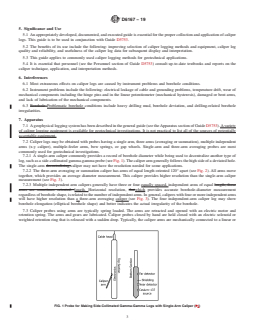
(see Fig. 1). The caliper arm generally follows the high side of
a deviated hole. The single-arm caliper may not have the
4. Summary of Guide
resolution needed for some applications.
4.1 This guide applies to borehole caliper logging and is to
7.2.2 The three-arm averaging or summation caliper has
be used in conjunction with Guide D5753.
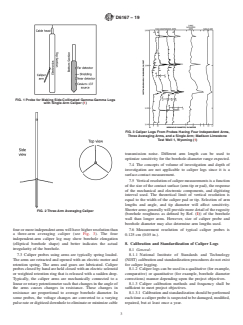
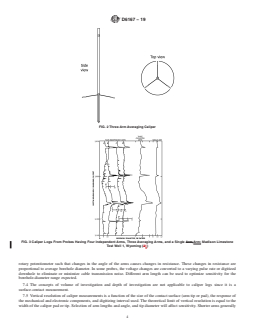
arms of equal length oriented 120° apart (see Fig. 2).All arms
4.2 This guide briefly describes the significance and use, move together, which provides an average diameter measure-
ment. This caliper provides higher resolution than the single-
apparatus, calibration and standardization, procedures, and
reports for conducting borehole caliper logging. arm caliper measurement (see Fig. 3).
7.2.3 Multiple independent arm calipers generally have
three or four equally spaced, independent arms of equal length.
For referenced ASTM standards, visit the ASTM website, www.astm.org, or
Horizontal resolution, which provides accurate borehole-
contact ASTM Customer Service at service@astm.org. For Annual Book of ASTM
diameter measurement regardless of borehole shape, is related
Standards volume information, refer to the standard’s Document Summary page on
the ASTM website. to the number of independent arms. In general, calipers with
D6167 − 19
FIG. 1 Probe for Making Side-Collimated Gamma-Gamma Logs
with Single-Arm Caliper (1)
FIG. 3 Caliper Logs From Probes Having Four Independent Arms,
Three Averaging Arms, and a Single Arm; Madison Limestone
Test Well 1, Wyoming (1)
transmission noise. Different arm length can be used to
optimize sensitivity for the borehole-diameter range expected.
7.4 The concepts of volume of investigation and depth of
investigation are not applicable to caliper logs since it is a
surface-contact measurement.
7.5 Vertical resolution of caliper measurements is a function
of the size of the contact surface (arm tip or pad), the response
of the mechanical and electronic components, and digitizing
interval used. The theoretical limit of vertical resolution is
equal to the width of the caliper pad or tip. Selection of arm
lengths and angle, and tip diameter will affect sensitivity.
Shorter arms generally will provide more detail of the rugosity
FIG. 2 Three-Arm Averaging Caliper
(borehole roughness as defined by Ref. (1)) of the borehole
wall than longer arms. However, size of caliper probe and
borehole diameter may also determine arm lengths used.
fourormoreindependentarmswillhavehigherresolutionthan
7.6 Measurement resolution of typical caliper probes is
a three-arm averaging caliper (see Fig. 3). The four
0.125 cm (0.05 in.).
independent-arm caliper log may show borehole elongation
(elliptical borehole shape) and better indicates the actual 8. Calibration and Standardization of Caliper Logs
irregularity of the borehole.
8.1 General:
7.3 Caliper probes using arms are typically spring loaded. 8.1.1 National Institute of Standards and Technology
The arms are retracted and opened with an electric motor and (NIST) calibration and standardization procedures do not exist
retention spring. The arms and gears are lubricated. Caliper for caliper logging.
probes closed by hand are held closed with an electric solenoid 8.1.2 Caliper logs can be used in a qualitative (for example,
or weighted retention ring that is released with a sudden drop. comparative) or quantitative (for example, borehole diameter
Typically, the caliper arms are mechanically connected to a corrections) manner depending upon the project objectives.
linear or rotary potentiometer such that changes in the angle of 8.1.3 Caliper calibration methods and frequency shall be
the arms causes changes in resistance. These changes in sufficient to meet project objectives.
resistance are proportional to average borehole diameter. In 8.1.3.1 Calibrationandstandardizationshouldbeperformed
some probes, the voltage changes are converted to a varying eachtimeacaliperprobeissuspectedtobedamaged,modified,
pulserateordigitizeddownholetoeliminateorminimizecable repaired, but at least once a year.
...
This document is not an ASTM standard and is intended only to provide the user of an ASTM standard an indication of what changes have been made to the previous version. Because
it may not be technically possible to adequately depict all changes accurately, ASTM recommends that users consult prior editions as appropriate. In all cases only the current version
of the standard as published by ASTM is to be considered the official document.
Designation: D6167 − 11 D6167 − 19
Standard Guide for
Conducting Borehole Geophysical Logging: Mechanical
Caliper
This standard is issued under the fixed designation D6167; the number immediately following the designation indicates the year of
original adoption or, in the case of revision, the year of last revision. A number in parentheses indicates the year of last reapproval. A
superscript epsilon (´) indicates an editorial change since the last revision or reapproval.
1. Scope*Scope
1.1 This guide covers the general procedures necessary to conduct caliper logging of boreholes, wells, access tubes, caissons,
or shafts (hereafter referred to as boreholes) as commonly applied to geologic, engineering, groundwater, and environmental
(hereafter referred to as geotechnical) investigations. Caliper logging for mineral or petroleum exploration and development are
excluded.
1.1.1 This guide offers an organized collection of information or a series of options and does not recommend a specific course
of action. This document cannot replace education or experience and should be used in conjunction with professional judgment.
Not all aspects of this guide may be applicable in all circumstances. This ASTM standard is not intended to represent or replace
the standard of care by which the adequacy of a given professional service must be judged, nor should this document be applied
without consideration of a project’s many unique aspects. The word “Standard” in the title of this document means only that the
document has been approved through the ASTM consensus process.
1.2 This guide defines a caliper log as a record of borehole diameter with depth.
1.2.1 Caliper logs are essential in the interpretation of geophysical logs since they geophysical results can be significantly
affected by borehole diameter.
1.2.2 Caliper logs provide useful information for borehole completion and testing and are commonly used to measureassess
borehole diameter, shape, roughness, and stability; calculate borehole volume; provide information on borehole construction; and
delineate lithologic contacts, fractures, and solution cavities and other openings.
1.2.2.1 Borehole-diameter information is essential for calculation of volumetric rate from flowmeter logs.
1.2.2.2 Caliper logs provide useful information for borehole completion and testing.
1.2.2.2 Caliper logs are used to locate the optimum placement of inflatable packers for borehole testing. Inflatable packers can
only form an effective seal within a specified range of borehole diameters, and can be damaged if they are set in rough or irregular
parts of the borehole.
1.2.2.3 Caliper logs are used to estimate the volume of borehole completion material (cement, gravel, etc.) needed to fill the
annular space between borehole and casing(s) or well screen.
1.2.2.4 Caliper logs may be applied to correlate lithology between boreholes based upon enlargements related to lithology. The
measured borehole diameter may be significantly different than the drilled diameter because of plastic formations extrudedex-
panded into the borehole and friable formations enlarging the borehole. A series of caliper logs may also show increases or
decreases in borehole diameter with time.
1.3 This guide is restricted to mechanically based devices with spring-loaded arms, which are the most common calipers used
in caliper logging with geotechnical applications.
1.4 This guide provides an overview of caliper logging, including general procedures, specific documentation, calibration and
standardization, and log quality and interpretation.
1.5 To obtain additional information on caliper logs see Section 9 of this guide.
1.5 This guide is to be used in conjunction with Guide D5753.
1.6 This guide should not be used as a sole criterion for caliper logging and does not replace professional judgment. Caliper
logging procedures should be adapted to meet the needs of a range of applications and applications. Information in this guide is
stated in general terms so that flexibility or innovation is not suppressed.
This guide is under the jurisdiction of ASTM Committee D18 on Soil and Rock and is the direct responsibility of Subcommittee D18.01 on Surface and Subsurface
Characterization.
Current edition approved May 1, 2011May 1, 2019. Published June 2011May 2019. Originally approved in 1997. Last previous edition approved in 19972011 as
D6167-97(2004).D6167-11. DOI: 10.1520/D6167-11. 10.1520/D6167-19.
*A Summary of Changes section appears at the end of this standard
Copyright © ASTM International, 100 Barr Harbor Drive, PO Box C700, West Conshohocken, PA 19428-2959. United States
D6167 − 19
1.7 Units—The geotechnical industry uses English or SI units. The caliper log is typically recorded in units of inches,
millimetres, or centimetres.values stated in SI units are to be regarded as standard. The values given in parentheses are
mathematical conversions to inch-pound units, which are provided for information only and are not considered standard. Reporting
of test results in units other than SI shall not be regarded as nonconformance with this standard.
1.8 This guide does not purport to address all of the safety and liability problems (for example, lost or lodged probes and
equipment decontamination) associated with its use.
1.9 This standard does not purport to address all of the safety concerns, if any, associated with its use. It is the responsibility
of the user of this standard to establish appropriate safety safety, health, and healthenvironmental practices and determine the
applicability of regulatory limitations prior to use.
1.10 This international standard was developed in accordance with internationally recognized principles on standardization
established in the Decision on Principles for the Development of International Standards, Guides and Recommendations issued
by the World Trade Organization Technical Barriers to Trade (TBT) Committee.
2. Referenced Documents
2.1 ASTM Standards:
D653 Terminology Relating to Soil, Rock, and Contained Fluids
D5088 Practice for Decontamination of Field Equipment Used at Waste Sites
D5608 Practices for Decontamination of Sampling and Non Sample Contacting Equipment Used at Low Level Radioactive
Waste Sites
D5753 Guide for Planning and Conducting Geotechnical Borehole Geophysical Logging
3. Terminology
3.1 Definitions:
3.1.1 For definitions of common technical terms used in this standard, refer to Terminology D653.
3.2 Definitions:Definitions of Terms Specific to This Standard:
3.1.1 Definitions shall be in accordance with Terminology D653, Section 12, Ref (1), or as defined below:
3.1.2 accuracy, n—how close a measured log values approaches true value. It is determined in a controlled environment. A
controlled environment represents a homogeneous sample volume with known properties.
3.2.1 depth of investigation, n—the radial distance from the measurement point to a point where the predominant measured
response may be considered centered, that is not to be confused with borehole depth (for example, distance) measured from the
surface.centered.
3.2.1.1 Discussion—
The depth of investigation for borehole logging is a radial distance from the borehole and is not to be confused with borehole depth
or any depth measured from the surface.
3.2.2 measurement resolution, n—the minimum change in measured value that can be detected.
3.1.5 repeatability, n—the difference in magnitude of two measurements with the same equipment and in the same environment.
3.2.3 vertical resolution, n—the minimum thickness that can be separated into distinct units.
3.2.4 volume of investigation, n—the volume that contributes 90 % of the measured response. It is determined by a combination
of theoretical and empirical modeling. The volume of investigation is non-spherical and has gradational boundaries.
3.2.4.1 Discussion—
It is determined by a combination of theoretical and empirical modeling. The volume of investigation is non-spherical and has
gradational boundaries.
4. Summary of Guide
4.1 This guide applies to borehole caliper logging and is to be used in conjunction with Guide D5753.
4.2 This guide briefly describes the significance and use, apparatus, calibration and standardization, procedures, and reports for
conducting borehole caliper logging.
For referenced ASTM standards, visit the ASTM website, www.astm.org, or contact ASTM Customer Service at service@astm.org. For Annual Book of ASTM Standards
volume information, refer to the standard’s Document Summary page on the ASTM website.
D6167 − 19
5. Significance and Use
5.1 An appropriately developed, documented, and executed guide is essential for the proper collection and application of caliper
logs. This guide is to be used in conjunction with Guide D5753.
5.2 The benefits of its use include the following: improving selection of caliper logging methods and equipment, caliper log
quality and reliability, and usefulness of the caliper log data for subsequent display and interpretation.
5.3 This guide applies to commonly used caliper logging methods for geotechnical applications.
5.4 It is essential that personnel (see the Personnel section of Guide D5753) consult up-to-date textbooks and reports on the
caliper technique, application, and interpretation methods.
6. Interferences
6.1 Most extraneous effects on caliper logs are caused by instrument problems and borehole conditions.
6.2 Instrument problems include the following: electrical leakage of cable and grounding problems, temperature drift, wear of
mechanical components including the hinge pins and in the linear potentiometer (mechanical hysteresis), damaged or bent arms,
and lack of lubrication of the mechanical components.
6.3 Borehole Problematic borehole conditions include heavy drilling mud, borehole deviation, and drilling-related borehole
irregularities.
7. Apparatus
7.1 A geophysical logging system has been described in the general guide (see the Apparatus section of Guide D5753). A variety
of caliper logging equipment is available for geotechnical investigations. It is not practical to list all of the sources of potentially
acceptable equipment.
7.2 Caliper logs may be obtained with probes having a single arm, three arms (averaging or summation), multiple independent
arms (x-y caliper), multiple-feeler arms, bow springs, or gap wheels. Single-arm and three-arm averaging probes are most
commonly used for geotechnical investigations.
7.2.1 A single-arm caliper commonly provides a record of borehole diameter while being used to decentralize another type of
log, such as a side-collimated gamma-gamma probe (see Fig. 1). The caliper arm generally follows the high side of a deviated hole.
The single-arm decentralizing caliper may not have the resolution needed for some applications.
7.2.2 The three-arm averaging or summation caliper has arms of equal length oriented 120° apart (see Fig. 2). All arms move
together, which provides an average diameter measurement. This caliper provides higher resolution than the single-arm caliper
measurement (see Fig. 3).
7.2.3 Multiple independent arm calipers generally have three or four equally spaced, independent arms of equal length; these
arms are sometimes oriented. length. Horizontal resolution, thatwhich provides accurate borehole-diameter measurement
regardless of borehole shape, is related to the number of independent arms. In general, calipers with four or more independent arms
will have higher resolution than a three-arm averaging caliper (see Fig. 3). The four independent-arm caliper log may show
borehole elongation (elliptical borehole shape) and better indicates the actual irregularity of the borehole.
7.3 Caliper probes using arms are typically spring loaded. The arms are retracted and opened with an electric motor and
retention spring. The arms and gears are lubricated. Caliper probes closed by hand are held closed with an electric solenoid or
weighted retention ring that is released with a sudden drop. Typically, the caliper arms are mechanically connected to a linear or
FIG. 1 Probe for Making Side-Collimated Gamma-Gamma Logs with Single-Arm Caliper (21)
D6167 − 19
FIG. 2 Three-Arm Averaging Caliper
FIG. 3 Caliper Logs From Probes Having Four Independent Arms, Three Averaging Arms, and a Single Arm,Arm; Madison Limestone
Test Well 1, Wyoming (21)
rotary potentiometer such that changes in the angle of the arms causes changes in resistance. These changes in resistance are
proportional to average borehole diameter. In some probes, the voltage changes are converted to a varying pulse rate or digitized
downhole to eliminate or minimize cable transmission noise. Different arm length can be used to optimize sensitivity for the
borehole-diameter range expected.
7.4 The concepts of volume of investigation and depth of investigation are not applicable to caliper logs since it is a
surface-contact measurement.
7.5 Vertical resolution of caliper measurements is a function of the size of the contact surface (arm tip or pad), the response of
the mechanical and electronic components, and digitizing interval used. The theoretical limit of vertical resolution is equal to the
width of the caliper pad or tip. Selection of arm lengths and angle, and tip diameter will affect sensitivity. Shorter arms generally
D6167 − 19
will provide more detail of the rugosity (borehole roughness as defined by Ref. (21)) of the borehole wall than longer arms.
However, size of caliper probe and borehole diameter may also determine arm lengths used.
7.6 Measurement resolution of typical caliper probes is 0.05 in. (0.13 cm) of borehole diameter.0.125 cm (0.05 in.).
7.7 A variety of caliper logging equipment is available for geotechnical investigations. It is not practical to list all of the sources
of potentially acceptable equipment.
8. Calibration and Standardization of Caliper Logs
8.1 General:
8.1.1 National Institute of Standards and Technology (NIST) calibration and standardization procedures do not exist for caliper
logging.
8.1.2 Caliper logs can be used in a qualitative (for example, comparative) or quantitative
...