

ASTM D5764-23a
(Test Method)Standard Test Method for Evaluating Dowel-Bearing Strength of Wood and Wood-Based Products
General Information
- Abstract
SIGNIFICANCE AND USE
5.1 The localized crushing behavior of wood or wood-base products beneath a fastener where the fastener does not bend provides a material property that is used in theoretical models for connections where crushing or fastener bending, or both, occur. These theoretical models are used to establish design values for wood and wood-base connections. The tests are appropriate when studying the effects of such variables as fastener diameter, fastener hole size, moisture content, specific gravity, and grain direction on the dowel-bearing strength.
SCOPE
1.1 This test method provides the basic procedure for evaluating dowel-bearing strength of wood and wood-based products. The bearing test results are used to determine the static load resistance and deformation characteristics of connections in wood and wood-base products resulting from the application of a load transmitted by a fastener inserted into a predrilled hole, or driven without drilling. Methods are given for preparing specimens with predrilled holes larger than the fastener diameter and specimens with holes produced by inserting fasteners in holes smaller than the fastener diameter. The methods apply to fasteners such as dowels, bolts, nails, spikes, drift pins, screws, lag screws, and staples.
1.2 This test method also provides the basis for determining the compression behavior of wood products beneath a laterally loaded fastener where the thickness of the product and the diameter of the fastener are such that minimal bending of the fastener occurs during testing.
1.3 The values stated in inch-pound units are to be regarded as standard. The values given in parentheses are mathematical conversions to SI units that are provided for information only and are not considered standard.
1.4 This standard does not purport to address all of the safety concerns, if any, associated with its use. It is the responsibility of the user of this standard to establish appropriate safety, health, and environmental practices and determine the applicability of regulatory limitations prior to use.
1.5 This international standard was developed in accordance with internationally recognized principles on standardization established in the Decision on Principles for the Development of International Standards, Guides and Recommendations issued by the World Trade Organization Technical Barriers to Trade (TBT) Committee.
- Status
- Published
- Publication Date
- 31-Mar-2023
- Technical Committee
- D07 - Wood
- Drafting Committee
- D07.05 - Wood Assemblies
Buy Documents
ASTM D5764-23a - Standard Test Method for Evaluating Dowel-Bearing Strength of Wood and Wood-Based Products
REDLINE ASTM D5764-23a - Standard Test Method for Evaluating Dowel-Bearing Strength of Wood and Wood-Based Products
Overview
ASTM D5764-23a: Standard Test Method for Evaluating Dowel-Bearing Strength of Wood and Wood-Based Products provides a uniform procedure for assessing the dowel-bearing strength of wood and wood-based materials. Dowel-bearing strength is a critical property in wood connections, representing the localized load-deformation behavior beneath a fastener such as a dowel, bolt, nail, spike, screw, or staple. The results from this test method are fundamental in determining the static load resistance and deformation characteristics of wood connections, supporting the design and evaluation of joints in structural applications.
Key Topics
Dowel-Bearing Strength
The standard defines dowel-bearing strength as the yield load from a load-deformation curve, normalized by the fastener's diameter and specimen thickness.Test Specimens
Procedures are outlined for preparing specimens with predrilled holes either larger or smaller than the fastener diameter. Both half-hole and full-hole configurations are included to minimize fastener bending and material splitting.Fastener Types
Methods apply to a wide range of fasteners, including dowels, bolts, nails, screws, lag screws, drift pins, spikes, and staples.Material Variables
The test method accommodates studies on the effects of fastener diameter, fastener hole size, moisture content, grain direction, and specific gravity on connection strength.Measurement and Apparatus
Detailed requirements are provided for load calibration, deformation measurement (using devices such as LVDTs), rate of testing, and specimen conditioning.
Applications
ASTM D5764-23a finds extensive use in the following areas:
Structural Engineering and Timber Design
Engineers use this test method to derive design values for wood connections, ensuring safety and reliability in timber structures.Material and Product Development
Manufacturers of wood-based products utilize the standard to evaluate new materials and fastening systems, supporting product innovation and performance verification.Research and Testing Laboratories
Academic and industrial labs apply this method to analyze the influence of various parameters (e.g., moisture content, fastener type) on the dowel-bearing strength of wood specimens.Building Code Compliance
Results from ASTM D5764-23a support documentation and certification required for meeting structural requirements in construction codes.Quality Control
Routine testing of wood products and fasteners ensures consistent performance, especially where localized crushing or compressive behavior is a concern.
Related Standards
ASTM D143
Test Methods for Small Clear Specimens of Timber
Used for general timber property assessment.ASTM D2395
Test Methods for Density and Specific Gravity (Relative Density) of Wood and Wood-Based Materials
Provides methods for determining basic wood material properties relevant to dowel-bearing strength.ASTM D2915
Practice for Sampling and Data-Analysis for Structural Wood and Wood-Based Products
Describes statistical methods for sample selection.ASTM D4442
Test Methods for Direct Moisture Content Measurement of Wood and Wood-Based Materials
Critical for accurate dowel-bearing strength evaluation.ASTM E4
Practices for Force Calibration and Verification of Testing Machines
Ensures load measurement reliability.ASTM E2309
Practices for Verification of Displacement Measuring Systems and Devices Used in Material Testing Machines
Supports accurate deformation measurement during testing.
By following ASTM D5764-23a, engineers, manufacturers, and researchers ensure that wood and wood-based products meet rigorous performance criteria for fastener connections, resulting in safe and durable structural applications. This standard is foundational in the field of wood engineering, enabling reliable comparison and evaluation of materials and fastening techniques.
Relations
- Effective Date
- 01-Mar-2020
- Effective Date
- 15-Nov-2016
- Effective Date
- 01-Jun-2015
- Effective Date
- 01-Jun-2014
- Effective Date
- 01-May-2014
- Effective Date
- 01-May-2014
- Refers
ASTM D2915-10 - Practice for Sampling and Data-Analysis for Structural Wood and Wood-Based Products - Effective Date
- 01-Nov-2010
- Effective Date
- 01-Jun-2010
- Effective Date
- 01-Nov-2009
- Effective Date
- 01-Apr-2009
- Effective Date
- 01-Dec-2008
- Effective Date
- 15-Nov-2007
- Effective Date
- 01-Jul-2007
- Refers
ASTM D2395-07ae1 - Standard Test Methods for Specific Gravity of Wood and Wood-Based Materials - Effective Date
- 01-Jul-2007
- Effective Date
- 01-Apr-2007
Buy Documents
ASTM D5764-23a - Standard Test Method for Evaluating Dowel-Bearing Strength of Wood and Wood-Based Products
REDLINE ASTM D5764-23a - Standard Test Method for Evaluating Dowel-Bearing Strength of Wood and Wood-Based Products
Get Certified
Connect with accredited certification bodies for this standard

Gozdarski inštitut Slovenije
Slovenian Forestry Institute. Forest management certification support, timber testing.
Sponsored listings
Frequently Asked Questions
ASTM D5764-23a is a standard published by ASTM International. Its full title is "Standard Test Method for Evaluating Dowel-Bearing Strength of Wood and Wood-Based Products". This standard covers: SIGNIFICANCE AND USE 5.1 The localized crushing behavior of wood or wood-base products beneath a fastener where the fastener does not bend provides a material property that is used in theoretical models for connections where crushing or fastener bending, or both, occur. These theoretical models are used to establish design values for wood and wood-base connections. The tests are appropriate when studying the effects of such variables as fastener diameter, fastener hole size, moisture content, specific gravity, and grain direction on the dowel-bearing strength. SCOPE 1.1 This test method provides the basic procedure for evaluating dowel-bearing strength of wood and wood-based products. The bearing test results are used to determine the static load resistance and deformation characteristics of connections in wood and wood-base products resulting from the application of a load transmitted by a fastener inserted into a predrilled hole, or driven without drilling. Methods are given for preparing specimens with predrilled holes larger than the fastener diameter and specimens with holes produced by inserting fasteners in holes smaller than the fastener diameter. The methods apply to fasteners such as dowels, bolts, nails, spikes, drift pins, screws, lag screws, and staples. 1.2 This test method also provides the basis for determining the compression behavior of wood products beneath a laterally loaded fastener where the thickness of the product and the diameter of the fastener are such that minimal bending of the fastener occurs during testing. 1.3 The values stated in inch-pound units are to be regarded as standard. The values given in parentheses are mathematical conversions to SI units that are provided for information only and are not considered standard. 1.4 This standard does not purport to address all of the safety concerns, if any, associated with its use. It is the responsibility of the user of this standard to establish appropriate safety, health, and environmental practices and determine the applicability of regulatory limitations prior to use. 1.5 This international standard was developed in accordance with internationally recognized principles on standardization established in the Decision on Principles for the Development of International Standards, Guides and Recommendations issued by the World Trade Organization Technical Barriers to Trade (TBT) Committee.
SIGNIFICANCE AND USE 5.1 The localized crushing behavior of wood or wood-base products beneath a fastener where the fastener does not bend provides a material property that is used in theoretical models for connections where crushing or fastener bending, or both, occur. These theoretical models are used to establish design values for wood and wood-base connections. The tests are appropriate when studying the effects of such variables as fastener diameter, fastener hole size, moisture content, specific gravity, and grain direction on the dowel-bearing strength. SCOPE 1.1 This test method provides the basic procedure for evaluating dowel-bearing strength of wood and wood-based products. The bearing test results are used to determine the static load resistance and deformation characteristics of connections in wood and wood-base products resulting from the application of a load transmitted by a fastener inserted into a predrilled hole, or driven without drilling. Methods are given for preparing specimens with predrilled holes larger than the fastener diameter and specimens with holes produced by inserting fasteners in holes smaller than the fastener diameter. The methods apply to fasteners such as dowels, bolts, nails, spikes, drift pins, screws, lag screws, and staples. 1.2 This test method also provides the basis for determining the compression behavior of wood products beneath a laterally loaded fastener where the thickness of the product and the diameter of the fastener are such that minimal bending of the fastener occurs during testing. 1.3 The values stated in inch-pound units are to be regarded as standard. The values given in parentheses are mathematical conversions to SI units that are provided for information only and are not considered standard. 1.4 This standard does not purport to address all of the safety concerns, if any, associated with its use. It is the responsibility of the user of this standard to establish appropriate safety, health, and environmental practices and determine the applicability of regulatory limitations prior to use. 1.5 This international standard was developed in accordance with internationally recognized principles on standardization established in the Decision on Principles for the Development of International Standards, Guides and Recommendations issued by the World Trade Organization Technical Barriers to Trade (TBT) Committee.
ASTM D5764-23a is classified under the following ICS (International Classification for Standards) categories: 21.060.99 - Other fasteners; 79.020 - Wood technology processes. The ICS classification helps identify the subject area and facilitates finding related standards.
ASTM D5764-23a has the following relationships with other standards: It is inter standard links to ASTM D4442-20, ASTM D4442-16, ASTM D4442-15, ASTM E4-14, ASTM D2395-14, ASTM D2395-14e1, ASTM D2915-10, ASTM E4-10, ASTM E4-09a, ASTM E4-09, ASTM E4-08, ASTM D4442-07, ASTM D2395-07a, ASTM D2395-07ae1, ASTM D2395-07. Understanding these relationships helps ensure you are using the most current and applicable version of the standard.
ASTM D5764-23a is available in PDF format for immediate download after purchase. The document can be added to your cart and obtained through the secure checkout process. Digital delivery ensures instant access to the complete standard document.
Standards Content (Sample)
This international standard was developed in accordance with internationally recognized principles on standardization established in the Decision on Principles for the
Development of International Standards, Guides and Recommendations issued by the World Trade Organization Technical Barriers to Trade (TBT) Committee.
Designation: D5764 − 23a
Standard Test Method for
Evaluating Dowel-Bearing Strength of Wood and Wood-
Based Products
This standard is issued under the fixed designation D5764; the number immediately following the designation indicates the year of
original adoption or, in the case of revision, the year of last revision. A number in parentheses indicates the year of last reapproval. A
superscript epsilon (´) indicates an editorial change since the last revision or reapproval.
1. Scope 2. Referenced Documents
2.1 ASTM Standards:
1.1 This test method provides the basic procedure for
D2395 Test Methods for Density and Specific Gravity (Rela-
evaluating dowel-bearing strength of wood and wood-based
tive Density) of Wood and Wood-Based Materials
products. The bearing test results are used to determine the
D2915 Practice for Sampling and Data-Analysis for Struc-
static load resistance and deformation characteristics of con-
tural Wood and Wood-Based Products
nections in wood and wood-base products resulting from the
D4442 Test Methods for Direct Moisture Content Measure-
application of a load transmitted by a fastener inserted into a
ment of Wood and Wood-Based Materials
predrilled hole, or driven without drilling. Methods are given
E4 Practices for Force Calibration and Verification of Test-
for preparing specimens with predrilled holes larger than the
ing Machines
fastener diameter and specimens with holes produced by
E2309 Practices for Verification of Displacement Measuring
inserting fasteners in holes smaller than the fastener diameter.
Systems and Devices Used in Material Testing Machines
The methods apply to fasteners such as dowels, bolts, nails,
spikes, drift pins, screws, lag screws, and staples.
3. Terminology
3.1 Definitions:
1.2 This test method also provides the basis for determining
3.1.1 dowel-bearing behavior, n—the load-deformation be-
the compression behavior of wood products beneath a laterally
havior of wood or wood-base products laterally loaded by a
loaded fastener where the thickness of the product and the
fastener where the fastener does not bend during loading.
diameter of the fastener are such that minimal bending of the
fastener occurs during testing. 3.1.2 dowel-bearing strength, n—yield load obtained from
the load-deformation curve of a dowel-bearing test divided by
1.3 The values stated in inch-pound units are to be regarded
the dowel diameter and specimen thickness.
as standard. The values given in parentheses are mathematical
conversions to SI units that are provided for information only
4. Summary of Test Method
and are not considered standard.
4.1 Specimens consisting of a single rectangular parallele-
piped member with a fastener hole perpendicular to the faces of
1.4 This standard does not purport to address all of the
the member are evaluated for the resistance to embedding the
safety concerns, if any, associated with its use. It is the
fastener into the fastener hole, so as not to bend the fastener.
responsibility of the user of this standard to establish appro-
Tests are conducted on a testing machine at a uniform
priate safety, health, and environmental practices and deter-
deformation rate, while loads and deformation are measured at
mine the applicability of regulatory limitations prior to use.
various intervals. Supplementary physical properties of the
1.5 This international standard was developed in accor-
wood or wood-base member are also determined.
dance with internationally recognized principles on standard-
ization established in the Decision on Principles for the
5. Significance and Use
Development of International Standards, Guides and Recom-
5.1 The localized crushing behavior of wood or wood-base
mendations issued by the World Trade Organization Technical
products beneath a fastener where the fastener does not bend
Barriers to Trade (TBT) Committee.
provides a material property that is used in theoretical models
for connections where crushing or fastener bending, or both,
This test method is under the jurisdiction of ASTM Committee D07 on Wood
and is the direct responsibility of Subcommittee D07.05 on Wood Assemblies. For referenced ASTM standards, visit the ASTM website, www.astm.org, or
Current edition approved April 1, 2023. Published April 2023. Originally contact ASTM Customer Service at service@astm.org. For Annual Book of ASTM
approved in 1995. Last previous edition approved in 2023 as D5764 – 23. DOI: Standards volume information, refer to the standard’s Document Summary page on
10.1520/D5764-23A the ASTM website.
Copyright © ASTM International, 100 Barr Harbor Drive, PO Box C700, West Conshohocken, PA 19428-2959. United States
D5764 − 23a
occur. These theoretical models are used to establish design
values for wood and wood-base connections. The tests are
appropriate when studying the effects of such variables as
fastener diameter, fastener hole size, moisture content, specific
gravity, and grain direction on the dowel-bearing strength.
6. Apparatus
6.1 Testing Machine—Any suitable testing machine capable
of operation at a constant rate of motion of its movable head
and having an accuracy of 61 % when calibrated in accor-
dance with Practices E4.
6.2 Deformation Gage(s)—Deformation-measuring de-
vice(s) shall be used for measuring the embedment of the
dowel into the wood or wood-based specimen. These devices
shall achieve at least a Class B rating when verified in
accordance with Practices E2309.
6.3 Loading Configuration—To promote uniform embed-
ment stress along the dowel, the moveable crosshead shall be
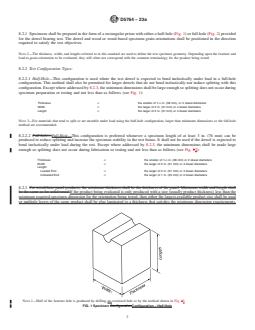
NOTE 1—Half of the fastener hole is produced by drilling an oversized
equipped with a spherical loading block to allow for minor
hole or by the method shown in Fig. 3.
alignment movement prior to loading.
FIG. 1 Specimen Configuration – Half-Hole
7. Sampling
7.1 Sampling shall provide for selection of representative
test specimens which are appropriate to the objectives of the
testing program.
7.2 Sample size shall be estimated using procedures in
Practice D2915.
NOTE 1—The precision required, the manner of sampling, and the
number of tests will depend upon the specific test objectives. General
experience indicates that the coefficient of variation from embedment tests
ranges from 15 % to 30 %.
8. Specimens
8.1 Wood members shall be selected, and the dowel posi-
tioned in such a way that the results are not affected by knots,
cross grain, or other natural or manufacturing characteristics,
unless the objective of the study is to determine the effect of
such variables. Frequently, this will necessitate selecting mem-
bers which are essentially clear and straight grained. For
wood-based products, specimens shall be selected with regard
to manufactured characteristics.
8.2 Specimen Dimensions:
8.2.1 Specimens shall be prepared in the form of a rectan-
gular prism with either a half-hole (Fig. 1) or full-hole (Fig. 2)
provided for the dowel bearing test. The dowel and wood or
wood-based specimen grain orientations shall be positioned in
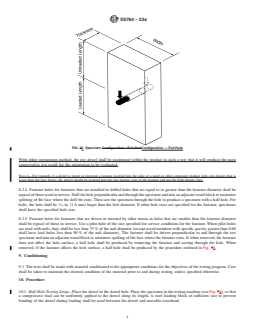
FIG. 2 Specimen Configuration — Full-Hole
the direction required to satisfy the test objectives.
NOTE 2—The thickness, width, and lengths referred to in this standard
are used to define the test specimen geometry. Depending upon the
minimum dimensions shall be large enough so splitting does
fastener and load-to-grain orientation to be evaluated, they will often not
not occur during specimen preparation or testing and not less
correspond with the common terminology for the product being tested.
than as follows (see Fig. 1):
8.2.2 Test Configuration Types:
Thickness $ the smaller of 1 ⁄2 in. (38 mm), or 2 dowel diameters
8.2.2.1 Half-Hole—This configuration is used where the test
Width $ the larger of 2 in. (51 mm) or 4 dowel diameters
dowel is expected to bend inelastically under load in a full-hole Length $ the larger of 2 in. (51 mm) or 4 dowel diameters
configuration. This method shall also be permitted for larger
NOTE 3—For materials that tend to split or are unstable under load using
dowels that do not bend inelastically nor induce splitting with
the half-hole configuration, larger than minimum dimensions or the
this configuration. Except where addressed by 8.2.3, the full-hole method are recommended.
D5764 − 23a
8.2.2.2 Full-Hole—This configuration is preferred when-
ever a specimen length of at least 3 in. (76 mm) can be
produced to reduce splitting and increase the specimen stability
in the test frame. It shall not be used if the dowel is expected
to bend inelastically under load during the test. Except where
addressed by 8.2.3, the minimum dimensions shall be made
large enough so splitting does not occur during fabrication or
testing and not less than as follows (see Fig. 2):
Thickness $ the smaller of 1 ⁄2 in. (38 mm) or 2 dowel diameters
NOTE 1—The procedure is as follows:
Width $ the larger of 2 in. (51 mm) or 4 dowel diameters
Length:
(1) Cut specimen at point where fastener is to be installed.
Loaded End $ the larger of 2 in. (51 mm) or 4 dowel diameters (2) Clamp the two pieces together with sufficient pressure to maintain
Unloaded End $ the larger of 1 in. (25 mm) or 2 dowel diameters
contact between adjoining faces during fastening.
(3) Drill lead hole in seam of abutting pieces.
8.2.3 If the product being evaluated is only produced with a
(4) Drive or insert fastener in lead hole.
size (usually product thickness) less than the minimum re- (5) Remove clamps and
...
This document is not an ASTM standard and is intended only to provide the user of an ASTM standard an indication of what changes have been made to the previous version. Because
it may not be technically possible to adequately depict all changes accurately, ASTM recommends that users consult prior editions as appropriate. In all cases only the current version
of the standard as published by ASTM is to be considered the official document.
Designation: D5764 − 23 D5764 − 23a
Standard Test Method for
Evaluating Dowel-Bearing Strength of Wood and Wood-
Based Products
This standard is issued under the fixed designation D5764; the number immediately following the designation indicates the year of
original adoption or, in the case of revision, the year of last revision. A number in parentheses indicates the year of last reapproval. A
superscript epsilon (´) indicates an editorial change since the last revision or reapproval.
1. Scope
1.1 This test method provides the basic procedure for evaluating dowel-bearing strength of wood and wood-based products. The
bearing test results are used to determine the static load resistance and deformation characteristics of connections in wood and
wood-base products resulting from the application of a load transmitted by a fastener inserted into a predrilled hole, or driven
without drilling. Methods are given for preparing specimens with predrilled holes larger than the fastener diameter and specimens
with holes produced by inserting fasteners in holes smaller than the fastener diameter. The methods apply to fasteners such as
dowels, bolts, nails, spikes, drift pins, screws, lag screws, and staples.
1.2 This test method also provides the basis for determining the compression behavior of wood products beneath a laterally loaded
fastener where the thickness of the product and the diameter of the fastener are such that minimal bending of the fastener occurs
during testing.
1.3 The values stated in inch-pound units are to be regarded as standard. The values given in parentheses are mathematical
conversions to SI units that are provided for information only and are not considered standard.
1.4 This standard does not purport to address all of the safety concerns, if any, associated with its use. It is the responsibility
of the user of this standard to establish appropriate safety, health, and environmental practices and determine the applicability of
regulatory limitations prior to use.
1.5 This international standard was developed in accordance with internationally recognized principles on standardization
established in the Decision on Principles for the Development of International Standards, Guides and Recommendations issued
by the World Trade Organization Technical Barriers to Trade (TBT) Committee.
2. Referenced Documents
2.1 ASTM Standards:
D143 Test Methods for Small Clear Specimens of Timber
D2395 Test Methods for Density and Specific Gravity (Relative Density) of Wood and Wood-Based Materials
D2915 Practice for Sampling and Data-Analysis for Structural Wood and Wood-Based Products
D4442 Test Methods for Direct Moisture Content Measurement of Wood and Wood-Based Materials
E4 Practices for Force Calibration and Verification of Testing Machines
E2309 Practices for Verification of Displacement Measuring Systems and Devices Used in Material Testing Machines
This test method is under the jurisdiction of ASTM Committee D07 on Wood and is the direct responsibility of Subcommittee D07.05 on Wood Assemblies.
Current edition approved Feb. 1, 2023April 1, 2023. Published February 2023April 2023. Originally approved in 1995. Last previous edition approved in 20182023 as
D5764 – 97a (2018).D5764 – 23. DOI: 10.1520/D5764-23.10.1520/D5764-23A
For referenced ASTM standards, visit the ASTM website, www.astm.org, or contact ASTM Customer Service at service@astm.org. For Annual Book of ASTM Standards
volume information, refer to the standard’s Document Summary page on the ASTM website.
Copyright © ASTM International, 100 Barr Harbor Drive, PO Box C700, West Conshohocken, PA 19428-2959. United States
D5764 − 23a
3. Terminology
3.1 Definitions:
3.1.1 dowel-bearing behavior—behavior, n—the load-deformation behavior of wood or wood-base products laterally loaded by a
fastener where the fastener does not bend during loading.
3.1.2 dowel-bearing strength—strength, n—yield load obtained from the load-deformation curve of a dowel-bearing test divided
by the dowel diameter and specimen thickness.
4. Summary of Test Method
4.1 Specimens consisting of a single rectangular parallele-piped member with a fastener hole perpendicular to the faces of the
member are evaluated for the resistance to embedding the fastener into the fastener hole, so as not to bend the fastener. Tests are
conducted on a testing machine at a uniform deformation rate, while loads and deformation are measured at various intervals.
Supplementary physical properties of the wood or wood-base member are also determined.
5. Significance and Use
5.1 The localized crushing behavior of wood or wood-base products beneath a fastener where the fastener does not bend provides
a material property that is used in theoretical models for connections where crushing or fastener bending, or both, occur. These
theoretical models are used to establish design values for wood and wood-base connections. The tests are appropriate when
studying the effects of such variables as fastener diameter, fastener hole size, moisture content, specific gravity, and grain direction
on the dowel-bearing strength.
6. Apparatus
6.1 Testing Machine—Any suitable testing machine capable of operation at a constant rate of motion of its movable head and
having an accuracy of 61 % when calibrated in accordance with Practices E4.
6.2 Deformation Gage—Gage(s)—A deformation-measuring device, with a least reading of 0.001 in. (0.025 mm) Deformation-
measuring device(s) shall be used for measuring the movementembedment of the fastenerdowel into the wood or wood-base
specimen.wood-based specimen. These devices shall achieve at least a Class B rating when verified in accordance with Practices
E2309.
6.3 Loading Configuration—To promote uniform embedment stress along the dowel, the moveable crosshead shall be equipped
with a spherical loading block to allow for minor alignment movement prior to loading.
7. Sampling
7.1 Sampling shall provide for selection of representative test specimens which are appropriate to the objectives of the testing
program.
7.2 Sample size shall be estimated using procedures in Practice D2915.
NOTE 1—The precision required, the manner of sampling, and the number of tests will depend upon the specific test objectives. General experience
indicates that the coefficient of variation from embedment tests ranges from 1515 % to 30 %.
8. Specimens
8.1 Wood members shall be selected, and the dowel positioned in such a way that the results are not affected by knots, cross grain,
or other natural or manufacturing characteristics, unless the objective of the study is to determine the effect of such variables.
Frequently, this will necessitate selecting members which are essentially clear and straight grained. For wood-based products,
specimens shall be selected with regard to manufactured characteristics.
8.2 Specimen Dimensions:
D5764 − 23a
8.2.1 Specimens shall be prepared in the form of a rectangular prism with either a half-hole (Fig. 1) or full-hole (Fig. 2) provided
for the dowel bearing test. The dowel and wood or wood-based specimen grain orientations shall be positioned in the direction
required to satisfy the test objectives.
NOTE 2—The thickness, width, and lengths referred to in this standard are used to define the test specimen geometry. Depending upon the fastener and
load-to-grain orientation to be evaluated, they will often not correspond with the common terminology for the product being tested.
8.2.2 Test Configuration Types:
8.2.2.1 Half-Hole—This configuration is used where the test dowel is expected to bend inelastically under load in a full-hole
configuration. This method shall also be permitted for larger dowels that do not bend inelastically nor induce splitting with this
configuration. Except where addressed by 8.2.3, the minimum dimensions shall be large enough so splitting does not occur during
specimen preparation or testing and not less than as follows (see Fig. 1):
Thickness $ the smaller of 1 ⁄2 in. (38 mm), or 2 dowel diameters
Width $ the larger of 2 in. (51 mm) or 4 dowel diameters
Length $ the larger of 2 in. (51 mm) or 4 dowel diameters
NOTE 3—For materials that tend to split or are unstable under load using the half-hole configuration, larger than minimum dimensions or the full-hole
method are recommended.
8.2.2.2 Full-hole—Full-Hole—This configuration is preferred whenever a specimen length of at least 3 in. (76 mm) can be
produced to reduce splitting and increase the specimen stability in the test frame. It shall not be used if the dowel is expected to
bend inelastically under load during the test. Except where addressed by 8.2.3, the minimum dimensions shall be made large
enough so splitting does not occur during fabrication or testing and not less than as follows (see Fig. 32):
Thickness $ the smaller of 1 ⁄2 in. (38 mm) or 2 dowel diameters
Width $ the larger of 2 in. (51 mm) or 4 dowel diameters
Length:
Loaded End $ the larger of 2 in. (51 mm) or 4 dowel diameters
Unloaded End $ the larger of 1 in. (25 mm) or 2 dowel diameters
8.2.3 For wood-base panel products, the minimum thickness shall be the thickness of the panel. Minimum width and length shall
be the same as for solid wood.If the product being evaluated is only produced with a size (usually product thickness) less than the
minimum required specimen dimension for the orientation being tested, then either the largest available product size shall be used
or multiple layers of the same product shall be glue laminated to a thickness that satisfies the minimum dimension requirements.
NOTE 1—Half of the fastener hole is produced by drilling an oversized hole or by the method shown in Fig. 43.
FIG. 1 Specimen ConfigurationConfiguration – Half-Hole
D5764 − 23a
FIG. 32 Specimen Configuration—Full HoleConfiguration — Full-Hole
With either preparation method, the test dowel
...