

ASTM D1002-10(2019)
(Test Method)Standard Test Method for Apparent Shear Strength of Single-Lap-Joint Adhesively Bonded Metal Specimens by Tension Loading (Metal-to-Metal)
General Information
- Abstract
SIGNIFICANCE AND USE
4.1 This test method is primarily comparative. However, it does have application as a discriminator in determining variations in adherend surface preparation parameters and adhesive environmental durability. The test method has found applications in controlling surface preparations, primer, and adhesive systems for determining strength properties of tested systems.
4.2 The misuse of strength values obtained from this test method as design-allowable stress values for structural joints could lead to product failure, property damage, and human injury. The apparent shear strength of an adhesive obtained from a given small single-lap specimen may differ from that obtained from a joint made with different adherends or by a different bonding process. The normal variation of temperature and moisture in the service environment causes the adherends and the adhesive to swell or shrink. The adherends and adhesive are likely to have different thermal and moisture coefficients of expansion.
4.3 Even in small specimens, short-term environmental changes may induce internal stresses or chemical changes in the adhesive that permanently affect the apparent strength and other mechanical properties of the adhesive. The problem of predicting joint behavior in a changing environment is even more difficult if a different type of adherend is used in a larger structural joint than was used in the small specimen.
4.4 The apparent shear strength measured with a single-lap specimen is not suitable for determining design-allowable stresses for designing structural joints that differ in any manner from the joints tested without thorough analysis and understanding of the joint and adhesive behaviors.
4.5 Single-lap tests may be used for comparing and selecting adhesives or bonding processes for susceptibility to fatigue and environmental changes, but such comparisons must be made with great caution since different adhesives may respond differently in different joints. See Guide D4896 f...
SCOPE
1.1 This test method covers the determination of the apparent shear strengths of adhesives for bonding metals when tested on a standard single-lap-joint specimen and under specified conditions of preparation and test.
1.2 The values stated in SI units are to be regarded as standard. The values given in parentheses after SI units are provided for information only and are not considered standard.
1.3 This standard does not purport to address all of the safety concerns, if any, associated with its use. It is the responsibility of the user of this standard to establish appropriate safety, health, and environmental practices and determine the applicability of regulatory limitations prior to use.
1.4 This international standard was developed in accordance with internationally recognized principles on standardization established in the Decision on Principles for the Development of International Standards, Guides and Recommendations issued by the World Trade Organization Technical Barriers to Trade (TBT) Committee.
- Status
- Published
- Publication Date
- 31-Mar-2019
- Technical Committee
- D14 - Adhesives
- Drafting Committee
- D14.80 - Metal Bonding Adhesives
Overview
ASTM D1002-10(2019): Standard Test Method for Apparent Shear Strength of Single-Lap-Joint Adhesively Bonded Metal Specimens by Tension Loading (Metal-to-Metal) provides a method for determining the apparent shear strengths of adhesives used in metal-to-metal bonding. This international standard applies specifically to single-lap-joint specimens tested under controlled conditions, making it a widely referenced procedure within the adhesives industry and related fields such as materials engineering, aerospace, and automotive manufacturing.
The primary aim of the test method is to enable comparative evaluation of adhesives, surface preparation techniques, primer use, and adhesive system durability under tension loading.
Key Topics
- Comparative Testing: This standard is primarily comparative and serves as a tool for evaluating differences in adhesive strength due to variables such as surface preparation, adhesion system, and environmental exposure.
- Controlled Conditions: Results are highly dependent on specified parameters such as metal thickness, surface treatment, adhesive mixing/application, curing, and testing machine setup.
- Environmental Impact: Apparent shear strength is influenced by temperature, moisture, and the differing thermal and moisture expansion coefficients of adhesives and adherends. Short-term environmental changes may introduce internal stress or cause chemical changes in the adhesive, permanently affecting strength.
- Limitations for Structural Design: The values obtained are not intended to be used as design-allowable stresses for structural joints unless an in-depth understanding and analysis of the joint and adhesive behaviors are undertaken.
- Specimen Preparation & Testing: The standard outlines procedures for specimen preparation, including cutting, surface cleaning, adhesive application, and precise dimensions for overlap and metal thickness, ensuring repeatability and reliability.
Applications
- Adhesive Selection and Qualification: The method is used for preliminary screening when selecting adhesives or bonding processes for metal joining, comparing fatigue or environmental susceptibility.
- Process Control: Provides a technical basis for controlling and validating manufacturing procedures involving adhesive bonding of metals, ensuring that parameters like surface cleaning, primer application, and curing processes meet required standards.
- Quality Assurance and R&D: Used extensively in research and development as well as quality assurance laboratories to monitor consistency between batches of adhesives and assess the performance impact of formulation or process changes.
- Failure Analysis: Enables investigation into modes of failure - adhesion versus cohesion - and helps identify the impact of environmental factors and surface treatments under controlled, reproducible conditions.
- Not for Direct Structural Design: The data derived from ASTM D1002-10(2019) is not suitable for use as design-allowable values in structural applications involving joints different from the tested specimens.
Related Standards
- ASTM D907 - Terminology of Adhesives (definitions for terms used in this method)
- ASTM D4896 - Guide for Use of Adhesive-Bonded Single Lap-Joint Specimen Test Results (interpretation guidance)
- ASTM E4 - Practices for Force Verification of Testing Machines (ensures machine calibration)
- ASTM E177 - Practice for Use of the Terms Precision and Bias in ASTM Test Methods
- ASTM E691 - Practice for Conducting an Interlaboratory Study to Determine the Precision of a Test Method
Commonly referenced material specifications for specimen preparation include ASTM B209 for aluminum, ASTM A109 for cold-rolled steel, ASTM B36/B152 for copper and brass, and ASTM B265 for titanium.
Keywords: ASTM D1002, apparent shear strength, single-lap-joint, adhesively bonded, metal-to-metal adhesives, tension loading, adhesive testing, comparative adhesive evaluation, environmental durability, industrial adhesive standards
Relations
- Effective Date
- 01-Apr-2019
- Effective Date
- 01-Mar-2024
- Effective Date
- 01-Oct-2023
- Refers
ASTM B265-20a - Standard Specification for Titanium and Titanium Alloy Strip, Sheet, and Plate - Effective Date
- 01-Apr-2020
- Effective Date
- 01-Jan-2020
- Effective Date
- 01-Oct-2019
- Effective Date
- 01-Nov-2018
- Effective Date
- 01-Oct-2018
- Effective Date
- 01-Sep-2016
- Effective Date
- 01-May-2016
- Effective Date
- 01-Nov-2015
- Effective Date
- 01-Nov-2015
- Effective Date
- 01-Jun-2014
- Effective Date
- 01-May-2014
- Effective Date
- 01-May-2014
Get Certified
Connect with accredited certification bodies for this standard

DIN CERTCO
DIN Group product certification.

Smithers Quality Assessments
US management systems and product certification.
Sponsored listings
Frequently Asked Questions
ASTM D1002-10(2019) is a standard published by ASTM International. Its full title is "Standard Test Method for Apparent Shear Strength of Single-Lap-Joint Adhesively Bonded Metal Specimens by Tension Loading (Metal-to-Metal)". This standard covers: SIGNIFICANCE AND USE 4.1 This test method is primarily comparative. However, it does have application as a discriminator in determining variations in adherend surface preparation parameters and adhesive environmental durability. The test method has found applications in controlling surface preparations, primer, and adhesive systems for determining strength properties of tested systems. 4.2 The misuse of strength values obtained from this test method as design-allowable stress values for structural joints could lead to product failure, property damage, and human injury. The apparent shear strength of an adhesive obtained from a given small single-lap specimen may differ from that obtained from a joint made with different adherends or by a different bonding process. The normal variation of temperature and moisture in the service environment causes the adherends and the adhesive to swell or shrink. The adherends and adhesive are likely to have different thermal and moisture coefficients of expansion. 4.3 Even in small specimens, short-term environmental changes may induce internal stresses or chemical changes in the adhesive that permanently affect the apparent strength and other mechanical properties of the adhesive. The problem of predicting joint behavior in a changing environment is even more difficult if a different type of adherend is used in a larger structural joint than was used in the small specimen. 4.4 The apparent shear strength measured with a single-lap specimen is not suitable for determining design-allowable stresses for designing structural joints that differ in any manner from the joints tested without thorough analysis and understanding of the joint and adhesive behaviors. 4.5 Single-lap tests may be used for comparing and selecting adhesives or bonding processes for susceptibility to fatigue and environmental changes, but such comparisons must be made with great caution since different adhesives may respond differently in different joints. See Guide D4896 f... SCOPE 1.1 This test method covers the determination of the apparent shear strengths of adhesives for bonding metals when tested on a standard single-lap-joint specimen and under specified conditions of preparation and test. 1.2 The values stated in SI units are to be regarded as standard. The values given in parentheses after SI units are provided for information only and are not considered standard. 1.3 This standard does not purport to address all of the safety concerns, if any, associated with its use. It is the responsibility of the user of this standard to establish appropriate safety, health, and environmental practices and determine the applicability of regulatory limitations prior to use. 1.4 This international standard was developed in accordance with internationally recognized principles on standardization established in the Decision on Principles for the Development of International Standards, Guides and Recommendations issued by the World Trade Organization Technical Barriers to Trade (TBT) Committee.
SIGNIFICANCE AND USE 4.1 This test method is primarily comparative. However, it does have application as a discriminator in determining variations in adherend surface preparation parameters and adhesive environmental durability. The test method has found applications in controlling surface preparations, primer, and adhesive systems for determining strength properties of tested systems. 4.2 The misuse of strength values obtained from this test method as design-allowable stress values for structural joints could lead to product failure, property damage, and human injury. The apparent shear strength of an adhesive obtained from a given small single-lap specimen may differ from that obtained from a joint made with different adherends or by a different bonding process. The normal variation of temperature and moisture in the service environment causes the adherends and the adhesive to swell or shrink. The adherends and adhesive are likely to have different thermal and moisture coefficients of expansion. 4.3 Even in small specimens, short-term environmental changes may induce internal stresses or chemical changes in the adhesive that permanently affect the apparent strength and other mechanical properties of the adhesive. The problem of predicting joint behavior in a changing environment is even more difficult if a different type of adherend is used in a larger structural joint than was used in the small specimen. 4.4 The apparent shear strength measured with a single-lap specimen is not suitable for determining design-allowable stresses for designing structural joints that differ in any manner from the joints tested without thorough analysis and understanding of the joint and adhesive behaviors. 4.5 Single-lap tests may be used for comparing and selecting adhesives or bonding processes for susceptibility to fatigue and environmental changes, but such comparisons must be made with great caution since different adhesives may respond differently in different joints. See Guide D4896 f... SCOPE 1.1 This test method covers the determination of the apparent shear strengths of adhesives for bonding metals when tested on a standard single-lap-joint specimen and under specified conditions of preparation and test. 1.2 The values stated in SI units are to be regarded as standard. The values given in parentheses after SI units are provided for information only and are not considered standard. 1.3 This standard does not purport to address all of the safety concerns, if any, associated with its use. It is the responsibility of the user of this standard to establish appropriate safety, health, and environmental practices and determine the applicability of regulatory limitations prior to use. 1.4 This international standard was developed in accordance with internationally recognized principles on standardization established in the Decision on Principles for the Development of International Standards, Guides and Recommendations issued by the World Trade Organization Technical Barriers to Trade (TBT) Committee.
ASTM D1002-10(2019) is classified under the following ICS (International Classification for Standards) categories: 83.180 - Adhesives. The ICS classification helps identify the subject area and facilitates finding related standards.
ASTM D1002-10(2019) has the following relationships with other standards: It is inter standard links to ASTM D1002-10, ASTM A109/A109M-24, ASTM B36/B36M-23, ASTM B265-20a, ASTM B265-20, ASTM B152/B152M-19, ASTM A109/A109M-16(2018), ASTM B36/B36M-18, ASTM A109/A109M-16, ASTM D4896-01(2016), ASTM A109/A109M-15, ASTM B265-15, ASTM E4-14, ASTM A109/A109M-14, ASTM E177-14. Understanding these relationships helps ensure you are using the most current and applicable version of the standard.
ASTM D1002-10(2019) is available in PDF format for immediate download after purchase. The document can be added to your cart and obtained through the secure checkout process. Digital delivery ensures instant access to the complete standard document.
Standards Content (Sample)
This international standard was developed in accordance with internationally recognized principles on standardization established in the Decision on Principles for the
Development of International Standards, Guides and Recommendations issued by the World Trade Organization Technical Barriers to Trade (TBT) Committee.
Designation: D1002 − 10 (Reapproved 2019)
Standard Test Method for
Apparent Shear Strength of Single-Lap-Joint Adhesively
Bonded Metal Specimens by Tension Loading (Metal-to-
Metal)
This standard is issued under the fixed designation D1002; the number immediately following the designation indicates the year of
original adoption or, in the case of revision, the year of last revision. A number in parentheses indicates the year of last reapproval. A
superscript epsilon (´) indicates an editorial change since the last revision or reapproval.
This standard has been approved for use by agencies of the U.S. Department of Defense.
INTRODUCTION
The accuracy of the results of strength tests of adhesive bonds will depend on the conditions under
which the bonding process is carried out. Unless otherwise agreed upon by the manufacturer and the
purchaser, the bonding conditions shall be prescribed by the manufacturer of the adhesive. In order to
ensure that complete information is available to the individual conducting the tests, the manufacturer
of the adhesive shall furnish numerical values and other specific information for each of the following
variables:
(1) Procedure for preparation of surfaces prior to application of the adhesive, the cleaning and
drying of metal surfaces, and special surface treatments such as sanding that are not specifically
limited by the pertinent test method.
(2) Complete mixing directions for the adhesive.
(3) Conditions for application of the adhesive, including the rate of spread or thickness of film,
number of coats to be applied, whether to be applied to one or both surfaces, and the conditions of
drying where more than one coat is required.
(4) Assembly conditions before application of pressure, including the room temperature, relative
humidity, length of time, and whether open or closed assembly is to be used.
(5) Curing conditions, including the amount of pressure to be applied, the length of time under
pressure, method of applying pressure (pressure bag, press platens, etc.), heat-up rate, and the
temperature of the assembly when under pressure. It should be stated whether this temperature is that
of the bondline or of the atmosphere at which the assembly is to be maintained.
(6) Conditioning procedure before testing, unless a standard procedure is specified, including the
length of time, temperature, and relative humidity.
Arangemaybeprescribedforanyvariablebythemanufactureroftheadhesiveifitcanbeassumed
by the test operator that any arbitrarily chosen value within such a range, or any combination of such
values for several variables will be acceptable to both the manufacturer and the purchaser of the
adhesive.
1. Scope 1.2 The values stated in SI units are to be regarded as
standard. The values given in parentheses after SI units are
1.1 This test method covers the determination of the appar-
provided for information only and are not considered standard.
entshearstrengthsofadhesivesforbondingmetalswhentested
on a standard single-lap-joint specimen and under specified 1.3 This standard does not purport to address all of the
conditions of preparation and test. safety concerns, if any, associated with its use. It is the
responsibility of the user of this standard to establish appro-
1 priate safety, health, and environmental practices and deter-
This test method is under the jurisdiction of ASTM Committee D14 on
Adhesives and is the direct responsibility of Subcommittee D14.80 on Metal
mine the applicability of regulatory limitations prior to use.
Bonding Adhesives.
1.4 This international standard was developed in accor-
Current edition approved April 1, 2019. Published April 2019. Originally
dance with internationally recognized principles on standard-
approved in 1949. Last previous edition approved in 2010 as D1002 – 10. DOI:
10.1520/D1002-10R19. ization established in the Decision on Principles for the
Copyright © ASTM International, 100 Barr Harbor Drive, PO Box C700, West Conshohocken, PA 19428-2959. United States
D1002 − 10 (2019)
Development of International Standards, Guides and Recom- the adhesive that permanently affect the apparent strength and
mendations issued by the World Trade Organization Technical other mechanical properties of the adhesive. The problem of
Barriers to Trade (TBT) Committee. predicting joint behavior in a changing environment is even
more difficult if a different type of adherend is used in a larger
2. Referenced Documents
structural joint than was used in the small specimen.
2.1 ASTM Standards:
4.4 The apparent shear strength measured with a single-lap
A109/A109M Specification for Steel, Strip, Carbon (0.25
specimen is not suitable for determining design-allowable
Maximum Percent), Cold-Rolled
stresses for designing structural joints that differ in any manner
A167 Specification for Stainless and Heat-Resisting
from the joints tested without thorough analysis and under-
Chromium-Nickel Steel Plate, Sheet, and Strip (With-
standing of the joint and adhesive behaviors.
drawn 2014)
4.5 Single-lap tests may be used for comparing and select-
B36/B36M Specification for Brass Plate, Sheet, Strip, And
ing adhesives or bonding processes for susceptibility to fatigue
Rolled Bar
and environmental changes, but such comparisons must be
B152/B152M Specification for Copper Sheet, Strip, Plate,
made with great caution since different adhesives may respond
and Rolled Bar
differently in different joints. See Guide D4896 for further
B209 Specification for Aluminum and Aluminum-Alloy
discussion of the concepts relative to interpretation of
Sheet and Plate
adhesive-bonded single-lap-joints.
B265 Specification for Titanium and Titanium Alloy Strip,
Sheet, and Plate
5. Apparatus
D907 Terminology of Adhesives
5.1 The testing machine shall conform to the requirements
D4896 Guide for Use ofAdhesive-Bonded Single Lap-Joint
of Practices E4. The testing machine shall be so selected that
Specimen Test Results
the breaking load of the specimens falls between 15 and 85
E4 Practices for Force Verification of Testing Machines
percent of the full-scale capacity.The machine shall be capable
E177 Practice for Use of the Terms Precision and Bias in
of maintaining a rate of loading of 80 to 100 kg/cm (1200 to
ASTM Test Methods
1400 psi)/min, or, if the rate is dependent on crosshead motion,
E691 Practice for Conducting an Interlaboratory Study to
the machine should be set to approach this rate of loading,
Determine the Precision of a Test Method
approximately 0.05 in./min. It shall be provided with a suitable
3. Terminology
pair of self-aligning grips to hold the specimen. It is recom-
mended that the jaws of these grips shall engage the outer 25
3.1 Definitions—Many terms in this test method are defined
mm (1 in.) of each end of the test specimen firmly.
in Terminology D907.
5.2 The grips and attachments shall be so constructed that
4. Significance and Use
they will move into alignment with the test specimen as soon
4.1 This test method is primarily comparative. However, it
as the load is applied, so that the long axis of the test specimen
does have application as a discriminator in determining varia-
will coincide with the direction of the applied pull through the
tions in adherend surface preparation parameters and adhesive
center line of the grip assembly.
environmental durability. The test method has found applica-
5.3 The length of overlap of the specimen may be varied
tions in controlling surface preparations, primer, and adhesive
where necessary. The length of the specimen in the jaws,
systems for determining strength properties of tested systems.
however, must not be varied. The distance from the end of the
4.2 The misuse of strength values obtained from this test
lap to the end of the jaws should be 63 mm (2 ⁄2 in.) in all tests.
method as design-allowable stress values for structural joints
6. Test Specimens
could lead to product failure, property damage, and human
injury. The apparent shear strength of an adhesive obtained
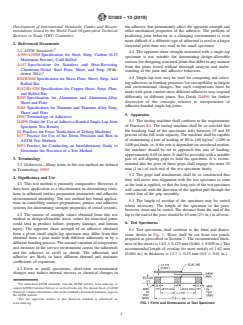
6.1 Test specimens shall conform to the form and dimen-
from a given small single-lap specimen may differ from that
sions shown in Fig. 1. These shall be cut from test panels
obtained from a joint made with different adherends or by a
prepared as prescribed in Section 7. The recommended thick-
different bonding process.The normal variation of temperature
ness of the sheets is 1.62 6 0.125 mm (0.064 6 0.005 in.).The
and moisture in the service environment causes the adherends
recommended length of overlap for most metals of 1.62 mm
and the adhesive to swell or shrink. The adherends and
(0.064 in.) in thickness is 12.7 6 0.25 mm (0.5 6 0.01 in.).
adhesive are likely to have different thermal and moisture
coefficients of expansion.
4.3 Even in small specimens, short-term environmental
changes may induce internal stresses or chemical changes in
For referenced ASTM standards, visit the ASTM website, www.astm.org, or
contact ASTM Customer Service at service@astm.org. For Annual Book of ASTM
Standards volume information, refer to the standard’s Document Summary page on
the ASTM website.
The last approved version of this historical standard is referenced on
www.astm.org. FIG. 1 Form and Dimensions of Test Specimen
D1002 − 10 (2019)
6.2 Since it is undesirable to exceed the yield point of the
Metal ASTM Designation
Brass B36/B36M, C26800 (Alloy 8)
metal in tension during test, the permissible length of overlap
Copper B152/B152M, C11000
in the specimen will vary with the thickness and type of metal,
Aluminum B209, Alloy 2024, T3 temper
and on the general level of strength of the adhesive being
Steel A109/A109M, Grade 2
Corrosion-resisting steel A167, Type 302
investigated. The maximum permissible length may be com-
Titanium B265
puted from the following relationship:
6.5 At least 30 specimens shall be tested, representing at
L 5 Fty t/τ (1)
least four different joints. However, if statistical analysis of
data and variance is employed, it should be possible to reduce
where:
this number.
L = length of overlap, in.,
t = thickness of metal, in.,
7. Preparation of Test Joints
Fty = yield point of metal (or the stress at proportional
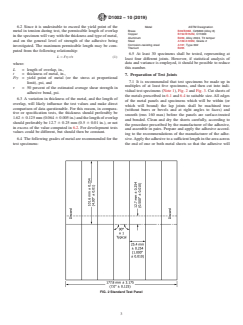
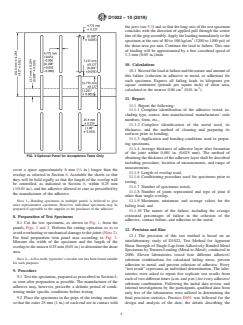
7.1 It is recommended that test specimens be made up in
limit), psi, and
multiples of at least five specimens, and then cut into indi-
τ = 50 percent of the estimated average shear strength in
vidual test specimens (Note 1), Fig. 2 and Fig. 3. Cut sheets of
adhesive bond, psi.
the metals prescribed in 6.1 and 6.4 to suitable size. All edges
6.3 A variation in thickness of the metal, and the length of
of the metal panels and specimens which will be within (or
overlap, will likely influence the test values and make direct
which will bound) the lap joints shall be machined true
comparison of data questionable. For this reason, in compara-
(without burrs or bevels and at right angles to faces) and
tive or specifica
...