

ASTM D6507-19
(Practice)Standard Practice for Fiber Reinforcement Orientation Codes for Composite Materials
General Information
- Abstract
SIGNIFICANCE AND USE
4.1 The purpose of a laminate orientation code is to provide a simple, easily understood method of describing the lay-up of a laminate. The laminate orientation code is based largely on a combination of industry practice and the codes used in the NASA/DOD Advanced Composites Design Guide,5 CMH-17-2G, and ISO 1268-1.
4.2 The braiding orientation code provides similar information for a two-dimensional braid, based largely on Standard Test Methods for Textile Composites.6
SCOPE
1.1 This practice establishes orientation codes for continuous-fiber-reinforced composite materials. Orientation codes are explicitly provided for two-dimensional laminates and braids. The laminate code may also be used for filament-wound materials. A method is included for presenting subscript information in computerized formats that do not permit subscript notation.
1.2 This standard does not purport to address all of the safety concerns, if any, associated with its use. It is the responsibility of the user of this standard to establish appropriate safety, health, and environmental practices and determine the applicability of regulatory limitations prior to use.
1.3 This international standard was developed in accordance with internationally recognized principles on standardization established in the Decision on Principles for the Development of International Standards, Guides and Recommendations issued by the World Trade Organization Technical Barriers to Trade (TBT) Committee.
- Status
- Published
- Publication Date
- 14-Oct-2019
- Technical Committee
- D30 - Composite Materials
- Drafting Committee
- D30.01 - Editorial and Resource Standards
Buy Documents
ASTM D6507-19 - Standard Practice for Fiber Reinforcement Orientation Codes for Composite Materials
REDLINE ASTM D6507-19 - Standard Practice for Fiber Reinforcement Orientation Codes for Composite Materials
Overview
ASTM D6507-19 is the international standard practice issued by ASTM International for establishing fiber reinforcement orientation codes in continuous-fiber-reinforced composite materials. The standard provides a systematic and clear method for specifying the orientation of fibers within composite laminates and braids, supporting effective communication and documentation throughout the composite materials industry. The fiber orientation code outlined in this standard is heavily influenced by recognized industry practices, including those found in the NASA/DOD Advanced Composites Design Guide, CMH-17-2G, and ISO 1268-1. ASTM D6507-19 applies to both two-dimensional laminates and braids, and can also be utilized for filament-wound materials.
Key Topics
- Orientation Code Systems: Defines a notation system to describe the stacking sequence, fiber direction, and symmetry within composite laminates.
- Laminate and Braiding Codes: Presents explicit orientation codes for both laminate lay-up and two-dimensional braided composites, streamlining design and manufacturing documentation.
- Reference Axes and Planes: Details the method of selecting and referencing coordinate axes, planes, and directions when describing ply orientation for both flat and curved geometries.
- Subscript Alternatives for Digital Formats: Offers practical recommendations for representing subscripted information in computerized systems that do not support subscripts, ensuring compatibility with electronic documentation.
- Industry Best Practices: Synthesizes terminology and conventions from widely recognized sources, promoting consistency and interoperability across design, testing, and manufacturing processes.
Applications
ASTM D6507-19 is an essential tool for professionals involved in the design, fabrication, testing, and documentation of advanced composite structures. Key applications include:
- Composite Design and Documentation: Engineers and designers rely on standardized orientation codes to accurately specify the lay-up or braiding configuration of composite components, ensuring repeatable manufacturing and robust structural performance.
- Manufacturing and Quality Assurance: Manufacturers utilize the orientation code for interpreting and transferring lay-up instructions, reducing the risk of miscommunication and errors during component fabrication.
- Testing and Analysis: Researchers and quality assurance teams apply the codes when preparing samples for mechanical property testing, such as in-plane shear tests, and when analyzing the influence of fiber orientation on composite performance.
- Filament-Wound Structures: The code system is also applicable for filament-wound composite parts, supporting aerospace, automotive, and industrial applications where precise fiber placement determines structural attributes.
- Digital Engineering Workflows: The recommended notation alternatives play a critical role in digital environments and CAD/CAM systems, allowing unambiguous code representation even when subscripting is not possible.
Related Standards
Organizations applying ASTM D6507-19 may also reference related standards and guides for comprehensive composite material specification and testing:
- ASTM D3518/D3518M: Test Method for In-Plane Shear Response of Polymer Matrix Composite Materials
- ASTM D3878: Terminology for Composite Materials
- CMH-17-2G: Polymer Matrix Composites - Materials Properties
- ISO 1268-1: Fibre-reinforced Plastics – Methods of Producing Test Plates
- NASA/DOD Advanced Composites Design Guide: Fundamental design source for composite materials
By employing ASTM D6507-19, organizations enhance clarity in communication, improve documentation practices, and ensure consistency throughout the composite material lifecycle-from engineering design to end-product verification. This standard supports both domestic and international requirements for fiber-reinforced composite materials, aligning with globally recognized best practices.
Relations
- Replaces
ASTM D6507-16 - Standard Practice for Fiber Reinforcement Orientation Codes for Composite Materials - Effective Date
- 15-Oct-2019
- Effective Date
- 15-Oct-2019
- Effective Date
- 15-Apr-2019
- Effective Date
- 01-Nov-2018
- Effective Date
- 01-Apr-2018
- Effective Date
- 01-Aug-2016
- Effective Date
- 01-Jul-2015
- Effective Date
- 01-Aug-2013
- Effective Date
- 01-May-2013
- Effective Date
- 01-May-2007
- Effective Date
- 01-May-2007
- Effective Date
- 01-May-2004
- Effective Date
- 01-Mar-2004
- Effective Date
- 01-Oct-2003
- Effective Date
- 10-Jan-2003
Buy Documents
ASTM D6507-19 - Standard Practice for Fiber Reinforcement Orientation Codes for Composite Materials
REDLINE ASTM D6507-19 - Standard Practice for Fiber Reinforcement Orientation Codes for Composite Materials
Get Certified
Connect with accredited certification bodies for this standard

Control Union Certifications
Global certification for agriculture and sustainability.

ECOCERT
Organic and sustainability certification.

FSC International
Forest Stewardship Council certification.
Sponsored listings
Frequently Asked Questions
ASTM D6507-19 is a standard published by ASTM International. Its full title is "Standard Practice for Fiber Reinforcement Orientation Codes for Composite Materials". This standard covers: SIGNIFICANCE AND USE 4.1 The purpose of a laminate orientation code is to provide a simple, easily understood method of describing the lay-up of a laminate. The laminate orientation code is based largely on a combination of industry practice and the codes used in the NASA/DOD Advanced Composites Design Guide,5 CMH-17-2G, and ISO 1268-1. 4.2 The braiding orientation code provides similar information for a two-dimensional braid, based largely on Standard Test Methods for Textile Composites.6 SCOPE 1.1 This practice establishes orientation codes for continuous-fiber-reinforced composite materials. Orientation codes are explicitly provided for two-dimensional laminates and braids. The laminate code may also be used for filament-wound materials. A method is included for presenting subscript information in computerized formats that do not permit subscript notation. 1.2 This standard does not purport to address all of the safety concerns, if any, associated with its use. It is the responsibility of the user of this standard to establish appropriate safety, health, and environmental practices and determine the applicability of regulatory limitations prior to use. 1.3 This international standard was developed in accordance with internationally recognized principles on standardization established in the Decision on Principles for the Development of International Standards, Guides and Recommendations issued by the World Trade Organization Technical Barriers to Trade (TBT) Committee.
SIGNIFICANCE AND USE 4.1 The purpose of a laminate orientation code is to provide a simple, easily understood method of describing the lay-up of a laminate. The laminate orientation code is based largely on a combination of industry practice and the codes used in the NASA/DOD Advanced Composites Design Guide,5 CMH-17-2G, and ISO 1268-1. 4.2 The braiding orientation code provides similar information for a two-dimensional braid, based largely on Standard Test Methods for Textile Composites.6 SCOPE 1.1 This practice establishes orientation codes for continuous-fiber-reinforced composite materials. Orientation codes are explicitly provided for two-dimensional laminates and braids. The laminate code may also be used for filament-wound materials. A method is included for presenting subscript information in computerized formats that do not permit subscript notation. 1.2 This standard does not purport to address all of the safety concerns, if any, associated with its use. It is the responsibility of the user of this standard to establish appropriate safety, health, and environmental practices and determine the applicability of regulatory limitations prior to use. 1.3 This international standard was developed in accordance with internationally recognized principles on standardization established in the Decision on Principles for the Development of International Standards, Guides and Recommendations issued by the World Trade Organization Technical Barriers to Trade (TBT) Committee.
ASTM D6507-19 is classified under the following ICS (International Classification for Standards) categories: 65.020.20 - Plant growing. The ICS classification helps identify the subject area and facilitates finding related standards.
ASTM D6507-19 has the following relationships with other standards: It is inter standard links to ASTM D6507-16, ASTM D3878-19a, ASTM D3878-19, ASTM D3518/D3518M-18, ASTM D3878-18, ASTM D3878-16, ASTM D3878-15, ASTM D3518/D3518M-13, ASTM D3878-07(2013), ASTM D3518/D3518M-94(2007), ASTM D3878-07, ASTM D3878-04a, ASTM D3878-04, ASTM D3878-03a, ASTM D3878-03. Understanding these relationships helps ensure you are using the most current and applicable version of the standard.
ASTM D6507-19 is available in PDF format for immediate download after purchase. The document can be added to your cart and obtained through the secure checkout process. Digital delivery ensures instant access to the complete standard document.
Standards Content (Sample)
This international standard was developed in accordance with internationally recognized principles on standardization established in the Decision on Principles for the
Development of International Standards, Guides and Recommendations issued by the World Trade Organization Technical Barriers to Trade (TBT) Committee.
Designation: D6507 − 19
Standard Practice for
Fiber Reinforcement Orientation Codes for Composite
Materials
This standard is issued under the fixed designation D6507; the number immediately following the designation indicates the year of
original adoption or, in the case of revision, the year of last revision. A number in parentheses indicates the year of last reapproval. A
superscript epsilon (´) indicates an editorial change since the last revision or reapproval.
1. Scope Stacking Designation Systems
1.1 This practice establishes orientation codes for
3. Terminology
continuous-fiber-reinforced composite materials. Orientation
codes are explicitly provided for two-dimensional laminates 3.1 Definitions—Definitions in accordance with Terminol-
ogy D3878 shall be used where applicable.
and braids. The laminate code may also be used for filament-
wound materials.Amethod is included for presenting subscript
4. Significance and Use
information in computerized formats that do not permit sub-
script notation.
4.1 The purpose of a laminate orientation code is to provide
a simple, easily understood method of describing the lay-up of
1.2 This standard does not purport to address all of the
safety concerns, if any, associated with its use. It is the a laminate. The laminate orientation code is based largely on a
combination of industry practice and the codes used in the
responsibility of the user of this standard to establish appro-
priate safety, health, and environmental practices and deter- NASA/DOD Advanced Composites Design Guide, CMH-17-
2G, and ISO 1268-1.
mine the applicability of regulatory limitations prior to use.
1.3 This international standard was developed in accor-
4.2 The braiding orientation code provides similar informa-
dance with internationally recognized principles on standard-
tion for a two-dimensional braid, based largely on Standard
ization established in the Decision on Principles for the
Test Methods for Textile Composites.
Development of International Standards, Guides and Recom-
mendations issued by the World Trade Organization Technical
5. Reference Systems
Barriers to Trade (TBT) Committee.
5.1 A set of reference coordinate axes and associated
reference plane and direction are selected before writing the
2. Referenced Documents
orientation code.
2.1 ASTM Standards:
5.1.1 The reference plane is selected as the bottom or top
D3518/D3518M Test Method for In-Plane Shear Response
layer for the laminate orientation code. The orientation code is
of Polymer Matrix Composite Materials byTensileTest of
thendeterminedbyprogressingthroughthelaminatethickness.
a 645° Laminate
For a laminate symmetric about its midplane, the orientation
D3878 Terminology for Composite Materials
code using the top layer as the reference plane is identical to
2.2 Other Documents:
the orientation code using the bottom layer as the reference
CMH-17-2G, Polymer Matrix Composites, Volume 2 Ma-
plane.
terials Properties, Section 1.6.1
5.1.2 The reference direction, from which ply orientation is
ISO 1268-1 Fibre-reinforced Plastics—Methods of Produc-
measured,issomewhatarbitrarilyselectedforconvenienceand
ing Test Plates—Part 1: General Conditions, Annex
relevance to the application. Often, a dominant fiber direction,
such as that aligned with the laminate principal axis, is defined
to be 0°. An example in which relevance to testing determines
This practice is under the jurisdiction ofASTM Committee D30 on Composite
Materials and is the direct responsibility of Subcommittee D30.01 on Editorial and
the reference direction is the Test Method D3518/D3518M
Resource Standards.
Current edition approved Oct. 15, 2019. Published November 2019. Originally
approved in 2000. Last previous edition approved in 2016 as D6507 – 16. DOI:
10.1520/D6507-19. Available from American National Standards Institute (ANSI), 25 W. 43rd St.,
For referenced ASTM standards, visit the ASTM website, www.astm.org, or 4th Floor, New York, NY 10036, http://www.ansi.org.
contact ASTM Customer Service at service@astm.org. For Annual Book of ASTM NASA/DOD Advanced Composites Design Guide, Vol. 4, Section 4.0.5, Air
Standards volume information, refer to the standard’s Document Summary page on Force Wright Aeronautical Laboratories, Day, OH, prepared by Rockwell Interna-
the ASTM website. tional Corp., 1983 (distribution limited).
3 6
Available from SAE International (SAE), 400 Commonwealth Dr., Warrendale, Masters, J. E., and Portanova, M. A., Standard Test Methods for Textile
PA 15096, http://www.sae.org. Composites, NASA CR-4751, NASA Langley Research Center, 1996.
Copyright © ASTM International, 100 Barr Harbor Drive, PO Box C700, West Conshohocken, PA 19428-2959. United States
D6507 − 19
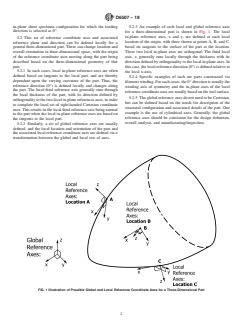
in-plane shear specimen configuration for which the loading 5.2.3 An example of such local and global reference axes
direction is selected as 0°. for a three-dimensional part is shown in Fig. 1. The local
in-plane reference axes, x and y, are defined at each local
5.2 This set of reference coordinate axes and associated
location of the origin, with three shown at points A, B, and C,
reference plane and direction can be defined locally for a
based on tangents to the surface of the part at the location.
general three-dimensional part. These can change location and
These two local in-plane axes are orthogonal. The third local
overall orientation in three-dimensional space, with the origin
axis, z, generally runs locally through the thickness with its
of the reference coordinate axes moving along the part being
direction defined by orthogonality to the local in-plane axes. In
described based on the three-dimensional geometry of that
part. this case, the local reference direction (0°) is defined relative to
5.2.1 In such cases, local in-plane reference axes are often the local x-axis.
defined based on tangents to the local part, and are thereby
5.2.4 Specific examples of such are parts constructed via
dependent upon the varying curvature of the part. Thus, the
filament winding. For such cases, the 0° direction is usually the
reference direction (0°) is defined locally and changes along
winding axis of symmetry and the in-plane axes of the local
the part. The local third reference axis generally runs through
reference coordinate axes are usually based on the tool surface.
the local thickness of the part, with its direction defined by
5.2.5 The global reference axes do not need to be Cartesian,
orthogonality to the two local in-plane references axes, in order
but can be defined based on the needs for description of the
to complete the local set of right-handed Cartesian coordinate
structural configuration and associated details of the part. One
axes. This results in the local third reference axis being normal
example is the use of cylindrical axes. Generally, the global
to the part when the local in-plane reference axes are based on
reference axes should be consistent for the design definition,
the tangents to the local part.
overall analysis, and manufacturing/inspection.
5.2.2 Similarly, a set of global reference axes are usually
defined, and the local location and orientation of the part and
the associated local reference coordinate axes are defined via a
transformation between the global and local sets of axes.
FIG. 1 Illustration of Possible Global and Local Reference Coordinate Axes for a Three-Dimensional Part
D6507 − 19
6. Laminate Orientation (Lay-up) Code θ m b /θ m b . notes (1)
@ #
1 1 1 2 2 2
nsb
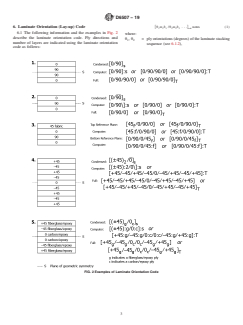
6.1 The following information and the examples in Fig. 2
where:
describe the laminate orientation code. Ply directions and
θ , θ = ply orientations (degrees) of the laminate stacking
1 2
number of layers are indicated using the laminate orientation
sequence (see 6.1.2),
code as follows:
FIG. 2 Examples of Laminate Orientation Code
D6507 − 19
between subscript and material type must be ident
...
This document is not an ASTM standard and is intended only to provide the user of an ASTM standard an indication of what changes have been made to the previous version. Because
it may not be technically possible to adequately depict all changes accurately, ASTM recommends that users consult prior editions as appropriate. In all cases only the current version
of the standard as published by ASTM is to be considered the official document.
Designation: D6507 − 16 D6507 − 19
Standard Practice for
Fiber Reinforcement Orientation Codes for Composite
Materials
This standard is issued under the fixed designation D6507; the number immediately following the designation indicates the year of
original adoption or, in the case of revision, the year of last revision. A number in parentheses indicates the year of last reapproval. A
superscript epsilon (´) indicates an editorial change since the last revision or reapproval.
1. Scope
1.1 This practice establishes orientation codes for continuous-fiber-reinforced composite materials. Orientation codes are
explicitly provided for two-dimensional laminates and braids. The laminate code may also be used for filament-wound materials.
A method is included for presenting subscript information in computerized formats that do not permit subscript notation.
1.2 This standard does not purport to address all of the safety concerns, if any, associated with its use. It is the responsibility
of the user of this standard to establish appropriate safety, health, and environmental practices and determine the applicability of
regulatory limitations prior to use.
1.3 This international standard was developed in accordance with internationally recognized principles on standardization
established in the Decision on Principles for the Development of International Standards, Guides and Recommendations issued
by the World Trade Organization Technical Barriers to Trade (TBT) Committee.
2. Referenced Documents
2.1 ASTM Standards:
D3518/D3518M Test Method for In-Plane Shear Response of Polymer Matrix Composite Materials by Tensile Test of a 645°
Laminate
D3878 Terminology for Composite Materials
2.2 Other Documents:
CMH-17-2G, Polymer Matrix Composites, Volume 2 Materials Properties, Section 1.6.1
ISO 1268-1 Fibre-reinforced Plastics—Methods of Producing Test Plates—Part 1: General Conditions, Annex Stacking
Designation Systems
3. Terminology
3.1 Definitions—Definitions in accordance with Terminology D3878 shall be used where applicable.
4. Significance and Use
4.1 The purpose of a laminate orientation code is to provide a simple, easily understood method of describing the lay-up of a
laminate. The laminate orientation code is based largely on a combination of industry practice and the codes used in the
NASA/DOD Advanced Composites Design Guide, CMH-17-2G, and ISO 1268-1.
4.2 The braiding orientation code provides similar information for a two-dimensional braid, based largely on Standard Test
Methods for Textile Composites.
This practice is under the jurisdiction of ASTM Committee D30 on Composite Materials and is the direct responsibility of Subcommittee D30.01 on Editorial and
Resource Standards.
Current edition approved July 1, 2016Oct. 15, 2019. Published July 2016November 2019. Originally approved in 2000. Last previous edition approved in 20112016 as
D6507 – 11.D6507 – 16. DOI: 10.1520/D6507-16.10.1520/D6507-19.
For referenced ASTM standards, visit the ASTM website, www.astm.org, or contact ASTM Customer Service at service@astm.org. For Annual Book of ASTM Standards
volume information, refer to the standard’s Document Summary page on the ASTM website.
Available from SAE International (SAE), 400 Commonwealth Dr., Warrendale, PA 15096, http://www.sae.org.
Available from American National Standards Institute (ANSI), 25 W. 43rd St., 4th Floor, New York, NY 10036, http://www.ansi.org.
NASA/DOD Advanced Composites Design Guide, Vol. 4, Section 4.0.5, Air Force Wright Aeronautical Laboratories, Day, OH, prepared by Rockwell International Corp.,
1983 (distribution limited).
Masters, J. E., and Portanova, M. A., Standard Test Methods for Textile Composites, Standard Test Methods for Textile Composites, NASA CR-4751, NASA Langley
Research Center, 19961996.
Copyright © ASTM International, 100 Barr Harbor Drive, PO Box C700, West Conshohocken, PA 19428-2959. United States
D6507 − 19
5. Reference SystemSystems
5.1 A reference set of reference coordinate axes and associated reference plane and direction are selected before writing the
orientation code. The reference plane is selected as the bottom or top layer for the laminate orientation code. For laminates
symmetric about their midplane, the orientation code using the top layer as the reference plane is identical to the orientation code
using the bottom layer as the reference plane; selection of the reference plane effectively determines the positive z- or three-axis
of the laminate. The reference direction (0°) is somewhat arbitrarily selected for convenience and relevance to the application.
Often, a dominant fiber direction is defined to be 0°. An example in which relevance to testing determines the reference direction
is the D3518/D3518M in-plane shear specimen configuration for which the loading direction is selected as 0°.
5.1.1 The reference plane is selected as the bottom or top layer for the laminate orientation code. The orientation code is then
determined by progressing through the laminate thickness. For a laminate symmetric about its midplane, the orientation code using
the top layer as the reference plane is identical to the orientation code using the bottom layer as the reference plane.
5.1.2 The reference direction, from which ply orientation is measured, is somewhat arbitrarily selected for convenience and
relevance to the application. Often, a dominant fiber direction, such as that aligned with the laminate principal axis, is defined to
be 0°. An example in which relevance to testing determines the reference direction is the Test Method D3518/D3518M in-plane
shear specimen configuration for which the loading direction is selected as 0°.
5.2 This set of reference coordinate axes and associated reference plane and direction can be defined locally for a general
three-dimensional part. These can change location and overall orientation in three-dimensional space, with the origin of the
reference coordinate axes moving along the part being described based on the three-dimensional geometry of that part.
5.2.1 In such cases, local in-plane reference axes are often defined based on tangents to the local part, and are thereby dependent
upon the varying curvature of the part. Thus, the reference direction (0°) is defined locally and changes along the part. The local
third reference axis generally runs through the local thickness of the part, with its direction defined by orthogonality to the two
local in-plane references axes, in order to complete the local set of right-handed Cartesian coordinate axes. This results in the local
third reference axis being normal to the part when the local in-plane reference axes are based on the tangents to the local part.
5.2.2 Similarly, a set of global reference axes are usually defined, and the local location and orientation of the part and the
associated local reference coordinate axes are defined via a transformation between the global and local sets of axes.
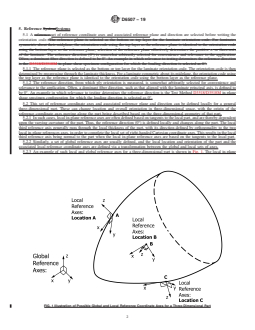
5.2.3 An example of such local and global reference axes for a three-dimensional part is shown in Fig. 1. The local in-plane
FIG. 1 Illustration of Possible Global and Local Reference Coordinate Axes for a Three-Dimensional Part
D6507 − 19
reference axes, x and y, are defined at each local location of the origin, with three shown at points A, B, and C, based on tangents
to the surface of the part at the location. These two local in-plane axes are orthogonal. The third local axis, z, generally runs locally
through the thickness with its direction defined by orthogonality to the local in-plane axes. In this case, the local reference direction
(0°) is defined relative to the local x-axis.
5.2.4 Specific examples of such are parts constructed via filament winding. For such cases, the 0° direction is usually the
winding axis of symmetry and the in-plane axes of the local reference coordinate axes are usually based on the tool surface.
5.2.5 The global reference axes do not need to be Cartesian, but can be defined based on the needs for description of the
structural configuration and associated details of the part. One example is the use of cylindrical axes. Generally, the global
reference axes should be consistent for the design definition, overall analysis, and manufacturing/inspection.
6. Laminate Orientation (Lay-up) Code
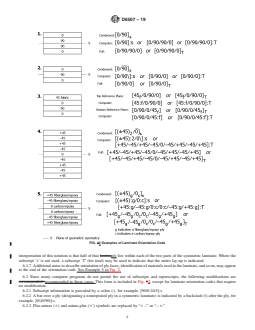
6.1 The following information and the examples in Fig. 12 describe the laminate orientation code. Ply directions and number
of layers are indicated using the laminate orientation code as follows:
θ m b /θ m b . . . notes (1)
@ #
1 1 1 2 2 2 nsb
where:
θ , θ = ply orientations (degrees) of the lamina
...