

ASTM D3316-06(2022)
(Test Method)Standard Test Method for Stability of Perchloroethylene with Copper
General Information
- Abstract
SIGNIFICANCE AND USE
4.1 This test method is to be used as a guide in selecting or eliminating certain grades of perchloroethylene used for drycleaning fabrics or degreasing metal parts.
SCOPE
1.1 This test method covers the evaluation of the corrosiveness to copper metal by perchloroethylene.
1.2 The values stated in SI units are to be regarded as standard. No other units of measurement are included in this standard.
1.3 This standard does not purport to address all of the safety concerns, if any, associated with its use. It is the responsibility of the user of this standard to establish appropriate safety, health, and environmental practices and determine the applicability of regulatory limitations prior to use.
1.4 This international standard was developed in accordance with internationally recognized principles on standardization established in the Decision on Principles for the Development of International Standards, Guides and Recommendations issued by the World Trade Organization Technical Barriers to Trade (TBT) Committee.
- Status
- Published
- Publication Date
- 30-Apr-2022
- Technical Committee
- D26 - Halogenated Organic Solvents and Fire Extinguishing Agents
- Drafting Committee
- D26.04 - Test Methods


Overview
ASTM D3316-06(2022) - Standard Test Method for Stability of Perchloroethylene with Copper establishes a standardized procedure to evaluate the corrosiveness of perchloroethylene when in contact with copper. This method guides the selection or elimination of specific grades of perchloroethylene, particularly for their use in drycleaning fabrics and for degreasing metal parts. By determining the stability of the solvent with copper, this test method helps ensure the performance and longevity of materials in industrial applications.
Developed in accordance with internationally recognized standardization principles, ASTM D3316-06(2022) provides clear criteria for evaluating copper corrosion and contributes to assuring process quality in relevant industries.
Key Topics
- Corrosiveness Assessment: The procedure details how to measure the corrosive effect of perchloroethylene on copper, providing a quantitative assessment through weight loss in copper strips and acidity formation.
- Material Selection: By identifying the stability of different grades of perchloroethylene, the standard supports the selection of products suitable for sensitive applications, such as fabric drycleaning and metal degreasing.
- Testing Protocol:
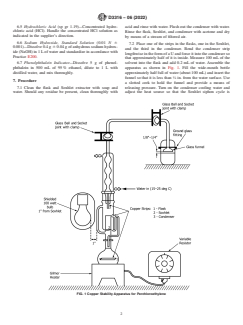
- Use of specific apparatus, including flasks, Soxhlet extractors, and condensers
- Cleaning and preparation methods for copper strips
- Exposure of copper strips to boiling perchloroethylene both in liquid and vapor phases for a set period
- Measurement of copper weight loss and any acid formed during testing
- Reporting Requirements: All results, including acid levels and weight loss for each copper strip, are to be reported accurately to indicate the quality of the perchloroethylene tested.
- Safety Considerations: Emphasizes user responsibility for implementing proper safety, health, and environmental practices during testing.
Applications
ASTM D3316-06(2022) is widely used in:
- Drycleaning Industry: Ensuring perchloroethylene is non-corrosive to copper components, protecting machinery and extending equipment life.
- Metal Degreasing: Selecting perchloroethylene grades that do not promote copper corrosion in industrial cleaning processes, thus maintaining the integrity of metal parts.
- Quality Assurance and Procurement: Guiding procurement teams in specifying and sourcing perchloroethylene suitable for operational needs, and conducting incoming quality control tests.
- Regulatory Compliance: Supporting compliance with international quality and safety standards by providing an established method for assessing solvent compatibility and stability.
By utilizing this standard, organizations mitigate risks of equipment degradation due to corrosive solvents and support a higher level of product reliability.
Related Standards
Organizations applying ASTM D3316-06(2022) may also find value in these related documents:
- ASTM E200: Practice for Preparation, Standardization, and Storage of Standard and Reagent Solutions for Chemical Analysis - details procedures for preparing chemical solutions, as referenced in this method.
- Other ASTM Halogenated Solvent Methods: Standards relevant to the analysis and quality control of halogenated organic solvents in industrial applications.
- International Guidelines: Adherence to World Trade Organization’s Technical Barriers to Trade (TBT) principles for internationally recognized testing procedures.
Keywords: ASTM D3316, stability, perchloroethylene, copper, corrosion, drycleaning, metal degreasing, solvent testing, industrial solvent standards, ASTM standards.
Get Certified
Connect with accredited certification bodies for this standard

Element Materials Technology
Materials testing and product certification.

Inštitut za kovinske materiale in tehnologije
Institute of Metals and Technology. Materials testing, metallurgical analysis, NDT.
Sponsored listings
Frequently Asked Questions
ASTM D3316-06(2022) is a standard published by ASTM International. Its full title is "Standard Test Method for Stability of Perchloroethylene with Copper". This standard covers: SIGNIFICANCE AND USE 4.1 This test method is to be used as a guide in selecting or eliminating certain grades of perchloroethylene used for drycleaning fabrics or degreasing metal parts. SCOPE 1.1 This test method covers the evaluation of the corrosiveness to copper metal by perchloroethylene. 1.2 The values stated in SI units are to be regarded as standard. No other units of measurement are included in this standard. 1.3 This standard does not purport to address all of the safety concerns, if any, associated with its use. It is the responsibility of the user of this standard to establish appropriate safety, health, and environmental practices and determine the applicability of regulatory limitations prior to use. 1.4 This international standard was developed in accordance with internationally recognized principles on standardization established in the Decision on Principles for the Development of International Standards, Guides and Recommendations issued by the World Trade Organization Technical Barriers to Trade (TBT) Committee.
SIGNIFICANCE AND USE 4.1 This test method is to be used as a guide in selecting or eliminating certain grades of perchloroethylene used for drycleaning fabrics or degreasing metal parts. SCOPE 1.1 This test method covers the evaluation of the corrosiveness to copper metal by perchloroethylene. 1.2 The values stated in SI units are to be regarded as standard. No other units of measurement are included in this standard. 1.3 This standard does not purport to address all of the safety concerns, if any, associated with its use. It is the responsibility of the user of this standard to establish appropriate safety, health, and environmental practices and determine the applicability of regulatory limitations prior to use. 1.4 This international standard was developed in accordance with internationally recognized principles on standardization established in the Decision on Principles for the Development of International Standards, Guides and Recommendations issued by the World Trade Organization Technical Barriers to Trade (TBT) Committee.
ASTM D3316-06(2022) is classified under the following ICS (International Classification for Standards) categories: 77.060 - Corrosion of metals. The ICS classification helps identify the subject area and facilitates finding related standards.
ASTM D3316-06(2022) is available in PDF format for immediate download after purchase. The document can be added to your cart and obtained through the secure checkout process. Digital delivery ensures instant access to the complete standard document.
Standards Content (Sample)
This international standard was developed in accordance with internationally recognized principles on standardization established in the Decision on Principles for the
Development of International Standards, Guides and Recommendations issued by the World Trade Organization Technical Barriers to Trade (TBT) Committee.
Designation: D3316 − 06 (Reapproved 2022)
Standard Test Method for
Stability of Perchloroethylene with Copper
This standard is issued under the fixed designation D3316; the number immediately following the designation indicates the year of
original adoption or, in the case of revision, the year of last revision. A number in parentheses indicates the year of last reapproval. A
superscript epsilon (´) indicates an editorial change since the last revision or reapproval.
1. Scope 5. Apparatus
1.1 This test method covers the evaluation of the corrosive- 5.1 Flask, 300 mL, 24/40 standard-taper joint.
ness to copper metal by perchloroethylene.
5.2 Soxhlet Extractor, 30 mm inside diameter, 24/40
1.2 The values stated in SI units are to be regarded as standard-taper bottom joint, 34/45 standard-taper upper joint.
standard. No other units of measurement are included in this
5.3 Allihn Condenser, bulb type, 34/45 standard-taper bot-
standard.
tom joint.
1.3 This standard does not purport to address all of the
5.4 Bottle, wide-mouth, 8 oz.
safety concerns, if any, associated with its use. It is the
5.5 Funnel, 8 mm outside diameter stem, 35 mm diameter
responsibility of the user of this standard to establish appro-
opening.
priate safety, health, and environmental practices and deter-
mine the applicability of regulatory limitations prior to use.
5.6 Heater, variable control.
1.4 This international standard was developed in accor-
5.7 Light Bulb, 100 W.
dance with internationally recognized principles on standard-
5.8 Beaker, 400 mL.
ization established in the Decision on Principles for the
Development of International Standards, Guides and Recom-
5.9 Analytical Balance.
mendations issued by the World Trade Organization Technical
Barriers to Trade (TBT) Committee.
6. Reagents and Materials
6.1 Purity of Reagents—Reagent grade chemicals shall be
2. Referenced Documents
used in all tests. Unless otherwise indicated, it is intended that
2.1 ASTM Standards:
all reagents shall conform to the specifications of the Commit-
E200 Practice for Preparation, Standardization, and Storage
tee on Analytical Reagents of the American Chemical Society,
of Standard and Reagent Solutions for ChemicalAnalysis
where such specifications are available. Other grades may be
used, provided it is first ascertained that the reagent is of
3. Summary of Test Method
sufficiently high purity to permit its use without lessening the
3.1 Clean copper strips are subjected to the action of liquid accuracy of the determination.
and vapor phases of boiling perchloroethylene for 72 h in the
6.2 Purity of Water—Unless otherwise indicated, references
presence of light. Weight loss of copper strips and acid
to water shall be understood to mean distilled water or water of
formation are determined at the end of the test period.
equal purity.
6.3 Acetone, practical grade.
4. Significance and Use
6.4 Copper, electrolytic foil, 0.05 mm thick. Cut three
4.1 This test method is to be used as a guide in selecting or
copper strips, 20 mm by 75 mm. Immerse the strips in
eliminating certain grades of perchloroethylene used for dry-
cleaning fabrics or degreasing metal parts. concentrated HCl until the surface is bright and free of tarnish.
Scribe consecutive identification numbers on the strips. Rinse
thoroughly in running water and dry with a towel. Weigh the
This test method is under the jurisdiction of ASTM Committee D26 on
strips to the nearest 0.1 mg on an analytical balance.
Halogenated Organic Solvents and Fire Extinguishing Agents and is the direct
responsibility of Subcommittee D26.04 on Test Methods.
Current edition approved May 1, 2022. Published May 2022. Originally
approved in 1974. Last previous edition approved in 2016 as D3316-06(2016). DOI: Reagent Chemicals, American Chemical Society Specifications, American
10.1520/D3316-06R22. Chemical Society, Washington, DC. For suggestions on the testing of reagents not
For referenced ASTM standards, visit the ASTM website, www.astm.org, or listed by the American Chemical Society, see Analar Standards for Laboratory
contact ASTM Customer Service at service@astm.org. For Annual Book of ASTM Chemicals, BDH Ltd., Poole, Dorset, U.K., and the United States Pharmacopeia
Standards volume information, refer to the standard’s Document Summary page on and National Formulary, U.S. Pharmacopeial Convention, Inc. (USP), Rockville,
the ASTM website. MD.
Copyright © ASTM International, 100 B
...