

ASTM D4626-23
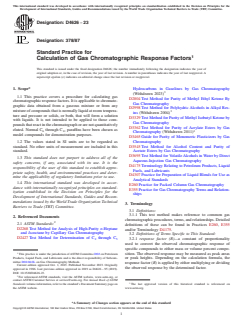
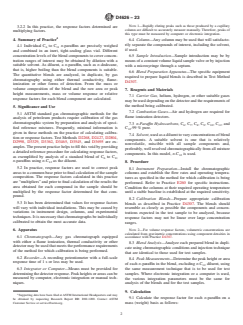
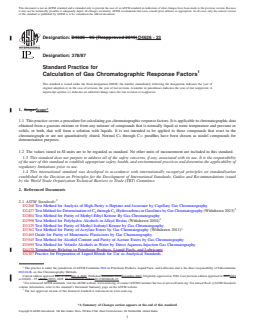
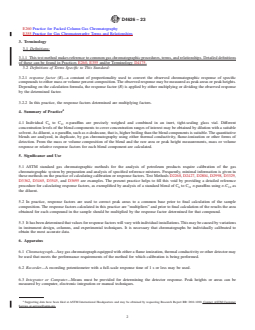
(Practice)Standard Practice for Calculation of Gas Chromatographic Response Factors
General Information
- Abstract
SIGNIFICANCE AND USE
5.1 ASTM standard gas chromatographic methods for the analysis of petroleum products require calibration of the gas chromatographic system by preparation and analysis of specified reference mixtures. Frequently, minimal information is given in these methods on the practice of calculating calibration or response factors. Test Methods D2268, D2427, D2804, D2998, D3329, D3362, D3465, D3545, and D3695 are examples. The present practice helps to fill this void by providing a detailed reference procedure for calculating response factors, as exemplified by analysis of a standard blend of C6 to C11 n-paraffins using n-C12 as the diluent.
5.2 In practice, response factors are used to correct peak areas to a common base prior to final calculation of the sample composition. The response factors calculated in this practice are “multipliers” and prior to final calculation of the results the area obtained for each compound in the sample should be multiplied by the response factor determined for that compound.
5.3 It has been determined that values for response factors will vary with individual installations. This may be caused by variations in instrument design, columns, and experimental techniques. It is necessary that chromatographs be individually calibrated to obtain the most accurate data.
SCOPE
1.1 This practice covers a procedure for calculating gas chromatographic response factors. It is applicable to chromatographic data obtained from a gaseous mixture or from any mixture of compounds that is normally liquid at room temperature and pressure or solids, or both, that will form a solution with liquids. It is not intended to be applied to those compounds that react in the chromatograph or are not quantitatively eluted. Normal C6 through C11 paraffins have been chosen as model compounds for demonstration purposes.
1.2 The values stated in SI units are to be regarded as standard. No other units of measurement are included in this standard.
1.3 This standard does not purport to address all of the safety concerns, if any, associated with its use. It is the responsibility of the user of this standard to establish appropriate safety, health, and environmental practices and determine the applicability of regulatory limitations prior to use.
1.4 This international standard was developed in accordance with internationally recognized principles on standardization established in the Decision on Principles for the Development of International Standards, Guides and Recommendations issued by the World Trade Organization Technical Barriers to Trade (TBT) Committee.
- Status
- Published
- Publication Date
- 30-Sep-2023
- Technical Committee
- D02 - Petroleum Products, Liquid Fuels, and Lubricants
- Drafting Committee
- D02.04.0L - Gas Chromatography Methods



Overview
ASTM D4626-23: Standard Practice for Calculation of Gas Chromatographic Response Factors is an essential international standard published by ASTM International. This practice specifies detailed procedures for calculating gas chromatographic (GC) response factors used in the analysis of petroleum products and other chemical mixtures. Calibration of GC systems is vital to ensure accurate qualitative and quantitative results, particularly where peak areas must be corrected to provide reliable sample composition data. ASTM D4626-23 fills the gap left by many gas chromatographic methods, providing comprehensive guidance on response factor calculation for precise analytical outcomes.
Key Topics
- Calibration of Gas Chromatographic Systems
- Ensures each chromatograph reflects individual variances in instrument design, columns, and experimental techniques.
- Involves preparation and analysis of reference mixtures, commonly using n-paraffins (C6 to C11) with a higher boiling diluent such as n-dodecane.
- Definition and Use of Response Factors
- Response factors are multipliers calculated to standardize the detector response (peak areas or heights) for different compounds.
- Used to convert observed chromatographic responses to mass or volume percent compositions.
- Correct peak areas to a common base, crucial for the final calculation of sample composition.
- Calculation Procedure
- Response factor calculation is performed on both mass and volume bases, relative to a reference compound (often n-heptane).
- Requires accurate measurement and integration of chromatographic peaks, as well as meticulous preparation of calibration blends.
- Applicability
- Applies to liquid, gaseous, or solid mixtures capable of forming solutions with liquids.
- Not intended for reactive compounds or those that are not fully eluted from the chromatograph.
Applications
ASTM D4626-23 is widely applicable in laboratories and industries utilizing gas chromatography, including:
- Petroleum Analysis
- Essential for standard methods involving the quantification of hydrocarbons and other components in fuels, lubricants, solvents, and chemical feedstocks.
- Quality Control
- Provides reliable procedures for calibration of GC instrumentation, ensuring repeatability and validity in routine and regulatory analyses.
- Analytical Chemistry
- Used wherever accurate quantitative GC data is required, such as environmental monitoring and product certification.
- Custom Method Development
- Supports analysts developing new or modified chromatographic methods needing accurate response factor determinations.
By following ASTM D4626-23, laboratories achieve greater comparability, traceability, and confidence in their GC results, complying with international best practices.
Related Standards
ASTM D4626-23 references and complements several important standards, ensuring robust calibration and analytical performance:
- ASTM D2268 - Analysis of High-Purity n-Heptane and Isooctane by Capillary Gas Chromatography
- ASTM D2427 - Determination of C2 through C5 Hydrocarbons in Gasolines by Gas Chromatography
- ASTM D2804 - Purity of Methyl Ethyl Ketone by Gas Chromatography
- ASTM D2998 - Polyhydric Alcohols in Alkyd Resins by Gas Chromatography
- ASTM D3329 - Purity of Methyl Isobutyl Ketone by Gas Chromatography
- ASTM D3545 - Alcohol Content and Purity of Acetate Esters by Gas Chromatography
- ASTM D3695 - Volatile Alcohols in Water by Direct Aqueous-Injection Gas Chromatography
- ASTM D4307 - Preparation of Liquid Blends for Use as Analytical Standards
- Practice E260, E355 - Terms and techniques in packed column and general gas chromatography
Summary
Adherence to ASTM D4626-23 guarantees precise calibration of gas chromatographic systems, ensuring accurate, repeatable, and internationally recognized results across a broad range of applications in petroleum analysis, quality control, and analytical laboratories. Utilizing well-established response factor calculations, this practice maximizes the reliability of gas chromatographic data critical to industrial and regulatory requirements.
Keywords: gas chromatography, response factor calculation, ASTM D4626-23, calibration, petroleum analysis, chromatographic method standardization, reference compounds, analytical chemistry.
Relations
- Replaces
ASTM D4626-95(2019) - Standard Practice for Calculation of Gas Chromatographic Response Factors - Effective Date
- 01-Oct-2023
- Refers
ASTM D4175-23a - Standard Terminology Relating to Petroleum Products, Liquid Fuels, and Lubricants - Effective Date
- 15-Dec-2023
- Refers
ASTM D4175-23 - Standard Terminology Relating to Petroleum Products, Liquid Fuels, and Lubricants - Effective Date
- 01-Jul-2023
- Refers
ASTM D4175-23e1 - Standard Terminology Relating to Petroleum Products, Liquid Fuels, and Lubricants - Effective Date
- 01-Jul-2023
- Effective Date
- 01-Dec-2019
- Effective Date
- 01-Oct-2023
- Effective Date
- 01-Oct-2023
- Effective Date
- 01-Oct-2023
- Effective Date
- 01-Oct-2023
- Effective Date
- 01-Oct-2023
- Effective Date
- 01-Oct-2023
- Effective Date
- 01-Oct-2023
- Effective Date
- 01-Oct-2023
- Effective Date
- 01-Oct-2023
- Effective Date
- 01-Oct-2023
Get Certified
Connect with accredited certification bodies for this standard

ECOCERT
Organic and sustainability certification.

Eurofins Food Testing Global
Global leader in food, environment, and pharmaceutical product testing.

Intertek Bangladesh
Intertek certification and testing services in Bangladesh.
Sponsored listings
Frequently Asked Questions
ASTM D4626-23 is a standard published by ASTM International. Its full title is "Standard Practice for Calculation of Gas Chromatographic Response Factors". This standard covers: SIGNIFICANCE AND USE 5.1 ASTM standard gas chromatographic methods for the analysis of petroleum products require calibration of the gas chromatographic system by preparation and analysis of specified reference mixtures. Frequently, minimal information is given in these methods on the practice of calculating calibration or response factors. Test Methods D2268, D2427, D2804, D2998, D3329, D3362, D3465, D3545, and D3695 are examples. The present practice helps to fill this void by providing a detailed reference procedure for calculating response factors, as exemplified by analysis of a standard blend of C6 to C11 n-paraffins using n-C12 as the diluent. 5.2 In practice, response factors are used to correct peak areas to a common base prior to final calculation of the sample composition. The response factors calculated in this practice are “multipliers” and prior to final calculation of the results the area obtained for each compound in the sample should be multiplied by the response factor determined for that compound. 5.3 It has been determined that values for response factors will vary with individual installations. This may be caused by variations in instrument design, columns, and experimental techniques. It is necessary that chromatographs be individually calibrated to obtain the most accurate data. SCOPE 1.1 This practice covers a procedure for calculating gas chromatographic response factors. It is applicable to chromatographic data obtained from a gaseous mixture or from any mixture of compounds that is normally liquid at room temperature and pressure or solids, or both, that will form a solution with liquids. It is not intended to be applied to those compounds that react in the chromatograph or are not quantitatively eluted. Normal C6 through C11 paraffins have been chosen as model compounds for demonstration purposes. 1.2 The values stated in SI units are to be regarded as standard. No other units of measurement are included in this standard. 1.3 This standard does not purport to address all of the safety concerns, if any, associated with its use. It is the responsibility of the user of this standard to establish appropriate safety, health, and environmental practices and determine the applicability of regulatory limitations prior to use. 1.4 This international standard was developed in accordance with internationally recognized principles on standardization established in the Decision on Principles for the Development of International Standards, Guides and Recommendations issued by the World Trade Organization Technical Barriers to Trade (TBT) Committee.
SIGNIFICANCE AND USE 5.1 ASTM standard gas chromatographic methods for the analysis of petroleum products require calibration of the gas chromatographic system by preparation and analysis of specified reference mixtures. Frequently, minimal information is given in these methods on the practice of calculating calibration or response factors. Test Methods D2268, D2427, D2804, D2998, D3329, D3362, D3465, D3545, and D3695 are examples. The present practice helps to fill this void by providing a detailed reference procedure for calculating response factors, as exemplified by analysis of a standard blend of C6 to C11 n-paraffins using n-C12 as the diluent. 5.2 In practice, response factors are used to correct peak areas to a common base prior to final calculation of the sample composition. The response factors calculated in this practice are “multipliers” and prior to final calculation of the results the area obtained for each compound in the sample should be multiplied by the response factor determined for that compound. 5.3 It has been determined that values for response factors will vary with individual installations. This may be caused by variations in instrument design, columns, and experimental techniques. It is necessary that chromatographs be individually calibrated to obtain the most accurate data. SCOPE 1.1 This practice covers a procedure for calculating gas chromatographic response factors. It is applicable to chromatographic data obtained from a gaseous mixture or from any mixture of compounds that is normally liquid at room temperature and pressure or solids, or both, that will form a solution with liquids. It is not intended to be applied to those compounds that react in the chromatograph or are not quantitatively eluted. Normal C6 through C11 paraffins have been chosen as model compounds for demonstration purposes. 1.2 The values stated in SI units are to be regarded as standard. No other units of measurement are included in this standard. 1.3 This standard does not purport to address all of the safety concerns, if any, associated with its use. It is the responsibility of the user of this standard to establish appropriate safety, health, and environmental practices and determine the applicability of regulatory limitations prior to use. 1.4 This international standard was developed in accordance with internationally recognized principles on standardization established in the Decision on Principles for the Development of International Standards, Guides and Recommendations issued by the World Trade Organization Technical Barriers to Trade (TBT) Committee.
ASTM D4626-23 is classified under the following ICS (International Classification for Standards) categories: 71.040.50 - Physicochemical methods of analysis. The ICS classification helps identify the subject area and facilitates finding related standards.
ASTM D4626-23 has the following relationships with other standards: It is inter standard links to ASTM D4626-95(2019), ASTM D4175-23a, ASTM D4175-23, ASTM D4175-23e1, ASTM D2427-06(2019), ASTM D6228-19, ASTM D3524-14(2020), ASTM D6417-15(2019), ASTM D7807-20, ASTM D7796-21, ASTM D7164-21, ASTM D8442-22, ASTM D7398-21, ASTM D7165-22, ASTM D6352-19e1. Understanding these relationships helps ensure you are using the most current and applicable version of the standard.
ASTM D4626-23 is available in PDF format for immediate download after purchase. The document can be added to your cart and obtained through the secure checkout process. Digital delivery ensures instant access to the complete standard document.
Standards Content (Sample)
This international standard was developed in accordance with internationally recognized principles on standardization established in the Decision on Principles for the
Development of International Standards, Guides and Recommendations issued by the World Trade Organization Technical Barriers to Trade (TBT) Committee.
Designation: D4626 − 23
Designation: 378/87
Standard Practice for
Calculation of Gas Chromatographic Response Factors
This standard is issued under the fixed designation D4626; the number immediately following the designation indicates the year of
original adoption or, in the case of revision, the year of last revision. A number in parentheses indicates the year of last reapproval. A
superscript epsilon (´) indicates an editorial change since the last revision or reapproval.
1. Scope* Hydrocarbons in Gasolines by Gas Chromatography
(Withdrawn 2023)
1.1 This practice covers a procedure for calculating gas
D2804 Test Method for Purity of Methyl Ethyl Ketone By
chromatographic response factors. It is applicable to chromato-
Gas Chromatography
graphic data obtained from a gaseous mixture or from any
D2998 Test Method for Polyhydric Alcohols in Alkyd Res-
mixture of compounds that is normally liquid at room tempera-
ins (Withdrawn 2004)
ture and pressure or solids, or both, that will form a solution
D3329 Test Method for Purity of Methyl Isobutyl Ketone by
with liquids. It is not intended to be applied to those com-
Gas Chromatography
pounds that react in the chromatograph or are not quantitatively
D3362 Test Method for Purity of Acrylate Esters by Gas
eluted. Normal C through C paraffins have been chosen as
6 11
Chromatography (Withdrawn 2011)
model compounds for demonstration purposes.
D3465 Guide for Purity of Monomeric Plasticizers by Gas
1.2 The values stated in SI units are to be regarded as Chromatography
standard. No other units of measurement are included in this D3545 Test Method for Alcohol Content and Purity of
standard. Acetate Esters by Gas Chromatography
D3695 Test Method for Volatile Alcohols in Water by Direct
1.3 This standard does not purport to address all of the
Aqueous-Injection Gas Chromatography
safety concerns, if any, associated with its use. It is the
D4175 Terminology Relating to Petroleum Products, Liquid
responsibility of the user of this standard to establish appro-
Fuels, and Lubricants
priate safety, health, and environmental practices and deter-
D4307 Practice for Preparation of Liquid Blends for Use as
mine the applicability of regulatory limitations prior to use.
Analytical Standards
1.4 This international standard was developed in accor-
E260 Practice for Packed Column Gas Chromatography
dance with internationally recognized principles on standard-
E355 Practice for Gas Chromatography Terms and Relation-
ization established in the Decision on Principles for the
ships
Development of International Standards, Guides and Recom-
mendations issued by the World Trade Organization Technical
3. Terminology
Barriers to Trade (TBT) Committee.
3.1 Definitions:
3.1.1 This test method makes reference to common gas
2. Referenced Documents
chromatographic procedures, terms, and relationships. Detailed
2.1 ASTM Standards:
definitions of these can be found in Practices E260, E355
D2268 Test Method for Analysis of High-Purity n-Heptane
and/or Terminology D4175.
and Isooctane by Capillary Gas Chromatography
3.2 Definitions of Terms Specific to This Standard:
D2427 Test Method for Determination of C through C
2 5 3.2.1 response factor (R)—a constant of proportionality
used to convert the observed chromatographic response of
specific compounds to either mass or volume percent compo-
sition. The observed response may be measured as peak areas
This practice is under the jurisdiction of ASTM Committee D02 on Petroleum
Products, Liquid Fuels, and Lubricants and is the direct responsibility of Subcom-
or peak heights. Depending on the calculation formula, the
mittee D02.04.0L on Gas Chromatography Methods.
response factor (R) is applied by either multiplying or dividing
Current edition approved Oct. 1, 2023. Published November 2023. Originally
the observed response by the determined factor.
approved in 1986. Last previous edition approved in 2019 as D4626 – 95 (2019).
DOI: 10.1520/D4626-23.
For referenced ASTM standards, visit the ASTM website, www.astm.org, or
contact ASTM Customer Service at service@astm.org. For Annual Book of ASTM
Standards volume information, refer to the standard’s Document Summary page on The last approved version of this historical standard is referenced on
the ASTM website. www.astm.org.
*A Summary of Changes section appears at the end of this standard
Copyright © ASTM International, 100 Barr Harbor Drive, PO Box C700, West Conshohocken, PA 19428-2959. United States
D4626 − 23
NOTE 1—Rapidly eluting peaks such as those produced by a capillary
3.2.2 In this practice, the response factors determined are
column are difficult to accurately measure manually. Therefore, peaks of
multiplying factors.
this type must be measured by computer or electronic integration.
4. Summary of Practice
6.4 Column—Any column may be used that will satisfacto-
rily separate the compounds of interest, including the solvent,
4.1 Individual C to C n-paraffins are precisely weighed
6 11
if used.
and combined in an inert, tight-sealing glass vial. Different
concentration levels of the blend components to cover concen-
6.5 Sample Introduction—Sample introduction may be by
tration ranges of interest may be obtained by dilution with a
means of a constant volume liquid sample valve or by injection
suitable solvent. As diluent, a n-paraffin, such as n-dodecane,
with a microsyringe through a septum.
that is, higher boiling than the blend components is suitable.
6.6 Blend Preparation Apparatus—The specific equipment
The quantitative blends are analyzed, in duplicate, by gas
required to prepare liquid blends is described in Test Method
chromatography using either thermal conductivity, flame-
D4307.
ionization or other forms of detection. From the mass or
volume composition of the blend and the raw area or peak
7. Reagents and Materials
height measurements, mass or volume response or relative
7.1 Carrier Gas, helium, hydrogen, or other suitable gases
response factors for each blend component are calculated.
may be used depending on the detector and the requirements of
the method being calibrated.
5. Significance and Use
7.2 Combustion Gases—Air and hydrogen are required for
5.1 ASTM standard gas chromatographic methods for the
flame ionization detectors.
analysis of petroleum products require calibration of the gas
chromatographic system by preparation and analysis of speci-
7.3 n-Paraffın Hydrocarbons, C , C , C , C , C , C , and
6 7 8 9 10 11
fied reference mixtures. Frequently, minimal information is
C -99 % pure.
given in
...
This document is not an ASTM standard and is intended only to provide the user of an ASTM standard an indication of what changes have been made to the previous version. Because
it may not be technically possible to adequately depict all changes accurately, ASTM recommends that users consult prior editions as appropriate. In all cases only the current version
of the standard as published by ASTM is to be considered the official document.
Designation: D4626 − 95 (Reapproved 2019) D4626 − 23
Designation: 378/87
Standard Practice for
Calculation of Gas Chromatographic Response Factors
This standard is issued under the fixed designation D4626; the number immediately following the designation indicates the year of
original adoption or, in the case of revision, the year of last revision. A number in parentheses indicates the year of last reapproval. A
superscript epsilon (´) indicates an editorial change since the last revision or reapproval.
1. Scope Scope*
1.1 This practice covers a procedure for calculating gas chromatographic response factors. It is applicable to chromatographic data
obtained from a gaseous mixture or from any mixture of compounds that is normally liquid at room temperature and pressure or
solids, or both, that will form a solution with liquids. It is not intended to be applied to those compounds that react in the
chromatograph or are not quantitatively eluted. Normal C through C paraffins have been chosen as model compounds for
6 11
demonstration purposes.
1.2 The values stated in SI units are to be regarded as standard. No other units of measurement are included in this standard.
1.3 This standard does not purport to address all of the safety concerns, if any, associated with its use. It is the responsibility
of the user of this standard to establish appropriate safety, health, and environmental practices and determine the applicability of
regulatory limitations prior to use.
1.4 This international standard was developed in accordance with internationally recognized principles on standardization
established in the Decision on Principles for the Development of International Standards, Guides and Recommendations issued
by the World Trade Organization Technical Barriers to Trade (TBT) Committee.
2. Referenced Documents
2.1 ASTM Standards:
D2268 Test Method for Analysis of High-Purity n-Heptane and Isooctane by Capillary Gas Chromatography
D2427 Test Method for Determination of C through C Hydrocarbons in Gasolines by Gas Chromatography (Withdrawn 2023)
2 5
D2804 Test Method for Purity of Methyl Ethyl Ketone By Gas Chromatography
D2998 Test Method for Polyhydric Alcohols in Alkyd Resins (Withdrawn 2004)
D3329 Test Method for Purity of Methyl Isobutyl Ketone by Gas Chromatography
D3362 Test Method for Purity of Acrylate Esters by Gas Chromatography (Withdrawn 2011)
D3465 Guide for Purity of Monomeric Plasticizers by Gas Chromatography
D3545 Test Method for Alcohol Content and Purity of Acetate Esters by Gas Chromatography
D3695 Test Method for Volatile Alcohols in Water by Direct Aqueous-Injection Gas Chromatography
D4175 Terminology Relating to Petroleum Products, Liquid Fuels, and Lubricants
D4307 Practice for Preparation of Liquid Blends for Use as Analytical Standards
This practice is under the jurisdiction of ASTM Committee D02 on Petroleum Products, Liquid Fuels, and Lubricants and is the direct responsibility of Subcommittee
D02.04.0L on Gas Chromatography Methods.
Current edition approved Dec. 1, 2019Oct. 1, 2023. Published December 2019November 2023. Originally approved in 1986. Last previous edition approved in 20152019
as D4626 – 95 (2015).(2019). DOI: 10.1520/D4626-95R19.10.1520/D4626-23.
For referenced ASTM standards, visit the ASTM website, www.astm.org, or contact ASTM Customer Service at service@astm.org. For Annual Book of ASTM Standards
volume information, refer to the standard’s Document Summary page on the ASTM website.
The last approved version of this historical standard is referenced on www.astm.org.
*A Summary of Changes section appears at the end of this standard
Copyright © ASTM International, 100 Barr Harbor Drive, PO Box C700, West Conshohocken, PA 19428-2959. United States
D4626 − 23
E260 Practice for Packed Column Gas Chromatography
E355 Practice for Gas Chromatography Terms and Relationships
3. Terminology
3.1 Definitions:
3.1.1 This test method makes reference to common gas chromatographic procedures, terms, and relationships. Detailed definitions
of these can be found in Practices E260, E355 and/or Terminology D4175.
3.2 Definitions of Terms Specific to This Standard:
3.2.1 response factor (R)—a constant of proportionality used to convert the observed chromatographic response of specific
compounds to either mass or volume percent composition. The observed response may be measured as peak areas or peak heights.
Depending on the calculation formula, the response factor (R) is applied by either multiplying or dividing the observed response
by the determined factor.
3.2.2 In this practice, the response factors determined are multiplying factors.
4. Summary of Practice
4.1 Individual C to C n-paraffins are precisely weighed and combined in an inert, tight-sealing glass vial. Different
6 11
concentration levels of the blend components to cover concentration ranges of interest may be obtained by dilution with a suitable
solvent. As diluent, a n-paraffin, such as n-dodecane, that is, higher boiling than the blend components is suitable. The quantitative
blends are analyzed, in duplicate, by gas chromatography using either thermal conductivity, flame-ionization or other forms of
detection. From the mass or volume composition of the blend and the raw area or peak height measurements, mass or volume
response or relative response factors for each blend component are calculated.
5. Significance and Use
5.1 ASTM standard gas chromatographic methods for the analysis of petroleum products require calibration of the gas
chromatographic system by preparation and analysis of specified reference mixtures. Frequently, minimal information is given in
these methods on the practice of calculating calibration or response factors. Test Methods D2268, D2427, D2804, D2998, D3329,
D3362, D3465, D3545, and D3695 are examples. The present practice helps to fill this void by providing a detailed reference
procedure for calculating response factors, as exemplified by analysis of a standard blend of C to C n-paraffins using n-C as
6 11 12
the diluent.
5.2 In practice, response factors are used to correct peak areas to a common base prior to final calculation of the sample
composition. The response factors calculated in this practice are “multipliers” and prior to final calculation of the results the area
obtained for each compound in the sample should be multiplied by the response factor determined for that compound.
5.3 It has been determined that values for response factors will vary with individual installations. This may be caused by va
...