

ASTM D6352-19e1
(Test Method)Standard Test Method for Boiling Range Distribution of Petroleum Distillates in Boiling Range from 174 °C to 700 °C by Gas Chromatography
General Information
- Abstract
SIGNIFICANCE AND USE
5.1 The boiling range distribution of medium and heavy petroleum distillate fractions provides an insight into the composition of feed stocks and products related to petroleum refining processes (for example, hydrocracking, hydrotreating, visbreaking, or deasphalting). The gas chromatographic simulation of this determination can be used to replace conventional distillation methods for control of refining operations. This test method can be used for product specification testing with the mutual agreement of interested parties.
5.2 This test method extends the scope of boiling range determination by gas chromatography to include medium and heavy petroleum distillate fractions beyond the scope of Test Method D2887 (538 °C).
5.3 Boiling range distributions obtained by this test method have not been analyzed for correlation to those obtained by low efficiency distillation, such as with Test Method D86 or D1160.
SCOPE
1.1 This test method covers the determination of the boiling range distribution of petroleum distillate fractions. The test method is applicable to petroleum distillate fractions having an initial boiling point greater than 174 °C (345 °F) and a final boiling point of less than 700 °C (1292 °F) (C10 to C90) at atmospheric pressure as measured by this test method.
1.2 The test method is not applicable for the analysis of petroleum or petroleum products containing low molecular weight components (for example naphthas, reformates, gasolines, crude oils). Materials containing heterogeneous components (for example alcohols, ethers, acids, or esters) or residue are not to be analyzed by this test method. See Test Methods D3710, D2887, or D5307 for possible applicability to analysis of these types of materials.
1.3 The values stated in SI units are to be regarded as standard. The values stated in inch-pound units are for information only and may be included as parenthetical values.
1.4 This standard does not purport to address all of the safety concerns, if any, associated with its use. It is the responsibility of the user of this standard to establish appropriate safety, health, and environmental practices and determine the applicability of regulatory limitations prior to use.
1.5 This international standard was developed in accordance with internationally recognized principles on standardization established in the Decision on Principles for the Development of International Standards, Guides and Recommendations issued by the World Trade Organization Technical Barriers to Trade (TBT) Committee.
- Status
- Published
- Publication Date
- 30-Nov-2019
- Technical Committee
- D02 - Petroleum Products, Liquid Fuels, and Lubricants
- Drafting Committee
- D02.04.0H - Chromatographic Distribution Methods
Overview
ASTM D6352-19e1 specifies the standard test method for determining the boiling range distribution of petroleum distillates with initial boiling points greater than 174 °C and final boiling points less than 700 °C. This method employs gas chromatography (GC) to simulate distillation processes, focusing on medium to heavy distillate fractions. Developed by ASTM International, this GC-based approach offers faster, safer, and more precise analysis compared to traditional distillation methods, making it highly valuable in petroleum refining and quality control operations.
Key Topics
Boiling Range Distribution: The standard outlines procedures for accurately mapping out the boiling profiles of petroleum distillate fractions using gas chromatography. Understanding the boiling range helps characterize the composition and properties of petroleum feeds and products.
Applicability: This method targets samples with initial boiling points above 174 °C (345 °F) and final boiling points below 700 °C (1292 °F), generally corresponding to C10–C90 hydrocarbons. It is not designed for light hydrocarbons, crude oils, or materials with heterogeneous components such as alcohols, ethers, acids, esters, or residues.
Operational Guidance: The standard provides comprehensive requirements for apparatus setup, calibration using n-paraffin mixtures, sample preparation, and data analysis. It emphasizes proper system configuration, choice of capillary columns, use of a flame ionization detector (FID), and verification of system response and baseline stability for accurate GC analysis.
Precision and Quality Control: To ensure consistency and reliability, ASTM D6352-19e1 includes the use of reference materials and gravimetric blends for calibration and regular quality checks. This supports high levels of reproducibility and comparability between laboratories.
Safety and Compliance: The standard encourages users to establish appropriate safety, health, and environmental practices, aligning with international standardization principles and regulatory requirements.
Applications
ASTM D6352-19e1 is widely used in various sectors of the petroleum industry, including:
- Petroleum Refining Operations: Monitor and control the composition of feedstocks and products in processes like hydrocracking, hydrotreating, visbreaking, and deasphalting.
- Quality Control & Product Specification: Verify boiling range distribution for compliance with product specifications when mutually agreed by interested parties.
- Process Optimization: Aid in the optimization of refining processes by rapidly assessing changes in feedstock or product composition.
- Research & Development: Support the development of new refining methodologies or formulations by providing accurate analysis of heavier hydrocarbon fractions.
This method enables the replacement of conventional high-temperature distillation with safer, automated, and reliable gas chromatographic analysis-delivering operational efficiencies and improved laboratory throughput.
Related Standards
For specific petroleum products or analysis outside the scope of ASTM D6352, the following related ASTM standards may be referenced:
- ASTM D2887: Standard Test Method for Boiling Range Distribution of Petroleum Fractions by Gas Chromatography (for lower boiling fractions, up to 538 °C).
- ASTM D86: Standard Test Method for Distillation of Petroleum Products and Liquid Fuels at Atmospheric Pressure.
- ASTM D1160: Standard Test Method for Distillation of Petroleum Products at Reduced Pressure.
- ASTM D3710: Test Method for Boiling Range Distribution of Gasoline and Gasoline Fractions by Gas Chromatography.
- ASTM D5307: Determination of Boiling Range Distribution of Crude Petroleum by Gas Chromatography.
By following ASTM D6352-19e1, laboratories and refineries gain the ability to efficiently characterize mid- and heavy-boiling petroleum fractions, improving process control, product quality, and overall analytical safety. This gas chromatographic method is crucial for industries where understanding the boiling range distribution of petroleum products supports both operational excellence and regulatory compliance.
Relations
- Effective Date
- 01-Dec-2019
- Effective Date
- 01-Dec-2023
- Effective Date
- 01-Dec-2023
- Effective Date
- 01-Dec-2023
- Effective Date
- 01-Nov-2023
- Effective Date
- 01-Oct-2023
- Effective Date
- 01-Jul-2023
- Effective Date
- 01-Jun-2020
- Refers
ASTM D4626-95(2019) - Standard Practice for Calculation of Gas Chromatographic Response Factors - Effective Date
- 01-Dec-2019
- Effective Date
- 01-Sep-2019
- Effective Date
- 01-Jul-2019
- Effective Date
- 01-Apr-2018
- Effective Date
- 15-Dec-2017
- Effective Date
- 15-Nov-2017
- Effective Date
- 01-May-2017
Get Certified
Connect with accredited certification bodies for this standard

Element Materials Technology
Materials testing and product certification.

ABS Group Brazil
ABS Group certification services in Brazil.

ABS Quality Evaluations Inc.
American Bureau of Shipping quality certification.
Sponsored listings
Frequently Asked Questions
ASTM D6352-19e1 is a standard published by ASTM International. Its full title is "Standard Test Method for Boiling Range Distribution of Petroleum Distillates in Boiling Range from 174 °C to 700 °C by Gas Chromatography". This standard covers: SIGNIFICANCE AND USE 5.1 The boiling range distribution of medium and heavy petroleum distillate fractions provides an insight into the composition of feed stocks and products related to petroleum refining processes (for example, hydrocracking, hydrotreating, visbreaking, or deasphalting). The gas chromatographic simulation of this determination can be used to replace conventional distillation methods for control of refining operations. This test method can be used for product specification testing with the mutual agreement of interested parties. 5.2 This test method extends the scope of boiling range determination by gas chromatography to include medium and heavy petroleum distillate fractions beyond the scope of Test Method D2887 (538 °C). 5.3 Boiling range distributions obtained by this test method have not been analyzed for correlation to those obtained by low efficiency distillation, such as with Test Method D86 or D1160. SCOPE 1.1 This test method covers the determination of the boiling range distribution of petroleum distillate fractions. The test method is applicable to petroleum distillate fractions having an initial boiling point greater than 174 °C (345 °F) and a final boiling point of less than 700 °C (1292 °F) (C10 to C90) at atmospheric pressure as measured by this test method. 1.2 The test method is not applicable for the analysis of petroleum or petroleum products containing low molecular weight components (for example naphthas, reformates, gasolines, crude oils). Materials containing heterogeneous components (for example alcohols, ethers, acids, or esters) or residue are not to be analyzed by this test method. See Test Methods D3710, D2887, or D5307 for possible applicability to analysis of these types of materials. 1.3 The values stated in SI units are to be regarded as standard. The values stated in inch-pound units are for information only and may be included as parenthetical values. 1.4 This standard does not purport to address all of the safety concerns, if any, associated with its use. It is the responsibility of the user of this standard to establish appropriate safety, health, and environmental practices and determine the applicability of regulatory limitations prior to use. 1.5 This international standard was developed in accordance with internationally recognized principles on standardization established in the Decision on Principles for the Development of International Standards, Guides and Recommendations issued by the World Trade Organization Technical Barriers to Trade (TBT) Committee.
SIGNIFICANCE AND USE 5.1 The boiling range distribution of medium and heavy petroleum distillate fractions provides an insight into the composition of feed stocks and products related to petroleum refining processes (for example, hydrocracking, hydrotreating, visbreaking, or deasphalting). The gas chromatographic simulation of this determination can be used to replace conventional distillation methods for control of refining operations. This test method can be used for product specification testing with the mutual agreement of interested parties. 5.2 This test method extends the scope of boiling range determination by gas chromatography to include medium and heavy petroleum distillate fractions beyond the scope of Test Method D2887 (538 °C). 5.3 Boiling range distributions obtained by this test method have not been analyzed for correlation to those obtained by low efficiency distillation, such as with Test Method D86 or D1160. SCOPE 1.1 This test method covers the determination of the boiling range distribution of petroleum distillate fractions. The test method is applicable to petroleum distillate fractions having an initial boiling point greater than 174 °C (345 °F) and a final boiling point of less than 700 °C (1292 °F) (C10 to C90) at atmospheric pressure as measured by this test method. 1.2 The test method is not applicable for the analysis of petroleum or petroleum products containing low molecular weight components (for example naphthas, reformates, gasolines, crude oils). Materials containing heterogeneous components (for example alcohols, ethers, acids, or esters) or residue are not to be analyzed by this test method. See Test Methods D3710, D2887, or D5307 for possible applicability to analysis of these types of materials. 1.3 The values stated in SI units are to be regarded as standard. The values stated in inch-pound units are for information only and may be included as parenthetical values. 1.4 This standard does not purport to address all of the safety concerns, if any, associated with its use. It is the responsibility of the user of this standard to establish appropriate safety, health, and environmental practices and determine the applicability of regulatory limitations prior to use. 1.5 This international standard was developed in accordance with internationally recognized principles on standardization established in the Decision on Principles for the Development of International Standards, Guides and Recommendations issued by the World Trade Organization Technical Barriers to Trade (TBT) Committee.
ASTM D6352-19e1 is classified under the following ICS (International Classification for Standards) categories: 75.080 - Petroleum products in general. The ICS classification helps identify the subject area and facilitates finding related standards.
ASTM D6352-19e1 has the following relationships with other standards: It is inter standard links to ASTM D6352-19, ASTM D86-23a, ASTM D86-23ae1, ASTM D6299-23a, ASTM D2892-23, ASTM D4626-23, ASTM D2887-23, ASTM D2892-20, ASTM D4626-95(2019), ASTM E594-96(2019), ASTM D2887-19, ASTM D2892-18, ASTM D6299-17b, ASTM D6299-17a, ASTM D2892-17. Understanding these relationships helps ensure you are using the most current and applicable version of the standard.
ASTM D6352-19e1 is available in PDF format for immediate download after purchase. The document can be added to your cart and obtained through the secure checkout process. Digital delivery ensures instant access to the complete standard document.
Standards Content (Sample)
This international standard was developed in accordance with internationally recognized principles on standardization established in the Decision on Principles for the
Development of International Standards, Guides and Recommendations issued by the World Trade Organization Technical Barriers to Trade (TBT) Committee.
´1
Designation: D6352 − 19
Standard Test Method for
Boiling Range Distribution of Petroleum Distillates in
Boiling Range from 174 °C to 700 °C by Gas
Chromatography
This standard is issued under the fixed designation D6352; the number immediately following the designation indicates the year of
original adoption or, in the case of revision, the year of last revision.Anumber in parentheses indicates the year of last reapproval.A
superscript epsilon (´) indicates an editorial change since the last revision or reapproval.
ε NOTE—Editorially added research report information to Table 3 in May 2020.
1. Scope* 2. Referenced Documents
2.1 ASTM Standards:
1.1 Thistestmethodcoversthedeterminationoftheboiling
D86Test Method for Distillation of Petroleum Products and
range distribution of petroleum distillate fractions. The test
Liquid Fuels at Atmospheric Pressure
methodisapplicabletopetroleumdistillatefractionshavingan
D1160TestMethodforDistillationofPetroleumProductsat
initial boiling point greater than 174°C (345°F) and a final
Reduced Pressure
boiling point of less than 700°C (1292°F) (C10 to C90) at
D2887Test Method for Boiling Range Distribution of Pe-
atmospheric pressure as measured by this test method.
troleum Fractions by Gas Chromatography
1.2 The test method is not applicable for the analysis of D2892Test Method for Distillation of Crude Petroleum
(15-Theoretical Plate Column)
petroleum or petroleum products containing low molecular
D3710TestMethodforBoilingRangeDistributionofGaso-
weight components (for example naphthas, reformates,
line and Gasoline Fractions by Gas Chromatography
gasolines, crude oils). Materials containing heterogeneous
(Withdrawn 2014)
components (for example alcohols, ethers, acids, or esters) or
D4626Practice for Calculation of Gas Chromatographic
residue are not to be analyzed by this test method. See Test
Response Factors
MethodsD3710,D2887,orD5307forpossibleapplicabilityto
D5307Test Method for Determination of Boiling Range
analysis of these types of materials.
Distribution of Crude Petroleum by Gas Chromatography
1.3 The values stated in SI units are to be regarded as (Withdrawn 2011)
D6299Practice for Applying Statistical Quality Assurance
standard. The values stated in inch-pound units are for infor-
and Control Charting Techniques to Evaluate Analytical
mation only and may be included as parenthetical values.
Measurement System Performance
1.4 This standard does not purport to address all of the
E355PracticeforGasChromatographyTermsandRelation-
safety concerns, if any, associated with its use. It is the
ships
responsibility of the user of this standard to establish appro-
E594Practice for Testing Flame Ionization Detectors Used
priate safety, health, and environmental practices and deter-
in Gas or Supercritical Fluid Chromatography
mine the applicability of regulatory limitations prior to use.
E1510Practice for Installing Fused Silica Open Tubular
1.5 This international standard was developed in accor- Capillary Columns in Gas Chromatographs
dance with internationally recognized principles on standard-
3. Terminology
ization established in the Decision on Principles for the
Development of International Standards, Guides and Recom-
3.1 Definitions—This test method makes reference to many
mendations issued by the World Trade Organization Technical common gas chromatographic procedures, terms, and relation-
Barriers to Trade (TBT) Committee. ships. For definitions of these terms used in this test method,
refer to Practices E355, E594, and E1510.
1 2
This test method is under the jurisdiction of ASTM Committee D02 on For referenced ASTM standards, visit the ASTM website, www.astm.org, or
Petroleum Products, Liquid Fuels, and Lubricants and is the direct responsibility of contact ASTM Customer Service at service@astm.org. For Annual Book of ASTM
Subcommittee D02.04.0H on Chromatographic Distribution Methods. Standards volume information, refer to the standard’s Document Summary page on
Current edition approved Dec. 1, 2019. Published February 2020. Originally the ASTM website.
approved in 1998. Last previous edition approved in 2015 as D6352–15. DOI: The last approved version of this historical standard is referenced on
10.1520/D6352-19E01. www.astm.org.
*A Summary of Changes section appears at the end of this standard
Copyright © ASTM International, 100 Barr Harbor Drive, PO Box C700, West Conshohocken, PA 19428-2959. United States
´1
D6352 − 19
3.2 Definitions of Terms Specific to This Standard: 4.4 Retentiontimesofknownnormalparaffinhydrocarbons,
3.2.1 areaslice,n—thearearesultingfromtheintegrationof spanning the scope of the test method, are determined and
the chromatographic detector signal within a specified reten- correlated to their boiling point temperatures. The normalized
tiontimeinterval.Inareaslicemode(see6.4.2),peakdetection cumulative corrected sample areas for each consecutive re-
parameters are bypassed and the detector signal integral is corded time interval are used to calculate the boiling range
recorded as area slices of consecutive, fixed duration time distribution. The boiling point temperature at each reported
intervals. percent off increment is calculated from the retention time
calibration.
3.2.2 corrected area slice, n—an area slice corrected for
baselineoffsetbysubtractionoftheexactlycorrespondingarea
5. Significance and Use
slice in a previously recorded blank (non-sample) analysis.
5.1 The boiling range distribution of medium and heavy
3.2.3 cumulativecorrectedarea,n—theaccumulatedsumof
petroleum distillate fractions provides an insight into the
correctedareaslicesfromthebeginningoftheanalysisthrough
composition of feed stocks and products related to petroleum
a given retention time, ignoring any non-sample area (for
refining processes (for example, hydrocracking, hydrotreating,
example, solvent).
visbreaking, or deasphalting). The gas chromatographic simu-
3.2.4 final boiling point (FBP), n—the temperature (corre-
lationofthisdeterminationcanbeusedtoreplaceconventional
spondingtotheretentiontime)atwhichacumulativecorrected
distillationmethodsforcontrolofrefiningoperations.Thistest
area count equal to 99.5% of the total sample area under the
method can be used for product specification testing with the
chromatogram is obtained.
mutual agreement of interested parties.
3.2.5 initial boiling point (IBP), n—the temperature (corre-
5.2 This test method extends the scope of boiling range
spondingtotheretentiontime)atwhichacumulativecorrected
determination by gas chromatography to include medium and
area count equal to 0.5% of the total sample area under the
heavy petroleum distillate fractions beyond the scope of Test
chromatogram is obtained.
Method D2887 (538°C).
3.2.6 slice rate, n—the time interval used to integrate the
5.3 Boiling range distributions obtained by this test method
continuous (analog) chromatographic detector response during
havenotbeenanalyzedforcorrelationtothoseobtainedbylow
an analysis. The slice rate is expressed in Hz (for example
efficiencydistillation,suchaswithTestMethodD86orD1160.
integrations or slices per second).
6. Apparatus
3.2.7 slice time, n—the analysis time associated with each
area slice throughout the chromatographic analysis. The slice
6.1 Chromatograph—Thegaschromatographicsystemused
time is the time at the end of each contiguous area slice.
shall have the following performance characteristics:
3.2.8 total sample area, n—the cumulative corrected area, 6.1.1 Carrier Gas Flow Control—The chromatograph shall
from the initial area point to the final area point, where the beequippedwithcarriergaspressureorflowcontrolcapableof
chromatographicsignalhasreturnedtobaselineaftercomplete maintaining constant carrier gas flow control through the
sample elution.
column throughout the column temperature program cycle.
6.1.2 Column Oven—Capable of sustained and linear pro-
3.3 Abbreviations—Acommonabbreviationofhydrocarbon
grammed temperature operation from near ambient (for
compounds is to designate the number of carbon atoms in the
example, 30°C to 35°C) up to 450°C.
compound.Aprefix is used to indicate the carbon chain form,
6.1.3 Column Temperature Programmer—The chromato-
while a subscripted suffix denotes the number of carbon atoms
graph shall be capable of linear programmed temperature
(for example n-C for normal-decane, i-C for iso-
10 14
operation up to 450°C at selectable linear rates up to
tetradecane).
20°C⁄min. The programming rate shall be sufficiently repro-
4. Summary of Test Method ducible to obtain the retention time repeatability of 0.1 min
(6s) for each component in the calibration mixture described
4.1 The boiling range distribution determination by distilla-
in 7.5.
tion is simulated by the use of gas chromatography. A
6.1.4 Detector—Thistestmethodrequirestheuseofaflame
non-polar open tubular (capillary) gas chromatographic col-
ionizationdetector(FID).Thedetectorshallmeetorexceedthe
umnisusedtoelutethehydrocarboncomponentsofthesample
followingspecificationsinaccordancewithPracticeE594.The
in order of increasing boiling point.
flame jet should have an orifice of approximately 0.05mm to
4.2 A sample aliquot is diluted with a viscosity reducing
0.070 mm (0.020 in. to 0.030 in.).
solvent and introduced into the chromatographic system.
6.1.4.1 Operating Temperature—100°C to 450°C.
Sample vaporization is provided by separate heating of the
6.1.4.2 Sensitivity—>0.005 C/g carbon.
point of injection or in conjunction with column oven heating.
6.1.4.3 Minimum Detectability—1 × 10-11 g carbon/s.
4.3 The column oven temperature is raised at a specified 6.1.4.4 Linear Range—>10
linear rate to affect separation of the hydrocarbon components 6.1.4.5 Connection of the column to the detector shall be
in order of increasing boiling point. The elution of sample such that no temperature below the column temperature exists
components is quantitatively determined using a flame ioniza- between the column and the detector. Refer to Practice E1510
tion detector. The detector signal is recorded as area slices for for proper installation and conditioning of the capillary col-
consecutive retention time intervals during the analysis. umn.
´1
D6352 − 19
6.1.5 Sample Inlet System—Any sample inlet system ca- nitrogenisdescribedinAppendixX2.(Warning—Heliumand
pableofmeetingtheperformancespecificationin7.6and8.2.2 nitrogenarecompressedgasesunderhighpressure)Additional
may be used. Programmable temperature vaporization (PTV) purification is recommended by the use of molecular sieves or
and cool on-column injection systems have been used success- other suitable agents to remove water, oxygen, and hydrocar-
fully. bons.Availablepressureshallbesufficienttoensureaconstant
carrier gas flow rate.
6.2 Microsyringe—A microsyringe with a 23-gage or
smaller stainless steel needle is used for on-column sample
7.2 Hydrogen—Hydrogen of high purity (for example, hy-
introduction. Syringes of 0.1µL to 10µL capacity are avail-
drocarbon free) is used as fuel for the FID. Hydrogen can also
able.
be used as the carrier gas. (Warning—Hydrogen is an ex-
6.2.1 Automatic syringe injection is recommended to
tremely flammable gas under high pressure).
achieve best precision.
7.3 Air—High purity (for example, hydrocarbon free) com-
6.3 Column—This test method is limited to the use of
pressed air is used as the oxidant for the FID. (Warning—
non-polar wall coated open tubular (WCOT) columns of high
Compressed air is a gas under high pressure and supports
thermal stability (see Note 1). Glass, fused silica, and stainless
combustion).
steelcolumnswith0.53mmto0.75mminternaldiameterhave
7.4 Solvents—Unless otherwise indicated, it is intended that
been successfully used. Cross-linked or bonded 100 %
all solvents conform to the specifications of the Committee on
dimethyl-polysiloxane stationary phases with film thickness of
Analytical Reagents of theAmerican Chemical Society where
0.10µm to 0.20 µm have been used. The column length and
such specifications are available. Other grades may be used,
liquid phase film thickness shall allow the elution of at least
provided it is first ascertained that the solvent is of sufficiently
C90 n-paraffin (BP= 700°C).The column and conditions shall
high purity to permit its use without lessening the accuracy of
provide separation of typical petroleum hydrocarbons in order
the determination.
of increasing boiling point and meet the column performance
7.4.1 Carbon Disulfide (CS )—(99+% pure) is used as a
requirements of 8.2.1. The column shall provide a resolution
viscosity-reducing solvent and as a means of reducing mass of
between three (3) and ten (10) using the test method operating
sample introduced onto the column to ensure linear detector
conditions.
response and reduced peak skewness. It is miscible with
NOTE 1—Based on recent information that suggests that true boiling
asphaltic hydrocarbons and provides a relatively small re-
points(atmosphericequivalenttemperatures)versusretentiontimesforall
sponsewiththeFID.Thequality(hydrocarboncontent)should
components do not fall on the same line, other column systems that can
be determined by this test method prior to use as a sample
meet this criteria will be considered. These criteria will be specified after
diluent. (Warning—CS is extremely flammable and toxic.)
a round robin evaluation of the test method is completed.
7.4.2 Cyclohexane (C H )—(99+% pure) may be used in
6 12
6.4 Data Acquisition System:
place of CS for the preparation of the calibration mixture.
6.4.1 Recorder—A 0mV to 1 mV range recording potenti-
ometer or equivalent with a full-scale response time of2sor
7.5 Calibration Mixture—A qualitative mixture of
less may be used. It is, however, not a necessity if an
n-paraffins (nominally C10 to C100) dissolved in a suitable
integrator/computer data system is used.
solvent. The final concentration should be approximately one
6.4.2 Integrator—Means shall be provided for determining
part of n-paraffin mixture to 200 parts of solvent.At least one
the accumulated area under the chromatogram. This can be
compound in the mixture shall have a boiling point lower than
done by means of an electronic integrator or computer-based
the initial boiling point and one shall have a boiling point
chromatography data system. The integrator/computer system
higher than the final boiling point of the sample being
shallhavenormalchromatographicsoftwareformeasuringthe
analyzed, as defined in 1.1. The calibration mixture shall
retention time and areas of eluting peaks (peak detection
contain at least eleven known n-paraffins (for example C10,
mode). In addition, the system shall be capable of converting
C12, C16, C20, C30, C40, C50, C60, C70, C80, and C90).
the continuously integrated detector signal into area slices of
Atmospheric equivalent boiling points of n-paraffins are listed
fixed duration. These contiguous area slices, collected for the
in Table 1.
entire analysis, are stored for later processing. The electronic
NOTE 3—A suitable calibration mixture can be obtained by dissolving
range of the integrator/computer (for example 1 V, 10 V) shall
a hydrogenated polyethylene wax (for example, Polywax 655 or Polywax
beoperatedwithinthelinearrangeofthedetector/electrometer
1000)inavolatilesolvent(forexample,CS orC H ).Solutionsof1part
2 6 12
system used.
Polywax to 200 parts solvent can be prepared. Lower boiling point
paraffins will have to be added to ensure conformance with 7.5. Fig. 1
NOTE 2—Some gas chromatographs have an algorithm built into their
illustrates a typical calibration mixture chromatogram, and Fig. 2 illus-
operating software that allows a mathematical model of the baseline
trates an expanded scale of carbon numbers above 75.
profile to be stored in memory. This profile is automatically subtracted
from the detector signal on subsequent sample runs to compensate for the
column bleed. Some integration systems also store and automatically
subtract a blank analysis from subsequent analytical determinations.
ACS Reagent Chemicals, Specifications and Procedures for Reagents and
Standard-Grade Reference Materials, American Chemical Society, Washington,
7. Reagents and Materials DC. For suggestions on the testing of reagents not listed by theAmerican Chemical
Society, see Analar Standards for Laboratory Chemicals, BDH Ltd., Poole, Dorset,
7.1 Carrier Gas—Helium, hydrogen, or nitrogen of high
U.K., and the United States Pharmacopeia and National Formulary, U.S. Pharma-
purity. The use of alternative carrier gases hydrogen and copeial Convention, Inc. (USPC), Rockville, MD.
´1
D6352 − 19
A,B
TABLE 1 Continued
TABLE 1 Boiling Points of n-Paraffins
Carbon No. Boiling Point, °C Boiling Point, °F Carbon No. Boiling Point, °C Boiling Point, °F
1 –162 –259 76 664 1227
2 –89 –127
77 667 1233
3 –42 –44 78 670 1238
40 31
79 673 1243
536 97 80 675 1247
6 69 156 81 678 1252
7 98 209 82 681 1258
8 126 258 83 683 1261
9 151 303 84 686 1267
10 174 345 85 688 1270
11 196 385
86 691 1276
12 216 421 87 693 1279
13 235 456
88 695 1283
14 254 488 89 697 1287
15 271 519 90 700 1292
16 287 548 91 702 1296
17 302 576 92 704 1299
18 316 601 93 706 1303
19 330 625 94 708 1306
20 344 651
95 710 1310
21 356 675 96 712 1314
22 369 696
97 714 1317
23 380 716 98 716 1321
24 391 736 99 718 1324
25 402 755 100 720 1328
26 412 774
A
API Project 44, October 31, 1972 is believed to have provided the original normal
27 422 791
paraffin boiling point data that are listed in Table 1. However, over the years some
28 431 808
of the data contained in both API Project 44 (Thermodynamics Research Center
29 440 824
Hydrocarbon Project) and Test Method D6352 have changed and they are no
30 449 840
longer equivalent. Table 1 represents the current normal paraffin boiling point
31 458 856
values accepted by Subcommittee D02.04 and found in all test methods under the
32 466 870
jurisdiction of Section D02.04.0H.
33 474 885
B
Test Method D6352 has traditionally used n-paraffin boiling points rounded to the
34 481 898
nearest whole degree for calibration. The boiling points listed in Table 1 are correct
35 489 912
to the nearest whole number in both degrees Celsius and degrees Fahrenheit.
36 496 925
However, if a conversion is made from one unit to the other and then rounded to
37 503 937
a whole number, the results will not agree with the table values for a few carbon
38 509 948
numbers. For example, the boiling point of n-heptane is 98.425 °C, which is
39 516 961
correctly rounded to 98 °C in the table. However, converting 98.425 °C gives
40 522 972
209.165 °F, which rounds to 209 °F, while converting 98 °C gives 208.4 °F, which
41 528 982
rounds to 208 °F. Carbon numbers 2, 4, 7, 8, 9, 13, 14, 15, 16, 25, 27, and 32 are
42 534 993
affected by rounding.
43 540 1004
44 545 1013
45 550 1022
46 556 1033
47 561 1042
48 566 1051
49 570 1058
50 575 1067
51 579 1074
52 584 1083
53 588 1090
54 592 1098
55 596 1105
56 600 1112
57 604 1119
58 608 1126
59 612 1134
60 615 1139
61 619 1146
62 622 1152
63 625 1157
64 629 1164
65 632 1170
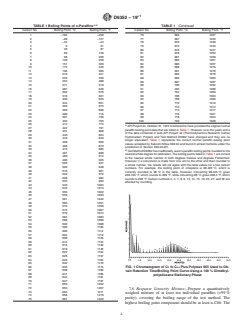
66 635 1175 FIG. 1 Chromatogram of C to C Plus Polywax 655 Used to Ob-
5 44
67 638 1180
tain Retention Time/Boiling Point Curve Using a 100 % Dimethyl-
68 641 1186
polysiloxane Stationary Phase
69 644 1191
70 647 1197
71 650 1202
72 653 1207
7.6 Response Linearity Mixture—Prepare a quantitatively
73 655 1211
weighed mixture of at least ten individual paraffins (>99%
74 658 1216
purity), covering the boiling range of the test method. The
75 661 1222
highest boiling point component should be at least n-C60. The
´1
D6352 − 19
A
TABLE 2 Test Method D6352 Reference Material 5010
% OFF Average, Allowable Average, Allowable
°F Difference, °F °C Difference, °C
IBP 801 16 428 9
5 891 5 477 3
10 918 5 493 3
15 936 5 502 3
20 950 6 510 3
25 963 6 518 4
30 975 7 524 4
35 987 7 531 4
40 998 8 537 4
45 1008 8 543 4
50 1019 8 548 5
55 1030 8 554 4
60 1040 8 560 4
65 1051 8 566 4
70 1062 8 572 4
75 1073 9 578 5
80 1086 8 585 4
FIG. 2 Scale-Expanded Chromatogram of Latest Eluting Peaks
85 1099 7 593 4
Showing C to C Normal Paraffins on a 100 % Dimethylpolysi-
76 98 90 1116 8 602 4
loxane Stationary Phase
95 1140 7 616 4
FBP 1213 32 655 18
A
Consensus results obtained from 14 laboratories in 2000.
mixture shall contain n-C40. Use a suitable solvent to provide
a solution of each component at approximately 0.5 % by mass
TABLE 3 Boiling Point Distribution and Cut Points of Gravimetric
A,B
to 2.0% by mass. Blend No. 1
% Off BP, °C Allowed BP, °F Allowed
7.7 Use of Quality Control Materials—These materials are
Deviation, Deviation, °F
intended as a check of the performance of the gas chromato-
°C
IBP 184.1 8.0 363.3 14.3
graphic system. In order to develop a new QC material, it is
5 204.7 6.9 400.5 12.5
necessary that the material’s boiling point distribution consen-
10 216.0 3.0 420.8 5.4
sus values are obtained with an ILS consisting of a minimum
15 219.3 2.1 426.8 3.8
20 225.6 3.4 438.1 6.1
of 16 labs as described in 6.2 of Practice D6299. It is also
25 229.8 4.0 445.6 7.3
necessary that the existing QC material is analyzed as part of
30 235.3 4.3 455.5 7.8
the ILS whenever possible.
35 238.5 4.4 461.3 8.0
40 246.8 3.6 476.2 6.4
7.7.1 ReferenceMaterial5010—Areferencesamplethathas
45 254.9 2.5 490.8 4.5
been analyzed by laboratories participating in the test method
cooperative study. Consensus values for the boiling range
55 495.6 6.2 924.0 11.2
60 511.4 4.7 952.6 8.4
distribution of this sample are given in Table 2.
65 523.8 4.1 974.8 7.5
7.7.2 Gravimetric Blend No. 1—In lieu of Reference Mate-
70 534.2 4.1 993.5 7.3
rial 5010, Gravimetric Blend No. 1 can be used. This blend is
75 543.5 4.1 1010.4 7.4
80 553.3 4.2 1027.9 7.5
made by gravimetrically combining two cuts in equal propor-
85 563.2 4.1 1045.7 7.3
tions by weight. The blend is not only used to determine the
90 573.9 4.0 1064.9 7.2
boiling point distributions shown in Table 3, but also to verify
95 588.8 4.6 1091.8 8.2
FBP 628.5 7.4 1163.3 13.3
the gravimetric composition of the two cuts as also shown in
Cut Point 1 SET – 330 °C (626 °F) 49.44 % ±0.64 %
Table 3. Agreement with the gravimetric composition within
Cut Point 2 330 °C (626 °F) – EET 50.56 % ±0.64 %
the allowable deviations of Table 3, can be used as an
A
The data is interpreted using the 95 % / 95 % Tolerance Margin where a user can
additional check of the detector response described in 8.2.2.A
be 95 % confident that at least 95 % of all future measurements at any of the listed
distillation or cut points (for example, 20 % Off), by multiple labs, will fall within their
typical chromatogram of Gravimetric Blend No. 1 as well as
corresponding allowed deviations (for example, 3.40 °C of 225.6 °C).
the distillation curve are shown in Fig. 3.
B
ILS results for Gravimetric Blend No.1 are detailed in Research Report
RR:D02-1926.
8. Preparation of Apparatus
8.1 Gas Chromatograph Setup:
8.1.1 Place the gas chromatograph and ancillary equipment from combustion of silicone liquid phase or other materials.
into operation in accordance with the manufacturer’s instruc- Such deposits will change the response characteristics of the
tions. Typical operating conditions are shown in Table 4. detector.
8.1.2 Attach one of the column specified in Table 5 to the 8.1.4 If the sample inlet system is heated, a blank analysis
detectorinletbyensuringthattheendofthecolumnterminates shall be made after a new septum is installed to ensure that no
as close as possible to the FID jet tip. Follow the instructions extraneous peaks are produced by septum bleed. At the
in Practice E1510. sensitivity levels commonly employed in this test method,
8.1.3 The FID should be periodically inspected and, if conditioning of the septum at the upper operating temperature
necessary, remove any foreign deposits formed in the detector of the sample inlet system for several hours will minimize this
´1
D6352 − 19
FIG. 3 Chromatogram and Distillation Curve of Gravimetric Blend No. 1
TABLE 4 Typical Gas Chromatographic Conditions for the TABLE 5 Column Selection for Performing Boiling Range
Simulated Distillation of Petroleum Fractions in the Boiling Distribution of Petroleum Distillates in the Range from 174 °C to
Range from 174 °C to 700 °C 700 °C by Gas Chromatography
Instrument a gas chromatography equipped with an on-column Capillary Column
or temperature programmable vaporizing injector 5m×0.53mmI.D., Polymide or aluminum clad fused silica capillary column
(PTV) with a bonded phase of 100 % dimethylpolysiloxane of 0.1 µm film thickness.
Column capillary, aluminum clad fused silica 5m×0.53mI.D., stainless steel columns with a bonded phase of 100 %
5m×0.53mmid dimethylpolysiloxane of 0.1 µm film thickness
film thickness 0.1 µm
of a 100 % dimethylpolysiloxane stationary phase
Flow conditions UHP helium at 18 mL/min (constant flow)
8.2 System Performance Specification:
Injection temperature oven-track mode 8.2.1 Column Resolution—The column resolution, influ-
enced by both the column physical parameters and operating
Detector flame ionization;
conditions, affects the overall determination of boiling range
air 400 mL/min, hydrogen 32 mL/min
distribution. Resolution is, therefore, specified to maintain
make-up gas, helium at 24 mL/min
temperature: 450 °C
equivalence between different systems (laboratories) employ-
range: 2E5
ing this test method. Resolution is determined using Eq 1 and
Oven program initial oven temperature 50 °C, the C and C paraffins from a calibration mixture analysis
50 52
initial hold 0 min,
(orapolywaxretentiontimeboilingpointmixture).Resolution
program rate 10 °C ⁄min,
(R)shouldbeatleasttwo(2)andnotmorethanfour(4),using
final oven temperature 400 °C,
final hold 6 min, the identical conditions employed for sample analyses.
equilibration time 5 min.
R 52 t 2 t / 1.699 w 1w (1)
~ ! ~ ~ !!
2 1 2 1
Sample size 0.5 µL
where:
Sample dilution 1 weight percent in carbon disulfide
t = time (s) for the n-C peak max,
1 50
t = time (s) for the n-C peak max,
Calibration dilution 0.5 weight percent in carbon disulfide 2 52
w = peak width (s), at half height, of the n-C peak, and
1 50
w = peak width (s), at half height, of the n-C peak.
2 52
problem. The inlet liner and initial portion of the column shall 8.2.2 Detector Response Calibration —This test method
be periodically inspected and replaced, if necessary, to remove assumes that the FID response to petroleum hydrocarbons is
extraneous deposits or sample residue. proportional to the mass of individual components. This shall
8.1.5 Column Conditioning—A new column will require beverifiedwhenthesystemisputinservice,andwheneverany
conditioning at the upper test method operating temperature to changes are made to the system or operational parameters.
reduceoreliminatesignificantliquidphasebleedtoproduceor Analyze the response linearity mixture (see 7.6) using the
generate a stable and repeatable chromatographic baseline. identical procedure to be used for the analysis of samples (see
Follow the guidelines outlined in Practice E1510. Section 9). Calculate the relative response factor for each
´1
D6352 − 19
TABLE 6 Measured Response of the Flame Ionization Detector as
9.1.2 During the cool down and equilibration time, ready
a Function of Carbon Number for One Laboratory Using a Fused
the integrator/computer system. If a retention time calibration
Silica Column with 100 % Dimethylpolysiloxane Stationary Phase
is being performed, use the peak detection mode. For samples
Measured
Carbon and baseline compensation (with or without solvent injection),
Response Factor
No.
use the area slice mode operation. For the selection of slice
(nC = 1.00)
12 0.98
width, see 10.
14 0.96
9.1.3 At the exact time set by the schedule, inject either the
17 0.95
calibrationmixture,solvent,orsampleintothechromatograph;
20 0.97
28 0.96
ormakenoinjection(performabaselineblank).Atthetimeof
32 0.98
injection, start the chromatograph time cycle and the
36 0.96
integrator/computer data acquisition. Follow the analysis pro-
40 1.00
44 0.98
tocol for all subsequent repetitive analyses or calibrations.
60 0.97
Since complete resolution of sample peaks is not expected, do
not change the sensitivity setting during the analysis.
9.2 Baseline Blank—Ablank analysis (baseline blank) shall
be performed at least once per day. The blank analysis may be
without injection or by injection of an equivalent solvent
n-paraffin (relative to n-tetracontane) in accordance with Prac-
volume as used with sample injections, depending upon the
tice D4626 and Eq 2:
subsequentdatahandlingcapabilitiesforbaseline/solventcom-
Fn 5 Cn/An / Cn 2C40/An 2C40 (2)
~ ! ~ !
pensation. The blank analysis is typically performed prior to
where:
sample analyses, but may be useful if determined between
samples or at the end of a sample sequence to provide
Cn = concentration of the n-paraffin in the mixture,
additional data regarding instrument operation or residual
An = peak area of the n-paraffin in the mixture,
Cn-C40 = concentrationofthen-tetracontaneinthemixture,
sample carry over from previous sample analyses.
and
NOTE 4—If automatic baseline correction (see Note 2) is provided by
An-C40 = peak area of the n-tetracontane in the mixture.
the gas chromatograph, further correction of area slices may not be
required. However, if an electronic offset is added to the signal after
The relative response factor (Fn) of each n-paraffin shall not
baselinecompensation,additionalareaslicecorrectionmayberequiredin
deviate from unity by more than 65%. Results of response
the form of offset subtraction. Consult the specific instrumentation
factor determinations by one lab are presented in Table 6.
instructions to determine if an offset is applied to the signal. If the
8.2.3 Column Temperature—The column temperature pro-
algorithmusedisunclear,thesliceareadatacanbeexaminedtodetermine
gram profile is selected such that there is baseline separation if further correction is necessary. Determine if any offset has been added
to the compensated signal by examining the corrected area slices of those
between the solvent and the first n-paraffin peak (C10) in the
time slices that precede the elution of any chromatographic unretained
calibration mixture and the maximum boiling point (700°C).
substance. If these corrected area slices (representing the true baseline)
n-Paraffin (C90) is eluted from the column before reaching the
deviate from zero, subtract the average of these corrected area slices from
end of the temperature program. The actual program rate used
each corrected area slice in the analysis.
will be influenced by other operating conditions, such as
9.3 Retention Time versus Boiling Point Calibration—A
column dimensions, carrier gas and flow rate, and sample size.
retention time versus boiling point calibration shall be per-
Thin liquid phase film thickness and narrower bore columns
formed on the same day that analyses are performed. Inject an
may require lower carrier gas flow rates and faster column
appropriatealiquot(0.2µLto2.0µL)ofthecalibrationmixture
temperature program rates to compensate for sample compo-
(see 7.5) into the chromatograph, using the analysis schedule
nent overloading (see 9.3.1).
protocol. Obtain a normal (peak detection) data record to
8.2.4 Column Elution Characteristics —The column phase
determine the peak retention times and the peak areas for each
is non-polar and having McReynolds numbers of x = 15–17, y
component. Collect a time slice area record if a boiling range
= 53–57, z = 43–46, u = 65–67, and s = 42–45.
distribution report is desired.
9.3.1 Inspect the chromatogram of the calibration mixture
9. Procedure
for evidence of skewed (non-Gaussian shaped) peaks. Skew-
9.1 Analysis Sequence Protocol—Defineanduseapredeter- ness is often an indication of overloading the sample capacity
mined schedule of analysis events designed to achieve maxi- of the column, which will result in displacement of the peak
mum reproducibility for these determinations. The schedule apex relative to non-overloaded peaks. Skewness results ob-
shallincludecoolingthecolumnovenandinjectortotheinitial tainedbyonelaboratoryarepresentedinTable7.Distortionin
starting temperature, equilibration time, sample injection and retention time measurement and, hence, errors in boiling point
system start, analysis, and final high temperature hold time. temperaturedeterminationwillbelikelyifcolumnoverloading
9.1.1 After chromatographic conditions have been set to occurs. The column liquid phase loading has a direct bearing
meet performance requirements, program the column tempera- on acceptable sample size. Reanalyze the calibration mixture
ture upward to the maximum temperature to be used and hold using a smaller sample size or a more dilute solution if peak
that temperature for the selected time. Following the analysis distortion or skewness is evident.
sequence protocol, cool the column to the initial starting 9.3.1.1 Skewness Calculation—Calculate the ratio A/B on
temperature. specified peaks in the calibration mixture as indicated by the
´1
D6352 − 19
TABLE 7 Measured Resolution and Skewness for One Laboratory
Using a Fused Silica Column Coated with a 100 %
Dimethylpolysiloxane Stationary Phase
Resolution between: nC and nC 3.3
50 52
Skewness for nC
at 10 % of peak height: 1.17
at 50 % of peak height: 1.00
designations in Fig. 4. A is the width in seconds of the portion
of the peak eluting prior to the time of the apex peak and
measured at 10% of peak height (0.10-H), and B is the width
in seconds of the portion of the peak eluting after the time of
the peak apex at 10% of peak height (0.10-H). This ratio for
the n-pentacontane (normal C ) peak in the calibration mix-
ture shall not be less than 0.5 or more than 2.0. Results of
analysis in one laboratory are presented in Table 7.
9.3.2 Prepare a calibration table based upon the results of
the analysis of the calibration mixture by recording the time of
each peak maximum and the boiling point temperature in °C
(or°F)foreachcomponentinthemixture.Atypicalcalibration
table is presented in Table 8. n-Paraffin boiling point (atmo-
spheric equivalent temperatures) are listed in Table 1. Fig. 1
illustrates a graphic plot of typical calibration data.
9.4 Sample Preparation—Sample aliquots are introduced
into the gas chromatograph as solutions in a suitable solvent
(for example, CS ).
FIG. 4 Designation of Parameters for Calculation of Peak Skew-
ness
9.4.1 Place approximately 0.1g to1gofthe sample aliquot
into a screw-capped or crimp-cap vial.
9.4.2 Dilute the sample aliquot to approximately 1 weight
the column flow, column film thickness, and initial column
percent with the solvent.
temperature as well as column length. In addition the detector
9.4.3 Seal(cap)thevial,andmixthecontentsthoroughlyto
signal level has to be as low as possible at the initial
provide a homogeneous mixture. It may be necessary to warm
temperature of the analysis. The detector signal level for both
the mixture initially to affect complete solution of the sample.
the sample signal and the blank at the beginning of the run has
However, the sample shall be in stable solution at room
to be similar for proper zeroing of the signals.
temperature prior to injection. If necessary, prepare a more
10.1.2 The sampling frequency has to be adjusted so that at
dilute solution.
least a significant number of slices are acquired prior to the
start of elution of sample or solvent. For example, if the time
9.5 SampleAnalysis—Usingtheanalysissequenceprotocol,
for start of sample elution is 0.06 min (3.6 s), a sampling rate
inject a diluted sample aliquot into the gas chromatograph.
of5Hzwouldacquire18slices.Howeverarateof1Hzwould
Collect a contiguous time slice record of the entire analysis.
only acquire 3.6 slices which would not be sufficient for
9.5.1 Be careful that the injection size chosen does not
zeroing the signals. Rather than specifying number of slices, it
exceedthelinearrangeofthedetector.Thetypicalsamplesize
isimportanttoselectaninitialtimesegment,thatis,oneortwo
ranges from 0.2µL to 2.0 µL of the diluted sample. The
seconds. Ensure that the smallest number of slices is 5 or
maximum sample signal amplitude should not exceed the
greater.
maximum calibration signal amplitude found in 9.3.1.A
10.1.3 Verifythattheslicewidthusedtoacquirethesample
chromatogramforroundrobinsample95-3ispresentedinFig.
chromatogram is the same used to acquire the blank run
5.
chromatogram.
9.5.2 Ensure that the system’s return to baseline is achieved
near the end of the run. If the sample chromatogram does not
10.2 Chromatograms Offset for Sample and Blank—
return to baseline by the end of the temperature program, the
Perform a slice offset for the sample chromatogram and blank
sampleapparentlyhasnotcompletelyelutedfromthecolumns,
chromatogram.This operation is necessary so that the signal is
and the sample is considered outside the scope of the test
corrected from its displacement from the origin. This is
method.
achievedbydetermininganaveragesliceoffsetfromtheslices
accumulatedinthefirstsegment(thatis,firsts)andperforming
10. Calculations
a standard deviation calculation for the first N slices accumu-
10.1 Acquisition Rate Requirements: lated. It is carried out for both sample signal and baseline
10.1.1 The number of slices required at the beginning of signal.
dataacquisitiondependsonchromatographicvariablessuchas 10.2.1 Sample Offset:
´1
D6352 − 19
TABLE 8 Typical Calibration Report of Retention Time and
Boiling Points, °C, for Normal Paraffins on 100 %
Dimethylpolysiloxane Stationary Phase
Carbon Boiling Retention Time,
No. Point, °C min
nC10 174 0.25
nC12 216 0.58
nC14 254 1.61
nC15 271 2.40
nC16 287 3.27
nC17 302 4.18
nC18 316 5.07
nC20 344 6.78
nC22 369 8.38
nC24 391 9.84
nC26 412 11.21
nC28 431 12.48
nC30 449 13.67
nC32 466 14.79
nC34 481 15.86
FIG. 5 Chromatogram of Round Robin Sample 95-3 Obtained Us-
nC36 496 16.88
ing a Fused Silica Capillary Column with 100 % Dimethylpolysi-
nC38 509 17.83
loxane Stationary Phase
nC40 522 18.74
nC42 534 19.62
nC44 545 20.46
nC46 556 21.26
nC48 566 22.02
nC50 575 22.77
10.2.1.1 Calculate the average slice offset of sample chro-
nC52 584 23.47
matogram using the first second of acquired slices. Insure that
nC54 592 24.15
no sample has eluted during this time and that the number of
nC56 600 24.82
nC58 608 25.46
slices acquired is at least 5. Throw out any of the first N slices
nC60 615 26.08
selected that are not within one standard deviation of the
nC62 622 26.68
nC64 629 27.25
average and recompute the average. This eliminates any area
nC66 635 27.81
that is due to possible baseline upset from injection.
nC68 641 28.35
nC70 647 28.88 10.2.1.2 Subtract the average slice offset from all the slices
nC72 653 29.39
of the sample chromatogram. Set negative slices to zero. This
nC74 658 29.90
will zero the chromatogram.
nC76 664 30.39
nC78 670 30.86
10.2.2 Blank Offset:
nC80 675 31.31
nC82 681 31.77
NOTE 5—If you are using electronic baseline compensation, proceed to
nC84 686 32.22
10.4.Itisstronglyrecommendedthatablankbaselinebeacquiredwithor
nC86 691 32.64
without solvent according to how the sample was prepared for injection.
nC88 695 33.05
nC90 700 34.25
The slice by slice offset is a preferred method for offset the signals.
nC92 704 34.32
10.2.2.1 Repeat 10.2.1 using the blank run table.
´1
D6352 − 19
10.3 Offset the Sample Chromatogram with Blank to or greater than the area percent being analyzed.As in 10.8.1
Chromatogram—Subtract from each slice in the sample chro- and 10.8.2, use interpolation when the accumulated sum
matogram table with its correspondent slice in the blank run exceedstheareapercenttobeestimated(refertothealgorithm
chromatogram table. Set negative slices to zero. in 10.9.1). Use the calibration table to assign the boiling point.
10.4 Determine the Start of Sample Elution Time:
10.9 Calculation Algorithm:
10.4.1 Calculate the Total Area—Add all the corrected
10.9.1 Calculationstodeterminetheexactpointintimethat
slices in the table. If the sample to be analyzed has a solvent
will generate the X percent of total area, where X = 0.5, 1, 2,
peak, start counting area from the point at which the solvent
..., 99.5 %.
peak has eluted completely. Otherwise, start at the first cor-
10.9.1.1 Record the time of the slice just prior to the slice
rected slice.
that will generate a cumulative slice area larger than the X
10.4.2 Calculate the Rate of Change Between Each Two
percent of the total area. Let us call this time, T , and the
s
Consecutive Area Slices—Begin at the slice set in 10.4.1 and
cumulative area at this point, A .
c
workforward.Therateofchangeisobtainedbysubtractingthe
10.9.1.2 Calculate the fraction of the slice required to
areaofaslicefromtheareaoftheimmediatelyprecedingslice
produce the exact X percent of the total area:
and dividing by the slice width. The time where the rate of
X 2 A
c
change first exceeds 0.0001 % per second of the total area (see
A 5 (3)
x
A 2 A
c11 c
10.4.1)isdefinedasthestartofsampleelutiontime.Toreduce
the possibility of noise or an electronic spike falsely indicating where:
thestartofsampleelutiontime,a1-ssliceaveragecanbeused
A = fraction of the slice that will yield the exact percent,
x
instead of a single slice. For noisier baselines, a slice average
A = cumulative percent up to the slice prior to X,
c
larger than 3 s may be required.
A = cumulative percent up to the slice right after X, and
c+1
X = desired cumulative percent.
10.5 Determine the End of Sample Elution Time:
10.5.1 Calculate the Rate of Change Between Each Two
10.9.1.3 Calculate the time required to generate the fraction
Consecutive Area Slices—Begin at the end of run and work of area Ax:
backwards. The rate of change is obtained by subtracting the
T 5 A ·W (4)
f x
areaofaslicefromtheareaoftheimmediatelyprecedingslice
where:
and dividing by the slice width. The time where the rate of
change first exceeds 0.00001 % per second of the total area W = slice width
A = fraction of the slice that will yield the exact percent,
(see 10.4.1) is defined as the end of sample elution time. To
x
and
reduce the possibility of noise or an electronic spike falsely
T = fraction of time that will yield A .
indicating the end of sample elution time, a 1s slice average
f x
can be used instead of a single slice. For noisier baselines, a
10.9.1.4 Recordtheexacttimewherethecumulativeareais
slice average larger than 1 s may be required.
equal to the X percent of the total area:
10.6 Calculate the Sample Total Area—Add all the slices
T 5 T 1T (5)
t s f
fromtheslicecorrespondingtothestartofsampleelutiontime
where:
to the slice corresponding to the end of sample elution time.
T = fraction of the slice that yields the cumulative percent
s
10.7 Normalize to Area Percent—Divide each slice in the
up to the slice prior to X,
sample chromatogram table by the total area (see 10.6) and
T = fraction of time that will yield A , and
f x
multiply it by 100.
T = time where the cumulative area is equal to X percent of
t
10.8 Calculate the Boiling Point Distribution Table: the total area.
10.8.1 Initial Boiling Point—Add slices in the sample chro-
10.9.2 Interpolatetodeterminetheexactboilingpointgiven
matogramuntilthesumisequaltoorgreaterthan0.5%.Ifthe
the retention time corresponding to a cumulative slice area.
sum is greater than 0.5 %, interpolate (refer to the algorithm in
10.9.2.1 Comparethegiventimeagainsteachretentiontime
10.9.1)todeterminethetimethatwillgeneratetheexact0.5%
in the calibration table. Select the nearest standard having a
ofthearea.Calculatetheboilingpointtemperaturecorrespond-
retention time equal to or larger than the interpolation time.
ing to this slice time using the calibration table. Use interpo-
(Warning—The retention time table shall be sorted in ascend-
lation when required (refer to the algorithm in 10.9.2).
ing order.)
10.8.2 Final Boiling Point—Add slices in the sample chro-
10.9.2.2 If the interpolation time is equal to the retention
matogram until the sum is equal to or greater than 99.5 %. If
time of the standard, record the corresponding boiling point.
the sum is greater than 99.5 %, inte
...