

ASTM B386/B386M-19e1
(Specification)Standard Specification for Molybdenum and Molybdenum Alloy Plate,Sheet, Strip, Foil, and Ribbon
General Information
- Abstract
ABSTRACT
This specification covers unalloyed molybdenum and molybdenum alloy plate, sheet, strip, and foil as follows: Molybdenum 360; Molybdenum 361; Molybdenum Alloy 363; Molybdenum Alloy 364; Molybdenum 365; and Molybdenum Alloy 366. The various molybdenum mill products covered by this specification shall be formed with the conventional extrusion, forging, or rolling equipment normally found in primary ferrous and nonferrous plants. The ingot metal for Molybdenum 360 and 365 and Molybdenum Alloys 363 and 366 is vacuum arc-melted in furnaces of a type suitable for reactive, refractory metals. For Molybdenum 361 and Molybdenum Alloy 364, the metal is consolidated by powder metallurgy methods. The molybdenum and molybdenum alloy ingots and billets for conversion to finished products covered by this specification shall conform to the chemical composition requirements for carbon, oxygen, nitrogen, iron, nickel, silicon, titanium, tungsten, zirconium, and molybdenum. The material shall conform to the mechanical property requirements for tensile strength, yield strength, elongation, and minimum bend radius.
SCOPE
1.1 This specification covers unalloyed molybdenum and molybdenum alloy plate, sheet, strip, foil, and ribbon as follows:
1.1.1 Molybdenum 360—Unalloyed vacuum arc-cast molybdenum.
1.1.2 Molybdenum 361—Unalloyed powder metallurgy molybdenum.
1.1.3 Molybdenum Alloy 363—Vacuum arc-cast molybdenum-0.5 % titanium-0.1 % zirconium (TZM) alloy.
1.1.4 Molybdenum Alloy 364—Powder metallurgy molybdenum-0.5 % titanium-0.1 % zirconium (TZM) alloy.
1.1.5 Molybdenum 365—Unalloyed vacuum arc-cast molybdenum, low carbon.
1.1.6 Molybdenum Alloy 366—Vacuum arc-cast molybdenum-30 % tungsten alloy.
1.1.7 Drawing Grade—A drawing grade is defined, which may be specified as a separate requirement by the purchaser.
1.2 Units—The values stated in either SI units or inch-pound units are to be regarded separately as standard. The values stated in each system are not necessarily exact equivalents; therefore, to ensure conformance with the standard, each system shall be used independently of the other, and values from the two systems shall not be combined.
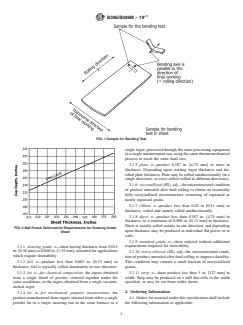
1.2.1 The ball punch deformation test called for in 8.4 is a test that is specified in the inch-pound system, and original test results used to produce Fig. 2 were all obtained using inch-pound measurements. For this reason, the graph of minimum required cup height as a function of sheet thickness has been retained in its original inch-pound system. The graphical data has been scanned and a straight line fitted to the scan data. The equation of this line is included in both inch-pound and SI units.
1.3 The following precautionary caveat pertains only to the test method portions of this specification: This standard does not purport to address all of the safety concerns, if any, associated with its use. It is the responsibility of the user of this standard to establish appropriate safety, health, and environmental practices and determine the applicability of regulatory limitations prior to use.
1.4 This international standard was developed in accordance with internationally recognized principles on standardization established in the Decision on Principles for the Development of International Standards, Guides and Recommendations issued by the World Trade Organization Technical Barriers to Trade (TBT) Committee.
- Status
- Published
- Publication Date
- 31-Oct-2019
- Technical Committee
- B10 - Reactive and Refractory Metals and Alloys
- Drafting Committee
- B10.04 - Molybdenum and Tungsten
Overview
ASTM B386/B386M-19e1 is the international standard specification developed by ASTM for molybdenum and molybdenum alloy plate, sheet, strip, foil, and ribbon. This standard outlines the requirements for six key material compositions, including unalloyed and alloyed vacuum arc-cast and powder metallurgy molybdenum grades. The specification covers materials used in demanding applications where high performance, uniform quality, and reliable properties are critical, such as in high-temperature, electrical, and industrial equipment.
Conformance to ASTM B386/B386M is essential for assuring that molybdenum mill products meet rigorous chemical, mechanical, and dimensional requirements, thus supporting consistent performance and safety in various industrial sectors.
Key Topics
- Material Coverage: Specifies requirements for unalloyed molybdenum and molybdenum alloys (grades 360, 361, 363, 364, 365, and 366), including notable alloys such as TZM (titanium-zirconium-molybdenum) and molybdenum-tungsten.
- Product Forms: Applies to plate, sheet, strip, foil, and ribbon, each defined by precise thickness, width, and processing techniques.
- Manufacturing Methods:
- Vacuum arc-melting for grades 360, 365, 363, and 366
- Powder metallurgy consolidation for grades 361 and 364
- Chemical Composition: Includes limits for elements such as carbon, oxygen, nitrogen, iron, nickel, silicon, titanium, tungsten, and zirconium to ensure product purity.
- Mechanical Properties: Requires conformance to key metrics including tensile strength, yield strength, elongation, and bend radius, as well as thermal stability under specified test conditions.
- Testing and Inspection: Outlines methods for sampling, mechanical testing (e.g., tension and bend tests), and check analysis to ensure specification adherence.
- Certification and Marking: Includes documentation and traceability requirements, marking methods, and package marking for safe handling and identification.
Applications
Materials conforming to ASTM B386/B386M are used in a wide range of high-demand applications, benefiting from molybdenum’s excellent high-temperature strength, corrosion resistance, and stability. Key applications include:
- Aerospace and Defense: Structural and thermal management components exposed to extreme environments.
- Electronics and Electrical: Contacts, heat sinks, and supports in vacuum furnaces, lighting, and semiconductor manufacturing.
- Metallurgical Processing: Hot zone components and fixtures for sintering, annealing, or thermal processing.
- Medical Devices: Shields, diagnostics, and high-performance parts requiring corrosion-resistance and biocompatibility.
- Chemical Processing Equipment: Reactor parts, valves, and pump components exposed to corrosive agents and high temperatures.
Compliance with ASTM B386/B386M ensures manufacturers and end-users alike receive materials manufactured to globally recognized quality standards, supporting safety, reliability, and efficient operation in mission-critical environments.
Related Standards
Users of ASTM B386/B386M may also reference or be subject to the following related ASTM standards for product performance and testing:
- ASTM E8/E8M - Test Methods for Tension Testing of Metallic Materials
- ASTM E92 - Test Methods for Vickers Hardness and Knoop Hardness of Metallic Materials
- ASTM E345 - Test Methods of Tension Testing of Metallic Foil
- ASTM E384 - Test Method for Microindentation Hardness of Materials
- ASTM E643 - Test Method for Ball Punch Deformation of Metallic Sheet Material
- ASTM E1941 - Test Method for Determination of Carbon in Refractory and Reactive Metals and Their Alloys by Combustion Analysis
Adhering to these standards in conjunction with ASTM B386/B386M promotes consistency, comparability, and trust throughout the molybdenum supply chain, from producers and fabricators to end users in technology and industry.
Relations
- Effective Date
- 01-Nov-2019
- Effective Date
- 01-Jan-2024
- Effective Date
- 15-Jul-2016
- Effective Date
- 01-May-2015
- Effective Date
- 01-Nov-2013
- Effective Date
- 01-Dec-2010
- Effective Date
- 01-Feb-2010
- Effective Date
- 01-Feb-2010
- Effective Date
- 01-May-2009
- Effective Date
- 01-Oct-2008
- Effective Date
- 01-May-2008
- Effective Date
- 15-Mar-2008
- Effective Date
- 15-Mar-2008
- Effective Date
- 01-Jan-2008
- Effective Date
- 15-Dec-2007
Get Certified
Connect with accredited certification bodies for this standard

Element Materials Technology
Materials testing and product certification.

Inštitut za kovinske materiale in tehnologije
Institute of Metals and Technology. Materials testing, metallurgical analysis, NDT.
Sponsored listings
Frequently Asked Questions
ASTM B386/B386M-19e1 is a technical specification published by ASTM International. Its full title is "Standard Specification for Molybdenum and Molybdenum Alloy Plate,<brk/>Sheet, Strip, Foil, and Ribbon". This standard covers: ABSTRACT This specification covers unalloyed molybdenum and molybdenum alloy plate, sheet, strip, and foil as follows: Molybdenum 360; Molybdenum 361; Molybdenum Alloy 363; Molybdenum Alloy 364; Molybdenum 365; and Molybdenum Alloy 366. The various molybdenum mill products covered by this specification shall be formed with the conventional extrusion, forging, or rolling equipment normally found in primary ferrous and nonferrous plants. The ingot metal for Molybdenum 360 and 365 and Molybdenum Alloys 363 and 366 is vacuum arc-melted in furnaces of a type suitable for reactive, refractory metals. For Molybdenum 361 and Molybdenum Alloy 364, the metal is consolidated by powder metallurgy methods. The molybdenum and molybdenum alloy ingots and billets for conversion to finished products covered by this specification shall conform to the chemical composition requirements for carbon, oxygen, nitrogen, iron, nickel, silicon, titanium, tungsten, zirconium, and molybdenum. The material shall conform to the mechanical property requirements for tensile strength, yield strength, elongation, and minimum bend radius. SCOPE 1.1 This specification covers unalloyed molybdenum and molybdenum alloy plate, sheet, strip, foil, and ribbon as follows: 1.1.1 Molybdenum 360—Unalloyed vacuum arc-cast molybdenum. 1.1.2 Molybdenum 361—Unalloyed powder metallurgy molybdenum. 1.1.3 Molybdenum Alloy 363—Vacuum arc-cast molybdenum-0.5 % titanium-0.1 % zirconium (TZM) alloy. 1.1.4 Molybdenum Alloy 364—Powder metallurgy molybdenum-0.5 % titanium-0.1 % zirconium (TZM) alloy. 1.1.5 Molybdenum 365—Unalloyed vacuum arc-cast molybdenum, low carbon. 1.1.6 Molybdenum Alloy 366—Vacuum arc-cast molybdenum-30 % tungsten alloy. 1.1.7 Drawing Grade—A drawing grade is defined, which may be specified as a separate requirement by the purchaser. 1.2 Units—The values stated in either SI units or inch-pound units are to be regarded separately as standard. The values stated in each system are not necessarily exact equivalents; therefore, to ensure conformance with the standard, each system shall be used independently of the other, and values from the two systems shall not be combined. 1.2.1 The ball punch deformation test called for in 8.4 is a test that is specified in the inch-pound system, and original test results used to produce Fig. 2 were all obtained using inch-pound measurements. For this reason, the graph of minimum required cup height as a function of sheet thickness has been retained in its original inch-pound system. The graphical data has been scanned and a straight line fitted to the scan data. The equation of this line is included in both inch-pound and SI units. 1.3 The following precautionary caveat pertains only to the test method portions of this specification: This standard does not purport to address all of the safety concerns, if any, associated with its use. It is the responsibility of the user of this standard to establish appropriate safety, health, and environmental practices and determine the applicability of regulatory limitations prior to use. 1.4 This international standard was developed in accordance with internationally recognized principles on standardization established in the Decision on Principles for the Development of International Standards, Guides and Recommendations issued by the World Trade Organization Technical Barriers to Trade (TBT) Committee.
ABSTRACT This specification covers unalloyed molybdenum and molybdenum alloy plate, sheet, strip, and foil as follows: Molybdenum 360; Molybdenum 361; Molybdenum Alloy 363; Molybdenum Alloy 364; Molybdenum 365; and Molybdenum Alloy 366. The various molybdenum mill products covered by this specification shall be formed with the conventional extrusion, forging, or rolling equipment normally found in primary ferrous and nonferrous plants. The ingot metal for Molybdenum 360 and 365 and Molybdenum Alloys 363 and 366 is vacuum arc-melted in furnaces of a type suitable for reactive, refractory metals. For Molybdenum 361 and Molybdenum Alloy 364, the metal is consolidated by powder metallurgy methods. The molybdenum and molybdenum alloy ingots and billets for conversion to finished products covered by this specification shall conform to the chemical composition requirements for carbon, oxygen, nitrogen, iron, nickel, silicon, titanium, tungsten, zirconium, and molybdenum. The material shall conform to the mechanical property requirements for tensile strength, yield strength, elongation, and minimum bend radius. SCOPE 1.1 This specification covers unalloyed molybdenum and molybdenum alloy plate, sheet, strip, foil, and ribbon as follows: 1.1.1 Molybdenum 360—Unalloyed vacuum arc-cast molybdenum. 1.1.2 Molybdenum 361—Unalloyed powder metallurgy molybdenum. 1.1.3 Molybdenum Alloy 363—Vacuum arc-cast molybdenum-0.5 % titanium-0.1 % zirconium (TZM) alloy. 1.1.4 Molybdenum Alloy 364—Powder metallurgy molybdenum-0.5 % titanium-0.1 % zirconium (TZM) alloy. 1.1.5 Molybdenum 365—Unalloyed vacuum arc-cast molybdenum, low carbon. 1.1.6 Molybdenum Alloy 366—Vacuum arc-cast molybdenum-30 % tungsten alloy. 1.1.7 Drawing Grade—A drawing grade is defined, which may be specified as a separate requirement by the purchaser. 1.2 Units—The values stated in either SI units or inch-pound units are to be regarded separately as standard. The values stated in each system are not necessarily exact equivalents; therefore, to ensure conformance with the standard, each system shall be used independently of the other, and values from the two systems shall not be combined. 1.2.1 The ball punch deformation test called for in 8.4 is a test that is specified in the inch-pound system, and original test results used to produce Fig. 2 were all obtained using inch-pound measurements. For this reason, the graph of minimum required cup height as a function of sheet thickness has been retained in its original inch-pound system. The graphical data has been scanned and a straight line fitted to the scan data. The equation of this line is included in both inch-pound and SI units. 1.3 The following precautionary caveat pertains only to the test method portions of this specification: This standard does not purport to address all of the safety concerns, if any, associated with its use. It is the responsibility of the user of this standard to establish appropriate safety, health, and environmental practices and determine the applicability of regulatory limitations prior to use. 1.4 This international standard was developed in accordance with internationally recognized principles on standardization established in the Decision on Principles for the Development of International Standards, Guides and Recommendations issued by the World Trade Organization Technical Barriers to Trade (TBT) Committee.
ASTM B386/B386M-19e1 is classified under the following ICS (International Classification for Standards) categories: 77.150.99 - Other products of non-ferrous metals. The ICS classification helps identify the subject area and facilitates finding related standards.
ASTM B386/B386M-19e1 has the following relationships with other standards: It is inter standard links to ASTM B386/B386M-19, ASTM E345-24, ASTM E345-16, ASTM E643-15, ASTM E345-93(2013)e1, ASTM E1941-10, ASTM E384-10e1, ASTM E384-10, ASTM E384-09, ASTM E29-08, ASTM E345-93(2008), ASTM E384-08ae1, ASTM E384-08a, ASTM E384-08, ASTM E384-07a. Understanding these relationships helps ensure you are using the most current and applicable version of the standard.
ASTM B386/B386M-19e1 is available in PDF format for immediate download after purchase. The document can be added to your cart and obtained through the secure checkout process. Digital delivery ensures instant access to the complete standard document.
Standards Content (Sample)
This international standard was developed in accordance with internationally recognized principles on standardization established in the Decision on Principles for the
Development of International Standards, Guides and Recommendations issued by the World Trade Organization Technical Barriers to Trade (TBT) Committee.
´1
Designation:B386/B386M −19
Standard Specification for
Molybdenum and Molybdenum Alloy Plate,
Sheet, Strip, Foil, and Ribbon
This standard is issued under the fixed designation B386/B386M; the number immediately following the designation indicates the year
of original adoption or, in the case of revision, the year of last revision. A number in parentheses indicates the year of last reapproval.
A superscript epsilon (´) indicates an editorial change since the last revision or reapproval.
ε NOTE—An editorial correction was made to Table 4 in January 2020.
1. Scope 1.3 The following precautionary caveat pertains only to the
test method portions of this specification: This standard does
1.1 This specification covers unalloyed molybdenum and
not purport to address all of the safety concerns, if any,
molybdenum alloy plate, sheet, strip, foil, and ribbon as
associated with its use. It is the responsibility of the user of this
follows:
standard to establish appropriate safety, health, and environ-
1.1.1 Molybdenum 360—Unalloyed vacuum arc-cast mo-
mental practices and determine the applicability of regulatory
lybdenum.
limitations prior to use.
1.1.2 Molybdenum 361—Unalloyed powder metallurgy mo-
1.4 This international standard was developed in accor-
lybdenum.
dance with internationally recognized principles on standard-
1.1.3 Molybdenum Alloy 363—Vacuum arc-cast molybde-
ization established in the Decision on Principles for the
num-0.5 % titanium-0.1 % zirconium (TZM) alloy.
Development of International Standards, Guides and Recom-
1.1.4 Molybdenum Alloy 364—Powder metallurgy molyb-
mendations issued by the World Trade Organization Technical
denum-0.5 % titanium-0.1 % zirconium (TZM) alloy.
Barriers to Trade (TBT) Committee.
1.1.5 Molybdenum 365—Unalloyed vacuum arc-cast
molybdenum, low carbon.
2. Referenced Documents
1.1.6 Molybdenum Alloy 366—Vacuum arc-cast molybde-
2.1 ASTM Standards:
num-30 % tungsten alloy.
E8 Test Methods for Tension Testing of Metallic Materials
1.1.7 Drawing Grade—A drawing grade is defined, which
[Metric] E0008_E0008M
may be specified as a separate requirement by the purchaser.
E29 Practice for Using Significant Digits in Test Data to
1.2 Units—The values stated in either SI units or inch-
Determine Conformance with Specifications
pound units are to be regarded separately as standard. The
E92 Test Methods for Vickers Hardness and Knoop Hard-
values stated in each system are not necessarily exact equiva-
ness of Metallic Materials
lents; therefore, to ensure conformance with the standard, each
E345 Test Methods of Tension Testing of Metallic Foil
system shall be used independently of the other, and values
E384 Test Method for Microindentation Hardness of Mate-
from the two systems shall not be combined.
rials
1.2.1 The ball punch deformation test called for in 8.4 is a
E643 Test Method for Ball Punch Deformation of Metallic
test that is specified in the inch-pound system, and original test
Sheet Material
results used to produce Fig. 2 were all obtained using inch-
E1941 Test Method for Determination of Carbon in Refrac-
pound measurements. For this reason, the graph of minimum
tory and Reactive Metals andTheirAlloys by Combustion
required cup height as a function of sheet thickness has been
Analysis
retained in its original inch-pound system. The graphical data
has been scanned and a straight line fitted to the scan data. The 3. Terminology
equation of this line is included in both inch-pound and SI
3.1 Definitions of Terms Specific to This Standard (Note that
units.
definitions reflect varying nomenclature from producer to
producer, and are not necessarily exclusive, for example,
sheet/ribbon/strip; foil/ribbon/strip):
This specification is under the jurisdiction of ASTM Committee B10 on
Reactive and Refractory Metals and Alloys and is the direct responsibility of
Subcommittee B10.04 on Molybdenum and Tungsten. For referenced ASTM standards, visit the ASTM website, www.astm.org, or
Current edition approved Nov. 1, 2019. Published December 2019. Originally contact ASTM Customer Service at service@astm.org. For Annual Book of ASTM
approved in 1991. Last previous edition approved in 2011 as B386 – 03 (2011). Standards volume information, refer to the standard’s Document Summary page on
DOI: 10.1520/B0386_B0386M-19E01. theASTM website.
Copyright © ASTM International, 100 Barr Harbor Drive, PO Box C700, West Conshohocken, PA 19428-2959. United States
´1
B386/B386M−19
FIG. 1Sample for Bending Test
single ingot, processed through the same processing equipment
inasingleuninterruptedrun,usingthesamethermomechanical
process to reach the same final size.
3.1.5 plate, n—product 0.187 in. [4.75 mm] or more in
thickness. Depending upon starting ingot thickness and fin-
ished plate thickness, Plate may be rolled unidirectionally (in a
single direction), or cross-rolled (rolled in different directions).
3.1.6 recrystallized (RX), adj—themicrostructuralcondition
of product annealed after final rolling to obtain an essentially
fully recrystallized microstructure consisting of equiaxed or
nearly equiaxed grains.
3.1.7 ribbon, n—product less than 0.02 in [0.51 mm] in
thickness, coiled and mainly rolled unidirectionally.
3.1.8 sheet, n—product less than 0.187 in. [4.75 mm] in
thickness, to a minimum of 0.005 in. [0.13 mm] in thickness.
Sheet is usually rolled mainly in one direction, and depending
FIG. 2Ball Punch Deformation Requirements for Drawing Grade
upon thickness may be produced as individual flat pieces or in
Sheet
coils.
3.1.9 standard grade, n—sheet ordered without additional
3.1.1 drawing grade, n—sheet having thickness from 0.015 requirements imposed for drawability.
in. [0.38 mm] to 0.060 in. [1.52 mm], intended for applications
3.1.10 stress relieved (SR), adj—the microstructural condi-
which require drawability.
tion of product annealed after final rolling to improve ductility.
3.1.2 foil, n—product less than 0.005 in. [0.13 mm] in This condition may contain a small fraction of recrystallized
thickness; foil is typically rolled dominantly in one direction. grains.
3.1.3 lot, n—for chemical composition, the ingots obtained 3.1.11 strip, n—sheet product less than 5 in. [127 mm] in
width. Strip may be produced on a mill that rolls to the width
from a single blend of powder, sintered together under the
same conditions, or the ingots obtained from a single vacuum- specified, or may be cut from wider sheets.
melted ingot.
4. Ordering Information
3.1.4 lot, n—for mechanical property measurement, the
product manufactured from ingots sintered from either a single 4.1 Orders for material under this specification shall include
powder lot in a single sintering run in the same furnace or a the following information as applicable:
´1
B386/B386M−19
TABLE 2 Permissible Variations in Check Analysis
4.1.1 Material number and temper designation (Sections 1
and 3), Check Permissible
Analysis Variations
4.1.2 Product form and grade (Section 3),
Material No.
Limits, in Check
4.1.3 Chemical requirements (Section 6, Table 1, and Table
max or range, % Analysis, %
2),
C 361, 365 0.010 +0.002
360, 366 0.030 +0.005
4.1.4 Mechanical requirements (Section 8, Table 3, Fig. 1,
360, 364 0.010–0.040 ±0.005
and Fig. 2),
360, 365 0.0020 +10 % relative
4.1.5 Thermal stability (Section 9 and Table 4),
361 0.0070 +10 % relative
363 0.0030 +10 % relative
4.1.6 Tolerances (Section 10, Table 5 and Fig. 3),
364 0.050 +10 % relative
4.1.7 Workmanship, finish, and appearance (Section 11),
366 0.0025 +10 % relative
4.1.8 Sampling (Section 12),
N 360, 361, 363, 364, 365, 366 0.0020 +0.0005
Fe 360, 361, 363, 364, 365, 366 0.010 +10 % relative
4.1.9 Rejection and disposition of rejected material (Section
Ni 360, 363, 365, 366 0.002 +10 % relative
13),
361, 364 0.005 +10 % relative
4.1.10 Certification and reports (Section 14),
Si 360, 361, 363, 364, 365, 366 0.010 +0.002
Ti 363, 364 0.40–0.55 ±0.05
4.1.11 Marking (Section 15), and
W 366 27.0–33.0 ±1.0
4.1.12 Packaging and package marking (Section 16)
Zr 363, 364 0.06–0.12 ±0.02
5. Materials and Manufacture
6.4 The chemical composition enumerated in this specifica-
5.1 The various molybdenum mill products covered by this
tionshall in case of disagreement, be determinedin accordance
specification shall be processed with the conventional
with methods of analysis mutually agreed upon by the manu-
extrusion, forging, or rolling equipment normally found in
facturer and the purchaser.
primary ferrous and nonferrous plants. The ingot metal for
Molybdenum 360 and 365 and Molybdenum Alloys 363 and
6.5 Check Analysis:
366 are vacuum arc-melted in furnaces of a type suitable for
6.5.1 Checkanalysisisananalysismadebythepurchaseror
reactive, refractory metals. Molybdenum 361 and Molybde-
the manufacturer of the metal after it has been processed into
num Alloy 364 are consolidated by powder metallurgy meth-
finished mill forms, either for the purpose of verifying the
ods.
composition of a heat or lot, or to determine variations in the
composition within a heat or lot.
6. Chemical Composition
6.5.2 Checkanalysistolerancesdonotbroadenthespecified
heat analysis requirements but cover variations between labo-
6.1 The molybdenum and molybdenum alloy ingots and
ratories in the measurement of chemical content.
billets for conversion to finished products covered by this
6.5.3 Check analysis limits shall be as specified in Table 2.
specification shall conform to the requirements of the chemical
composition prescribed in Table 1.
7. Metallurgical Condition
6.2 The manufacturer shall not ship material that is outside
7.1 Products shall be furnished in the wrought and stress
the limits specified in Table 1 for the applicable type.
relieved condition unless otherwise stated on the purchase
6.3 Analysis may be made using the manufacturer’s stan-
order.
dard methods. If there is any question relating to the sampling
8. Mechanical Properties
technique or the analysis of the sample, the methods of
sampling and analysis shall be as agreed upon between the 8.1 Material supplied under this specification shall conform
purchaser and the manufacturer. to the mechanical property requirements given in Table 3,
TABLE 1 Chemical Requirements
NOTE 1—By agreement between purchaser and supplier, analysis may be required and limits established for elements or compounds not specified in
the table of chemical composition.
Composition, wt. %
Element Material Number
360 361 363 364 365 366
C 0.030 max 0.010 max 0.010–0.030 0.010–0.040 0.010 max 0.030 max
O, max 0.0020 0.0070 0.0030 0.050 0.0020 0.0025
N, max 0.002 0.002 0.002 0.002 0.002 0.002
Fe, max 0.010 0.010 0.010 0.010 0.010 0.010
Ni, max 0.002 0.005 0.002 0.005 0.002 0.002
Si, max 0.010 0.010 0.010 0.005 0.010 0.010
Ti . . 0.40–0.55 0.40–0.55 . .
W . . . . . 27–33
Zr . . 0.06–0.12 0.06–0.12 . .
Mo balance balance balance balance balance balance
´1
B386/B386M−19
TABLE 3 Mechanical Requirements, When Tested Between 65 and 85°F [18 and 29°C]
A A
Yield Elonga-
A
Tensile
Minimum
Strength tionin2
Temper Strength,
Type Thickness, in. [mm] 0.2 % Offset, in. [50 Bend Ra-
min, ksi
Condition
min, mm], min,
dius
[MPa]
ksi [MPa] %
360, 361, 365 SR to 0.001 [0.025] 115 [790] 95 [660] 1 .
over 0.001 to 0.002 [0.025 to 0.051] 115 [790] 95 [660] 2 .
over 0.002 to 0.003 [0.051 to 0.076] 115 [790] 95 [660] 3 .
over 0.003 to 0.005 [0.076 to 0.127] 115 [790] 95 [660] 4 .
B
over 0.005 to 0.010 [0.127 to 0.254] 110 [760] 90 [620] 5 2t
over 0.010 to 0.02
...