

ASTM C51-23
(Terminology)Standard Terminology Relating to Lime and Limestone (as Used by the Industry)
General Information
- Abstract
SCOPE
1.1 This terminology refers to the terms relating to lime and limestone products as used by the industry.
1.2 Where appropriate, the various terms defined below should be prefixed with one or other of the adjectives “high-calcium,” “magnesian,” or “dolomitic.” (Examples: dolomitic quicklime; high-calcium hydraulic hydrated lime; magnesian or dolomitic limestone.)
1.3 The composition of a limestone should be given in terms of a percentage of the carbonates present. In limestone of interest to the lime industry, it is usually assumed that the material consists almost entirely of carbonates. Where this assumption is not valid, the percentage of noncarbonate material should be determined, and the composition expressed in terms of the carbonate material present.
1.4 For specific application of lime or a limestone product, see the appropriate ASTM specification.
1.5 This international standard was developed in accordance with internationally recognized principles on standardization established in the Decision on Principles for the Development of International Standards, Guides and Recommendations issued by the World Trade Organization Technical Barriers to Trade (TBT) Committee.
- Status
- Published
- Publication Date
- 30-Sep-2023
- Technical Committee
- C07 - Lime and Limestone
- Drafting Committee
- C07.08 - Editorial and Terminology


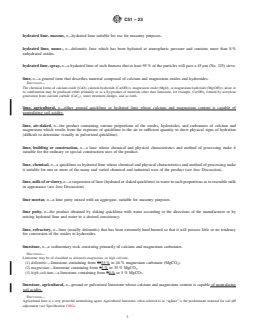
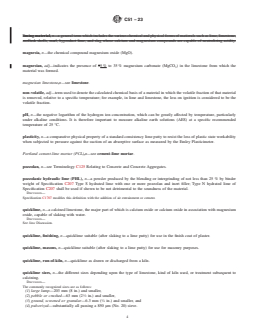
Overview
ASTM C51-23, Standard Terminology Relating to Lime and Limestone (as Used by the Industry), provides a comprehensive set of standardized terms and definitions for lime and limestone products widely used across various industries. Developed by ASTM International, this standard enables consistent communication and understanding throughout the lime and limestone supply chain, supporting product specification, quality assessment, regulatory compliance, and trade. Its terminology covers both traditional and emerging uses, ensuring relevance to current industry practices.
The scope of ASTM C51-23 specifically encompasses terminology related to the types, composition, and characteristics of lime and limestone materials. Where necessary, it directs users to apply qualifiers such as “high-calcium,” “magnesian,” or “dolomitic” to reflect the chemical makeup of products. This facilitates accurate product identification, selection, and compliance with technical requirements.
Key Topics
ASTM C51-23 addresses essential aspects of lime and limestone, including:
Material Types and Composition
- Definitions for high-calcium, magnesian, and dolomitic lime and limestone.
- Guidance on expressing composition, especially carbonate content.
Product Forms and Processing
- Clarification of terms for quicklime, hydrated lime, slaked or air-slaked lime, lime putty, and agricultural lime.
- Distinctions between primary and by-product lime materials, as well as specific processing techniques (e.g., dead burned dolomite).
Functional and Application-Specific Terminology
- Terms for products used in construction (building lime), in agriculture (agricultural limestone, aglime), and in chemical processes (chemical lime).
- Definitions related to properties such as reactivity, plasticity, and slaking behavior.
Special Additives and Blends
- Terminology for blended or modified products, such as pozzolanic hydraulic lime and cement-lime mortars.
- Reference to particle size classifications for quicklime and lime-based products.
Applications
The standardized terminology defined in ASTM C51-23 is critical across a variety of practical applications, including:
Construction and Building Materials
- Ensures the correct identification and specification of hydrated lime, quicklime, lime putty, and related products in mortar, plaster, and stucco systems.
- Facilitates compliance with quality standards and enhances performance in masonry, finishing, and structural applications.
Agriculture
- Supports proper selection and usage of agricultural lime (aglime) for soil pH management and crop yield optimization.
Industrial and Chemical Manufacturing
- Standardizes the use of lime and limestone in steel, glass, water treatment, and environmental applications, including as fluxing agents or pH adjusters.
Trade and Regulatory Compliance
- Assures national and international buyers and sellers of standardized naming conventions for product documentation, contracts, and customs.
Related Standards
ASTM C51-23 is used in conjunction with several other important ASTM standards and specifications, such as:
- ASTM C207 - Specification for Hydrated Lime for Masonry Purposes
- ASTM C602 - Specification for Agricultural Liming Materials
- ASTM C1707 - Specification for Pozzolanic Hydraulic Lime for Structural Purposes
- ASTM C270 - Specification for Mortar for Unit Masonry
- ASTM C125 - Terminology Relating to Concrete and Concrete Aggregates
These related standards provide detailed requirements for specific lime products, materials, and their uses in applications referenced by ASTM C51-23.
Keywords: ASTM C51-23, lime terminology, limestone terminology, high-calcium lime, magnesian lime, dolomitic limestone, hydrated lime, quicklime, lime standards, limestone specifications, building lime, agricultural lime, ASTM standards.
Relations
- Effective Date
- 01-Oct-2023
- Effective Date
- 01-May-2020
- Effective Date
- 01-May-2019
- Effective Date
- 01-Oct-2023
- Referred By
ASTM C25-19 - Standard Test Methods for Chemical Analysis of Limestone, Quicklime, and Hydrated Lime - Effective Date
- 01-Oct-2023
- Effective Date
- 01-Oct-2023
- Effective Date
- 01-Oct-2023
- Effective Date
- 01-Oct-2023
- Effective Date
- 01-Oct-2023
- Effective Date
- 01-Oct-2023
- Effective Date
- 01-Oct-2023
- Effective Date
- 01-Oct-2023
- Effective Date
- 01-Oct-2023
- Effective Date
- 01-Oct-2023
- Effective Date
- 01-Oct-2023
Get Certified
Connect with accredited certification bodies for this standard

DIBt (Deutsches Institut für Bautechnik)
German Institute for Building Technology.
DIN CERTCO
DIN Group product certification.

Aboma Certification B.V.
Specialized in construction, metal, and transport sectors.
Sponsored listings
Frequently Asked Questions
ASTM C51-23 is a standard published by ASTM International. Its full title is "Standard Terminology Relating to Lime and Limestone (as Used by the Industry)". This standard covers: SCOPE 1.1 This terminology refers to the terms relating to lime and limestone products as used by the industry. 1.2 Where appropriate, the various terms defined below should be prefixed with one or other of the adjectives “high-calcium,” “magnesian,” or “dolomitic.” (Examples: dolomitic quicklime; high-calcium hydraulic hydrated lime; magnesian or dolomitic limestone.) 1.3 The composition of a limestone should be given in terms of a percentage of the carbonates present. In limestone of interest to the lime industry, it is usually assumed that the material consists almost entirely of carbonates. Where this assumption is not valid, the percentage of noncarbonate material should be determined, and the composition expressed in terms of the carbonate material present. 1.4 For specific application of lime or a limestone product, see the appropriate ASTM specification. 1.5 This international standard was developed in accordance with internationally recognized principles on standardization established in the Decision on Principles for the Development of International Standards, Guides and Recommendations issued by the World Trade Organization Technical Barriers to Trade (TBT) Committee.
SCOPE 1.1 This terminology refers to the terms relating to lime and limestone products as used by the industry. 1.2 Where appropriate, the various terms defined below should be prefixed with one or other of the adjectives “high-calcium,” “magnesian,” or “dolomitic.” (Examples: dolomitic quicklime; high-calcium hydraulic hydrated lime; magnesian or dolomitic limestone.) 1.3 The composition of a limestone should be given in terms of a percentage of the carbonates present. In limestone of interest to the lime industry, it is usually assumed that the material consists almost entirely of carbonates. Where this assumption is not valid, the percentage of noncarbonate material should be determined, and the composition expressed in terms of the carbonate material present. 1.4 For specific application of lime or a limestone product, see the appropriate ASTM specification. 1.5 This international standard was developed in accordance with internationally recognized principles on standardization established in the Decision on Principles for the Development of International Standards, Guides and Recommendations issued by the World Trade Organization Technical Barriers to Trade (TBT) Committee.
ASTM C51-23 is classified under the following ICS (International Classification for Standards) categories: 01.040.91 - Construction materials and building (Vocabularies); 91.100.10 - Cement. Gypsum. Lime. Mortar. The ICS classification helps identify the subject area and facilitates finding related standards.
ASTM C51-23 has the following relationships with other standards: It is inter standard links to ASTM C51-21, ASTM C602-20, ASTM C270-19ae1, ASTM C593-19, ASTM C25-19, ASTM C737-22, ASTM C1489-15(2022), ASTM C602-23, ASTM C1529-19, ASTM C1797-23, ASTM C1097-19, ASTM C1164-22, ASTM C219-20a, ASTM C150/C150M-22, ASTM C706-19. Understanding these relationships helps ensure you are using the most current and applicable version of the standard.
ASTM C51-23 is available in PDF format for immediate download after purchase. The document can be added to your cart and obtained through the secure checkout process. Digital delivery ensures instant access to the complete standard document.
Standards Content (Sample)
This international standard was developed in accordance with internationally recognized principles on standardization established in the Decision on Principles for the
Development of International Standards, Guides and Recommendations issued by the World Trade Organization Technical Barriers to Trade (TBT) Committee.
Designation: C51 − 23
Standard Terminology Relating to
Lime and Limestone (as Used by the Industry)
This standard is issued under the fixed designation C51; the number immediately following the designation indicates the year of original
adoption or, in the case of revision, the year of last revision. A number in parentheses indicates the year of last reapproval. A superscript
epsilon (´) indicates an editorial change since the last revision or reapproval.
This standard has been approved for use by agencies of the U.S. Department of Defense.
1. Scope* C602 Specification for Agricultural Liming Materials
C1707 Specification for Pozzolanic Hydraulic Lime for
1.1 This terminology refers to the terms relating to lime and
Structural Purposes
limestone products as used by the industry.
1.2 Where appropriate, the various terms defined below
3. Terminology
should be prefixed with one or other of the adjectives “high-
calcium,” “magnesian,” or “dolomitic.” (Examples: dolomitic alkaline earth solutions (AES), n—an aqueous solution of the
oxide or hydroxide of an element of group IIa in the periodic
quicklime; high-calcium hydraulic hydrated lime; magnesian
or dolomitic limestone.) table, such as calcium or magnesium, which can be strongly
alkaline.
1.3 The composition of a limestone should be given in terms
of a percentage of the carbonates present. In limestone of
available lime index, n—those constituents of a lime which
interest to the lime industry, it is usually assumed that the
enter into a desired reaction under the conditions of a
material consists almost entirely of carbonates. Where this
specific method or process.
assumption is not valid, the percentage of noncarbonate mate-
by-product lime, n—a variety of calcium or calcium/
rial should be determined, and the composition expressed in
magnesium compounds, or both, that are usable for specific
terms of the carbonate material present.
applications but generally do not meet one or more specifi-
1.4 For specific application of lime or a limestone product,
cations required of primary lime products.
see the appropriate ASTM specification.
DISCUSSION—Examples include lime kiln dust and lime hydrator
1.5 This international standard was developed in accor-
rejects. It is advised that the specific compositions, physical properties,
performance characteristics, and anticipated variabilities of such mate-
dance with internationally recognized principles on standard-
rials be evaluated for the service intended.
ization established in the Decision on Principles for the
Development of International Standards, Guides and Recom-
calcareous, adj—originating from predominately calcium car-
mendations issued by the World Trade Organization Technical
bonate or one of its derivative forms.
Barriers to Trade (TBT) Committee.
calcia, n—the chemical compound calcium oxide (CaO).
2. Referenced Documents
cement-lime mortar, n—cement-lime mortar primarily con-
2.1 ASTM Standards:
sists of hydraulic cement, hydrated lime or lime putty,
C125 Terminology Relating to Concrete and Concrete Ag-
mason’s sand and water.
gregates
DISCUSSION—These mortars can be specified by proportions or
C207 Specification for Hydrated Lime for Masonry Pur-
properties indicated in Specification C270.
poses
dead burned dolomite, n—dolomitic limestone that has been
C270 Specification for Mortar for Unit Masonry
heated with or without additives to a temperature sufficiently
high and for a long enough time to decompose the carbonate
1 structure so as to form calcium oxide and periclase in a
This terminology is under the jurisdiction of ASTM Committee C07 on Lime
and Limestone and is the direct responsibility of Subcommittee C07.08 on Editorial matrix that provides resistance to subsequent hydration and
and Terminology.
recombination with carbon dioxide.
Current edition approved Oct. 1, 2023. Published October 2023. Originally
approved in 1922. Last previous edition approved in 2021 as C51 – 21. DOI:
dolomitic, adj—indicates the presence of 35 % to 46 % mag-
10.1520/C0051-23.
nesium carbonate (MgCO ) in the limestone from which the
For referenced ASTM standards, visit the ASTM website, www.astm.org, or
contact ASTM Customer Service at service@astm.org. For Annual Book of ASTM material was formed.
Standards volume information, refer to the standard’s Document Summary page on
the ASTM website. dolomitic limestone, n—see limestone.
*A Summary of Changes section appears at the end of this standard
Copyright © ASTM International, 100 Barr Harbor Drive, PO Box C700, West Conshohocken, PA 19428-2959. United States
C51 − 23
fluxing lime, n—a term referring to quicklime used as an agent lime, building or construction, n—a lime whose chemical and
in the manufacture of steel or glass. physical characteristics and method of processing make it
suitable for the ordinary or special construction uses of the
fluxstone, n—a term referring to limestone (high-calcium,
product.
magnesian, or dolomitic) used as an agent in the manufac-
lime, chemical, n—a quicklime or hydrated lime whose
ture of iron and steel or glass.
chemical and physical characteristics and method of process-
high-calcium, adj—indicates the presence of 0 % to 5 %
ing make it suitable for one or more of the many and varied
magnesium carbonate (MgCO ) in the limestone from which
chemical and industrial uses of the product (see lime
the material was formed.
Discussion).
high-calcium limestone, n—see limestone.
lime, milk of or slurry, n—a suspension of lime (hydrated or
hydrated lime, n—a dry powder obtained by treating quick-
slaked quicklime) in water in such proportions as to re-
lime with water enough to satisfy its chemical affinity for
semble milk in appearance (see lime Discussion).
water under the conditions of its hydration.
lime mortar, n—a lime putty mixed with an aggregate, suitable
DISCUSSION—Hydrated lime consists essentially of calcium hydrox-
for masonry purposes.
ide or a mixture of calcium hydroxide and magnesium hydroxide, or
both (see lime Discussion).
lime putty, n—the product obtained by slaking quicklime with
water according to the directions of the manufacturer or by
hydrated lime, di-hydrated or double, n—dolomitic lime
mixing hydrated lime and water to a desired consistency.
which has been hydrated under greater than atmospheric
pressure and contains less than 8 % unhydrated oxides.
lime, refractory, n—lime (usually dolomitic) that has been
extremely hard burned so that it will possess little or no
hydrated lime, finishing, n—hydrated lime suitable for use in
tendency for conversion of the oxides to hydroxides.
the finish coat of plaster.
limestone, n—a sedimentary rock consisting primarily of
hydrated lime, h
...
This document is not an ASTM standard and is intended only to provide the user of an ASTM standard an indication of what changes have been made to the previous version. Because
it may not be technically possible to adequately depict all changes accurately, ASTM recommends that users consult prior editions as appropriate. In all cases only the current version
of the standard as published by ASTM is to be considered the official document.
Designation: C51 − 21 C51 − 23
Standard Terminology Relating to
Lime and Limestone (as Used by the Industry)
This standard is issued under the fixed designation C51; the number immediately following the designation indicates the year of original
adoption or, in the case of revision, the year of last revision. A number in parentheses indicates the year of last reapproval. A superscript
epsilon (´) indicates an editorial change since the last revision or reapproval.
This standard has been approved for use by agencies of the U.S. Department of Defense.
1. Scope*
1.1 This terminology refers to the terms relating to lime and limestone products as used by the industry.
1.2 Where appropriate, the various terms defined below should be prefixed with one or other of the adjectives “high-calcium,”
“magnesian,” or “dolomitic.” (Examples: dolomitic quicklime; high-calcium hydraulic hydrated lime; magnesian or dolomitic
limestone.)
1.3 The composition of a limestone should be given in terms of a percentage of the carbonates present. In limestone of interest
to the lime industry, it is usually assumed that the material consists almost entirely of carbonates. Where this assumption is not
valid, the percentage of noncarbonate material should be determined, and the composition expressed in terms of the carbonate
material present.
1.4 For specific application of lime or a limestone product, see the appropriate ASTM specification.
1.5 This international standard was developed in accordance with internationally recognized principles on standardization
established in the Decision on Principles for the Development of International Standards, Guides and Recommendations issued
by the World Trade Organization Technical Barriers to Trade (TBT) Committee.
2. Referenced Documents
2.1 ASTM Standards:
C125 Terminology Relating to Concrete and Concrete Aggregates
C207 Specification for Hydrated Lime for Masonry Purposes
C270 Specification for Mortar for Unit Masonry
C602
C1707 Specification for Pozzolanic Hydraulic Lime for Structural Purposes
3. Terminology
alkaline earth solutions (AES), n—an aqueous solution of the oxide or hydroxide of an element of group IIa in the periodic
table, such as calcium or magnesium, which can be strongly alkaline.
This terminology is under the jurisdiction of ASTM Committee C07 on Lime and Limestone and is the direct responsibility of Subcommittee C07.08 on Editorial and
Terminology.
Current edition approved June 15, 2021Oct. 1, 2023. Published July 2021October 2023. Originally approved in 1922. Last previous edition approved in 20202021 as
C51 – 20.C51 – 21. DOI: 10.1520/C0051-21.10.1520/C0051-23.
For referenced ASTM standards, visit the ASTM website, www.astm.org, or contact ASTM Customer Service at service@astm.org. For Annual Book of ASTM Standards
volume information, refer to the standard’s Document Summary page on the ASTM website.
*A Summary of Changes section appears at the end of this standard
Copyright © ASTM International, 100 Barr Harbor Drive, PO Box C700, West Conshohocken, PA 19428-2959. United States
C51 − 23
available lime index, n—those constituents of a lime which enter into a desired reaction under the conditions of a specific
method or process.
by-product lime, n—a variety of calcium or calcium/magnesium compounds, or both, that are usable for specific applications
but generally do not meet one or more specifications required of primary lime products.
DISCUSSION—
Examples include lime kiln dust and lime hydrator rejects. It is advised that the specific compositions, physical properties, performance characteristics,
and anticipated variabilities of such materials be evaluated for the service intended.
calcareous, adj—originating from predominately calcium carbonate or one of its derivative forms.
calcia, n—the chemical compound calcium oxide (CaO).
cement-lime mortar, n—cement-lime mortar primarily consists of hydraulic cement, hydrated lime or lime putty, mason’s sand
and water.
DISCUSSION—
These mortars can be specified by proportions or properties indicated in Specification C270.
dead burned dolomite, n—dolomitic limestone that has been heated with or without additives to a temperature sufficiently high
and for a long enough time to decompose the carbonate structure so as to form calcium oxide and periclase in a matrix that
provides resistance to subsequent hydration and recombination with carbon dioxide.
dolomitic, adj—indicates the presence of 3535 % to 46 % magnesium carbonate (MgCO ) in the limestone from which the
material was formed.
dolomitic limestone,n—see limestone.
fluxing lime, n—a term referring to quicklime used as an agent in the manufacture of steel or glass.
fluxstone, n—a term referring to limestone (high-calcium, magnesian, or dolomitic) used as an agent in the manufacture of iron
and steel or glass.
high-calcium, adj—indicates the presence of 00 % to 5 % magnesium carbonate (MgCO ) in the limestone from which the
material was formed.
high-calcium limestone,n—see limestone.
hydrated lime, n—a dry powder obtained by treating quicklime with water enough to satisfy its chemical affinity for water under
the conditions of its hydration.
DISCUSSION—
Hydrated lime consists essentially of calcium hydroxide or a mixture of calcium hydroxide and magnesium hydroxide, or both (see lime Discussion).
hydrated lime, di-hydrated or double, n—dolomitic lime which has been hydrated under greater than atmospheric pressure and
contains less than 8 % unhydrated oxides.
hydrated lime, finishing, n—hydrated lime suitable for use in the finish coat of plaster.
hydrated lime, hydraulic, n—the hydrated dry cementitious product obtained by calcining a limestone containing silica and
alumina to a temperature short of incipient fusion so as to form sufficient free lime (CaO) to permit hydration, and at the same
time, leaving unhydrated sufficient calcium silicates to give a dry powder meeting hydraulic property requirements.
C51 − 23
hydrated lime, masons, n—hydrated lime suitable for use for masonry purposes.
hydrated lime, mono-, n—dolomitic lime which has been hydrated at atmospheric pressure and contains more than 8 %
unhydrated oxides.
hydrated lime, spray, n—a hydrated lime of such fineness that at least 95 % of the particles will pass a 45 μm (No. 325) sieve.
lime, n—a general term that describes material composed of calcium and magnesium oxides and hydroxides.
DISCUSSION—
The chemical forms of calcium oxide (CaO), calcium hydroxide (Ca(OH) ), magnesium oxide (MgO), or magnesium hydroxide (Mg(OH) ) alone or
2 2
in combination may be produced either primarily or as a by-product of materials other than limestone, for example, Ca(OH) formed by acetylene
generation from calcium carbide (CaC ), water treatment sludges, and so forth.
lime, agricultural, n—either ground quicklime or hydrated lime whose calcium and magnesium content is capable of
neutralizing soil acidity.
lime, air-slaked, n—the pro
...