

ASTM C1797-23a
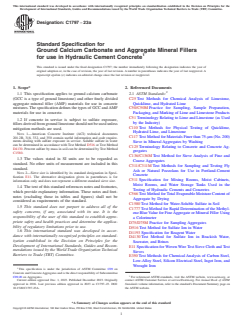
(Specification)Standard Specification for Ground Calcium Carbonate and Aggregate Mineral Fillers for use in Hydraulic Cement Concrete
General Information
- Abstract
ABSTRACT
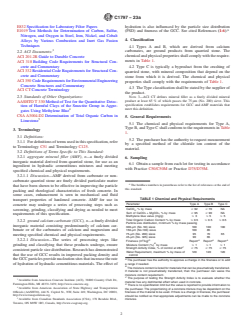
This specification covers ground calcium carbonate (GCC, a type of ground limestone) and other finely divided aggregate mineral filler (AMF) materials for use in concrete mixtures. It defines the types of GCC and AMF materials for use in concrete. If concrete in service is subject to sulfate exposure, fillers derived from ground limestone should not be used unless mitigation methods are used.
SIGNIFICANCE AND USE
A1.3 Significance and Use
A1.3.1 This test method provides analytical procedures to determine the major chemical constituents of limestone (see Note 1). The percentages of specific constituents that determine a material’s quality or fitness for use are of significance depending upon the purpose or end use of the material. Results obtained may be used in relation to specification requirements.
Note A1.1: This test method can be applied to other calcareous materials if provisions are made to compensate for known interferences.
SCOPE
1.1 This specification applies to ground calcium carbonate (GCC is a type of ground limestone) and other finely divided aggregate mineral filler (AMF) materials for use in concrete mixtures. The specification defines the types of GCC and AMF materials for use in concrete.
1.2 If concrete in service is subject to sulfate exposure, fillers derived from ground limestone should not be used unless mitigation methods are used.
Note 1: American Concrete Institute (ACI) technical documents 201.2R, 318, 332, and 350 contain useful information and code requirements dealing with sulfate exposure in service. Soluble sulfate in water can be determined in accordance with Test Method D516 or Test Method D4130. Percent sulfate by mass in soil can be determined by Test Method C1580.
1.3 The values stated in SI units are to be regarded as standard. No other units of measurement are included in this standard.
Note 2: Sieve size is identified by its standard designation in Specification E11. The alternative designation given in parentheses is for information only and does not represent a different standard sieve size.
1.4 The text of this standard references notes and footnotes, which provide explanatory information. These notes and footnotes (excluding those in tables and figures) shall not be considered as requirements of the standard.
1.5 This standard does not purport to address all of the safety concerns, if any, associated with its use. It is the responsibility of the user of this standard to establish appropriate safety and health practices and determine the applicability of regulatory limitations prior to use.
1.6 This international standard was developed in accordance with internationally recognized principles on standardization established in the Decision on Principles for the Development of International Standards, Guides and Recommendations issued by the World Trade Organization Technical Barriers to Trade (TBT) Committee.
- Status
- Published
- Publication Date
- 30-Nov-2023
- Technical Committee
- C09 - Concrete and Concrete Aggregates
- Drafting Committee
- C09.20 - Aggregates
Buy Documents
ASTM C1797-23a - Standard Specification for Ground Calcium Carbonate and Aggregate Mineral Fillers for use in Hydraulic Cement Concrete
REDLINE ASTM C1797-23a - Standard Specification for Ground Calcium Carbonate and Aggregate Mineral Fillers for use in Hydraulic Cement Concrete
Overview
ASTM C1797-23a is the international standard specification for the use of ground calcium carbonate (GCC) and aggregate mineral fillers (AMF) as ingredients in hydraulic cement concrete. Developed by ASTM International, this standard establishes requirements for the types, chemical composition, and physical properties of finely divided GCC and other aggregate mineral fillers intended to enhance concrete properties and performance. The standard ensures that these materials are suitable for use in a variety of concrete applications, provided their use does not negatively affect durability-especially where sulfate exposure is concerned.
Key Topics
Material Types and Definitions
- GCC is a finely divided inorganic material, primarily composed of calcium carbonate, produced via grinding and classification processes.
- AMF refers to finely divided mineral fillers derived from quarried stone, both carbonate and non-carbonate, meeting specified chemical and physical criteria for use in hydraulic cement mixtures.
Chemical and Physical Requirements
- Materials must comply with stringent limits for parameters such as calcium carbonate content, total organic carbon, and particle size distribution.
- Strength Activity Index, methylene blue value, moisture content, and water requirement are important indicators of performance and suitability.
Sulfate Exposure Risk
- The standard cautions that GCC (or ground limestone) fillers should not be used in environments where concrete is exposed to sulfates unless appropriate mitigation methods are implemented, referencing best practices from ACI and ASTM methods.
Testing and Certification
- Details are provided for sampling, test methodology, and certification to confirm compliance, enabling clear communication and quality assurance between material suppliers and purchasers.
Packaging and Traceability
- Clear requirements for packaging and product marking help ensure traceability and proper identification in supply chains.
Applications
ASTM C1797-23a is critically relevant for professionals involved in concrete formulation, materials supply, and construction where the use of mineral fillers improves concrete performance or economy. Applications include:
Ready-Mix and Precast Concrete
Utilization of GCC and AMF can improve particle packing, workability, and finish of fresh concrete, and may enhance durability and mechanical properties of hardened concrete.Sustainable Construction
By partially replacing other cementitious materials, compliant GCC and mineral fillers contribute to reduced clinker content and lower carbon footprint in concrete production.Infrastructure Projects
Use in roads, bridges, and environmental engineering structures, provided adherence to specifications regarding sulfate resistance where required.Quality Assurance in Procurement
Producers and buyers of concrete materials can use this standard to specify and verify the quality and fitness-for-use of mineral fillers, relying on defined testing protocols and certification procedures.
Related Standards
For effective implementation and to ensure compatibility with other requirements, ASTM C1797-23a references and aligns with a range of important standards and guidelines, including:
ASTM Test Methods and Practices
- C25: Chemical Analysis of Limestone
- C110: Physical Testing of Quicklime, Hydrated Lime, and Limestone
- C117, C136: Sieve Analysis Methods
- C311: Fly Ash or Natural Pozzolan Testing
- C566: Moisture Content of Aggregates
American Concrete Institute (ACI) Documents
- ACI 201.2R, 318, 332, 350 for sulfate exposure and structural codes
Other Relevant Documents
- AASHTO T330, CSA A3004-D2 for additional test methods and filler definitions
- ASTM E11: Standard for Sieve Cloth and Test Sieves
Practical Value
Complying with ASTM C1797-23a ensures the proper selection, testing, and application of ground calcium carbonate and mineral fillers in hydraulic cement concrete. This not only safeguards performance and durability, but also supports regulatory compliance, quality consistency, and sustainable construction practices.
Keywords: ground calcium carbonate, GCC, mineral fillers, aggregate mineral filler, hydraulic cement concrete, ASTM C1797-23a, concrete additives, sulfate resistance, limestone filler, concrete standards.
Relations
- Effective Date
- 01-Dec-2023
- Effective Date
- 01-Jan-2024
- Effective Date
- 15-Nov-2023
- Effective Date
- 15-Nov-2023
- Effective Date
- 01-Feb-2022
- Refers
ASTM C25-19 - Standard Test Methods for Chemical Analysis of Limestone, Quicklime, and Hydrated Lime - Effective Date
- 01-May-2019
- Effective Date
- 01-May-2019
- Effective Date
- 15-Mar-2018
- Effective Date
- 01-Aug-2017
- Effective Date
- 01-Feb-2015
- Effective Date
- 01-Dec-2023
- Effective Date
- 01-Dec-2023
Buy Documents
ASTM C1797-23a - Standard Specification for Ground Calcium Carbonate and Aggregate Mineral Fillers for use in Hydraulic Cement Concrete
REDLINE ASTM C1797-23a - Standard Specification for Ground Calcium Carbonate and Aggregate Mineral Fillers for use in Hydraulic Cement Concrete
Get Certified
Connect with accredited certification bodies for this standard

DIBt (Deutsches Institut für Bautechnik)
German Institute for Building Technology.
DIN CERTCO
DIN Group product certification.

Aboma Certification B.V.
Specialized in construction, metal, and transport sectors.
Sponsored listings
Frequently Asked Questions
ASTM C1797-23a is a technical specification published by ASTM International. Its full title is "Standard Specification for Ground Calcium Carbonate and Aggregate Mineral Fillers for use in Hydraulic Cement Concrete". This standard covers: ABSTRACT This specification covers ground calcium carbonate (GCC, a type of ground limestone) and other finely divided aggregate mineral filler (AMF) materials for use in concrete mixtures. It defines the types of GCC and AMF materials for use in concrete. If concrete in service is subject to sulfate exposure, fillers derived from ground limestone should not be used unless mitigation methods are used. SIGNIFICANCE AND USE A1.3 Significance and Use A1.3.1 This test method provides analytical procedures to determine the major chemical constituents of limestone (see Note 1). The percentages of specific constituents that determine a material’s quality or fitness for use are of significance depending upon the purpose or end use of the material. Results obtained may be used in relation to specification requirements. Note A1.1: This test method can be applied to other calcareous materials if provisions are made to compensate for known interferences. SCOPE 1.1 This specification applies to ground calcium carbonate (GCC is a type of ground limestone) and other finely divided aggregate mineral filler (AMF) materials for use in concrete mixtures. The specification defines the types of GCC and AMF materials for use in concrete. 1.2 If concrete in service is subject to sulfate exposure, fillers derived from ground limestone should not be used unless mitigation methods are used. Note 1: American Concrete Institute (ACI) technical documents 201.2R, 318, 332, and 350 contain useful information and code requirements dealing with sulfate exposure in service. Soluble sulfate in water can be determined in accordance with Test Method D516 or Test Method D4130. Percent sulfate by mass in soil can be determined by Test Method C1580. 1.3 The values stated in SI units are to be regarded as standard. No other units of measurement are included in this standard. Note 2: Sieve size is identified by its standard designation in Specification E11. The alternative designation given in parentheses is for information only and does not represent a different standard sieve size. 1.4 The text of this standard references notes and footnotes, which provide explanatory information. These notes and footnotes (excluding those in tables and figures) shall not be considered as requirements of the standard. 1.5 This standard does not purport to address all of the safety concerns, if any, associated with its use. It is the responsibility of the user of this standard to establish appropriate safety and health practices and determine the applicability of regulatory limitations prior to use. 1.6 This international standard was developed in accordance with internationally recognized principles on standardization established in the Decision on Principles for the Development of International Standards, Guides and Recommendations issued by the World Trade Organization Technical Barriers to Trade (TBT) Committee.
ABSTRACT This specification covers ground calcium carbonate (GCC, a type of ground limestone) and other finely divided aggregate mineral filler (AMF) materials for use in concrete mixtures. It defines the types of GCC and AMF materials for use in concrete. If concrete in service is subject to sulfate exposure, fillers derived from ground limestone should not be used unless mitigation methods are used. SIGNIFICANCE AND USE A1.3 Significance and Use A1.3.1 This test method provides analytical procedures to determine the major chemical constituents of limestone (see Note 1). The percentages of specific constituents that determine a material’s quality or fitness for use are of significance depending upon the purpose or end use of the material. Results obtained may be used in relation to specification requirements. Note A1.1: This test method can be applied to other calcareous materials if provisions are made to compensate for known interferences. SCOPE 1.1 This specification applies to ground calcium carbonate (GCC is a type of ground limestone) and other finely divided aggregate mineral filler (AMF) materials for use in concrete mixtures. The specification defines the types of GCC and AMF materials for use in concrete. 1.2 If concrete in service is subject to sulfate exposure, fillers derived from ground limestone should not be used unless mitigation methods are used. Note 1: American Concrete Institute (ACI) technical documents 201.2R, 318, 332, and 350 contain useful information and code requirements dealing with sulfate exposure in service. Soluble sulfate in water can be determined in accordance with Test Method D516 or Test Method D4130. Percent sulfate by mass in soil can be determined by Test Method C1580. 1.3 The values stated in SI units are to be regarded as standard. No other units of measurement are included in this standard. Note 2: Sieve size is identified by its standard designation in Specification E11. The alternative designation given in parentheses is for information only and does not represent a different standard sieve size. 1.4 The text of this standard references notes and footnotes, which provide explanatory information. These notes and footnotes (excluding those in tables and figures) shall not be considered as requirements of the standard. 1.5 This standard does not purport to address all of the safety concerns, if any, associated with its use. It is the responsibility of the user of this standard to establish appropriate safety and health practices and determine the applicability of regulatory limitations prior to use. 1.6 This international standard was developed in accordance with internationally recognized principles on standardization established in the Decision on Principles for the Development of International Standards, Guides and Recommendations issued by the World Trade Organization Technical Barriers to Trade (TBT) Committee.
ASTM C1797-23a is classified under the following ICS (International Classification for Standards) categories: 91.100.15 - Mineral materials and products; 91.100.30 - Concrete and concrete products. The ICS classification helps identify the subject area and facilitates finding related standards.
ASTM C1797-23a has the following relationships with other standards: It is inter standard links to ASTM C1797-23, ASTM C311/C311M-24, ASTM E350-23, ASTM C117-23, ASTM C311/C311M-22, ASTM C25-19, ASTM C25-19e1, ASTM E350-18, ASTM C117-17, ASTM D4130-15, ASTM E3355-23, ASTM C94/C94M-23. Understanding these relationships helps ensure you are using the most current and applicable version of the standard.
ASTM C1797-23a is available in PDF format for immediate download after purchase. The document can be added to your cart and obtained through the secure checkout process. Digital delivery ensures instant access to the complete standard document.
Standards Content (Sample)
This international standard was developed in accordance with internationally recognized principles on standardization established in the Decision on Principles for the
Development of International Standards, Guides and Recommendations issued by the World Trade Organization Technical Barriers to Trade (TBT) Committee.
Designation: C1797 − 23a
Standard Specification for
Ground Calcium Carbonate and Aggregate Mineral Fillers
for use in Hydraulic Cement Concrete
This standard is issued under the fixed designation C1797; the number immediately following the designation indicates the year of
original adoption or, in the case of revision, the year of last revision. A number in parentheses indicates the year of last reapproval. A
superscript epsilon (´) indicates an editorial change since the last revision or reapproval.
1. Scope* 2. Referenced Documents
1.1 This specification applies to ground calcium carbonate 2.1 ASTM Standards:
(GCC is a type of ground limestone) and other finely divided C25 Test Methods for Chemical Analysis of Limestone,
aggregate mineral filler (AMF) materials for use in concrete Quicklime, and Hydrated Lime
mixtures. The specification defines the types of GCC and AMF C50/C50M Practice for Sampling, Sample Preparation,
materials for use in concrete. Packaging, and Marking of Lime and Limestone Products
C51 Terminology Relating to Lime and Limestone (as Used
1.2 If concrete in service is subject to sulfate exposure,
by the Industry)
fillers derived from ground limestone should not be used unless
C110 Test Methods for Physical Testing of Quicklime,
mitigation methods are used.
Hydrated Lime, and Limestone
NOTE 1—American Concrete Institute (ACI) technical documents
C117 Test Method for Materials Finer than 75-μm (No. 200)
201.2R, 318, 332, and 350 contain useful information and code require-
ments dealing with sulfate exposure in service. Soluble sulfate in water
Sieve in Mineral Aggregates by Washing
can be determined in accordance with Test Method D516 or Test Method
C125 Terminology Relating to Concrete and Concrete Ag-
D4130. Percent sulfate by mass in soil can be determined by Test Method
gregates
C1580.
C136/C136M Test Method for Sieve Analysis of Fine and
1.3 The values stated in SI units are to be regarded as
Coarse Aggregates
standard. No other units of measurement are included in this
C311/C311M Test Methods for Sampling and Testing Fly
standard.
Ash or Natural Pozzolans for Use in Portland-Cement
NOTE 2—Sieve size is identified by its standard designation in Speci-
Concrete
fication E11. The alternative designation given in parentheses is for
C511 Specification for Mixing Rooms, Moist Cabinets,
information only and does not represent a different standard sieve size.
Moist Rooms, and Water Storage Tanks Used in the
1.4 The text of this standard references notes and footnotes,
Testing of Hydraulic Cements and Concretes
which provide explanatory information. These notes and foot-
C566 Test Method for Total Evaporable Moisture Content of
notes (excluding those in tables and figures) shall not be
Aggregate by Drying
considered as requirements of the standard.
C1580 Test Method for Water-Soluble Sulfate in Soil
1.5 This standard does not purport to address all of the
C1777 Test Method for Rapid Determination of the Methyl-
safety concerns, if any, associated with its use. It is the
ene Blue Value for Fine Aggregate or Mineral Filler Using
responsibility of the user of this standard to establish appro-
a Colorimeter
priate safety and health practices and determine the applica-
D75/D75M Practice for Sampling Aggregates
bility of regulatory limitations prior to use.
D516 Test Method for Sulfate Ion in Water
1.6 This international standard was developed in accor-
D1193 Specification for Reagent Water
dance with internationally recognized principles on standard-
D4130 Test Method for Sulfate Ion in Brackish Water,
ization established in the Decision on Principles for the
Seawater, and Brines
Development of International Standards, Guides and Recom-
E11 Specification for Woven Wire Test Sieve Cloth and Test
mendations issued by the World Trade Organization Technical
Sieves
Barriers to Trade (TBT) Committee.
E350 Test Methods for Chemical Analysis of Carbon Steel,
Low-Alloy Steel, Silicon Electrical Steel, Ingot Iron, and
Wrought Iron
This specification is under the jurisdiction of ASTM Committee C09 on
Concrete and Concrete Aggregates and is the direct responsibility of Subcommittee
C09.20 on Aggregates. For referenced ASTM standards, visit the ASTM website, www.astm.org, or
Current edition approved Dec. 1, 2023. Published December 2023. Originally contact ASTM Customer Service at service@astm.org. For Annual Book of ASTM
approved in 2016. Last previous edition approved in 2023 as C1797–23. DOI: Standards volume information, refer to the standard’s Document Summary page on
10.1520/C1797-23A. the ASTM website.
*A Summary of Changes section appears at the end of this standard
Copyright © ASTM International, 100 Barr Harbor Drive, PO Box C700, West Conshohocken, PA 19428-2959. United States
C1797 − 23a
E832 Specification for Laboratory Filter Papers hydration is also influenced by the particle size distribution
E1019 Test Methods for Determination of Carbon, Sulfur, (PSD) and fineness of the GCC. See cited References (1-6).
Nitrogen, and Oxygen in Steel, Iron, Nickel, and Cobalt
4. Classification
Alloys by Various Combustion and Inert Gas Fusion
Techniques
4.1 Types A and B, which are derived from calcium
carbonates, are ground products from quarried stone. The
2.2 ACI Documents:
chemical and physical properties shall comply with the require-
ACI 201.2R Guide to Durable Concrete
ments in Table 1.
ACI 318 Building Code Requirements for Structural Con-
crete and Commentary
4.2 Type C is typically a byproduct from the crushing of
ACI 332 Residential Code Requirements for Structural Con-
quarried stone, with mineral composition that depend on the
crete and Commentary
stone from which it is derived. The chemical and physical
ACI 350 Code Requirements for Environmental Engineering
properties shall comply with the requirements of Table 1.
Concrete Structures and Commentary
4.3 The Type classification shall be stated by the supplier of
ACI CT Concrete Terminology
the product.
2.3 Standards of Other Organizations:
NOTE 3—ACI CT defines mineral filler as a finely divided mineral
product at least 65 % of which passes the 75 μm (No. 200) sieve. This
AASHTO T 330 Method of Test for the Quantitative Detec-
specification establishes requirements for GCC and AMF materials that
tion of Harmful Clays of the Smectite Group in Aggre-
meet this definition.
gates Using Methylene Blue
CSA A3004-D2 Determination of Total Organic Carbon in
5. General Requirements
Limestone
5.1 The chemical and physical requirements for Type A,
Type B, and Type C shall conform to the requirements in Table
3. Terminology
1.
3.1 Definitions:
5.2 The purchaser has the authority to request measurement
3.1.1 For definitions of terms used in this specification, refer
by a specified method of the chloride ion content of the
to Terminology C51 and Terminology C125.
material.
3.2 Definitions of Terms Specific to This Standard:
3.2.1 aggregate mineral filler (AMF), n—a finely divided
6. Sampling
inorganic material derived from quarried stone, for use as an
6.1 Obtain a sample from each lot for testing in accordance
ingredient in hydraulic cementitious mixtures and meeting
with Practice C50/C50M or Practice D75/D75M.
specified chemical and physical requirements.
3.2.1.1 Discussion—AMF derived from carbonate or non-
carbonate quarried stone are finely divided particulate matter
The boldface numbers in parentheses refer to the list of references at the end of
that have been shown to be effective in improving the particle
this standard.
packing and rheological characteristics of fresh concrete. In
some cases, enhancement is seen in mechanical and fluid
TABLE 1 Chemical and Physical Requirements
transport properties of hardened concrete. AMF for use in
Parameter Type A Type B Type C
concrete may undergo a series of processing steps such as
CaCO , % by mass $ 92 $ 70 NA
screening, grinding, classifying and drying as needed to meet 3
Sum of CaCO + MgCO , % by mass $ 95 $ 90 NA
3 3
requirements of this specification.
Methylene blue value (mg/g) # 3 # 5 # 5
Total Organic Carbon Content % by mass # 0.5 # 0.5 # 0.5
3.2.2 ground calcium carbonate (GCC), n—a finely divided
Particle size distribution, minimum % by mass passing
inorganic material consisting predominantly of calcium car-
300-μm (No. 50) sieve 100 100 100
bonate or of the carbonates of calcium and magnesium and 150-μm (No.100) sieve 100 85
75-μm (No. 200) sieve 95 70 65
meeting specified chemical and physical requirements.
45-μm (No. 325) sieve 90 65
2 D A A A
3.2.2.1 Discussion—The series of processing steps like
Fineness (m /kg) Report Report Report
B
Moisture Content (%) by mass # 1 # 1 # 1
grinding and classifying that these products undergo, ensure
C
Strength Activity Index, % of control at 28d $ 75 $ 75 $ 75
consistent particle size distribution. Research has demonstrated
Water Requirement, maximum % by mass of 120 120 120
that the use of GCC results in improved packing density and
control
the GCC particles provide nucleation sites that increase the rate A
The purchaser has the authority to approve a change in the fineness or to add
of hydration of hydraulic cementitious materials. The effect of a range if needed.
B
The moisture content is listed for materials that can be pneumatically transferred.
If material is not pneumatically transferred, then the purchaser can waive the
moisture content requirement.
C
The purpose of testing the Strength Activity Index is to evaluate whether the
Available from American Concrete Institute (ACI), 38800 Country Club Dr.,
material has any detrimental effect when used in concrete.
Farmington Hills, MI 48331-3439, http://www.concrete.org. D
There is no specification limit but the value is reported to provide information to
Available from American Association of State Highway and Transportation
the purchaser. The proportioning of a concrete mixture may be dependent on the
Officials (AASHTO), 444 N. Capitol St., NW, Suite 249, Washington, DC 20001,
fineness of the material to be used. If there is a change in fineness, the purchaser
http://www.transportation.org.
should be notified so that appropriate adjustments can be made to the concrete
Available from Canadian Standards Association (CSA), 178 Rexdale Blvd.,
mixtures.
Toronto, ON M9W 1R3, Canada, http://www.csagroup.org.
C1797 − 23a
7. Test Methods 9. Rejection
9.1 The purchaser has the right to reject material that fails to
7.1 Calcium carbonate and magnesium carbonate content –
conform to the requirements of this specification. Rejection
Test Methods C25 or Annex A1.
shall be reported to the producer or supplier in writing.
7.2 Methylene Blue Value – AASHTO T330 or Test Method
C1777.
10. Packaging and Package Marking
7.3 Total Organic Carbon (TOC) Content – Annex A2.
10.1 If the product is delivered in packages, the name of the
manufacturer, Type, and the mass of the material contained
7.4 Particle Size Distribution (PSD) – Test Method C110 for
therein shall be plainly marked on each package. Similar
Types A and B. Test Method C136/C136M and Test Method
information shall be provided in the shipping invoices accom-
C117 for Type C.
panying the packaged or bulk material.
7.5 Strength Activity Index – Test Methods C311/C311M
11. Certification
replacing the mass of pozzolan in the test mixture with GCC or
AMF.
11.1 If specified in the purchase order or contract, the
purchaser shall be furnished certification that samples repre-
7.6 Water requirement – Test Methods C311/C311M.
senting each lot have been tested as directed in this specifica-
7.7 Fineness – Test Methods C110.
tion and the specified requirements have been met. When
specified in the purchase order or contract, a report of the test
7.8 Moisture Content – Test Methods C25 or Test Method
results shall be furnished.
C566.
12. Manufacturer’s Statement
8. Storage and Inspection
12.1 At the request of the purchaser, the manufacturer shall
8.1 Store the product in such a manner as to permit easy
state in writing the mineral origin, nature, amount, and type of
access for proper inspection and identification of each ship-
any processing or other additions made to the product.
ment.
13. Keywords
8.2 Inspection of the material shall be made as agreed upon
by the purchaser and the supplier as part of the purchase order 13.1 aggregate mineral filler; ground calcium carbonate;
or contract. hydraulic cement concrete; limestone; mineral filler
ANNEXES
(Mandatory Information)
A1. CHEMICAL ANALYSIS OF CALCIUM AND MAGNESIUM CARBONATES IN GROUND LIMESTONE
BY EDTA TITRATION
A1.1 Scope
A1.1.1 This test method covers the chemical analysis of A1.3 Significance and Use
high-calcium and dolomitic limestone.
A1.3.1 This test method provides analytical procedures to
determine the major chemical constituents of limestone (see
A1.1.2 The standard test method uses classical gravimetric
Note 1). The percentages of specific constituents that deter-
and volumetric analytical procedures and are typically required
mine a material’s quality or fitness for use are of significance
for referee analyses if conformance with chemical specification
depending upon the purpose or end use of the material. Results
requirements is part of contractual agreement between pur-
obtained may be used in relation to specification requirements.
chaser and producer.
NOTE A1.1—This test method can be applied to other calcareous
A1.1.3 This standard does not purport to address all of the
materials if provisions are made to compensate for known interferences.
safety concerns, if any, associated with its use. It is the
A1.4 Apparatus
responsibility of the user of this standard to establish appro-
priate safety and health practices and determine the applica-
A1.4.1 Balance—The balance shall be of an analytical type
bility of regulatory limitations prior to use.
with a capacity not to exceed 200 g. It may be of conventional
design or it may be a constant-load, direct-reading type. It shall
A1.2 Referenced Documents
be capable of reproducing weighings within 0.0002 g with an
2 accuracy of 60.0002 g.
A1.2.1 ASTM Standards:
D1193 Specification for Reagent Water A1.4.2 Glassware and Laboratory Containers—Standard
E832 Specification for Laboratory Filter Papers volumetric flasks, burets, pipets, dispensers, etc. should be of
C1797 − 23a
precision grade or better (Class A). Polyethylene containers are A1.6.4 Calculations:
recommended for all aqueous solutions of alkalies and for
Mc × P
Calcium carbonate factor, Fc, %⁄mL 5 × 500
standard solutions where the presence of dissolved silica or
V
alkali from the glass would be objectionable.
(A1.1)
A1.4.3 Filter Paper—Filter paper shall conform to the
where:
requirements of Specification E832, Type II, Quantitative,
Mc = mass of ACS grade calcium carbonate,
Class F.
P = purity percentage of ACS grade calcium carbonate,
A1.5 Reagents 99.95 – 100.05, and
V = volume of EDTA to reach end point.
A1.5.1 Purity of Reagents—Reagent grade chemicals shall
be used in all tests. Unless otherwise indicated, it is intended
Magnesium factor, Fm, %⁄mL 5 Fc × 0.84254 (A1.2)
that all reagents conform to the specifications of the Committee
where:
on Analytical Reagents of the American Chemical Society if
Fc = calcium carbonate factor.
such specifications are available. Other grades may be used,
provided it is first ascertained that the reagent is of sufficiently
A1.7 Procedure
high purity to permit its use without lessening the accuracy of
A1.7.1 Weigh a 2.00 g limestone sample and place into a
the determination.
600 mL beaker. Add 50 mL dilute HCl. Cover beaker with
A1.5.2 Purity of Water—Unless otherwise indicated, refer-
watch glass and heat to boiling point. Remove from heat when
ences to water shall be understood to mean reagent water as
the sample goes into solution. Cool to room temperature.
defined by Type I or II of Specification D1193.
NOTE A1.2—Fading end point on dolomites can be lessened by adding
tartrate or a couple drops of triethanolamine.
A1.5.3 Ethylenediaminetetraacetic Acid, EDTA—Dissolve
NOTE A1.3—Interference by iron, copper or other transition elements
18 g of Disodium EDTA in 1 L of water.
can be obviated by addition of 10 mL of 2 % KCN.
A1.5.4 Potassium hydroxide, KOH—Dissolve 56 g of KOH
A1.7.2 Fold filter paper to fit inside glass funnel. Place
in 1 L of water.
funnel with filter paper into a into a 500 mL volumetric flask.
Pour the prepared solution from A1.7.1 through the filter pap
...
This document is not an ASTM standard and is intended only to provide the user of an ASTM standard an indication of what changes have been made to the previous version. Because
it may not be technically possible to adequately depict all changes accurately, ASTM recommends that users consult prior editions as appropriate. In all cases only the current version
of the standard as published by ASTM is to be considered the official document.
Designation: C1797 − 23 C1797 − 23a
Standard Specification for
Ground Calcium Carbonate and Aggregate Mineral Fillers
for use in Hydraulic Cement Concrete
This standard is issued under the fixed designation C1797; the number immediately following the designation indicates the year of
original adoption or, in the case of revision, the year of last revision. A number in parentheses indicates the year of last reapproval. A
superscript epsilon (´) indicates an editorial change since the last revision or reapproval.
1. Scope*
1.1 This specification applies to ground calcium carbonate (GCC is a type of ground limestone) and other finely divided aggregate
mineral filler (AMF) materials for use in concrete mixtures. The specification defines the types of GCC and AMF materials for
use in concrete.
1.2 If concrete in service is subject to sulfate exposure, fillers derived from ground limestone should not be used unless mitigation
methods are used.
NOTE 1—American Concrete Institute (ACI) technical documents 201.2R, 318, 332, and 350 contain useful information and code requirements dealing
with sulfate exposure in service. Soluble sulfate in water can be determined in accordance with Test Method D516 or Test Method D4130. Percent sulfate
by mass in soil can be determined by Test Method C1580.
1.3 The values stated in SI units are to be regarded as standard. No other units of measurement are included in this standard.
NOTE 2—Sieve size is identified by its standard designation in Specification E11. The alternative designation given in parentheses is for information only
and does not represent a different standard sieve size.
1.4 The text of this standard references notes and footnotes, which provide explanatory information. These notes and footnotes
(excluding those in tables and figures) shall not be considered as requirements of the standard.
1.5 This standard does not purport to address all of the safety concerns, if any, associated with its use. It is the responsibility
of the user of this standard to establish appropriate safety and health practices and determine the applicability of regulatory
limitations prior to use.
1.6 This international standard was developed in accordance with internationally recognized principles on standardization
established in the Decision on Principles for the Development of International Standards, Guides and Recommendations issued
by the World Trade Organization Technical Barriers to Trade (TBT) Committee.
2. Referenced Documents
2.1 ASTM Standards:
C25 Test Methods for Chemical Analysis of Limestone, Quicklime, and Hydrated Lime
C50/C50M Practice for Sampling, Sample Preparation, Packaging, and Marking of Lime and Limestone Products
This specification is under the jurisdiction of ASTM Committee C09 on Concrete and Concrete Aggregates and is the direct responsibility of Subcommittee C09.20 on
Aggregates.
Current edition approved Aug. 15, 2023Dec. 1, 2023. Published August 2023December 2023. Originally approved in 2016. Last previous edition approved in 20172023
as C1797–17. DOI: 10.1520/C1797-23.–23. DOI: 10.1520/C1797-23A.
For referenced ASTM standards, visit the ASTM website, www.astm.org, or contact ASTM Customer Service at service@astm.org. For Annual Book of ASTM Standards
volume information, refer to the standard’s Document Summary page on the ASTM website.
*A Summary of Changes section appears at the end of this standard
Copyright © ASTM International, 100 Barr Harbor Drive, PO Box C700, West Conshohocken, PA 19428-2959. United States
C1797 − 23a
C51 Terminology Relating to Lime and Limestone (as Used by the Industry)
C110 Test Methods for Physical Testing of Quicklime, Hydrated Lime, and Limestone
C117 Test Method for Materials Finer than 75-μm (No. 200) Sieve in Mineral Aggregates by Washing
C125 Terminology Relating to Concrete and Concrete Aggregates
C136/C136M Test Method for Sieve Analysis of Fine and Coarse Aggregates
C311/C311M Test Methods for Sampling and Testing Fly Ash or Natural Pozzolans for Use in Portland-Cement Concrete
C511 Specification for Mixing Rooms, Moist Cabinets, Moist Rooms, and Water Storage Tanks Used in the Testing of Hydraulic
Cements and Concretes
C566 Test Method for Total Evaporable Moisture Content of Aggregate by Drying
C595/C595M Specification for Blended Hydraulic Cements
C1580 Test Method for Water-Soluble Sulfate in Soil
C1777 Test Method for Rapid Determination of the Methylene Blue Value for Fine Aggregate or Mineral Filler Using a
Colorimeter
D75/D75M Practice for Sampling Aggregates
D516 Test Method for Sulfate Ion in Water
D1193 Specification for Reagent Water
D4130 Test Method for Sulfate Ion in Brackish Water, Seawater, and Brines
E11 Specification for Woven Wire Test Sieve Cloth and Test Sieves
E350 Test Methods for Chemical Analysis of Carbon Steel, Low-Alloy Steel, Silicon Electrical Steel, Ingot Iron, and Wrought
Iron
E832 Specification for Laboratory Filter Papers
E1019 Test Methods for Determination of Carbon, Sulfur, Nitrogen, and Oxygen in Steel, Iron, Nickel, and Cobalt Alloys by
Various Combustion and Inert Gas Fusion Techniques
2.2 ACI Documents:
ACI 201.2R Guide to Durable Concrete
ACI 318 Building Code Requirements for Structural Concrete and Commentary
ACI 332 Residential Code Requirements for Structural Concrete and Commentary
ACI 350 Code Requirements for Environmental Engineering Concrete Structures and Commentary
ACI CT-13CT Concrete Terminology
2.3 Standards of Other Organizations:
AASHTO T 330 Method of Test for the Quantitative Detection of Harmful Clays of the Smectite Group in Aggregates Using
Methylene Blue
CSA A3004-D2 Determination of Total Organic Carbon in Limestone
3. Terminology
3.1 Definitions:
3.1.1 For definitions of terms used in this specification, refer to Terminology C51 and Terminology C125.
3.2 Definitions of Terms Specific to This Standard:
3.2.1 aggregate mineral filler (AMF), n—a finely divided inorganic material derived from quarried stone, for use as an ingredient
in hydraulic cementitious mixtures and meeting specified chemical and physical requirements.
3.2.1.1 Discussion—
AMF derived from carbonate or non-carbonate quarried stone are finely divided particulate matter that have been shown to be
effective in improving the particle packing and rheological characteristics of fresh concrete. In some cases, enhancement is seen
in mechanical and fluid transport properties of hardened concrete. AMF for use in concrete may undergo a series of processing
steps such as screening, grinding, classifying and drying as needed to meet requirements of this specification.
3.2.2 ground calcium carbonate (GCC), n—a finely divided inorganic material consisting predominantly of calcium carbonate or
of the carbonates of calcium and magnesium and meeting specified chemical and physical requirements.
3.2.2.1 Discussion—
The series of processing steps like grinding and classifying that these products undergo, ensure consistent particle size distribution.
Research has demonstrated that the use of GCC results in improved packing density and the GCC particles provide nucleation sites
Available from American Concrete Institute (ACI), 38800 Country Club Dr., Farmington Hills, MI 48331-3439, http://www.concrete.org.
Available from American Association of State Highway and Transportation Officials (AASHTO), 444 N. Capitol St., NW, Suite 249, Washington, DC 20001,
http://www.transportation.org.
Available from Canadian Standards Association (CSA), 178 Rexdale Blvd., Toronto, ON M9W 1R3, Canada, http://www.csagroup.org.
C1797 − 23a
that increase the rate of hydration of hydraulic cementitious materials. The effect of hydration is also influenced by the particle size
distribution (PSD) and fineness of the GCC. See cited References (1-6).
4. Classification
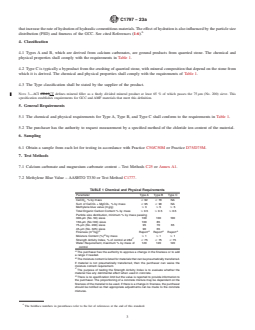
4.1 Types A and B, which are derived from calcium carbonates, are ground products from quarried stone. The chemical and
physical properties shall comply with the requirements in Table 1.
4.2 Type C is typically a byproduct from the crushing of quarried stone, with mineral composition that depend on the stone from
which it is derived. The chemical and physical properties shall comply with the requirements of Table 1.
4.3 The Type classification shall be stated by the supplier of the product.
NOTE 3—ACI CT-13CT defines mineral filler as a finely divided mineral product at least 65 % of which passes the 75 μm (No. 200) sieve. This
specification establishes requirements for GCC and AMF materials that meet this definition.
5. General Requirements
5.1 The chemical and physical requirements for Type A, Type B, and Type C shall conform to the requirements in Table 1.
5.2 The purchaser has the authority to request measurement by a specified method of the chloride ion content of the material.
6. Sampling
6.1 Obtain a sample from each lot for testing in accordance with Practice C50/C50M or Practice D75/D75M.
7. Test Methods
7.1 Calcium carbonate and magnesium carbonate content – Test Methods C25 or Annex A1.
7.2 Methylene Blue Value – AASHTO T330 or Test Method C1777.
TABLE 1 Chemical and Physical Requirements
Parameter Type A Type B Type C
CaCO , % by mass $ 92 $ 70 NA
Sum of CaCO + MgCO , % by mass $ 95 $ 90 NA
3 3
Methylene blue value (mg/g) # 3 # 5 # 5
Total Organic Carbon Content % by mass # 0.5 # 0.5 # 0.5
Particle size distribution, minimum % by mass passing
300-μm (No. 50) sieve 100 100 100
150-μm (No.100) sieve 100 85
75-μm (No. 200) sieve 95 70 65
45-μm (No. 325) sieve 90 65
2 D A A A
Fineness (m /kg) Report Report Report
B
Moisture Content (%) by mass # 1 # 1 # 1
C
Strength Activity Index, % of control at 28d $ 75 $ 75 $ 75
Water Requirement, maximum % by mass of 120 120 120
control
A
The purchaser has the authority to approve a change in the fineness or to add
a range if needed.
B
The moisture content is listed for materials that can be pneumatically transferred.
If material is not pneumatically transferred, then the purchaser can waive the
moisture content requirement.
C
The purpose of testing the Strength Activity Index is to evaluate whether the
material has any detrimental effect when used in concrete.
D
There is no specification limit but the value is reported to provide information to
the purchaser. The proportioning of a concrete mixture may be dependent on the
fineness of the material to be used. If there is a change in fineness, the purchaser
should be notified so that appropriate adjustments can be made to the concrete
mixtures.
The boldface numbers in parentheses refer to the list of references at the end of this standard.
C1797 − 23a
7.3 Total Organic Carbon (TOC) Content – Annex A2Specification .C595/C595M-15 Annex A3.
7.4 Particle Size Distribution (PSD) – Test Method C110 for Types A and B. Test Method C136/C136M and Test Method C117
for Type C.
7.5 Strength Activity Index – Test Methods C311/C311M replacing the mass of pozzolan in the test mixture with GCC or AMF.
7.6 Water requirement – Test Methods C311/C311M.
7.7 Fineness – Test Methods C110.
7.8 Moisture Content – Test Methods C25 or Test Method C566.
8. Storage and Inspection
8.1 Store the product in such a manner as to permit easy access for proper inspection and identification of each shipment.
8.2 Inspection of the material shall be made as agreed upon by the purchaser and the supplier as part of the purchase order or
contract.
9. Rejection
9.1 The purchaser has the right to reject material that fails to conform to the requirements of this specification. Rejection shall be
reported to the producer or supplier in writing.
10. Packaging and Package Marking
10.1 If the product is delivered in packages, the name of the manufacturer, Type, and the mass of the material contained therein
shall be plainly marked on each package. Similar information shall be provided in the shipping invoices accompanying the
packaged or bulk material.
11. Certification
11.1 If specified in the purchase order or contract, the purchaser shall be furnished certification that samples representing each lot
have been tested as directed in this specification and the specified requirements have been met. When specified in the purchase
order or contract, a report of the test results shall be furnished.
12. Manufacturer’s Statement
12.1 At the request of the purchaser, the manufacturer shall state in writing the mineral origin, nature, amount, and type of any
processing or other additions made to the product.
13. Keywords
13.1 aggregate mineral filler; ground calcium carbonate; hydraulic cement concrete; limestone; mineral filler
C1797 − 23a
ANNEXANNEXES
(Mandatory Information)
A1. CHEMICAL ANALYSIS OF CALCIUM AND MAGNESIUM CARBONATES IN GROUND LIMESTONE
BY EDTA TITRATION
A1.1 Scope
A1.1.1 This test method covers the chemical analysis of high-calcium and dolomitic limestone.
A1.1.2 The standard test method uses classical gravimetric and volumetric analytical procedures and are typically required for
referee analyses if conformance with chemical specification requirements is part of contractual agreement between purchaser and
producer.
A1.1.3 This standard does not purport to address all of the safety concerns, if any, associated with its use. It is the responsibility
of the user of this standard to establish appropriate safety and health practices and determine the applicability of regulatory
limitations prior to use.
A1.2 Referenced Documents
A1.2.1 ASTM Standards:
D1193 Specification for Reagent Water
E832 Specification for Laboratory Filter Papers
A1.3. Significance and Use
A1.3.1 This test method provides analytical procedures to determine the major chemical constituents of limestone (see Note 1).
The percentages of specific constituents that determine a material’s quality or fitness for use are of significance depending upon
the purpose or end use of the material. Results obtained may be used in relation to specification requirements.
NOTE A1.1—This test method can be applied to other calcareous materials if provisions are made to compensate for known interferences.
A1.4. Apparatus
A1.4.1 Balance—The balance shall be of an analytical type with a capacity not to exceed 200 g. It may be of conventional design
or it may be a constant-load, direct-reading type. It shall be capable of reproducing weighings within 0.0002 g with an accuracy
of 60.0002 g.
A1.4.2 Glassware and Laboratory Containers—Standard volumetric flasks, burets, pipets, dispensers, etc. should be of precision
grade or better (Class A). Polyethylene containers are recommended for all aqueous solutions of alkalies and for standard solutions
where the presence of dissolved silica or alkali from the glass would be objectionable.
A1.4.3 Filter Paper—Filter paper shall conform to the requirements of Specification E832, Type II, Quantitative, Class F.
A1.5. Reagents
C1797 − 23a
A1.5.1 Purity of Reagents—Reagent grade chemicals shall be used in all tests. Unless otherwise indicated, it is intended that all
reagents conform to the specifications of the Committee on Analytical Reagents of the American Chemical Society if such
specifications are available. Other grades may be used, provided it is first ascertained that the reagent is of sufficiently high purity
to permit its use without lessening the accuracy of the determination.
A1.5.2 Purity of Water—Unless otherwise indicated, references to water shall be understood to mean reagent water as defined by
Type I or II of Specification D1193.
A1.5.3 Ethylenediaminetetraacetic Acid, EDTA—Dissolve 18 g of Disodium EDTA in 1 L of water.
A1.5.4 Potassium hydroxide, KOH—Dissolve 56 g of KOH in 1 L of water.
A1.5.5 Ammonia Buffer—Dissolve 66 g of ammonium chloride, NH Cl, in 300 mL water in a 2 L beaker. Add 560 mL ammonium
hydroxide, NH OH. Transfer to a 1000 mL volumetric flask and make up to volume with water.
A1.5.6 Calcium Carbonate, CaCO —ACS grade, 99.95 – 100.05 % purity, dry basis.
A1.5.7 Dilute Hydrochloric Acid (dilute HCl)—Dilute 1 part of concentrated HCl (12N) into 4 parts of water.
A1.5.8 Hydroxy napthol blue indicator.
A1.5.9 Calmagite (1-(1-hydroxy-4-methyl-2-phenylazo)-2-napthol-4-sulfonic acid) indicator.
A1.6 Standardization of the EDTA Titration Solution
A1.6.1 Weigh out two samples of ACS grade CaCO into 600-mL beakers. Use 0.200 g. Record mass of each sample.
A1.6.2 Add 10 mL water and 5 mL dilute HCl to each beaker with CaCO . Stir solution to disperse CaCO . When CaCO is
3 3 3
dissolved add 285 mL water.
A1.6.3 Fill 50 mL burette with EDTA solution. To prevent precipitation of
...