

ASTM D8215-21
(Practice)Standard Practice for Statistical Modeling of Uncertainty in Assessment of In-place Coal Resources
General Information
- Abstract
SIGNIFICANCE AND USE
5.1 Traditional methods for expressing geological uncertainty consist of preparing reliability categories based simply on the distance between drill hole data points, such as the one described by Wood et al. (5) that uses only the drill holes within the coal bed. A major drawback of distance methods is their weak to null association with estimation errors. This practice provides a methodology for effectively assessing the uncertainty in coal resource estimates utilizing stochastic simulation. In determining uncertainty for any coal assessment, stochastic simulation enables consideration of other important factors and information beyond the geometry of drill hole locations, both in and out of the coal bed, including: non-depositional channels, depth of weathering, complexity of seam boundaries, coal seam subcrop projections, and varying coal bed geology for different seams due to fluctuating peat depositional environments. Olea et al. (6) explains in detail the methodology behind this practice and illustrates it with an example.
5.2 For multi-seam deposits, uncertainty can be expressed on an individual seam basis as well as an aggregated uncertainty for an entire coal deposit.
5.3 The uncertainty is expressed directly in tons of coal. Additionally, this practice allows the statistical analysis to be presented according to widely-accepted conventions, such as percentiles and confidence intervals. For example, there is a 90 % probability that the actual tonnage in place is 314 million metric tons ± 28.8 million metric tons (346 million tons ± 31.7 million tons) of coal.
5.4 The results of an uncertainty determination can provide important input into an overall risk analysis assessing the commercial feasibility of a coal deposit.
5.5 A company may rank coal resources per block (cell) based on the degree of uncertainty.
SCOPE
1.1 This practice covers a procedure for quantitatively determining in-place tonnage uncertainty in a coal resource assessment. The practice uses a database on coal occurrence and applies geostatistical methods to model the uncertainty associated with a tonnage estimated for one or more coal seams. The practice includes instruction for the preparation of results in graphical form.
1.2 This document does not include a detailed presentation of the basic theory behind the formulation of the standard, which can be found in numerous publications, with a selection being given in the references (1-3).2
1.3 This practice should be used in conjunction with professional judgment of the many unique aspects of a coal deposit.
1.4 Units—The values stated in SI units are to be regarded as standard. The values given in parentheses after SI units are provided for information only and are not considered standard.
Note 1: All values given in parentheses after SI units are stated in inch-pound units.
1.5 This standard does not purport to address all of the safety concerns, if any, associated with its use. It is the responsibility of the user of this standard to establish appropriate safety, health, and environmental practices and determine the applicability of regulatory limitations prior to use.
1.6 This international standard was developed in accordance with internationally recognized principles on standardization established in the Decision on Principles for the Development of International Standards, Guides and Recommendations issued by the World Trade Organization Technical Barriers to Trade (TBT) Committee.
- Status
- Published
- Publication Date
- 30-Sep-2021
- Technical Committee
- D05 - Coal and Coke
- Drafting Committee
- D05.07 - Physical Characteristics of Coal
Buy Documents
ASTM D8215-21 - Standard Practice for Statistical Modeling of Uncertainty in Assessment of In-place Coal Resources
REDLINE ASTM D8215-21 - Standard Practice for Statistical Modeling of Uncertainty in Assessment of In-place Coal Resources
Overview
ASTM D8215-21: Standard Practice for Statistical Modeling of Uncertainty in Assessment of In-place Coal Resources establishes a geostatistical methodology for quantitatively determining the uncertainty associated with in-place coal resource estimates. Developed by ASTM International, this practice addresses the limitations of traditional distance-based classification methods, offering advanced probabilistic techniques-such as stochastic simulation-to better assess uncertainties in coal deposits. The standard applies to both single and multi-seam coal deposits and enables the analysis and graphical presentation of uncertainty results, supporting robust coal resource assessment and risk evaluation.
Key Topics
- Geostatistical Methods: Focuses on techniques like kriging and stochastic simulation to model spatial uncertainty, moving beyond simple distance-based reliability classes.
- Comprehensive Data Use: Integrates multiple geologic factors, including non-depositional channels, depth of weathering, seam boundary complexity, and varied basinal environments, not just drill hole spacing.
- Quantitative Uncertainty Expression: Results are expressed directly in tons of coal, allowing assessments using percentiles and confidence intervals commonly used in resource evaluation.
- Cell-Based and Aggregate Analysis: Enables uncertainty evaluation on both the individual block (cell) and total deposit levels, providing detailed breakdowns for commercial and strategic decision-making.
- Risk Analysis Input: The modeled uncertainty statistics are valuable for broader risk analyses concerning the commercial feasibility and development plans for coal deposits.
- Professional Judgment: Stresses the importance of integrating the practice with expert geological evaluation of specific deposit characteristics.
Applications
ASTM D8215-21 is highly applicable across various stages and scales of coal resource evaluation and planning, including:
- Resource Estimation: Geologists and resource analysts can better estimate the quantity and reliability of coal in-place using statistical models that quantify the inherent uncertainty.
- Risk Assessment: Mining companies use the uncertainty results as key input for financial modeling and feasibility studies, enabling more informed decisions on investment and development strategies.
- Ranking and Classification: Allows for ranking coal resources on a block-by-block basis, prioritizing areas with higher confidence in tonnage estimations.
- Strategic Exploration Planning: Informs where additional drilling or sampling can most effectively reduce uncertainty, optimizing exploration budgets.
- Reporting and Compliance: Results visualized as histograms and confidence curves support clear and accepted presentations in technical and regulatory reports.
Related Standards
For a comprehensive approach to spatial modeling and coal resource estimation, users of ASTM D8215-21 should consider the following related ASTM standards and guides:
- ASTM D653: Terminology Relating to Soil, Rock, and Contained Fluids
- ASTM D5549: Guide for Contents of Geostatistical Site Investigation Report
- ASTM D5922: Guide for Analysis, Interpretation, and Modeling of Spatial Variation in Geostatistical Site Investigations
- ASTM D5923: Guide for Selection of Kriging Methods in Geostatistical Site Investigations
- ASTM D5924: Guide for Selection of Simulation Approaches in Geostatistical Site Investigations
- ASTM MNL11: Manual on Drilling, Sampling, and Analysis of Coal
Practical Value
By employing statistical modeling of uncertainty in assessment of coal resources, ASTM D8215-21 enhances the reliability and transparency of resource estimations. This standard is essential for organizations seeking to maximize the accuracy of coal resource reporting, facilitate stakeholder confidence, and optimize investment decisions in the coal mining industry. Integrating these best practices ensures that assessments consider the full geologic complexity and deliver outputs consistent with modern quantitative resource evaluation standards.
Relations
- Effective Date
- 01-May-2019
- Effective Date
- 15-Dec-2018
- Effective Date
- 15-Dec-2018
- Effective Date
- 15-Jul-2018
- Effective Date
- 01-Aug-2014
- Effective Date
- 01-Sep-2011
- Effective Date
- 01-May-2010
- Effective Date
- 01-May-2010
- Effective Date
- 01-May-2010
- Effective Date
- 01-Jan-2009
- Effective Date
- 01-Dec-2008
- Effective Date
- 01-Nov-2008
- Effective Date
- 15-Dec-2007
- Effective Date
- 01-Nov-2007
- Effective Date
- 01-Aug-2007
Buy Documents
ASTM D8215-21 - Standard Practice for Statistical Modeling of Uncertainty in Assessment of In-place Coal Resources
REDLINE ASTM D8215-21 - Standard Practice for Statistical Modeling of Uncertainty in Assessment of In-place Coal Resources
Get Certified
Connect with accredited certification bodies for this standard

BSI Group
BSI (British Standards Institution) is the business standards company that helps organizations make excellence a habit.

Bureau Veritas Chile
Bureau Veritas certification services in Chile.
Bureau Veritas Peru
Bureau Veritas certification services in Peru.
Sponsored listings
Frequently Asked Questions
ASTM D8215-21 is a standard published by ASTM International. Its full title is "Standard Practice for Statistical Modeling of Uncertainty in Assessment of In-place Coal Resources". This standard covers: SIGNIFICANCE AND USE 5.1 Traditional methods for expressing geological uncertainty consist of preparing reliability categories based simply on the distance between drill hole data points, such as the one described by Wood et al. (5) that uses only the drill holes within the coal bed. A major drawback of distance methods is their weak to null association with estimation errors. This practice provides a methodology for effectively assessing the uncertainty in coal resource estimates utilizing stochastic simulation. In determining uncertainty for any coal assessment, stochastic simulation enables consideration of other important factors and information beyond the geometry of drill hole locations, both in and out of the coal bed, including: non-depositional channels, depth of weathering, complexity of seam boundaries, coal seam subcrop projections, and varying coal bed geology for different seams due to fluctuating peat depositional environments. Olea et al. (6) explains in detail the methodology behind this practice and illustrates it with an example. 5.2 For multi-seam deposits, uncertainty can be expressed on an individual seam basis as well as an aggregated uncertainty for an entire coal deposit. 5.3 The uncertainty is expressed directly in tons of coal. Additionally, this practice allows the statistical analysis to be presented according to widely-accepted conventions, such as percentiles and confidence intervals. For example, there is a 90 % probability that the actual tonnage in place is 314 million metric tons ± 28.8 million metric tons (346 million tons ± 31.7 million tons) of coal. 5.4 The results of an uncertainty determination can provide important input into an overall risk analysis assessing the commercial feasibility of a coal deposit. 5.5 A company may rank coal resources per block (cell) based on the degree of uncertainty. SCOPE 1.1 This practice covers a procedure for quantitatively determining in-place tonnage uncertainty in a coal resource assessment. The practice uses a database on coal occurrence and applies geostatistical methods to model the uncertainty associated with a tonnage estimated for one or more coal seams. The practice includes instruction for the preparation of results in graphical form. 1.2 This document does not include a detailed presentation of the basic theory behind the formulation of the standard, which can be found in numerous publications, with a selection being given in the references (1-3).2 1.3 This practice should be used in conjunction with professional judgment of the many unique aspects of a coal deposit. 1.4 Units—The values stated in SI units are to be regarded as standard. The values given in parentheses after SI units are provided for information only and are not considered standard. Note 1: All values given in parentheses after SI units are stated in inch-pound units. 1.5 This standard does not purport to address all of the safety concerns, if any, associated with its use. It is the responsibility of the user of this standard to establish appropriate safety, health, and environmental practices and determine the applicability of regulatory limitations prior to use. 1.6 This international standard was developed in accordance with internationally recognized principles on standardization established in the Decision on Principles for the Development of International Standards, Guides and Recommendations issued by the World Trade Organization Technical Barriers to Trade (TBT) Committee.
SIGNIFICANCE AND USE 5.1 Traditional methods for expressing geological uncertainty consist of preparing reliability categories based simply on the distance between drill hole data points, such as the one described by Wood et al. (5) that uses only the drill holes within the coal bed. A major drawback of distance methods is their weak to null association with estimation errors. This practice provides a methodology for effectively assessing the uncertainty in coal resource estimates utilizing stochastic simulation. In determining uncertainty for any coal assessment, stochastic simulation enables consideration of other important factors and information beyond the geometry of drill hole locations, both in and out of the coal bed, including: non-depositional channels, depth of weathering, complexity of seam boundaries, coal seam subcrop projections, and varying coal bed geology for different seams due to fluctuating peat depositional environments. Olea et al. (6) explains in detail the methodology behind this practice and illustrates it with an example. 5.2 For multi-seam deposits, uncertainty can be expressed on an individual seam basis as well as an aggregated uncertainty for an entire coal deposit. 5.3 The uncertainty is expressed directly in tons of coal. Additionally, this practice allows the statistical analysis to be presented according to widely-accepted conventions, such as percentiles and confidence intervals. For example, there is a 90 % probability that the actual tonnage in place is 314 million metric tons ± 28.8 million metric tons (346 million tons ± 31.7 million tons) of coal. 5.4 The results of an uncertainty determination can provide important input into an overall risk analysis assessing the commercial feasibility of a coal deposit. 5.5 A company may rank coal resources per block (cell) based on the degree of uncertainty. SCOPE 1.1 This practice covers a procedure for quantitatively determining in-place tonnage uncertainty in a coal resource assessment. The practice uses a database on coal occurrence and applies geostatistical methods to model the uncertainty associated with a tonnage estimated for one or more coal seams. The practice includes instruction for the preparation of results in graphical form. 1.2 This document does not include a detailed presentation of the basic theory behind the formulation of the standard, which can be found in numerous publications, with a selection being given in the references (1-3).2 1.3 This practice should be used in conjunction with professional judgment of the many unique aspects of a coal deposit. 1.4 Units—The values stated in SI units are to be regarded as standard. The values given in parentheses after SI units are provided for information only and are not considered standard. Note 1: All values given in parentheses after SI units are stated in inch-pound units. 1.5 This standard does not purport to address all of the safety concerns, if any, associated with its use. It is the responsibility of the user of this standard to establish appropriate safety, health, and environmental practices and determine the applicability of regulatory limitations prior to use. 1.6 This international standard was developed in accordance with internationally recognized principles on standardization established in the Decision on Principles for the Development of International Standards, Guides and Recommendations issued by the World Trade Organization Technical Barriers to Trade (TBT) Committee.
ASTM D8215-21 is classified under the following ICS (International Classification for Standards) categories: 35.240.70 - IT applications in science; 73.020 - Mining and quarrying. The ICS classification helps identify the subject area and facilitates finding related standards.
ASTM D8215-21 has the following relationships with other standards: It is inter standard links to ASTM D5549-19, ASTM D5923-18, ASTM D5922-18, ASTM D5924-18, ASTM D653-14, ASTM D653-11, ASTM D5922-96(2010), ASTM D5924-96(2010), ASTM D5923-96(2010), ASTM D653-09, ASTM D653-08a, ASTM D653-08, ASTM D653-07f, ASTM D653-07e, ASTM D653-07d. Understanding these relationships helps ensure you are using the most current and applicable version of the standard.
ASTM D8215-21 is available in PDF format for immediate download after purchase. The document can be added to your cart and obtained through the secure checkout process. Digital delivery ensures instant access to the complete standard document.
Standards Content (Sample)
This international standard was developed in accordance with internationally recognized principles on standardization established in the Decision on Principles for the
Development of International Standards, Guides and Recommendations issued by the World Trade Organization Technical Barriers to Trade (TBT) Committee.
Designation: D8215 − 21
Standard Practice for
Statistical Modeling of Uncertainty in Assessment of In-
place Coal Resources
This standard is issued under the fixed designation D8215; the number immediately following the designation indicates the year of
original adoption or, in the case of revision, the year of last revision.Anumber in parentheses indicates the year of last reapproval.A
superscript epsilon (´) indicates an editorial change since the last revision or reapproval.
INTRODUCTION
Assessmentofcoaltonnagein-placeisafundamentalfactorinevaluatingthecommercialfeasibility
ofanydeposit.Equallyimportantisanappraisalofthereliabilitythatcanbeplacedinthedrillingdata
available for an estimation. Traditional methods for quantitatively expressing uncertainty use
reliability categories based simply on the distance between drill-hole data within the boundaries of a
coal bed. A significant limitation of the distance approach is the inability to express uncertainty in
terms of how close a resource estimate is to the true value.
This practice provides a geostatistical methodology to calculate the uncertainty of an in-place, coal
resourceestimate,bothatthedepositandblocklevel.Inadditiontoexaminingthedrillingpatternboth
within and outside the coal bed, other factors influencing the complexity in the geology are also
considered, resulting in realistic estimates of uncertainty. Most importantly, the uncertainty is
expressed directly in tons of coal. Like other coal properties, uncertainty can be used to rank the
resources in classes.
NOTE 1—All values given in parentheses after SI units are stated in
1. Scope*
inch-pound units.
1.1 This practice covers a procedure for quantitatively
1.5 This standard does not purport to address all of the
determining in-place tonnage uncertainty in a coal resource
safety concerns, if any, associated with its use. It is the
assessment. The practice uses a database on coal occurrence
responsibility of the user of this standard to establish appro-
and applies geostatistical methods to model the uncertainty
priate safety, health, and environmental practices and deter-
associated with a tonnage estimated for one or more coal
mine the applicability of regulatory limitations prior to use.
seams. The practice includes instruction for the preparation of
1.6 This international standard was developed in accor-
results in graphical form.
dance with internationally recognized principles on standard-
1.2 This document does not include a detailed presentation
ization established in the Decision on Principles for the
of the basic theory behind the formulation of the standard,
Development of International Standards, Guides and Recom-
which can be found in numerous publications, with a selection
mendations issued by the World Trade Organization Technical
being given in the references (1-3).
Barriers to Trade (TBT) Committee.
1.3 This practice should be used in conjunction with pro-
2. Referenced Documents
fessional judgment of the many unique aspects of a coal
2.1 ASTM Standards:
deposit.
D621Test Methods for Deformation of Plastics Under Load
1.4 Units—The values stated in SI units are to be regarded
(Withdrawn 1994)
as standard. The values given in parentheses after SI units are
D653Terminology Relating to Soil, Rock, and Contained
providedforinformationonlyandarenotconsideredstandard.
Fluids
D5549Guide for Contents of Geostatistical Site Investiga-
tion Report
This practice is under the jurisdiction of ASTM Committee D05 on Coal and
Coke and is the direct responsibility of Subcommittee D05.07 on Physical
Characteristics of Coal. For referenced ASTM standards, visit the ASTM website, www.astm.org, or
Current edition approved Oct. 1, 2021. Published October 2021. Originally contact ASTM Customer Service at service@astm.org. For Annual Book of ASTM
approved in 2018. Last previous edition approved in 2020 as D8215–20. DOI: Standards volume information, refer to the standard’s Document Summary page on
10.1520/D8215-21. the ASTM website.
2 4
Theboldfacenumbersinparenthesesrefertothelistofreferencesattheendof The last approved version of this historical standard is referenced on
this standard. www.astm.org.
*A Summary of Changes section appears at the end of this standard
Copyright © ASTM International, 100 Barr Harbor Drive, PO Box C700, West Conshohocken, PA 19428-2959. United States
D8215 − 21
D5922Guide for Analysis, Interpretation, and Modeling of 3.1.9 histogram, n—agraphicalrepresentationofanempiri-
Spatial Variation in Geostatistical Site Investigations cal probability distribution.
D5923GuideforSelectionofKrigingMethodsinGeostatis-
3.1.9.1 Discussion—The values of the random variable are
tical Site Investigations
divided into multiple intervals called bins; all values are
D5924Guide for Selection of Simulation Approaches in
allocated to the bins; final relative counts are displayed as bars
Geostatistical Site Investigations
that are proportional to the empirical probabilities.
2.2 ASTM Manuals, Monographs, and Data Series:
3.1.10 kriging, n—agroupofgeostatisticalestimationmeth-
MNL11ManualonDrilling,Sampling,andAnalysisofCoal
ods formulated to minimize estimation errors in a minimum
mean square error sense.
3. Terminology
3.1.11 lower quartile, n—in a split of a ranked sample into
3.1 Definitions:
four parts of equal size, the divider between the two partitions
3.1.1 average, n—mean.
below the median. It is synonymous with the 25th percentile.
3.1.2 bin, n—eachofasetoftheadjoiningintervalsusedfor
3.1.12 mean, n—a measure of centrality in a sample,
separating numerical values according to magnitude.
population, or probability distribution. For a sample, the
3.1.3 cell, n—any of the subdivisions of a seam whose
sample mean is equal to the sum of all values divided by the
centers are the nodes in a regular grid.
sample size:
3.1.4 confidence interval, n—a range of values calculated
n
from sample observations and supposed to contain the true z¯ 5 z (1)
( i
n
i51
parameter value with certain probability of coverage.
3.1.13 median, n—in a probability distribution or ranked
3.1.4.1 Discussion—For example, a 95% confidence inter-
sample or population, the divider evenly splitting the observa-
val implies that if the estimation process were repeated many
tions into two halves of equal size: a half of lowest values and
times, then 95% of the calculated intervals would be expected
a half of highest values; it is a measure of centrality and is
to contain the true value.
synonymous with the 50th percentile.
3.1.5 cumulative distribution function, n—a mathematical
3.1.14 normal distribution, n—the family of symmetric,
expressionprovidingtheprobabilitythatthevalueofarandom
bell-shaped functions that expresses the probability, f(x), that
variable is less than or equal to any given value.
the random variable will be between any two values of x:
3.1.6 estimation, n—the process of providing a numerical
1 1 x 2 µ
value for an unknown quantity based on the information
f x 5 · exp 2 (2)
~ ! F S D G
2 σ
σ=2π
provided by a sample.
3.1.7 geostatistics, n—a branch of statistics in which all
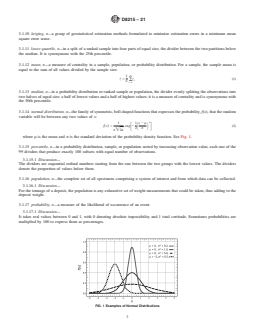
where µ is the mean and σ is the standard deviation of the
inferences are done by taking into account data, the style of probability density function. See Fig. 1.
spatial fluctuation of the variable(s), and the location of each
3.1.15 percentile, n—in a probability distribution, sample,
observation.
or population sorted by increasing observation value, each one
3.1.8 grid, n—a regular arrangement of crossing lines, such
of the 99 dividers that produce exactly 100 subsets with equal
as the threads in a square mesh.The intersection points are the
number of observations.
nodes.
3.1.15.1 Discussion—The dividers are sequential ordinal
numbersstartingfromtheonebetweenthetwogroupswiththe
lowest values. The dividers denote the proportion of values
below them.
For referencedASTM publications, visit theASTM website, www.astm.org, or
contact ASTM Customer Service at service@astm.org.
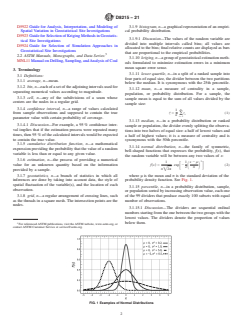
FIG. 1 Examples of Normal Distributions
D8215 − 21
n
3.1.16 population, n—the complete set of all specimens
2 2
s 5 z 2 z¯ (3)
~ !
( i
comprising a system of interest and from which data can be n 21
i51
collected.
3.2 Fordefinitionsofothertermsusedinthisstandard,refer
to Olea (4); Test Methods D621; Terminology D653; and
3.1.16.1 Discussion—For the tonnage of a deposit, the
Guides D5549, D5922, D5923, and D5924.
population is any exhaustive set of weight measurements that
could be taken, thus adding to the deposit weight.
4. Summary of Practice
3.1.17 probability, n—a measure of the likelihood of occur-
4.1 The practice has two phases: data gathering and prepa-
rence of an event.
ration of a geologic model. These phases assess two forms of
3.1.17.1 Discussion—It takes real values between 0 and 1,
uncertaintyassociatedwithin-placecoalresourcecalculations:
with 0 denoting absolute impossibility and 1 total certitude.
uncertainty in total coal tonnage and uncertainty in the mod-
Sometimes probabilities are multiplied by 100 to express them
eling at the cell level.
as percentages.
4.2 All available geologic information is used to create the
3.1.18 probability density function, n—a mathematical
model of seam thickness and other variables if required by the
expression, f(x), describing relative likelihoods in a random
geological complexity, so that geologic or technically feasible
variable.
boundaries of individual coal seams, or of the entire deposit,
3.1.18.1 Discussion—For discrete random variables, f(x) can be taken into account in the modeling.
directlyprovidesthelikelihoodofeachrandomvariablevalue;
4.3 The deposit is subdivided into cells. Geostatistical
for a continuous random variable, the area under f(x) between
modeling, stochastic simulation in particular, is applied to the
any two values of the variable provides the likelihood of the
coal seam data. The simulations create a series of two-
interval.
dimensional maps (realizations), each honoring the original
3.1.19 probability distribution, n—probability density func-
data and having the same probability of being the correct
tion.
solution. Different types of sampling and deposits require
applying different procedures. Annex A1 and Annex A2 are a
3.1.20 quartile, n—in a distribution, ranked sample, or
toolkit for the practical modeling of scenarios with various
population, any of the three dividers that separate the obser-
degrees of geologic complexity.
vations in four parts of equal size.
4.4 Results from the realizations and tonnage calculations
3.1.21 random function, n—a collection of random vari-
are summarized in two graphs, one for each form of uncer-
ables.
tainty: (a) a numerical approximation to the probability distri-
3.1.22 random variable, n—the collection of all possible
bution (histogram) of the total coal resources denoting uncer-
outcomes in an event or study, and their associated probability
tainty in the magnitude of the deposit and (b) a graph
of occurrence.
displaying uncertainty in cell by cell assessment as measured
3.1.23 realization, n—an observed or simulated outcome of
by a 90% confidence interval plotted against cumulative
a random variable, such as three tails in flipping a coin or a
tonnage and cell count. The user can select any desired
map of a random function.
uncertaintyboundariesfromthisgraphtosubdividethedeposit
according to the degree of reliability of interest in the analysis
3.1.24 resource, n—a numerical representation of the
of cell tonnage calculations.
amount of a commodity in the ground.
3.1.25 sample, n—(a) in geology, a specimen taken for
5. Significance and Use
inspection, analysis, or display; (b) in statistics, a representa-
5.1 Traditional methods for expressing geological uncer-
tive subset of a population comprising several observations.
tainty consist of preparing reliability categories based simply
3.1.26 sample size, n—the number of specimens in a subset
on the distance between drill hole data points, such as the one
of a population, which coincides with the number of observa-
described by Wood et al. (5) that uses only the drill holes
tions when there is one variable.
within the coal bed.Amajor drawback of distance methods is
3.1.27 standard deviation, n—thepositivesquarerootofthe their weak to null association with estimation errors. This
variance.
practice provides a methodology for effectively assessing the
uncertainty in coal resource estimates utilizing stochastic
3.1.28 stochastic simulation, n—mathematical modeling of
simulation.Indetermininguncertaintyforanycoalassessment,
a complex system using probabilistic methods involving ran-
stochastic simulation enables consideration of other important
dom variables.
factors and information beyond the geometry of drill hole
3.1.29 upper quartile, n—in a split of a sample into four
locations, both in and out of the coal bed, including: non-
parts of equal size, the divider between the two partitions
depositional channels, depth of weathering, complexity of
above the median; it is equivalent to the 75th percentile.
seam boundaries, coal seam subcrop projections, and varying
3.1.30 variance, n—a measure of spread in a sample, coal bed geology for different seams due to fluctuating peat
population,orprobabilitydistribution.Forasample,itisequal depositionalenvironments.Oleaetal. (6)explainsindetailthe
to the sum of the square of all observations minus the mean methodology behind this practice and illustrates it with an
divided by the sample size minus 1: example.
D8215 − 21
5.2 For multi-seam deposits, uncertainty can be expressed 7.5 If outcropping or depth of burial is a concern, surface
on an individual seam basis as well as an aggregated uncer- elevation and roof elevation(s) data are also required.
tainty for an entire coal deposit.
8. Procedure for Modeling the Deposit
5.3 The uncertainty is expressed directly in tons of coal.
8.1 Gridding:
Additionally, this practice allows the statistical analysis to be
8.1.1 Subdivide the study area into a regular grid. The
presented according to widely-accepted conventions, such as
rectangular shape of the study area with sides parallel to the
percentiles and confidence intervals. For example, there is a
coordinate axes usually forces to either truncate the lateral
90% probability that the actual tonnage in place is 314mil-
extension of the seam or include areas beyond its boundaries.
lionmetrictons 628.8millionmetrictons(346milliontons 6
8.1.2 Avoidhavingcellstoolargethatmorethan5%ofthe
31.7 million tons) of coal.
drill holes land in the same cell with at least one other drill
5.4 The results of an uncertainty determination can provide
hole.Onefourththeaveragedistancetotheclosestdrillholeis
important input into an overall risk analysis assessing the
a reasonable default.
commercial feasibility of a coal deposit.
8.1.3 The cell area shall not be less than the area of the
5.5 A company may rank coal resources per block (cell)
smallest detail of interest to capture in the modeling.
based on the degree of uncertainty.
8.2 Mapping:
8.2.1 If drill holes indicate that the seam is missing at some
6. Software
locations or the seam does not extend over the entire study
6.1 Mathematical modeling of a coal deposit requires the
area, use kriging to produce a map of the thickness indicators
useofcomputerprogramsforthefastandpreciseperformance
to have a first approximation of the seam extension.
of numerical calculations.
8.2.2 Complete the modeling of the seam boundary gener-
ating multiple realizations (maps) of the thickness indicators
6.2 Use of geostatistical software packages available to the
withintherestrictedareasdeterminedinthepreviousstep.The
public that are capable of generating probabilistic geologic
realizations take advantage of freedoms in fluctuations that are
mapping in the form of kriging estimations and stochastic
possible in between data locations, always honoring the data
realizations, such as those by Remy et al. (7) or Geovariances
and the style of spatial variation. Coal seam predictions using
(8), are required.
stochastic realizations tend to stabilize after 40 realizations to
6.3 Application of the standard also requires a program
80realizations(deSouzaetal., 11).Thus,generateatleast100
capable of performing grid operations, such as converting
thickness realizations to safely capture uncertainty in the
thickness maps to tonnage maps, and preparing the summaries
characterization.
described in Sections 9 and 10.Asuite of 15 standalone utility
8.2.3 Generateanequalnumberofrealizationsforthickness
programs is publicly available (Olea and Shaffer, 9).
using some of the same software. The extension of each
thickness map shall be conditioned by one of the indicator
NOTE 2—Relevant grid operation programs applicable to Practice
D8215 have not been widely available, either commercially or in the
realizations generated in the previous step.
public domain. Those interested in applying Practice D8215 have been
8.3 Tonnage:
required to develop their own codes, making it more difficult to use the
standardpractice.Thepublicationofthesourcecodeof15supplementary 8.3.1 The last step in the preparation of the deposit model
computer programs that can be used to perform the more specific aspects
involves the use of coal density for conversion of thickness to
of the modeling will facilitate the implementation of Practice D8215 for
tonnage realizations.
the determination of uncertainty in coal resource assessments.
8.3.2 Different drilling patterns and geology require differ-
entprocedurestomodelthegeology.AnnexA1andAnnexA2
7. Sampling and Data Preparation
include approaches for the modeling of the most typical
7.1 Prepare a database that ideally is free of institutional
situations.
uncertainties, such as insufficient drilling depth, inconsistency
in picking the top and bottom of a seam, or errors coding the 9. Uncertainty in Total In-place Tonnage
data (MNL11).
9.1 Foreachrealization,addthecoaltonnageforallcellsin
7.2 Like in the distance methods, if drill hole locations are the study area. Each tonnage realization contributes one value.
in some system that is not Cartesian, such as latitude and
If there are 100 tonnage realizations, there will be 100 values
longitude, convert the values to Cartesian coordinates, such as
for total tonnage that together numerically characterize the
Universal Transverse Mercator (UTM) coordinates or state
random variable total tonnage.
plane coordinates (for example, ArcGIS, 10).
9.1.1 Summarizetheresultsasahistogramplusatabulation
of summary statistics to facilitate interpretation (Fig. 2).
7.3 In addition to location, minimal information shall in-
9.1.2 Fig. 2 allows probabilistic analyses not possible to
clude thickness for the seam(s) to assess.
performapplyingdistanceclassificationmethods.Forexample,
7.4 If some drill holes show that the seam is missing at
with 90% probability, the deposit has at least 34.181 billion
certain locations, use the thickness values to prepare a second
metrictons(37.678billiontons)anditdoesnothavemorethan
datasetofindicatorsdenotingpresenceorabsenceoftheseam:
37.192 billion metric tons (40.997 billion tons), which is
1, ifthickness .0
equivalent to stating that there is a 90% probability that the
thickness indicator 5 % (4)
H
0, ifthickness=0 magnitude of the resources is 35.686billion metric tons 6
D8215 − 21
FIG. 2 Example of Display of Total Tonnage Uncertainty
1.506billion metric tons (39.337billion tons 6 1.660 billion 10.2 The values at each cell numerically define one random
tons) of coal.The value 35.686billion metric tons (39.337bil- variable per node modeling the uncertainty in tonnage at each
lion tons) is the average of the 34.181 billion metric tons cell.
(37.678 billion tons) and the 37.192 billion metric tons
10.3 Considering that ordinarily there are thousands of
(40.997billion tons). The value 1.506billion metric tons
nodes per seam, some simplification is in order. The best
(1.660billion tons) is equal to one-half the difference between
alternativeistokeepthespreadbetweenthe5thpercentileand
the 37.192billion metric tons (40.997billion tons) and the
the 95th percentile, which constitutes a confidence interval
34.181 billion metric tons (37.678bi
...
This document is not an ASTM standard and is intended only to provide the user of an ASTM standard an indication of what changes have been made to the previous version. Because
it may not be technically possible to adequately depict all changes accurately, ASTM recommends that users consult prior editions as appropriate. In all cases only the current version
of the standard as published by ASTM is to be considered the official document.
Designation: D8215 − 20 D8215 − 21
Standard Practice for
Statistical Modeling of Uncertainty in Assessment of In-
place Coal Resources
This standard is issued under the fixed designation D8215; the number immediately following the designation indicates the year of
original adoption or, in the case of revision, the year of last revision. A number in parentheses indicates the year of last reapproval. A
superscript epsilon (´) indicates an editorial change since the last revision or reapproval.
INTRODUCTION
Assessment of coal tonnage in-place is a fundamental factor in evaluating the commercial feasibility
of any deposit. Equally important is an appraisal of the reliability that can be placed in the drilling data
available for an estimation. Traditional methods for quantitatively expressing uncertainty use
reliability categories based simply on the distance between drill-hole data within the boundaries of a
coal bed. A significant limitation of the distance approach is the inability to express uncertainty in
terms of how close a resource estimate is to the true value.
This practice provides a geostatistical methodology to calculate the uncertainty of an in-place, coal
resource estimate, both at the deposit and block level. In addition to examining the drilling pattern both
within and outside the coal bed, other factors influencing the complexity in the geology are also
considered, resulting in realistic estimates of uncertainty. Most importantly, the uncertainty is
expressed directly in tons of coal. Like other coal properties, uncertainty can be used to rank the
resources in classes.
1. Scope*
1.1 This practice covers a procedure for quantitatively determining in-place tonnage uncertainty in a coal resource assessment. The
practice uses a database on coal occurrence and applies geostatistical methods to model the uncertainty associated with a tonnage
estimated for one or more coal seams. The practice includes instruction for the preparation of results in graphical form.
1.2 This document does not include a detailed presentation of the basic theory behind the formulation of the standard, which can
be found in numerous publications, with a selection being given in the references (1-3).
1.3 This practice should be used in conjunction with professional judgment of the many unique aspects of a coal deposit.
1.4 Units—The values stated in SI units are to be regarded as standard. The values given in parentheses after SI units are provided
for information only and are not considered standard.
NOTE 1—All values given in parentheses after SI units are stated in inch-pound units.
This practice is under the jurisdiction of ASTM Committee D05 on Coal and Coke and is the direct responsibility of Subcommittee D05.07 on Physical Characteristics
of Coal.
Current edition approved Oct. 1, 2020Oct. 1, 2021. Published October 2020October 2021. Originally approved in 2018. Last previous edition approved in 20192020 as
D8215 – 19a.D8215 – 20. DOI: 10.1520/D8215-20.10.1520/D8215-21.
The boldface numbers in parentheses refer to the list of references at the end of this standard.
*A Summary of Changes section appears at the end of this standard
Copyright © ASTM International, 100 Barr Harbor Drive, PO Box C700, West Conshohocken, PA 19428-2959. United States
D8215 − 21
1.5 This standard does not purport to address all of the safety concerns, if any, associated with its use. It is the responsibility
of the user of this standard to establish appropriate safety, health, and environmental practices and determine the applicability of
regulatory limitations prior to use.
1.6 This international standard was developed in accordance with internationally recognized principles on standardization
established in the Decision on Principles for the Development of International Standards, Guides and Recommendations issued
by the World Trade Organization Technical Barriers to Trade (TBT) Committee.
2. Referenced Documents
2.1 ASTM Standards:
D621 Test Methods for Deformation of Plastics Under Load (Withdrawn 1994)
D653 Terminology Relating to Soil, Rock, and Contained Fluids
D5549 Guide for Contents of Geostatistical Site Investigation Report
D5922 Guide for Analysis, Interpretation, and Modeling of Spatial Variation in Geostatistical Site Investigations
D5923 Guide for Selection of Kriging Methods in Geostatistical Site Investigations
D5924 Guide for Selection of Simulation Approaches in Geostatistical Site Investigations
2.2 ASTM Manuals, Monographs, and Data Series:
MNL11 Manual on Drilling, Sampling, and Analysis of Coal
3. Terminology
3.1 Definitions:
3.1.1 average, n—mean.
3.1.2 bin, n—each of a set of the adjoining intervals used for separating numerical values according to magnitude.
3.1.3 cell, n—any of the subdivisions of a seam whose centers are the nodes in a regular grid.
3.1.4 confidence interval, n—a range of values calculated from sample observations and supposed to contain the true parameter
value with certain probability of coverage.
3.1.4.1 Discussion—
For example, a 95 % confidence interval implies that if the estimation process were repeated many times, then 95 % of the
calculated intervals would be expected to contain the true value.
3.1.5 cumulative distribution function, n—a mathematical expression providing the probability that the value of a random variable
is less than or equal to any given value.
3.1.6 estimation, n—the process of providing a numerical value for an unknown quantity based on the information provided by
a sample.
3.1.7 geostatistics, n—a branch of statistics in which all inferences are done by taking into account data, the style of spatial
fluctuation of the variable(s), and the location of each observation.
3.1.8 grid, n—a regular arrangement of crossing lines, such as the threads in a square mesh. The intersection points are the nodes.
3.1.9 histogram, n—a graphical representation of an empirical probability distribution.
3.1.9.1 Discussion—
The values of the random variable are divided into multiple intervals called bins; all values are allocated to the bins; final relative
counts are displayed as bars that are proportional to the empirical probabilities.
For referenced ASTM standards, visit the ASTM website, www.astm.org, or contact ASTM Customer Service at service@astm.org. For Annual Book of ASTM Standards
volume information, refer to the standard’s Document Summary page on the ASTM website.
The last approved version of this historical standard is referenced on www.astm.org.
For referenced ASTM publications, visit the ASTM website, www.astm.org, or contact ASTM Customer Service at service@astm.org.
D8215 − 21
3.1.10 kriging, n—a group of geostatistical estimation methods formulated to minimize estimation errors in a minimum mean
square error sense.
3.1.11 lower quartile, n—in a split of a ranked sample into four parts of equal size, the divider between the two partitions below
the median. It is synonymous with the 25th percentile.
3.1.12 mean, n—a measure of centrality in a sample, population, or probability distribution. For a sample, the sample mean is
equal to the sum of all values divided by the sample size:
n
z¯ 5 z (1)
( i
n
i51
3.1.13 median, n—in a probability distribution or ranked sample or population, the divider evenly splitting the observations into
two halves of equal size: a half of lowest values and a half of highest values; it is a measure of centrality and is synonymous with
the 50th percentile.
3.1.14 normal distribution, n—the family of symmetric, bell-shaped functions that expresses the probability, f(x), that the random
variable will be between any two values of x:
1 1 x 2 μ
f~x! 5 · exp 2 (2)
F S D G
2 σ
σ=2π
where μ is the mean and σ is the standard deviation of the probability density function. See Fig. 1.
3.1.15 percentile, n—in a probability distribution, sample, or population sorted by increasing observation value, each one of the
99 dividers that produce exactly 100 subsets with equal number of observations.
3.1.15.1 Discussion—
The dividers are sequential ordinal numbers starting from the one between the two groups with the lowest values. The dividers
denote the proportion of values below them.
3.1.16 population, n—the complete set of all specimens comprising a system of interest and from which data can be collected.
3.1.16.1 Discussion—
For the tonnage of a deposit, the population is any exhaustive set of weight measurements that could be taken, thus adding to the
deposit weight.
3.1.17 probability, n—a measure of the likelihood of occurrence of an event.
3.1.17.1 Discussion—
It takes real values between 0 and 1, with 0 denoting absolute impossibility and 1 total certitude. Sometimes probabilities are
multiplied by 100 to express them as percentages.
FIG. 1 Examples of Normal Distributions
D8215 − 21
3.1.18 probability density function, n—a mathematical expression, f(x), describing relative likelihoods in a random variable.
3.1.18.1 Discussion—
For discrete random variables, f(x) directly provides the likelihood of each random variable value; for a continuous random
variable, the area under f(x) between any two values of the variable provides the likelihood of the interval.
3.1.19 probability distribution, n—probability density function.
3.1.20 quartile, n—in a distribution, ranked sample, or population, any of the three dividers that separate the observations in four
parts of equal size.
3.1.21 random function, n—a collection of random variables.
3.1.22 random variable, n—the collection of all possible outcomes in an event or study, and their associated probability of
occurrence.
3.1.23 realization, n—an observed or simulated outcome of a random variable, such as three tails in flipping a coin or a map of
a random function.
3.1.24 resource, n—a numerical representation of the amount of a commodity in the ground.
3.1.25 sample, n—(a) in geology, a specimen taken for inspection, analysis, or display; (b) in statistics, a representative subset of
a population comprising several observations.
3.1.26 sample size, n—the number of specimens in a subset of a population, which coincides with the number of observations
when there is one variable.
3.1.27 standard deviation, n—the positive square root of the variance.
3.1.28 stochastic simulation, n—mathematical modeling of a complex system using probabilistic methods involving random
variables.
3.1.29 upper quartile, n—in a split of a sample into four parts of equal size, the divider between the two partitions above the
median; it is equivalent to the 75th percentile.
3.1.30 variance, n—a measure of spread in a sample, population, or probability distribution. For a sample, it is equal to the sum
of the square of all observations minus the mean divided by the sample size minus 1:
n
2 2
s 5 ~z 2 z¯! (3)
( i
n 2 1
i51
3.2 For definitions of other terms used in this standard, refer to Olea (4); Test Methods D621; Terminology D653; and Guides
D5549, D5922, D5923, and D5924.
4. Summary of Practice
4.1 The practice has two phases: data gathering and preparation of a geologic model. These phases assess two forms of uncertainty
associated with in-place coal resource calculations: uncertainty in total coal tonnage and uncertainty in the modeling at the cell
level.
4.2 All available geologic information is used to create the model of seam thickness and other variables if required by the
geological complexity, so that geologic or technically feasible boundaries of individual coal seams, or of the entire deposit, can
be taken into account in the modeling.
4.3 The deposit is subdivided into cells. Geostatistical modeling, stochastic simulation in particular, is applied to the coal seam
D8215 − 21
data. The simulations create a series of two-dimensional maps (realizations), each honoring the original data and having the same
probability of being the correct solution. Different types of sampling and deposits require applying different procedures. Annex A1
and Annex A2 are a toolkit for the practical modeling of scenarios with various degrees of geologic complexity.
4.4 Results from the realizations and tonnage calculations are summarized in two graphs, one for each form of uncertainty: (a)
a numerical approximation to the probability distribution (histogram) of the total coal resources denoting uncertainty in the
magnitude of the deposit and (b) a graph displaying uncertainty in cell by cell assessment as measured by a 90 % confidence
interval plotted against cumulative tonnage and cell count. The user can select any desired uncertainty boundaries from this graph
to subdivide the deposit according to the degree of reliability of interest in the analysis of cell tonnage calculations.
5. Significance and Use
5.1 Traditional methods for expressing geological uncertainty consist of preparing reliability categories based simply on the
distance between drill hole data points, such as the one described by Wood et al. (5) that uses only the drill holes within the coal
bed. A major drawback of distance methods is their weak to null association with estimation errors. This practice provides a
methodology for effectively assessing the uncertainty in coal resource estimates utilizing stochastic simulation. In determining
uncertainty for any coal assessment, stochastic simulation enables consideration of other important factors and information beyond
the geometry of drill hole locations, both in and out of the coal bed, including: non-depositional channels, depth of weathering,
complexity of seam boundaries, coal seam subcrop projections, and varying coal bed geology for different seams due to fluctuating
peat depositional environments. Olea et al. (6) explains in detail the methodology behind this practice and illustrates it with an
example.
5.2 For multi-seam deposits, uncertainty can be expressed on an individual seam basis as well as an aggregated uncertainty for
an entire coal deposit.
5.3 The uncertainty is expressed directly in tons of coal. Additionally, this practice allows the statistical analysis to be presented
according to widely-accepted conventions, such as percentiles and confidence intervals. For example, there is a 90 % probability
that the actual tonnage in place is 314 million metric tons 6 28.8 million metric tons (346 million tons 6 31.7 million tons) of
coal.
5.4 The results of an uncertainty determination can provide important input into an overall risk analysis assessing the commercial
feasibility of a coal deposit.
5.5 A company may rank coal resources per block (cell) based on the degree of uncertainty.
6. Software
6.1 Mathematical modeling of a coal deposit requires the use of computer programs for the fast and precise performance of
numerical calculations.
6.2 Use of a geostatistical software package that ispackages available to the public that are capable of generating probabilistic
geologic mapping in the form of kriging estimations and stochastic realizations, such as the ones those by Remy et al. (67) or
Geovariances (78), isare required.
6.3 Application of the standard also requires a program capable of performing grid operations, such as converting thickness maps
to tonnage maps, and preparing the summaries described in Sections 9 and 10. A suite of 15 standalone utility programs is publicly
available (Olea and Shaffer, 9).
NOTE 2—Relevant grid operation programs applicable to Practice D8215 have not been widely available, either commercially or in the public domain.
Those interested in applying Practice D8215 have been required to develop their own codes, making it more difficult to use the standard practice. The
publication of the source code of 15 supplementary computer programs that can be used to perform the more specific aspects of the modeling will facilitate
the implementation of Practice D8215 for the determination of uncertainty in coal resource assessments.
7. Sampling and Data Preparation
7.1 Prepare a database that ideally is free of institutional uncertainties, such as insufficient drilling depth, inconsistency in picking
the top and bottom of a seam, or errors coding the data (MNL11).
D8215 − 21
7.2 Like in the distance methods, if drill hole locations are in some system that is not Cartesian, such as latitude and longitude,
convert the values to Cartesian coordinates, such as Universal Transverse Mercator (UTM) coordinates or state plane coordinates
(for example, ArcGIS, 810).
7.3 In addition to location, minimal information shall include thickness for the seam(s) to assess.
7.4 If some drill holes show that the seam is missing at certain locations, use the thickness values to prepare a second dataset of
indicators denoting presence or absence of the seam:
1, if thickness . 0
thickness indicator 5 % (4)
H
0, if thickness = 0
7.5 If outcropping or depth of burial is a concern, surface elevation and roof elevation(s) data are also required.
8. Procedure for Modeling the Deposit
8.1 Gridding:
8.1.1 Subdivide the study area into a regular grid. The rectangular shape of the study area with sides parallel to the coordinate axes
usually forces to either truncate the lateral extension of the seam or include areas beyond its boundaries.
8.1.2 Avoid having cells too large that more than 5 % of the drill holes land in the same cell with at least one other drill hole. One
fourth the average distance to the closest drill hole is a reasonable default.
8.1.3 The cell area shall not be less than the area of the smallest detail of interest to capture in the modeling.
8.2 Mapping:
8.2.1 If drill holes indicate that the seam is missing at some locations or the seam does not extend over the entire study area, use
kriging to produce a map of the thickness indicators to have a first approximation of the seam extension.
8.2.2 Complete the modeling of the seam boundary generating multiple realizations (maps) of the thickness indicators within the
restricted areas determined in the previous step. The realizations take advantage of freedoms in fluctuations that are possible in
between data locations, always honoring the data and the style of spatial variation. Coal seam predictions using stochastic
realizations tend to stabilize after 40 realizations to 80 realizations (de Souza et al., 911). Thus, generate at least 100 thickness
realizations to safely capture uncertainty in the characterization.
8.2.3 Generate an equal number of realizations for thickness using some of the same software. The extension of each thickness
map shall be conditioned by one of the indicator realizations generated in the previous step.
8.3 Tonnage:
8.3.1 The last step in the preparation of the deposit model involves the use of coal density for conversion of thickness to tonnage
realizations.
8.3.2 Different drilling patterns and geology require different procedures to model the geology. Annex A1 and Annex A2 include
approaches for the modeling of the most typical situations.
9. Uncertainty in Total In-place Tonnage
9.1 For each realization, add the coal tonnage for all cells in the study area. Each tonnage realization contributes one value. If there
are 100 tonnage realizations, there will be 100 values for total tonnage that together numerically characterize the random variable
total tonnage.
9.1.1 Summarize the results as a histogram plus a tabulation of summary statistics to facilitate interpretation (Fig. 2).
D8215 − 21
FIG. 2 Example of Display of Total Tonnage Uncertainty
9.1.2 Fig. 2 allows probabilistic analyses not possible to perform applying distance classification methods. For example, with 90 %
probability, the deposit has at least 34.181 billion metric tons (37.678 billion tons) and it does not have more than 37.192 billion
metric tons (40.997 billion tons), which is equivalent to stating that there is a 90 % probability that the magnitude of the resources
is 35.686 billion metric tons 6 1.506 billion metric tons (39.337 billion tons 6 1.660 billion tons) of coal. The value 35.686 billion
metric tons (39.337 billion tons) is the average of the 34.181 billion metric tons (37.678 billion tons) and the 37.192 billion metric
tons (40.997 billion tons). The value 1.506 billion metric tons (1.660 billion tons) is equal to one-half the difference between the
37.192 billion metric tons (40.997 billion tons) and the 34.181 billion metric tons (37.678 billion tons).
10. Determination of Uncertainty at Cell Level
10.1 Use the same set of tonnage realizations to model uncertainty throughout the deposit at the cell level. For this determination,
it is necessary to group the values in the tonnage realizations by cell. Assuming that there are 100 realizations, there will be 100
values per cell when the seam extends over the entire study area.
10.2 The values at each cell numerically define one random v
...