

ASTM F1863-16(2021)
(Test Method)Standard Test Method for Measuring the Night Vision Goggle-Weighted Transmissivity of Transparent Parts
General Information
- Abstract
SIGNIFICANCE AND USE
5.1 Significance—This test method provides a means to measure the compatibility of a given transparency through which NVGs are used at night to view outside, nighttime ambient illuminated natural scenes.
5.2 Use—This test method may be used on any transparent part, including sample coupons. It is primarily intended for use on large, curved, or thick parts that may already be installed (for example, windscreens on aircraft).
SCOPE
1.1 This test method covers apparatuses and procedures that are suitable for measuring the NVG-weighted transmissivity of transparent parts including those that are large, thick, curved, or already installed. This test method is sensitive to transparencies that vary in transmissivity as a function of wavelength.
1.2 Since the transmissivity (or transmission coefficient) is a ratio of two radiance values, it has no units. The units of radiance recorded in the intermediate steps of this test method are not critical; any recognized units of radiance (for example, watts/m2-str) may be used, as long as it is consistent.2
1.3 This standard does not purport to address all of the safety concerns, if any, associated with its use. It is the responsibility of the user of this standard to establish appropriate safety, health, and environmental practices and determine the applicability of regulatory limitations prior to use.
1.4 This international standard was developed in accordance with internationally recognized principles on standardization established in the Decision on Principles for the Development of International Standards, Guides and Recommendations issued by the World Trade Organization Technical Barriers to Trade (TBT) Committee.
- Status
- Published
- Publication Date
- 30-Apr-2021
- Technical Committee
- F07 - Aerospace and Aircraft
- Drafting Committee
- F07.08 - Transparent Enclosures and Materials
Overview
ASTM F1863-16(2021) is an internationally recognized standard developed by ASTM for testing the night vision goggle (NVG)-weighted transmissivity of transparent parts. This test method provides essential guidance for evaluating how well large, thick, curved, or already installed transparent materials transmit light in the spectral regions that affect NVG performance. Ensuring high NVG-weighted transmissivity in applications such as aircraft windscreens, vehicle canopies, and navigational windows is critical for safety and effective night-time operations.
Testing the NVG-weighted transmissivity helps determine the compatibility of transparencies through which NVGs are used to observe outdoor, ambient-light scenes at night. The method is sensitive to transparencies that vary in light transmission based on wavelength and supports direct assessment in installed or operational settings.
Key Topics
- NVG-Weighted Transmissivity: Measures how much light, including visible and near-infrared, passes through a transparent part, weighted for the spectral sensitivity of the intended NVG.
- Applicability to Large and Curved Parts: The test method is suitable for measuring not only small samples but also large, curved, thick, or pre-installed transparencies such as those found in aircraft or vehicles.
- Direct and Analytical Methods: Offers both direct luminance measurement using photodetectors and analytical techniques utilizing spectrophotometric data, supporting flexible application based on specimen size and installation.
- Test Environment: Requires a highly controlled lighting environment, such as a darkened room or outdoor night setting, to prevent interference and ensure accurate NVG sensitivity assessment.
- No Units for Transmissivity: As the NVG-weighted transmission coefficient is a ratio of two radiance values, results are unitless, supporting straightforward comparison.
- Precision and Reproducibility: The standard has been validated in interlaboratory studies, demonstrating reliable repeatability and reproducibility for various transparent materials.
Applications
- Aerospace: Assessing NVG compatibility of aircraft windscreens and canopies to ensure optimal pilot visibility and safety during night missions.
- Automotive and Marine: Testing vehicle and boat windows where NVGs might be used for night navigation, preventing significant vision degradation due to inappropriate transparency properties.
- Military and Defense: Evaluating goggles and transparencies used in armored vehicles or observation posts to maximize operational effectiveness in low-light environments.
- Research and Development: Supporting the design, manufacturing, and certification of new transparent materials and coatings intended for NVG environments.
- Quality Control: Facilitating the acceptance and installation validation of transparent parts in fields where NVG usage is common.
Related Standards
- ASTM D1003 - Test Method for Haze and Luminous Transmittance of Transparent Plastics: Focuses on visible region transmissivity, generally for small, flat samples.
- ASTM F1316 - Measuring the Transmissivity of Transparent Parts: Broader test method for both visible and near-infrared transmission in larger or curved areas.
- ASTM E177 - Practice for Use of the Terms Precision and Bias in ASTM Test Methods: Guidance for evaluating the statistical reliability of measurement procedures.
- ASTM E691 - Practice for Conducting an Interlaboratory Study to Determine the Precision of a Test Method: Ensures consistent reproducibility across different laboratories.
By following ASTM F1863-16(2021), organizations can assure the optical compatibility and performance of transparencies for NVG-assisted night-time operations, supporting safety, efficiency, and regulatory compliance across aviation, automotive, marine, and defense sectors.
Keywords: NVG-weighted transmissivity, night vision goggles, ASTM F1863, transparent parts, transmissivity measurement, aircraft windscreen, canopy, optics testing, standard test method.
Relations
- Effective Date
- 01-May-2014
- Refers
ASTM F1316-90(2013) - Standard Test Method for Measuring the Transmissivity of Transparent Parts - Effective Date
- 01-Dec-2013
- Effective Date
- 01-May-2013
- Effective Date
- 01-May-2013
- Effective Date
- 01-Nov-2011
- Refers
ASTM D1003-11e1 - Standard Test Method for Haze and Luminous Transmittance of Transparent Plastics - Effective Date
- 15-Apr-2011
- Refers
ASTM D1003-11 - Standard Test Method for Haze and Luminous Transmittance of Transparent Plastics - Effective Date
- 15-Apr-2011
- Effective Date
- 01-Oct-2010
- Effective Date
- 01-Oct-2008
- Effective Date
- 01-Oct-2008
- Refers
ASTM F1316-90(2008) - Standard Test Method for Measuring the Transmissivity of Transparent Parts - Effective Date
- 01-Apr-2008
- Refers
ASTM D1003-07 - Standard Test Method for Haze and Luminous Transmittance of Transparent Plastics - Effective Date
- 01-Nov-2007
- Refers
ASTM E177-06b - Standard Practice for Use of the Terms Precision and Bias in ASTM Test Methods - Effective Date
- 15-Nov-2006
- Refers
ASTM E177-06a - Standard Practice for Use of the Terms Precision and Bias in ASTM Test Methods - Effective Date
- 01-Nov-2006
- Effective Date
- 01-Nov-2005
Frequently Asked Questions
ASTM F1863-16(2021) is a standard published by ASTM International. Its full title is "Standard Test Method for Measuring the Night Vision Goggle-Weighted Transmissivity of Transparent Parts". This standard covers: SIGNIFICANCE AND USE 5.1 Significance—This test method provides a means to measure the compatibility of a given transparency through which NVGs are used at night to view outside, nighttime ambient illuminated natural scenes. 5.2 Use—This test method may be used on any transparent part, including sample coupons. It is primarily intended for use on large, curved, or thick parts that may already be installed (for example, windscreens on aircraft). SCOPE 1.1 This test method covers apparatuses and procedures that are suitable for measuring the NVG-weighted transmissivity of transparent parts including those that are large, thick, curved, or already installed. This test method is sensitive to transparencies that vary in transmissivity as a function of wavelength. 1.2 Since the transmissivity (or transmission coefficient) is a ratio of two radiance values, it has no units. The units of radiance recorded in the intermediate steps of this test method are not critical; any recognized units of radiance (for example, watts/m2-str) may be used, as long as it is consistent.2 1.3 This standard does not purport to address all of the safety concerns, if any, associated with its use. It is the responsibility of the user of this standard to establish appropriate safety, health, and environmental practices and determine the applicability of regulatory limitations prior to use. 1.4 This international standard was developed in accordance with internationally recognized principles on standardization established in the Decision on Principles for the Development of International Standards, Guides and Recommendations issued by the World Trade Organization Technical Barriers to Trade (TBT) Committee.
SIGNIFICANCE AND USE 5.1 Significance—This test method provides a means to measure the compatibility of a given transparency through which NVGs are used at night to view outside, nighttime ambient illuminated natural scenes. 5.2 Use—This test method may be used on any transparent part, including sample coupons. It is primarily intended for use on large, curved, or thick parts that may already be installed (for example, windscreens on aircraft). SCOPE 1.1 This test method covers apparatuses and procedures that are suitable for measuring the NVG-weighted transmissivity of transparent parts including those that are large, thick, curved, or already installed. This test method is sensitive to transparencies that vary in transmissivity as a function of wavelength. 1.2 Since the transmissivity (or transmission coefficient) is a ratio of two radiance values, it has no units. The units of radiance recorded in the intermediate steps of this test method are not critical; any recognized units of radiance (for example, watts/m2-str) may be used, as long as it is consistent.2 1.3 This standard does not purport to address all of the safety concerns, if any, associated with its use. It is the responsibility of the user of this standard to establish appropriate safety, health, and environmental practices and determine the applicability of regulatory limitations prior to use. 1.4 This international standard was developed in accordance with internationally recognized principles on standardization established in the Decision on Principles for the Development of International Standards, Guides and Recommendations issued by the World Trade Organization Technical Barriers to Trade (TBT) Committee.
ASTM F1863-16(2021) is classified under the following ICS (International Classification for Standards) categories: 37.020 - Optical equipment. The ICS classification helps identify the subject area and facilitates finding related standards.
ASTM F1863-16(2021) has the following relationships with other standards: It is inter standard links to ASTM E177-14, ASTM F1316-90(2013), ASTM E177-13, ASTM E691-13, ASTM E691-11, ASTM D1003-11e1, ASTM D1003-11, ASTM E177-10, ASTM E691-08, ASTM E177-08, ASTM F1316-90(2008), ASTM D1003-07, ASTM E177-06b, ASTM E177-06a, ASTM E691-05. Understanding these relationships helps ensure you are using the most current and applicable version of the standard.
ASTM F1863-16(2021) is available in PDF format for immediate download after purchase. The document can be added to your cart and obtained through the secure checkout process. Digital delivery ensures instant access to the complete standard document.
Standards Content (Sample)
This international standard was developed in accordance with internationally recognized principles on standardization established in the Decision on Principles for the
Development of International Standards, Guides and Recommendations issued by the World Trade Organization Technical Barriers to Trade (TBT) Committee.
Designation: F1863 − 16 (Reapproved 2021)
Standard Test Method for
Measuring the Night Vision Goggle-Weighted Transmissivity
of Transparent Parts
This standard is issued under the fixed designation F1863; the number immediately following the designation indicates the year of
original adoption or, in the case of revision, the year of last revision.Anumber in parentheses indicates the year of last reapproval.A
superscript epsilon (´) indicates an editorial change since the last revision or reapproval.
INTRODUCTION
Test Methods D1003 and F1316 apply to the transmissivity measurement of transparent materials,
theformerbeingforsmallflatsamples,andthelatterforanymaterialsincludinglarger,curvedpieces
such as aircraft transparencies. Additionally, in Test Method D1003, the transmissivity is measured
perpendicular to the surface of test sample and both test methods measure only in the visible light
spectral region. Night vision goggles (NVGs) are being used in aircraft and other applications (for
example, marine navigation, driving) with increasing frequency. These devices amplify both visible
and near-infrared (NIR) spectral energy. Overall visual performance can be degraded if the observer
uses the NVGs while looking through a transparency that has poor transmissivity in the visible and
NIR spectral regions. This test method describes both direct and analytical measurement techniques
that determine the NVG-weighted transmissivity of transparent pieces including ones that are large,
curved, or held at the installed position.
1. Scope mendations issued by the World Trade Organization Technical
Barriers to Trade (TBT) Committee.
1.1 Thistestmethodcoversapparatusesandproceduresthat
aresuitableformeasuringtheNVG-weightedtransmissivityof
2. Referenced Documents
transparent parts including those that are large, thick, curved,
2.1 ASTM Standards:
or already installed. This test method is sensitive to transpar-
D1003Test Method for Haze and Luminous Transmittance
encies that vary in transmissivity as a function of wavelength.
of Transparent Plastics
1.2 Sincethetransmissivity(ortransmissioncoefficient)isa
E177Practice for Use of the Terms Precision and Bias in
ratio of two radiance values, it has no units. The units of
ASTM Test Methods
radiance recorded in the intermediate steps of this test method
E691Practice for Conducting an Interlaboratory Study to
are not critical; any recognized units of radiance (for example,
Determine the Precision of a Test Method
2 2
watts/m -str) may be used, as long as it is consistent.
F1316Test Method for Measuring the Transmissivity of
1.3 This standard does not purport to address all of the
Transparent Parts
safety concerns, if any, associated with its use. It is the
3. Terminology
responsibility of the user of this standard to establish appro-
priate safety, health, and environmental practices and deter-
3.1 Definitions:
mine the applicability of regulatory limitations prior to use.
3.1.1 analytical test method, n—the test method that uses
1.4 This international standard was developed in accor-
spectral transmissivity data of a transparent part collected by
dance with internationally recognized principles on standard-
the use of either spectrophotometric or spectroradiometric
ization established in the Decision on Principles for the
instrumentation. The data are then examined using analytic
Development of International Standards, Guides and Recom-
methods to determine the NVG-weighted transmissivity of the
part.
1 3.1.2 direct test method, n—the test method that uses the
This test method is under the jurisdiction of ASTM Committee F07 on
Aerospace andAircraft and is the direct responsibility of Subcommittee F07.08 on
actualluminousoutput,asmeasuredbyaphotometer,properly
Transparent Enclosures and Materials.
Current edition approved May 1, 2021. Published May 2021. Originally
approved in 1998. Last previous edition approved in 2016 as F1863–16. DOI: For referenced ASTM standards, visit the ASTM website, www.astm.org, or
10.1520/F1863-16R21. contact ASTM Customer Service at service@astm.org. For Annual Book of ASTM
RCA Electro-Optics Handbook, RCA/Solid State Division/Electro Optics and Standards volume information, refer to the standard’s Document Summary page on
Devices. Technical Series EOH-11. Lancaster, PA; 1974. the ASTM website.
Copyright © ASTM International, 100 Barr Harbor Drive, PO Box C700, West Conshohocken, PA 19428-2959. United States
F1863 − 16 (2021)
coupled to the eyepiece of the test NVG. The NVG-weighted light sources). The ambient illumination must be very low
transmissivity of the part is then determined by forming the becauseoftheextremesensitivityoftheNVGs.Afixtureholds
ratio of the NVG output luminance with the transparent part in the NVG and its objective lens is aimed at and focused on a
place to the luminance output without the part. target. The target shall be either an evenly illuminated white,
diffusely reflecting surface or a transilluminated screen (light-
3.1.3 NVG-weighted spectral transmissivity, n—the spectral
box). The illumination is provided by a white, incandescent
transmissivity of a transparent part multiplied by the spectral
light source. Handle the samples carefully so as not to cause
sensitivity of a given NVG (see Fig. 1).
any damage. Do not clean them with any solvents. Use
3.1.4 NVG-weighted transmissivity (T ), n—the spectral
NVG
part-specific, prescribed cleaning materials and methods.
transmissivity of a transparent part multiplied by the spectral
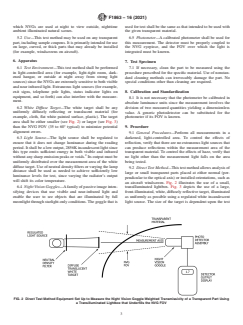
4.1.1 Direct Test Method—Attached directly to the eyepiece
sensitivity of a given NVG integrated with respect to wave-
of the NVG is a photodetector. The measured field of view
length (see Fig. 1, Eq 1 and Eq 2).
(FOV) shall be smaller than the uniformly illuminated portion
3.1.5 NVG spectral sensitivity, n—thesensitivityofanNVG
of the target. The target illumination is adjusted so that the
as a function of input wavelength.
output of the NVGs is about 1.7 cd/m (0.5 fL). This ensures
3.1.6 photometer, n—a device that measures luminous in- that the NVG input level is sufficiently low that it does not
activate the NVG automatic gain control (AGC) circuitry. The
tensity or brightness by converting (weighting) the radiant
intensityofanobjectusingtherelativesensitivityofthehuman luminance output of the NVG is measured with no transpar-
2,4
encyinplaceandthenrepeatedwiththetransparentmaterialin
visual system as defined by the photopic curve.
place between the light source and the NVG. The transmissiv-
3.1.7 photopic curve, n—the photopic curve is the spectral
ity is equal to the NVG output luminance with the transparent
sensitivity of the human eye for daytime conditions as defined
material in place divided by the NVG output luminance
by the Commission Internationale d’Eclairage (CIE) 1931
2,4 without the material (see Eq 1). The result is the NVG-
standard observer.
weighted transmissivity (T ) of the transparent material.
NVG
3.1.8 transmission coeffıcient, n—see transmissivity.
4.1.2 Analytical Test Method—Without the sample in place,
3.1.9 transmissivity, n—the transmissivity of a transparent
measure the light source’s spectral energy distribution from
medium is the ratio of the luminance of an object measured
450 through 950 nm in 5-nm incremental steps. Place the
through the medium to the luminance of the same object
sample into the spectrophotometer or spectroradiometer fix-
measured directly.
ture. Perform spectral measurements, also from 450 through
950 nm in 5-nm incremental steps. Obtain from the NVG
4. Summary of Test Method
manufacturer the spectral sensitivity of the goggle that will be
4.1 General Test Conditions—The test method shall be
used in conjunction with the part. Perform the analytic method
performed in light-controlled area (for example, light-tight
as defined in Eq 2 to derive the T .
NVG
room, darkened hangar, or outside at night away from strong
5. Significance and Use
5.1 Significance—This test method provides a means to
Wyszecki, Gunter, and Stiles, WS, Color Science: Concepts and Methods,
measure the compatibility of a given transparency through
Quantitative Data and Formulae, 2nd ed., New York, John Wiley and Sons, 1982.
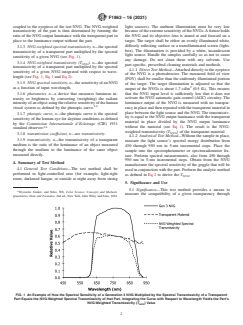
FIG. 1 An Example of How the Spectral Sensitivity of a Generation 3 NVG Multiplied by the Spectral Transmissivity of a Transparent
Part Equals the NVG-Weighted Spectral Transmissivity of that Part. Integrating the Curve with Respect to Wavelength Yields the Part’s
NVG-Weighted Transmissivity (T ) Value
NVG
F1863 − 16 (2021)
which NVGs are used at night to view outside, nighttime used for test shall be the same as that intended to be used with
ambient illuminated natural scenes. the given transparent material.
5.2 Use—This test method may be used on any transparent 6.5 Photometer—A calibrated photometer shall be used for
part,includingsamplecoupons.Itisprimarilyintendedforuse this measurement. The detector must be properly coupled to
on large, curved, or thick parts that may already be installed the NVG eyepiece, and the FOV over which the light is
(for example, windscreens on aircraft). integrated must be known.
6. Apparatus 7. Test Specimen
6.1 Test Environment—This test method shall be performed
7.1 If necessary, clean the part to be measured using the
in light-controlled area (for example, light-tight room, dark- procedure prescribed for the specific material. Use of nonstan-
ened hangar, or outside at night away from strong light
dard cleaning methods can irrevocably damage the part. No
sources)sincetheNVGsareextremelysensitivetobothvisible special conditions other than cleaning are required.
and near infrared light. Extraneous light sources (for example,
exit signs, telephone pole lights, status indicator lights on 8. Calibration and Standardization
equipment, and so forth) can also interfere with the measure-
8.1 It is not necessary that the photometer be calibrated in
ment.
absolute luminance units since the measurement involves the
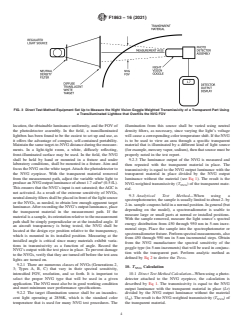
6.2 White Diffuse Target—The white target shall be any division of two measured quantities yielding a dimensionless
uniformly diffusely reflecting or translucent material (for value. A generic photodetector can be substituted for the
example, cloth, flat white painted surface, plastic). The target photometer if its FOV is known.
area shall be either smaller (see Fig. 2) or larger (see Fig. 3)
than the NVG FOV (35 to 60° typical) to minimize potential 9. Procedure
alignment errors.
9.1 General Procedures—Perform all measurements in a
6.3 Light Source—The light source shall be regulated to darkened, light-controlled area. To control the effects of
ensure that it does not change luminance during the reading reflection, verify that there are no extraneous light so
...