

ASTM C1937-24
(Specification)Standard Specification for Layered, Glass Fiber Felt Pipe and Board Insulation
General Information
- Abstract
SCOPE
1.1 This specification addresses layered, glass fiber felt pipe and board insulation for use on surfaces with temperatures from ambient up to 1400°F (760°C) continuous.
1.2 Glass fibers used to make this product are sometimes referred to as E-glass fibers.
1.3 Facings are not added in the manufacturing process and are not addressed by this specification.
1.4 This material is a high temperature, industrial thermal insulation that is typically covered with field-installed protective jacketing. However, jacketing materials are not addressed in this specification.
1.5 The values stated in inch-pound units are to be regarded as standard. The values given in parentheses are mathematical conversions to SI units that are provided for information only and are not considered standard.
1.6 The following safety hazards caveat pertains only to the test methods described in this specification. This standard does not purport to address all of the safety concerns, if any, associated with its use. It is the responsibility of the user of this standard to establish appropriate safety, health, and environmental practices and determine the applicability of regulatory limitations prior to use.
1.7 This international standard was developed in accordance with internationally recognized principles on standardization established in the Decision on Principles for the Development of International Standards, Guides and Recommendations issued by the World Trade Organization Technical Barriers to Trade (TBT) Committee.
- Status
- Published
- Publication Date
- 29-Feb-2024
- Technical Committee
- C16 - Thermal Insulation
- Drafting Committee
- C16.20 - Homogeneous Inorganic Thermal Insulations
Overview
ASTM C1937-24: Standard Specification for Layered, Glass Fiber Felt Pipe and Board Insulation establishes requirements for pre-formed insulation products manufactured from layered, mechanically bonded glass fiber felts. This standard covers both pipe and board insulation intended for use on surfaces with continuous temperatures from ambient up to 1400°F (760°C). These insulation materials, made primarily from E-glass fibers, are typically installed with field-applied protective jacketing (not covered by this specification). ASTM C1937-24 provides criteria for physical, thermal, mechanical, and chemical properties relevant for industrial thermal insulation applications.
Key Topics
- Product Types and Forms
- Type I: Pre-formed pipe insulation, typically in two halves, for standard pipe sizes
- Type II: Board insulation, available as flat boards or curved boards for cylindrical surfaces
- Material Properties
- Manufactured from layered E-glass fibrous mat bonded with inorganic binder
- No facings or jacketing included in the standard
- Performance Requirements
- Maximum continuous use temperature: Up to 1400°F (760°C)
- Thermal conductivity: Limits set for both pipe (C335) and board (C518) forms across multiple temperatures
- Compressive resistance: Board insulation must withstand 900 lb/ft² (43.1 kPa) at 10% deformation
- Density: Maximum 14.5 lb/ft³ (pipes) and 13.5 lb/ft³ (boards)
- Dimensional stability: Linear shrinkage <2% at max temperature and sag resistance <1%
- Water vapor sorption: <2% by mass
- Noncombustibility: Must pass E136 combustibility tests
- Testing and Qualification
- Detailed test methods cited for thermal, chemical, and physical characterization, including ASTM C165, C177, C335, C356, C411, C447, E84, and others
- Requirements for sampling, inspection, and rejection of non-conforming materials
- Ordering and Packaging
- Guidance for specifying type, shape, size, and special requirements
- Standard marking and packaging practices for both pipe and board insulation
Applications
Layered, glass fiber felt pipe and board insulation specified by ASTM C1937-24 is widely used for high-temperature industrial thermal insulation applications, including:
- Process Piping: Thermal insulation for hot and cold pipework in power plants, refineries, petrochemical facilities, and manufacturing plants
- Equipment Insulation: Used on vessels, reactors, and equipment operating at elevated temperatures
- Duct and Exhaust Systems: Suitable for flat or curved surfaces in ventilation, exhaust, or flue gas systems exposed to high temperatures
- Industrial Facilities: Provides energy conservation, personnel protection, condensation control, and process stability in heavy industries
This material is suitable when tested performance, noncombustibility, dimensional stability, and resistance to moisture or corrosion are critical. It is especially valuable in environments where insulation must operate reliably at temperatures up to 1400°F (760°C).
Related Standards
For specification, selection, and performance of glass fiber felt pipe and board insulation, ASTM C1937-24 references and aligns with numerous related standards:
- ASTM C165: Compressive properties of thermal insulations
- ASTM C335: Steady-state heat transfer in pipe insulation
- ASTM C356: Linear shrinkage of high-temperature insulation
- ASTM C518: Thermal transmission properties using heat flow meter
- ASTM C585: Pipe and tubing insulation dimensions
- ASTM E84: Surface burning characteristics
- ASTM E136: Noncombustibility testing
- ASTM C447/C1045: Maximum use temperature and thermal transmission calculations
- ASTM C795: Corrosion performance for use with austenitic stainless steel
Other relevant ASTM standards are referenced for testing density, dimensions, water vapor sorption, corrosion tendencies, and more, ensuring broad applicability and compliance in industrial thermal insulation projects.
Keywords: glass fiber insulation, felt pipe insulation, board insulation, ASTM C1937, E-glass, thermal properties, noncombustible insulation, high temperature, industrial insulation, thermal conductivity, pipe insulation, board insulation standard.
Relations
- Effective Date
- 15-Apr-2024
- Effective Date
- 01-May-2022
Frequently Asked Questions
ASTM C1937-24 is a technical specification published by ASTM International. Its full title is "Standard Specification for Layered, Glass Fiber Felt Pipe and Board Insulation". This standard covers: SCOPE 1.1 This specification addresses layered, glass fiber felt pipe and board insulation for use on surfaces with temperatures from ambient up to 1400°F (760°C) continuous. 1.2 Glass fibers used to make this product are sometimes referred to as E-glass fibers. 1.3 Facings are not added in the manufacturing process and are not addressed by this specification. 1.4 This material is a high temperature, industrial thermal insulation that is typically covered with field-installed protective jacketing. However, jacketing materials are not addressed in this specification. 1.5 The values stated in inch-pound units are to be regarded as standard. The values given in parentheses are mathematical conversions to SI units that are provided for information only and are not considered standard. 1.6 The following safety hazards caveat pertains only to the test methods described in this specification. This standard does not purport to address all of the safety concerns, if any, associated with its use. It is the responsibility of the user of this standard to establish appropriate safety, health, and environmental practices and determine the applicability of regulatory limitations prior to use. 1.7 This international standard was developed in accordance with internationally recognized principles on standardization established in the Decision on Principles for the Development of International Standards, Guides and Recommendations issued by the World Trade Organization Technical Barriers to Trade (TBT) Committee.
SCOPE 1.1 This specification addresses layered, glass fiber felt pipe and board insulation for use on surfaces with temperatures from ambient up to 1400°F (760°C) continuous. 1.2 Glass fibers used to make this product are sometimes referred to as E-glass fibers. 1.3 Facings are not added in the manufacturing process and are not addressed by this specification. 1.4 This material is a high temperature, industrial thermal insulation that is typically covered with field-installed protective jacketing. However, jacketing materials are not addressed in this specification. 1.5 The values stated in inch-pound units are to be regarded as standard. The values given in parentheses are mathematical conversions to SI units that are provided for information only and are not considered standard. 1.6 The following safety hazards caveat pertains only to the test methods described in this specification. This standard does not purport to address all of the safety concerns, if any, associated with its use. It is the responsibility of the user of this standard to establish appropriate safety, health, and environmental practices and determine the applicability of regulatory limitations prior to use. 1.7 This international standard was developed in accordance with internationally recognized principles on standardization established in the Decision on Principles for the Development of International Standards, Guides and Recommendations issued by the World Trade Organization Technical Barriers to Trade (TBT) Committee.
ASTM C1937-24 has the following relationships with other standards: It is inter standard links to ASTM C168-24, ASTM C168-22. Understanding these relationships helps ensure you are using the most current and applicable version of the standard.
ASTM C1937-24 is available in PDF format for immediate download after purchase. The document can be added to your cart and obtained through the secure checkout process. Digital delivery ensures instant access to the complete standard document.
Standards Content (Sample)
This international standard was developed in accordance with internationally recognized principles on standardization established in the Decision on Principles for the
Development of International Standards, Guides and Recommendations issued by the World Trade Organization Technical Barriers to Trade (TBT) Committee.
Designation: C1937 − 24
Standard Specification for
Layered, Glass Fiber Felt Pipe and Board Insulation
This standard is issued under the fixed designation C1937; the number immediately following the designation indicates the year of
original adoption or, in the case of revision, the year of last revision. A number in parentheses indicates the year of last reapproval. A
superscript epsilon (´) indicates an editorial change since the last revision or reapproval.
1. Scope C165 Test Method for Measuring Compressive Properties of
Thermal Insulations
1.1 This specification addresses layered, glass fiber felt pipe
C168 Terminology Relating to Thermal Insulation
and board insulation for use on surfaces with temperatures
C177 Test Method for Steady-State Heat Flux Measure-
from ambient up to 1400°F (760°C) continuous.
ments and Thermal Transmission Properties by Means of
1.2 Glass fibers used to make this product are sometimes
the Guarded-Hot-Plate Apparatus
referred to as E-glass fibers.
C302 Test Method for Density and Dimensions of Pre-
formed Pipe-Covering-Type Thermal Insulation
1.3 Facings are not added in the manufacturing process and
are not addressed by this specification. C303 Test Method for Dimensions and Density of Pre-
formed Block and Board–Type Thermal Insulation
1.4 This material is a high temperature, industrial thermal
C335 Test Method for Steady-State Heat Transfer Properties
insulation that is typically covered with field-installed protec-
of Pipe Insulation
tive jacketing. However, jacketing materials are not addressed
C356 Test Method for Linear Shrinkage of Preformed High-
in this specification.
Temperature Thermal Insulation Subjected to Soaking
1.5 The values stated in inch-pound units are to be regarded
Heat
as standard. The values given in parentheses are mathematical
C390 Practice for Sampling and Acceptance of Thermal
conversions to SI units that are provided for information only
Insulation Lots
and are not considered standard.
C411 Test Method for Hot-Surface Performance of High-
1.6 The following safety hazards caveat pertains only to the Temperature Thermal Insulation
test methods described in this specification. This standard does C447 Practice for Estimating the Maximum Use Tempera-
not purport to address all of the safety concerns, if any, ture of Thermal Insulations
associated with its use. It is the responsibility of the user of this C518 Test Method for Steady-State Thermal Transmission
standard to establish appropriate safety, health, and environ- Properties by Means of the Heat Flow Meter Apparatus
mental practices and determine the applicability of regulatory C585 Practice for Inner and Outer Diameters of Thermal
limitations prior to use. Insulation for Nominal Sizes of Pipe and Tubing
1.7 This international standard was developed in accor- C680 Practice for Estimate of the Heat Gain or Loss and the
dance with internationally recognized principles on standard- Surface Temperatures of Insulated Flat, Cylindrical, and
ization established in the Decision on Principles for the Spherical Systems by Use of Computer Programs
Development of International Standards, Guides and Recom- C692 Test Method for Evaluating the Influence of Thermal
mendations issued by the World Trade Organization Technical Insulations on External Stress Corrosion Cracking Ten-
Barriers to Trade (TBT) Committee. dency of Austenitic Stainless Steel
C795 Specification for Thermal Insulation for Use in Con-
2. Referenced Documents
tact with Austenitic Stainless Steel
C871 Test Methods for Chemical Analysis of Thermal Insu-
2.1 ASTM Standards:
lation Materials for Leachable Chloride, Fluoride, Silicate,
and Sodium Ions
This test method is under the jurisdiction of ASTM Committee C16 on Thermal
C1045 Practice for Calculating Thermal Transmission Prop-
Insulation and is the direct responsibility of Subcommittee C16.20 on Homogeneous
erties Under Steady-State Conditions
Inorganic Thermal Insulations.
C1058/C1058M Practice for Selecting Temperatures for
Current edition approved March 1, 2024. Published April 2024. DOI: 10.1520/
C1937-24.
Evaluating and Reporting Thermal Properties of Thermal
For referenced ASTM standards, visit the ASTM website, www.astm.org, or
Insulation
contact ASTM Customer Service at service@astm.org. For Annual Book of ASTM
C1104/C1104M Test Method for Determining the Water
Standards volume information, refer to the standard’s Document Summary page on
the ASTM website. Vapor Sorption of Unfaced Mineral Fiber Insulation
Copyright © ASTM International, 100 Barr Harbor Drive, PO Box C700, West Conshohocken, PA 19428-2959. United States
C1937 − 24
C1617 Practice for Quantitative Accelerated Laboratory 6.4 Standard Type II board dimensions are 39.37 in. (1.00
2 2
Evaluation of Extraction Solutions Containing Ions m) by 39.37 in. (1.00 m) or 10.76 ft /board (1 m ) or as
Leached from Thermal Insulation on Aqueous Corrosion otherwise specified. For curved boards, those same dimensions
of Metals apply inside the curved surface. Unless otherwise specified,
C1936 Test Method for Corrosiveness of Mineral-Fiber or curved board radii of curvature shall range from 25.6 in. (650
Cellulosic-Fiber Insulation by Comparison to Control mm) to 118 in. (3000 mm).
E84 Test Method for Surface Burning Characteristics of
Building Materials 7. Performance, Physical, and Chemical Characteristics
E136 Test Method for Assessing Combustibility of Materials
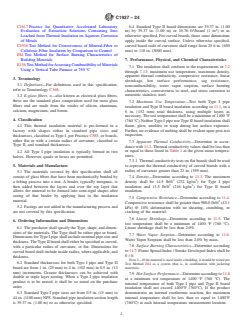
7.1 The insulation shall conform to the requirements in 7.2
Using a Vertical Tube Furnace at 750 °C
through 7.13: maximum use temperature, maximum density,
apparent thermal conductivity, compressive resistance, linear
3. Terminology
shrinkage, hot surface performance, sag resistance,
3.1 Definitions—For definitions used in this specification,
noncombustibility, water vapor sorption, surface burning
refer to Terminology C168.
characteristics, corrosiveness to steel, and stress corrosion to
austenitic stainless steel.
3.2 E-glass fibers, n—also known as electrical glass fibers,
these are the standard glass composition used for most glass
7.2 Maximum Use Temperature—Test both Type I pipe
fibers and are made from the oxides of silicon, aluminum,
insulation and Type II board insulation according to 11.1, in a
calcium, magnesium, and boron.
6 in. (152 mm) total thickness, using multiple layers as
necessary. The test temperature shall be a minimum of 1400 °F
4. Classification
(760 °C) Neither Type I pipe nor Type II board insulation shall
flame, glow, smolder, or warp during hot surface exposure.
4.1 This thermal insulation material is pre-formed in a
Further, no evidence of melting shall be evident upon post-test
factory with shapes either in standard pipe sizes and
inspection.
thicknesses, classified as Type I, per Practice C585, or boards,
either flat or with a certain radius of curvature, classified as
7.3 Apparent Thermal Conductivity—Determine in accor-
Type II, and standard thicknesses.
dance with 11.2. Thermal conductivity values shall be less than
or equal to those listed in Table 1 at the given mean tempera-
4.2 All Type I pipe insulation is typically formed in two
halves. However, quads or hexes are permitted. tures.
7.3.1 Thermal conductivity tests on flat boards shall be used
5. Materials and Manufacture to represent the thermal conductivity of curved boards with a
radius of curvature greater than 22 in. (559 mm).
5.1 The materials covered by this specification shall all
consist of glass fibers that have been mechanically bonded by 7.4 Density—Determine according to 11.3. The maximum
3 3
a felting process into a mat. A binder, typically inorganic, is density shall be 14.5 lb/ft (232 kg/m ) for Type I pipe
3 3
then added between the layers and over the top layer that insulation and 13.5 lb/ft (216 kg/m ) for Type II board
allows the material to be formed into semi-rigid shapes after insulation.
curing of that binder by applying heat to the insulation
7.5 Compressive Resistance—Determine according to 11.4.
material. 2
Compressive resistance shall be greater than 900.0 lb/ft (43.1
5.2 Facings are not added in the manufacturing process and kPa) @ 10% deformation with no shearing, crumbling, or
are not covered by this specification.
cracking of the material.
7.6 Linear Shrinkage—Determine according to 11.5. The
6. Ordering Information and Dimensions
test temperature shall be a minimum of 1400 °F (760 °C).
6.1 The purchaser shall specify the Type, shape, and dimen-
Linear shrinkage shall be less than 2.0%.
sions of the materials. The Type shall be either pipe or board.
7.7 Water Vapor Sorption—Determine according to 11.6.
Dimensions for Type I pipe shall include nominal pipe size and
Water Vapor Sorption shall be less than 2.0% by mass.
thickness. The Type II board shall either be specified as curved,
7.8 Surface Burning Characteristics—Determine according
with a particular radius of curvature, or flat. Dimensions for
to 11.7. Flame Spread Index / Smoke Developed Index shall be
curved board shall include inside radius, where applicable, and
0 / 0.
thickness.
NOTE 1—If the material is used inside a building, it should be tested per
6.2 Standard thicknesses for both Type I pipe and Type II
Test Method E84 as a system (that is, in combination with jacketing
board are from 1 in. (25 mm) to 4 in. (102 mm) in 0.5 in. (13
materials).
mm) increments. Greater thicknesses can be achieved with
7.9 Hot Surface Performance—Determine according to 11.8
double or triple layer nesting. When a Type I pipe insulation
at a minimum test temperature of 1400 °F (760 °C). The
product is to be nested, it shall be so stated on the purchase
internal temperature of both Type I pipe and Type II board
order.
insulation shall not exceed 1400°F (760°C). If the product
6.3 Standard Type I pipe sizes are from 0.5 in. (15 mm) to demonstrates an internal exothermic reaction, the maximum
44 in. (1100 mm) NPS. Standard pipe insulation section length internal temperature shall be less than or equal to 1400°F
is 39.37 in. (1.00 m) or as otherwise specified. (760°C) at each internal temperature measurement location.
C1937 − 24
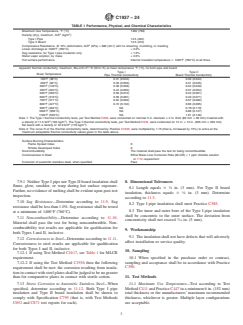
TABLE 1 Performance, Physical, and Chemical Characteristics
Maximum Use Temperature, °F (°C) 1400 (760)
3 3
Density (dry), maximum, lb/ft (kg/m )
Type I Pipe 14.5 (232)
Type II Board 13.5 (216)
Compressive Resistance, @ 10% deformation, lb/ft (kPa) > 900 (43.1) with no shearing, crumbling, or cracking
Linear shrinkage at 1400°F (760°C) < 2.0%
Sag resistance, for Type I pipe insulation only < 1.0%
Water vapor sorption, by mass < 2.0%
Hot surface performance Internal insulation temperature # 1400°F (760°C) at all times
Apparent thermal conductivity, maximum, Btu-in/hr-ft -°R (W/m-°K) at mean temperature °F (°C), for both pipe and board:
Type I Type II
Mean Temperature
Pipe Thermal Conductivity Board Thermal Conductivity
100°F (38°C) 0.31 (0.044) 0.30 (0.044)
200°F (93°C) 0.35 (0.050) 0.31 (0.045)
300°F (149°C) 0.39 (0.056) 0.34 (0.049)
400°F (204°C) 0.44 (0.063) 0.37 (0.054)
500°F (260°C) 0.50 (0.072) 0.43 (0.061)
600°F (316°C) 0.56 (0.081) 0.49 (0.071)
700°F (371°C) 0.64 (0.092) 0.57 (0.082)
800°F (427°C) 0.72 (0.104) 0.66 (0.095)
900°F (482°C) NA 0.76 (0.110)
1000°F (538°C) NA 0.88 (0.127)
1100°F (593°C) NA 1.01 (0.146)
Note 1: The Type I thermal conductivity tests, per Test Method C335, were conducted on nominal 3 in. diameter × 2 in. thick (80 mm × 50 mm) material with
3 3
a density of 11.5 lb/ft (185 kg/m ). The Type II thermal conduct
...