

ASTM E3066-20
(Practice)Standard Practice for Evaluating Relative Sustainability Involving Energy or Chemicals from Biomass
General Information
- Abstract
SCOPE
1.1 This standard practice provides a science-based methodology for evaluating the relative sustainability of options involving energy or chemicals derived from biomass. Options may involve products, processes, or projects.
1.2 The methodology includes setting goals and objectives, identifying stakeholders, selecting appropriate indicators, and evaluating the relative sustainability of options where at least one option is available from biomass.
1.3 The objectives are to facilitate fair comparison of options, focus efforts on practical indicators reflecting stakeholder priorities, and support continual improvement for more sustainable outcomes.
1.4 The purpose of this standard practice is not to declare something as sustainable or not sustainable but to help users assess, compare, and rank options based on specific goals and objectives.
1.5 This standard does not purport to address all of the safety concerns, if any, associated with its use. It is the responsibility of the user of this standard to establish appropriate safety, health, and environmental practices and determine the applicability of regulatory limitations prior to use.
1.6 This international standard was developed in accordance with internationally recognized principles on standardization established in the Decision on Principles for the Development of International Standards, Guides and Recommendations issued by the World Trade Organization Technical Barriers to Trade (TBT) Committee.
- Status
- Published
- Publication Date
- 30-Apr-2020
- Technical Committee
- E48 - Bioenergy and Industrial Chemicals from Biomass
Buy Documents
ASTM E3066-20 - Standard Practice for Evaluating Relative Sustainability Involving Energy or Chemicals from Biomass
REDLINE ASTM E3066-20 - Standard Practice for Evaluating Relative Sustainability Involving Energy or Chemicals from Biomass
Overview
ASTM E3066-20: Standard Practice for Evaluating Relative Sustainability Involving Energy or Chemicals from Biomass provides a robust, science-based methodology for evaluating and comparing the sustainability of options related to energy or chemical production from biomass. This international standard, developed by ASTM, is focused on enabling users to assess and rank the relative sustainability of products, processes, or projects, driving improved outcomes in the bioenergy and biochemicals sectors.
Unlike eco-labels or certification schemes, ASTM E3066-20 does not seek to declare if something is or is not sustainable. Instead, it enables fair and context-specific comparison between options-where at least one relies on biomass-by utilizing measurable indicators and consistent evaluation plans, aligning approaches with international best practices.
Key Topics
- Goal Setting and Context: Define specific sustainability goals and consideration of the unique context for each project (geographical, socio-economic, regulatory).
- Stakeholder Engagement: Identification and meaningful involvement of stakeholders is emphasized to clarify priorities and inform indicator selection.
- Selection of Science-Based Indicators: Key indicators are chosen to reflect environmental, social, and economic performance. These must be measurable, science-based, and relevant to priorities.
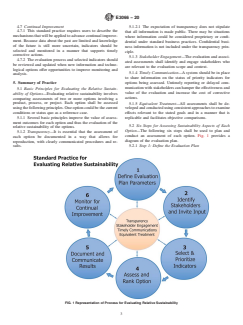
- Evaluation Process: A transparent, iterative process is followed:
- Defining an evaluation plan
- Identifying stakeholders and collecting input
- Selecting and prioritizing indicators
- Assessing and ranking options based on indicator results
- Documenting and communicating findings
- Using monitoring to support continual improvement
- Relative Sustainability: Focuses on comparing options, identifying trade-offs, and supporting decisions that result in more sustainable outcomes over time, rather than claiming absolute sustainability.
Applications
ASTM E3066-20 is applicable for organizations and projects seeking to:
- Assess Bioenergy and Biochemical Pathways: Support internal decision-making by comparing the relative sustainability of various biomass conversion technologies or feedstock choices.
- Guide Product or Process Development: Evaluate new products or process changes for their sustainability impacts by referencing practical, prioritized indicators.
- Support Stakeholder Communication: Engage internal and external stakeholders with clear, transparent documentation and presentation of sustainability trade-offs.
- Continuous Improvement: Implement ongoing monitoring plans to drive incremental improvements, guided by up-to-date data on key indicators.
- Stay Aligned with International Best Practices: By employing methodologies rooted in globally accepted life cycle assessment and sustainability frameworks, ASTM E3066-20 ensures compatibility with broader sustainability reporting efforts.
Common examples include comparing bio-based chemicals to petrochemical alternatives, evaluating different biomass feedstocks, or assessing project proposals in renewable energy initiatives.
Related Standards
For comprehensive and consistent sustainability assessments, ASTM E3066-20 references or complements several international standards, including:
- ASTM E1705: Terminology relating to biotechnology, providing consistency in definitions.
- ISO 14040 / ISO 14044: Environmental management – Life cycle assessment (LCA) principles, framework, requirements, and guidelines.
- ISO 13065: Sustainability criteria for bioenergy, establishing requirements for credible sustainability assessments.
- Other Relevant Guidelines: Integration with recognized concepts such as the “three pillars of sustainability” (environmental, economic, social) and alignment with the World Trade Organization’s Technical Barriers to Trade (TBT) principles.
Practical Value
Implementing ASTM E3066-20 helps organizations:
- Ensure transparent, replicable sustainability comparisons
- Tailor sustainability assessments to stakeholder priorities and local context
- Make informed decisions that promote continual improvement and resource efficiency
- Meet regulatory expectations and support international trade through consistent, objective methods
By following ASTM E3066-20, users benefit from a structured approach that advances sustainability in the energy and chemical sectors through objective, stakeholder-engaged, and science-based evaluation.
Relations
- Effective Date
- 01-May-2020
- Effective Date
- 01-Nov-2013
- Effective Date
- 01-May-2011
- Effective Date
- 15-Apr-1995
- Effective Date
- 01-Jan-1995
- Effective Date
- 01-May-2020
Buy Documents
ASTM E3066-20 - Standard Practice for Evaluating Relative Sustainability Involving Energy or Chemicals from Biomass
REDLINE ASTM E3066-20 - Standard Practice for Evaluating Relative Sustainability Involving Energy or Chemicals from Biomass
Get Certified
Connect with accredited certification bodies for this standard

DNV
DNV is an independent assurance and risk management provider.

BSI Group
BSI (British Standards Institution) is the business standards company that helps organizations make excellence a habit.

Bureau Veritas
Bureau Veritas is a world leader in laboratory testing, inspection and certification services.
Sponsored listings
Frequently Asked Questions
ASTM E3066-20 is a standard published by ASTM International. Its full title is "Standard Practice for Evaluating Relative Sustainability Involving Energy or Chemicals from Biomass". This standard covers: SCOPE 1.1 This standard practice provides a science-based methodology for evaluating the relative sustainability of options involving energy or chemicals derived from biomass. Options may involve products, processes, or projects. 1.2 The methodology includes setting goals and objectives, identifying stakeholders, selecting appropriate indicators, and evaluating the relative sustainability of options where at least one option is available from biomass. 1.3 The objectives are to facilitate fair comparison of options, focus efforts on practical indicators reflecting stakeholder priorities, and support continual improvement for more sustainable outcomes. 1.4 The purpose of this standard practice is not to declare something as sustainable or not sustainable but to help users assess, compare, and rank options based on specific goals and objectives. 1.5 This standard does not purport to address all of the safety concerns, if any, associated with its use. It is the responsibility of the user of this standard to establish appropriate safety, health, and environmental practices and determine the applicability of regulatory limitations prior to use. 1.6 This international standard was developed in accordance with internationally recognized principles on standardization established in the Decision on Principles for the Development of International Standards, Guides and Recommendations issued by the World Trade Organization Technical Barriers to Trade (TBT) Committee.
SCOPE 1.1 This standard practice provides a science-based methodology for evaluating the relative sustainability of options involving energy or chemicals derived from biomass. Options may involve products, processes, or projects. 1.2 The methodology includes setting goals and objectives, identifying stakeholders, selecting appropriate indicators, and evaluating the relative sustainability of options where at least one option is available from biomass. 1.3 The objectives are to facilitate fair comparison of options, focus efforts on practical indicators reflecting stakeholder priorities, and support continual improvement for more sustainable outcomes. 1.4 The purpose of this standard practice is not to declare something as sustainable or not sustainable but to help users assess, compare, and rank options based on specific goals and objectives. 1.5 This standard does not purport to address all of the safety concerns, if any, associated with its use. It is the responsibility of the user of this standard to establish appropriate safety, health, and environmental practices and determine the applicability of regulatory limitations prior to use. 1.6 This international standard was developed in accordance with internationally recognized principles on standardization established in the Decision on Principles for the Development of International Standards, Guides and Recommendations issued by the World Trade Organization Technical Barriers to Trade (TBT) Committee.
ASTM E3066-20 is classified under the following ICS (International Classification for Standards) categories: 13.020.60 - Product life-cycles; 27.190 - Biological sources and alternative sources of energy. The ICS classification helps identify the subject area and facilitates finding related standards.
ASTM E3066-20 has the following relationships with other standards: It is inter standard links to ASTM E3066-16a, ASTM E1705-13, ASTM E1705-11, ASTM E1705-95(2002), ASTM E1705-95, ASTM E3256-20. Understanding these relationships helps ensure you are using the most current and applicable version of the standard.
ASTM E3066-20 is available in PDF format for immediate download after purchase. The document can be added to your cart and obtained through the secure checkout process. Digital delivery ensures instant access to the complete standard document.
Standards Content (Sample)
This international standard was developed in accordance with internationally recognized principles on standardization established in the Decision on Principles for the
Development of International Standards, Guides and Recommendations issued by the World Trade Organization Technical Barriers to Trade (TBT) Committee.
Designation: E3066 − 20
Standard Practice for
Evaluating Relative Sustainability Involving Energy or
Chemicals from Biomass
This standard is issued under the fixed designation E3066; the number immediately following the designation indicates the year of
original adoption or, in the case of revision, the year of last revision. A number in parentheses indicates the year of last reapproval. A
superscript epsilon (´) indicates an editorial change since the last revision or reapproval.
1. Scope 2.2 ISO Standard:
ISO 13065 Sustainability Criteria for Bioenergy
1.1 This standard practice provides a science-based meth-
odology for evaluating the relative sustainability of options
3. Terminology
involving energy or chemicals derived from biomass. Options
may involve products, processes, or projects. 3.1 For general terminology, refer to Terminology E1705.
1.2 The methodology includes setting goals and objectives,
NOTE 1—The user is advised that the definitions used by various
identifying stakeholders, selecting appropriate indicators, and industries, marketers, and regulatory bodies can differ from those in this
standard. It is the responsibility of the user to ensure that the terms used
evaluating the relative sustainability of options where at least
in a particular context are clearly understood.
one option is available from biomass.
3.2 Definitions:
1.3 The objectives are to facilitate fair comparison of
3.2.1 biomass, n—substance wholly comprised of living or
options, focus efforts on practical indicators reflecting stake-
recently living (nonfossil) material.
holder priorities, and support continual improvement for more
3.2.1.1 Discussion—Sometimes referred to as “renewable
sustainable outcomes.
organic material,” examples of biomass include whole or parts
1.4 The purpose of this standard practice is not to declare
of plants, trees, aquatic organisms, animals, algae, and micro-
something as sustainable or not sustainable but to help users
organisms.
assess, compare, and rank options based on specific goals and
3.2.2 context, n—the historical conditions, trends, and other
objectives.
forces that influence or define the measurement and interpre-
1.5 This standard does not purport to address all of the
tation of environmental, economic, and social indicators in a
safety concerns, if any, associated with its use. It is the
specific place and time.
responsibility of the user of this standard to establish appro-
3.2.3 continual improvement, n—a systematic, iterative pro-
priate safety, health, and environmental practices and deter-
cess of identifying and evaluating options and selecting those
mine the applicability of regulatory limitations prior to use.
that provide incremental improvements toward achieving de-
1.6 This international standard was developed in accor-
fined goals and objectives.
dance with internationally recognized principles on standard-
3.2.4 indicator, n—specific, science-based, observable, and
ization established in the Decision on Principles for the
measurable characteristic.
Development of International Standards, Guides and Recom-
3.2.4.1 Discussion—Indicators can be used to assess
mendations issued by the World Trade Organization Technical
environmental, social, or economic conditions of a system, to
Barriers to Trade (TBT) Committee.
assess effects of activities on phenomena of concern, or to
2. Referenced Documents
monitor trends in conditions over time. (1)
2.1 ASTM Standards:
3.2.5 measure, v—quantifythesize,amount,ordegreeusing
E1705 Terminology Relating to Biotechnology
a science-based approach and appropriate unit(s).
3.2.6 relative sustainability, n—theresultofacomparisonof
This practice is under the jurisdiction of ASTM Committee E48 on Bioenergy
two or more options that enables the evaluation of costs,
and Industrial Chemicals from Biomass and is the direct responsibility of Subcom-
mittee E48.80 on Sustainability of Bioenergy and Industrial Chemicals from
benefits, and trade-offs.
Biomass.
Current edition approved May 1, 2020. Published May 2020. Originally
approved in 2016. Last previous edition approved in 2016 as E3066 – 16a. DOI:
10.1520/E3066–20. Available from International Organization for Standardization (ISO), ISO
For referenced ASTM standards, visit the ASTM website, www.astm.org, or Central Secretariat, BIBC II, Chemin de Blandonnet 8, CP 401, 1214 Vernier,
contact ASTM Customer Service at service@astm.org. For Annual Book of ASTM Geneva, Switzerland, http://www.iso.org.
Standards volume information, refer to the standard’s Document Summary page on The boldface numbers in parentheses refer to the list of references at the end of
the ASTM website. this standard.
Copyright © ASTM International, 100 Barr Harbor Drive, PO Box C700, West Conshohocken, PA 19428-2959. United States
E3066 − 20
3.2.6.1 Discussion—Relative sustainability involves a de- in a more sustainable outcome under one set of conditions may
fined application of goals, objectives, and indicators within a not produce a more sustainable outcome under other condi-
specified context. tions.
3.2.6.2 Discussion—For additional information, see 4.2.3. 4.3.2 Defining context and identifying stakeholders depend
on the proposed goals of an evaluation. Typically, the evalua-
3.2.7 science-based, adj—applying principles and practices
tion goals are directly linked to the options to be assessed.
that employ the scientific method.
Objectives and context help establish the appropriate scope
3.2.7.1 Discussion—The scientific method is a process of
including the temporal and spatial boundaries. Assessments
testing a hypothesis based on evidence and typically involves
should focus on a scale that facilitates stakeholder engagement
objective observation, experiment, critical analysis,
and enables researchers to collect and analyze data for activi-
verification, replication, and induction.
ties that are causally linked to locally defined problems and
3.2.8 stakeholder, n—individual, group, or organization that
observable values.
can affect or be directly affected by the options being evalu-
4.3.3 Aclearly defined project purpose, addressing a clearly
ated.
articulated problem, will help establish boundaries that facili-
3.2.8.1 Discussion—The identification of stakeholders de-
tate constructive stakeholder engagement.
pends on the specific product, process, or project, and its
4.3.4 Stakeholder input is important to help identify and
context. Stakeholders may vary over time and can include
prioritize indicators and evaluation goals. Stakeholders also
regulatory bodies, customers, neighbors, employees, suppliers,
contribute to considering trade-offs, identifying sources of
and surrogates.
information, and supporting ongoing work (monitoring) to-
3.2.9 sustainability, n—aspirational concept denoting the
ward continual improvement.
capacity to meet current needs while maintaining options for
4.3.5 Transparent communication is a prerequisite for con-
future generations to meet their needs. (2); (3); (4)
structive stakeholder engagement. Transparency helps develop
3.2.9.1 Discussion—For additional information, see 4.2.1.
trust among parties and is a cornerstone for an evaluation of
3.3 Definitions of Terms Specific to This Standard: relative sustainability and the future monitoring and evaluation
3.3.1 assessment, n—collecting and analyzing data for the required for continual improvement.
selected indicators.
4.4 Science-based Indicators
3.3.2 evaluation, n—a systematic, iterative process for com-
4.4.1 The assessment of options shall be based on relevant
paring options using prioritized science-based indicators and
indicators. Separate standards should be cited and employed to
comparing the assessments while considering the trade-offs
assure replicable, science-based methods are used to measure
based on identified goals and boundary conditions.
each indicator.
3.3.2.1 Discussion—Within this standard practice, the
4.4.2 This standard practice encourages the development of
evaluation may be referred to as the “evaluation plan” or
new science-based indicators for areas of stakeholder concern
simply “the plan.”
that are not yet adequately defined in standards.
4.4.3 See Appendix X1 for examples of science-based,
4. Discussion of Concepts
measurable indicators.
4.1 Concepts used in this practice can differ from their use
4.5 Comparison of Options
in other sustainability certification standards and schemes.
4.5.1 Comparing the relative sustainability of options typi-
cally involves the interpretation of data related to past events
4.2 Evaluating Relative Sustainability
and conditions (historical baseline) as well as goals and
4.2.1 Sustainability does not imply a steady state or an
expectations about the future that are inherent when document-
absolute value; for human activity to be “sustainable,” change
ing and comparing the effects of a proposed option to the
or adaptation over time is required. To make the concept of
effects of an alternative or “business as usual” option.
sustainability operational, objectives must be defined within a
specified context, stakeholders engaged, and consistent ap-
4.6 More Sustainable Outcomes
proaches applied to facilitate comparable, science-based as-
4.6.1 An evaluation of relative sustainability is limited to
sessments (2-5).
identifying what appears to be a better way of achieving
4.2.2 Environmental, economic, and social changes are
specified goals within a defined context and based on selected
inevitable. Staying on course toward goals entails an iterative
indicators. More sustainable outcomes necessarily consider the
process and adaptation to changing contextual conditions.
value of conserving non-renewable resources for future gen-
4.2.3 Evaluation of relative sustainability is supported by
erations (1). The ability to compare options and guide deci-
science-based analysis of environmental, economic, and social
sions to support more sustainable outcomes is compromised if
indicators of conditions associated with the options under
the assessment of one or more options relies on generalized
consideration. The evaluation process includes documenting
data that do not capture the priorities and trade-offs involved in
costs, benefits, and trade-offs among selected environmental,
the specified context.
economic, and social indicators.
4.6.2 An evaluation of relative sustainability involves en-
4.3 Context and Stakeholders gaging stakeholders to identify priorities and build consensus
4.3.1 Determining the context for evaluating the relative around what being “more sustainable” means within the
sustainability is a critical step.Adecision or action that results specified context.
E3066 − 20
4.7 Continual Improvement 5.1.2.1 The expectation of transparency does not stipulate
4.7.1 This standard practice requires users to describe the that all information is made public. There may be situations
mechanismsthatwillbeappliedtoadvancecontinualimprove-
where information could be considered proprietary or confi-
ment. Because data about the past are limited and knowledge
dential under standard business practices. Confidential busi-
of the future is still more uncertain, indicators should be
ness information is not included under the transparency prin-
selected and monitored in a manner that supports timely
ciple.
corrective actions.
5.1.3 Stakeholder Engagement—The evaluation and associ-
4.7.2 The evaluation process and selected indicators should
ated assessments shall identify and engage stakeholders who
be reviewed and updated when new information and techno-
are relevant to the evaluation scope and context.
logical options offer opportunities to improve monitoring and
5.1.4 Timely Communication—A system should be in place
analysis.
to share information on the status of priority indicators for
5. Summary of Practice
options being assessed. Untimely reporting or delayed com-
munication with stakeholders can hamper the effectiveness and
5.1 Basic Principles for Evaluating the Relative Sustain-
value of the evaluation and increase the cost of corrective
ability of Options—Evaluating relative sustainability involves
actions.
comparing assessments of two or more options involving a
product, process, or project. Each option shall be assessed 5.1.5 Equivalent Treatment—All assessments shall be de-
using the following principles. One option could be the current
velopedandconductedusingconsistentapproachestoexamine
conditions or status quo as a reference case.
effects relevant to the stated goals and in a manner that is
5.1.1 Several basic principles improve the value of assess-
replicable and facilitates objective comparisons.
ment outcomes for each option and thus the evaluation of the
5.2 Six Steps for Assessing Sustainability Aspects of Each
relative sustainability of the options.
Option—The following si
...
This document is not an ASTM standard and is intended only to provide the user of an ASTM standard an indication of what changes have been made to the previous version. Because
it may not be technically possible to adequately depict all changes accurately, ASTM recommends that users consult prior editions as appropriate. In all cases only the current version
of the standard as published by ASTM is to be considered the official document.
Designation: E3066 − 16a E3066 − 20
Standard Practice for
Evaluating Relative Sustainability Involving Energy or
Chemicals from Biomass
This standard is issued under the fixed designation E3066; the number immediately following the designation indicates the year of
original adoption or, in the case of revision, the year of last revision. A number in parentheses indicates the year of last reapproval. A
superscript epsilon (´) indicates an editorial change since the last revision or reapproval.
1. Scope
1.1 This standard practice provides a science-based methodology for evaluating the relative sustainability of options involving
energy or chemicals derived from biomass. Options may involve products, processes, or projects.
1.2 The methodology includes setting goals and objectives, identifying stakeholders, selecting appropriate indicators, and
evaluating the relative sustainability of options where at least one option is available from biomass.
1.3 The objectives are to facilitate fair comparison of options, focus efforts on practical indicators reflecting stakeholder
priorities, and support continual improvement for more sustainable outcomes.
1.4 The purpose of this standard practice is not to declare something as sustainable or not sustainable but to help users assess,
compare, and rank options based on specific goals and objectives.
1.5 This standard does not purport to address all of the safety concerns, if any, associated with its use. It is the responsibility
of the user of this standard to establish appropriate safety safety, health, and healthenvironmental practices and determine the
applicability of regulatory limitations prior to use.
1.6 This international standard was developed in accordance with internationally recognized principles on standardization
established in the Decision on Principles for the Development of International Standards, Guides and Recommendations issued
by the World Trade Organization Technical Barriers to Trade (TBT) Committee.
2. Referenced Documents
2.1 ASTM Standards:
E1705 Terminology Relating to Biotechnology
2.2 ISO Standards:Standard:
ISO 14040 Environmental Management—Life Cycle Assessment—Principles and framework
ISO 14044 Life Cycle Assessment—Requirements and Guidelines
ISO 13065 Sustainability Criteria for Bioenergy
3. Terminology
3.1 For general terminology, refer to Terminology E1705.
NOTE 1—The user is advised that the definitions used by various industries, marketers, and regulatory bodies can differ from those in this standard.
It is the responsibility of the user to ensure that the terms used in a particular context are clearly understood.
3.2 Definitions:
3.2.1 biomass, n—substance wholly comprised of living or recently living (nonfossil) material.
3.2.1.1 Discussion—
This practice is under the jurisdiction of ASTM Committee E48 on Bioenergy and Industrial Chemicals from Biomass and is the direct responsibility of Subcommittee
E48.80 on Sustainability of Bioenergy and Industrial Chemicals from Biomass.
Current edition approved Dec. 1, 2016May 1, 2020. Published January 2017May 2020. Originally approved in 2016. Last previous edition approved in 2016 as
E3066E3066 – 16a.–16. DOI: E3066–16A.10.1520/E3066–20.
For referenced ASTM standards, visit the ASTM website, www.astm.org, or contact ASTM Customer Service at service@astm.org. For Annual Book of ASTM Standards
volume information, refer to the standard’s Document Summary page on the ASTM website.
Available from International Organization for Standardization (ISO), ISO Central Secretariat, BIBC II, Chemin de Blandonnet 8, CP 401, 1214 Vernier, Geneva,
Switzerland, http://www.iso.org.
Copyright © ASTM International, 100 Barr Harbor Drive, PO Box C700, West Conshohocken, PA 19428-2959. United States
E3066 − 20
Sometimes referred to as “renewable organic material,” examples of biomass include whole or parts of plants, trees, aquatic
organisms, animals, algae, and micro-organisms.
3.2.2 continual improvement, n—a systematic, iterative process of identifying and evaluating options and selecting those that
provide incremental improvements toward achieving defined goals and objectives.
3.2.2 context, n—the historical conditions, trends, and other forces that influence or define the measurement and interpretation
of environmental, economic, and social indicators in a specific place and time.
3.2.3 continual improvement, n—a systematic, iterative process of identifying and evaluating options and selecting those that
provide incremental improvements toward achieving defined goals and objectives.
3.2.4 indicator, n—specific, science-based, observable, and measurable characteristic.
3.2.4.1 Discussion—
Indicators can be used to assess environmental, social, or economic conditions of a system, to assess effects of activities on
phenomena of concern, or to monitor trends in conditions over time. (1)
3.2.5 measure, v—quantify the size, amount, or degree using a science-based approach and appropriate unit(s).
3.2.6 relative sustainability, n—the result of a comparison of two or more options that enables the evaluation of costs, benefits,
and trade-offs.
3.2.6.1 Discussion—
Relative sustainability involves a defined application of goals, objectives, and indicators within a specified context.
3.2.6.2 Discussion—
For additional information, see 4.2.3.
3.2.7 science-based, adj—applying principles and practices that employ the scientific method.
3.2.7.1 Discussion—
The scientific method is a process of testing a hypothesis based on evidence and typically involves objective observation,
experiment, critical analysis, verification, repetition,replication, and induction.
3.2.8 stakeholder, n—individual, group, or organization that can affect or be directly affected by the options being evaluated.
3.2.8.1 Discussion—
The identification of stakeholders depends on the specific product, process, or project, and its context. Stakeholders may vary over
time and can include regulatory bodies, customers, neighbors, employees, suppliers, and surrogates.
3.2.9 sustainability, n—aspirational concept denoting the capacity to meet current needs while maintaining options for future
generations to meet their needs. (2); (3); (4)
3.2.9.1 Discussion—
For additional information, see 4.2.1.
3.2.9 relative sustainability, n—a comparison of two or more options that enables the evaluation of costs, benefits, and trade-offs
that apply goals, objectives, and indicators within a specified context.
3.2.9.1 Discussion—
for additional information see 4.2.3.
3.3 Definitions of Terms Specific to This Standard:
3.3.1 assessment, n—collecting and analyzing data for the indicators selected in an evaluation plan.selected indicators.
The boldface numbers in parentheses refer to athe list of references at the end of this standard.
E3066 − 20
3.3.2 evaluation, n—a systematic, iterative process for comparing options using prioritized science-based indicators and
comparing the assessments while considering the trade-offs based on identified goals and boundary conditions.
3.3.2.1 Discussion—
Within this standard practice, the evaluation may be referred to as the “evaluation plan” or simply “the plan.”
4. Discussion of Concepts
4.1 Concepts used in this practice can differ from their use in other sustainability certification standards and schemes.
4.2 Evaluating Relative Sustainability
4.2.1 Sustainability does not imply a steady state or an absolute value; for human activity to be “sustainable,” change or
adaptation over time is required. To make the concept of sustainability operational, objectives must be defined within a specified
context, stakeholders engaged, and consistent approaches applied to facilitate comparable, science-based assessments (2-5).
4.2.2 Environmental, economic, and social changes are inevitable. Staying on course toward goals entails an iterative process
and adaptation to changing contextual conditions.
4.2.3 Evaluation of relative sustainability is supported by science-based analysis of environmental, economic, and social
indicators of conditions associated with the options under consideration. The evaluation process includes documenting costs,
benefits, and trade-offs among selected environmental, economic, and social indicators.
4.3 Context and Stakeholders
4.3.1 Determining the context for evaluating the relative sustainability is a critical step. A decision or action that results in a
more sustainable outcome under one set of conditions may not produce a more sustainable outcome under other conditions.
4.3.2 Defining context and identifying stakeholders depend on the proposed goals of an evaluation. Typically, the evaluation
goals are directly linked to the options to be assessed. Objectives and context help establish the appropriate scope including the
temporal and spatial boundaries. Assessments should focus on a scale that facilitates stakeholder engagement and enables
researchers to collect and analyze data for activities that are causally linked to locally defined problems and observable values.
4.3.3 A clearly defined project purpose, addressing a clearly articulated problem, will help establish boundaries that facilitate
constructive stakeholder engagement.
4.3.4 Stakeholder input is important to help identify and prioritize indicators and evaluation goals. Stakeholders also contribute
to considering trade-offs, identifying sources of information, and supporting ongoing work (monitoring) toward continual
improvement.
4.3.5 Transparent communication is a prerequisite for constructive stakeholder engagement. Transparency helps develop trust
among parties and is a cornerstone for an evaluation of relative sustainability and the future monitoring and evaluation required
for continual improvement.
4.4 Science-based Indicators
4.4.1 The assessment of options shall be based on relevant indicators. Separate standards should be cited and employed to assure
replicable, science-based methods are used to measure each indicator.
4.4.2 This standard practice encourages the development of new science-based indicators for areas of stakeholder concern that
are not yet adequately defined in standards.
4.4.3 See Appendix X1 for examples of science-based, measurable indicators.
4.5 Comparison of Options
4.5.1 Comparing the relative sustainability of options typically involves the interpretation of data related to past events and
conditions (historical baseline) as well as goals and expectations about the future that are inherent when documenting and
comparing the effects of a proposed option to the effects of an alternative or “business as usual” option.
4.6 More Sustainable Outcomes
4.6.1 An evaluation of relative sustainability is limited to identifying what appears to be a better way of achieving specified
goals within a defined context and based on selected indicators. More sustainable outcomes necessarily consider the value of
conserving non-renewable resources for future generations (1). The ability to compare options and guide decisions to support more
sustainable outcomes is compromised if the assessment of one or more options relies on generalized data that do not capture the
priorities and trade-offs involved in the specified context.
4.6.2 An evaluation of relative sustainability involves engaging stakeholders to identify priorities and build consensus around
what being “more sustainable” means within the specified context.
4.7 Continual Improvement
4.7.1 This standard practice requires users to describe the mechanisms that will be applied to advance continual improvement.
Because data about the past are limited and knowledge of the future is still more uncertain, indicators should be selected and
monitored in a manner that supports timely corrective actions.
E3066 − 20
4.7.2 The evaluation process and selected indicators should be reviewed and updated when new information and technological
options offer opportunities to improve monitoring and analysis.
5. Summary of Practice
5.1 Basic Principles for Evaluating the Relative Sustainability of Options—Evaluating relative sustainability involves
comparing assessments of two or more options involving a product, process, or project. Each option shall be assessed using the
following principles. One option could be the current conditions or status quo as a reference case.
5.1.1 Several basic principles improve the value of assessment outcomes for each option and thus the evaluation of the relative
sustainability of the options.
5.1.2 Transparency—It is essential that the assessment of each option be documented in a way that allows for reproduction, with
clearly communicated procedures and results.
5.1.2.1 The expectation of transparency does not stipulate that all information is made public. There may be situations where
information could be considered proprietary or confidential under standard business practices. Confidential business information
is not included under the transparency principle.
5.1.3 Stakeholder Engagement—The evaluation and associated assessments shall identify and engage stakeholders who are
relevant to the evaluation scope and context.
5.1.4 Timely Communication—A system should be in place to share information on the status of priority indicators for options
being assessed. U
...