

ASTM F1315-17
(Test Method)Standard Test Method for Density of a Sheet Gasket Material
General Information
- Abstract
SIGNIFICANCE AND USE
4.1 Density is an important property of a gasket material, since it has an inverse relationship to the void volume of the material. Density is often used in a specification, since relationships to sealability, compressibility, creep relaxation, and tensile strength can be found for a given gasket grade.
4.2 Density is a measurement of the mass to the volume ratio and therefore easily determined with a weight scale and thickness measuring device. This test method requires from 1 h to two days of sample conditioning, which is necessary to achieve a high level of precision, but which detracts from its usefulness as a production test method. Where it must be modified for manufacturing control, it is recommended that thickness and weight measurement methods be adhered to strictly.
SCOPE
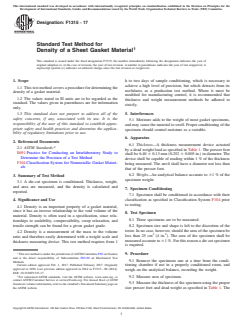
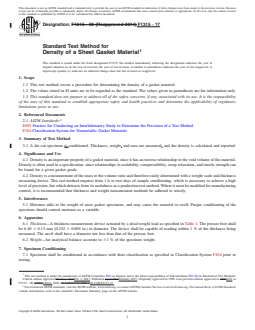
1.1 This test method covers a procedure for determining the density of a gasket material.
1.2 The values stated in SI units are to be regarded as the standard. The values given in parentheses are for information only.
1.3 This standard does not purport to address all of the safety concerns, if any, associated with its use. It is the responsibility of the user of this standard to establish appropriate safety and health practices and determine the applicability of regulatory limitations prior to use.
- Status
- Published
- Publication Date
- 31-Jan-2017
- Technical Committee
- F03 - Gaskets
- Drafting Committee
- F03.20 - Mechanical Test Methods




Overview
ASTM F1315-17 is the standard test method established by ASTM International for determining the density of sheet gasket material. Density is a critical property in gasket production and specification because it directly correlates with the material’s void volume and impacts other essential characteristics, such as sealability, compressibility, creep relaxation, and tensile strength. This standard provides a reliable and precise laboratory procedure to calculate the mass-to-volume ratio of nonmetallic gasket materials, supporting consistent quality control and product performance.
Key Topics
- Significance of Density: The density of a sheet gasket material reveals information about the internal structure and void content. It is often used in material specifications to predict related properties influencing application suitability.
- Test Method Procedure:
- Preparation and conditioning of a die-cut specimen according to classification requirements.
- Measurement of specimen thickness with a standardized presser foot and dead weight.
- Precise weighing of the specimen using an analytical balance.
- Calculation of density using mass, thickness, and area measurements.
- Sample Conditioning: Proper conditioning-often required for up to two days-ensures that moisture content is controlled and does not influence results.
- Measurement Accuracy: The method requires strict adherence to specified techniques for thickness and weight measurement, which is essential for lab reproducibility and interlaboratory comparison.
- Limitations: While suitable for laboratory settings, longer conditioning times make this standard less ideal for rapid production testing. When adapted for process control, all measurement protocols must be observed closely.
- Safety Considerations: The standard reminds users to implement appropriate safety and health practices and evaluate any regulatory limitations.
Applications
ASTM F1315-17 serves multiple practical roles in the gasket manufacturing and quality assurance industries:
- Quality Control: Helps manufacturers verify that sheet gasket materials meet density specifications, ensuring reliable sealing performance in the final application.
- Material Comparison: Allows technical personnel to compare different gasket grades by a standardized metric, which can inform material selection, procurement, and engineering decisions.
- Specification Compliance: Supports compliance with industry standards and customer requirements by providing an objective, quantifiable measure of material consistency.
- Research and Development: Facilitates the evaluation of new or modified gasket materials where density is an indicator of formulation changes or process improvements.
- Laboratory Testing: Used as a basis for interlaboratory studies and for establishing statistical precision in test results across different facilities.
Related Standards
Users of ASTM F1315-17 may also find the following ASTM standards relevant for complementary testing and classification:
- ASTM E691 - Standard Practice for Conducting an Interlaboratory Study to Determine the Precision of a Test Method. Valuable for establishing reproducibility and precision in laboratory testing environments.
- ASTM F104 - Standard Classification System for Nonmetallic Gasket Materials. Provides material classification details and specifies conditioning protocols for test specimens.
Conclusion
Implementing ASTM F1315-17 for density determination of sheet gasket materials ensures consistent material performance, supports quality assurance programs, and assists in meeting customer and industry requirements. By following the procedures outlined in this standard, organizations can reliably compare, specify, and certify gasket materials for diverse sealing and gasketing applications. For further guidance or updates, always refer to the latest official ASTM documentation.
Relations
- Effective Date
- 01-Feb-2017
- Effective Date
- 01-May-2013
- Effective Date
- 01-Nov-2011
- Effective Date
- 01-Apr-2011
- Effective Date
- 01-Oct-2009
- Effective Date
- 01-Oct-2008
- Effective Date
- 01-Nov-2005
- Effective Date
- 10-Apr-2003
- Effective Date
- 10-Oct-2002
- Effective Date
- 10-Oct-2000
- Effective Date
- 10-May-1999
- Effective Date
- 01-Feb-2017
- Effective Date
- 01-Feb-2017
Frequently Asked Questions
ASTM F1315-17 is a standard published by ASTM International. Its full title is "Standard Test Method for Density of a Sheet Gasket Material". This standard covers: SIGNIFICANCE AND USE 4.1 Density is an important property of a gasket material, since it has an inverse relationship to the void volume of the material. Density is often used in a specification, since relationships to sealability, compressibility, creep relaxation, and tensile strength can be found for a given gasket grade. 4.2 Density is a measurement of the mass to the volume ratio and therefore easily determined with a weight scale and thickness measuring device. This test method requires from 1 h to two days of sample conditioning, which is necessary to achieve a high level of precision, but which detracts from its usefulness as a production test method. Where it must be modified for manufacturing control, it is recommended that thickness and weight measurement methods be adhered to strictly. SCOPE 1.1 This test method covers a procedure for determining the density of a gasket material. 1.2 The values stated in SI units are to be regarded as the standard. The values given in parentheses are for information only. 1.3 This standard does not purport to address all of the safety concerns, if any, associated with its use. It is the responsibility of the user of this standard to establish appropriate safety and health practices and determine the applicability of regulatory limitations prior to use.
SIGNIFICANCE AND USE 4.1 Density is an important property of a gasket material, since it has an inverse relationship to the void volume of the material. Density is often used in a specification, since relationships to sealability, compressibility, creep relaxation, and tensile strength can be found for a given gasket grade. 4.2 Density is a measurement of the mass to the volume ratio and therefore easily determined with a weight scale and thickness measuring device. This test method requires from 1 h to two days of sample conditioning, which is necessary to achieve a high level of precision, but which detracts from its usefulness as a production test method. Where it must be modified for manufacturing control, it is recommended that thickness and weight measurement methods be adhered to strictly. SCOPE 1.1 This test method covers a procedure for determining the density of a gasket material. 1.2 The values stated in SI units are to be regarded as the standard. The values given in parentheses are for information only. 1.3 This standard does not purport to address all of the safety concerns, if any, associated with its use. It is the responsibility of the user of this standard to establish appropriate safety and health practices and determine the applicability of regulatory limitations prior to use.
ASTM F1315-17 is classified under the following ICS (International Classification for Standards) categories: 21.140 - Seals, glands. The ICS classification helps identify the subject area and facilitates finding related standards.
ASTM F1315-17 has the following relationships with other standards: It is inter standard links to ASTM F1315-00(2014), ASTM E691-13, ASTM E691-11, ASTM F104-11, ASTM F104-03(2009), ASTM E691-08, ASTM E691-05, ASTM F104-03, ASTM F104-02e1, ASTM F104-00, ASTM E691-99, ASTM F1574-03a(2017), ASTM F104-11(2020). Understanding these relationships helps ensure you are using the most current and applicable version of the standard.
ASTM F1315-17 is available in PDF format for immediate download after purchase. The document can be added to your cart and obtained through the secure checkout process. Digital delivery ensures instant access to the complete standard document.
Standards Content (Sample)
This international standard was developed in accordance with internationally recognized principles on standardization established in the Decision on Principles for the
Development of International Standards, Guides and Recommendations issued by the World Trade Organization Technical Barriers to Trade (TBT) Committee.
Designation: F1315 − 17
Standard Test Method for
Density of a Sheet Gasket Material
This standard is issued under the fixed designation F1315; the number immediately following the designation indicates the year of
original adoption or, in the case of revision, the year of last revision. A number in parentheses indicates the year of last reapproval. A
superscript epsilon (´) indicates an editorial change since the last revision or reapproval.
1. Scope h to two days of sample conditioning, which is necessary to
achieve a high level of precision, but which detracts from its
1.1 This test method covers a procedure for determining the
usefulness as a production test method. Where it must be
density of a gasket material.
modified for manufacturing control, it is recommended that
1.2 The values stated in SI units are to be regarded as the
thickness and weight measurement methods be adhered to
standard. The values given in parentheses are for information
strictly.
only.
5. Interferences
1.3 This standard does not purport to address all of the
safety concerns, if any, associated with its use. It is the
5.1 Moisture adds to the weight of most gasket specimens,
responsibility of the user of this standard to establish appro-
and may cause the material to swell. Proper conditioning of the
priate safety and health practices and determine the applica-
specimen should control moisture as a variable.
bility of regulatory limitations prior to use.
6. Apparatus
2. Referenced Documents
6.1 Thickness—A thickness measurement device actuated
2.1 ASTM Standards:
by a dead weight load as specified in Table 1. The presser foot
E691 Practice for Conducting an Interlaboratory Study to
shall be 6.40 6 0.13 mm (0.252 6 0.005 in.) in diameter. The
Determine the Precision of a Test Method
device shall be capable of reading within 1 % of the thickness
F104 Classification System for Nonmetallic Gasket Materi-
being measured. The anvil shall have a diameter not less than
als
that of the presser foot.
6.2 Weight—An analytical balance accurate to 61%ofthe
3. Summary of Test Method
specimen weight.
3.1 A die-cut specimen is conditioned. Thickness, weight,
and area are measured, and the density is calculated and
7. Specimen Conditioning
reported.
7.1 Specimen shall be conditioned in accordance with their
classification as specified in Classification System F104 prior
4. Significance and Use
to testing.
4.1 Density is an important property of a gasket material,
since it has an inverse relationship to the void volume of the
8. Test Specimen
material. Density is often used in a specification, since rela-
8.1 Three specimens are to be measured.
tionships to sealability, compressibility, creep relaxation, and
tensile strength can be found for a given gasket grade.
8.2 Specimen size and shape is left to the discretion of the
tester. In no case, however, should the area of the specimen be
4.2 Density is a measurement of the mass to the volume
2 2
less than 25 cm (4 in. ). The area of the specimen shall be
ratio and therefore easily determined with a weight scale and
measured accurate to 61 %. For this reason a die cut specimen
thickness measuring device. This test method requires from 1
is required.
This test method is under the jurisdiction ofASTM Committee F03 on Gaskets 9. Procedure
and is the direct responsibility of Subcommittee F03.20 on Mechanical Test
9.1 Remove the specimens one at a time from the condi-
Methods.
Current edition approved Feb. 1, 2017. Published February 2017. Originally tioning chamber if not in a properly conditioned room, and
approved in 1990. Last previous edition approved in 2014 as F1315 – 00 (2014).
weigh on the analytical balance, recording the weight.
DOI: 10.1520/F1315
...
This document is not an ASTM standard and is intended only to provide the user of an ASTM standard an indication of what changes have been made to the previous version. Because
it may not be technically possible to adequately depict all changes accurately, ASTM recommends that users consult prior editions as appropriate. In all cases only the current version
of the standard as published by ASTM is to be considered the official document.
Designation: F1315 − 00 (Reapproved 2014) F1315 − 17
Standard Test Method for
Density of a Sheet Gasket Material
This standard is issued under the fixed designation F1315; the number immediately following the designation indicates the year of
original adoption or, in the case of revision, the year of last revision. A number in parentheses indicates the year of last reapproval. A
superscript epsilon (´) indicates an editorial change since the last revision or reapproval.
1. Scope
1.1 This test method covers a procedure for determining the density of a gasket material.
1.2 The values stated in SI units are to be regarded as the standard. The values given in parentheses are for information only.
1.3 This standard does not purport to address all of the safety concerns, if any, associated with its use. It is the responsibility
of the user of this standard to establish appropriate safety and health practices and determine the applicability of regulatory
limitations prior to use.
2. Referenced Documents
2.1 ASTM Standards:
E691 Practice for Conducting an Interlaboratory Study to Determine the Precision of a Test Method
F104 Classification System for Nonmetallic Gasket Materials
3. Summary of Test Method
3.1 A die-cut specimen is conditioned. Thickness, weight, and area are measured, and the density is calculated and reported.
4. Significance and Use
4.1 Density is an important property of a gasket material, since it has an inverse relationship to the void volume of the material.
Density is often used in a specification, since relationships to sealability, compressibility, creep relaxation, and tensile strength can
be found for a given gasket grade.
4.2 Density is a measurement of the mass to the volume ratio and therefore easily determined with a weight scale and thickness
measuring device. This test method requires from 1 h to two days of sample conditioning, which is necessary to achieve a high
level of precision, but which detracts from its usefulness as a production test method. Where it must be modified for manufacturing
control, it is recommended that thickness and weight measurement methods be adhered to strictly.
5. Interferences
5.1 Moisture adds to the weight of most gasket specimens, and may cause the material to swell. Proper conditioning of the
specimen should control moisture as a variable.
6. Apparatus
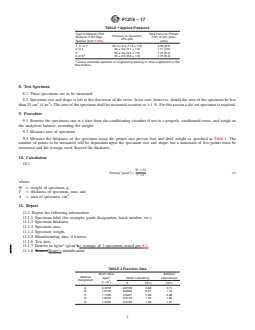
6.1 Thickness—A thickness measurement device actuated by a dead weight load as specified in Table 1. The presser foot shall
be 6.40 6 0.13 mm (0.252 6 0.005 in.) in diameter. The device shall be capable of reading within 1 % of the thickness being
measured. The anvil shall have a diameter not less than that of the presser foot.
6.2 Weight—An analytical balance accurate to 61 % of the specimen weight.
7. Specimen Conditioning
7.1 Specimen shall be conditioned in accordance with their classification as specified in Classification System F104 prior to
testing.
This test method is under the jurisdiction of ASTM Committee F03 on Gaskets and is the direct responsibility of Subcommittee F03.20 on Mechanical Test Methods.
Current edition approved March 1, 2014Feb. 1, 2017. Published April 2014February 2017. Originally approved in 1990. Last previous edition approved in 20062014 as
F1315 – 00 (2006).(2014). DOI: 10.1520/F1315-00R14.10.1520/F1315-17.
For referenced ASTM standards, visit the ASTM website, www.astm.org, or contact ASTM Customer Service at service@astm.org. For Annual Book of ASTM Standards
volume information, refer to the standard’s Document Summary page on the ASTM website.
Copyright © ASTM International, 100 Barr Harbor Drive, PO Box C700, West Conshohocken, PA 19428-2959. United States
F1315 − 17
TABLE 1 Applied Pre
...