

ASTM C1600/C1600M-23
(Specification)Standard Specification for Rapid Hardening Hydraulic Cement
General Information
- Abstract
ABSTRACT
This specification covers performance requirements for rapid hardening hydraulic cements. There are no restrictions on the compositions of the cement or its constituents. The specification classifies cements by type based on specific requirements for very early compressive strength development. The following are the four types of rapid hardening cement: (1) Type URH, ultra rapid hardening for use where high early strength is desired; (2) Type VRH, very rapid hardening for use where very high early strength is desired; (3) Type MRH, medium rapid hardening for use where mid-range hardening high early strength is desired; and (4) Type GRH, general rapid hardening for use when the higher strength properties of a Type VRH or a Type MRH cement is not required. Cement of the type specified shall conform to all of the applicable standard physical requirements for compressive strength and drying shrinkage. Cement shall be tested using the following methods: autoclave expansion; time of setting; compressive strength; drying shrinkage of mortar; heat of hydration; surface resistance; alkali silica resistivity; and expansion in water.
SCOPE
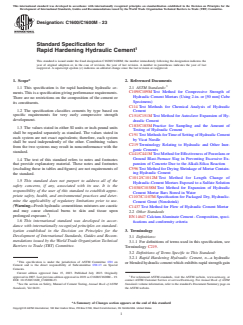
1.1 This specification is for rapid hardening hydraulic cements. This is a specification giving performance requirements. There are no restrictions on the composition of the cement or its constituents.
1.2 The specification classifies cements by type based on specific requirements for very early compressive strength development.
1.3 The values stated in either SI units or inch-pound units shall be regarded separately as standard. The values stated in each system are not exact equivalents; therefore, each system shall be used independently of the other. Combining values from the two systems may result in nonconformance with the standard.
1.4 The text of this standard refers to notes and footnotes that provide explanatory material. These notes and footnotes (excluding those in tables and figures) are not requirements of the standard.
1.5 This standard does not purport to address all of the safety concerns, if any, associated with its use. It is the responsibility of the user of this standard to establish appropriate safety, health, and environmental practices and determine the applicability of regulatory limitations prior to use. (Warning—Fresh hydraulic cementitious mixtures are caustic and may cause chemical burns to skin and tissue upon prolonged exposure.2)
1.6 This international standard was developed in accordance with internationally recognized principles on standardization established in the Decision on Principles for the Development of International Standards, Guides and Recommendations issued by the World Trade Organization Technical Barriers to Trade (TBT) Committee.
- Status
- Published
- Publication Date
- 14-Jun-2023
- Technical Committee
- C01 - Cement
- Drafting Committee
- C01.13 - Special Cements
Buy Documents
ASTM C1600/C1600M-23 - Standard Specification for Rapid Hardening Hydraulic Cement
REDLINE ASTM C1600/C1600M-23 - Standard Specification for Rapid Hardening Hydraulic Cement
Overview
ASTM C1600/C1600M-23 is the internationally recognized standard specification for rapid hardening hydraulic cements. Developed by ASTM International, this standard sets out the key performance and physical property requirements for hydraulic cements designed to develop high early compressive strength. The specification covers various types of rapid hardening cements and provides guidance on testing methods and classification. Notably, the standard does not restrict cement composition, giving producers flexibility while ensuring conformity to essential quality benchmarks.
Key Topics
Types of Rapid Hardening Hydraulic Cement
The standard defines and classifies five types:- Type URH (Ultra Rapid Hardening): For applications requiring ultra high early strength.
- Type VRH (Very Rapid Hardening): For projects demanding very high early strength.
- Type MRH (Medium Rapid Hardening): Delivers mid-range rapid hardening with high early strength.
- Type GRH (General Rapid Hardening): Suitable when the higher strengths of VRH or MRH are unnecessary.
- Type RH-CAC: Rapid hardening calcium aluminate cement requiring special conversion testing.
Performance Requirements
- Minimum compressive strength at various intervals (as early as 30 minutes and up to 28 days).
- Maximum permissible drying shrinkage.
- Limits on autoclave expansion, time of set, and other physical properties.
- Optional requirements for sulfate resistance, alkali-silica reactivity, and heat of hydration.
Testing Methods
The standard prescribes recognized ASTM procedures for:- Compressive strength (ASTM C109/C109M)
- Autoclave expansion (ASTM C151/C151M)
- Time of setting (ASTM C191)
- Drying shrinkage (ASTM C596)
- Alkali silica reactivity and expansion in water (ASTM C441/C441M, C1038/C1038M)
Certification, Marking, and Quality Control
- Manufacturer certification upon shipment, including test results and declaration of cement type.
- Clear marking on all packaging indicating cement type and specification details.
- Guidance for sampling, storage, inspection, and reporting procedures.
Applications
Rapid hardening hydraulic cements are essential in scenarios requiring quick turnaround, early load application, or time-sensitive repairs, such as:
- Highway and airfield pavements: Fast reopening to traffic after patching or slab replacement.
- Precast and prestressed concrete elements: Accelerated demolding and early handling.
- Emergency structural repairs: Rapid return to service in critical infrastructure.
- Cold weather concreting: Achieving strength milestones before exposure to freezing.
This standard is also referenced in construction projects where compliance with high early strength concrete is mandated. It supports quality assurance for producers and contractors, reducing downtime and maintenance cycles.
Related Standards
Several ASTM and international standards complement ASTM C1600/C1600M-23, supporting comprehensive hydraulic cement testing and application:
- ASTM C109/C109M: Test Method for Compressive Strength of Hydraulic Cement Mortars
- ASTM C151/C151M: Test Method for Autoclave Expansion of Hydraulic Cement
- ASTM C191: Test Methods for Time of Setting of Hydraulic Cement by Vicat Needle
- ASTM C596: Test Method for Drying Shrinkage of Mortar Containing Hydraulic Cement
- ASTM C1012/C1012M: Test Method for Length Change of Hydraulic-Cement Mortars Exposed to Sulfate Solution
- EN 14647: International standard for calcium aluminate cement composition and conformity
Practical Value
Implementing ASTM C1600/C1600M-23 ensures:
- Verified rapid strength development for construction efficiency.
- Standardized physical performance across cement types and suppliers.
- Defined quality controls for safety and durability.
- Clear communication between producers, buyers, and regulatory bodies.
Keywords: rapid hardening hydraulic cement, high early strength, ASTM C1600, concrete repair, precast concrete, compressive strength, cement specification, quality assurance, construction materials.
Relations
- Effective Date
- 01-Apr-2024
- Effective Date
- 01-Apr-2024
- Effective Date
- 01-Apr-2024
- Effective Date
- 15-Dec-2023
- Refers
ASTM C596-23 - Standard Test Method for Drying Shrinkage of Mortar Containing Hydraulic Cement - Effective Date
- 01-Dec-2023
- Effective Date
- 01-Dec-2023
- Effective Date
- 01-Oct-2023
- Effective Date
- 01-Aug-2020
- Effective Date
- 01-Apr-2020
- Refers
ASTM C1107/C1107M-20 - Standard Specification for Packaged Dry, Hydraulic-Cement Grout (Nonshrink) - Effective Date
- 01-Feb-2020
- Effective Date
- 15-Dec-2019
- Effective Date
- 15-Nov-2019
- Effective Date
- 01-Jun-2019
- Effective Date
- 15-Dec-2018
- Refers
ASTM C596-18 - Standard Test Method for Drying Shrinkage of Mortar Containing Hydraulic Cement - Effective Date
- 01-Dec-2018
Buy Documents
ASTM C1600/C1600M-23 - Standard Specification for Rapid Hardening Hydraulic Cement
REDLINE ASTM C1600/C1600M-23 - Standard Specification for Rapid Hardening Hydraulic Cement
Get Certified
Connect with accredited certification bodies for this standard

DIBt (Deutsches Institut für Bautechnik)
German Institute for Building Technology.
DIN CERTCO
DIN Group product certification.

Aboma Certification B.V.
Specialized in construction, metal, and transport sectors.
Sponsored listings
Frequently Asked Questions
ASTM C1600/C1600M-23 is a technical specification published by ASTM International. Its full title is "Standard Specification for Rapid Hardening Hydraulic Cement". This standard covers: ABSTRACT This specification covers performance requirements for rapid hardening hydraulic cements. There are no restrictions on the compositions of the cement or its constituents. The specification classifies cements by type based on specific requirements for very early compressive strength development. The following are the four types of rapid hardening cement: (1) Type URH, ultra rapid hardening for use where high early strength is desired; (2) Type VRH, very rapid hardening for use where very high early strength is desired; (3) Type MRH, medium rapid hardening for use where mid-range hardening high early strength is desired; and (4) Type GRH, general rapid hardening for use when the higher strength properties of a Type VRH or a Type MRH cement is not required. Cement of the type specified shall conform to all of the applicable standard physical requirements for compressive strength and drying shrinkage. Cement shall be tested using the following methods: autoclave expansion; time of setting; compressive strength; drying shrinkage of mortar; heat of hydration; surface resistance; alkali silica resistivity; and expansion in water. SCOPE 1.1 This specification is for rapid hardening hydraulic cements. This is a specification giving performance requirements. There are no restrictions on the composition of the cement or its constituents. 1.2 The specification classifies cements by type based on specific requirements for very early compressive strength development. 1.3 The values stated in either SI units or inch-pound units shall be regarded separately as standard. The values stated in each system are not exact equivalents; therefore, each system shall be used independently of the other. Combining values from the two systems may result in nonconformance with the standard. 1.4 The text of this standard refers to notes and footnotes that provide explanatory material. These notes and footnotes (excluding those in tables and figures) are not requirements of the standard. 1.5 This standard does not purport to address all of the safety concerns, if any, associated with its use. It is the responsibility of the user of this standard to establish appropriate safety, health, and environmental practices and determine the applicability of regulatory limitations prior to use. (Warning—Fresh hydraulic cementitious mixtures are caustic and may cause chemical burns to skin and tissue upon prolonged exposure.2) 1.6 This international standard was developed in accordance with internationally recognized principles on standardization established in the Decision on Principles for the Development of International Standards, Guides and Recommendations issued by the World Trade Organization Technical Barriers to Trade (TBT) Committee.
ABSTRACT This specification covers performance requirements for rapid hardening hydraulic cements. There are no restrictions on the compositions of the cement or its constituents. The specification classifies cements by type based on specific requirements for very early compressive strength development. The following are the four types of rapid hardening cement: (1) Type URH, ultra rapid hardening for use where high early strength is desired; (2) Type VRH, very rapid hardening for use where very high early strength is desired; (3) Type MRH, medium rapid hardening for use where mid-range hardening high early strength is desired; and (4) Type GRH, general rapid hardening for use when the higher strength properties of a Type VRH or a Type MRH cement is not required. Cement of the type specified shall conform to all of the applicable standard physical requirements for compressive strength and drying shrinkage. Cement shall be tested using the following methods: autoclave expansion; time of setting; compressive strength; drying shrinkage of mortar; heat of hydration; surface resistance; alkali silica resistivity; and expansion in water. SCOPE 1.1 This specification is for rapid hardening hydraulic cements. This is a specification giving performance requirements. There are no restrictions on the composition of the cement or its constituents. 1.2 The specification classifies cements by type based on specific requirements for very early compressive strength development. 1.3 The values stated in either SI units or inch-pound units shall be regarded separately as standard. The values stated in each system are not exact equivalents; therefore, each system shall be used independently of the other. Combining values from the two systems may result in nonconformance with the standard. 1.4 The text of this standard refers to notes and footnotes that provide explanatory material. These notes and footnotes (excluding those in tables and figures) are not requirements of the standard. 1.5 This standard does not purport to address all of the safety concerns, if any, associated with its use. It is the responsibility of the user of this standard to establish appropriate safety, health, and environmental practices and determine the applicability of regulatory limitations prior to use. (Warning—Fresh hydraulic cementitious mixtures are caustic and may cause chemical burns to skin and tissue upon prolonged exposure.2) 1.6 This international standard was developed in accordance with internationally recognized principles on standardization established in the Decision on Principles for the Development of International Standards, Guides and Recommendations issued by the World Trade Organization Technical Barriers to Trade (TBT) Committee.
ASTM C1600/C1600M-23 is classified under the following ICS (International Classification for Standards) categories: 91.100.10 - Cement. Gypsum. Lime. Mortar. The ICS classification helps identify the subject area and facilitates finding related standards.
ASTM C1600/C1600M-23 has the following relationships with other standards: It is inter standard links to ASTM C219-24, ASTM C1038/C1038M-24, ASTM C1012/C1012M-24, ASTM C109/C109M-23, ASTM C596-23, ASTM C151/C151M-23, ASTM C114-23, ASTM C219-20a, ASTM C219-20, ASTM C1107/C1107M-20, ASTM C1038/C1038M-19, ASTM C219-19a, ASTM C219-19, ASTM C1012/C1012M-18b, ASTM C596-18. Understanding these relationships helps ensure you are using the most current and applicable version of the standard.
ASTM C1600/C1600M-23 is available in PDF format for immediate download after purchase. The document can be added to your cart and obtained through the secure checkout process. Digital delivery ensures instant access to the complete standard document.
Standards Content (Sample)
This international standard was developed in accordance with internationally recognized principles on standardization established in the Decision on Principles for the
Development of International Standards, Guides and Recommendations issued by the World Trade Organization Technical Barriers to Trade (TBT) Committee.
Designation: C1600/C1600M − 23
Standard Specification for
Rapid Hardening Hydraulic Cement
This standard is issued under the fixed designation C1600/C1600M; the number immediately following the designation indicates the
year of original adoption or, in the case of revision, the year of last revision. A number in parentheses indicates the year of last
reapproval. A superscript epsilon (´) indicates an editorial change since the last revision or reapproval.
1. Scope* 2. Referenced Documents
2.1 ASTM Standards:
1.1 This specification is for rapid hardening hydraulic ce-
C109/C109M Test Method for Compressive Strength of
ments. This is a specification giving performance requirements.
Hydraulic Cement Mortars (Using 2-in. or [50 mm] Cube
There are no restrictions on the composition of the cement or
Specimens)
its constituents.
C114 Test Methods for Chemical Analysis of Hydraulic
1.2 The specification classifies cements by type based on
Cement
specific requirements for very early compressive strength
C151/C151M Test Method for Autoclave Expansion of Hy-
development.
draulic Cement
C183/C183M Practice for Sampling and the Amount of
1.3 The values stated in either SI units or inch-pound units
Testing of Hydraulic Cement
shall be regarded separately as standard. The values stated in
C191 Test Methods for Time of Setting of Hydraulic Cement
each system are not exact equivalents; therefore, each system
by Vicat Needle
shall be used independently of the other. Combining values
C219 Terminology Relating to Hydraulic and Other Inor-
from the two systems may result in nonconformance with the
ganic Cements
standard.
C441/C441M Test Method for Effectiveness of Pozzolans or
Ground Blast-Furnace Slag in Preventing Excessive Ex-
1.4 The text of this standard refers to notes and footnotes
pansion of Concrete Due to the Alkali-Silica Reaction
that provide explanatory material. These notes and footnotes
C596 Test Method for Drying Shrinkage of Mortar Contain-
(excluding those in tables and figures) are not requirements of
ing Hydraulic Cement
the standard.
C1012/C1012M Test Method for Length Change of
1.5 This standard does not purport to address all of the
Hydraulic-Cement Mortars Exposed to a Sulfate Solution
safety concerns, if any, associated with its use. It is the
C1038/C1038M Test Method for Expansion of Hydraulic
responsibility of the user of this standard to establish appro-
Cement Mortar Bars Stored in Water
priate safety, health, and environmental practices and deter-
C1107/C1107M Specification for Packaged Dry, Hydraulic-
mine the applicability of regulatory limitations prior to use.
Cement Grout (Nonshrink)
(Warning—Fresh hydraulic cementitious mixtures are caustic
C1437 Test Method for Flow of Hydraulic Cement Mortar
and may cause chemical burns to skin and tissue upon
2.2 Other Standards
prolonged exposure. )
EN 14647 Calcium Aluminate Cement - Composition, speci-
1.6 This international standard was developed in accor-
fications and conformity criteria
dance with internationally recognized principles on standard-
ization established in the Decision on Principles for the 3. Terminology
Development of International Standards, Guides and Recom-
3.1 Definitions:
mendations issued by the World Trade Organization Technical
3.1.1 For definitions of terms used in this specification, see
Barriers to Trade (TBT) Committee.
Terminology C219.
3.2 Definitions of Terms Specific to This Standard:
3.2.1 Rapid Hardening Hydraulic Cement, n—a hydraulic
This specification is under the jurisdiction of ASTM Committee C01 on
or blended hydraulic cement which exhibits rapid strength gain
Cement and is the direct responsibility of Subcommittee C01.13 on Special
Cements.
Current edition approved June 15, 2023. Published July 2023. Originally
approved in 2007. Last previous edition approved in 2019 as C1600/C1600M – 19. For referenced ASTM standards, visit the ASTM website, www.astm.org, or
DOI: 10.1520/C1600_C1600M-23. contact ASTM Customer Service at service@astm.org. For Annual Book of ASTM
See the section on Safety, Manual of Cement Testing, Annual Book of ASTM Standards volume information, refer to the standard’s Document Summary page on
Standards, Vol 04.01. the ASTM website.
*A Summary of Changes section appears at the end of this standard
Copyright © ASTM International, 100 Barr Harbor Drive, PO Box C700, West Conshohocken, PA 19428-2959. United States
C1600/C1600M − 23
during the first 24 h of hydration, with or without other 7. Physical Properties
constituents, processing additions, and functional additions.
7.1 Cement of the type specified shall conform to all of the
applicable standard physical requirements in Table 1.
4. Nomenclature, Classifications and Use
7.2 The water/cement ratio used to determine strength
4.1 Cements conforming to this specification shall be des-
requirement compliance shall be reported in the manufacturer’s
ignated “Rapid Hardening Hydraulic Cement” by the producer
certification.
with the high early strength gain characteristic indicated by
7.3 The density for the cement is not specified. However,
type in accordance with the types described in 4.2.
the density shall be determined by the manufacturer and
4.2 The specification is for five types of rapid hardening
reported in the manufacturer’s certification.
cement as follows:
4.2.1 Type URH—Ultra Rapid Hardening For use where
8. Sampling
ultra high early strength is desired (see Table 1).
8.1 When the purchaser desires that the cement be sampled
4.2.2 Type VRH—Very Rapid Hardening For use where very
and tested to verify compliance with this specification, the
high early strength is desired (see Table 1).
finished cement shall be sampled in accordance with Practice
4.2.3 Type MRH—Medium Rapid Hardening for use where
C183/C183M at the mill or at the job site in accordance with
mid-range rapid hardening high early strength is desired (see
the purchaser’s requirements (see Note 1).
Table 1).
NOTE 1—Practice C183/C183M is not designed for manufacturing
4.2.4 Type GRH—General Rapid Hardening for use when
quality control and is not required for manufacturer’s certification.
the higher strength properties of a Type VRH or a Type MRH
cement is not required (see Table 1). 9. Test Methods
4.2.5 Type RH-CAC—Rapid hardening cement which re-
9.1 When testing cement for compliance with this
quires accelerated conversion testing (see Table 1).
specification, use the following methods, with modifications or
exceptions as indicated:
5. Ordering Information
9.1.1 Autoclave Expansion—Determine autoclave expan-
5.1 Orders for cement meeting the requirements of this
sion by Test Method C151/C151M as specified in Table 1.
specification shall include the following:
9.1.2 Time of Setting—Determine the time of setting using
5.1.1 This specification designation and date.
Test Method C191 as specified in Table 1. Immediately after
5.1.2 The quantity of cement desired.
molding the test specimen in the conical ring, determine the
5.1.3 The type of cement desired.
penetration of the needle at this time and every 3 min. until the
5.1.4 A request for the manufacturer’s certification, if de-
needle no longer penetrates to the bottom of the specimen, then
sired.
every 1 min. until final set is determined.
9.1.3 Compressive Strength—Determine compressive
6. Chemical Composition
strength using Test Method C109/C109M as modified herein.
6.1 The chemical composition for the cement is not speci- Tests shall be run at each age specified in Table 1. The mixing
fied. However, the purchaser shall have the option to request water requirement in Test Method C109/C109M shall be
the cement composition from the producer. If analyzed, the
adjusted to produce a flow of 110 6 5 as determined using Test
procedure used shall be Test Methods C114. Method C1437.
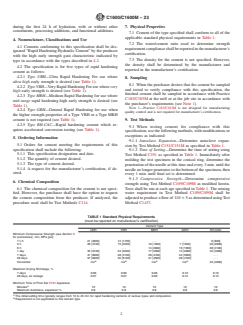
TABLE 1 Standard Physical Requirements
(must be reported on manufacturer’s certification)
Cement Type
URH VRH MRH GRH RH-CAC
Minimum Compressive Strength (see Section 9
for procedures), min, MPa [psi]
1 ⁄2 h 21 [3000] 12 [1700] . . . . . . 6 [800]
3 h 28 [4100] 15 [2200] 10 [1500] 7 [1000] 20 [2900]
6 h . . . . . . 14 [2000] 10 [1500] 28 [4100]
1 day 35 [5100] 24 [3500] 17 [2500] 14 [2000] 34 [4900]
7 days 41 [6000] 28 [4100] 28 [4100] 24 [3500] . . .
28 days 57 [8300] 35 [5100] 31 [4500] 28 [4100] . . .
B B B B
Converted n/a n/a n/a n/a 34 [4900]
Maximum Drying Shrinkage, %
7 days 0.06 0.06 0.08 0.10 0.10
28 days, air storage 0.07 0.07 0.09 0.12 0.12
Minimum Time of Final Set C191 Apparatus
A
Minutes 10 10 10 10 10
Maximum Autoclave, expansion % 0.8 0.8 0.8 0.8 0.8
A
The initial setting time typically ranges from 10 to 45 min for rapid hardening cements of various types and composition.
B
Requirement is not applicable to this cement type.
C1600/C160
...
This document is not an ASTM standard and is intended only to provide the user of an ASTM standard an indication of what changes have been made to the previous version. Because
it may not be technically possible to adequately depict all changes accurately, ASTM recommends that users consult prior editions as appropriate. In all cases only the current version
of the standard as published by ASTM is to be considered the official document.
Designation: C1600/C1600M − 19 C1600/C1600M − 23
Standard Specification for
Rapid Hardening Hydraulic Cement
This standard is issued under the fixed designation C1600/C1600M; the number immediately following the designation indicates the
year of original adoption or, in the case of revision, the year of last revision. A number in parentheses indicates the year of last
reapproval. A superscript epsilon (´) indicates an editorial change since the last revision or reapproval.
1. Scope*
1.1 This specification is for rapid hardening hydraulic cements. This is a specification giving performance requirements. There are
no restrictions on the composition of the cement or its constituents.
1.2 The specification classifies cements by type based on specific requirements for very early compressive strength development.
1.3 The values stated in either SI units or inch-pound units shall be regarded separately as standard. The values stated in each
system are not exact equivalents; therefore, each system shall be used independently of the other. Combining values from the two
systems may result in nonconformance with the standard.
1.4 The text of this standard refers to notes and footnotes that provide explanatory material. These notes and footnotes (excluding
those in tables and figures) are not requirements of the standard.
1.5 This standard does not purport to address all of the safety concerns, if any, associated with its use. It is the responsibility of
the user of this standard to establish appropriate safety and health practices and determine the applicability of regulatory
limitations prior to use. (Warning—Fresh hydraulic cementitious mixtures are caustic and may cause chemical burns to skin and
tissue upon prolonged exposure. )
1.5 This standard does not purport to address all of the safety concerns, if any, associated with its use. It is the responsibility
of the user of this standard to establish appropriate safety, health, and environmental practices and determine the applicability of
regulatory limitations prior to use. (Warning—Fresh hydraulic cementitious mixtures are caustic and may cause chemical burns
to skin and tissue upon prolonged exposure. )
1.6 This international standard was developed in accordance with internationally recognized principles on standardization
established in the Decision on Principles for the Development of International Standards, Guides and Recommendations issued
by the World Trade Organization Technical Barriers to Trade (TBT) Committee.
2. Referenced Documents
2.1 ASTM Standards:
C109/C109M Test Method for Compressive Strength of Hydraulic Cement Mortars (Using 2-in. or [50 mm] Cube Specimens)
C114 Test Methods for Chemical Analysis of Hydraulic Cement
C151/C151M Test Method for Autoclave Expansion of Hydraulic Cement
This test method specification is under the jurisdiction of ASTM Committee C01 on Cement and is the direct responsibility of Subcommittee C01.13 on Special Cements.
Current edition approved Dec. 15, 2019June 15, 2023. Published January 2020July 2023. Originally approved in 2007. Last previous edition approved in 20182019 as
C1600/C1600M – 18.C1600/C1600M – 19. DOI: 10.1520/C1600_C1600M-19.10.1520/C1600_C1600M-23.
See the section on Safety, Manual of Cement Testing, Annual Book of ASTM Standards, Vol 04.01.
For referenced ASTM standards, visit the ASTM website, www.astm.org, or contact ASTM Customer Service at service@astm.org. For Annual Book of ASTM Standards
volume information, refer to the standard’s Document Summary page on the ASTM website.
*A Summary of Changes section appears at the end of this standard
Copyright © ASTM International, 100 Barr Harbor Drive, PO Box C700, West Conshohocken, PA 19428-2959. United States
C1600/C1600M − 23
C183/C183M Practice for Sampling and the Amount of Testing of Hydraulic Cement
C186 Test Method for Heat of Hydration of Hydraulic Cement (Withdrawn 2019)
C191 Test Methods for Time of Setting of Hydraulic Cement by Vicat Needle
C219 Terminology Relating to Hydraulic and Other Inorganic Cements
C441/C441M Test Method for Effectiveness of Pozzolans or Ground Blast-Furnace Slag in Preventing Excessive Expansion of
Concrete Due to the Alkali-Silica Reaction
C596 Test Method for Drying Shrinkage of Mortar Containing Hydraulic Cement
C1012/C1012M Test Method for Length Change of Hydraulic-Cement Mortars Exposed to a Sulfate Solution
C1038/C1038M Test Method for Expansion of Hydraulic Cement Mortar Bars Stored in Water
C1107/C1107M Specification for Packaged Dry, Hydraulic-Cement Grout (Nonshrink)
C1437 Test Method for Flow of Hydraulic Cement Mortar
2.2 Other Standards
EN 14647 Calcium Aluminate Cement - Composition, specifications and conformity criteria
3. Terminology
3.1 Definitions:
3.1.1 For definitions of terms used in this specification, see Terminology C219.
3.2 Definitions of Terms Specific to This Standard:
3.2.1 Rapid Hardening Hydraulic Cement, n—a hydraulic or blended hydraulic cement which exhibits rapid strength gain during
the first 24 h of hydration, with or without other constituents, processing additions, and functional additions.
4. Nomenclature, Classifications and Use
4.1 Cements conforming to this specification shall be designated “Rapid Hardening Hydraulic Cement” by the producer with the
high early strength gain characteristic indicated by type in accordance with the types described in 4.2.
4.2 The specification is for five types of rapid hardening cement as follows:
4.2.1 Type URH—Ultra Rapid Hardening For use where ultra high early strength is desired (see Table 1).
4.2.2 Type VRH—Very Rapid Hardening For use where very high early strength is desired (see Table 1).
4.2.3 Type MRH—Medium Rapid Hardening for use where mid-range rapid hardening high early strength is desired (see Table
1).
TABLE 1 Standard Physical Requirements
(must be reported on manufacturer’s certification)
Cement Type
URH VRH MRH GRH RH-CAC
Minimum Compressive Strength (see Section 9
for procedures), min, MPa [psi]
1 ⁄2 h 21 [3000] 12 [1700] . . . . . . 6 [800]
3 h 28 [4100] 15 [2200] 10 [1500] 7 [1000] 20 [2900]
6 h . . . . . . 14 [2000] 10 [1500] 28 [4100]
1 day 35 [5100] 24 [3500] 17 [2500] 14 [2000] 34 [4900]
7 days 41 [6000] 28 [4100] 28 [4100] 24 [3500] . . .
28 days 57 [8300] 35 [5100] 31 [4500] 28 [4100] . . .
B B B B
Converted n/a n/a n/a n/a 34 [4900]
Maximum Drying Shrinkage, %
7 days 0.06 0.06 0.08 0.10 0.10
28 days, air storage 0.07 0.07 0.09 0.12 0.12
Minimum Time of Final Set C191 Apparatus
A
Minutes 10 10 10 10 10
Maximum Autoclave, expansion % 0.8 0.8 0.8 0.8 0.8
A
The initial setting time typically ranges from 10 to 45 min for rapid hardening cements of various types and composition.
B
Requirement is not applicable to this cement type.
C1600/C1600M − 23
4.2.4 Type GRH—General Rapid Hardening for use when the higher strength properties of a Type VRH or a Type MRH cement
is not required (see Table 1).
4.2.5 Type RH-CAC—Rapid hardening cement which requires accelerated conversion testing (see Table 1).
5. Ordering Information
5.1 Orders for cement meeting the requirements of this specification shall include the following:
5.1.1 This specification designation and date.
5.1.2 The quantity of cement desired.
5.1.3 The type of cement desired.
5.1.4 A request for the manufacturer’s certification, if desired.
6. Chemical Composition
6.1 The chemical composition for the cement is not specified. However, the purchaser shall have the option to request the cement
composition from the producer. If analyzed, the procedure used shall be Test Methods C114.
7. Physical Properties
7.1 Cement of the type specified shall conform to all of the applicable standard physical requirements in Table 1.
7.2 The water/cement ratio used to determine strength requirement compliance shall be reported in the manufacturer’s
certification.
7.3 The density for the cement is not specified. However, the density shall be determined by the manufacturer and reported in the
manufacturer’s certification.
8. Sampling
8.1 When the purchaser desires that the cement be sampled and tested to verify compliance with this specification, the finished
cement shall be sampled in accordance with Practice C183/C183M at the mill or at the job site in accordance with the purchaser’s
requirements (see Note 1).
NOTE 1—Practice C183/C183M is not designed for manufacturing quality control and is not required for manufacturer’s certification.
9. Test Methods
9.1 When testing cement for compliance with this specification, use the following methods, with modifications or exceptions as
indicated:
9.1.1 Autoclave Expansion—Determine autoclave expansion by Test Method C151/C151M as specified in Table 1.
9.1.2 Time of Setting—Determine the time of setting using Test Method C191 as specified in Table 1. Immediately after molding
the test specimen in the conical ring, determine the penetration of the needle at this time and every 3 min. until the needle no longer
penetrates to the bottom of the specimen, then every 1 min. until final set is determined.
9.1.3 Compressive Strength—Determine compressive strength using Test Method C109/C109M as modified herein. Tests shall be
run at each age specified in Table 1. The mixing water requirement in Test Method C109/C109M shall be adjusted to produce a
flow of 110 6 5 as determined using Test Method C1437.
9.1.3.1 Converted Strength—For Type RH-CAC only, determine converted strength using the water bath curing procedure in EN
14647 Annex A.7:
...