

ASTM E2984/E2984M-21
(Practice)Standard Practice for Acoustic Emission Examination of High Pressure, Low Carbon, Forged Piping using Controlled Hydrostatic Pressurization
General Information
- Abstract
SIGNIFICANCE AND USE
5.1 High pressure fluids being pumped in all oil field applications often stress iron pipes where subsequent failure can lead to injury to personnel or equipment. These forgings are typically constructed from 4700 series low carbon steel with a wall thickness in excess of 1.25 cm [0.5 in.], dependent on the manufacturers' specification. The standard method to certify that these iron segments can withstand operational pressures is to perform dye penetrant (PT) or magnetic particle penetrant (MT) tests, or both, to reveal defects (cracks and corrosion). As these methods are subject to interpretation by the human eye, it is desirable to employ a technique whereby a sensor based system can provide a signal to either pass or fail the test object. To that end, the acoustic emission (AE) method provides the requisite data from which acceptance/rejection can be made by a computer, taking the human out of the loop, providing that a human has correctly programmed the acceptance criteria. Most of these pipe segments are not linear, thus a 3D defect location method is desirable. The 3D source indication represents the spatial location of the defect without regard to its orientation, recognizing the source location is only approximate due to sound propagation through the part and water bath.
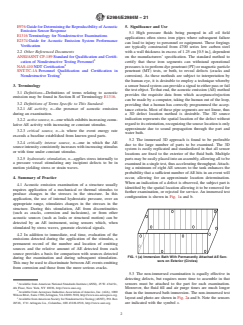
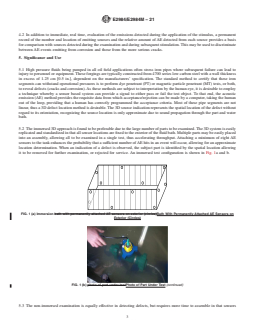
5.2 The immersed 3D approach is found to be preferable due to the large number of parts to be examined. The 3D system is easily replicated and standardized in that all sensor locations are fixed to the exterior of the fluid bath. Multiple parts may be easily placed into an assembly, allowing all to be examined in a single test, thus accelerating throughput. Attaching a minimum of eight AE sensors to the tank enhances the probability that a sufficient number of AE hits in an event will occur, allowing for an approximate location determination. When an indication of a defect is observed, the subject part is identified by the spatial location allowing it to be removed for further examination...
SCOPE
1.1 This practice is no longer being updated but is being retained for historical value as it represents the only AE practice using hydrostatic testing in which the sensors are not in direct contact with the part.
1.2 In the preferred embodiment, this practice examines immersed low carbon, forged piping being immersed in a water tank with the acoustic sensors permanently mounted on the tank walls rather than temporarily on the part itself. The pipes are monitored while being internally loaded (stressed) by hydrostatic means up to 1000 bar.
1.3 This practice examines either an immersed pipe, or non-immersed pipe being stressed by internal hydrostatic means to create acoustic emissions when cracks are present. However, the non-immersed method is time consuming, requiring placement and removal of sensors for each pipe inspected, while the immersed method has sensors permanently mounted, providing consistent sensor coupling to the tank-eliminating reinstallation. The non-immersed method is not recommended for the specified reasons and only the immersed method will be discussed throughout the remainder of the practice. This is similar to pressure vessel testing described in Practice E569, but uses hydrostatic means not included in that standard.
1.4 This Acoustic Emission (AE) method addresses examination for monitoring low carbon, forged piping systems being internally loaded (stressed) by hydrostatic means up to 1000 bar [15,000 psi] while being immersed in a water bath to facilitate sensor coupling.
1.5 The basic functions of an AE monitoring system are to detect, locate, and classify emission sources. Other methods of nondestructive testing (NDT) may be used to further evaluate the significance of acoustic emission sources.
1.6 This practice can be used to replace visual methods, which are unreliable and have significant safety risks.
1.7 This practice describes procedures to install and monitor acoustic...
- Status
- Published
- Publication Date
- 31-Oct-2021
- Technical Committee
- E07 - Nondestructive Testing
- Drafting Committee
- E07.04 - Acoustic Emission Method
Buy Documents
ASTM E2984/E2984M-21 - Standard Practice for Acoustic Emission Examination of High Pressure, Low Carbon, Forged Piping using Controlled Hydrostatic Pressurization
REDLINE ASTM E2984/E2984M-21 - Standard Practice for Acoustic Emission Examination of High Pressure, Low Carbon, Forged Piping using Controlled Hydrostatic Pressurization
Overview
ASTM E2984/E2984M-21 specifies the standard practice for the acoustic emission (AE) examination of high pressure, low carbon, forged piping using controlled hydrostatic pressurization. This standard, developed by ASTM International, provides comprehensive guidance on how to examine forged piping systems-primarily made of 4700 series low carbon steel-under internal hydrostatic loads up to 1000 bar (15,000 psi). The method is designed for oilfield and industrial applications where high-pressure fluids can stress pipes, potentially causing failure and associated safety risks.
This practice is historically significant as it is the only ASTM AE method using hydrostatic testing with sensors not mounted directly on the piping but on the exterior of the immersion tank, greatly aiding standardization and efficiency.
Key Topics
- Acoustic Emission Testing (AET): AE techniques detect sound waves produced by defect activity such as cracks or corrosion. These emissions enable real-time, non-destructive examination of pressure piping.
- Controlled Hydrostatic Pressurization: Pipes are subjected to gradually increasing internal water pressure while submerged. AE sensors detect and classify emissions indicating stress points or flaws.
- Sensor Placement and 3D Source Location: A minimum of eight AE sensors are permanently fixed to the tank walls, providing reliable, repeatable detection and approximate three-dimensional location of potential defects.
- Comparison to Traditional NDT Methods: AE testing can supplement or replace visual, dye penetrant (PT), and magnetic particle (MT) tests, minimizing human interpretation and increasing safety.
- Historical and Standardization Value: Though not updated further, the standard remains relevant for its unique approach to AE inspection, particularly for complex, non-linear pipe segments found in oilfields.
Applications
ASTM E2984/E2984M-21 finds practical use in several industrial settings:
- Oilfield Pressure Pipe Certification: Ensuring high pressure, low carbon forged piping is free from critical defects before use prevents hazardous failures in oil and gas applications.
- Batch Testing and Throughput Optimization: The immersed AE testing system enables multiple pipe sections to be screened simultaneously, accelerating testing in high-volume production environments.
- Replacement of Risky Visual Inspection: Automated AE methods reduce the subjectivity and safety hazards inherent in manual, visual piping inspections.
- Defect Detection and Location: The system not only detects the existence of flaws but can also estimate their location in three dimensions. This directs further detailed examination or immediate removal of defected parts from the service inventory.
Related Standards
ASTM E2984/E2984M-21 should be considered alongside several other standards that govern nondestructive testing and AE evaluation:
- ASTM E569: Practice for Acoustic Emission Monitoring of Structures During Controlled Stimulation. Similar in methodology but applies to other types of pressure vessel testing.
- ASTM E543: Specification for Agencies Performing Nondestructive Testing. Sets requirements for NDT organizations.
- ASTM E650, E750, E976, E2374: Guidelines covering sensor mounting, instrumentation characterization, reproducibility, and system performance verification for AE methods.
- ANSI/ASNT CP-189, NAS-410, SNT-TC-1A: Standards for qualification and certification of NDT personnel.
Practical Value
The adoption of ASTM E2984/E2984M-21 brings several benefits:
- Improved Detection Reliability: Permanent sensor placement and computer-aided analysis minimize human error and ensure consistent, repeatable test conditions.
- Enhanced Safety: Automated acoustic emission monitoring reduces personnel exposure to risk during high-pressure tests.
- Process Efficiency: The ability to test multiple piping sections simultaneously and quickly identify defective parts supports large-scale industrial inspection programs.
For organizations concerned with the integrity of high-pressure forged piping, especially in harsh environments, this standard provides an advanced, historically significant, and efficient nondestructive testing solution.
Keywords: acoustic emission testing, high pressure piping, hydrostatic pressurization, nondestructive examination, AE sensor location, ASTM E2984
Relations
- Effective Date
- 01-Feb-2024
- Effective Date
- 01-Jun-2020
- Effective Date
- 01-Dec-2019
- Effective Date
- 01-Mar-2019
- Effective Date
- 01-Jan-2018
- Effective Date
- 15-Jun-2017
- Effective Date
- 01-Feb-2017
- Effective Date
- 01-Aug-2016
- Effective Date
- 01-Feb-2016
- Effective Date
- 01-Dec-2015
- Effective Date
- 01-Dec-2015
- Effective Date
- 01-Dec-2015
- Effective Date
- 01-Sep-2015
- Effective Date
- 01-Jun-2014
- Effective Date
- 01-Jun-2014
Buy Documents
ASTM E2984/E2984M-21 - Standard Practice for Acoustic Emission Examination of High Pressure, Low Carbon, Forged Piping using Controlled Hydrostatic Pressurization
REDLINE ASTM E2984/E2984M-21 - Standard Practice for Acoustic Emission Examination of High Pressure, Low Carbon, Forged Piping using Controlled Hydrostatic Pressurization
Get Certified
Connect with accredited certification bodies for this standard

DIBt (Deutsches Institut für Bautechnik)
German Institute for Building Technology.
DIN CERTCO
DIN Group product certification.

Aboma Certification B.V.
Specialized in construction, metal, and transport sectors.
Sponsored listings
Frequently Asked Questions
ASTM E2984/E2984M-21 is a standard published by ASTM International. Its full title is "Standard Practice for Acoustic Emission Examination of High Pressure, Low Carbon, Forged Piping using Controlled Hydrostatic Pressurization". This standard covers: SIGNIFICANCE AND USE 5.1 High pressure fluids being pumped in all oil field applications often stress iron pipes where subsequent failure can lead to injury to personnel or equipment. These forgings are typically constructed from 4700 series low carbon steel with a wall thickness in excess of 1.25 cm [0.5 in.], dependent on the manufacturers' specification. The standard method to certify that these iron segments can withstand operational pressures is to perform dye penetrant (PT) or magnetic particle penetrant (MT) tests, or both, to reveal defects (cracks and corrosion). As these methods are subject to interpretation by the human eye, it is desirable to employ a technique whereby a sensor based system can provide a signal to either pass or fail the test object. To that end, the acoustic emission (AE) method provides the requisite data from which acceptance/rejection can be made by a computer, taking the human out of the loop, providing that a human has correctly programmed the acceptance criteria. Most of these pipe segments are not linear, thus a 3D defect location method is desirable. The 3D source indication represents the spatial location of the defect without regard to its orientation, recognizing the source location is only approximate due to sound propagation through the part and water bath. 5.2 The immersed 3D approach is found to be preferable due to the large number of parts to be examined. The 3D system is easily replicated and standardized in that all sensor locations are fixed to the exterior of the fluid bath. Multiple parts may be easily placed into an assembly, allowing all to be examined in a single test, thus accelerating throughput. Attaching a minimum of eight AE sensors to the tank enhances the probability that a sufficient number of AE hits in an event will occur, allowing for an approximate location determination. When an indication of a defect is observed, the subject part is identified by the spatial location allowing it to be removed for further examination... SCOPE 1.1 This practice is no longer being updated but is being retained for historical value as it represents the only AE practice using hydrostatic testing in which the sensors are not in direct contact with the part. 1.2 In the preferred embodiment, this practice examines immersed low carbon, forged piping being immersed in a water tank with the acoustic sensors permanently mounted on the tank walls rather than temporarily on the part itself. The pipes are monitored while being internally loaded (stressed) by hydrostatic means up to 1000 bar. 1.3 This practice examines either an immersed pipe, or non-immersed pipe being stressed by internal hydrostatic means to create acoustic emissions when cracks are present. However, the non-immersed method is time consuming, requiring placement and removal of sensors for each pipe inspected, while the immersed method has sensors permanently mounted, providing consistent sensor coupling to the tank-eliminating reinstallation. The non-immersed method is not recommended for the specified reasons and only the immersed method will be discussed throughout the remainder of the practice. This is similar to pressure vessel testing described in Practice E569, but uses hydrostatic means not included in that standard. 1.4 This Acoustic Emission (AE) method addresses examination for monitoring low carbon, forged piping systems being internally loaded (stressed) by hydrostatic means up to 1000 bar [15,000 psi] while being immersed in a water bath to facilitate sensor coupling. 1.5 The basic functions of an AE monitoring system are to detect, locate, and classify emission sources. Other methods of nondestructive testing (NDT) may be used to further evaluate the significance of acoustic emission sources. 1.6 This practice can be used to replace visual methods, which are unreliable and have significant safety risks. 1.7 This practice describes procedures to install and monitor acoustic...
SIGNIFICANCE AND USE 5.1 High pressure fluids being pumped in all oil field applications often stress iron pipes where subsequent failure can lead to injury to personnel or equipment. These forgings are typically constructed from 4700 series low carbon steel with a wall thickness in excess of 1.25 cm [0.5 in.], dependent on the manufacturers' specification. The standard method to certify that these iron segments can withstand operational pressures is to perform dye penetrant (PT) or magnetic particle penetrant (MT) tests, or both, to reveal defects (cracks and corrosion). As these methods are subject to interpretation by the human eye, it is desirable to employ a technique whereby a sensor based system can provide a signal to either pass or fail the test object. To that end, the acoustic emission (AE) method provides the requisite data from which acceptance/rejection can be made by a computer, taking the human out of the loop, providing that a human has correctly programmed the acceptance criteria. Most of these pipe segments are not linear, thus a 3D defect location method is desirable. The 3D source indication represents the spatial location of the defect without regard to its orientation, recognizing the source location is only approximate due to sound propagation through the part and water bath. 5.2 The immersed 3D approach is found to be preferable due to the large number of parts to be examined. The 3D system is easily replicated and standardized in that all sensor locations are fixed to the exterior of the fluid bath. Multiple parts may be easily placed into an assembly, allowing all to be examined in a single test, thus accelerating throughput. Attaching a minimum of eight AE sensors to the tank enhances the probability that a sufficient number of AE hits in an event will occur, allowing for an approximate location determination. When an indication of a defect is observed, the subject part is identified by the spatial location allowing it to be removed for further examination... SCOPE 1.1 This practice is no longer being updated but is being retained for historical value as it represents the only AE practice using hydrostatic testing in which the sensors are not in direct contact with the part. 1.2 In the preferred embodiment, this practice examines immersed low carbon, forged piping being immersed in a water tank with the acoustic sensors permanently mounted on the tank walls rather than temporarily on the part itself. The pipes are monitored while being internally loaded (stressed) by hydrostatic means up to 1000 bar. 1.3 This practice examines either an immersed pipe, or non-immersed pipe being stressed by internal hydrostatic means to create acoustic emissions when cracks are present. However, the non-immersed method is time consuming, requiring placement and removal of sensors for each pipe inspected, while the immersed method has sensors permanently mounted, providing consistent sensor coupling to the tank-eliminating reinstallation. The non-immersed method is not recommended for the specified reasons and only the immersed method will be discussed throughout the remainder of the practice. This is similar to pressure vessel testing described in Practice E569, but uses hydrostatic means not included in that standard. 1.4 This Acoustic Emission (AE) method addresses examination for monitoring low carbon, forged piping systems being internally loaded (stressed) by hydrostatic means up to 1000 bar [15,000 psi] while being immersed in a water bath to facilitate sensor coupling. 1.5 The basic functions of an AE monitoring system are to detect, locate, and classify emission sources. Other methods of nondestructive testing (NDT) may be used to further evaluate the significance of acoustic emission sources. 1.6 This practice can be used to replace visual methods, which are unreliable and have significant safety risks. 1.7 This practice describes procedures to install and monitor acoustic...
ASTM E2984/E2984M-21 is classified under the following ICS (International Classification for Standards) categories: 91.120.20 - Acoustics in building. Sound insulation; 91.140.60 - Water supply systems. The ICS classification helps identify the subject area and facilitates finding related standards.
ASTM E2984/E2984M-21 has the following relationships with other standards: It is inter standard links to ASTM E1316-24, ASTM E750-15(2020), ASTM E1316-19b, ASTM E1316-19, ASTM E1316-18, ASTM E1316-17a, ASTM E1316-17, ASTM E1316-16a, ASTM E1316-16, ASTM E1316-15a, ASTM E750-15, ASTM E2374-15, ASTM E1316-15, ASTM E1316-14, ASTM E1316-14e1. Understanding these relationships helps ensure you are using the most current and applicable version of the standard.
ASTM E2984/E2984M-21 is available in PDF format for immediate download after purchase. The document can be added to your cart and obtained through the secure checkout process. Digital delivery ensures instant access to the complete standard document.
Standards Content (Sample)
This international standard was developed in accordance with internationally recognized principles on standardization established in the Decision on Principles for the
Development of International Standards, Guides and Recommendations issued by the World Trade Organization Technical Barriers to Trade (TBT) Committee.
Designation: E2984/E2984M − 21
Standard Practice for
Acoustic Emission Examination of High Pressure, Low
Carbon, Forged Piping using Controlled Hydrostatic
Pressurization
ThisstandardisissuedunderthefixeddesignationE2984/E2984M;thenumberimmediatelyfollowingthedesignationindicatestheyear
of original adoption or, in the case of revision, the year of last revision. A number in parentheses indicates the year of last reapproval.
A superscript epsilon (´) indicates an editorial change since the last revision or reapproval.
1. Scope 1.6 This practice can be used to replace visual methods,
which are unreliable and have significant safety risks.
1.1 This practice is no longer being updated but is being
1.7 Thispracticedescribesprocedurestoinstallandmonitor
retained for historical value as it represents the only AE
acoustic emission resulting from local anomalies stimulated by
practice using hydrostatic testing in which the sensors are not
controlled hydrostatic pressure.
in direct contact with the part.
1.8 Other methods of nondestructive testing (NDT) may be
1.2 In the preferred embodiment, this practice examines
used to further evaluate the significance of acoustic emission
immersedlowcarbon,forgedpipingbeingimmersedinawater
sources.
tank with the acoustic sensors permanently mounted on the
tank walls rather than temporarily on the part itself. The pipes
1.9 Units—The values stated in either SI units or inch-
are monitored while being internally loaded (stressed) by
pound units are to be regarded separately as standard. The
hydrostatic means up to 1000 bar.
values stated in each system are not necessarily exact equiva-
lents; therefore, to ensure conformance with the standard, each
1.3 This practice examines either an immersed pipe, or
system shall be used independently of the other, and values
non-immersed pipe being stressed by internal hydrostatic
from the two systems shall not be combined.
means to create acoustic emissions when cracks are present.
However,thenon-immersedmethodistimeconsuming,requir- 1.10 This standard does not purport to address all of the
ing placement and removal of sensors for each pipe inspected, safety concerns, if any, associated with its use. It is the
while the immersed method has sensors permanently mounted, responsibility of the user of this standard to establish appro-
providing consistent sensor coupling to the tank-eliminating priate safety, health, and environmental practices and deter-
mine the applicability of regulatory limitations prior to use.
reinstallation. The non-immersed method is not recommended
for the specified reasons and only the immersed method will be 1.11 This international standard was developed in accor-
dance with internationally recognized principles on standard-
discussed throughout the remainder of the practice. This is
similar to pressure vessel testing described in Practice E569, ization established in the Decision on Principles for the
Development of International Standards, Guides and Recom-
but uses hydrostatic means not included in that standard.
mendations issued by the World Trade Organization Technical
1.4 This Acoustic Emission (AE) method addresses exami-
Barriers to Trade (TBT) Committee.
nation for monitoring low carbon, forged piping systems being
internally loaded (stressed) by hydrostatic means up to 1000
2. Referenced Documents
bar [15,000 psi] while being immersed in a water bath to 2
2.1 ASTM Standards:
facilitate sensor coupling.
E543 Specification for Agencies Performing Nondestructive
Testing
1.5 The basic functions of an AE monitoring system are to
detect, locate, and classify emission sources. Other methods of E569 Practice for Acoustic Emission Monitoring of Struc-
tures During Controlled Stimulation
nondestructive testing (NDT) may be used to further evaluate
the significance of acoustic emission sources. E650 Guide for Mounting Piezoelectric Acoustic Emission
Sensors
E750 Practice for Characterizing Acoustic Emission Instru-
mentation
This practice is under the jurisdiction of ASTM Committee E07 on Nonde-
structive Testing and is the direct responsibility of Subcommittee E07.04 on
Acoustic Emission Method. For referenced ASTM standards, visit the ASTM website, www.astm.org, or
Current edition approved Nov. 1, 2021. Published November 2021. Originally contact ASTM Customer Service at service@astm.org. For Annual Book of ASTM
approved in 2014. Last previous edition approved in 2014 as E2984/E2984M – 14. Standards volume information, refer to the standard’s Document Summary page on
DOI: 10.1520/E2984_E2984M-21. the ASTM website.
Copyright © ASTM International, 100 Barr Harbor Drive, PO Box C700, West Conshohocken, PA 19428-2959. United States
E2984/E2984M − 21
E976 GuideforDeterminingtheReproducibilityofAcoustic 5. Significance and Use
Emission Sensor Response
5.1 High pressure fluids being pumped in all oil field
E1316 Terminology for Nondestructive Examinations
applications often stress iron pipes where subsequent failure
E2374 Guide for Acoustic Emission System Performance
can lead to injury to personnel or equipment. These forgings
Verification
are typically constructed from 4700 series low carbon steel
2.2 Other Referenced Documents with a wall thickness in excess of 1.25 cm [0.5 in.], dependent
ANSI/ASNT CP-189 Standard for Qualification and Certifi- on the manufacturers’ specification. The standard method to
cation of Nondestructive Testing Personnel certify that these iron segments can withstand operational
NAS-410 NDT Certification pressures is to perform dye penetrant (PT) or magnetic particle
SNT-TC-1A Personnel Qualification and Certification in penetrant (MT) tests, or both, to reveal defects (cracks and
Nondestructive Testing corrosion). As these methods are subject to interpretation by
the human eye, it is desirable to employ a technique whereby
3. Terminology a sensor based system can provide a signal to either pass or fail
the test object. To that end, the acoustic emission (AE) method
3.1 Definitions—Definitions of terms relating to acoustic
provides the requisite data from which acceptance/rejection
emission may be found in Section B of Terminology E1316.
can be made by a computer, taking the human out of the loop,
3.2 Definitions of Terms Specific to This Standard:
providing that a human has correctly programmed the accep-
3.2.1 AE activity, n—the presence of acoustic emission
tance criteria. Most of these pipe segments are not linear, thus
during an examination.
a 3D defect location method is desirable. The 3D source
indication represents the spatial location of the defect without
3.2.2 active source, n—onewhichexhibitsincreasingcumu-
regard to its orientation, recognizing the source location is only
lative AE activity with increasing or constant stimulus.
approximate due to sound propagation through the part and
3.2.3 critical source, n—is where the event energy rate
water bath.
exceeds a baseline established from known good parts.
5.2 The immersed 3D approach is found to be preferable
3.2.4 critically intense source, n—one in which the AE
due to the large number of parts to be examined. The 3D
source intensity consistently increases with increasing stimulus
system is easily replicated and standardized in that all sensor
or with time under constant stimulus.
locations are fixed to the exterior of the fluid bath. Multiple
3.2.5 hydrostatic stimulation, n—applies stress internally to
parts may be easily placed into an assembly, allowing all to be
a pressure vessel stimulating any incipient defects to be in
examined in a single test, thus accelerating throughput.Attach-
motion yielding stress or strain waves.
ing a minimum of eight AE sensors to the tank enhances the
probability that a sufficient number ofAE hits in an event will
4. Summary of Practice occur, allowing for an approximate location determination.
When an indication of a defect is observed, the subject part is
4.1 Acoustic emission examination of a structure usually
identified by the spatial location allowing it to be removed for
requires application of a mechanical or thermal stimulus to
further examination, or rejected for service. An immersed test
produce changes in the stresses in the structure. In this
configuration is shown in Fig. 1a and b.
application, the use of internal hydrostatic pressure, over an
appropriate range, stimulates changes in the stresses in the
structure. During this stimulation, AE from discontinuities
(such as cracks, corrosion and inclusions), or from other
acoustic sources (such as leaks or structural motion) can be
detected by an AE instrument, using sensors which, when
stimulated by stress waves, generate electrical signals.
4.2 In addition to immediate, real time, evaluation of the
emissions detected during the application of the stimulus, a
permanent record of the number and location of emitting
sources and the relative amount of AE detected from each
source provides a basis for comparison with sources detected
FIG. 1 (a) Immersion Bath With Permanently Attached AE Sen-
during the examination and during subsequent stimulation.
sors on Exterior (Circles)
This may be used to discriminate between AE events emitting
from corrosion and those from the more serious cracks.
5.3 The non-immersed examination is equally effective in
detecting defects, but requires more time to assemble in that
sensors must be attached to the part for each examination.
Available from American National Standards Institute (ANSI), 25 W. 43rd St.,
4th Floor, New York, NY 10036, http://www.ansi.org.
Moreover, the fluid fill and air purge times are much longer
Available fromAerospace IndustriesAssociation ofAmerica, Inc. (AIA), 1000
than in the immersed bath immersion. The non-immersed test
WilsonBlvd.,Suite1700,Arlington,VA22209-3928,http://www.aia-aerospace.org.
layout and photo are shown in Fig. 2a and b. Note the sensors
AvailablefromAmericanSocietyforNondestructiveTesting(ASNT),P.O.Box
28518, 1711 Arlingate Ln., Columbus, OH 43228-0518, http://www.asnt.org. are indicated with the symbol x.
E2984/E2984M − 21
6.3 Qualification of Nondestructive Testing Agencies—If
specified in the contractual agreement, NDT agencies shall be
qualifiedandevaluatedasdescribedinSpecificationE543.The
applicable edition of Specification E543 shall be specified in
the contractual agreement.
6.4 Timing of Examination—The timing of the examination
shall be in accordance with a contractual agreement or with an
established internal procedure.
6.5 Extent of Examination—This application requires sen-
sor(s) placement such that the location where an AE event
occurs can be reliably detected.
6.6 Reporting Criteria/Acceptance—Reporting criteria for
FIG. 1 (b) Photo of Part Under Test (continued)
the examination results shall be in accordance with Sections
11, 12, and 13.
6.7 Reexamination of Repaired/Reworked Items—
Reexamination of repaired or reworked items is not addressed
in this practice and if required shall be specified in a contrac-
tual agreement.
7. Examination Preparation
7.1 Before the examination begins, make the following
preparations for AE monitoring:
7.1.1 Sensor Requirements—Consideration should be given
to the fact that multiple pieces of treating iron will be tested
simultaneously. The type, number, and placement of sensors is
critical in that source location will be used to determine which
pieces are emitting during a hydrotest. Three dimensional
FIG. 2 (a) Is the Layout, With sensors 1–4, of A Typical Non-
source location is ideal for this application if used properly.
immersed Test as is Shown in the Photo (b)
7.1.1.1 This requires knowledge of materials and physical
characteristics of the structure being tested as well as the
liquid-filled container in which they are tested. It also requires
knowledge of wave propagation through a liquid as well as the
instrumentation used to collect and process these waves.
Knowledge of overdetermined source location is also helpful.
7.1.1.2 This determination is also dependent upon the re-
quired precision and the accuracy of examination. It is impor-
tant to use an appropriate number of sensors to provide
sufficiently accurate 3D source location to distinguish which
piece of iron is generating significant AE.
7.1.1.3 No fewer than eight sensors are desirable for an
immersion tank that is 10 ft. long by 5 ft. wide by 5 ft. deep.
7.1.1.4 Tanks with dimensions greater than these (for ac-
commodating multiple pieces of treating iron) will require
FIG. 2 (b) Sensors 1–4, of A Typical Non-immersed Test (contin-
ued)
more sensors to instrument.
7.1.2 The immersion tank shell (walls) shall be constructed
from stainless steel to avoid corrosion. This allows for a
6. Basis of Application
permanent attachment of all AE sensors defining a stable 3D
6.1 The following items are subject to contractual agree-
location geometry. The water holding tank shall be no smaller
ment between the parties using or referencing this practice.
than 400 cm [13 ft.] long by 150 cm [5 ft.] wide by 90 cm [3
6.2 Personnel Qualification ft.] tall, with 25 cm [10 in.] legs and levelers to raise the height
6.2.1 If specified in the contractual agreement, personnel to be a comfortable working height and accommodate a roll
performing examinations to this practice shall be qualified in undercranefor
...
This document is not an ASTM standard and is intended only to provide the user of an ASTM standard an indication of what changes have been made to the previous version. Because
it may not be technically possible to adequately depict all changes accurately, ASTM recommends that users consult prior editions as appropriate. In all cases only the current version
of the standard as published by ASTM is to be considered the official document.
Designation: E2984/E2984M − 14 E2984/E2984M − 21
Standard Practice for
Acoustic Emission Examination of High Pressure, Low
Carbon, Forged Piping using Controlled Hydrostatic
Pressurization
This standard is issued under the fixed designation E2984/E2984M; the number immediately following the designation indicates the year
of original adoption or, in the case of revision, the year of last revision. A number in parentheses indicates the year of last reapproval.
A superscript epsilon (´) indicates an editorial change since the last revision or reapproval.
1. Scope
1.1 This practice is no longer being updated but is being retained for historical value as it represents the only AE practice using
hydrostatic testing in which the sensors are not in direct contact with the part.
1.2 In the preferred embodiment, this practice examines immersed low carbon, forged piping being immersed in a water tank with
the acoustic sensors permanently mounted on the tank walls rather than temporarily on the part itself. The pipes are monitored
while being internally loaded (stressed) by hydrostatic means up to 1000 bar.
1.3 This practice examines either an immersed pipe, or non-immersed pipe being stressed by internal hydrostatic means to create
acoustic emissions when cracks are present. However, the non-immersed method is time consuming, requiring placement and
removal of sensors for each pipe inspected, while the immersed method has sensors permanently mounted, providing consistent
sensor coupling to the tank-eliminating reinstallation. The non-immersed method is not recommended for the specified reasons and
only the immersed method will be discussed throughout the remainder of the standard.practice. This is similar to pressure vessel
testing described in Practice E569, but uses hydrostatic means not included in that standard.
1.4 This Acoustic Emission (AE) method addresses examination for monitoring low carbon, forged piping systems being
internally loaded (stressed) by hydrostatic means up to 1000 bar [15,000 psi] while being immersed in a water bath to facilitate
sensor coupling.
1.5 The basic functions of an AE monitoring system are to detect, locate, and classify emission sources. Other methods of
nondestructive testing (NDT) may be used to further evaluate the significance of acoustic emission sources.
1.6 This practice can be used to replace visual methods, which are unreliable and have significant safety risks.
1.7 This practice describes procedures to install and monitor acoustic emission resulting from local anomalies stimulated by
controlled hydrostatic pressure.
1.8 Other methods of nondestructive testing (NDT) may be used to further evaluate the significance of acoustic emission sources.
This test method practice is under the jurisdiction of ASTM Committee E07 on Nondestructive Testing and is the direct responsibility of Subcommittee E07.04 on
Acoustic Emission Method.
Current edition approved Oct. 1, 2014Nov. 1, 2021. Published October 2014November 2021. Originally approved in 2014. Last previous edition approved in 2014 as
E2984/E2984M – 14. DOI: 10.1520/E2984_E2984M-14.10.1520/E2984_E2984M-21.
Copyright © ASTM International, 100 Barr Harbor Drive, PO Box C700, West Conshohocken, PA 19428-2959. United States
E2984/E2984M − 21
1.9 Units—The values stated in either SI units or inch-pound units are to be regarded separately as standard. The values stated in
each system are not necessarily exact equivalents; therefore, to ensure conformance with the standard, each system shall be used
independently of the other, and values from the two systems shall not be combined.
1.10 This standard does not purport to address all of the safety concerns, if any, associated with its use. It is the responsibility
of the user of this standard to establish appropriate safety safety, health, and healthenvironmental practices and determine the
applicability of regulatory limitations prior to use.
1.11 This international standard was developed in accordance with internationally recognized principles on standardization
established in the Decision on Principles for the Development of International Standards, Guides and Recommendations issued
by the World Trade Organization Technical Barriers to Trade (TBT) Committee.
2. Referenced Documents
2.1 ASTM Standards:
E543 Specification for Agencies Performing Nondestructive Testing
E569 Practice for Acoustic Emission Monitoring of Structures During Controlled Stimulation
E650 Guide for Mounting Piezoelectric Acoustic Emission Sensors
E750 Practice for Characterizing Acoustic Emission Instrumentation
E976 Guide for Determining the Reproducibility of Acoustic Emission Sensor Response
E1316 Terminology for Nondestructive Examinations
E2374 Guide for Acoustic Emission System Performance Verification
2.2 Other Referenced Documents
ANSI/ASNT CP-189 Standard for Qualification and Certification of Nondestructive Testing Personnel
NAS-410 NDT Certification
SNT-TC-1A Personnel Qualification and Certification in Nondestructive Testing
3. Terminology
3.1 Definitions—Definitions of terms relating to acoustic emission may be found in Section B of Terminology E1316.
3.2 Definitions of Terms Specific to This Standard:
3.2.1 AE activity—activity, n—the presence of acoustic emission during an examination.
3.2.2 active source—source, n—one which exhibits increasing cumulative AE activity with increasing or constant stimulus.
3.2.3 critical source—source, n—is where the event energy rate exceeds a baseline established from known good parts.
3.2.4 critically intense source—source, n—one in which the AE source intensity consistently increases with increasing stimulus
or with time under constant stimulus.
3.2.5 hydrostatic stimulation—stimulation, n—applies stress internally to a pressure vessel stimulating any incipient defects to be
in motion yielding stress or strain waves.
4. Summary of Practice
4.1 Acoustic emission examination of a structure usually requires application of a mechanical or thermal stimulus to produce
changes in the stresses in the structure. In this application, the use of internal hydrostatic pressure, over an appropriate range,
stimulates changes in the stresses in the structure. During this stimulation, AE from discontinuities (such as cracks, corrosion and
inclusions), or from other acoustic sources (such as leaks or structural motion) can be detected by an AE instrument, using sensors
which, when stimulated by stress waves, generate electrical signals.
For referenced ASTM standards, visit the ASTM website, www.astm.org, or contact ASTM Customer Service at service@astm.org. For Annual Book of ASTM Standards
volume information, refer to the standard’s Document Summary page on the ASTM website.
Available from American National Standards Institute (ANSI), 25 W. 43rd St., 4th Floor, New York, NY 10036, http://www.ansi.org.
Available from Aerospace Industries Association of America, Inc. (AIA), 1000 Wilson Blvd., Suite 1700, Arlington, VA 22209-3928, http://www.aia-aerospace.org.
Available from American Society for Nondestructive Testing (ASNT), P.O. Box 28518, 1711 Arlingate Ln., Columbus, OH 43228-0518, http://www.asnt.org.
E2984/E2984M − 21
4.2 In addition to immediate, real time, evaluation of the emissions detected during the application of the stimulus, a permanent
record of the number and location of emitting sources and the relative amount of AE detected from each source provides a basis
for comparison with sources detected during the examination and during subsequent stimulation. This may be used to discriminate
between AE events emitting from corrosion and those from the more serious cracks.
5. Significance and Use
5.1 High pressure fluids being pumped in all oil field applications often stress iron pipes where subsequent failure can lead to
injury to personnel or equipment. These forgings are typically constructed from 4700 series low carbon steel with a wall thickness
in excess of 1.25 cm [0.5 in.], dependent on the manufacturers’ specification. The standard method to certify that these iron
segments can withstand operational pressures is to perform dye penetrant (PT) or magnetic particle penetrant (MT) tests, or both,
to reveal defects (cracks and corrosion). As these methods are subject to interpretation by the human eye, it is desirable to employ
a technique whereby a sensor based system can provide a signal to either pass or fail the test object. To that end, the acoustic
emission (AE) method provides the requisite data from which acceptance/rejection can be made by a computer, taking the human
out of the loop, providing that a human has correctly programmed the acceptance criteria. Most of these pipe segments are not
linear, thus a 3D defect location method is desirable. The 3D source indication represents the spatial location of the defect without
regard to its orientation, recognizing the source location is only approximate due to sound propagation through the part and water
bath.
5.2 The immersed 3D approach is found to be preferable due to the large number of parts to be examined. The 3D system is easily
replicated and standardized in that all sensor locations are fixed to the exterior of the fluid bath. Multiple parts may be easily placed
into an assembly, allowing all to be examined in a single test, thus accelerating throughput. Attaching a minimum of eight AE
sensors to the tank enhances the probability that a sufficient number of AE hits in an event will occur, allowing for an approximate
location determination. When an indication of a defect is observed, the subject part is identified by the spatial location allowing
it to be removed for further examination, or rejected for service. An immersed test configuration is shown in Fig. 1a and b.
FIG. 1 (a) Immersion bath with permanently attached AE sensors on exterior (circles)Bath With Permanently Attached AE Sensors on
Exterior (Circles)
FIG. 1 (b) photo of part under testPhoto of Part Under Test (continued)
5.3 The non-immersed examination is equally effective in detecting defects, but requires more time to assemble in that sensors
E2984/E2984M − 21
must be attached to the part for each examination. Moreover, the fluid fill and air purge times are much longer than in the immersed
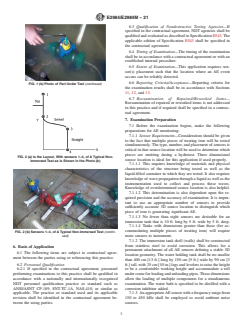
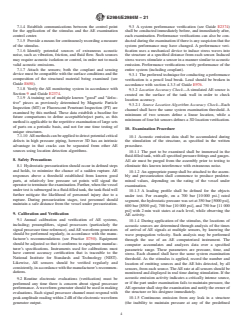
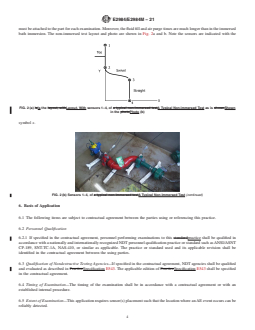
bath immersion. The non-immersed test layout and photo are shown in Fig. 2a and b. Note the sensors are indicated with the
FIG. 2 (a) isIs the layout, withLayout, With sensors 1–4, of a typical non-immersed testA Typical Non-immersed Test as is shownShown
in the photoPhoto (b)
symbol x.
FIG. 2 (b) Sensors 1–4, of a typical non-immersed testA Typical Non-immersed Test (continued)
6. Basis of Application
6.1 The following items are subject to contractual agreement between the parties using or referencing this practice.
6.2 Personnel Qualification
6.2.1 If specified in the contractual agreement, personnel performing examinations to this standardpractice shall be qualified in
accordance with a nationally and internationally recognized NDT personnel qualification practice or standard such as ANSI/ASNT
CP-189, SNT-TC-1A, NAS-410, or similar as applicable. The practice or standard used and its applicable revision shall be
identified in the contractual agreement between the using parties.
6.3 Qualification of Nondestructive Testing Agencies—If specified in the contractual agreement, NDT agencies shall be qualified
and evaluated as described in PracticeSpecification E543. The applicable edition of PracticeSpecification E543 shall be specified
in the contractual agreement.
6.4 Timing of Examination—The timing of the examination shall be in accordance with a contractual agreement or with an
established internal procedure.
6.5 Extent of Examination—This application requires sensor(s) placement such that the location where an AE event occurs can be
reliably detected.
E2984/E2984M − 21
6.6 Reporting Criteria/Acceptance—Reporting criteria for the examination results shall be in accordance with Sections 11, 12, and
13.
6.7 Reexamination of Repaired/Reworked Items—Reexamination of repaired or reworked items is not addressed in this
standardpractice and if required shall be specified in a contractual agreement.
7. Examination Preparation
7.1 Before the examination begins, make the following preparations for AE monitoring:
7.1.1 Sensor requirements—Requirements—Consideration should be given to the fact that multiple pieces of treating iron will be
tested simultaneously. The type, number, and placement of sensors is critical in that source location will be used to determine which
pieces are emitting during a hydrotest. Three dimensional source location is ideal for this application if used properly.
7.1.1.1 This requires knowledge of materials and physical characteristics of the structure being tested as well as the liquid-filled
container in which they are tested. It also requires knowledge of wave propagation through a liquid as well as the instrumentation
used to collect and process these waves. Knowledge of overdetermined source location is also helpful.
7.1.1.2 This determination is also dependent upon the required precision and the accuracy of examination. It is important to use
an appropriate number of sensors to provide sufficiently accurate 3D source location to distinguish which piece of iron is generating
significant AE.
7.1.1.3 No fewer than eight sensors are desirable for an immersion tank that is 10 ft. long by 5 ft. wide by 5 ft. deep.
7.1.1.4 Tanks with dimensions greater than these (for accommodating multiple pieces of treating iron) will require more sensors
to instrument.
7.1.2
...