

ASTM C1683-10(2019)
(Practice)Standard Practice for Size Scaling of Tensile Strengths Using Weibull Statistics for Advanced Ceramics
General Information
- Abstract
SIGNIFICANCE AND USE
5.1 Advanced ceramics usually display a linear stress-strain behavior to failure. Lack of ductility combined with flaws that have various sizes and orientations typically leads to large scatter in failure strength. Strength is not a deterministic property, but instead reflects the intrinsic fracture toughness and a distribution (size and orientation) of flaws present in the material. This standard is applicable to brittle monolithic ceramics which fail as a result of catastrophic propagation of flaws. Possible rising R-curve effects are also not considered, but are inherently incorporated into the strength measurements.
5.2 Two- and three-parameter formulations exist for the Weibull distribution. This standard is restricted to the two-parameter formulation.
5.3 Tensile and flexural test specimens are the most commonly used test configurations for advanced ceramics. Ring-on-ring and pressure-on-ring test specimens which have multi-axial states of stress are also included. Closed-form solutions for the effective volume and effective surfaces and the Weibull material scale factor are included for these configurations. This practice also incorporates size-scaling methods for C-ring test specimens for which numerical approaches are necessary. A generic approach for arbitrary shaped test specimens or components that utilizes finite element analyses is presented in Annex A3.
5.4 The fracture origins of failed test specimens can be determined using fractographic analysis. The spatial distribution of these strength-controlling flaws can be over a volume or an area (as in the case of surface flaws). This standard allows for the conversion of strength parameters associated with either type of spatial distribution. Length scaling for strength-controlling flaws located along edges of a test specimen is not covered in this practice.
5.5 The scaling of strength with size in accordance with the Weibull model is based on several key assumptions (5). It is assumed that th...
SCOPE
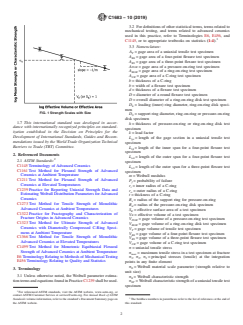
1.1 This standard practice provides methodology to convert fracture strength parameters (primarily the mean strength and the Weibull characteristic strength) estimated from data obtained with one test geometry to strength parameters representing other test geometries. This practice addresses uniaxial strength data as well as some biaxial strength data. It may also be used for more complex geometries proved that the effective areas and effective volumes can be estimated. It is for the evaluation of Weibull probability distribution parameters for advanced ceramics that fail in a brittle fashion. Fig. 1 shows the typical variation of strength with size. The larger the specimen or component, the weaker it is likely to be.
1.5 The values stated in SI units are to be regarded as standard. No other units of measurement are included in this standard.
1.5.1 The values stated in SI units are in accordance with IEEE/ASTM SI 10.
1.6 This standard does not purport to address all of the safety concerns, if any, associated with its use. It is the responsibility of the user of this standard to establish appropriate safety, health, and environmental practices and determine the applicability of regulatory limitations prior to use.
1.7 This international standard was developed in accordance with internationally recognized principles on standardization established in the Decision on Principles for the Development of International Standards, Guides and Recommendations issued by the World Trade Organization Technical Barriers to Trade (TBT) Committee.
- Status
- Published
- Publication Date
- 30-Jun-2019
- Technical Committee
- C28 - Advanced Ceramics
- Drafting Committee
- C28.01 - Mechanical Properties and Performance
Overview
ASTM C1683-10(2019): Standard Practice for Size Scaling of Tensile Strengths Using Weibull Statistics for Advanced Ceramics provides a comprehensive methodology for converting fracture strength parameters, specifically the mean strength and Weibull characteristic strength, from one test specimen geometry to another. Developed by ASTM, this standard focuses on advanced ceramics-materials known for their brittle failure behavior and variance in strength due to microstructural flaws. By utilizing the two-parameter Weibull distribution, ASTM C1683-10(2019) enables accurate size scaling of strength values across various testing configurations, making it essential for material evaluation and engineering design involving advanced ceramics.
Key Topics
- Strength Variability in Advanced Ceramics: Advanced ceramics exhibit linear stress-strain responses leading up to abrupt failure due to inherent material flaws. Tensile strength is thus a statistical, not deterministic, property, related to flaw size, distribution, and orientation.
- Weibull Statistics: The standard adopts a two-parameter Weibull model, suitable for brittle fracture analysis and size scaling. This statistical method is widely recognized for representing failure probabilities in ceramics, accounting for the random nature of material flaws.
- Specimen and Test Geometry Conversion: Procedures for converting Weibull characteristic strengths and mean strengths from one specimen geometry to another are outlined, supporting uniaxial tensile, flexural, ring-on-ring, and pressure-on-ring configurations.
- Volume and Surface Flaw Distribution: The standard differentiates between volume- and surface-distributed flaws, allowing for appropriate strength parameter conversions based on the spatial distribution of flaws observed using fractographic analysis.
- Assumptions for Applicability: Key assumptions include flaw population stability, uniformity of material properties, and the absence of slow crack growth. The Weibull size-scaling model is most accurate when these conditions are met.
Applications
- Materials Research and Development: Provides a scientific basis for comparing tensile strengths across different specimen sizes and test setups, critical in material certification, process optimization, and quality control of advanced ceramics.
- Engineering Design: Enables engineers to predict the performance and reliability of ceramic components of varying sizes and geometries using standardized strength scaling methods, aiding safe and efficient mechanical design.
- Component Testing and Validation: Supports the conversion of laboratory test data to service component geometries, improving the relevance and applicability of mechanical property data for real-world applications.
- Quality Assurance: Facilitates consistent reporting and interpretation of mechanical testing results, using established statistical relationships for failure probability and material strength.
Related Standards
ASTM C1683-10(2019) is closely integrated with several other ASTM standards pertinent to advanced ceramics and mechanical testing:
- ASTM C1161: Test Method for Flexural Strength of Advanced Ceramics at Ambient Temperature
- ASTM C1211: Test Method for Flexural Strength of Advanced Ceramics at Elevated Temperatures
- ASTM C1273: Test Method for Tensile Strength of Monolithic Advanced Ceramics at Ambient Temperatures
- ASTM C1322: Practice for Fractography and Characterization of Fracture Origins in Advanced Ceramics
- ASTM C1323: Test Method for Ultimate Strength of Advanced Ceramics with Diametrally Compressed C-Ring Specimens
- ASTM C1366: Test Method for Tensile Strength of Monolithic Advanced Ceramics at Elevated Temperatures
- ASTM C1499: Test Method for Monotonic Equibiaxial Flexural Strength of Advanced Ceramics at Ambient Temperature
- ASTM C1239: Practice for Reporting Uniaxial Strength Data and Estimating Weibull Distribution Parameters for Advanced Ceramics
By conforming to the principles established by international standardization bodies, including those of the World Trade Organization Technical Barriers to Trade (TBT) Committee, ASTM C1683-10(2019) ensures international recognition and applicability in fields ranging from material science to structural engineering.
Keywords: ASTM C1683, advanced ceramics, tensile strength, Weibull statistics, strength scaling, material testing, specimen geometry, mechanical properties, brittle fracture, quality assurance, size effect, failure probability.
Relations
- Effective Date
- 01-Jul-2019
- Effective Date
- 01-Apr-2022
- Effective Date
- 01-Aug-2019
- Effective Date
- 01-Jul-2019
- Effective Date
- 01-Jul-2019
- Effective Date
- 01-Jul-2019
- Effective Date
- 01-Jul-2018
- Effective Date
- 01-Jul-2018
- Effective Date
- 01-Oct-2017
- Effective Date
- 01-Oct-2017
- Effective Date
- 01-Jul-2015
- Effective Date
- 01-Jul-2015
- Effective Date
- 01-Jul-2015
- Effective Date
- 15-Nov-2013
- Effective Date
- 15-Nov-2013
Frequently Asked Questions
ASTM C1683-10(2019) is a standard published by ASTM International. Its full title is "Standard Practice for Size Scaling of Tensile Strengths Using Weibull Statistics for Advanced Ceramics". This standard covers: SIGNIFICANCE AND USE 5.1 Advanced ceramics usually display a linear stress-strain behavior to failure. Lack of ductility combined with flaws that have various sizes and orientations typically leads to large scatter in failure strength. Strength is not a deterministic property, but instead reflects the intrinsic fracture toughness and a distribution (size and orientation) of flaws present in the material. This standard is applicable to brittle monolithic ceramics which fail as a result of catastrophic propagation of flaws. Possible rising R-curve effects are also not considered, but are inherently incorporated into the strength measurements. 5.2 Two- and three-parameter formulations exist for the Weibull distribution. This standard is restricted to the two-parameter formulation. 5.3 Tensile and flexural test specimens are the most commonly used test configurations for advanced ceramics. Ring-on-ring and pressure-on-ring test specimens which have multi-axial states of stress are also included. Closed-form solutions for the effective volume and effective surfaces and the Weibull material scale factor are included for these configurations. This practice also incorporates size-scaling methods for C-ring test specimens for which numerical approaches are necessary. A generic approach for arbitrary shaped test specimens or components that utilizes finite element analyses is presented in Annex A3. 5.4 The fracture origins of failed test specimens can be determined using fractographic analysis. The spatial distribution of these strength-controlling flaws can be over a volume or an area (as in the case of surface flaws). This standard allows for the conversion of strength parameters associated with either type of spatial distribution. Length scaling for strength-controlling flaws located along edges of a test specimen is not covered in this practice. 5.5 The scaling of strength with size in accordance with the Weibull model is based on several key assumptions (5). It is assumed that th... SCOPE 1.1 This standard practice provides methodology to convert fracture strength parameters (primarily the mean strength and the Weibull characteristic strength) estimated from data obtained with one test geometry to strength parameters representing other test geometries. This practice addresses uniaxial strength data as well as some biaxial strength data. It may also be used for more complex geometries proved that the effective areas and effective volumes can be estimated. It is for the evaluation of Weibull probability distribution parameters for advanced ceramics that fail in a brittle fashion. Fig. 1 shows the typical variation of strength with size. The larger the specimen or component, the weaker it is likely to be. 1.5 The values stated in SI units are to be regarded as standard. No other units of measurement are included in this standard. 1.5.1 The values stated in SI units are in accordance with IEEE/ASTM SI 10. 1.6 This standard does not purport to address all of the safety concerns, if any, associated with its use. It is the responsibility of the user of this standard to establish appropriate safety, health, and environmental practices and determine the applicability of regulatory limitations prior to use. 1.7 This international standard was developed in accordance with internationally recognized principles on standardization established in the Decision on Principles for the Development of International Standards, Guides and Recommendations issued by the World Trade Organization Technical Barriers to Trade (TBT) Committee.
SIGNIFICANCE AND USE 5.1 Advanced ceramics usually display a linear stress-strain behavior to failure. Lack of ductility combined with flaws that have various sizes and orientations typically leads to large scatter in failure strength. Strength is not a deterministic property, but instead reflects the intrinsic fracture toughness and a distribution (size and orientation) of flaws present in the material. This standard is applicable to brittle monolithic ceramics which fail as a result of catastrophic propagation of flaws. Possible rising R-curve effects are also not considered, but are inherently incorporated into the strength measurements. 5.2 Two- and three-parameter formulations exist for the Weibull distribution. This standard is restricted to the two-parameter formulation. 5.3 Tensile and flexural test specimens are the most commonly used test configurations for advanced ceramics. Ring-on-ring and pressure-on-ring test specimens which have multi-axial states of stress are also included. Closed-form solutions for the effective volume and effective surfaces and the Weibull material scale factor are included for these configurations. This practice also incorporates size-scaling methods for C-ring test specimens for which numerical approaches are necessary. A generic approach for arbitrary shaped test specimens or components that utilizes finite element analyses is presented in Annex A3. 5.4 The fracture origins of failed test specimens can be determined using fractographic analysis. The spatial distribution of these strength-controlling flaws can be over a volume or an area (as in the case of surface flaws). This standard allows for the conversion of strength parameters associated with either type of spatial distribution. Length scaling for strength-controlling flaws located along edges of a test specimen is not covered in this practice. 5.5 The scaling of strength with size in accordance with the Weibull model is based on several key assumptions (5). It is assumed that th... SCOPE 1.1 This standard practice provides methodology to convert fracture strength parameters (primarily the mean strength and the Weibull characteristic strength) estimated from data obtained with one test geometry to strength parameters representing other test geometries. This practice addresses uniaxial strength data as well as some biaxial strength data. It may also be used for more complex geometries proved that the effective areas and effective volumes can be estimated. It is for the evaluation of Weibull probability distribution parameters for advanced ceramics that fail in a brittle fashion. Fig. 1 shows the typical variation of strength with size. The larger the specimen or component, the weaker it is likely to be. 1.5 The values stated in SI units are to be regarded as standard. No other units of measurement are included in this standard. 1.5.1 The values stated in SI units are in accordance with IEEE/ASTM SI 10. 1.6 This standard does not purport to address all of the safety concerns, if any, associated with its use. It is the responsibility of the user of this standard to establish appropriate safety, health, and environmental practices and determine the applicability of regulatory limitations prior to use. 1.7 This international standard was developed in accordance with internationally recognized principles on standardization established in the Decision on Principles for the Development of International Standards, Guides and Recommendations issued by the World Trade Organization Technical Barriers to Trade (TBT) Committee.
ASTM C1683-10(2019) is classified under the following ICS (International Classification for Standards) categories: 81.060.30 - Advanced ceramics. The ICS classification helps identify the subject area and facilitates finding related standards.
ASTM C1683-10(2019) has the following relationships with other standards: It is inter standard links to ASTM C1683-10(2015), ASTM E456-13a(2022)e1, ASTM C1366-19, ASTM C1322-15(2019), ASTM C1145-19, ASTM C1499-19, ASTM C1239-13(2018), ASTM C1273-18, ASTM E456-13A(2017)e1, ASTM E456-13A(2017)e3, ASTM C1273-15, ASTM C1499-15, ASTM C1322-15, ASTM E456-13ae1, ASTM E456-13ae2. Understanding these relationships helps ensure you are using the most current and applicable version of the standard.
ASTM C1683-10(2019) is available in PDF format for immediate download after purchase. The document can be added to your cart and obtained through the secure checkout process. Digital delivery ensures instant access to the complete standard document.
Standards Content (Sample)
This international standard was developed in accordance with internationally recognized principles on standardization established in the Decision on Principles for the
Development of International Standards, Guides and Recommendations issued by the World Trade Organization Technical Barriers to Trade (TBT) Committee.
Designation: C1683 − 10 (Reapproved 2019)
Standard Practice for
Size Scaling of Tensile Strengths Using Weibull Statistics
for Advanced Ceramics
This standard is issued under the fixed designation C1683; the number immediately following the designation indicates the year of
original adoption or, in the case of revision, the year of last revision. A number in parentheses indicates the year of last reapproval. A
superscript epsilon (´) indicates an editorial change since the last revision or reapproval.
1. Scope also assumes that the flaw population is stable with time and
that no slow crack growth occurs.
1.1 This standard practice provides methodology to convert
fracture strength parameters (primarily the mean strength and
1.4 This practice includes the following topics:
the Weibull characteristic strength) estimated from data ob-
Section
tained with one test geometry to strength parameters represent-
Scope 1
Referenced Documents 2
ing other test geometries. This practice addresses uniaxial
Terminology 3
strength data as well as some biaxial strength data. It may also
Summary of Practice 4
be used for more complex geometries proved that the effective
Significance and Use 5
Probability of Failure Relationships 6
areas and effective volumes can be estimated. It is for the
Test Specimens with Uniaxial Stress States—Effective 7
evaluation of Weibull probability distribution parameters for
Volume and Area Relationships
advancedceramicsthatfailinabrittlefashion.Fig.1showsthe
Uniaxial Tensile Test Specimens 7.1
Rectangular Flexure Test Specimens 7.2
typical variation of strength with size. The larger the specimen
Round Flexure Test Specimens 7.3
or component, the weaker it is likely to be.
C-Ring Test Specimens 7.4
Test Specimens with Multiaxial Stress States—Effective 8
1.2 As noted in Practice C1239, the failure strength of
Volume and Area Relationships
advanced ceramics is treated as a continuous random variable.
Pressure-on-Ring Test Specimens 8.1
Anumberoffunctionsmaybeusedtocharacterizethestrength Ring-on-Ring Test Specimens 8.2
Examples—Converting Characteristic Strengths 9
distribution of brittle ceramics, but the Weibull distribution is
Report 10
the most appropriate, especially since it permits strength
Precision and Bias 11
scaling for the size of specimens or component. Typically, a Keywords 12
Combined Gamma Function for Round Rods Tested Annex A1
number of test specimens with well-defined geometry are
in Flexure
broken under well-defined loading conditions. The force at
Components or Test Specimens with Multiaxial Annex A2
Stress Distributions
whicheachtestspecimenfailsisrecordedandfracturestrength
Components or Test Specimens with Complex Annex A3
calculated. The strength values are used to obtain Weibull
Geometries and Stress Distributions
parameter estimates associated with the underlying population
1.5 The values stated in SI units are to be regarded as
distribution.
standard. No other units of measurement are included in this
1.3 This standard is restricted to the assumption that the
standard.
distribution underlying the failure strengths is the two-
1.5.1 The values stated in SI units are in accordance with
parameter Weibull distribution with size scaling. The practice
IEEE/ASTM SI 10.
1.6 This standard does not purport to address all of the
This practice is under the jurisdiction of ASTM Committee C28 on Advanced
Ceramics and is the direct responsibility of Subcommittee C28.01 on Mechanical
safety concerns, if any, associated with its use. It is the
Properties and Performance.
responsibility of the user of this standard to establish appro-
Current edition approved July 1, 2019. Published July 2019. Originally approved
priate safety, health, and environmental practices and deter-
in 2008. Last previous edition approved in 2015 as C1683 –10 (2015). DOI:
10.1520/C1683-10R19. mine the applicability of regulatory limitations prior to use.
Copyright © ASTM International, 100 Barr Harbor Drive, PO Box C700, West Conshohocken, PA 19428-2959. United States
C1683 − 10 (2019)
3.2 For definitions of other statistical terms, terms related to
mechanical testing, and terms related to advanced ceramics
used in this practice, refer to Terminologies E6, E456, and
C1145, or to appropriate textbooks on statistics (1-4).
3.3 Nomenclature:
A = gage area of a uniaxial tensile test specimen
T
A = gage area of a four-point flexure test specimen
B4
A = gage area of a three-point flexure test specimen
B3
A = gage area of a pressure-on-ring test specimen
POR
A = gage area of a ring-on-ring test specimen
ROR
A = gage area of a C-ring test specimen
CR
b = thickness of a C-ring
b = width of a flexure test specimen
d = thickness of a flexure test specimen
D = diameter of a round flexure test specimen
D = overall diameter of a ring-on-ring disk test specimen
D = loading (inner) ring diameter, ring-on-ring disk speci-
L
men
FIG. 1 Strength Scales with Size
D = support ring diameter, ring-on-ring or pressure-on-ring
S
disk specimen
1.7 This international standard was developed in accor-
h = thickness of pressure-on-ring or ring-on-ring disk test
dance with internationally recognized principles on standard-
specimen
ization established in the Decision on Principles for the
k = load factor
Development of International Standards, Guides and Recom-
L = length of the gage section in a uniaxial tensile test
gs
mendations issued by the World Trade Organization Technical
specimen
Barriers to Trade (TBT) Committee.
L = length of the inner span for a four-point flexure test
i4
specimen
2. Referenced Documents
L = length of the outer span for a four-point flexure test
o4
2.1 ASTM Standards:
specimen
C1145 Terminology of Advanced Ceramics
L = length of the outer span for a three-point flexure test
o3
C1161 Test Method for Flexural Strength of Advanced
specimen
Ceramics at Ambient Temperature
m = Weibull modulus
C1211 Test Method for Flexural Strength of Advanced
P = probability of failure
f
Ceramics at Elevated Temperatures
r = inner radius of a C-ring
i
C1239 Practice for Reporting Uniaxial Strength Data and
r = outer radius of a C-ring
o
Estimating Weibull Distribution Parameters forAdvanced
t = thickness of a C-ring
Ceramics
R = radius of the support ring for pressure-on-ring
s
C1273 Test Method for Tensile Strength of Monolithic
R = radius of the pressure-on-ring disk specimen
d
Advanced Ceramics at Ambient Temperatures
S = effective surface area of a test specimen
E
C1322 Practice for Fractography and Characterization of
V = effective volume of a test specimen
E
Fracture Origins in Advanced Ceramics
V = gage volume of a pressure-on-ring test specimen
POR
C1323 Test Method for Ultimate Strength of Advanced
V = gage volume of a ring-on-ring disk test specimen
ROR
Ceramics with Diametrally Compressed C-Ring Speci-
V = gage volume of tensile test specimen
T
mens at Ambient Temperature
V = gage volume of a four-point flexure test specimen
B4
C1366 Test Method for Tensile Strength of Monolithic
V = gage volume of a three-point flexure test specimen
B3
Advanced Ceramics at Elevated Temperatures
V = gage volume of a C-ring test specimen
CR
C1499 Test Method for Monotonic Equibiaxial Flexural
σ = uniaxial tensile stress
Strength of Advanced Ceramics at Ambient Temperature
σ = maximum tensile stress in a test specimen at fracture
max
E6 Terminology Relating to Methods of Mechanical Testing
σ , σ , σ = principal stresses (tensile) at the integration
1 2 3
E456 Terminology Relating to Quality and Statistics
points in any finite element
σ = Weibull material scale parameter (strength relative to
3. Terminology
unit size)
3.1 Unless otherwise noted, the Weibull parameter estima-
σ = Weibull characteristic strength
θ
tiontermsandequationsfoundinPracticeC1239shallbeused.
σ = Weibull characteristic strength of a uniaxial tensile test
θT
specimen
For referenced ASTM standards, visit the ASTM website, www.astm.org, or
contact ASTM Customer Service at service@astm.org. For Annual Book of ASTM
Standards volume information, refer to the standard’s Document Summary page on The boldface numbers in parentheses refer to the list of references at the end of
the ASTM website. this standard.
C1683 − 10 (2019)
σ = Weibullcharacteristicstrengthforafour-pointflexure for the effective volume and effective surfaces and the Weibull
θB4
test specimen material scale factor are included for these configurations.This
σ = Weibull characteristic strength for a three-point flex- practice also incorporates size-scaling methods for C-ring test
θB3
ure test specimen specimens for which numerical approaches are necessary. A
σ = WeibullcharacteristicstrengthforaC-ringtestspeci-
generic approach for arbitrary shaped test specimens or com-
θCR
men ponents that utilizes finite element analyses is presented in
σ = Weibull characteristic strength for a pressure-on-
Annex A3.
θPOR
ring test specimen
5.4 The fracture origins of failed test specimens can be
σ = Weibull characteristic strength for a ring-on-ring
θROR
determined using fractographic analysis. The spatial distribu-
test specimen
tionofthesestrength-controllingflawscanbeoveravolumeor
σ* = an arbitrary, assumed estimate of the Weibull material
an area (as in the case of surface flaws). This standard allows
scale factor
fortheconversionofstrengthparametersassociatedwitheither
σ¯ = mean strength
type of spatial distribution. Length scaling for strength-
σ¯ = mean strength for a uniaxial tensile test specimen
T
controlling flaws located along edges of a test specimen is not
σ¯ = mean strength for a four-point flexure test specimen
B4
covered in this practice.
σ¯ = mean strength for a three-point flexure test specimen
B3
σ¯ = mean strength for a C-ring test specimen
CR 5.5 The scaling of strength with size in accordance with the
σ¯ = mean strength for a pressure-on-ring test specimen
Weibull model is based on several key assumptions (5).Itis
POR
σ¯ = mean strength for a ring-on-ring test specimen
ROR assumed that the same specific flaw type controls strength in
θ = angle in a C-ring test specimen
the various specimen configurations. It is assumed that the
ν = Poisson’s ratio
material is uniform, homogeneous, and isotropic. If the mate-
rial is a composite, it is assumed that the composite phases are
4. Summary of Practice
sufficiently small that the structure behaves on an engineering
4.1 The observed strength values of advanced ceramics are
scale as a homogeneous and isotropic body. The composite
dependent on test specimen size, geometry, and stress state.
must contain a sufficient quantity of uniformly distributed,
This standard practice enables the user to convert tensile
randomly oriented reinforcing elements such that the material
strength parameters obtained from one test geometry to that of
is effectively homogeneous. Whisker-toughened ceramic com-
another, on the basis of assumptions listed in 5.5. Using the
posites may be representative of this type of material. This
existing fracture strength data, estimates of the Weibull char-
practice is also applicable to composite ceramics that do not
acteristic strength σ , and the Weibull modulus m, are calcu-
θ exhibit any appreciable bilinear or nonlinear deformation
latedinaccordancewithrelatedPracticeC1239fortheoriginal
behavior. This standard and the conventional Weibull strength
test geometry. This practice uses the test specimen and loading
scaling with size may not be suitable for continuous fiber-
sizes and geometries, and σ and m to calculate the Weibull
θ reinforced composite ceramics. The material is assumed to
materialscaleparameterσ .TheWeibullcharacteristicstrength
fracture in a brittle fashion, a consequence of stress causing
σ , the mean strengthσ¯, or theWeibull material scale factorσ ,
θ 0 catastrophic propagation of flaws. The material is assumed to
may be scaled to alternative test specimen geometries. Finally,
be consistent (batch to batch, day to day, etc.). It is assumed
a report citing the original test specimen geometry and strength
that the strength distribution follows a Weibull two-parameter
parameters, as well as the size-scaled Weibull strength param-
distribution. It is assumed that each test piece has a statistically
eters is prepared.
significant number of flaws and that they are randomly
distributed. It is assumed that the flaws are small relative to the
5. Significance and Use
specimen cross section size. If multiple flaw types are present
5.1 Advanced ceramics usually display a linear stress-strain
and control strength, then strengths may scale differently for
behavior to failure. Lack of ductility combined with flaws that
each flaw type. Consult Practice C1239 and the example in 9.1
have various sizes and orientations typically leads to large
forfurtherguidanceonhowtoapplycensoredstatisticsinsuch
scatter in failure strength. Strength is not a deterministic
cases. It is also assumed that the specimen stress state and the
property, but instead reflects the intrinsic fracture toughness
maximum stress are accurately determined. It is assumed that
and a distribution (size and orientation) of flaws present in the
the actual data from a set of fractured specimens are accurate
material. This standard is applicable to brittle monolithic
and precise. (SeeTerminology E456 for definitions of the latter
ceramics which fail as a result of catastrophic propagation of
two terms.) For this reason, this standard frequently references
flaws. Possible rising R-curve effects are also not considered,
other ASTM standard test methods and practices which are
butareinherentlyincorporatedintothestrengthmeasurements.
known to be reliable in this respect.
5.2 Two- and three-parameter formulations exist for the
5.6 Even if test data has been accurately and precisely
Weibull distribution. This standard is restricted to the two-
measured, it should be recognized that the Weibull parameters
parameter formulation.
determined from test data are in fact estimates. The estimates
5.3 Tensile and flexural test specimens are the most com- can vary from the actual (population) material strength param-
monly used test configurations for advanced ceramics. Ring- eters. Consult Practice C1239 for further guidance on the
on-ring and pressure-on-ring test specimens which have multi- confidence bounds of Weibull parameter estimates based on
axial states of stress are also included. Closed-form solutions test data for a finite sample size of test fractures.
C1683 − 10 (2019)
5.7 When correlating strength parameters from test data where:
from one specimen geometry to a second, the accuracy of the
P = the probability of failure,
f
correlation depends upon whether the assumptions listed in 5.5
σ = maximum tensile stress in a test specimen at failure,
max
are met. In addition, statistical sampling effects as discussed in σ = the Weibull characteristic strength (corresponding to
θ
5.6 may also contribute to variations between computed and
a P = 0.632 or 63.2 %), and
f
m = Weibull modulus.
observed strength-size scaling trends.
5.8 TherearepracticallimitstoWeibullstrengthscalingthat
6.1.2 As noted earlier, the Weibull characteristic strength is
should be considered. For example, it is implicitly assumed in
dependent on the test specimen and will change with test
the Weibull model that flaws are small relative to the specimen
specimen geometry as well as the stress state. The Weibull
size. Pores that are 50 µm (0.050 mm) in diameter are
characteristic strength has units of stress, and should be
volume-distributed flaws in tension or flexural strength speci-
reported using units of MPa or GPa. As was noted in the
mens with 5 mm or greater cross section sizes. The same may
previous section, strength-controlling flaws can be spatially
not be true if the cross section size is only 100 µm.
distributed over the volume or the surface (area) of a test
specimen. If the strength-controlling flaws are volume
6. Probability of Failure Relationships
distributed, the volume characteristic strength shall be desig-
6.1 General:
nated as (σ ) , and the volume Weibull modulus shall be
θ V
6.1.1 The random variable representing uniaxial tensile
designated m . If the strength-controlling flaws are surface
V
strength of an advanced ceramic will assume only positive
distributed, the area characteristic strength shall be designated
values, and the distribution is usually asymmetric about the
as (σ ) , and the area Weibull modulus shall be designated m .
θ A A
mean. These characteristics limit the use of the normal distri-
Practice C1322 should be used to determine whether flaws are
bution (as well as others) and point to the use of the Weibull
surface or volume distributed. It should be borne in mind that
and similar skewed distributions. Fig. 2 shows the shape of the
a flaw located at the surface of a test specimen does not
Weibull distribution as compared to a normal distribution. If
necessarily mean it was a surface-distributed flaw. It may be a
the random variable representing uniaxial tensile strength of an
surface-distributed flaw, or it may be a volume-distributed flaw
advanced ceramic is characterized by a two-parameter Weibull
which by chance is located at the surface.
distribution (see Practice C1239 for a detailed discussion
regarding the mathematical description of the Weibull
6.2 Volume Distribution:
distribution), then the failure probability for a test specimen
6.2.1 An alternative expression for the probability of failure
fabricated from such an advanced ceramic is given by the
is given by:
cumulative distribution function:
m
V
m σ
*
σ
max
P 5 1 2 exp dV (3)
S D
f F G
P 5 1 2 exp 2 σ .0 (1)
F S D G
f max σ
~ !
σ V V
θ
P 5 0 σ #0 (2) P 5 0 σ#0 (4)
f max f
FIG. 2 The Probability Density Function Graphs for Weibull and Gaussian (Normal) Strength Distributions
C1683 − 10 (2019)
6.2.1.1 The integration within the exponential function is small amount of material to the maximum stress and k << 1.
performed over all tensile stressed regions of the test specimen The flexure specimen is “equivalent” to a much smaller test
volume if the strength-controlling flaws are randomly distrib- piece that is pulled in uniaxial direct tension. The k factors
uted through the volume of the material. m is the Weibull depend upon the geometry and loading configuration and they
V
modulus associated with strength-controlling flaws distributed usually are very sensitive to the Weibull modulus.
through the volume. (σ ) is the Weibull material scale
0 V
6.3 Surface Distribution:
parameter and can be described as the Weibull characteristic
6.3.1 If the strength-controlling flaws are distributed along
strength of a hypothetical test specimen with unit volume
the surface of the test specimens, then the following expres-
loaded in uniform uniaxial tension. The Weibull material scale
1/m sion:
V
parameter has units of stress·(volume) and should be
3/ m 3/m
V V
m
reported using units of MPa·(m) or GPa·(m) . Eq 1 and
A
σ
*
P 5 1 2 exp dA (9)
F S D G
f
Eq 3 can be equated for a given test specimen geometry, which
~σ !
A 0 A
yields an expression relating (σ ) and (σ ) for that test
0 V θ V
P 5 0 σ#0 (10)
f
specimen geometry. Expressions for specific test specimen
geometries are presented in Sections 7 and 8.
shallbeutilizedfortheprobabilityoffailure.Theintegration
6.2.2 For the general case where stress varies with position
within the exponential is performed over all tensile regions of
within a test specimen are volume distributed, the integration
the test specimen surface. The integration is sometimes carried
given by Eq 3 can be carried out to yield the following
outovertheareaofaneffectivegagesectioninsteadofoverthe
expression:
total area of the test specimen. In Eq 9, m is the Weibull
A
m
V modulus associated with surface flaws. (σ ) is the Weibull
σ
0 A
max
P 5 1 2 exp 2kV (5)
F S D G
f
material scale parameter and can be described as the Weibull
~σ !
V
characteristic strength of a test specimen with unit surface area
6.2.2.1 Here k is a dimensionless factor and has been
loaded in uniform uniaxial tension. Here the Weibull material
2/m
identified as a “load factor” (e.g., Johnson and Tucker (6)).
A
scale parameter should be reported using units of MPa·(m)
2/m
σ is the maximum stress in the test specimen at failure. A
max
or GPa·(m) . For a given test specimen geometry, Eq 1 and
Thus, in general:
Eq 9 can be equated, which yields an expression relating (σ )
0 A
1/m 1/m
V V
σ 5 σ kV 5 σ V (6) and (σ ) . Expressions for specific test specimen geometries
~ ! ~ ! ~ ! ~ !
θ A
0 V θ V θ V E
are presented in Sections 7 and 8.
when the strength-controlling flaws are spatially distributed
6.3.2 For the general case where stress varies within a test
through the volume. Inclusions are an example of such flaws.
specimen and the flaws are surface distributed, the integration
For all loading geometries except uniaxial tension (see 7.1), k
given by Eq 3 can be carried out for the surface areas of the
is a function of the Weibull modulus m and the test geometry.
specimens that are stressed in tension. This yields the follow-
The load factor is evaluated numerically and is always positive
ing expression:
and usually less than unity. Notice that the Weibull modulus in
m
A
σ
this instance, m , is associated with volume flaws.
max
V
P 5 1 2 exp 2kA (11)
F S D G
f
~σ !
6.2.3 The product k times V is often termed an “effective A
volume, V ,” in the ceramic literature. The effective volume is
E
6.3.2.1 Again, k is a dimensionless factor and has been
the size of a hypothetical tension test specimen that, when
identified as a “load factor” (e.g., Johnson andTucker (6)). For
stressed to the same level as the test specimen in question, has
all loading geometries except uniaxial tension (see 7.1), k is a
the same probability of fracture. Expressions for the effective
function of the Weibull modulus m and the test geometry.
volume of specific test specimen geometries are given Sections
Notice that the Weibull modulus in this instance, m,is
A
7 and 8. Noting that (σ ) is a material parameter (that is in
0 V
associated with surface flaws. σ is the maximum stress in
max
principle independent of the test specimen type), then:
the test specimen at failure. Thus, in general:
1/m 1/m
V V
~σ ! 5 ~σ ! ~k V ! 5 ~σ ! ~k V ! (7) 1/m 1/m
0 V θ,1 V 1 1 θ,2 V 2 2 A A
σ 5 σ kA 5 σ S (12)
~ ! ~ ! ~ ! ~ !
0 θ θ E
A A A
where the subscripts 1 and 2 denote two different geometries
when the strength-controlling flaws are spatially distributed
of test specimens fabricated from the same material.This leads
along the surfaces of the test specimens. Surface grinding
to the following relationship:
cracks are an example of such.
1/m 1/m 1/m
V V V
σ k V k V V
~ ! ~ !
θ,1 2 2 2 2 E,2
V
NOTE 1—The conventional nomenclature in the literature is used here.
5 5 5 (8)
S D S D
1/m
V
~σ ! ~k V ! k V V
θ,2 V 1 1 1 1 E,1
Areas are denoted by symbols with the letter A. The effective area or
effective surface is commonly denoted by the letter S.
6.2.3.1 It is implied that the same type of volume-
distributedflawscontrolstrengthineachgeometry.Eq8means 6.3.3 For all loading geometries except for uniaxial tension
that knowledge of the effective volume of both specimen types (see 7.2), k is a function of the Weibull modulus m. The load
allows the computation of one characteristic strength value factor, k, is evaluated numerically and is always positive and
basedonthecharacteristicstrengthvalueoftheotherspecimen usually less than unity. In the ceramics literature, the product k
geometry. Test specimens with stress gradients have effective times A is often termed an “effective area” or “effective
volumes less than the size of the test piece. In other words, surface, S .” The effective surface is the size of a hypothetical
E
k < 1. For example, flexural strength specimens expose only a uniaxial tensile test specimen that, when stressed to the same
C1683 − 10 (2019)
characteristic, median, or mean strengths. It is beyond the scope of this
level as the test specimen in question, has the same probability
practice to quantify the confidence intervals for the scaled strengths.
of fracture. Expressions for the effective area of specific test
specimen geometries are given in Sections 7 and 8. Noting that
6.6 Edge-Distributed:
(σ ) isamaterialparameter(thatisinprincipleindependentof
0 A
6.6.1 Weibull edge or length scaling is not covered in this
the test specimen type), then:
practice.Inprinciple,thesameconceptsandsimilarmathemat-
1/m 1/m 1/m
A A A
σ k A k A S
~ ! ~ !
ics could be used to scale strengths for edge-distributed flaws,
θ,1 A 2 2 2 2 E,2
5 5 5 (13)
S D S D
1/m
A
σ k A k A S
~ ! ~ !
θ,2 1 1 1 1 E,1 however edge-distributed flaws are often very specific to a
A
particular test specimen type. Edge-distributed flaws are those
where the subscripts 1 and 2 denote two different geometries
which form as a result of some process such as chipping,
for test specimens fabricated from the same material. It is
cutting, or grinding and are only found at an edge. Volume or
implied that the same type of surface-distributed flaws control
surface-type flaws such as pores, inclusions, or normal grind-
strength in each geometry. Eq 13 means that knowledge of the
ing cracks, which by chance are located at a test specimen
effective surfaces of both specimen types allows the computa-
edge, are not considered edge-distributed flaws. If test speci-
tion of one characteristic strength value based on the charac-
menshaveoriginsthatarebynatureedge-distributedflaws,the
teristic strength value of the other specimen geometry. Test
data should be censored as discussed in Practice C1322 in
specimens with stress gradients have effective surface areas
order to properly analyze the surface and volume distribution
thatarelessthanthesizeofthetestpieceand k<1.Theflexure
specimenis“equivalent”toasmallertestpiecethatispulledin parameters.
uniaxial direct tension. The k factors depend upon the geom-
etry and loading configuration and they usually are very 7. Test Specimens with Uniaxial Stress States—Effective
sensitive to the Weibull modulus. Volume and Area Relationships
6.4 Mixed Distributions:
7.1 Uniaxial Tensile Test Specimens:
6.4.1 Strength-scalingrelationssuchasEq8andEq13shall
7.1.1 For ambient test temperatures, uniaxial tensile test
not be used to scale strengths where the flaw type in one test
specimens such as shown in Fig. 3 should be tested in
specimen type is surface distributed (e.g., machining cracks)
accordance with Test Method C1273. For elevated test
and the flaw type in the second specimen type is volume
temperatures, tensile test specimens shall be tested in accor-
distributed (e.g. inclusions), or vice versa. The scaling equa-
dance with Test Method C1366. Various accepted test speci-
tions are only suited for cases where the same flaw type is
men geometries are presented within these standards. In
active in the two specimen types. For example, if inclusions
general, the volume of material subjected to a uniform tensile
control strength in specimen type 1, then the scaling may be
stress for a single uniaxially loaded tensile test specimen may
suitable if inclusions control strength in specimen type 2. If
be many times that of a single flexural test specimen. Strength
inclusions control strength in specimen type 1, but pores
values obtained using the different recommended tensile test
control strength in specimen type 2, then the correlation will
specimens (Test Method C1273 or C1366) with different
probably not be accurate.
volumes (areas) of material will be different due to these
6.5 What May be Scaled:
volume (area) differences. Characteristic or mean strength
6.5.1 Eq 8 and Eq 13 are for scaling the Weibull character-
values can be scaled to any gage section and to other test
istic strengths, σ , of two different type specimens. The
θ
configurations using the volume and area relationships pre-
characteristic strengths correspond to a probability of failure,
sented in this section, which are applicable to the test specimen
P, of 63.2 % for each test specimen set. The equations may
f
geometries presented in Test Methods C1273 and C1366.
also be used to scale strengths at other probabilities of failure,
7.1.2 Volume Distribution—The relationship between the
P. For example, the median strength (P =50%) of one
f f
characteristic strength (σ ) and the Weibull material scale
θT V
specimen type can be compared to the median strength of
parameter (σ ) for a tension test specimen with volume flaws
0 V
another size or type specimen. Similarly, the strengths at a 1 %
is:
probability of failure may be scaled.
1/m
V
σ 5 σ V (14)
~ ! ~ !
0 V θT V T
NOTE 2—These equations may also be used to scale mean strengths,
since they closely approximate the median strengths.
7.1.2.1 This expression is obtained by setting Eq 1 equal to
NOTE 3—Scaling predictions or correlations at the 1 % probabilities of
Eq 3, after the integration in Eq 3 has been performed over the
failure will be subject to considerable uncertainty, since the confidence
intervals for such estimates are much broader than those for the gage section volume of the uniaxial tensile test specimen.
NOTE 1—L is the length of the gage section.
gs
FIG. 3 Example of a Round Tension Strength Specimen
C1683 − 10 (2019)
omitted here for simplicity.
Thus, V is the volume of the gage section. Comparison of Eq
T
14 with Eq 6 yields the following formulation for the effective
7.1.3.3 The procedure in 7.1.3 is an approximation and does
volume:
not include the portions of the test piece on either side of the
V 5 kV 5 V (15)
gage section. Hence, k and S are underestimated by a small
E T
E
amount. Improved estimates of k and S should be obtained by
E
7.1.2.2 Thus, for uniaxial tension, k is equal to unity. An
numerical analysis as discussed in Annex A3.
expression (7) similar to Eq 14 can be derived relating the
7.1.4 No adjustments are made to the volume or surface
material scale parameter to the average uniaxial tensile
integrals for the presence of chamfers or edge rounding in
strength, that is:
square or rectangular cross section tension specimens. This is
1/m
V
σ¯ V
~ !
T T
V
an acceptable approximation provided that the chamfer and
~σ ! 5 (16)
V
Γ 11 rounding sizes are small. See 6.6 if origins are on the specimen
F G
m
V
edges.
NOTE 4—Ideally the tapered regions at the end of a gage section should
be included in the volume, but their contribution to the effective volume
7.2 Rectangular Flexure Test Specimens:
usually is relatively small compared to the gage section. They therefore
7.2.1 For ambient test temperatures, flexure test specimens
are omitted here for simplicity.
NOTE 5—The gamma function in the denominator may be found in any
with rectangular cross sections such as shown in Fig. 4 should
handbook on mathematical functions.
be tested in three- or four-point flexure in accordance withTest
7.1.2.3 Theprocedurein7.1.2isanapproximationthatdoes
Method C1161. For elevated test temperatures, flexure test
not include the tapered portions of the test piece on either side
specimens should be tested in accordance with Test Method
of the gage section. Hence, k and V are underestimated by a
C1211. Since volume and/or surface effects will affect strength
E
small amount. Better estimates of k and the effective volume
values, then the strength values obtained using bend bars with
should be obtained by numerical analysis as discussed in
different sizes and loading configurations (e.g., three-point,
1 1
Annex A3.
⁄4-point four-point, or ⁄3-point four-point) will vary. Charac-
7.1.3 Surface Distribution—The following equation defines
teristic or mean strength values can be scaled to other test
the relationship between the characteristic strength and the
specimen geometries using the volume and area relationships
material scale parameter for a tension test specimen with
presented in this section.
surface flaws is:
7.2.2 Volume Distribution—For flexural test specimen
1/m
A
~σ ! 5 ~σ ! A (17)
geometries, the strength relationships become more complex
0 A θT A T
due to the nonuniform stress state (8, 9). The stress state is
7.1.3.1 This expression is obtained by Eq 1 and Eq 9, after
primarily uniaxial, however. For four-point flexure test
the integration in Eq 9 has been performed over the gage
specimens, the gage volume within the outer supporting points
section area of the uniaxial tensile test specimen. A is the area
T
V is given by:
B4
ofthegagesection.ComparisonofEq17withEq12yieldsthe
V 5 bdL (20)
following formulation for the effective area:
B4 o4
S 5 kA 5 A (18)
E T
where b and d are dimensions identified in Fig. 4. One half
of this gage volume is stressed in tension. The relationship
7.1.3.2 Thus, for uniaxial tension k is equal to unity. An
between the characteristic strength (σ ) and the Weibull
expressionsimilartoEq17canbederivedrelatingthematerial
θB4 V
material scale parameter (σ ) for a rectangular flexure speci-
scale parameter to the average uniaxial tensile strength, that is: 0 V
men with volume flaws is (8, 9):
1/m
A
~σ¯ ! A
T T
A
~σ ! 5 (19) 1/m
V
0 A
L 1
1 i4
σ 5 σ m 11 V (21)
~ ! ~ ! ~ !
Γ 11 HFS D GF 2G J
F G 0 V θB4 V V B4
L 2 m 11
~ !
m
o4 V
A
NOTE 6—Ideally the tapered regions at the end of a gage section should
which relates the Weibull characteristic strength (σ ) to the
be included in the area, but their contribution to the effective area usually θ V
is relatively small compared to the gage section. They therefore are Weibull material scale parameter (σ )
0 V
NOTE 1—The four-point configuration is shown.
FIG. 4 Typical Flexural Strength Test Specimen Geometry
C1683 − 10 (2019)
where: side surfaces that are stressed in tension. Comparing Eq 26
with Eq 12 yields the following formulation for the effective
L = length of inner span identified in Fig. 4, and
i4
area:
L = length of outer span identified in Fig. 4.
o4
d L 1
7.2.2.1 Eq 21 is obtained by settingEq 1 equal to Eq 3, after i4
S 5 kA 5 L 1b m 11
F GFS D GF G
E B4 o4 A
m 11 L m 11
~ ! ~ !
the integration in Eq 3 has been performed over the gage A o4 A
(27)
section volume of the flexure test specimen. Comparing Eq 21
with Eq 6 yields the following formulation for the effective
7.2.3.3 The average flexure strength (σ¯ ) is related to the
B4 A
volume:
Weibull material scale parameter (σ ) :
0 A
L 1
i4
1/m
A
V 5 kV 5 ~m !11 V (22) d L 1
FS D GF G
E B4 V 2 B4 i4
L 2~m 11!
σ¯ L 1b m 11
o4 V ~ ! H F GFS D GF GJ
B4 o4 A
A
m 11 L m 11
A o4 A
~σ ! 5
A
7.2.2.2 For specific flexural strength configurations, the
Γ 11
S D
above formula simplifies considerably. For example, for ⁄4- m
A
point, 4-point loading as specified in Test Methods C1161 and
(28)
C1211:
7.2.4 Three-Point Flexure—The Weibull material scale
m 12
~ !
V
parameter, and the effective volumes and effective areas of
V 5 kV 5 V (23)
E B4 2 B4
4~m 11!
V
rectangularcrosssectionalbeamsinthree-pointbendingcanbe
7.2.2.3 For the general four-point configuration, the rela- obtainedbysimplysetting L =0,andusing L inplaceof L
i4 o3 o4
in Eq 21, Eq 22, Eq 24, Eq 27, and Eq 28.
tionship between the mean flexure strength (σ¯ ) and the
B4
Weibull material scale parameter (σ ) is:
7.2.5 Stress-scaling ratios for flexural strength specimens of
0 V
1/m
various types usually depend upon whether the flaws are
V
L 1
i4
σ¯ m 11 V
~ ! HFS D ~ ! GF G J
B4 V 2 B surface or volume distributed. An important exception is for
V
L 2 m 11
~ !
o4 V
~σ ! 5 (24)
0 V flexural strength test specimens of identical cross section size
Γ 11
S D
(9).The strength scaling between any two flexural loadings are
m
V
the same, irrespective of whether volume or surface scaling is
7.2.3 Surface Distribution—The total gage area within the
used. For example, the relationship of the characteristic
outer supporting points A for four-point loading is given by:
B4 strengths of three-point and four-point flexure strengths for
either volume or surface flaws is:
A 5 2L ~b1d! (25)
B4 o4
1/m 1/m
σ L m12
θB3 o4
7.2.3.1 Only half of this area is stressed in tension. The
5 (29)
S D S D
σ L 2
θB4 o3
relationship between the characteristic strength (σ ) and the
θB4 A
Weibull material scale parameter (σ ) for rectangular flexure
0 A
7.2.5.1 This is true only if both sets break from volume
specimens with surface flaws is:
flaws (or alternatively both sets from surface flaws). The mean
d L strengths also scale according to Eq 29.
i4
~σ ! 5 ~σ ! L 1b m
H F GFS D
0 θB4 o4 A
A A
~m 11! L
7.2.6 No adjustments are made to the volume or surface
A o4
1/m
A integrals for the presence of chamfers or edge rounding in
11 (26)
GF GJ
flexure specimen. This is an acceptable approximation pro-
m 11
~ !
A
vided that the chamfer and rounding sizes are small. See 6.6 if
7.2.3.2 This expression is obtained by Eq 1 and Eq 9 after
origins are on the specimen edges.
the integration in Eq 9 has been performed over the gage
7.3 Round Flexural Strength Specimens:
section area of the flexure specimen. This integration includes
both the bottom tensile surface as well as the portions of the 7.3.1 Round rods such as shown in Fig. 5 may be tested by
FIG. 5 Round Flexural Strength Test Geometry
C1683 − 10 (2019)
any flexural testing procedure provided that it produces accu- Weibull material scale parameter (σ ) for a round flexure
0 A
rate and precise strength data. The strength values obtained specimen with surface flaws is:
using round rods with different sizes and loading configura-
L m 12 1
~ !
i4 A
1 1
~σ ! 5 ~σ ! ~m !11
tions (e.g., three-point, ⁄4-point four-point, or ⁄3-point four- HFS D GF GF G
0 A θB4 A A
L 2 ~m 11!
o4 A
point) will vary. Characteristic or mean strength values can be
1/m
V
G
scaled to other test specimen geometries using the volume and
A (37)
S D J
B4
π
area relationships presented in this section.
7.3.2 Volume Distribution—For round flexure test which relates the Weibull characteristic strength (σ ) to the
θ A
specimens, the gage volume within the outer supporting points
Weibull material scale parameter (σ ) . Comparing Eq 37 with
0 A
V is given by: Eq 12 yields the following formulation for the effective area:
B
V 5 πD L /4 (30) L m 12 1 G
~ !
B4 o4
i4 A
S 5 kA 5 m 11 A
FS D GF GF G S D
E B4 A B4
L 2 m 11 π
~ !
o4 A
where dimensions are identified in Fig. 5. Only half of this
(38)
gage volume is stressed in tension. The relationship between
the characteristic strength (σ ) and the Weibull material
θB4 V 7.3.3.2 This expression is obtained by Eq 1 and Eq 9, after
scale parameter (σ ) for round four-point flexure specimens
0 V integration in Eq 9 has been performed over the gage section
with volume flaws is (10):
area of the flexure bar. For specific flexural strength
1/m
V configurations, the above formula simplifies considerably. For
L 1 G
i4
σ 5 σ m 11 V
~ ! ~ ! HFS D ~ ! GF G S D J 1
0 θB4 V B4
V V example, for ⁄4-point four-point loading:
L m 11 π
o4 V
(31)
~m 12! G
A
S 5 kA 5 A (39)
S D
E B4 B4
4 m 11 π
~ !
A
where:
L = length of inner span identified in Fig. 4,
7.3.3.3 For the general case of four-point loading, the
i4
L = length of outer span identified in Fig. 4, and
average flexure strength (σ¯ ) is related to theWeibull material
o4
B4
G = a combined gamma function given by:
scale parameter (σ ) :
0 A
m11 3 ~σ ! 5 (40)
A
Γ Γ
S D S D
2 2
1/m
G 5 (32) A
L ~m 12! 1 G
i4 A
m14
σ¯ m 11 A
~ ! HFS D GF GF GS D J
1 2 B4 A B4
A
Γ
S D L 2 m 11 π
~ !
o4 A
Γ 11
S D
7.3.2.1 G is shown in Annex A1 for typical values of
m
A
Weibull moduli. Eq 31 is obtained by setting Eq 1 equal to Eq
7.3.4 The Weibull material scale parameter, and the effec-
3, after the integration in Eq 3 has been performed over the
tive volume and effective area of round rods in three-point
gagesectionvolumeoftheroundflexurespecimen.Comparing
bending can be obtained by simply setting L = 0, and using
i4
Eq 31 with Eq 6 yields the following formulation for the
L in place of L in Eq 31, Eq 33, Eq 35, Eq 37, and Eq 38.
o3 o4
effective volume:
7.3.5 Stress-scaling ratios for flexural strength specimens of
L 1 G
i4
V 5 kV 5 m 11 V (33) various types usually depend upon whether the flaws are
F ~ ! GF G
S D S D
E B4 V B4
L m 11 π
~ !
o4 V
surface or volume distributed.An important exception is round
flexural strength specimens with identical diameters (10). The
7.3.2.2 For specific flexural strength configurations, the
strength scaling between any two flexural loadings are the
above formula simplifies considerably. For example for ⁄4-
sameirrespectiveofwhethervolumeorsurfacescalingisused.
point four-point loading:
For example, the relationship of the characteristic strengths (or
~m 12! G
V
V 5 kV 5 V (34)
S D mean strengths) of three-point and four-point flexure strengths
E B4 B4
2 m 11 π
~ !
V
for either volume or surface flaws is:
7.3.2.3 For the general case of four-point loading, the 1/m 1/m
σ L m12
θB3 B4
5 (41)
relationship between the mean flexure strength (σ¯ ) and the S D S D
B4
σ L 2
θB4 B3
Weibull material scale parameter (σ ) is:
0 V
7.3.5.1 This is true only if both sets break from volume
1/m
V
L 1
i4
σ¯ m 11 V
~ ! HFS D ~ ! GF G J flaws (or alternatively both sets from surface flaws). The mean
B4 V V B4
L m 11
~ !
o4 V
σ 5 (35) strengths also scale according to Eq 41.
~ !
V
Γ 11
S D
m
NOTE 7—This is the same outcome as for rectangular test specimens in
V
7.2.5.
7.3.3 Surface Distribution—The total gage area within the
7.4 C-Ring Test Specimens:
outer supporting points A for four-point loading is given by:
B4
7.4.1 C-ring test specimens such as shown in Fig. 6 shall be
A 5 L πD (36)
~ !
B4 o4
tested in diametral compression in accordance with Test
7.3.3.1 Only half of this area is stressed in tension. The Method C1323. The strength values obtained using C-ring test
relationship between the characteristic strength (σ ) and the specimenswithdifferentsizeswillvary.Characteristicormean
θB4 A
C1683 − 10 (2019)
FIG. 6 Typical Compression C-Ring Test Specimen Geometry
strength values can be scaled to other test specimen geometries 7.4.3 Surface Distribution—The relationship between the
using the volume and area relationships presented in this characteristic strength (σ ) and the Weibull material scale
θCR A
section. parameter (σ ) for a C-ring specimen with surface flaws is
0 A
7.4.2 Volume Distribution—The gage section volume for a (11):
C-ring specimen is:
m 1/m
A A
~σ ! 5 ~σ ! @br f~θ!12~r ! f~θ! f~r!# (48)
0 θCR o o
A A
2 2
V 5 π r 2 r b/2 (42)
~ !
CR o i
7.4.3.1 This expression is obtained by Eq 1 and Eq 9, after
7.4.2.1 This is the volume of the C-ring on the right-hand the integration in Eq 9 has been performed over the gage
side of Fig. 6 between the top and bottom loading points. The section area of the C-ring test specimen. The gage section area
relationship between the characteristic strength (σ ) and the is the area of the C-ring on the right-hand side of Fig. 6
θCR V
Weibull material scale parameter (σ ) for a C-ring test betweenthetopandbottomloadingpoints.Itincludesthefront
0 V
specimen with volume flaws is (11): and back face surfaces between these two locations as well as
m 1/m the outer curved surface area. Eq 48 must be solved by
V V
~σ ! 5 ~σ ! @~r ! f~θ! f~r!# (43)
0 V θCR V o
numerical means since a closed-form solution does not as yet
where:
exist. Comparison of Eq 48 with Eq 12 yields the following
formulation for the effective surface (effective area):
m 11
V
Γ
S D
m
A
S 5 kA 5br f θ 12r f θ f r (49)
~ ! ~ ! ~ !
E CR o o
f θ 5 =π (44)
~ !
m
V
3 4
Γ 11 7.4.3.2 This equation must be solved by numerical means
S D
since a closed-form solution does not as yet exist. For C-ring
r
o
specimens,theaveragestrength(σ¯ ) isrelatedtotheWeibull
m CR A
V
r 2 r
a
12m
~ !
V
f r 5 2 r dr (45) material scale parameter, (σ ) :
~ ! *S D
0 A
r 2 r
o a
m 1/m
r A A
~σ¯ ! @br f~θ!12~r ! f~θ! f~r!#
a
CR o o
A
~σ ! 5 (50)
0 A
where r =(r – r)/2.TheexpressioninEq43isobtainedby
a o i Γ 11
F G
m
A
settingEq1equaltoEq3,aftertheintegrationinEq3hasbeen
performed over the gage section volume of the C-ring test
7.4.4 No adjustments are made to the volume or surface
specimen. Comparison of Eq 43 with Eq 6 yields the following
integrals for the presence of chamfers or edge rounding in
formulation for the effective volume:
C-ring specimen, if such exist. This is an accepta
...