

ASTM F1755M-96(2018)
(Specification)Standard Specification for Solid State Bargraph Meters for Shipboard Use (Metric)
General Information
- Abstract
ABSTRACT
This specification provides the requirements for design, construction, performance, and testing of solid state bargraphtype indicating meters. The solid state bargraph meters covered by this specification are intended for use in shipboard applications of electrical measurement. This specification covers the requirements and quality assurance provisions for solid state, panel-type (edgewise), and rectangular switchboard-type instruments, which use light-emitting diodes (LEDs) for bargraph indication and optional digital displays. Bargraph meters shall be classified by type and style. The type designation defines the physical configuration of the meter and the scale. The style designation defines the meters display attributes as follows: bargraph display, and digital display. Meters shall be examined visually and mechanically to verify that materials, design, construction, physical dimensions, workmanship, and markings are as specified.
SCOPE
1.1 This specification provides the requirements for design, construction, performance, and testing of solid state bargraph-type indicating meters.
1.2 The solid state bargraph meters covered by this specification are intended for use in shipboard applications of electrical measurement. This specification covers the requirements and quality assurance provisions for solid state, panel-type (edgewise), and rectangular switchboard-type instruments, which use light-emitting diodes (LEDs) for bargraph indication and optional digital displays.
1.3 This specification’s requirements may be invoked for specialized measurement applications where another quantity, for example, position, weight, concentration of a trace element in an atmosphere sample, and so forth, is converted to electrical energy for display and measurement. Special dial markings shall be specified for such cases.
1.4 The values stated in SI units are to be regarded as standard. The values given in parentheses are mathematical conversions to inch-pound units that are provided for information only and are not considered standard.
1.5 This international standard was developed in accordance with internationally recognized principles on standardization established in the Decision on Principles for the Development of International Standards, Guides and Recommendations issued by the World Trade Organization Technical Barriers to Trade (TBT) Committee.
- Status
- Published
- Publication Date
- 30-Sep-2018
- Technical Committee
- F25 - Ships and Marine Technology
- Drafting Committee
- F25.10 - Electrical
Overview
ASTM F1755M-96(2018), Standard Specification for Solid State Bargraph Meters for Shipboard Use (Metric), defines the requirements for the design, construction, performance, and testing of solid state bargraph-type indicating meters intended for shipboard electrical measurement. These instruments use light-emitting diodes (LEDs) for bargraph indication, with optional digital displays, and are constructed for durability and reliability in marine environments. The specification details classifications, display attributes, quality assurance, and environmental performance standards, ensuring these meters meet the stringent conditions found on vessels.
Key Topics
Design and Construction
- Meters must be solid state, panel-type (edgewise), or rectangular switchboard-type.
- Displays use LEDs for clear, effective bargraph presentation, with optional digital readouts.
- Materials must be corrosion-resistant and of high quality, with robust manufacture suitable for shipboard environments.
- Meter windows are made from durable plastics or shatterproof glass, with anti-glare and splashproof options available.
- Dials have high-contrast markings for legibility, complying with marine equipment design practices.
Performance and Testing
- Specifies accuracy, response time, scale division standards, and scale visibility from various angles.
- Requires meters to withstand environmental stresses such as temperature extremes, humidity, salt fog, and vibration.
- Endurance against electrical overload and high insulation resistance are key requirements.
- Includes rigorous calibration and conformance testing procedures.
Classification and Display Options
- Meters are classified by type (rectangular/switchboard or edgewise/panel) and style (bargraph only, bargraph with digital display).
- Single or dual bargraph displays are available for multi-parameter measurements.
- Digital display options include various digit configurations and intensity control.
Quality Assurance
- Specifies mechanical and visual inspections, marking, packaging, and quality assurance protocols.
- Manufacturer certification and detailed test reporting ensure full compliance.
- Stipulates marking of manufacturer, model, serial number, and other key information.
Applications
Solid state bargraph meters designed under ASTM F1755M are widely used on ships and marine vessels for the reliable monitoring of electrical parameters such as voltage, current, and frequency. Their robust, corrosion-resistant construction and clear displays make them ideal for:
- Main and auxiliary switchboards
- Control panels for propulsion and power distribution
- Monitoring environmental system controls
- Specialized applications: They can be adapted for other measurement functions (e.g., position, weight, concentration) when these quantities are electrically converted, provided the appropriate dial markings are specified.
Meter features such as dual displays, adjustable set points, and internal or external illumination enhance their versatility and ease of operation in challenging lighting and operational conditions at sea.
Related Standards
For optimal integration and reliability, consider the following related standards:
- ASTM F1166: Practice for Human Engineering Design for Marine Systems, Equipment, and Facilities
- ASTM B117: Practice for Operating Salt Spray (Fog) Apparatus (relevant for environmental testing)
- ASTM D3951: Practice for Commercial Packaging
- FED-STD-H28: Screw Thread Standards for Federal Services
- MIL–STD–167–1 and MIL–S–901: For vibration and shock testing in military marine applications
- MIL–STD–461: Electromagnetic emission and susceptibility requirements, especially for applications requiring electromagnetic compatibility
Practical Value
ASTM F1755M-96(2018) provides ship operators, marine engineers, instrument manufacturers, and procurement professionals with a comprehensive specification for selecting and verifying solid state bargraph meters. Compliance with this standard ensures that shipboard meters deliver the necessary accuracy, robustness, and safety for continuous, high-reliability marine service, enhancing ship operation, safety, and maintenance efficiency. This standard aligns with internationally recognized principles, aiding in global harmonization of marine instrumentation.
Relations
- Effective Date
- 01-Oct-2018
- Effective Date
- 01-Oct-2023
- Effective Date
- 01-May-2018
- Effective Date
- 01-Dec-2015
- Effective Date
- 01-Oct-2011
- Effective Date
- 15-Aug-2010
- Effective Date
- 01-Jul-2009
- Effective Date
- 15-Dec-2007
- Effective Date
- 01-Mar-2007
- Effective Date
- 01-Jan-2007
- Effective Date
- 01-Jun-2006
- Effective Date
- 01-Oct-2003
- Effective Date
- 10-Oct-2002
- Effective Date
- 01-Jan-2000
- Effective Date
- 10-Nov-1998
Get Certified
Connect with accredited certification bodies for this standard

DNV
DNV is an independent assurance and risk management provider.

Lloyd's Register
Lloyd's Register is a global professional services organisation specialising in engineering and technology.

FSC International
Forest Stewardship Council certification.
Sponsored listings
Frequently Asked Questions
ASTM F1755M-96(2018) is a technical specification published by ASTM International. Its full title is "Standard Specification for Solid State Bargraph Meters for Shipboard Use (Metric)". This standard covers: ABSTRACT This specification provides the requirements for design, construction, performance, and testing of solid state bargraphtype indicating meters. The solid state bargraph meters covered by this specification are intended for use in shipboard applications of electrical measurement. This specification covers the requirements and quality assurance provisions for solid state, panel-type (edgewise), and rectangular switchboard-type instruments, which use light-emitting diodes (LEDs) for bargraph indication and optional digital displays. Bargraph meters shall be classified by type and style. The type designation defines the physical configuration of the meter and the scale. The style designation defines the meters display attributes as follows: bargraph display, and digital display. Meters shall be examined visually and mechanically to verify that materials, design, construction, physical dimensions, workmanship, and markings are as specified. SCOPE 1.1 This specification provides the requirements for design, construction, performance, and testing of solid state bargraph-type indicating meters. 1.2 The solid state bargraph meters covered by this specification are intended for use in shipboard applications of electrical measurement. This specification covers the requirements and quality assurance provisions for solid state, panel-type (edgewise), and rectangular switchboard-type instruments, which use light-emitting diodes (LEDs) for bargraph indication and optional digital displays. 1.3 This specification’s requirements may be invoked for specialized measurement applications where another quantity, for example, position, weight, concentration of a trace element in an atmosphere sample, and so forth, is converted to electrical energy for display and measurement. Special dial markings shall be specified for such cases. 1.4 The values stated in SI units are to be regarded as standard. The values given in parentheses are mathematical conversions to inch-pound units that are provided for information only and are not considered standard. 1.5 This international standard was developed in accordance with internationally recognized principles on standardization established in the Decision on Principles for the Development of International Standards, Guides and Recommendations issued by the World Trade Organization Technical Barriers to Trade (TBT) Committee.
ABSTRACT This specification provides the requirements for design, construction, performance, and testing of solid state bargraphtype indicating meters. The solid state bargraph meters covered by this specification are intended for use in shipboard applications of electrical measurement. This specification covers the requirements and quality assurance provisions for solid state, panel-type (edgewise), and rectangular switchboard-type instruments, which use light-emitting diodes (LEDs) for bargraph indication and optional digital displays. Bargraph meters shall be classified by type and style. The type designation defines the physical configuration of the meter and the scale. The style designation defines the meters display attributes as follows: bargraph display, and digital display. Meters shall be examined visually and mechanically to verify that materials, design, construction, physical dimensions, workmanship, and markings are as specified. SCOPE 1.1 This specification provides the requirements for design, construction, performance, and testing of solid state bargraph-type indicating meters. 1.2 The solid state bargraph meters covered by this specification are intended for use in shipboard applications of electrical measurement. This specification covers the requirements and quality assurance provisions for solid state, panel-type (edgewise), and rectangular switchboard-type instruments, which use light-emitting diodes (LEDs) for bargraph indication and optional digital displays. 1.3 This specification’s requirements may be invoked for specialized measurement applications where another quantity, for example, position, weight, concentration of a trace element in an atmosphere sample, and so forth, is converted to electrical energy for display and measurement. Special dial markings shall be specified for such cases. 1.4 The values stated in SI units are to be regarded as standard. The values given in parentheses are mathematical conversions to inch-pound units that are provided for information only and are not considered standard. 1.5 This international standard was developed in accordance with internationally recognized principles on standardization established in the Decision on Principles for the Development of International Standards, Guides and Recommendations issued by the World Trade Organization Technical Barriers to Trade (TBT) Committee.
ASTM F1755M-96(2018) is classified under the following ICS (International Classification for Standards) categories: 47.020.70 - Navigation and control equipment. The ICS classification helps identify the subject area and facilitates finding related standards.
ASTM F1755M-96(2018) has the following relationships with other standards: It is inter standard links to ASTM F1755M-96(2012)e1, ASTM D3951-18(2023), ASTM D3951-18, ASTM D3951-15, ASTM B117-11, ASTM D3951-10, ASTM B117-09, ASTM B117-07a, ASTM B117-07, ASTM F1166-07, ASTM F1166-95a(2006), ASTM B117-03, ASTM B117-02, ASTM F1166-95a(2000), ASTM D3951-98. Understanding these relationships helps ensure you are using the most current and applicable version of the standard.
ASTM F1755M-96(2018) is available in PDF format for immediate download after purchase. The document can be added to your cart and obtained through the secure checkout process. Digital delivery ensures instant access to the complete standard document.
Standards Content (Sample)
This international standard was developed in accordance with internationally recognized principles on standardization established in the Decision on Principles for the
Development of International Standards, Guides and Recommendations issued by the World Trade Organization Technical Barriers to Trade (TBT) Committee.
Designation: F1755M −96 (Reapproved 2018) An American National Standard
Standard Specification for
Solid State Bargraph Meters for Shipboard Use (Metric)
This standard is issued under the fixed designation F1755M; the number immediately following the designation indicates the year of
original adoption or, in the case of revision, the year of last revision.Anumber in parentheses indicates the year of last reapproval.A
superscript epsilon (´) indicates an editorial change since the last revision or reapproval.
1. Scope F1166Practice for Human Engineering Design for Marine
Systems, Equipment, and Facilities
1.1 This specification provides the requirements for design,
2.2 Federal Specifications:
construction, performance, and testing of solid state bargraph-
TT–E–529Enamel, Alkyd, Semigloss, Low VOC Content
type indicating meters.
2.3 Federal Standards:
1.2 The solid state bargraph meters covered by this speci-
FED-STD-H28Screw Thread Standards for Federal Ser-
fication are intended for use in shipboard applications of
vices
electrical measurement. This specification covers the require-
ments and quality assurance provisions for solid state, panel-
3. Terminology
type (edgewise), and rectangular switchboard-type
3.1 Definitions of Terms Specific to This Standard:
instruments, which use light-emitting diodes (LEDs) for bar-
3.1.1 accuracy, n—theaccuracyisanumberthatdefinesthe
graph indication and optional digital displays.
limit of errors expressed as a percentage of full-scale value.
1.3 This specification’s requirements may be invoked for
3.1.2 center-zero meter, n—meter with display mode char-
specialized measurement applications where another quantity,
acterized by a sequentially illuminated string of LEDs starting
for example, position, weight, concentration of a trace element
at the center scale zero position and extending in either
inanatmospheresample,andsoforth,isconvertedtoelectrical
directionfromzero,proportionaltothepolarityandmagnitude
energy for display and measurement. Special dial markings
of the input signal.
shall be specified for such cases.
3.1.3 dual bargraph display, n—two completely indepen-
1.4 The values stated in SI units are to be regarded as
dent bargraph displays included in a single enclosure.
standard. The values given in parentheses are mathematical
3.1.4 end-scale value, n—the value of the actuating electri-
conversions to inch-pound units that are provided for informa-
cal quantity that corresponds to end scale indication. When
tion only and are not considered standard.
zero is not at the end or at the electrical center of the scale, the
1.5 This international standard was developed in accor-
higher value is used. See Table 1.
dance with internationally recognized principles on standard-
3.1.5 end-zero meter, n—meter with display mode charac-
ization established in the Decision on Principles for the
terized by a sequentially illuminated string of LEDs starting
Development of International Standards, Guides and Recom-
from a zero point, normally at the left for switchboard-style
mendations issued by the World Trade Organization Technical
metersorhorizontallyinstallededgewisemeters,orthebottom
Barriers to Trade (TBT) Committee.
of vertically installed edgewise meters, that extends in the
direction of full-scale value.
2. Referenced Documents
2 3.1.6 full-scale value, n—full-scalevalueisthelargestvalue
2.1 ASTM Standards:
of the actuating electrical quantity that can be indicated on the
B117Practice for Operating Salt Spray (Fog) Apparatus
scale. For instruments with zero between the ends of the scale,
D3951Practice for Commercial Packaging
the full-scale value is the arithmetic sum of the values of the
actuating electrical quantity corresponding to the two ends of
the scale.
This specification is under the jurisdiction ofASTM Committee F25 on Ships
3.1.7 response time, n—the response time is the time re-
and Marine Technology and is the direct responsibility of Subcommittee F25.10 on
Electrical. quired for the indicating means to display a new value after a
Current edition approved Oct. 1, 2018. Published October 2018. Originally
step change has occurred in the measured quantity to a new
ɛ1
approvedin1996.Lastpreviouseditionapprovedin2012asF1755M–96(2012) .
constant value.
DOI: 10.1520/F1755M-96R18.
For referenced ASTM standards, visit the ASTM website, www.astm.org, or
contact ASTM Customer Service at service@astm.org. For Annual Book of ASTM
Standards volume information, refer to the standard’s Document Summary page on Available from DLA Document Services, Building 4/D, 700 Robbins Ave.,
the ASTM website. Philadelphia, PA 19111-5094, http://quicksearch.dla.mil.
Copyright © ASTM International, 100 Barr Harbor Drive, PO Box C700, West Conshohocken, PA 19428-2959. United States
F1755M − 96 (2018)
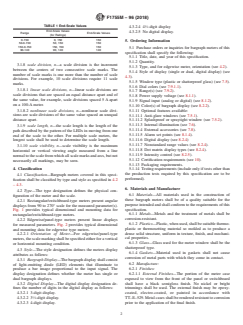
TABLE 1 End-Scale Values
4.3.2.4 4 ⁄2-digit display
End-Scale Values 4.3.2.5 No digital display.
Range End-Scale Values
(for Ratings)
0-150 0, 150 150
5. Ordering Information
50-0-150 50, 150 150
150-0-150 150, 150 150
5.1 Purchase orders or inquiries for bargraph meters of this
90-140 90, 140 140
specification shall specify the following:
5.1.1 Title, date, and year of this specification.
5.1.2 Quantity.
3.1.8 scale division, n—a scale division is the increment
5.1.3 Type, and for edgewise meter, orientation (see 4.2).
between the centers of two consecutive scale marks. The
5.1.4 Style of display (single or dual, digital display) (see
number of scale marks is one more than the number of scale
4.3).
divisions. For example, 10 scale divisions require 11 scale
5.1.5 Window type (plastic or shatterproof glass) (see 7.5).
marks.
5.1.6 Dial colors (see 7.9.1.1).
3.1.8.1 linear scale divisions, n—linear scale divisions are
5.1.7 Range(s) (see 7.9.2).
scale divisions that are spaced an equal distance apart and of
5.1.8 Power supply voltage (see 8.1.1).
the same value, for example, scale divisions spaced 5 A apart
5.1.9 Signal input (analog or digital) (see 8.1.2).
on a 100-A meter.
5.1.10 Color(s) of bargraph display (see 8.2.2).
3.1.8.2 nonlinear scale divisions, n—nonlinear scale divi- 5.1.11 Optional features available:
sions are scale divisions of the same value spaced an unequal
5.1.11.1 Anti-glare windows (see 7.5.1).
distance apart.
5.1.11.2 Splashproof or spraytight window (see 7.5.2).
5.1.11.3 Internal illumination (see 7.6).
3.1.9 scale length, n—the scale length is the length of the
5.1.11.4 External accessories (see 7.8).
path described by the pattern of the LEDs in moving from one
5.1.11.5 Alarm set points (see 8.1.4).
end of the scale to the other. For multiple scale meters, the
5.1.11.6 Digital display (see 8.2.4)
longest scale shall be used to determine the scale length.
5.1.11.7 Nonstandard range values (see 8.2.4).
3.1.10 scale visibility, n—scale visibility is the maximum
5.1.11.8 Dot matrix display types (see 8.2.4).
horizontal or vertical viewing angle measured from a line
5.1.11.9 Intensity control (see 8.2.5).
normaltothescalefromwhichallscalemarksandarcs,butnot
5.1.12 Certification requirements (see 10).
necessarily all markings, may be seen.
5.1.13 Packaging requirements.
4. Classification
5.1.14 Testing requirements (include only if tests other than
the production tests required by this specification are to be
4.1 Classification—Bargraph meters covered in this speci-
performed).
fication shall be classified by type and style as specified in 4.2
– 4.3.
6. Materials and Manufacture
4.2 Type—The type designation defines the physical con-
6.1 Materials—All materials used in the construction of
figuration of the meter and the scale.
these bargraph meters shall be of a quality suitable for the
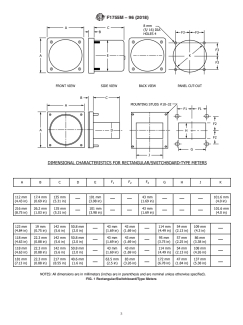
4.2.1 Rectangular/switchboard-type meters present angular
purpose intended and shall conform to the requirements of this
displays from 90 to 270° scale for the measured parameter(s).
specification.
Fig. 1 provides typical dimensional and mounting data for
6.1.1 Metals—Metals and the treatment of metals shall be
rectangular/switchboard-type meters.
corrosion-resistant.
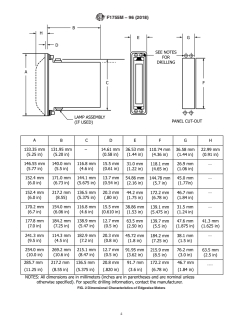
4.2.2 Edgewise/panel-type meters present linear displays
6.1.2 Plastics—Plastic,whenused,shallbesuitablethermo-
for measured parameters. Fig. 2 provides typical dimensional
plastic or thermosetting material so molded as to produce a
and mounting data for edgewise type meters.
dense solid structure, uniform in texture, finish, and mechani-
4.2.2.1 Orientation of Meter—For edgewise/panel-type
cal properties.
meters,thescalemarkingshallbespecifiedeitherforavertical
6.1.3 Glass—Glass used for the meter window shall be the
or horizontal mounting condition.
shatterproof type.
4.3 Style—The style designation defines the meters display
6.1.4 Gaskets—Material used in gaskets shall not cause
attributes as follows:
corrosion of metal parts with which they come in contact.
4.3.1 Bargraph Display—Thebargraphdisplayshallconsist
of light-emitting diode (LED) elements that illuminate to 6.2 Manufacture:
6.2.1 Finishes:
produce a bar image proportional to the input signal. The
display designation defines whether the meter has single or 6.2.1.1 External Finishes—The portion of the meter case
dual bargraph displays. exposed to view from the front of the panel or switchboard
4.3.2 Digital Display—The digital display designation de- shall have a black semigloss finish. No nickel or bright
fines the number of digits in the digital display as follows: trimmings shall be used. The external finish may be epoxy-
4.3.2.1 3-digit display. coated, electro-coated, or painted in accordance with
4.3.2.2 3 ⁄2-digit display. TT–E–529.Metalcasesshallberenderedresistanttocorrosion
4.3.2.3 4-digit display. prior to the application of the final finish.
F1755M − 96 (2018)
FIG. 1 Rectangular/Switchboard/Type Meters
F1755M − 96 (2018)
FIG. 2 Dimensional Characteristics of Edgewise Meters
F1755M − 96 (2018)
6.2.1.2 Internal Finishes—Internal finishes shall be of a 7.5.1.1 Specular Reflectance—The coating reflectance shall
material that shall not melt, crack, chip, blister, or scale as a be not greater than 0.6% for energy incident on the surface at
result of the tests specified herein. an angle of 0 to 15° inclusive. The reflectance shall be not
greater than 1.0% at an angle of 30°.
6.3 Threaded Parts—Threaded parts shall be in accordance
7.5.1.2 Light Loss—The coating light loss shall be not
with FED-STD-H28. Where practical, threads shall be in
greater than 2.0%.
conformitywiththecoarse-threadseries.Thefine-threadseries
7.5.2 Splashproof/Spraytight Windows—When specified,
shall be used only for applications that might show a definite
splashproof or spraytight windows shall be furnished.
advantage through their use. Where a special diameter pitch
7.6 Internal Illumination—When specified, meters shall be
combination is required, the thread shall be of American
equipped with internal illumination provided by a minimum of
National Form and of any pitch between 16 and 36 which is
two lamps, so placed to illuminate the dial evenly.
used in the fine-thread series.
6.3.1 Locking of Screw-Thread Assemblies—Screw-thread
7.7 AuxiliaryComponents—Allconnectionsfromtheshunts
assemblies shall not loosen as a result of the tests specified
and resistors to the input terminals of the meters shall be
herein. When practicable, split-type lockwashers or equivalent
insulated to prevent shock hazard.
means shall be provided under all nuts.
7.8 External Accessories—External shunt, shunt leads,
6.4 Sealing—The meter case shall be sealed by means of
transformers, resistors, and other external accessories shall be
gaskets, by fusing or soldering metal-to-metal or metal-to-
furnished when required.
glass, or other means which will enable the meter to withstand
7.9 Meter Scales:
the tests specified herein.
7.9.1 Dial—Thedialshallbemadeofstiffmaterialandshall
be supported and secured firmly to the meter.
7. Design and Construction
7.9.1.1 Dial Colors—The meter dial shall have white mark-
7.1 Dimensional Data—Typical physical dimensions for ings on a black background as standard.
switchboard and edgewise meters are shown in Fig. 1 and Fig.
7.9.1.2 Dial Markings—Dial legend markings shall be
2. sharply defined and visible from the front of the case but not
distract attention from the scale markings. Unless otherwise
7.2 Mounting—Bargraph meter shall be front panel
specified,thefollowinginformationshallbemarkedonthedial
mounted to simplify mechanical installation or removal for
or on an attached nameplate.
service, or both. Electrical connections locations shall be
(1)Manufacturer’s name.
designed to facilitate meter removal.Typical mounting dimen-
(2)Units of measurement.
sions are indicated in Fig. 1 and Fig. 2.
(3)The quantity producing end-scale deflection. For end-
7.2.1 Mounting Hardware—The necessary mounting
zerometers,thedialmarkingsshallbeFS,indicatingfullscale,
hardware,suchasmountingclips,nuts,washers,bolts,shallbe
followed by the full-scale value and units of measurement (for
supplied with each meter. The machine screws shall have the
example, FS-50 mV). For meters that are not end-zero meters,
same finish as the external finish (see 6.2.1.1).
the dial markings shall be marked ES indicating end scale
7.3 Maintainability—The meter shall be constructed so that followed by the end-scale value and units of measurement (for
example, ES-50 mV).
no special tools are required for insertion or removal of the
meter. 7.9.2 Ranges—For end-zero meters, the full-scale ranges
shall be as specified. For meters that are not end-zero meters,
7.4 Cases—Cases shall be corrosion resistant. Cases shall
thecenterandend-scalerangesshallbespecifiedappropriately.
be designed and constructed with close-fitting joints to mini-
7.9.3 ScaleDivisions—Unlessotherwisespecified,thevalue
mize the entrance of dust and moisture (see 6.4).
of each scale division shall be one, two, or five of the units
7.5 Windows—The meter display shall be provided with a
measured or any decimal multiple or submultiple of these
window of methyl methacrylate (MMA), polycarbonate (PC), numbers.
or shatterproof glass. If the window is made MMAor PC, the
7.9.3.1 Linear Scales—The total number of scale divisions
external surface shall be treated to resist scratching. The
shall be determined by dividing the total range by the smallest
window shall be free from detrimental defects that would
increment. For example; a 150-V scale with the smallest
prevent the display from being easily read or from meeting the
increment of 5 V is listed as having 30 scale divisions.
luminous distribution and color requirement. Such defects
7.9.3.2 Nonlinear Scales—The total number of scale divi-
include electrostatic effects, scratches, chips, cracks, or craze.
sions shall be determined by dividing the total range by the
smallest increment, although to avoid crowding scale marks, a
7.5.1 Anti-Glare Coatings—When anti-glare is specified,
windows shall be coated with an anti-glare coating. The portion of the scale shall not be marked. For example, a 100-A
scale with the smallest increment of 2 A, but with no marks
coating shall be uniform in quality and condition, clean,
smooth, and free from foreign materials. The coating shall between 0 and 10 A, is listed as having 50 scale divisions.
shownoevidenceofflaking,peeling,orblistering.Thecoating 7.9.4 Scale Visibility—The scale and characters shall be
shall not contain blemishes such as discolorations, stains, uniform visually in character brightness, legibility, and clean-
smears, and streaks. The coating shall show no evidence of a linessofdisplaywithallelementsofthemeterilluminated.The
cloudy or hazy appearance. entire meter scale shall be clearly visible from a distance of 1
F1755M − 96 (2018)
m (3 ft) and from a viewing angle of 45° from normal; both 8.2.4 Digital Display—When specified, the meter shall in-
vertically and horizontally. The scale visibility shall not dete- clude a red LED digital display that shall display continuously
riorate during the tests specified herein.
a specified range of values. The standard digital display shall
7.9.5 Scale Markings—Numerals, letters, and symbols shall
match the bargraph display. An optional feature of different
be in accordance with Practice F1166. Scale markings shall be
range values for the digital and bargraph displays shall be
as specified herein.
available when specified. The standard nominal character
7.9.5.1 The orientation of numerals shall be tangential or
heightshallbe4.88mm(0.192in.)foredgewisetypeswith2.4
erect for 90° scales, erect for 180 and 270° scaleplates, and
mm (0.095 in.) as an option. The standard nominal character
erect for edgewise scales.
heightshallbe10.5mm(0.41in.)forswitchboard-typemeters.
7.9.5.2 The sequence of scale divisions and numerals
The display type shall be seven segment as standard with dot
through the linear portion of the scale plate shall be uniform.
matrix as an option.
7.9.5.3 The scales shall begin and end with a numbered
8.2.5 Intensity Control—When specified, dimming controls
mark, including 0, when applicable.
shall be provided to maintain appropriate brightness, legibility,
7.9.5.4 There shall be not greater than five minor scale
and operator dark adaptation level. These controls shall apply
divisions between an intermediate or major scale division nor
to all LED displays and, when used, dial illumination. The
greaterthanthreeintermediatescaledivisionsbetweenamajor
display luminance shall vary in direct proportion to ambient
scale division.
lighting, and the dial illumination in inverse proportion.
7.9.5.5 The numbered markings shall be spaced uniformly
8.2.6 Adjustments—The meter shall contain provisions to
and shall be expressed in the same units of measurement as
adjust the zero-offset and full-scale range. The adjustment
those of the end-scale marking. One, two, and five or decimal
devices shall be accessible from the rear of the meter when
multiples thereof, shall be used when possible.
connected to the input signal and power supply sources.
7.9.5.6 Scale division markings shall occupy not greater
than 20% of the space between a scale division mark and an 8.2.7 Set Point Visual Indication—Visual indication of the
adjacent mark. set point locations shall be shown on the bargraph display by
illuminating that LED segment corresponding to the set value
8. Requirements
when the input signal is lower than the set point value. When
the input signal is greater than the set point value, the LED
8.1 Electrical Requirements:
segmentcorrespondingwiththesetpointvalueisoff.Whenthe
8.1.1 Power Supply Voltage—Themetersshalloperatefrom
signal level is one LED segment greater or lower than the set
a voltage as specified as follows. A means of reverse voltage
point value, the LED corresponding to the set point value will
protection shall be provided:
flash once a second (1 Hz). When the signal level and the set
5 ± 0.25 V direct current (Vdc)
point value are the same, the LED corresponding to the
28 ± 1.0 Vdc
115 ± 8.0 V alternating current (Vac)
location will flash twice a second (2 Hz).
8.1.2 Signal Input—The meters shall accept a digital or
8.3 Performance Requirements:
analog signal as specified.
8.3.1 Zero Adjustment—The meter shall include provision
8.1.3 Insulation Resistance—The insulation resistance shall
for zero adjustment by automatic or manual means. Manual
be not less than 2 MΩ between the external terminals and the
means for zero adjustments shall provide for a minimum
meter case.
excursion of 61% of full scale about scale zero. The means
8.1.4 Alarm Set Points—When specified, the meter shall be
shall be designed such that scale zero does not change as a
furnished with adjustable visible set points with form-C relay
result of any of the tests specified herein.
contact outputs for control of external devices such as remote
8.3.2 Span Adjustment—The meter shall include provision
alarms. The hysteresis of set points shall be not greater than
for span adjustment that provides for a full-scale adjustment
1.0% of full scale.
above and below full scale of not less than 1.0% of the rated
8.1.4.1 Setting—Set points shall be programmed from the
full scale. The span adjuster shall be designed to prevent it
front of the me
...