

ASTM F855-23
(Specification)Standard Specifications for Temporary Protective Grounds to Be Used on De-energized Electric Power Lines and Equipment
General Information
- Abstract
ABSTRACT
These specifications cover the equipment making up the temporary grounding system used on de-energized electric power lines, electric supply stations, and equipment. These specifications for a system of protective grounding utilizing copper cables are covered in four parts, as follows: clamps, ferrules, cables, and temporary protective grounds. Each of the four parts is an entity of itself, but is listed as a part of the system for completeness and clarification. The clamps shall be subject to design tests for determining mechanical torque strength and electrical short circuit capacity. The ferrules shall be tested for electrical short-circuit capacity and continuous current rating. The elastomer or thermoplastic making up the jacket of the flexible cable shall be tested according to the specified methods.
SCOPE
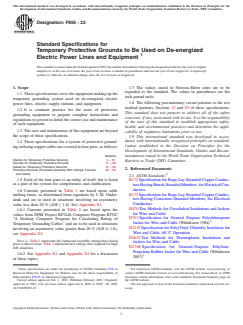
1.1 These specifications cover the equipment making up the temporary grounding system used on de-energized electric power lines, electric supply stations, and equipment.
1.2 It is common practice for the users of protective grounding equipment to prepare complete instructions and regulations to govern in detail the correct use and maintenance of such equipment.
1.3 The uses and maintenance of this equipment are beyond the scope of these specifications.
1.4 These specifications for a system of protective grounding utilizing copper cables are covered in four parts, as follows:
Sections
Clamps for Temporary Protective Grounds
4 – 16
Ferrules for Temporary Protective Grounds
17 – 30
Cables for Temporary Protective Grounds
31 – 39
Protective Grounds (Complete Assembly With Clamps, Ferrules, and Cable)
40 – 52
1.5 Each of the four parts is an entity of itself, but is listed as a part of the system for completeness and clarification.
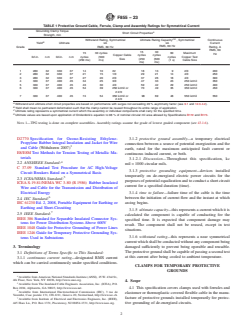
1.6 Currents presented in Table 1 are based upon cable melting times, as determined from equations by I. M. Onderdonk and are to used in situations involving an asymmetry value less than 20 % (X/R ≤ 1.8). See Appendix X1.
Note 1: TPG testing is done on complete assemblies. Assembly ratings assume the grade of lowest graded component (see 43.1.6).
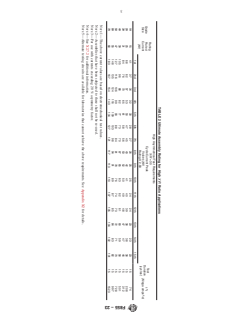
1.6.1 Currents presented in Table 2 are based upon the values from EPRI Project RP2446 Computer Program RTGC “A Desktop Computer Program for Calculating Rating of Temporary Grounding Cables” and are to be used in situations involving an asymmetry value greater than 20 % (X/R ≧ 1.8), see Appendix X2.
Note 1: The above current values are based on electromechanical test values.
Note 2: Assemblies that have been subjected to these shall not be re-used.
Note 3: For use with currents exceeding 20 % asymmetry factor.
Note 4: See X2.7.2 for additional information.
Note 5: Alternate testing circuits are available for laboratories that cannot achieve the above requirements. See Appendix X2 for details.
Note 1: Table 1 represents the clamp and assembly ratings that existed prior to this revision. Table 2 represents new ratings now required for high X/R situations.
1.6.2 See Appendix X1 and Appendix X2 for a discussion of these topics.
1.7 The values stated in Newton-Meter units are to be regarded as the standard. The values in parentheses are the inch-pound units.
1.8 The following precautionary caveat pertains to the test method portions, Sections 12 and 25 of these specifications: This standard does not purport to address all of the safety concerns, if any, associated with its use. It is the responsibility of the user of this standard to establish appropriate safety, health, and environmental practices and determine the applicability of regulatory limitations prior to use.
1.9 This international standard was developed in accordance with internationally recognized principles on standardization established in the Decision on Principles for the Development of International Standards, Guides and Recommendations issue...
- Status
- Published
- Publication Date
- 31-Jan-2023
- Technical Committee
- F18 - Electrical Protective Equipment for Workers
- Drafting Committee
- F18.45 - Mechanical Apparatus
Buy Documents
ASTM F855-23 - Standard Specifications for Temporary Protective Grounds to Be Used on De-energized Electric Power Lines and Equipment
REDLINE ASTM F855-23 - Standard Specifications for Temporary Protective Grounds to Be Used on De-energized Electric Power Lines and Equipment
Overview
ASTM F855-23 is the internationally recognized standard specification developed by ASTM for temporary protective grounds used on de-energized electric power lines, electric supply stations, and equipment. This standard specifically outlines the requirements and testing for a complete system of protective grounding using copper cables, covering four essential components: clamps, ferrules, cables, and complete ground assemblies.
The primary purpose of ASTM F855-23 is to ensure the safe and effective operation of temporary grounding systems, which are critical for worker protection against inadvertent energization and induced currents during maintenance or servicing of power lines and electrical equipment.
Key Topics
System Components
- Clamps: Designed to temporarily connect grounding cables to de-energized conductors or grounded structures. Three main types and various grades are specified based on installation method and mechanical strength.
- Ferrules: Compression devices that ensure a secure electrical connection between the cable strands and clamps or connectors. Multiple types and grades address compatibility and performance requirements.
- Cables: Flexible copper cables with elastomer or thermoplastic jackets provide the conductive path to ground and withstand mechanical and electrical stresses.
- Complete Assemblies: Integration of clamp, ferrule, and cable as a tested unit ensures system reliability and safety.
Performance and Testing
- Mechanical Strength: Clamps are tested for torque strength and resilience during installation and removal to prevent user injury.
- Electrical Capacity: Assemblies are validated for their ability to withstand specified symmetrical and asymmetrical fault currents using established test procedures.
- Material Requirements: Conductive parts must be of suitable copper or aluminum alloys, with performance characteristics verified through tensile, yield, and elongation tests.
- Inspection and Certification: Systematic inspection, sampling, and certification processes are provided to ensure consistent product quality and traceability.
Current Ratings
- The standard provides tables for short-circuit withstand and ultimate ratings, referencing both symmetrical and high asymmetrical current scenarios according to industry methodologies (Onderdonk equations and EPRI RTGC).
Safety and Compliance
- Emphasizes the necessity for users to develop detailed instructions and maintenance procedures outside the scope of this standard.
- Highlights the importance of safety, health, and environmental practices when installing and using protective grounding equipment.
Applications
Organizations and professionals involved in the operation and maintenance of electric power distribution and transmission systems rely on ASTM F855-23 to specify and procure compliant temporary protective grounding equipment. Applications include:
- Utility maintenance crews: Ensuring worker safety during planned outages or emergency repairs.
- Contractors and service providers: Procuring standardized, proven equipment for project-based work on substations and power lines.
- Manufacturers: Designing and testing clamps, cables, ferrules, and grounding assemblies to meet consistent industry performance benchmarks.
By adhering to ASTM F855-23 requirements, stakeholders help minimize the risks associated with electrical faults, reduce equipment failure, and maintain regulatory compliance.
Related Standards
ASTM F855-23 references and aligns with several other key industry standards relevant to protective grounding and cable assemblies, including:
- ASTM B172 & B173: Specifications for rope-lay-stranded copper conductors.
- ASTM D470, D2219, D2633, D2768, D2770, D753: Specifications and test methods for cable insulation and jacketing materials.
- ANSI/IEEE C37.09: Test procedures for AC high-voltage circuit breakers.
- ICEA S-19-81/NEMA WC 3-80: Rubber insulated wire and cable for electric energy transmission and distribution.
- IEC 61230: Portable equipment for earthing or earthing and short-circuiting.
- IEEE 1048 & IEEE 1246: Guides for temporary power line and substation protective grounding.
These related standards ensure a consistent and harmonized approach for temporary protective grounding systems across the global electric power industry.
For optimal worker protection and operational reliability, always use components and assemblies that are fully compliant with ASTM F855-23 and associated standards.
Relations
- Effective Date
- 01-Jan-2024
- Effective Date
- 01-Apr-2017
- Effective Date
- 01-Apr-2017
- Effective Date
- 15-Jul-2016
- Effective Date
- 01-Apr-2015
- Effective Date
- 01-Apr-2015
- Effective Date
- 01-Feb-2015
- Effective Date
- 01-Jun-2013
- Effective Date
- 01-Dec-2011
- Effective Date
- 01-Aug-2011
- Effective Date
- 01-Apr-2010
- Effective Date
- 01-Apr-2010
- Effective Date
- 01-Oct-2007
- Effective Date
- 15-Mar-2007
- Effective Date
- 15-Mar-2007
Buy Documents
ASTM F855-23 - Standard Specifications for Temporary Protective Grounds to Be Used on De-energized Electric Power Lines and Equipment
REDLINE ASTM F855-23 - Standard Specifications for Temporary Protective Grounds to Be Used on De-energized Electric Power Lines and Equipment
Get Certified
Connect with accredited certification bodies for this standard

IMQ S.p.A. (Certification)
Italian electrical product certification.

SLG Prüf- und Zertifizierungs GmbH
German testing and certification body.

UL Solutions
Global safety science company with testing, inspection and certification.
Sponsored listings
Frequently Asked Questions
ASTM F855-23 is a technical specification published by ASTM International. Its full title is "Standard Specifications for Temporary Protective Grounds to Be Used on De-energized Electric Power Lines and Equipment". This standard covers: ABSTRACT These specifications cover the equipment making up the temporary grounding system used on de-energized electric power lines, electric supply stations, and equipment. These specifications for a system of protective grounding utilizing copper cables are covered in four parts, as follows: clamps, ferrules, cables, and temporary protective grounds. Each of the four parts is an entity of itself, but is listed as a part of the system for completeness and clarification. The clamps shall be subject to design tests for determining mechanical torque strength and electrical short circuit capacity. The ferrules shall be tested for electrical short-circuit capacity and continuous current rating. The elastomer or thermoplastic making up the jacket of the flexible cable shall be tested according to the specified methods. SCOPE 1.1 These specifications cover the equipment making up the temporary grounding system used on de-energized electric power lines, electric supply stations, and equipment. 1.2 It is common practice for the users of protective grounding equipment to prepare complete instructions and regulations to govern in detail the correct use and maintenance of such equipment. 1.3 The uses and maintenance of this equipment are beyond the scope of these specifications. 1.4 These specifications for a system of protective grounding utilizing copper cables are covered in four parts, as follows: Sections Clamps for Temporary Protective Grounds 4 – 16 Ferrules for Temporary Protective Grounds 17 – 30 Cables for Temporary Protective Grounds 31 – 39 Protective Grounds (Complete Assembly With Clamps, Ferrules, and Cable) 40 – 52 1.5 Each of the four parts is an entity of itself, but is listed as a part of the system for completeness and clarification. 1.6 Currents presented in Table 1 are based upon cable melting times, as determined from equations by I. M. Onderdonk and are to used in situations involving an asymmetry value less than 20 % (X/R ≤ 1.8). See Appendix X1. Note 1: TPG testing is done on complete assemblies. Assembly ratings assume the grade of lowest graded component (see 43.1.6). 1.6.1 Currents presented in Table 2 are based upon the values from EPRI Project RP2446 Computer Program RTGC “A Desktop Computer Program for Calculating Rating of Temporary Grounding Cables” and are to be used in situations involving an asymmetry value greater than 20 % (X/R ≧ 1.8), see Appendix X2. Note 1: The above current values are based on electromechanical test values. Note 2: Assemblies that have been subjected to these shall not be re-used. Note 3: For use with currents exceeding 20 % asymmetry factor. Note 4: See X2.7.2 for additional information. Note 5: Alternate testing circuits are available for laboratories that cannot achieve the above requirements. See Appendix X2 for details. Note 1: Table 1 represents the clamp and assembly ratings that existed prior to this revision. Table 2 represents new ratings now required for high X/R situations. 1.6.2 See Appendix X1 and Appendix X2 for a discussion of these topics. 1.7 The values stated in Newton-Meter units are to be regarded as the standard. The values in parentheses are the inch-pound units. 1.8 The following precautionary caveat pertains to the test method portions, Sections 12 and 25 of these specifications: This standard does not purport to address all of the safety concerns, if any, associated with its use. It is the responsibility of the user of this standard to establish appropriate safety, health, and environmental practices and determine the applicability of regulatory limitations prior to use. 1.9 This international standard was developed in accordance with internationally recognized principles on standardization established in the Decision on Principles for the Development of International Standards, Guides and Recommendations issue...
ABSTRACT These specifications cover the equipment making up the temporary grounding system used on de-energized electric power lines, electric supply stations, and equipment. These specifications for a system of protective grounding utilizing copper cables are covered in four parts, as follows: clamps, ferrules, cables, and temporary protective grounds. Each of the four parts is an entity of itself, but is listed as a part of the system for completeness and clarification. The clamps shall be subject to design tests for determining mechanical torque strength and electrical short circuit capacity. The ferrules shall be tested for electrical short-circuit capacity and continuous current rating. The elastomer or thermoplastic making up the jacket of the flexible cable shall be tested according to the specified methods. SCOPE 1.1 These specifications cover the equipment making up the temporary grounding system used on de-energized electric power lines, electric supply stations, and equipment. 1.2 It is common practice for the users of protective grounding equipment to prepare complete instructions and regulations to govern in detail the correct use and maintenance of such equipment. 1.3 The uses and maintenance of this equipment are beyond the scope of these specifications. 1.4 These specifications for a system of protective grounding utilizing copper cables are covered in four parts, as follows: Sections Clamps for Temporary Protective Grounds 4 – 16 Ferrules for Temporary Protective Grounds 17 – 30 Cables for Temporary Protective Grounds 31 – 39 Protective Grounds (Complete Assembly With Clamps, Ferrules, and Cable) 40 – 52 1.5 Each of the four parts is an entity of itself, but is listed as a part of the system for completeness and clarification. 1.6 Currents presented in Table 1 are based upon cable melting times, as determined from equations by I. M. Onderdonk and are to used in situations involving an asymmetry value less than 20 % (X/R ≤ 1.8). See Appendix X1. Note 1: TPG testing is done on complete assemblies. Assembly ratings assume the grade of lowest graded component (see 43.1.6). 1.6.1 Currents presented in Table 2 are based upon the values from EPRI Project RP2446 Computer Program RTGC “A Desktop Computer Program for Calculating Rating of Temporary Grounding Cables” and are to be used in situations involving an asymmetry value greater than 20 % (X/R ≧ 1.8), see Appendix X2. Note 1: The above current values are based on electromechanical test values. Note 2: Assemblies that have been subjected to these shall not be re-used. Note 3: For use with currents exceeding 20 % asymmetry factor. Note 4: See X2.7.2 for additional information. Note 5: Alternate testing circuits are available for laboratories that cannot achieve the above requirements. See Appendix X2 for details. Note 1: Table 1 represents the clamp and assembly ratings that existed prior to this revision. Table 2 represents new ratings now required for high X/R situations. 1.6.2 See Appendix X1 and Appendix X2 for a discussion of these topics. 1.7 The values stated in Newton-Meter units are to be regarded as the standard. The values in parentheses are the inch-pound units. 1.8 The following precautionary caveat pertains to the test method portions, Sections 12 and 25 of these specifications: This standard does not purport to address all of the safety concerns, if any, associated with its use. It is the responsibility of the user of this standard to establish appropriate safety, health, and environmental practices and determine the applicability of regulatory limitations prior to use. 1.9 This international standard was developed in accordance with internationally recognized principles on standardization established in the Decision on Principles for the Development of International Standards, Guides and Recommendations issue...
ASTM F855-23 is classified under the following ICS (International Classification for Standards) categories: 29.120.50 - Fuses and other overcurrent protection devices. The ICS classification helps identify the subject area and facilitates finding related standards.
ASTM F855-23 has the following relationships with other standards: It is inter standard links to ASTM E8/E8M-24, ASTM B172-17, ASTM B173-17, ASTM E8/E8M-16, ASTM B172-10(2015), ASTM B173-10(2015), ASTM E8/E8M-15, ASTM E8/E8M-13, ASTM E8/E8M-11, ASTM D2219-11, ASTM B173-10, ASTM B172-10, ASTM D2219-02(2007)e1, ASTM B172-01a(2007)e1, ASTM B173-01a(2007)e1. Understanding these relationships helps ensure you are using the most current and applicable version of the standard.
ASTM F855-23 is available in PDF format for immediate download after purchase. The document can be added to your cart and obtained through the secure checkout process. Digital delivery ensures instant access to the complete standard document.
Standards Content (Sample)
This international standard was developed in accordance with internationally recognized principles on standardization established in the Decision on Principles for the
Development of International Standards, Guides and Recommendations issued by the World Trade Organization Technical Barriers to Trade (TBT) Committee.
Designation: F855 − 23
Standard Specifications for
Temporary Protective Grounds to Be Used on De-energized
Electric Power Lines and Equipment
This standard is issued under the fixed designation F855; the number immediately following the designation indicates the year of original
adoption or, in the case of revision, the year of last revision. A number in parentheses indicates the year of last reapproval. A superscript
epsilon (´) indicates an editorial change since the last revision or reapproval.
1. Scope 1.7 The values stated in Newton-Meter units are to be
regarded as the standard. The values in parentheses are the
1.1 These specifications cover the equipment making up the
inch-pound units.
temporary grounding system used on de-energized electric
1.8 The following precautionary caveat pertains to the test
power lines, electric supply stations, and equipment.
method portions, Sections 12 and 25 of these specifications:
1.2 It is common practice for the users of protective
This standard does not purport to address all of the safety
grounding equipment to prepare complete instructions and
concerns, if any, associated with its use. It is the responsibility
regulations to govern in detail the correct use and maintenance
of the user of this standard to establish appropriate safety,
of such equipment.
health, and environmental practices and determine the appli-
1.3 The uses and maintenance of this equipment are beyond
cability of regulatory limitations prior to use.
the scope of these specifications.
1.9 This international standard was developed in accor-
dance with internationally recognized principles on standard-
1.4 These specifications for a system of protective ground-
ization established in the Decision on Principles for the
ing utilizing copper cables are covered in four parts, as follows:
Development of International Standards, Guides and Recom-
Sections mendations issued by the World Trade Organization Technical
Clamps for Temporary Protective Grounds 4 – 16
Barriers to Trade (TBT) Committee.
Ferrules for Temporary Protective Grounds 17 – 30
Cables for Temporary Protective Grounds 31 – 39
2. Referenced Documents
Protective Grounds (Complete Assembly With Clamps, Ferrules, 40 – 52
and Cable) 2
2.1 ASTM Standards:
1.5 Each of the four parts is an entity of itself, but is listed
B172 Specification for Rope-Lay-Stranded Copper Conduc-
as a part of the system for completeness and clarification.
tors Having Bunch-Stranded Members, for Electrical Con-
ductors
1.6 Currents presented in Table 1 are based upon cable
B173 Specification for Rope-Lay-Stranded Copper Conduc-
melting times, as determined from equations by I. M. Onder-
tors Having Concentric-Stranded Members, for Electrical
donk and are to used in situations involving an asymmetry
Conductors
value less than 20 % (X/R ≤ 1.8). See Appendix X1.
D470 Test Methods for Crosslinked Insulations and Jackets
1.6.1 Currents presented in Table 2 are based upon the
for Wire and Cable
values from EPRI Project RP2446 Computer Program RTGC
D753 Specification for General Purpose Polychloroprene
“A Desktop Computer Program for Calculating Rating of
Jacket for Wire and Cable (Withdrawn 1984)
Temporary Grounding Cables” and are to be used in situations
D2219 Specification for Poly(Vinyl Chloride) Insulation for
involving an asymmetry value greater than 20 % (X/R ^ 1.8),
Wire and Cable, 60 °C Operation
see Appendix X2.
D2633 Test Methods for Thermoplastic Insulations and
NOTE 1—Table 1 represents the clamp and assembly ratings that existed
Jackets for Wire and Cable
prior to this revision. Table 2 represents new ratings now required for high
D2768 Specification for General-Purpose Ethylene-
X/R situations.
Propylene Rubber Jacket for Wire and Cable (Withdrawn
1.6.2 See Appendix X1 and Appendix X2 for a discussion
2007)
of these topics.
1 2
These specifications are under the jurisdiction of ASTM Committee F18 on For referenced ASTM standards, visit the ASTM website, www.astm.org, or
Electrical Protective Equipment for Workers and are the direct responsibility of contact ASTM Customer Service at service@astm.org. For Annual Book of ASTM
Subcommittee F18.45 on Mechanical Apparatus. Standards volume information, refer to the standard’s Document Summary page on
Current edition approved Feb. 1, 2023. Published February 2023. Originally the ASTM website.
approved in 1983. Last previous edition approved in 2020 as F855 – 20. DOI: The last approved version of this historical standard is referenced on www.ast-
10.1520/F0855-23. m.org.
Copyright © ASTM International, 100 Barr Harbor Drive, PO Box C700, West Conshohocken, PA 19428-2959. United States
F855 − 23
TABLE 1 Protective Ground Cable, Ferrule, Clamp and Assembly Ratings for Symmetrical Current
Grounding Clamp Torque
A
Short Circuit Properties
Strength, min
CD
Withstand Rating, Symmetrical Continuous
Ultimate Rating Capacity , Symmetrical
B
Yield Ultimate kA kA Current
RMS, 60 Hz
Grade RMS, 60 Hz Rating, A
RMS, 60
15 30
15 30 cycles 60 Maximum
Hz
Copper Cable cycles cycles
lbf·in. n·m lbf·in. n·m cycles (500 cycles Copper Test
Size (250 (500
(250 ms) ms) (1 s) Cable Size
ms) ms)
1 280 32 330 37 14 10 #2 18 13 9 2/0 200
2 280 32 330 37 21 15 1/0 29 21 14 4/0 250
3 280 32 330 37 27 20 2/0 37 26 18 4/0 300
4 330 37 400 45 34 25 3/0 47 33 23 250 kcmil 350
5 330 37 400 45 43 30 4/0 59 42 29 250 kcmil 400
6 330 37 400 45 54 39 250 kcmil or 70 49 35 350 kcmil 450
2 2/0
7 330 37 400 45 74 54 350 kcmil or 98 69 48 550 kcmil 550
2 4/0
A
Withstand and ultimate short circuit properties are based on performance with surges not exceeding 20 % asymmetry factor (see 9.1 and 12.3.4.2).
B
Yield shall mean no permanent deformation such that the clamp cannot be reused throughout its entire range of application.
C
Ultimate rating represents a symmetrical current which the assembly or individual components shall carry for the specified time.
D
Ultimate values are based upon application of Onderdonk’s equation to 98 % of nominal circular mil area allowed by Specifications B172 and B173.
NOTE 1—TPG testing is done on complete assemblies. Assembly ratings assume the grade of lowest graded component (see 43.1.6).
D2770 Specification for Ozone-Resisting Ethylene- 3.1.2 protective ground assembly—a temporary electrical
Propylene Rubber Integral Insulation and Jacket for Wire connection between a source of potential energization and the
and Cable (Withdrawn 2007)
earth, rated for the maximum anticipated fault current or
E8/E8M Test Methods for Tension Testing of Metallic Ma-
continuous induced current, or both.
terials
3.1.2.1 Discussion—Throughout this specification, kc
2.2 ANSI/IEEE Standard:
mil = 1000 circular mils.
C 37.09 Standard Test Procedure for AC High-Voltage
3.1.3 protective grounding equipment—devices installed
Circuit Breakers Rated on a Symmetrical Basis
temporarily on de-energized electric power circuits for the
2.3 ICEA/NEMA Standard:
purposes of potential equalization and to conduct a short circuit
ICEA S-19-81/NEMA WC 3-80 (R 1986) Rubber Insulated
current for a specified duration (time).
Wire and Cable for the Transmission and Distribution of
Electrical Energy
3.1.4 time to failure—failure time of the cable is the time
between the initiation of current flow and the instant at which
2.4 IEC Standard:
IEC 61230 Ed. 2, 2008, Portable Equipment for Earthing or arcing begins.
Earthing and Short-Circuiting
3.1.5 ultimate capacity—this represents a current which it is
2.5 IEEE Standard:
calculated the component is capable of conducting for the
IEEE 386 Standard for Separable Insulated Connector Sys-
specified time. It is expected that component damage may
tems for Power Distribution Systems Above 600V
result. The component shall not be reused, except in test
IEEE 1048 Guide for Protective Grounding of Power Lines
situations.
IEEE 1246 Guide for Temporary Protective Grounding Sys-
3.1.6 withstand rating—this represents a near symmetrical
tems Used in Substations
current which shall be conducted without any component being
3. Terminology
damaged sufficiently to prevent being operable and reusable.
The protective ground shall be capable of passing a second test
3.1 Definitions of Terms Specific to This Standard:
at this current after being cooled to ambient temperature.
3.1.1 continuous current rating—designated RMS current
which can be carried continuously under specified conditions.
CLAMPS FOR TEMPORARY PROTECTIVE
GROUNDS
Available from American National Standards Institute (ANSI), 25 W. 43rd St.,
4th Floor, New York, NY 10036, http://www.ansi.org.
4. Scope
Available from The Insulated Cable Engineers Association, Inc. (ICEA), P.O.
Box 2694, Alpharetta, GA 30023, http://www.icea.net. 4.1 This specification covers clamps used with ferrules and
Available from International Electrotechnical Commission (IEC), 3 rue de
elastomer or thermoplastic covered flexible cable in the manu-
Varembé, Case postale 131, CH-1211, Geneva 20, Switzerland, http://www.iec.ch.
7 facture of protective grounds installed temporarily for protec-
Available from Institute of Electrical and Electronics Engineers, Inc. (IEEE),
445 Hoes Ln., P.O. Box 1331, Piscataway, NJ 08854-1331, http://www.ieee.org. tive grounding of de-energized circuits.
F855 − 23
TABLE 2 Ultimate Assembly Rating for High X/R Ratio Applications
High Asymmetrical Test Requirements
X/R = 30
Rating
Test
Cycle Current Peak
Grade Rated 1 t
Duration
Values (kA)
Size Current (Mega amps -s)
(cycles)
Rating X 2.69
(kA)
1st 2nd 3rd 4th 5th 6th 7th 8th 9th 10th 11th 12th 13th 14th 15th
1H 15 41 37 34 32 30 28 27 26 25 25 24 24 23 23 23 15 74
2H 25 68 62 57 53 50 47 45 43 42 41 40 39 38 38 38 15 208
3H 31 84 76 70 65 61 58 56 53 52 50 49 48 47 47 46 15 312
4H 39 105 96 88 82 77 73 70 67 65 63 62 61 60 59 58 15 501
5H 47 127 116 106 99 93 88 84 81 78 76 74 73 72 71 70 15 728
6H 55 148 135 124 116 109 103 98 94 91 89 87 85 84 83 82 15 997
7H 68 183 167 154 143 134 127 121 117 113 110 107 105 104 102 101 15 1523
NOTE 1—The above current values are based on electromechanical test values.
NOTE 2—Assemblies that have been subjected to these shall not be re-used.
NOTE 3—For use with currents exceeding 20 % asymmetry factor.
NOTE 4—See X2.7.2 for additional information.
NOTE 5—Alternate testing circuits are available for laboratories that cannot achieve the above requirements. See Appendix X2 for details.
F855 − 23
NOTE 2—A typical ordering description is as follows: 100 Grounding
5. Classification
Clamps, Main contact range #2 to 350 kcmil for 2/0 Copper flexible
5.1 Clamps are furnished in, but not limited to, three types
grounding cable, ASTM F855, Type 1, Grade 3, Class A, Design C, Style
according to their function and method of installation, as
7.
NOTE 3—It is expected that manufacturers will publish catalog data
follows:
conforming to this specification that will combine the requirements of
5.1.1 Type I—Clamps for installation on de-energized con-
7.1.1 – 7.1.8 in a single product number. With that system, a typical order
ductors equipped with eyes for installation with removable hot
description is: 100 (Smith Manufacturing Co. Product No. XXXX)
sticks.
grounding clamps ASTM F855, Grade 2-max use 21kA, Ultimate Rating.
5.1.2 Type II—Clamps for installation on de-energized con-
8. Materials
ductors having permanently mounted hot sticks.
5.1.3 Type III—Clamps for installation on permanently 8.1 Current carrying parts made of copper base or aluminum
grounded conductors or metal structures with tee handles, and base alloy shall have the following material properties in
accordance with Test Methods E8/E8M:
eyes or square or hexagon head screw(s), or both.
5.1.4 Other types of special clamps, such as those for cluster
Copper Base Alloy Aluminum Base Alloy
grounds or for underground equipment grounding, may be
Tensile strength, min 207 MPa (30 000 psi) 207 MPa (30 000 psi)
made, tested, and certified by the manufacturer as meeting the
Yield strength, min 90 MPa (13 000 psi) 138 MPa (20 000 psi)
requirements of this specification.
Elongation, min 6 % 3 %
5.1.5 Separable insulated connectors used in manufacturing
8.2 Type II clamps shall be equipped with an insulating
underground equipment grounding assemblies shall meet the
handle (hot stick) appropriate for the nominal voltage of the
requirements of IEEE 386.
circuit to be grounded.
5.2 Clamps are furnished in grades according to mechanical
9. Electrical and Mechanical Properties
strengths, short circuit capabilities, and duration of faults, as
9.1 Electrical and mechanical properties shall conform to
indicated in Table 1 or Table 2. For Table 1 grade designations,
the requirements prescribed in Table 1 or Table 2, as
clamp ratings must include maximum use current and indica-
appropriate, and the following paragraphs. See Appendix X1
tion whether testing was done at Ultimate or Withstand
for a discussion and derivation of the current levels in Table 1.
Ratings. The maximum use current listed shall not exceed the
See Appendix X2 for a discussion of the effects of asymmetri-
test current used in their electrical short circuit design tests (per
cal current and the derivation of the currents in Table 2.
12.3.4).
9.1.1 Types I and II stick installed clamps shall be designed
5.3 Clamps are furnished in two classes according to the
such that a failure does not increase the risk of injury to the
characteristics of the main contact jaws:
user or have excess mechanical strength to prevent failure,
5.3.1 Class A—Clamp jaws with smooth contact surfaces.
defined as follows:
5.3.2 Class B—Clamp jaws with serrations, or cross
9.1.1.1 In the event the clamp is over-torqued during
hatching, or other means intended to abrade or bite through
installation, normal fracture shall be such that the attached
corrosion products on the surfaces of the conductor being
cable remains under control by being retained with the stick.
clamped.
9.1.1.2 Clamps with an ultimate torque strength exceeding
45 N·m (400 lbf·in.) are exempt from the provisions of 9.1.1.1.
6. Sizes
9.1.2 Resistance from the main contact to the attached cable
6.1 Clamp size is the combination of the main contact and
contact shall be less than that for an equal length of maximum
cable size ranges as listed by the manufacturers. It should be
size cable(s) for which the clamp is rated.
noted that the main contact may connect to a cable or bus bar
9.1.3 Main contacts shall accept and clamp all conductors or
or be used at the “ground end” to connect to a variety of
structural members in accordance with the manufacturer’s
conductive grounded objects.
rating.
9.1.4 Clamp shall accept hand assembly of all cables fitted
7. Ordering Information
with compatible ferrules as rated per Table 3.
9.1.5 Cable termination shall include a cable support or
7.1 Orders for clamps under this specification shall include
shall be made to accept a cable supporting ferrule. This support
this ASTM designation and the following information:
shall secure the entire cable over the jacket and is provided in
7.1.1 Quantity,
addition to the electrical connection to the strand.
7.1.2 Name (grounding clamp),
9.1.6 Type I clamps shall be operable with clamp sticks and
7.1.3 Main contact size ranges, conductor descriptions, and
shall fit securely inside a nominal 13 mm ( ⁄2 in.) wide slot in
materials which are to be clamped by main contact,
the head of the stick.
7.1.4 Cable size, material, and description by which clamps
are to be assembled,
10. Workmanship, Finish, and Appearance
7.1.5 Type (see 5.1),
10.1 Components shall be free of structural porosity, fins,
7.1.6 Grade (see 5.2 and Table 1 or Table 2),
sharp edges, splits, cracks, and other defects that affect
7.1.7 Class (see 5.3),
handling or performance.
7.1.8 Asymmetrical current or other supplementary
requirements, if applicable. (See Supplementary Requirements 10.2 All parts shall be formed, machined, and assembled
S1 to S10 for styles and designs.) with sufficient accuracy for smooth operation by hand, and
F855 − 23
TABLE 3 Cable Terminations and Compatible Ferrules for Protective Ground Clamps
Grounding Clamp Matching Cable Ferrule
ASTM
A
Essential Data
ASTM
Cable Cable Termination
Essential Size Data Ferrule Ferrule Description
Termination Description
Type Size
Style
1 Cable retaining eyebolt ferrule OD accepted I compression compressed OD
Stud and shroud OD accepted III plain stud shrouded stud dia and compressed shroud dia
compression
2 eyebolt and cable ferrule or stud dia accepted I compression compressed OD
support
3 plain bore bolted clamp III plain stud shrouded stud dia and compressed shroud dia
and cable support compression
4 plain bore tubular with
screws and cable
support
A
1 5 1 5
5 plain bore boss nominal ID ⁄2 in. (12.7 mm), ⁄8 in. (16 IV threaded stud shrouded stud or bolt dia ⁄2 in.-13NC, ⁄8
in.–11 NC, or ⁄4 in.–10 NC and
mm), or ⁄4 in. (20 mm) and included
included angle of cone contact
angle of cone contact
6 plain bore boss and I compression
cable support
V bolted shrouded compression
IV threaded stud shrouded
compression
V bolted shrouded compression
VI threaded stud compression
ferrule
B A
1 5 1 5
7 threaded bore boss thread size ⁄2 in.–13 NC, ⁄8 in.–11 NC, IV threaded stud shrouded stud size ⁄2 in.–13 NC, ⁄8 in.–11
3 3
or ⁄4 in.–10 NC NC, or ⁄4 in.–10 NC
compression
8 threaded bore boss and VI threaded stud compression
cable support ferrule
9 threaded bore clamp
and cable support
A
The material shall be copper or aluminum base. The cable size and material description shall include overall outside diameter.
B
1 5 3
Bolt stud and thread sizes metric conversion is as follows: ⁄2 in. – 13 NC . M12 × 1.75, ⁄8 in. – 11 NC . M16 × 2.00, ⁄4 in. – 10 NC . M20 × 2.50.
shall be free of excessive looseness to the extent detrimental to shall pass the inspection requirements of Section 13. When a
repeated applications at the recommended installing torque. failure occurs in one specimen from the first sample, a second
sample from the same lot shall be selected and tested. If the
10.3 Class A (smooth jaw) clamps shall have smooth
second sample (two specimens) passes, the lot shall be ac-
contact surfaces free of burrs, fins, or other protuberances that
cepted. If one specimen from the second sample fails, the lot
would impair performance.
shall be rejected.
10.4 Class B (serrated jaw) clamps shall have longitudinally
level surfaces that, with clamp movement as specified by the
12. Design Tests
manufacturer, will provide a cleaning effect on the surface of
12.1 The design tests that follow shall be made on test
the conductor from the serrations or crosshatching present.
samples of each product model to verify that the requirements
10.5 Snag grinding marks, depressions, and other surface
of this specification are met.
irregularities which do not affect strength, performance, or
12.2 Mechanical Torque Strength:
handling are not cause for rejection.
12.2.1 Install the clamp on the main conductor of the
minimum and maximum size for which the clamp is rated and
11. Sampling
apply torsional force to the main screw. Force may be applied
11.1 A product model represents a manufacturer’s design
to other devices designed to secure the clamp on the conductor.
specification standard according to which the production lot is
12.2.2 Measure torque by a torque wrench that indicates
manufactured.
torque directly or by another manner easily convertible.
11.2 A production lot shall consist of all clamps of one
12.2.3 The main conductor is defined as the material(s) for
product model produced at one time.
which the clamp is rated to be used.
11.3 A test sample shall consist of two specimens for each 12.2.4 Yield and ultimate strength shall equal or exceed the
different test specified. Specimens are selected at random and values shown in Table 1.
F855 − 23
12.3 Electrical Short Circuit Capacity: 12.3.4.3 The ultimate rating of Table 2 represents an asym-
12.3.1 Assemble the protective grounding equipment with metrical current at an X/R ratio of 30 which the clamp shall
cable, ferrules and clamps in accordance with the manufactur- carry for the specified time. The clamp thus tested might be
er’s specifications. The current is to be determined by the damaged and shall not be reused.
method described in ANSI/IEEE C37.09, latest revision. Quali-
12.4 Grounding clamps tested at their continuous current
fication testing of protective ground assembly methods and
rating shall have a lower maximum temperature than that of the
components such as clamps, ferrules and cable shall use a cable
maximum size copper main or tap cable for which rated.
length of 10 ft 6 4 in. (3 m). Other cable lengths and protective
Maintain current until thermal stability is achieved. Thermal
grounding equipment configurations may be tested to this
stability shall be achieved when the temperature rise of a
standard as agreed upon between the vendor and user.
minimum of three consecutive readings taken at five-minute
12.3.2 Electrode spacing shall be as specified in Fig. 1, with
intervals does not differ by more than 61 °C (1.8 °F) for each
the clamps in a vertical position, in order that the slack cable
thermocouple being used. Temperature shall be measured at the
length stresses the clamps with electromagnetic tensile impact
warmest spot on the clamp, midpoint on the ferrule and on the
during test surge.
metal strand at the midpoint of the main and tap conductors,
12.3.3 Test the clamp on the main conductor within the
each a minimum of 1.5 m (5 ft).
rated range established by manufacturer and torqued to the
value recommended by the manufacturer.
13. Inspection and Product Testing
12.3.4 Short circuit values and time durations specified by
13.1 The clamps shall be inspected and tested as follows:
the customer shall be as specified in Table 1 or Table 2, as
13.1.1 Verification of the main contact and cable capacities
appropriate. Table 2 shall be used if no asymmetrical currents
shall be in accordance with 9.1.2 and 9.1.3.
have been specified.
13.1.2 Visual inspection and hand operation to verify
12.3.4.1 The withstand rating of Table 1 represents a near
workmanship, finish, and appearance shall be in accordance
symmetrical current which the clamp shall conduct without
with Section 10.
being damaged sufficiently to prevent being operable and
13.1.3 Torque test on a test sample shall be in accordance
reusable.
with 12.2.
12.3.4.2 The ultimate rating of Table 1 represents a current
which the clamp shall carry for the specified time. The clamp
14. Acceptance, Rejection, and Rehearing
thus tested might be damaged and shall not be reused.
14.1 At the option of the purchaser, a production lot may be
subjected to the following:
14.1.1 Inspection in accordance with 13.1 for operation,
main contact range, workmanship, and appearance. Individual
clamps that do not conform may be rejected.
14.1.2 Resistance comparison test in accordance with 9.1.2.
14.2 Material that fails to conform to the requirements of
this specification may be rejected. Rejection should be reported
to the producer or supplier promptly and in writing. In case of
dissatisfaction with the results of the test, the producer or
supplier may make claim for a rehearing.
14.3 If electrical, or mechanical testing, or both, are re-
quired by a user prior to acceptance, minimum testing shall be
done in accordance with this specification for any part or for all
of the tests to be performed.
15. Certification
15.1 When specified in the purchase order or contract, a
manufacturer’s or supplier’s certification shall be furnished to
the purchaser that the clamps were manufactured, sampled,
tested, and inspected in accordance with this specification and
found to meet the requirements. When specified in the pur-
chase order or contract, a report of design test, or surge test
oscillogram, or both, shall be furnished.
16. Packaging and Package Marking
16.1 Clamps shall be marked with the name or logo of the
manufacturer, identity number, and date code to indicate year
FIG. 1 Fixture for Testing Ground Clamps, Ferrules, Cables, and
Jumpers of manufacture.
F855 − 23
16.2 A packing list indicating manufacturer’s product num- rent and indication whether testing was done at Ultimate or
bers and quantities of each different clamp shall be provided Withstand Ratings. The maximum use current listed shall not
with each shipment. exceed the test current used in their electrical short circuit
design tests (per 25.2.3).
16.3 Each shipment shall be packaged to provide protection
of the contents appropriate for the mode of transportation.
19. Size
CABLE FERRULES FOR TEMPORARY
19.1 Ferrule size is the combination of cable capacity, stud
PROTECTIVE GROUNDS
description, and size after installation of cable (see Table 1 for
standard sizes according to types and minimum grade require-
17. Scope
ments).
17.1 This specification covers ferrules used with cables,
20. Ordering Information
clamps, and connectors in the manufacture of protective
grounds, installed temporarily for protective grounding of
20.1 Orders for ferrules under this specification should
de-energized circuits.
include this ASTM designation and the following information:
20.1.1 Quantity,
18. Classification
20.1.2 Unit of measure (each or pair),
18.1 Ferrules are furnished in five types as shown in Table
20.1.3 Name (grounding cable ferrules),
4 and Table 5, and are as follows:
20.1.4 Tap contact size, description, and material of clamp
18.1.1 Type I—Compression ferrule is cylindrical and made
or connector in which ferrule is to be installed,
for installation on cable stranding by compression.
20.1.5 Cable description, to include strand size, material,
18.1.2 Type III—Plain stud-shrouded compression ferrule
and outside diameter on which ferrule is to be installed,
has a stepped bore that accepts entire cable over jacket.
20.1.6 Type (see 18.1),
18.1.3 Type IV—Threaded stud shrouded compression fer-
20.1.7 Grade (see 18.2 and Table 2), and
rule has a stepped bore that accepts entire cable over jacket and
20.1.8 Asymmetrical current or other supplementary
has male threads at forward end.
requirements, if applicable (see Supplementary Requirements
18.1.4 Type V—Bolted shrouded compression ferrule has
S1 to S17).
internal threads and a bolt at forward end.
NOTE 4—A typical ordering description is as follows: 100 Pairs
18.1.5 Type VI—Threaded stud compression ferrule has
Grounding Cable Ferrules, for tap contact 5/8-11 NC aluminum clamp and
male threads at forward end.
grounding cable 4/0-2019 W CU 21 mm (0.83 in.) O.D., ASTM F855,
Type IV, Grade 5 or 5H.
18.2 Ferrules are furnished in grades in accordance with
NOTE 5—It is expected that manufacturers will publish catalog data
cable capacity, short circuit capabilities, and duration of faults
conforming to this specification which will combine the requirements of
as indicated in Table 1 or Table 2. For Table 1 grade
20.1.2 – 20.1.8 in a single product number. With that system, a typical
designations, ferrule ratings must include maximum use cur- order description is as follows: 100 (Smith Manufacturing Co. Product
TABLE 4 Protective Ground Cable Ferrule Physical Specifications
Note—Inspection or vent holes are optional for Types III, IV, V, and VI.
A
1 5 3
Standard thread sizes are as follows: ⁄2 in. – 13 UNC . M12 × 1.75, ⁄8 in. – 11 UNC . M16 × 2.00, ⁄4 in. – 10 UNC . M20 × 2.50.
F855 − 23
TABLE 5 Protective Ground Cable Ferrule and Compatible Clamp Terminations
Note—Inspection or vent holes are optional for Types III, IV, V, and VI.
A
1 5 3
Standard thread sizes are as follows: ⁄2 in. – 13 UNC . M12 × 1.75, ⁄8 in. – 11 UNC . M16 × 2.00, ⁄4 in. – 10 UNC . M20 × 2.50.
No. XXXX) grounding cable ferrules, ASTM F855, Grade 5-max use
24. Sampling
30kA, Withstand Rating.
24.1 A product model represents a manufacturer’s design
21. Materials
specification according to which the production lot is manu-
factured.
21.1 Materials used shall meet the requirements of 8.1.
Current carrying parts of copper base or aluminum base
24.2 A production lot shall consist of all ferrules of one
ferrules shall meet the following requirements:
product model produced at one time.
21.1.1 Copper Base Alloy—Copper content 60 % minimum.
24.3 A test sample shall consist of two specimens selected at
21.1.2 Aluminum Base Alloy—Aluminum content 90 %
random from a production lot for each different test specified.
minimum.
When a failure occurs in one specimen from the first sample, a
22. Electrical and Physical Properties second sample shall be selected from the same lot and tested.
If the second sample (two specimens) passes, the lot shall be
22.1 Closed end ferrules utilizing the compression method
acceptable. If one specimen from the second sample fails, the
for cable installation may have a 3 mm (0.125 in.) minimum
lot shall be rejected.
diameter inspection vent hole through one side at the bottom of
the (cable) bore. This applies to Types III, IV, V, and VI.
25. Design Tests
22.2 Ferrules shall accept cables for which they are rated
25.1 Design tests shall be made on test samples of each
without alteration of strands, and can be assembled by hand
with compatible clamps. product model to verify that the requirements of the specifica-
tion are met.
22.3 Table 1 and Table 2 specify current levels. See Appen-
dix X1 for a discussion and the derivation of these current
25.2 Electrical Short-Circuit Capacity:
levels for near symmetrical currents. See Appendix X2 for a
25.2.1 Install the ferrules in accordance with specifications
similar discussion of the asymmetrical current requirements.
on maximum capacity grounding cable and clamps which have
been rated. The cable length shall be 10 ft 6 4 in. (3 m). See
23. Workmanship, Finish, and Appearance
12.3.1.
23.1 Components shall be free of structural defects that
25.2.2 Cable configuration and electrode spacing shall be as
affect installation, assembly, or performance.
specified in Fig. 1, with the clamps in the vertical position, in
23.2 Minor surface irregularities that do not affect strength order that the slack cable length stresses the ferrules with
or performance are not cause for rejection. electromagnetic tensile impact during test surge.
F855 − 23
25.2.3 Short circuit values and time durations specified by been found to meet the requirements. When specified in the
the customer shall be as specified in Table 1 or Table 2, as purchase order or contract, a report of design test shall be
appropriate. furnished.
25.2.3.1 The withstand rating of Table 1 represents a near
29. Product Marking
symmetrical current which ferrules shall conduct without being
damaged sufficiently to prevent being operable and reusable.
29.1 Ferrules shall be marked with the manufacturer’s
25.2.3.2 The ultimate rating of Table 1 represents a sym-
identity code.
metrical current which the ferrule shall carry for the specified
time. Table 2 represents an ultimate current at a specified X/R 30. Packaging
ratio of 30 which the ferrule shall carry for the specified time.
30.1 Each shipment shall be packaged to provide protection
The ferrule thus tested might be damaged and shall not be
of the contents appropriate for the mode of transportation.
reused except for test purposes.
25.2.3.3 The ultimate rating of Table 2 represents an asym- CABLES FOR TEMPORARY PROTECTIVE
GROUNDS
metrical current at an X/R ratio of 30 which the ferrule shall
carry for the specified time. The ferrules thus tested might be
31. Scope
damaged and shall not be reused.
31.1 This specification covers the elastomer or thermoplas-
25.3 Continuous Current Rating—Grounding ferrules tested
tic covered flexible cable used with ferrules, clamps, and
at their continuous current rating shall have a lower maximum
connectors in the manufacture of protective grounds, installed
temperature than that of the maximum size copper main or tap
temporarily for protective grounding of de-energized circuits.
cable for which rated. Maintain current until thermal stability is
achieved. Thermal stability shall be achieved when the tem-
32. Classification
perature rise of a minimum of three consecutive readings taken
at five-minute intervals does not differ by more than 61 °C
32.1 Grounding cables have flexible elastomer or thermo-
(1.8 °F) for each thermocouple being used. Temperature shall
plastic jackets primarily for mechanical protection of the
be measured at the warmest spot on the clamp, midpoint on the
conductor it covers.
ferrule and on the metal strand at the midpoint of the main and
32.2 Electrical characteristics shall be in accordance with
tap conductors, each a minimum of 1.5 m (5 ft).
Table 1 or Table 2. See Appendix X1 for a discussion and
derivation of near symmetrical c
...
This document is not an ASTM standard and is intended only to provide the user of an ASTM standard an indication of what changes have been made to the previous version. Because
it may not be technically possible to adequately depict all changes accurately, ASTM recommends that users consult prior editions as appropriate. In all cases only the current version
of the standard as published by ASTM is to be considered the official document.
Designation: F855 − 20 F855 − 23
Standard Specifications for
Temporary Protective Grounds to Be Used on De-energized
Electric Power Lines and Equipment
This standard is issued under the fixed designation F855; the number immediately following the designation indicates the year of original
adoption or, in the case of revision, the year of last revision. A number in parentheses indicates the year of last reapproval. A superscript
epsilon (´) indicates an editorial change since the last revision or reapproval.
1. Scope
1.1 These specifications cover the equipment making up the temporary grounding system used on de-energized electric power
lines, electric supply stations, and equipment.
1.2 It is common practice for the users of protective grounding equipment to prepare complete instructions and regulations to
govern in detail the correct use and maintenance of such equipment.
1.3 The uses and maintenance of this equipment are beyond the scope of these specifications.
1.4 These specifications for a system of protective grounding utilizing copper cables are covered in four parts, as follows:
Sections
Clamps for Temporary Protective Grounds 4 – 16
Ferrules for Temporary Protective Grounds 17 – 30
Cables for Temporary Protective Grounds 31 – 39
Protective Grounds (Complete Assembly With Clamps, Ferrules, 40 – 52
and Cable)
1.5 Each of the four parts is an entity of itself, but is listed as a part of the system for completeness and clarification.
1.6 Currents presented in Table 1 are based upon cable melting times, as determined from equations by I. M. Onderdonk and are
to used in situations involving an asymmetry value less than 20 % (X/R ≤ 1.8). See Appendix X1.
1.6.1 Currents presented in Table 2 are based upon the values from EPRI Project RP2446 Computer Program RTGC “A Desktop
Computer Program for Calculating Rating of Temporary Grounding Cables” and are to be used in situations involving an
asymmetry value greater than 20 % (X/R ^ 1.8), see Appendix X2.
NOTE 1—Table 1 represents the clamp and assembly ratings that existed prior to this revision. Table 2 represents new ratings now required for high X/R
situations.
1.6.2 See Appendix X1 and Appendix X2 for a discussion of these topics.
These specifications are under the jurisdiction of ASTM Committee F18 on Electrical Protective Equipment for Workers and are the direct responsibility of Subcommittee
F18.45 on Mechanical Apparatus.
Current edition approved Sept. 15, 2020Feb. 1, 2023. Published October 2020February 2023. Originally approved in 1983. Last previous edition approved in 20192020
as F855 – 19a.F855 – 20. DOI: 10.1520/F0855-20.10.1520/F0855-23.
Copyright © ASTM International, 100 Barr Harbor Drive, PO Box C700, West Conshohocken, PA 19428-2959. United States
F855 − 23
TABLE 1 Protective Ground Cable, Ferrule, Clamp and Assembly Ratings for Symmetrical Current
Grounding Clamp Torque
A
Short Circuit Properties
Strength, min
CD
Withstand Rating, Symmetrical Continuous
Ultimate Rating Capacity , Symmetrical
B
Yield Ultimate kA kA Current
RMS, 60 Hz
Grade RMS, 60 Hz Rating, A
RMS, 60
15 30
15 30 cycles 60 Maximum
Hz
Copper Cable cycles cycles
lbf·in. n·m lbf·in. n·m cycles (500 cycles Copper Test
Size (250 (500
(250 ms) ms) (1 s) Cable Size
ms) ms)
1 280 32 330 37 14 10 #2 18 13 9 2/0 200
2 280 32 330 37 21 15 1/0 29 21 14 4/0 250
3 280 32 330 37 27 20 2/0 37 26 18 4/0 300
4 330 37 400 45 34 25 3/0 47 33 23 250 kcmil 350
5 330 37 400 45 43 30 4/0 59 42 29 250 kcmil 400
6 330 37 400 45 54 39 250 kcmil or 70 49 35 350 kcmil 450
2 2/0
7 330 37 400 45 74 54 350 kcmil or 98 69 48 550 kcmil 550
2 4/0
A
Withstand and ultimate short circuit properties are based on performance with surges not exceeding 20 % asymmetry factor (see 9.1 and 12.3.4.2).
B
Yield shall mean no permanent deformation such that the clamp cannot be reused throughout its entire range of application.
C
Ultimate rating represents a symmetrical current which the assembly or individual components shall carry for the specified time.
D
Ultimate values are based upon application of Onderdonk’s equation to 98 % of nominal circular mil area allowed by Specifications B172 and B173.
NOTE 1—TPG testing is done on complete assemblies. Assembly ratings assume the grade of lowest graded component (see 43.1.6).
1.7 The values stated in Newton-Meter units are to be regarded as the standard. The values in parentheses are the inch-pound units.
1.8 The following precautionary caveat pertains to the test method portions, Sections 12 and 25 of these specifications: This
standard does not purport to address all of the safety concerns, if any, associated with its use. It is the responsibility of the user
of this standard to establish appropriate safety, health, and environmental practices and determine the applicability of regulatory
limitations prior to use.
1.9 This international standard was developed in accordance with internationally recognized principles on standardization
established in the Decision on Principles for the Development of International Standards, Guides and Recommendations issued
by the World Trade Organization Technical Barriers to Trade (TBT) Committee.
2. Referenced Documents
2.1 ASTM Standards:
B172 Specification for Rope-Lay-Stranded Copper Conductors Having Bunch-Stranded Members, for Electrical Conductors
B173 Specification for Rope-Lay-Stranded Copper Conductors Having Concentric-Stranded Members, for Electrical Conduc-
tors
D470 Test Methods for Crosslinked Insulations and Jackets for Wire and Cable
D753 Specification for General Purpose Polychloroprene Jacket for Wire and Cable (Withdrawn 1984)
D2219 Specification for Poly(Vinyl Chloride) Insulation for Wire and Cable, 60 °C Operation
D2633 Test Methods for Thermoplastic Insulations and Jackets for Wire and Cable
D2768 Specification for General-Purpose Ethylene-Propylene Rubber Jacket for Wire and Cable (Withdrawn 2007)
D2770 Specification for Ozone-Resisting Ethylene-Propylene Rubber Integral Insulation and Jacket for Wire and Cable
(Withdrawn 2007)
E8/E8M Test Methods for Tension Testing of Metallic Materials
2.2 ANSI/IEEE Standard:
C 37.09 Standard Test Procedure for AC High-Voltage Circuit Breakers Rated on a Symmetrical Basis
2.3 ICEA/NEMA Standard:
ICEA S-19-81/NEMA WC 3-80 (R 1986) Rubber Insulated Wire and Cable for the Transmission and Distribution of Electrical
Energy
For referenced ASTM standards, visit the ASTM website, www.astm.org, or contact ASTM Customer Service at service@astm.org. For Annual Book of ASTM Standards
volume information, refer to the standard’s Document Summary page on the ASTM website.
The last approved version of this historical standard is referenced on www.astm.org.
Available from American National Standards Institute (ANSI), 25 W. 43rd St., 4th Floor, New York, NY 10036, http://www.ansi.org.
Available from The Insulated Cable Engineers Association, Inc. (ICEA), P.O. Box 2694, Alpharetta, GA 30023, http://www.icea.net.
F855 − 23
TABLE 2 Ultimate Assembly Rating for High X/R Ratio Applications
High Asymmetrical Test Requirements
X/R = 30
Rating
Test
Cycle Current Peak
Grade Rated 1 t
Duration
Values (kA)
Size Current (Mega amps -s)
(cycles)
Rating X 2.69
(kA)
1st 2nd 3rd 4th 5th 6th 7th 8th 9th 10th 11th 12th 13th 14th 15th
1H 15 41 37 34 32 30 28 27 26 25 25 24 24 23 23 23 15 74
2H 25 68 62 57 53 50 47 45 43 42 41 40 39 38 38 38 15 208
3H 31 84 76 70 65 61 58 56 53 52 50 49 48 47 47 46 15 312
4H 39 105 96 88 82 77 73 70 67 65 63 62 61 60 59 58 15 501
5H 47 127 116 106 99 93 88 84 81 78 76 74 73 72 71 70 15 728
6H 55 148 135 124 116 109 103 98 94 91 89 87 85 84 83 82 15 997
7H 68 183 167 154 143 134 127 121 117 113 110 107 105 104 102 101 15 1523
NOTE 1—The above current values are based on electromechanical test values.
NOTE 2—Assemblies that have been subjected to these shall not be re-used.
NOTE 3—For use with currents exceeding 20 % asymmetry factor.
NOTE 4—See X2.7.2 for additional information.
NOTE 5—Alternate testing circuits are available for laboratories that cannot achieve the above requirements. See Appendix X2 for details.
F855 − 23
2.4 IEC Standard:
IEC 61230 Ed. 2, 2008, Portable Equipment for Earthing or Earthing and Short-Circuiting
2.5 IEEE Standard:
IEEE 386 Standard for Separable Insulated Connector Systems for Power Distribution Systems Above 600V
IEEE 1048 Guide for Protective Grounding of Power Lines
IEEE 1246 Guide for Temporary Protective Grounding Systems Used in Substations
3. Terminology
3.1 Definitions of Terms Specific to This Standard:
3.1.1 continuous current rating—designated RMS current which can be carried continuously under specified conditions.
3.1.2 protective ground assembly—a temporary electrical connection between a source of potential energization and the earth,
rated for the maximum anticipated fault current or continuous induced current, or both.
3.1.2.1 Discussion—
Throughout this specification, kc mil = 1000 circular mils.
3.1.3 protective grounding equipment—devices installed temporarily on de-energized electric power circuits for the purposes of
potential equalization and to conduct a short circuit current for a specified duration (time).
3.1.4 time to failure—failure time of the cable is the time between the initiation of current flow and the instant at which arcing
begins.
3.1.5 ultimate capacity—this represents a current which it is calculated the component is capable of conducting for the specified
time. It is expected that component damage may result. The component shall not be reused, except in test situations.
3.1.6 withstand rating—this represents a near symmetrical current which shall be conducted without any component being
damaged sufficiently to prevent being operable and reusable. The protective ground shall be capable of passing a second test at
this current after being cooled to ambient temperature.
CLAMPS FOR TEMPORARY PROTECTIVE GROUNDS
4. Scope
4.1 This specification covers clamps used with ferrules and elastomer or thermoplastic covered flexible cable in the manufacture
of protective grounds installed temporarily for protective grounding of de-energized circuits.
5. Classification
5.1 Clamps are furnished in, but not limited to, three types according to their function and method of installation, as follows:
5.1.1 Type I—Clamps for installation on de-energized conductors equipped with eyes for installation with removable hot sticks.
5.1.2 Type II—Clamps for installation on de-energized conductors having permanently mounted hot sticks.
5.1.3 Type III—Clamps for installation on permanently grounded conductors or metal structures with tee handles, and eyes or
square or hexagon head screw(s), or both.
5.1.4 Other types of special clamps, such as those for cluster grounds or for underground equipment grounding, may be made,
tested, and certified by the manufacturer as meeting the requirements of this specification.
5.1.5 Separable insulated connectors used in manufacturing underground equipment grounding assemblies shall meet the
requirements of IEEE 386.
Available from International Electrotechnical Commission (IEC), 3 rue de Varembé, Case postale 131, CH-1211, Geneva 20, Switzerland, http://www.iec.ch.
Available from Institute of Electrical and Electronics Engineers, Inc. (IEEE), 445 Hoes Ln., P.O. Box 1331, Piscataway, NJ 08854-1331, http://www.ieee.org.
F855 − 23
5.2 Clamps are furnished in grades according to mechanical strengths, short circuit capabilities, and duration of faults, as indicated
in Table 1 or Table 2. For Table 1 grade designations, clamp ratings must include maximum use current and indication whether
testing was done at Ultimate or Withstand Ratings. The maximum use current listed shall not exceed the test current used in their
electrical short circuit design tests (per 12.3.4).
5.3 Clamps are furnished in two classes according to the characteristics of the main contact jaws:
5.3.1 Class A—Clamp jaws with smooth contact surfaces.
5.3.2 Class B—Clamp jaws with serrations, or cross hatching, or other means intended to abrade or bite through corrosion products
on the surfaces of the conductor being clamped.
6. Sizes
6.1 Clamp size is the combination of the main contact and cable size ranges as listed by the manufacturers. It should be noted that
the main contact may connect to a cable or bus bar or be used at the “ground end” to connect to a variety of conductive grounded
objects.
7. Ordering Information
7.1 Orders for clamps under this specification shall include this ASTM designation and the following information:
7.1.1 Quantity,
7.1.2 Name (grounding clamp),
7.1.3 Main contact size ranges, conductor descriptions, and materials which are to be clamped by main contact,
7.1.4 Cable size, material, and description by which clamps are to be assembled,
7.1.5 Type (see 5.1),
7.1.6 Grade (see 5.2 and Table 1 or Table 2),
7.1.7 Class (see 5.3),
7.1.8 Asymmetrical current or other supplementary requirements, if applicable. (See Supplementary Requirements S1 to S10 for
styles and designs.)
NOTE 2—A typical ordering description is as follows: 100 Grounding Clamps, Main contact range #2 to 350 kcmil for 2/0 Copper flexible grounding cable,
ASTM F855, Type 1, Grade 3, Class A, Design C, Style 7.
NOTE 3—It is expected that manufacturers will publish catalog data conforming to this specification that will combine the requirements of 7.1.1 – 7.1.8
in a single product number. With that system, a typical order description is: 100 (Smith Manufacturing Co. Product No. XXXX) grounding clamps ASTM
F855, Grade 2-max use 21kA, Ultimate Rating.
8. Materials
8.1 Current carrying parts made of copper base or aluminum base alloy shall have the following material properties in accordance
with Test Methods E8/E8M:
Copper Base Alloy Aluminum Base Alloy
Tensile strength, min 207 MPa (30 000 psi) 207 MPa (30 000 psi)
Yield strength, min 90 MPa (13 000 psi) 138 MPa (20 000 psi)
Elongation, min 6 % 3 %
F855 − 23
8.2 Type II clamps shall be equipped with an insulating handle (hot stick) appropriate for the nominal voltage of the circuit to be
grounded.
9. Electrical and Mechanical Properties
9.1 Electrical and mechanical properties shall conform to the requirements prescribed in Table 1 or Table 2, as appropriate, and
the following paragraphs. See Appendix X1 for a discussion and derivation of the current levels in Table 1. See Appendix X2 for
a discussion of the effects of asymmetrical current and the derivation of the currents in Table 2.
9.1.1 Types I and II stick installed clamps shall be designed such that a failure does not increase the risk of injury to the user or
have excess mechanical strength to prevent failure, defined as follows:
9.1.1.1 In the event the clamp is over-torqued during installation, normal fracture shall be such that the attached cable remains
under control by being retained with the stick.
9.1.1.2 Clamps with an ultimate torque strength exceeding 45 N·m (400 lbf·in.) are exempt from the provisions of 9.1.1.1.
9.1.2 Resistance from the main contact to the attached cable contact shall be less than that for an equal length of maximum size
cable(s) for which the clamp is rated.
9.1.3 Main contacts shall accept and clamp all conductors or structural members in accordance with the manufacturer’s rating.
9.1.4 Clamp shall accept hand assembly of all cables fitted with compatible ferrules as rated per Table 3.
9.1.5 Cable termination shall include a cable support or shall be made to accept a cable supporting ferrule. This support shall
secure the entire cable over the jacket and is provided in addition to the electrical connection to the strand.
9.1.6 Type I clamps shall be operable with clamp sticks and shall fit securely inside a nominal 13 mm ( ⁄2 in.) wide slot in the head
of the stick.
10. Workmanship, Finish, and Appearance
10.1 Components shall be free of structural porosity, fins, sharp edges, splits, cracks, and other defects that affect handling or
performance.
10.2 All parts shall be formed, machined, and assembled with sufficient accuracy for smooth operation by hand, and shall be free
of excessive looseness to the extent detrimental to repeated applications at the recommended installing torque.
10.3 Class A (smooth jaw) clamps shall have smooth contact surfaces free of burrs, fins, or other protuberances that would impair
performance.
10.4 Class B (serrated jaw) clamps shall have longitudinally level surfaces that, with clamp movement as specified by the
manufacturer, will provide a cleaning effect on the surface of the conductor from the serrations or crosshatching present.
10.5 Snag grinding marks, depressions, and other surface irregularities which do not affect strength, performance, or handling are
not cause for rejection.
11. Sampling
11.1 A product model represents a manufacturer’s design specification standard according to which the production lot is
manufactured.
11.2 A production lot shall consist of all clamps of one product model produced at one time.
11.3 A test sample shall consist of two specimens for each different test specified. Specimens are selected at random and shall pass
F855 − 23
TABLE 3 Cable Terminations and Compatible Ferrules for Protective Ground Clamps
Grounding Clamp Matching Cable Ferrule
ASTM
A
Essential Data
ASTM
Cable Cable Termination
Essential Size Data Ferrule Ferrule Description
Termination Description
Type Size
Style
1 Cable retaining eyebolt ferrule OD accepted I compression compressed OD
Stud and shroud OD accepted III plain stud shrouded stud dia and compressed shroud dia
compression
2 eyebolt and cable ferrule or stud dia accepted I compression compressed OD
support
3 plain bore bolted clamp III plain stud shrouded stud dia and compressed shroud dia
and cable support compression
4 plain bore tubular with
screws and cable
support
A
1 5 1 5
5 plain bore boss nominal ID ⁄2 in. (12.7 mm), ⁄8 in. (16 IV threaded stud shrouded stud or bolt dia ⁄2 in.-13NC, ⁄8
3 in.–11 NC, or ⁄4 in.–10 NC and
mm), or ⁄4 in. (20 mm) and included
included angle of cone contact
angle of cone contact
6 plain bore boss and I compression
cable support
V bolted shrouded compression
IV threaded stud shrouded
compression
V bolted shrouded compression
VI threaded stud compression
ferrule
B A
1 5 1 5
7 threaded bore boss thread size ⁄2 in.–13 NC, ⁄8 in.–11 NC, IV threaded stud shrouded stud size ⁄2 in.–13 NC, ⁄8 in.–11
3 3
or ⁄4 in.–10 NC NC, or ⁄4 in.–10 NC
compression
8 threaded bore boss and VI threaded stud compression
cable support ferrule
9 threaded bore clamp
and cable support
A
The material shall be copper or aluminum base. The cable size and material description shall include overall outside diameter.
B
1 5 3
Bolt stud and thread sizes metric conversion is as follows: ⁄2 in. – 13 NC . M12 × 1.75, ⁄8 in. – 11 NC . M16 × 2.00, ⁄4 in. – 10 NC . M20 × 2.50.
the inspection requirements of Section 13. When a failure occurs in one specimen from the first sample, a second sample from the
same lot shall be selected and tested. If the second sample (two specimens) passes, the lot shall be accepted. If one specimen from
the second sample fails, the lot shall be rejected.
12. Design Tests
12.1 The design tests that follow shall be made on test samples of each product model to verify that the requirements of this
specification are met.
12.2 Mechanical Torque Strength:
12.2.1 Install the clamp on the main conductor of the minimum and maximum size for which the clamp is rated and apply torsional
force to the main screw. Force may be applied to other devices designed to secure the clamp on the conductor.
12.2.2 Measure torque by a torque wrench that indicates torque directly or by another manner easily convertible.
12.2.3 The main conductor is defined as the material(s) for which the clamp is rated to be used.
12.2.4 Yield and ultimate strength shall equal or exceed the values shown in Table 1.
12.3 Electrical Short Circuit Capacity:
F855 − 23
12.3.1 Assemble the protective grounding equipment with cable, ferrules and clamps in accordance with the manufacturer’s
specifications. The current is to be determined by the method described in ANSI/IEEE C37.09, latest revision. Qualification testing
of protective ground assembly methods and components such as clamps, ferrules and cable shall use a cable length of 10 ft 6 4
in. (3 m). Other cable lengths and protective grounding equipment configurations may be tested to this standard as agreed upon
between the vendor and user.
12.3.2 Electrode spacing shall be as specified in Fig. 1, with the clamps in a vertical position, in order that the slack cable length
stresses the clamps with electromagnetic tensile impact during test surge.
12.3.3 Test the clamp on the main conductor within the rated range established by manufacturer and torqued to the value
recommended by the manufacturer.
12.3.4 Short circuit values and time durations specified by the customer shall be as specified in Table 1 or Table 2, as appropriate.
Table 2 shall be used if no asymmetrical currents have been specified.
12.3.4.1 The withstand rating of Table 1 represents a near symmetrical current which the clamp shall conduct without being
damaged sufficiently to prevent being operable and reusable.
12.3.4.2 The ultimate rating of Table 1 represents a current which the clamp shall carry for the specified time. The clamp thus
tested might be damaged and shall not be reused.
12.3.4.3 The ultimate rating of Table 2 represents an asymmetrical current at an X/R ratio of 30 which the clamp shall carry for
the specified time. The clamp thus tested might be damaged and shall not be reused.
12.4 Grounding, clamps and ferrules Grounding clamps tested at their continuous current rating shall have a lower maximum
temperature than that of the maximum size copper main or tap cable for which rated. Maintain current until thermal stability is
achieved. Thermal stability shall be achieved when the temperature rise of a minimum of three consecutive readings taken at
five-minute intervals does not differ by more than 61 °C (1.8 °F) for each thermocouple being used. Temperature shall be
FIG. 1 Fixture for Testing Ground Clamps, Ferrules, Cables, and Jumpers
F855 − 23
measured at the warmest spot on the clamp, midpoint on the ferrule and on the metal strand at the midpoint of the main and toptap
conductors, each a minimum of 1.5 m (5 ft).
13. Inspection and Product Testing
13.1 The clamps shall be inspected and tested as follows:
13.1.1 Verification of the main contact and cable capacities shall be in accordance with 9.1.2 and 9.1.3.
13.1.2 Visual inspection and hand operation to verify workmanship, finish, and appearance shall be in accordance with Section
10.
13.1.3 Torque test on a test sample shall be in accordance with 12.2.
14. Acceptance, Rejection, and Rehearing
14.1 At the option of the purchaser, a production lot may be subjected to the following:
14.1.1 Inspection in accordance with 13.1 for operation, main contact range, workmanship, and appearance. Individual clamps that
do not conform may be rejected.
14.1.2 Resistance comparison test in accordance with 9.1.2.
14.2 Material that fails to conform to the requirements of this specification may be rejected. Rejection should be reported to the
producer or supplier promptly and in writing. In case of dissatisfaction with the results of the test, the producer or supplier may
make claim for a rehearing.
14.3 If electrical, or mechanical testing, or both, are required by a user prior to acceptance, minimum testing shall be done in
accordance with this specification for any part or for all of the tests to be performed.
15. Certification
15.1 When specified in the purchase order or contract, a manufacturer’s or supplier’s certification shall be furnished to the
purchaser that the clamps were manufactured, sampled, tested, and inspected in accordance with this specification and found to
meet the requirements. When specified in the purchase order or contract, a report of design test, or surge test oscillogram, or both,
shall be furnished.
16. Packaging and Package Marking
16.1 Clamps shall be marked with the name or logo of the manufacturer, identity number, and date code to indicate year of
manufacture.
16.2 A packing list indicating manufacturer’s product numbers and quantities of each different clamp shall be provided with each
shipment.
16.3 Each shipment shall be packaged to provide protection of the contents appropriate for the mode of transportation.
CABLE FERRULES FOR TEMPORARY PROTECTIVE GROUNDS
17. Scope
17.1 This specification covers ferrules used with cables, clamps, and connectors in the manufacture of protective grounds, installed
temporarily for protective grounding of de-energized circuits.
18. Classification
18.1 Ferrules are furnished in five types as shown in Table 4 and Table 5, and are as follows:
F855 − 23
TABLE 4 Protective Ground Cable Ferrule Physical Specifications
Note—Inspection or vent holes are optional for Types III, IV, V, and VI.
A
1 5 3
Standard thread sizes are as follows: ⁄2 in. – 13 UNC . M12 × 1.75, ⁄8 in. – 11 UNC . M16 × 2.00, ⁄4 in. – 10 UNC . M20 × 2.50.
TABLE 5 Protective Ground Cable Ferrule and Compatible Clamp Terminations
Note—Inspection or vent holes are optional for Types III, IV, V, and VI.
A
1 5 3
Standard thread sizes are as follows: ⁄2 in. – 13 UNC . M12 × 1.75, ⁄8 in. – 11 UNC . M16 × 2.00, ⁄4 in. – 10 UNC . M20 × 2.50.
18.1.1 Type I—Compression ferrule is cylindrical and made for installation on cable stranding by compression.
18.1.2 Type III—Plain stud-shrouded compression ferrule has a stepped bore that accepts entire cable over jacket.
F855 − 23
18.1.3 Type IV—Threaded stud shrouded compression ferrule has a stepped bore that accepts entire cable over jacket and has male
threads at forward end.
18.1.4 Type V—Bolted shrouded compression ferrule has internal threads and a bolt at forward end.
18.1.5 Type VI—Threaded stud compression ferrule has male threads at forward end.
18.2 Ferrules are furnished in grades in accordance with cable capacity, short circuit capabilities, and duration of faults as
indicated in Table 1 or Table 2. For Table 1 grade designations, ferrule ratings must include maximum use current and indication
whether testing was done at Ultimate or Withstand Ratings. The maximum use current listed shall not exceed the test current used
in their electrical short circuit design tests (per 25.2.3).
19. Size
19.1 Ferrule size is the combination of cable capacity, stud description, and size after installation of cable (see Table 1 for standard
sizes according to types and minimum grade requirements).
20. Ordering Information
20.1 Orders for ferrules under this specification should include this ASTM designation and the following information:
20.1.1 Quantity,
20.1.2 Unit of measure (each or pair),
20.1.3 Name (grounding cable ferrules),
20.1.4 Tap contact size, description, and material of clamp or connector in which ferrule is to be installed,
20.1.5 Cable description, to include strand size, material, and outside diameter on which ferrule is to be installed,
20.1.6 Type (see 18.1),
20.1.7 Grade (see 18.2 and Table 2), and
20.1.8 Asymmetrical current or other supplementary requirements, if applicable (see Supplementary Requirements S1 to S17).
NOTE 4—A typical ordering description is as follows: 100 Pairs Grounding Cable Ferrules, for tap contact 5/8-11 NC aluminum clamp and grounding
cable 4/0-2019 W CU 21 mm (0.83 in.) O.D., ASTM F855, Type IV, Grade 5 or 5H.
NOTE 5—It is expected that manufacturers will publish catalog data conforming to this specification which will combine the requirements of 20.1.2 –
20.1.8 in a single product number. With that system, a typical order description is as follows: 100 (Smith Manufacturing Co. Product No. XXXX)
grounding cable ferrules, ASTM F855, Grade 5-max use 30kA, Withstand Rating.
21. Materials
21.1 Materials used shall meet the requirements of 8.1. Current carrying parts of copper base or aluminum base ferrules shall meet
the following requirements:
21.1.1 Copper Base Alloy—Copper content 60 % minimum.
21.1.2 Aluminum Base Alloy—Aluminum content 90 % minimum.
22. Electrical and Physical Properties
22.1 Closed end ferrules utilizing the compression method for cable installation may have a 3 mm (0.125 in.) minimum diameter
inspection vent hole through one side at the bottom of the (cable) bore. This applies to Types III, IV, V, and VI.
F855 − 23
22.2 Ferrules shall accept cables for which they are rated without alteration of strands, and can be assembled by hand with
compatible clamps.
22.3 Table 1 and Table 2 specify current levels. See Appendix X1 for a discussion and the derivation of these current levels for
near symmetrical currents. See Appendix X2 for a similar discussion of the asymmetrical current requirements.
23. Workmanship, Finish, and Appearance
23.1 Components shall be free of structural defects that affect installation, assembly, or performance.
23.2 Minor surface irregularities that do not affect strength or performance are not cause for rejection.
24. Sampling
24.1 A product model represents a manufacturer’s design specification according to which the production lot is manufactured.
24.2 A production lot shall consist of all ferrules of one product model produced at one time.
24.3 A test sample shall consist of two specimens selected at random from a production lot for each different test specified. When
a failure occurs in one specimen from the first sample, a second sample shall be selected from the same lot and tested. If the second
sample (two specimens) passes, the lot shall be acceptable. If one specimen from the second sample fails, the lot shall be rejected.
25. Design Tests
25.1 Design tests shall be made on test samples of each product model to verify that the requirements of the specification are met.
25.2 Electrical Short-Circuit Capacity:
25.2.1 Install the ferrules in accordance with specifications on maximum capacity grounding cable and clamps which have been
rated. The cable length shall be 10 ft 6 4 in. (3 m). See 12.3.1.
25.2.2 Cable configuration and electrode spacing shall be as specified in Fig. 1, with the clamps in the vertical position, in order
that the slack cable length stresses the ferrules with electromagnetic tensile impact during test surge.
25.2.3 Short circuit values and time durations specified by the customer shall be as specified in Table 1 or Table 2, as appropriate.
25.2.3.1 The withstand rating of Table 1 represents a near symmetrical current which ferrules shall conduct without being
damaged sufficiently to prevent being operable and reusable.
25.2.3.2 The ultimate rating of Table 1 represents a symmetrical current which the ferrule shall carry for the specified time. Table
2 represents an ultimate current at a specified X/R ratio of 30 which the ferrule shall carry for the specified time. The ferrule thus
tested might be damaged and shall not be reused except for test purposes.
25.2.3.3 The ultimate rating of Table 2 represents an asymmetrical current at an X/R ratio of 30 which the ferrule shall carry for
the specified time. The ferrules thus tested might be damaged and shall not be reused.
25.3 Continuous Current Rating—Grounding, clamps and Grounding ferrules tested at their continuous current rating shall have
a lower maximum temperature than that of the maximum size copper main or tap cable for which rated. Maintain current until
thermal stability is achieved. Thermal stability shall be achieved when the temperature rise of a minimum of three consecutive
readings taken at five-minute intervals does not differ by more than 61 °C (1.8 °F) for each thermocouple being used. Temperature
shall be measured at the warmest spot on the clamp, midpoint on the ferrule and on the metal strand at the midpoint of the main
and toptap conductors, each a minimum of 1.5 m (5 ft).
F855 − 23
26. Inspection
26.1 Visual and gaging inspection shall verify workmanship, finish, and appearance in accordance with Section 23.
27. Acceptance, Rejection, and Rehearing
27.1 At the option of the purchaser, a production lot may be subjected to the following:
27.1.1 Gaging inspection in accordance with Section 26. Individual ferrules that do not conform may be rejected.
27.1.2 A test sample may be tested for continuous current, or surge, or both, in accordance with Table 1 or Table 2, as appropriate.
27.1.3 Failure of two specimens from two test samples which have been properly installed in accordance with the manufacturer’s
specifications shall be cause for rejection of the production lot from which the samples were taken.
27.1.4 Material that fails to conform to the requirements of this specification may be rejected. Rejection should be reported to the
producer or supplier promptly and in writing. In case of dissatisfaction with the results of the test, the producer or supplier may
make claim for a rehearing.
28. Certification
28.1 When specified in the purchase order or contract, a producer’s or supplier’s certification shall be furnished to the purchaser
that the ferrules were manufactured, sampled, tested, and inspected in accordance with this specification and have been found to
meet the requirements. When specified in the purchase order or contract, a report of design test shall be furnished.
29. Product Marking
29.1 Ferrules shall be marked with the manufacturer’s identity code.
30. Packaging
30.1 Each shipment shall be packaged to provide protection of the contents appropriate for the mode of transportation.
CABLES FOR TEMPORARY PROTECTIVE GROUNDS
31. Scope
31.1 This specification covers the elastomer or thermoplastic covered flexible cable used with ferrules, clamps, and connectors in
the manufacture of protective grounds, installed temporarily for protective grounding of de-energized circuits.
32. Classification
32.1 Grounding cables have flexible elastomer or thermoplastic jackets primarily for mechanical protection of the conductor it
covers.
32.2 Electrical characteristics shall be in accordance with Table 1 or Table 2. See Appendix X1 for a discussion and derivation
of near symmetrical current levels. See Appendix X2 for a discussion of asymmetrical current requirements.
32.3 Grounding cables are furnished in three types, as follows:
32.3.1 Type I—Cables shall have stranded soft drawn copper conductor with stranding of 665 wires or more #30 AWG (0.254
mm/0.0100 in. diameter) or #34 AWG (0.160 mm/0.0063 in. diameter) wire, and elastomer jackets rated by the manufacturer
flexible for installation and serviceable for continuous use at temperatures ranging from −40°C (−40°F) through + 90°C
( + 194°F).from −40 °C (−40 °F) through + 90 °C ( + 194 °F).
32.3.2 Type II—Cables shall have stranded soft drawn copper conductor with stranding of 133 wires or more for Size #2, or 259
F855 − 23
wires or more for size 1/0 and larger, and elastomer jackets rated by the manufacturer flexible for installation and serviceable for
continuous use at temperatures ranging from −25°C (−13°F) to + 90°C ( + 194°F).from −25 °C (−13 °F) to + 90 °C ( + 194 °F).
32.3.3 Type III—Cables shall have stranded soft drawn copper conductor with stranding of 665 wires or more #30 AWG (0.0100
in. diameter) and thermoplastic jackets rated by the manufacturer flexible for installation and serviceable for continuous use at
temperatures ranging from −10°C ( + 14°F) through + 60°C ( + 140°F).from −10 °C ( + 14 °F) through + 60 °C ( + 140 °F).
NOTE 6—The use of Type III jacketed cables is restricted to open areas or spaces with adequate ventilation, so that fumes which could be produced by
overheating the jacket during a short circuit fault on the cable can be dispersed.
32.4 Nonstandard cables and conductors which meet the electrical requirements of standard cables in accordance with Table 1 or
Table 2 may be utilized at the discretion of the user.
33. Size
33.1 Cable sizes shall be stated in American Wires Gage numbers (AWG). (See Table 6 for standard sizes and a comparison of
AWG and SI wire sizes.)
34. Ordering Information
34.1 Orders for cables under this specification shall include this ASTM designation and the following information:
34.1.1 Quantity,
34.1.2 Unit of measure, (feet or meters),
34.1.3 Type (see Section 32),
34.1.4 Size (see Section 33), and
34.1.5 Conductor material, if other than Type I, Type II, or Type III.
NOTE 7—A typical ordering description is as follows: 100 feet ASTM F855 Type I Copper Grounding Cable 1/0 AWG.
NOTE 8—It is expected that manufacturers will publish catalog data conforming to this specification which will combine the requirements of 34.1.1 –
34.1.5 in a single product number. With that system, a typical order description is as follows: 100 ft (Smith Manufacturing Co. Product No. XXXXX)
Grounding Cable, ASTM F855, Type I.
35. Materials
35.1 Copper Conductor:
TABLE 6 AWG Versus Metric Wire Sizes
Equivalent Circu- AWG Metric Wire
Circular Mils
cular Mils Size Size, mm
... 365 100 ... 185
350 000 . . .
300 000 . . 150
250 000 . . .
... 237 800 ... 120
211 600 . 4/0 .
... 187 500 ... 95
... 187 500 ... 95
167 800 . 3/0 .
167 800 . 3/0 .
... 138 100 ... 70
133 100 . 2/0 .
105 600 . 1/0 .
... 98 680 ... 50
83 690 . 1 .
... 69 070 ... 35
... 69 070 ... 35
66 360 . 2 .
F855 − 23
35.1.1 Type I Cables—Specification B172, Class K or M, or bunch stranded equal, copper.
35.1.2 Type II Cables—Specification B172, Class K or M, or bunch stranded equal, copper.
35.1.3 Type III Cables—Specification B172, Class K, or bunch stranded equal, copper.
35.1.4 Except as otherwise modified by this specification, grounding cables shall conform to the dc resistance requirements of
Table 2 of Specification B172 for Class K cable or Table 3 of Specification B172 for Class M cable.
35.1.5 See Table 7 for cable stranding.
35.2 Jacketing:
35.2.1 General—The jacket material shall be flexible without cracking within the temperature ranges established in 32.2.
35.2.2 Thickness—All grounding cable jackets covered by this specification shall have a minimum thickness of 1.14 mm (0.045
in.).
35.2.3 Material:
35.2.3.1 All jacket material shall conform to Specifications D753 (for polychloroprene), D2768 and D2770 (for ethylene
propylene rubber), and D2219 (for PVC combinations).
35.2.3.2 Thermoplastic rubber, when used, shall possess the following:
Tensile strength, min (1500 psi) 10.3 MPa
Elongation, min 250 %
35.2.3.3 Sample after aging by heat (oven for 168 h at 706 1°C) 70 6 1 °C) and oil immersion (18 h at 121 6 1°C)1 °C) at 75 %
of original values.
36. Workmanship, Finish, and Appearance
36.1 Cable shall be free of structural defects that affect installation, assembly, or performance.
36.2 Minor surface irregularities that do not affect strength or performance are not cause for rejection.
37. Sampling
37.1 Sampling for jacket tests shall be in accordance with Methods D470.
TABLE 7 Rope Lay Stranded Copper Conductors
Class K Class M
No. of Wires No. of Wires
Area of Cross AWG
0.0100 in. Strand Con- 0.0063 in. Strand Con-
Section, cmils Size
in Dia struction In Dia struction
(#30 AWG) (#34 AWG)
350 000 . 3458 19 × 7 × 2*6 8806 37 × 7 × 34
300 000 . 2989 7 × 7 × 61 7581 19 × 7 × 57
250 000 . 2499 7 × 7 × 51 6384 19 × 7 × 48
211 600 4/0 2107 7 × 7 × 43 5320 19 × 7 × 40
167 800 3/0 1666 7 × 7 × 34 4256 19 × 7 × 32
133 100 2/0 1323 7 × 7 × 27 3325 19 × 7 × 25
105 600 1/0 1064 19 × 56 2646 7 × 7 × 54
66 360 #2 665 19 × 35 1666 7 × 7 × 34
F855 − 23
37.2 Sampling for Electrical Short Circuit Testing:
37.2.1 A product model represents a manufacturer’s design specification according to which production lot is manufactured.
37.2.2 A production lot shall consist of all cable of one product model produced at one time.
37.2.3 A test sample shall consist of two specimens with a cable length of 10 ft 6 4 in. (3 m) selected at random from a production
lot for each different test specified. See 12.3.1. When a failure occurs in one specimen from the first sample, a second sample shall
be selected from the same lot and tested. If the second sample (two specimens) passes, the lot shall be accepted. If one specimen
from the second sample fails, the lot shall be rejected.
38. Tests
38.1 The testing of jackets shall conform to Test Methods D470 and D2633 and 35.2.3.2.
39. Protective Cable Ratings
39.1 The current values listed in Table 1 are divided into three general headings: withstand, ultimate and continuous. Table 2 lists
ultimate only.
39.1.1 Continuous Capacity—Designated RMS current which the cable can carry under specified conditions.
39.2 Current-Carrying Capabilities:
39.2.1 Table 1 currents are based upon the fusing (melting) current-time values for copper derived from I. M. Onderdonk’s
equation (see Fig. 2 and Appendix X1). The cable thus tested might be damaged and shall not be reused except in testing situations.
Table 1 is based on surges not exceeding 20 % asymmetry factor.
39.2.2 The values shown in Table 2 are based upon reduced values taken from EPRI Project RP2446 Computer Program RTGC,
“A Desktop Computer Program for Calculating Rating of Temporary Grounding Cables” using and X/R ratio of 30 as shown in
the notes of Table 2. See Appendix X2 for a discussion of asymmetrical current resulting from higher X/R ratios and further
recommendations.
39.2.3 The rationalization for detailing the grounding cable ratings in the manner in which it is presented is that it enables the user
to choose which cable and which rating is required for the user’s system and company’s philosophy.
39.2.3.1 The exterior jacket of the cable is provided for the protection of the inner strands only.
ASSEMBLED TEMPORARY PROTECTIVE GROUNDS
40. Scope
40.1 This specification covers temporary protective grounds assembled with clamps, ferrules, and elastomercovered flexible cable
primarily intended to be installed temporarily for protective grounding of de-energized circuits.
41. Classification
41.1 Protective grounds may be furnished with various combinations of clamps including, but not limited to, the following:
41.1.1 Design I—Protective grounds are equipped with a conductor clamp (Type I or Type II) on each end of the cable.
41.1.2 Design II—Protective grounds are equipped with a conductor clamp (Type I or Type II) on one end of the cable, and a
ground clamp (Type III) on the other end.
41.1.3 Design III—Protective grounds are equipped with a ground clamp (Type III) on each end of the cable.
F855 − 23
FIG. 2 Design c Clamps
41.1.4 Design IV—Protective grounds are equipped with either a conductor or ground clamp on one end of the cable and the same
or special (ground cluster or other) clamp at the other end.
41.1.5 Design V—Protective grounds are equipped with various special clamps or fittings designed for use on underground
equipment. If separable insulated connectors are utilized, they shall meet the requirements of IEEE 386.
41.2 Protective grounds are furnished in grades according to short circuit capabilities and duration of faults as indicated in Table
1 or Table 2. For Table 1 grade designations, assembly ratings must include maximum use current and indication whether testing
was done at Ultimate or Withstand Ratings. The maximum use current listed shall not exceed the test current used in their electrical
short circuit design test.
41.2.1 The short circuit rating associated to a protective grounding assembly shall be the same as the rating of the component with
the lowest short circuit rating.
NOTE 9—For example, consider an underground equipment protective grounding assembly consisting of a separable insulated connector, a cable and a
clamp. Typically, the sepa
...