


ASTM D4682-18
(Specification)Standard Specification for Miscibility with Gasoline and Fluidity of Two-Stroke-Cycle Gasoline Engine Lubricants
Standard Specification for Miscibility with Gasoline and Fluidity of Two-Stroke-Cycle Gasoline Engine Lubricants
ABSTRACT
This standard specification describes four categories of two-stroke-cycle gasoline engine lubricants based on their miscibility with gasoline and their low-temperature fluidity. The lubricant categories are classified according to the temperature at which the tests are conducted. The lubricants shall meet the requirements for viscosity and miscibility with gasoline. Miscibility test method shall be done using a rotator, graduated cylinders, stoppered flask, and freezer, and shall use reference oil and any full-boiling-range gasoline as indicated in the specification. Fluidity test method shall be done using Brookfield viscometer and its associated equipment. All test method shall be in accordance with the calibration and standardization procedure indicated in the specification.
SCOPE
1.1 This specification covers four categories of lubricants intended for use in two-stroke-cycle spark-ignition gasoline engines based on their miscibility with gasoline and their low-temperature fluidity.
1.2 The values stated in SI units are to be regarded as standard. No other units of measurement are included in this standard.
1.3 The following safety hazards caveat pertains only to the test methods described in this specification. This standard does not purport to address all of the safety concerns, if any, associated with its use. It is the responsibility of the user of this standard to establish appropriate safety, health, and environmental practices and determine the applicability of regulatory limitations prior to use.
1.4 This international standard was developed in accordance with internationally recognized principles on standardization established in the Decision on Principles for the Development of International Standards, Guides and Recommendations issued by the World Trade Organization Technical Barriers to Trade (TBT) Committee.
General Information
- Status
- Published
- Publication Date
- 30-Jun-2018
- Technical Committee
- D02 - Petroleum Products, Liquid Fuels, and Lubricants
- Drafting Committee
- D02.B0.07 - Development and Surveillance of Bench Tests Methods
Relations
- Effective Date
- 01-Jul-2018
- Effective Date
- 01-Apr-2024
- Effective Date
- 01-Nov-2023
- Effective Date
- 01-Nov-2023
- Effective Date
- 15-Dec-2016
- Effective Date
- 15-Dec-2016
- Effective Date
- 01-Jul-2014
- Effective Date
- 01-Jul-2014
- Effective Date
- 01-Sep-2013
- Effective Date
- 01-Aug-2013
- Effective Date
- 01-Dec-2012
- Effective Date
- 15-Apr-2012
- Effective Date
- 01-Jun-2011
- Effective Date
- 15-Apr-2009
- Effective Date
- 01-Sep-2008
Overview
ASTM D4682-18: Standard Specification for Miscibility with Gasoline and Fluidity of Two-Stroke-Cycle Gasoline Engine Lubricants establishes the requirements for four categories of lubricants designed for use in two-stroke-cycle spark-ignition gasoline engines. This international standard defines test methods and performance criteria relating to the miscibility (the ability of a lubricant to mix with gasoline) and low-temperature fluidity (viscosity performance at low temperatures) of these lubricants. Its systematic approach ensures reliable operation and compatibility of lubricants in a range of climatic and operational environments.
Key Topics
- Lubricant Categories: Four categories are delineated, each defined by the temperature at which miscibility and fluidity are tested: 0°C, −10°C, −25°C, and −40°C.
- Miscibility with Gasoline: Ensures that lubricants blend thoroughly with gasoline under controlled conditions, preventing separation and ensuring effective engine lubrication.
- Low-Temperature Fluidity: Focuses on the lubricant's viscosity at low temperatures, which is key to ensuring pumpability and mixing capability during cold starts and operation in colder climates.
- Test Methods:
- Miscibility is tested using graduated cylinders, a rotator, stoppered flasks, and a freezer set to the required category temperature.
- Fluidity is measured with a Brookfield rotational viscometer according to standard ASTM procedures.
- Reference Oils: Each category test uses a specific reference oil to standardize results and enable consistent comparison.
- Pass/Fail Criteria:
- Miscibility: Candidate oils must blend with gasoline within defined revolutions, comparable to reference oils, and remain stable without separating.
- Fluidity: Oil viscosity must not exceed the reference oil by more than 10% at the testing temperature.
Applications
ASTM D4682-18 is highly relevant for various stakeholders in the automotive and lubricant industries:
- Lubricant Manufacturers: Essential for developing and qualifying two-stroke-cycle gasoline engine oils that will perform optimally in different climates.
- Engine Manufacturers: Used as a benchmark to ensure lubricants specified or recommended for their engines are suitable for mixing with fuels and retain flow at low temperatures.
- Quality Control Laboratories: Reference standard for routine testing to ensure ongoing production of compliant lubricants.
- End Users: Assures the reliability and operational efficiency of two-stroke engines, especially in power equipment, marine vessels, motorcycles, and small engines requiring pre-mixed or injected lubricants.
Related Standards
For comprehensive lubricant testing and specification, ASTM D4682-18 references several related standards:
- ASTM D445: Test Method for Kinematic Viscosity of Transparent and Opaque Liquids
- ASTM D97: Test Method for Pour Point of Petroleum Products
- ASTM D2983: Test Method for Low-Temperature Viscosity of Automatic Transmission Fluids, Hydraulic Fluids, and Lubricants Using a Rotational Viscometer
- ASTM D874: Test Method for Sulfated Ash from Lubricating Oils and Additives
Additional alignment with international standardization principles, as established by WTO TBT Committee, strengthens the global relevance of this specification.
Practical Value
Implementing ASTM D4682-18 helps manufacturers and users:
- Avoid engine problems due to lubricant separation or inadequate flow properties in cold conditions.
- Improve efficiency and reliability in two-stroke-cycle engines, ensuring proper fuel-lubricant blending.
- Guarantee compliance with internationally recognized quality and safety benchmarks.
Keywords: two-stroke-cycle lubricants, gasoline miscibility, low-temperature fluidity, viscosity, ASTM D4682, engine oil standards, rotational viscometer, lubricant specification.
Buy Documents
ASTM D4682-18 - Standard Specification for Miscibility with Gasoline and Fluidity of Two-Stroke-Cycle Gasoline Engine Lubricants
REDLINE ASTM D4682-18 - Standard Specification for Miscibility with Gasoline and Fluidity of Two-Stroke-Cycle Gasoline Engine Lubricants
Get Certified
Connect with accredited certification bodies for this standard

ABS Quality Evaluations Inc.
American Bureau of Shipping quality certification.

Element Materials Technology
Materials testing and product certification.

ABS Group Brazil
ABS Group certification services in Brazil.
Sponsored listings
Frequently Asked Questions
ASTM D4682-18 is a technical specification published by ASTM International. Its full title is "Standard Specification for Miscibility with Gasoline and Fluidity of Two-Stroke-Cycle Gasoline Engine Lubricants". This standard covers: ABSTRACT This standard specification describes four categories of two-stroke-cycle gasoline engine lubricants based on their miscibility with gasoline and their low-temperature fluidity. The lubricant categories are classified according to the temperature at which the tests are conducted. The lubricants shall meet the requirements for viscosity and miscibility with gasoline. Miscibility test method shall be done using a rotator, graduated cylinders, stoppered flask, and freezer, and shall use reference oil and any full-boiling-range gasoline as indicated in the specification. Fluidity test method shall be done using Brookfield viscometer and its associated equipment. All test method shall be in accordance with the calibration and standardization procedure indicated in the specification. SCOPE 1.1 This specification covers four categories of lubricants intended for use in two-stroke-cycle spark-ignition gasoline engines based on their miscibility with gasoline and their low-temperature fluidity. 1.2 The values stated in SI units are to be regarded as standard. No other units of measurement are included in this standard. 1.3 The following safety hazards caveat pertains only to the test methods described in this specification. This standard does not purport to address all of the safety concerns, if any, associated with its use. It is the responsibility of the user of this standard to establish appropriate safety, health, and environmental practices and determine the applicability of regulatory limitations prior to use. 1.4 This international standard was developed in accordance with internationally recognized principles on standardization established in the Decision on Principles for the Development of International Standards, Guides and Recommendations issued by the World Trade Organization Technical Barriers to Trade (TBT) Committee.
ABSTRACT This standard specification describes four categories of two-stroke-cycle gasoline engine lubricants based on their miscibility with gasoline and their low-temperature fluidity. The lubricant categories are classified according to the temperature at which the tests are conducted. The lubricants shall meet the requirements for viscosity and miscibility with gasoline. Miscibility test method shall be done using a rotator, graduated cylinders, stoppered flask, and freezer, and shall use reference oil and any full-boiling-range gasoline as indicated in the specification. Fluidity test method shall be done using Brookfield viscometer and its associated equipment. All test method shall be in accordance with the calibration and standardization procedure indicated in the specification. SCOPE 1.1 This specification covers four categories of lubricants intended for use in two-stroke-cycle spark-ignition gasoline engines based on their miscibility with gasoline and their low-temperature fluidity. 1.2 The values stated in SI units are to be regarded as standard. No other units of measurement are included in this standard. 1.3 The following safety hazards caveat pertains only to the test methods described in this specification. This standard does not purport to address all of the safety concerns, if any, associated with its use. It is the responsibility of the user of this standard to establish appropriate safety, health, and environmental practices and determine the applicability of regulatory limitations prior to use. 1.4 This international standard was developed in accordance with internationally recognized principles on standardization established in the Decision on Principles for the Development of International Standards, Guides and Recommendations issued by the World Trade Organization Technical Barriers to Trade (TBT) Committee.
ASTM D4682-18 is classified under the following ICS (International Classification for Standards) categories: 75.160.20 - Liquid fuels. The ICS classification helps identify the subject area and facilitates finding related standards.
ASTM D4682-18 has the following relationships with other standards: It is inter standard links to ASTM D4682-13, ASTM D445-24, ASTM D445-23, ASTM D2983-23, ASTM D445-16, ASTM D2983-16, ASTM D445-14e1, ASTM D445-14, ASTM D874-13a, ASTM D874-13, ASTM D97-12, ASTM D445-12, ASTM D97-11, ASTM D97-09, ASTM D97-08. Understanding these relationships helps ensure you are using the most current and applicable version of the standard.
ASTM D4682-18 is available in PDF format for immediate download after purchase. The document can be added to your cart and obtained through the secure checkout process. Digital delivery ensures instant access to the complete standard document.
Standards Content (Sample)
This international standard was developed in accordance with internationally recognized principles on standardization established in the Decision on Principles for the
Development of International Standards, Guides and Recommendations issued by the World Trade Organization Technical Barriers to Trade (TBT) Committee.
Designation:D4682 −18
Standard Specification for
Miscibility with Gasoline and Fluidity of Two-Stroke-Cycle
Gasoline Engine Lubricants
This standard is issued under the fixed designation D4682; the number immediately following the designation indicates the year of
original adoption or, in the case of revision, the year of last revision.Anumber in parentheses indicates the year of last reapproval.A
superscript epsilon (´) indicates an editorial change since the last revision or reapproval.
1. Scope* D874Test Method for Sulfated Ash from Lubricating Oils
and Additives
1.1 This specification covers four categories of lubricants
D2983Test Method for Low-Temperature Viscosity of Au-
intended for use in two-stroke-cycle spark-ignition gasoline
tomaticTransmissionFluids,HydraulicFluids,andLubri-
engines based on their miscibility with gasoline and their
cants using a Rotational Viscometer
low-temperature fluidity.
1.2 The values stated in SI units are to be regarded as
3. Terminology
standard. No other units of measurement are included in this
3.1 Definitions of Terms Specific to This Standard:
standard.
3.1.1 fluidity, n—of two-stroke-cycle gasoline engine
1.3 The following safety hazards caveat pertains only to the
lubricants, following industry practice, this term is used to
testmethodsdescribedinthisspecification. This standard does
designate the absolute viscosity in millipascal·seconds (centi-
not purport to address all of the safety concerns, if any,
poises) of the lubricant under test. In general usage, fluidity is
associated with its use. It is the responsibility of the user of this
the reciprocal of absolute viscosity.
standard to establish appropriate safety, health, and environ-
3.1.2 miscibility, n—of two-stroke-cycle gasoline engine
mental practices and determine the applicability of regulatory
lubricants, an inverse function of the time required for a fuel
limitations prior to use.
and lubricant introduced into the apparatus as separate phases
1.4 This international standard was developed in accor-
toproduceasingle-phasemixturebyagitationundercontrolled
dance with internationally recognized principles on standard-
conditions.
ization established in the Decision on Principles for the
Development of International Standards, Guides and Recom-
4. Classification
mendations issued by the World Trade Organization Technical
4.1 The candidate oils are classified into Categories 1
Barriers to Trade (TBT) Committee.
through 4 according to the temperature at which the tests are
conducted; respectively, 0°C, −10°C, −25°C, and −40°C.
2. Referenced Documents
Each category has its own reference oil that is the same for
2.1 ASTM Standards:
both the miscibility and fluidity tests.
D97Test Method for Pour Point of Petroleum Products
D439Specification for Automotive Gasoline (Withdrawn
5. Qualification Requirements
1990)
5.1 Miscibility—When tested in accordance with Section 6,
D445Test Method for Kinematic Viscosity of Transparent
candidate oils that mix with the gasoline in not more than
and Opaque Liquids (and Calculation of DynamicViscos-
110%ofthenumberofinversionsoftheapparatusrequiredto
ity)
mix the reference oil, and that do not separate on standing,
qualify as miscible.
This specification is under the jurisdiction of ASTM Committee D02 on
5.2 Fluidity—When tested in accordance with Section 7,
Petroleum Products, Liquid Fuels, and Lubricants and is the direct responsibility of
Subcommittee D02.B0.07 on Development and Surveillance of Bench Tests candidate oils meet the requirements for fluidity if their
Methods.
viscosity is not more than 10 % higher than that of the
Current edition approved July 1, 2018. Published August 2018. Originally
reference oil.
approved in 1987. Last previous edition approved in 2013 as D4682–13. DOI:
10.1520/D4682-18.
TEST METHODS
For referenced ASTM standards, visit the ASTM website, www.astm.org, or
contact ASTM Customer Service at service@astm.org. For Annual Book of ASTM
Standards volume information, refer to the standard’s Document Summary page on 6. Miscibility Test Method
the ASTM website.
6.1 Summary of Test Method—The candidate oil and gaso-
The last approved version of this historical standard is referenced on
www.astm.org. line are placed as separate phases in a stoppered-glass cylinder
*A Summary of Changes section appears at the end of this standard
Copyright © ASTM International, 100 Barr Harbor Drive, PO Box C700, West Conshohocken, PA 19428-2959. United States
D4682−18
and mixed by end-over-end rotation of the cylinder under together with space for the storage of additional cylinders and
controlled conditions at the temperature appropriate to the flasks.Acover with two panes of glass or plastic separated by
category of the oil. an air space of about (10 to 15) mm is advised.
6.4 Reagents and Materials:
NOTE 1—This procedure specifies that the lubricant be mixed with
gasoline. Some fuels in current use are partially or predominately
6.4.1 Reference Oils—A different reference oil is required
composed of oxygenated compounds such as alcohols, and some lubri-
for each miscibility/fluidity category. These are: for Category
cantsthatmixreadilywithgasolinemaynotmixwithsuchfuels.Avariant
1, ASTM reference oil VI-GG; for Category 2, ASTM
procedure can be run to determine the ability of a lubricant to mix
reference oil VI-FF; for Category 3, ASTM reference oil
satisfactorily with a fuel consisting partially or wholly of oxygenates. In
VI-D; and for Category 4, ASTM reference oil VI-II. See
this case, run the miscibility test using the candidate oil in the oxygenate
or oxygenate-containing fuel against the reference oil in gasoline.
AnnexA1forinformationonthecompositionandpropertiesof
these oils.
6.2 Significance and Use:
6.4.2 Any full-boiling-range gasoline meeting the general
6.2.1 The lubricants used in two-stroke-cycle gasoline en-
requirements of Specification D439 volatility ClassesA, B, or
gines normally reach the surfaces to be lubricated as a mixture
C can be used.When this procedure is run in conjunction with
with the fuel. This mixture can either be prepared in advance,
an engine performance test, it is the normal practice to use the
usually in the engine fuel tank, or can be produced by the
gasoline specified for the performance test. Do not use oxy-
metered injection of oil into the fuel stream at some point
genate blends and other fuels containing non-hydrocarbon
before its entry into the engine crankcase. In either case, the
blending components.
fuelandlubricantshallbereadilymiscible,andifthelubricant
ismeteredintothefuelstream,itshallbereadilypumpable.As
6.5 Calibration and Standardization —As a reference oil is
it cannot be known in advance whether a given lubricant will
tested simultaneously with each set of candidate oils, no other
be mixed with the fuel in advance or be injected into the fuel
standardization procedure is required.
stream by a metering pump, both miscibility and fluidity shall
6.6 Procedure:
be determined.
6.6.1 Approximately 25 mL of the oil to be tested and
6.2.2 The temperature at which the miscibility and fluidity
450mL of gasoline shall be available for each sample to be
ofanoilisdetermineddoesnotnecessarilyreflecttheexpected
run, including the reference oil.
temperature of use. For example, outboard motor manufactur-
6.6.2 Pour(19to21)mLeachofthereferenceoilandofthe
ersnormallyrequiretheuseofoilsofCategory3thataretested
candidate oil(s) into separate 500 mL mixing cylinders and
at −25°C, even though outboards are rarely used at such
insert their stoppers.
temperatures. The reason is that Category 3 oils are readily
6.6.3 It is preferred, but not mandatory, to purge the
pumpable and will mix quite rapidly with gasoline at tempera-
cylinders with nitrogen before inserting the stoppers.
tures above about 5°C with little or no agitation. This is an
6.6.4 Prepare one (395 to 405)mL sample of gasoline in a
importantconsiderationforboatswithoutboardmotorsusinga
stoppered flask for each oil sample to be tested, including the
fuel-oil mix that is made up in large built-in tanks that cannot
reference oil.
readily be stirred or shaken.
6.6.5 Place the cylinders and the gasoline samples with the
6.3 Apparatus:
rotator into a freezer at the required test temperature for a
6.3.1 Rotator—This consists of three or four standard appa-
minimumof16h.Thecylindersmaybeattachedtotherotator
ratus clamps to carry the cylinders specified in 6.3.2 mounted
or may be stored separately in the freezer at this time.
on a horizontal shaft of about (12 to 14) mm diameter and
6.6.6 At the end of the soak period (if this has not already
about 300 mm long mounted between antifriction bearings,
been done), mount the mixing cylinders onto the rotator at
driven by an electric motor, and provided with a revolution
about 30° to the vertical, clamping them at about the 350mL
counter.The shaft is rotated at about (10 to 14) rpm so that the
mark.
cylindersarecontinuouslybeinginvertedastheshaftrotates.A
6.6.7 Remove the stopper and empty one of the gas
...
This document is not an ASTM standard and is intended only to provide the user of an ASTM standard an indication of what changes have been made to the previous version. Because
it may not be technically possible to adequately depict all changes accurately, ASTM recommends that users consult prior editions as appropriate. In all cases only the current version
of the standard as published by ASTM is to be considered the official document.
Designation: D4682 − 13 D4682 − 18
Standard Specification for
Miscibility with Gasoline and Fluidity of Two-Stroke-Cycle
Gasoline Engine Lubricants
This standard is issued under the fixed designation D4682; the number immediately following the designation indicates the year of
original adoption or, in the case of revision, the year of last revision. A number in parentheses indicates the year of last reapproval. A
superscript epsilon (´) indicates an editorial change since the last revision or reapproval.
1. Scope*
1.1 This specification covers four categories of lubricants intended for use in two-stroke-cycle spark-ignition gasoline engines
based on their miscibility with gasoline and their low-temperature fluidity.
1.2 The values stated in SI units are to be regarded as standard. No other units of measurement are included in this standard.
1.3 The following safety hazards caveat pertains only to the test methods described in this specification. This standard does not
purport to address all of the safety concerns, if any, associated with its use. It is the responsibility of the user of this standard to
establish appropriate safety safety, health, and healthenvironmental practices and determine the applicability of regulatory
limitations prior to use.
1.4 This international standard was developed in accordance with internationally recognized principles on standardization
established in the Decision on Principles for the Development of International Standards, Guides and Recommendations issued
by the World Trade Organization Technical Barriers to Trade (TBT) Committee.
2. Referenced Documents
2.1 ASTM Standards:
D97 Test Method for Pour Point of Petroleum Products
D439 Specification for Automotive Gasoline (Withdrawn 1990)
D445 Test Method for Kinematic Viscosity of Transparent and Opaque Liquids (and Calculation of Dynamic Viscosity)
D874 Test Method for Sulfated Ash from Lubricating Oils and Additives
D2983 Test Method for Low-Temperature Viscosity of Automatic Transmission Fluids, Hydraulic Fluids, and Lubricants using
a Rotational Viscometer
3. Terminology
3.1 Definitions of Terms Specific to This Standard:
3.1.1 fluidity—fluidity, n—of two-stroke-cycle gasoline engine lubricants, following industry practice, this term is used to
designate the absolute viscosity in millipascal·seconds (centipoises) of the lubricant under test. In general usage, fluidity is the
reciprocal of absolute viscosity.
3.1.2 miscibility—miscibility, n—of two-stroke-cycle gasoline engine lubricants, an inverse function of the time required for a
fuel and lubricant introduced into the apparatus as separate phases to produce a single-phase mixture by agitation under controlled
conditions.
4. Classification
4.1 The candidate oils are classified into Categories 1 through 4 according to the temperature at which the tests are conducted;
respectively, 0 °C, −10 °C, −25 °C, and −40 °C. Each category has its own reference oil that is the same for both the miscibility
and fluidity tests.
This specification is under the jurisdiction of ASTM Committee D02 on Petroleum Products, Liquid Fuels, and Lubricants and is the direct responsibility of Subcommittee
D02.B0.07 on Development and Surveillance of Bench Tests Methods.
Current edition approved June 15, 2013July 1, 2018. Published July 2013August 2018. Originally approved in 1987. Last previous edition approved in 20082013 as
D4682 – 08.D4682 – 13. DOI: 10.1520/D4682-13.10.1520/D4682-18.
For referenced ASTM standards, visit the ASTM website, www.astm.org, or contact ASTM Customer Service at service@astm.org. For Annual Book of ASTM Standards
volume information, refer to the standard’s Document Summary page on the ASTM website.
The last approved version of this historical standard is referenced on www.astm.org.
*A Summary of Changes section appears at the end of this standard
Copyright © ASTM International, 100 Barr Harbor Drive, PO Box C700, West Conshohocken, PA 19428-2959. United States
D4682 − 18
5. Qualification Requirements
5.1 Miscibility—When tested in accordance with Section 6, candidate oils that mix with the gasoline in not more than 110 %
of the number of inversions of the apparatus required to mix the reference oil, and that do not separate on standing, qualify as
miscible.
5.2 Fluidity—When tested in accordance with Section 7, candidate oils meet the requirements for fluidity if their viscosity is
not more than 10 % higher than that of the reference oil.
TEST METHODS
6. Miscibility Test Method
6.1 Summary of Test Method—The candidate oil and gasoline are placed as separate phases in a stoppered-glass cylinder and
mixed by end-over-end rotation of the cylinder under controlled conditions at the temperature appropriate to the category of the
oil.
NOTE 1—This procedure specifies that the lubricant be mixed with gasoline. Some fuels in current use are partially or predominately composed of
oxygenated compounds such as alcohols, and some lubricants that mix readily with gasoline may not mix with such fuels. A variant procedure can be
run to determine the ability of a lubricant to mix satisfactorily with a fuel consisting partially or wholly of oxygenates. In this case, run the miscibility
test using the candidate oil in the oxygenate or oxygenate-containing fuel against the reference oil in gasoline.
6.2 Significance and Use:
6.2.1 The lubricants used in two-stroke-cycle gasoline engines normally reach the surfaces to be lubricated as a mixture with
the fuel. This mixture can either be prepared in advance, usually in the engine fuel tank, or can be produced by the metered
injection of oil into the fuel stream at some point before its entry into the engine crankcase. In either case, the fuel and lubricant
shall be readily miscible, and if the lubricant is metered into the fuel stream, it shall be readily pumpable. As it cannot be known
in advance whether a given lubricant will be mixed with the fuel in advance or be injected into the fuel stream by a metering pump,
both miscibility and fluidity shall be determined.
6.2.2 The temperature at which the miscibility and fluidity of an oil is determined does not necessarily reflect the expected
temperature of use. For example, outboard motor manufacturers normally require the use of oils of Category 3 that are tested at
−25 °C, even though outboards are rarely used at such temperatures. The reason is that Category 3 oils are readily pumpable and
will mix quite rapidly with gasoline at temperatures above about 5 °C with little or no agitation. This is an important consideration
for boats with outboard motors using a fuel-oil mix that is made up in large built-in tanks that cannot readily be stirred or shaken.
6.3 Apparatus:
6.3.1 Rotator—This consists of three or four standard apparatus clamps to carry the cylinders specified in 6.3.2 mounted on a
horizontal shaft of about (12 to 14) mm diameter and about 300 mm long mounted between antifriction bearings, driven by an
electric motor, and provided with a revolution counter. The shaft is rotated at about (10 to 14) rpm so that the cylinders are
continuously being inverted as the shaft rotates. A maximum of three candidate oils can be run against one reference oil. While
it would be possible to design apparatus to handle a greater number of samples, four appears to be a practical limit for ease of
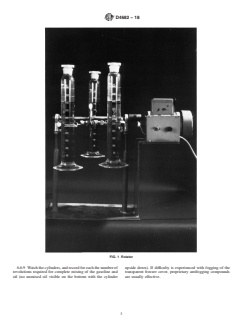
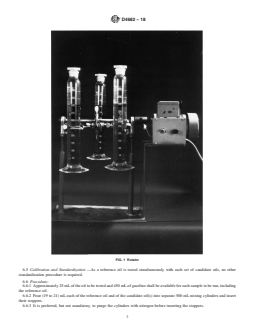
operation. In Fig. 1 a photograph of a suitable rotator is shown.
6.3.2 Four (or Fewer) Graduated Cylinders, 500 mL, capable of remaining securely stoppered in any attitude. The
length-to-diameter ratio of the cylinders may be in the range from 10 to 12:1, but all cylinders used in the same test shall be
identical within normal commercial glassware tolerance.
6.3.3 Stoppered Flask of about 500 mL capacity for each graduated cylinder.
6.3.4 Freezer capable of maintaining a temperature controllable within 61 °C in the range from (0 to −40) °C. Provide the
freezer with a transparent cover and be capable of accommodating the complete rotator assembly while in operation, together with
space for the storage of additional cylinders and flasks. A cover with two panes of glass or plastic separated by an air space of about
(10 to 15) mm is advised.
6.4 Reagents and Materials:
6.4.1 Reference Oils—A different reference oil is required for each miscibility/fluidity category. These are: for Category 1,
4 5
ASTM reference oil VI-GG; for Category 2, ASTM reference oil VI-FF; for Category 3, ASTM reference oil VI-D; and for
Category 4, ASTM reference oil VI-II. See Annex A1 for information on the composition and properties of these oils.
6.4.2 Any full-boiling-range gasoline meeting the general requirements of Specification D439 volatility Classes A, B, or C can
be used. When this procedure is run in conjunction with an engine performance test, it is the normal practice to use the gasoline
specified for the performance test. Do not use oxygenate blends and other fuels containing non-hydrocarbon blending components.
The sole source of supply of the reference oil known to the committee at this time is Lubrizol Corp., 29400 Lakeland Blvd, Wickliffe, OH 44092. If you are aware of
alternative suppliers, please provide this information to ASTM International Headquarters. Your comments will receive careful consideration a
...
Questions, Comments and Discussion
Ask us and Technical Secretary will try to provide an answer. You can facilitate discussion about the standard in here.
Loading comments...