

ASTM E3277-23a
(Test Method)Standard Test Method for Determining the Liquid or Solid State of a Material by Rheometry
General Information
- Abstract
SIGNIFICANCE AND USE
5.1 Shipping regulations often require the identification of a material as either a liquid or a solid. This test method may be used to make that determination for regulatory purposes. (See also Test Method D4359.)
5.2 For liquid thermosetting resin, as cure progresses, the liquid resin becomes a solid. A thermosetting resin is more easily worked or shaped while in the liquid-like form and becomes more difficult to do so as the cure advances. The point at which the solid-like character becomes dominant is called the gel point and is considered to be the end of the period where the thermosetting resin is workable. Gel point is identified as that point where tan δ = 1 as determined in Test Method D4473.
Note 1: Gel point at ambient temperature is seldom a useful parameter. Use of this test method at the more useful elevated temperatures requires capabilities readily available but outside of 7.2.6, 7.2.7, and Section 10.
5.3 This test method may be used in research, development, and for regulatory compliance.
SCOPE
1.1 Using rheometry, this test method determines, for regulatory purposes, whether a viscose viscous material is a liquid or a solid. Very small amounts of material (typically less than 3 g) may be used for this measurement.
1.2 The values stated in SI units are to be regarded as standard. No other units of measurement are included in this standard.
1.3 This standard does not purport to address all of the safety concerns, if any, associated with its use. It is the responsibility of the user of this standard to establish appropriate safety, health, and environmental practices and determine the applicability of regulatory limitations prior to use.
1.4 This international standard was developed in accordance with internationally recognized principles on standardization established in the Decision on Principles for the Development of International Standards, Guides and Recommendations issued by the World Trade Organization Technical Barriers to Trade (TBT) Committee.
- Status
- Published
- Publication Date
- 30-Sep-2023
- Technical Committee
- E37 - Thermal Measurements
- Drafting Committee
- E37.08 - Rheology
Buy Documents

ASTM E3277-23a - Standard Test Method for Determining the Liquid or Solid State of a Material by Rheometry
REDLINE ASTM E3277-23a - Standard Test Method for Determining the Liquid or Solid State of a Material by Rheometry
Overview
ASTM E3277-23a - Standard Test Method for Determining the Liquid or Solid State of a Material by Rheometry - is an internationally recognized method for identifying whether a viscous material behaves predominantly as a liquid or a solid. Developed and maintained by ASTM International's Committee E37, this test method is essential for regulatory compliance, particularly for shipping, handling, and labeling purposes. Using small sample sizes and precise rheometrical measurements, this method provides a standardized approach to regulatory classification and quality control for a wide range of materials.
Key Topics
Purpose and Scope
- This standard determines if a viscous material is a liquid or solid using rheometry, supporting shipping regulations and safety requirements.
- Only SI units are used in this method.
- The method applies to small test samples (typically less than 3 grams).
Test Principles
- Rheometry measures storage modulus (solid-like properties) and loss modulus (liquid-like properties).
- The ratio, known as tan δ (delta), distinguishes the state: a tan δ ≥ 1 indicates a liquid, while tan δ < 1 indicates a solid.
- Determination is conducted using a cone-and-plate or parallel plate rheometer under controlled temperature and frequency.
Application to Thermosetting Resins
- As thermosetting resins cure, they transition from a liquid to a solid.
- The gel point-where tan δ = 1-marks the end of the workable, liquid-like period, aligning with broader quality and performance standards.
Applications
ASTM E3277-23a is widely applicable in scenarios where accurate identification of material state is required for regulatory, safety, shipping, or research purposes:
Regulatory Compliance
- Meets requirements for international and domestic shipping of chemicals, polymers, and materials, ensuring correct classification as a liquid or solid.
- Supports documentation for compliance with safety and environmental regulations.
Quality Control in Manufacturing
- Used in the production and handling of resins, adhesives, coatings, and viscous formulations to assure materials are processed and shipped according to legal standards.
Research & Development
- Assists R&D teams in characterizing the cure behavior of thermosetting resins and other viscoelastic materials.
- Enables precise determination of the gel point and other critical transitions in material behavior.
Material Science and Analysis
- Applied in laboratories to analyze and classify new or modified materials, ensuring consistent and repeatable results across small sample sizes.
Related Standards
When implementing ASTM E3277-23a, consider cross-referencing these relevant ASTM standards for terminology and complementary methods:
- ASTM D4092 - Terminology for Plastics: Dynamic Mechanical Properties
- ASTM D4359 - Test Method for Determining Whether a Material is a Liquid or a Solid
- ASTM D4473 - Test Method for Plastics: Dynamic Mechanical Properties: Cure Behavior
- ASTM E473 - Terminology Relating to Thermal Analysis and Rheology
Keywords: rheometry, liquid or solid state, ASTM E3277, dynamic mechanical analysis, gel point, regulatory compliance, shipping regulations, storage modulus, loss modulus, tan delta, material classification, thermosetting resin, viscoelastic properties
By following ASTM E3277-23a, organizations ensure standardized, reproducible, and defensible results in the identification of the liquid or solid state of viscous materials, supporting safety, compliance, and product quality across chemical and material science industries.
Relations
- Effective Date
- 01-Oct-2023
- Effective Date
- 01-Oct-2023
- Effective Date
- 01-Aug-2023
Buy Documents
ASTM E3277-23a - Standard Test Method for Determining the Liquid or Solid State of a Material by Rheometry
REDLINE ASTM E3277-23a - Standard Test Method for Determining the Liquid or Solid State of a Material by Rheometry
Get Certified
Connect with accredited certification bodies for this standard

BSMI (Bureau of Standards, Metrology and Inspection)
Taiwan's standards and inspection authority.
Sponsored listings
Frequently Asked Questions
ASTM E3277-23a is a standard published by ASTM International. Its full title is "Standard Test Method for Determining the Liquid or Solid State of a Material by Rheometry". This standard covers: SIGNIFICANCE AND USE 5.1 Shipping regulations often require the identification of a material as either a liquid or a solid. This test method may be used to make that determination for regulatory purposes. (See also Test Method D4359.) 5.2 For liquid thermosetting resin, as cure progresses, the liquid resin becomes a solid. A thermosetting resin is more easily worked or shaped while in the liquid-like form and becomes more difficult to do so as the cure advances. The point at which the solid-like character becomes dominant is called the gel point and is considered to be the end of the period where the thermosetting resin is workable. Gel point is identified as that point where tan δ = 1 as determined in Test Method D4473. Note 1: Gel point at ambient temperature is seldom a useful parameter. Use of this test method at the more useful elevated temperatures requires capabilities readily available but outside of 7.2.6, 7.2.7, and Section 10. 5.3 This test method may be used in research, development, and for regulatory compliance. SCOPE 1.1 Using rheometry, this test method determines, for regulatory purposes, whether a viscose viscous material is a liquid or a solid. Very small amounts of material (typically less than 3 g) may be used for this measurement. 1.2 The values stated in SI units are to be regarded as standard. No other units of measurement are included in this standard. 1.3 This standard does not purport to address all of the safety concerns, if any, associated with its use. It is the responsibility of the user of this standard to establish appropriate safety, health, and environmental practices and determine the applicability of regulatory limitations prior to use. 1.4 This international standard was developed in accordance with internationally recognized principles on standardization established in the Decision on Principles for the Development of International Standards, Guides and Recommendations issued by the World Trade Organization Technical Barriers to Trade (TBT) Committee.
SIGNIFICANCE AND USE 5.1 Shipping regulations often require the identification of a material as either a liquid or a solid. This test method may be used to make that determination for regulatory purposes. (See also Test Method D4359.) 5.2 For liquid thermosetting resin, as cure progresses, the liquid resin becomes a solid. A thermosetting resin is more easily worked or shaped while in the liquid-like form and becomes more difficult to do so as the cure advances. The point at which the solid-like character becomes dominant is called the gel point and is considered to be the end of the period where the thermosetting resin is workable. Gel point is identified as that point where tan δ = 1 as determined in Test Method D4473. Note 1: Gel point at ambient temperature is seldom a useful parameter. Use of this test method at the more useful elevated temperatures requires capabilities readily available but outside of 7.2.6, 7.2.7, and Section 10. 5.3 This test method may be used in research, development, and for regulatory compliance. SCOPE 1.1 Using rheometry, this test method determines, for regulatory purposes, whether a viscose viscous material is a liquid or a solid. Very small amounts of material (typically less than 3 g) may be used for this measurement. 1.2 The values stated in SI units are to be regarded as standard. No other units of measurement are included in this standard. 1.3 This standard does not purport to address all of the safety concerns, if any, associated with its use. It is the responsibility of the user of this standard to establish appropriate safety, health, and environmental practices and determine the applicability of regulatory limitations prior to use. 1.4 This international standard was developed in accordance with internationally recognized principles on standardization established in the Decision on Principles for the Development of International Standards, Guides and Recommendations issued by the World Trade Organization Technical Barriers to Trade (TBT) Committee.
ASTM E3277-23a is classified under the following ICS (International Classification for Standards) categories: 17.060 - Measurement of volume, mass, density, viscosity. The ICS classification helps identify the subject area and facilitates finding related standards.
ASTM E3277-23a has the following relationships with other standards: It is inter standard links to ASTM E3277-23, ASTM E473-23b, ASTM E473-23a. Understanding these relationships helps ensure you are using the most current and applicable version of the standard.
ASTM E3277-23a is available in PDF format for immediate download after purchase. The document can be added to your cart and obtained through the secure checkout process. Digital delivery ensures instant access to the complete standard document.
Standards Content (Sample)
This international standard was developed in accordance with internationally recognized principles on standardization established in the Decision on Principles for the
Development of International Standards, Guides and Recommendations issued by the World Trade Organization Technical Barriers to Trade (TBT) Committee.
Designation: E3277 − 23a
Standard Test Method for
Determining the Liquid or Solid State of a Material by
Rheometry
This standard is issued under the fixed designation E3277; the number immediately following the designation indicates the year of
original adoption or, in the case of revision, the year of last revision. A number in parentheses indicates the year of last reapproval. A
superscript epsilon (´) indicates an editorial change since the last revision or reapproval.
1. Scope* 3. Terminology
3.1 Definitions—Technical terms used in this test method
1.1 Using rheometry, this test method determines, for regu-
are defined in Terminologies D4092 and E473 including
latory purposes, whether a viscose viscous material is a liquid
dynamic mechanical analyzer, loss modulus, phase angle,
or a solid. Very small amounts of material (typically less than
rheometer, shear, storage modulus, strain, stress, and tan delta.
3 g) may be used for this measurement.
3.1.1 dissipative, adj—in dynamic mechanical analysis, the
1.2 The values stated in SI units are to be regarded as
irrecoverably loss of mechanical energy usually as heat.
standard. No other units of measurement are included in this
3.1.2 gel point, n—the stage at which a liquid begins to
standard.
exhibit pseudo-elastic properties.
1.3 This standard does not purport to address all of the
3.1.3 slip, wall, n—in rheology, the lack of adhesion be-
safety concerns, if any, associated with its use. It is the
tween the test specimen and the shearing surface.
responsibility of the user of this standard to establish appro-
4. Summary of Test Method
priate safety, health, and environmental practices and deter-
mine the applicability of regulatory limitations prior to use.
4.1 Viscoelastic materials exhibit both solid-like and liquid-
1.4 This international standard was developed in accor-
like characteristics. The loss modulus of a material is a measure
dance with internationally recognized principles on standard-
of its liquid-like characteristic while the storage modulus of a
ization established in the Decision on Principles for the
material indicates its solid-like characteristics. When the loss
Development of International Standards, Guides and Recom-
modulus is greater than the storage modulus, a material is said
mendations issued by the World Trade Organization Technical
to be predominantly a liquid. When the storage modulus is
Barriers to Trade (TBT) Committee.
greater than the loss modulus, the material is said to be
predominantly a solid. The ratio of loss modulus to storage
2. Referenced Documents
modulus is known as tangent angle delta (tan δ).
4.2 Loss modulus and storage modulus of a material is
2.1 ASTM Standards:
measured using a cone-and-plate or parallel plate rheometer at
D4092 Terminology for Plastics: Dynamic Mechanical
ambient temperature conditions and tan δ is then calculated.
Properties
Materials with a tan δ greater than unity (tan δ ≥ 1.0) are
D4359 Test Method for Determining Whether a Material Is
identified as liquids. Those materials with a tan δ less than
a Liquid or a Solid
unity are identified as solids.
D4473 Test Method for Plastics: Dynamic Mechanical Prop-
erties: Cure Behavior
5. Significance and Use
E473 Terminology Relating to Thermal Analysis and Rhe-
5.1 Shipping regulations often require the identification of a
ology
material as either a liquid or a solid. This test method may be
used to make that determination for regulatory purposes. (See
also Test Method D4359.)
This test method is under the jurisdiction of ASTM Committee E37 on Thermal
Measurements and is the direct responsibility of Subcommittee E37.08 on Rheol-
5.2 For liquid thermosetting resin, as cure progresses, the
ogy.
liquid resin becomes a solid. A thermosetting resin is more
Current edition approved Oct. 1, 2023. Published November 2023. Originally
easily worked or shaped while in the liquid-like form and
approved in 2021. Last previous edition approved in 2023 as E3277 – 23. DOI:
becomes more difficult to do so as the cure advances. The point
10.1520/E3277-23A.
For referenced ASTM standards, visit the ASTM website, www.astm.org, or
contact ASTM Customer Service at service@astm.org. For Annual Book of ASTM
Standards volume information, refer to the standard’s Document Summary page on Bingham, E. C., Fluidity and Plasticity, McGraw-Hill, New York, NY, 1922, p.
the ASTM website. 231.
*A Summary of Changes section appears at the end of this standard
Copyright © ASTM International, 100 Barr Harbor Drive, PO Box C700, West Conshohocken, PA 19428-2959. United States
E3277 − 23a
been found suitable for this test method. Other diameters may be used but
at which the solid-like character becomes dominant is called
shall be reported. The appropriate geometries shall be agreed upon by all
the gel point and is considered to be the end of the period
interested parties.
where the thermosetting resin is workable. Gel point is
identified as that point where tan δ = 1 as determined in Test
7.2.3.3 The geometry surfaces are roughened in one of
Method D4473.
several ways. Type 1 geometries are supplied by a vendor with
serrated surfaces specially designed to limit wall slip. In type 2
NOTE 1—Gel point at ambient temperature is seldom a useful param-
geometries, the surfaces of the geometries are roughened using
eter. Use of this test method at the more useful elevated temperatures
requires capabilities readily available but outside of 7.2.6, 7.2.7, and
60 grit sandpaper. In type 3 geometries, 60 grit sandpaper is
Section 10.
mounted on the two geometry surfaces either by self-adhesive
5.3 This test method may be used in research, development, or by double-sided tape. Type 4 geometries are unroughened.
and for regulatory compliance.
7.2.4 Either a force sensor to measure the force developed
by the specimen to within 1 %.
6. Interferences
7.2.5 Or position sensor to measure the displacement of the
6.1 Since small quantities of material are used, it is essential
test specimen to within 1 %.
that the specimen be representative of the sample being tested.
7.2.6 A temperature sensor to provide an indicate of the
6.2 Wall slip may occur with a variety of materials to which
specimen temperature over the range of 20 °C to 25 °C
this test method is applicable. When slip occurs, the measured
readable to within 60.1 °C.
rheological properties are significantly lower than their true
7.2.7 A temperature controller to maintain the temperature
values. Roughened measuring geometries are useful in these
of the test specimen over the temperature range of 20 °C to
cases. The type of roughening shall be agreed upon by all
30 °C to within 0.5 °C.
interested parties.
7.2.8 A stress or strain controller, capable of executing a
specific unidirectional or oscillatory stress or strain program
7. Apparatus
between selected stress or strain limits to with 1 % or at an
7.1 A rheometer is a type of dynamic mechanical analyzer
iso-stress or iso-strain constant to within 1 %.
especially suited for testing liquid materials. The function of
7.2.9 A data collection device, to provide a means of
the rheometer apparatus is to hold a liquid test specimen of
acquiring, storing, and displaying measured or calculated
known volume and dimensions in which the material acts as
signals, or both. The minimum output signals required for this
the elastic and dissipative elements in a mechanically driven
measurement are temperature, frequency, loss modulus and
oscillatory shear system.
storage modulus.
7.2 Rheometer—The essential instrumentation required pro-
7.2.10 Auxiliary instrumentation considered necessary or
viding the minimum rheological analytical capabilities for this
useful in conducting this test method includes:
test method include:
7.2.1 A drive motor, to apply force or displacement to the 7.2.10.1 Cooling capability to sustain an isothermal tem-
specimen in a periodic manner capable of frequencies of perature in the range of 20 °C to 30 °C stable to with 0.5 °C.
oscillation from 0.5 Hz to 2 Hz. This motor may also be
7.2.10.2 Data analysis capability to provide storage
capable of providing static force or displacement on the
modulus, loss modulus and tangent angle delta or other useful
specimen.
parameters derived from the measured signals of stress and
7.2.2 A coupling shaft, or other means to transmit the forc
...
This document is not an ASTM standard and is intended only to provide the user of an ASTM standard an indication of what changes have been made to the previous version. Because
it may not be technically possible to adequately depict all changes accurately, ASTM recommends that users consult prior editions as appropriate. In all cases only the current version
of the standard as published by ASTM is to be considered the official document.
Designation: E3277 − 23 E3277 − 23a
Standard Test Method for
Determining the Liquid or Solid State of a Material by
Rheometry
This standard is issued under the fixed designation E3277; the number immediately following the designation indicates the year of
original adoption or, in the case of revision, the year of last revision. A number in parentheses indicates the year of last reapproval. A
superscript epsilon (´) indicates an editorial change since the last revision or reapproval.
1. Scope*
1.1 Using rheometry, this test method determines, for regulatory purposes, whether a viscose viscous material is a liquid or a solid.
Very small amounts of material (typical(typically less than 3 g) may be used for this measurement.
1.2 The values stated in SI units are to be regarded as standard. No other units of measurement are included in this standard.
1.3 This standard does not purport to address all of the safety concerns, if any, associated with its use. It is the responsibility
of the user of this standard to establish appropriate safety, health, and environmental practices and determine the applicability of
regulatory limitations prior to use.
1.4 This international standard was developed in accordance with internationally recognized principles on standardization
established in the Decision on Principles for the Development of International Standards, Guides and Recommendations issued
by the World Trade Organization Technical Barriers to Trade (TBT) Committee.
2. Referenced Documents
2.1 ASTM Standards:
D4092 Terminology for Plastics: Dynamic Mechanical Properties
D4359 Test Method for Determining Whether a Material Is a Liquid or a Solid
D4473 Test Method for Plastics: Dynamic Mechanical Properties: Cure Behavior
E473 Terminology Relating to Thermal Analysis and Rheology
3. Terminology
3.1 Definitions—Technical terms used in this test method are defined in Terminologies D4092 and E473 including dynamic
mechanical analyzer, loss modulus, phase angle, rheometer, shear, storage modulus, strain, stress, and tan delta.
3.1.1 dissipative, adj—in dynamic mechanical analysis, the irrecoverably loss of mechanical energy usually as heat.
3.1.2 gel point, n—the stage at which a liquid begins to exhibit pseudo-elastic properties.
3.1.3 slip, wall, n—in rheology, the lack of adhesion between the test specimen and the shearing surface.
This test method is under the jurisdiction of ASTM Committee E37 on Thermal Measurements and is the direct responsibility of Subcommittee E37.08 on Rheology.
Current edition approved June 1, 2023Oct. 1, 2023. Published June 2023November 2023. Originally approved in 2021. Last previous edition approved in 20222023 as
E3277 – 22. DOI: 10.1520/E3277-23.23. DOI: 10.1520/E3277-23A.
For referenced ASTM standards, visit the ASTM website, www.astm.org, or contact ASTM Customer Service at service@astm.org. For Annual Book of ASTM Standards
volume information, refer to the standard’s Document Summary page on the ASTM website.
Bingham, E. C., Fluidity and Plasticity, McGraw-Hill, New York, NY, 1922, p. 231.
*A Summary of Changes section appears at the end of this standard
Copyright © ASTM International, 100 Barr Harbor Drive, PO Box C700, West Conshohocken, PA 19428-2959. United States
E3277 − 23a
4. Summary of Test Method
4.1 Viscoelastic materials exhibit both solid-like and liquid-like characteristics. The loss modulus of a material is a measure of its
liquid-like characteristic while the storage modulus of a material indicates its solid-like characteristics. When the loss modulus is
greater than the storage modulus, a material is said to be predominantly a liquid. When the storage modulus is greater than the loss
modulus, the material is said to be predominantly a solid. The ratio of loss modulus to storage modulus is known as tangent angle
delta (tan δ).
4.2 Loss modulus and storage modulus of a material is measured using a cone-and-plate or parallel plate rheometer at ambient
temperature conditions and tan δ is then calculated. Materials with a tan δ greater than unity (tan δ ≥ 1.0) are identified as liquids.
Those materials with a tan δ less than unity are identified as solids.
5. Significance and Use
5.1 Shipping regulations often require the identification of a material as either a liquid or a solid. This test method may be used
to make that determination for regulatory purposes. (See also Test Method D4359.)
5.2 For liquid thermosetting resin, as cure progresses, the liquid resin becomes a solid. A thermosetting resin is more easily worked
or shaped while in the liquid-like form and becomes more difficult to do so as the cure advances. The point at which the solid-like
character becomes dominant is called the gel point and is considered to be the end of the period where the thermosetting resin is
workable. Gel point is identified as that point where tan δ = 1 as determined in Test Method D4473.
NOTE 1—Gel point at ambient temperature is seldom a useful parameter. Use of this test method at the more useful elevated temperatures requires
capabilities readily available but outside of 7.2.6, 7.2.7, and Section 10.
5.3 This test method may be used in research, development, and for regulatory compliance.
6. Interferences
6.1 Since small quantities of material are used, it is essential that the specimen be representative of the sample being tested.
6.2 Wall slip may occur with a variety of materials to which this test method is applicable. When slip occurs, the measured
rheological properties are significantly lower than their true values. Roughened measuring geometries are useful in these cases. The
type of roughening shall be agreed upon by all interested parties.
7. Apparatus
7.1 A rheometer is a type of dynamic mechanical analyzer especially suited for testing liquid materials. The function of the
rheometer apparatus is to hold a liquid test specimen of known volume and dimensions in which the material acts as the elastic
and dissipative elements in a mechanically driven oscillatory shear system.
7.2 Rheometer—The essential instrumentation required providing the minimum rheological analytical capabilities for this test
method include:
7.2.1 A drive motor, to apply force or displacement to the specimen in a periodic manner capable of frequencies of oscillation from
0.5 Hz to 2 Hz. This motor may also be capable of providing static force or displacement on the specimen.
7.2.2 A coupling shaft, or other means to transmit the force or displacement from the motor to the specimen.
7.2.3 A fixture, geometry, or tool to fix the specimen between the drive shaft and a stationary position.
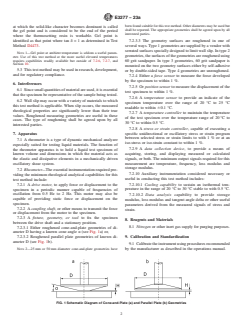
7.2.3.1 Either roughened cone-and-plate geometries of diameter D having a known cone angle α (see Fig. 1a) or,
7.2.3.2 Roughened parallel plate geometries of known diameter D (see Fig. 1b).
NOTE 2—25 mm or 50 mm diameter cone-and-plate geometries have been found suitable for this test method. Other diameters may be used but shall be
E3277 − 23a
FIG. 1 Schematic Diagram of Cone-and-Plate (a) and Parallel Plate (b) Geometries
reported. The appropriate geometries shall be agreed upon by all interested parties.
7.2.3.3 The geometry surfaces are roughened in one of several ways. Type 1 geometries are supplied by a vendor with serrated
surfaces specially designed to limit wall slip. In type 2 geometries, the surfaces of the geometries are roughened using 60 grit
sandpaper. In type 3 geometries, 60 grit sandpaper is mounted on the two geometry surfaces either by self-adhesive or by
double-sided tape. Type 4 geometries are unroughened.
7.2.4 Either a force sensor to measure the force developed by the specimen to within 1 %.
7.2.5 Or position sensor to measure the displacement of the test specimen to within 1 %.
7.2.6 A temperature sensor to provide an indicate of the specimen temperature over the range of 20 °C to 25 °C readable to within
60.1 °C.
7.2.7 A temperature controller to maintain the temperature of the test specimen over the temperature range of 20 °C to 30 °C to
within 0.5 °C.
7.2.8 A stress or strain controller, capable of executing a specific unidirectional or oscillatory stress or strain program between
selected stress or strain limits to with 1 % or at an iso-stress or iso-strain constant to within 1 %.
7.2.9 A data collection device, to provide a means of acquiring, storing, and displaying m
...