

ASTM E1981-22
(Guide)Standard Guide for Assessing Thermal Stability of Materials by Methods of Accelerating Rate Calorimetry
General Information
- Abstract
SIGNIFICANCE AND USE
5.1 The data from this guide seldom, if ever, directly simulate thermal and pressure events in the processing, storage, and shipping of chemicals. However, the data obtained from this guide may be used, with suitable precautions, to predict the thermal and pressure hazards associated with processing, storage, and shipping of a chemical or mixture of chemicals after appropriate scaling of the data. This has been addressed in the literature (1-4) but is beyond the scope of this guide.
5.2 This guide is suitable, under the proper conditions, for the investigation of the effects of catalyst, inhibitors, initiators, reaction atmospheres, materials of construction, or, if available, agitation (see 6.1.2).
5.3 Interpretation of the time-temperature or time-pressure data may be possible for relatively simple systems through the use of suitable temperature-dependent kinetic theories such as the Arrhenius and Absolute Reaction Rate theories (5, 6).
SCOPE
1.1 This guide covers suggested procedures for the operation of a calorimetric device designed to obtain temperature and pressure data as a function of time for systems undergoing a physicochemical change under nearly adiabatic conditions.
1.2 This guide outlines the calculation of thermodynamic parameters from the time, temperature, and pressure data recorded by a calorimetric device.
1.3 The assessment outlined in this guide may be used over a pressure range from full vacuum to the rated pressure of the reaction container and pressure transducer. The temperature range of the calorimeter typically varies from ambient to 500 °C, but also may be user specified (see 6.6).
1.4 The values stated in SI units are to be regarded as standard. No other units of measurement are included in this standard.
1.5 This standard does not purport to address all of the safety concerns, if any, associated with its use. It is the responsibility of the user of this standard to establish appropriate safety, health, and environmental practices and determine the applicability of regulatory limitations prior to use. Specific safety precautions are outlined in Section 7.
1.6 This international standard was developed in accordance with internationally recognized principles on standardization established in the Decision on Principles for the Development of International Standards, Guides and Recommendations issued by the World Trade Organization Technical Barriers to Trade (TBT) Committee.
- Status
- Published
- Publication Date
- 31-May-2022
- Technical Committee
- E27 - Hazard Potential of Chemicals
- Drafting Committee
- E27.02 - Thermal Stability and Condensed Phases
Buy Documents
ASTM E1981-22 - Standard Guide for Assessing Thermal Stability of Materials by Methods of Accelerating Rate Calorimetry
REDLINE ASTM E1981-22 - Standard Guide for Assessing Thermal Stability of Materials by Methods of Accelerating Rate Calorimetry
Overview
ASTM E1981-22: Standard Guide for Assessing Thermal Stability of Materials by Methods of Accelerating Rate Calorimetry provides recommended procedures for evaluating the thermal stability of materials through the use of accelerating rate calorimetry (ARC). Thermal stability assessments are critical in understanding and managing the risks associated with the storage, processing, and transport of chemicals. This standard details the methodology for generating and interpreting temperature and pressure data as materials undergo physicochemical changes under nearly adiabatic conditions.
ARC is a powerful tool for detecting hazardous exothermic reactions, calculating thermodynamic parameters, and identifying potential runaway reactions. While the standard does not simulate real-world events directly, it provides data that, when properly interpreted and scaled, help predict thermal and pressure hazards related to chemical systems. Compliance with ASTM E1981-22 supports improved chemical process safety, regulatory conformity, and hazard mitigation in chemical industries.
Key Topics
- Adiabatic Calorimetry: Details the use of adiabatic calorimeters, which maintain minimal heat exchange between the sample and the environment for accurate measurement.
- Testing Procedure: Outlines stepwise methods for sample preparation, mounting, calibration, data collection, and post-test analysis.
- Thermal Stability Assessment: Focuses on detecting exothermic events, quantifying self-heating rates, onset temperatures, and pressure changes during material degradation.
- Thermodynamic Calculations: Guides users in calculating critical parameters such as adiabatic temperature rise, heat of reaction, and time-to-maximum rate (TMR).
- Hazard Prediction: Discusses applying ARC data to assess and predict thermal and pressure hazards associated with chemical handling and storage.
- Operational Limitations: Addresses sample homogeneity, physical states (solid/liquid), agitation, and calibration limitations influencing test outcomes.
- Safety Precautions: Emphasizes safety measures for handling hazardous or reactive materials, pressurized containers, and potential toxic emissions during testing.
Applications
The practical value of ASTM E1981-22 lies in its wide range of industrial and research applications involving thermal stability:
- Chemical Manufacturing: Predicts and manages risks of runaway reactions and thermal hazards during processing of chemicals and chemical mixtures.
- Storage and Transportation: Assesses the stability of materials under varying environmental conditions, supporting safe storage and shipping protocols.
- Process Safety Management: Provides essential data to design safer processes, perform risk assessments, and implement engineering controls.
- Material Compatibility Studies: Evaluates the effects of catalysts, inhibitors, initiators, atmosphere, materials of construction, and agitation on reaction behavior.
- Kinetic Analysis: Assists in interpreting reaction kinetics using temperature-dependent theories for simple, non-autocatalytic systems.
- Incident Investigation: Offers data crucial for analyzing the root causes of thermal incidents involving chemical materials.
Related Standards
ASTM E1981-22 integrates with other ASTM international standards focused on thermal hazard assessment and calorimetry, supporting a comprehensive approach to chemical safety:
- ASTM E487: Test Methods for Constant-Temperature Stability of Chemical Materials
- ASTM E537: Test Method for Thermal Stability of Chemicals by Differential Scanning Calorimetry
- ASTM E698: Test Method for Kinetic Parameters for Thermally Unstable Materials Using Differential Scanning Calorimetry and the Flynn/Wall/Ozawa Method
- ASTM E680: Test Method for Drop Weight Impact Sensitivity of Solid-Phase Hazardous Materials
- ASTM E1231: Practice for Calculation of Hazard Potential Figures of Merit for Thermally Unstable Materials
Adhering to ASTM E1981-22 ensures consistent, reliable evaluation of thermal hazards, advancing chemical safety and regulatory compliance across industries that handle potentially reactive or unstable materials. Use of this standard contributes to the responsible management of chemical risks and underpins a strong safety culture.
Relations
- Effective Date
- 01-Feb-2020
- Effective Date
- 01-Feb-2020
- Effective Date
- 01-Sep-2019
- Effective Date
- 15-Nov-2018
- Effective Date
- 01-Nov-2015
- Effective Date
- 01-Mar-2014
- Effective Date
- 01-Dec-2012
- Effective Date
- 01-Aug-2011
- Effective Date
- 01-Mar-2011
- Effective Date
- 15-Apr-2010
- Effective Date
- 01-Nov-2009
- Effective Date
- 01-Oct-2007
- Effective Date
- 01-Apr-2006
- Effective Date
- 01-Mar-2005
- Refers
ASTM E698-05 - Standard Test Method for Arrhenius Kinetic Constants for Thermally Unstable Materials - Effective Date
- 01-Mar-2005
Buy Documents
ASTM E1981-22 - Standard Guide for Assessing Thermal Stability of Materials by Methods of Accelerating Rate Calorimetry
REDLINE ASTM E1981-22 - Standard Guide for Assessing Thermal Stability of Materials by Methods of Accelerating Rate Calorimetry
Get Certified
Connect with accredited certification bodies for this standard

BSMI (Bureau of Standards, Metrology and Inspection)
Taiwan's standards and inspection authority.
Sponsored listings
Frequently Asked Questions
ASTM E1981-22 is a guide published by ASTM International. Its full title is "Standard Guide for Assessing Thermal Stability of Materials by Methods of Accelerating Rate Calorimetry". This standard covers: SIGNIFICANCE AND USE 5.1 The data from this guide seldom, if ever, directly simulate thermal and pressure events in the processing, storage, and shipping of chemicals. However, the data obtained from this guide may be used, with suitable precautions, to predict the thermal and pressure hazards associated with processing, storage, and shipping of a chemical or mixture of chemicals after appropriate scaling of the data. This has been addressed in the literature (1-4) but is beyond the scope of this guide. 5.2 This guide is suitable, under the proper conditions, for the investigation of the effects of catalyst, inhibitors, initiators, reaction atmospheres, materials of construction, or, if available, agitation (see 6.1.2). 5.3 Interpretation of the time-temperature or time-pressure data may be possible for relatively simple systems through the use of suitable temperature-dependent kinetic theories such as the Arrhenius and Absolute Reaction Rate theories (5, 6). SCOPE 1.1 This guide covers suggested procedures for the operation of a calorimetric device designed to obtain temperature and pressure data as a function of time for systems undergoing a physicochemical change under nearly adiabatic conditions. 1.2 This guide outlines the calculation of thermodynamic parameters from the time, temperature, and pressure data recorded by a calorimetric device. 1.3 The assessment outlined in this guide may be used over a pressure range from full vacuum to the rated pressure of the reaction container and pressure transducer. The temperature range of the calorimeter typically varies from ambient to 500 °C, but also may be user specified (see 6.6). 1.4 The values stated in SI units are to be regarded as standard. No other units of measurement are included in this standard. 1.5 This standard does not purport to address all of the safety concerns, if any, associated with its use. It is the responsibility of the user of this standard to establish appropriate safety, health, and environmental practices and determine the applicability of regulatory limitations prior to use. Specific safety precautions are outlined in Section 7. 1.6 This international standard was developed in accordance with internationally recognized principles on standardization established in the Decision on Principles for the Development of International Standards, Guides and Recommendations issued by the World Trade Organization Technical Barriers to Trade (TBT) Committee.
SIGNIFICANCE AND USE 5.1 The data from this guide seldom, if ever, directly simulate thermal and pressure events in the processing, storage, and shipping of chemicals. However, the data obtained from this guide may be used, with suitable precautions, to predict the thermal and pressure hazards associated with processing, storage, and shipping of a chemical or mixture of chemicals after appropriate scaling of the data. This has been addressed in the literature (1-4) but is beyond the scope of this guide. 5.2 This guide is suitable, under the proper conditions, for the investigation of the effects of catalyst, inhibitors, initiators, reaction atmospheres, materials of construction, or, if available, agitation (see 6.1.2). 5.3 Interpretation of the time-temperature or time-pressure data may be possible for relatively simple systems through the use of suitable temperature-dependent kinetic theories such as the Arrhenius and Absolute Reaction Rate theories (5, 6). SCOPE 1.1 This guide covers suggested procedures for the operation of a calorimetric device designed to obtain temperature and pressure data as a function of time for systems undergoing a physicochemical change under nearly adiabatic conditions. 1.2 This guide outlines the calculation of thermodynamic parameters from the time, temperature, and pressure data recorded by a calorimetric device. 1.3 The assessment outlined in this guide may be used over a pressure range from full vacuum to the rated pressure of the reaction container and pressure transducer. The temperature range of the calorimeter typically varies from ambient to 500 °C, but also may be user specified (see 6.6). 1.4 The values stated in SI units are to be regarded as standard. No other units of measurement are included in this standard. 1.5 This standard does not purport to address all of the safety concerns, if any, associated with its use. It is the responsibility of the user of this standard to establish appropriate safety, health, and environmental practices and determine the applicability of regulatory limitations prior to use. Specific safety precautions are outlined in Section 7. 1.6 This international standard was developed in accordance with internationally recognized principles on standardization established in the Decision on Principles for the Development of International Standards, Guides and Recommendations issued by the World Trade Organization Technical Barriers to Trade (TBT) Committee.
ASTM E1981-22 is classified under the following ICS (International Classification for Standards) categories: 17.200.10 - Heat. Calorimetry. The ICS classification helps identify the subject area and facilitates finding related standards.
ASTM E1981-22 has the following relationships with other standards: It is inter standard links to ASTM E487-20, ASTM E537-20, ASTM E1231-19, ASTM E680-79(2018), ASTM E1231-15, ASTM E487-14, ASTM E537-12, ASTM E680-79(2011)e1, ASTM E698-11, ASTM E1231-10, ASTM E487-09, ASTM E537-07, ASTM E1231-01(2006), ASTM E680-79(2005), ASTM E698-05. Understanding these relationships helps ensure you are using the most current and applicable version of the standard.
ASTM E1981-22 is available in PDF format for immediate download after purchase. The document can be added to your cart and obtained through the secure checkout process. Digital delivery ensures instant access to the complete standard document.
Standards Content (Sample)
This international standard was developed in accordance with internationally recognized principles on standardization established in the Decision on Principles for the
Development of International Standards, Guides and Recommendations issued by the World Trade Organization Technical Barriers to Trade (TBT) Committee.
Designation: E1981 − 22
Standard Guide for
Assessing Thermal Stability of Materials by Methods of
Accelerating Rate Calorimetry
This standard is issued under the fixed designation E1981; the number immediately following the designation indicates the year of
original adoption or, in the case of revision, the year of last revision. A number in parentheses indicates the year of last reapproval. A
superscript epsilon (´) indicates an editorial change since the last revision or reapproval.
INTRODUCTION
This guide is one of several standards being developed by ASTM Committee E27 for determining
the physicochemical hazards of chemicals and chemical mixtures. This guide should be used in
conjunction with other test methods, as a complete assessment of the hazard potential of chemicals
must take into account a number of realistic factors not necessarily considered in this guide. The
expression hazard potential as used by this committee is defined as the degree of susceptibility of
material to ignition or release of energy under varying environmental conditions.
It is the intent of this guide to include any calorimetric device consistent with the principles of
adiabatic calorimetry. Device-specific information and specifications are located in appendices to the
guide. Any reference to specific devices in the guide are for purposes of illustration or clarity only.
1. Scope 1.6 This international standard was developed in accor-
dance with internationally recognized principles on standard-
1.1 This guide covers suggested procedures for the opera-
ization established in the Decision on Principles for the
tion of a calorimetric device designed to obtain temperature
Development of International Standards, Guides and Recom-
and pressure data as a function of time for systems undergoing
mendations issued by the World Trade Organization Technical
a physicochemical change under nearly adiabatic conditions.
Barriers to Trade (TBT) Committee.
1.2 This guide outlines the calculation of thermodynamic
parameters from the time, temperature, and pressure data
2. Referenced Documents
recorded by a calorimetric device.
2.1 ASTM Standards:
1.3 The assessment outlined in this guide may be used over
E476 Test Method for Thermal Instability of Confined Con-
a pressure range from full vacuum to the rated pressure of the
densed Phase Systems (Confinement Test) (Withdrawn
reaction container and pressure transducer. The temperature
2008)
range of the calorimeter typically varies from ambient to
E487 Test Methods for Constant-Temperature Stability of
500 °C, but also may be user specified (see 6.6).
Chemical Materials
1.4 The values stated in SI units are to be regarded as
E537 Test Method for Thermal Stability of Chemicals by
standard. No other units of measurement are included in this
Differential Scanning Calorimetry
standard.
E680 Test Method for Drop Weight Impact Sensitivity of
1.5 This standard does not purport to address all of the Solid-Phase Hazardous Materials
safety concerns, if any, associated with its use. It is the
E698 Test Method for Kinetic Parameters for Thermally
responsibility of the user of this standard to establish appro- Unstable Materials Using Differential Scanning Calorim-
priate safety, health, and environmental practices and deter- etry and the Flynn/Wall/Ozawa Method
mine the applicability of regulatory limitations prior to use. E1231 Practice for Calculation of Hazard Potential Figures
Specific safety precautions are outlined in Section 7. of Merit for Thermally Unstable Materials
1 2
This guide is under the jurisdiction of ASTM Committee E27 on Hazard For referenced ASTM standards, visit the ASTM website, www.astm.org, or
Potential of Chemicals and is the direct responsibility of Subcommittee E27.02 on contact ASTM Customer Service at service@astm.org. For Annual Book of ASTM
Thermal Stability and Condensed Phases. Standards volume information, refer to the standard’s Document Summary page on
Current edition approved June 1, 2022. Published September 2022. Originally the ASTM website.
published in 1998. Last previous edition approved in 2020 as E1981 – 98 (2020). The last approved version of this historical standard is referenced on
DOI: 10.1520/E1981-22. www.astm.org.
Copyright © ASTM International, 100 Barr Harbor Drive, PO Box C700, West Conshohocken, PA 19428-2959. United States
E1981 − 22
3. Terminology 3.1.12 time-to-maximum rate (TMR), n—the amount of time
that is needed for a reaction to reach its maximum self-heating
3.1 Definitions of Terms Specific to This Standard:
rate or pressure rate in a thermal runaway reaction, normally
3.1.1 adiabatic calorimeter, n—an instrument capable of
referenced from the time corresponding to the onset
making calorimetric measurements while maintaining a mini-
temperature, but may also be referenced from any time-
mal heat loss or gain between the sample and its environment,
temperature point to the time at which the maximum self-
which is verifiable by the capability to continuously measure
heating or pressure rate occurs. The experimentally observed
the temperature differential between the sample and its sur-
TMR is normally divided by the thermal inertia factor (see
roundings.
3.1.10) to obtain a more conservative assessment of TMR.
3.1.2 autocatalytic reaction, n—a chemical reaction in
(TMR divided by the thermal inertia factor is often referred to
which a product or reaction intermediate functions as a
as the “φ-corrected” TMR).
catalyst.
4. Summary of Guide
3.1.3 drift, n—a gradual unintended increase or decrease in
the system (sample container and surroundings) temperature
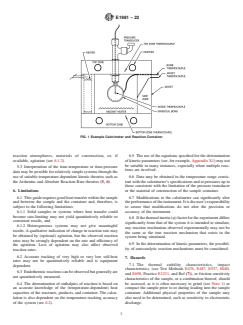
4.1 A sample is placed in a reaction container and posi-
due to limitations in the system calibration, or to changes
tioned in the calorimeter (see Fig. 1).
which occur in the system after calibration.
4.2 The sample container is heated to a user-specified initial
3.1.4 final temperature (T ), n—the observed system
final temperature and allowed to come to equilibrium, whereupon a
temperature at the end of an exotherm, generally at the
search for evidence of an exothermic reaction is undertaken.
temperature where the self-heat rate of the reaction has
An exotherm is considered to have occurred when the user-
decreased below the operator-defined slope sensitivity thresh-
specified rate of temperature rise is first exceeded. If no
old.
exotherm is detected, the system temperature is raised a
specified increment and the system allowed to equilibrate
3.1.5 heat of reaction (∆H), n—the net calculated heat
again. This heat-wait-search cycle is repeated until either an
(energy) liberated during an exothermic reaction.
exotherm is detected or the upper temperature limit of the test
3.1.6 ideal adiabatic temperature rise (∆T ), n—the tem-
ad
is reached. If an exotherm is detected, the surroundings are
perature rise which would be observed in an exothermic
keptatthesametemperatureasthereactioncontainer,allowing
reaction if all of the heat liberated were used to increase the
the system to be maintained without heat loss as the tempera-
temperature of only the sample. It is conveniently calculated as
ture of the system increases due to the heat evolved during the
the product of the observed adiabatic temperature rise, ∆T ,
obs
exotherm.
and the thermal inertia factor, φ.
4.3 Time, temperature, and pressure data are recorded at
3.1.7 observed adiabatic temperature rise (∆T ), n—the
obs
specified temperature intervals as a function of time. Addi-
observed temperature rise in the system during an exotherm;
tional user-selected parameters may also be recorded or stored.
mathematically, it is equal to the temperature difference be-
4.4 The recorded data are used to calculate the time rates of
tween the final temperature and the onset temperature of an
changes of pressure and temperature. These data may also be
exotherm.
usedtocalculateatime-to-maximumrate(asdefinedin3.1.12)
3.1.8 onset temperature (T ), n—the observed system
start 4
and to obtain kinetic parameters (1-4) for simple, non-
temperature at the start of an exotherm where the self-heating
autocatalytic exothermic reactions using the equations speci-
rate first exceeds the operator-defined slope sensitivity
fied in the vendors’ manual (subject to the limitations of 6.5).
threshold, usually 0.02 °C⁄min; the onset temperature is not a
These data may also be adjusted for the sample- and container-
fundamental property of a substance, but is apparatus-
specific heats to calculate an adiabatic temperature rise and
dependent, based upon the inherent sensitivity of the calori-
heat of reaction.
metric system.
3.1.9 self-heating, adj—any exothermic process which in-
5. Significance and Use
creases the temperature of the system by the self absorption of
5.1 The data from this guide seldom, if ever, directly
the liberated heat.
simulatethermalandpressureeventsintheprocessing,storage,
3.1.10 thermal inertia factor (φ), n—a correction factor
and shipping of chemicals. However, the data obtained from
applied to time and temperature differences observed in exo-
thisguidemaybeused,withsuitableprecautions,topredictthe
thermic reactions in the system (sample and container) under
thermal and pressure hazards associated with processing,
test, which accounts for the sensible heat absorbed by the
storage, and shipping of a chemical or mixture of chemicals
sample container that otherwise would lead to erroneously low
afterappropriatescalingofthedata.Thishasbeenaddressedin
heats of reaction and adiabatic temperature rise, as well as to
the literature (1-4) but is beyond the scope of this guide.
erroneously high time to maximum rates (TMR’s) (see 3.1.12).
5.2 This guide is suitable, under the proper conditions, for
See also 10.1 for a mathematical formula definition of the
the investigation of the effects of catalyst, inhibitors, initiators,
thermal inertia factor.
3.1.11 thermal runaway reaction, n—a chemical reaction in
which the heat generation rate in a system exceeds the heat
The boldface numbers in parentheses refer to a list of references at the end of
removal rate of that system. this standard.
E1981 − 22
FIG. 1 Example Calorimeter and Reaction Container
reaction atmospheres, materials of construction, or, if 6.5 The use of the equations specified for the determination
available, agitation (see 6.1.2). ofkineticparameters(see,forexample,AppendixX1)maynot
be suitable in many instances, especially when multiple reac-
5.3 Interpretation of the time-temperature or time-pressure
tions are involved.
data may be possible for relatively simple systems through the
use of suitable temperature-dependent kinetic theories such as 6.6 Data may be obtained in the temperature range consis-
the Arrhenius and Absolute Reaction Rate theories (5, 6). tent with the calorimeter’s specifications and at pressures up to
those consistent with the limitation of the pressure transducer
6. Limitations or the material of construction of the sample container.
6.1 This guide requires good heat transfer within the sample 6.7 Modifications to the calorimeter can significantly alter
theperformanceoftheinstrument.Itistheuser’sresponsibility
and between the sample and the container and, therefore, is
subject to the following limitations: to assure that modifications do not alter the precision or
accuracy of the instrument.
6.1.1 Solid samples or systems where heat transfer could
become rate-limiting may not yield quantitatively reliable or
6.8 Ifthethermalinertia(φ)factorfortheexperimentdiffers
consistent results, and
significantly from that of the system it is intended to simulate,
6.1.2 Heterogeneous systems may not give meaningful
any reaction mechanism observed experimentally may not be
results.Aqualitative indication of change in reaction rate may
the same as the true reaction mechanism that exists in the
be obtained by (optional) agitation, but the observed reaction
system being simulated.
rates may be strongly dependent on the rate and efficiency of
6.9 In the determination of kinetic parameters, the possibil-
the agitation. Loss of agitation may also affect observed
ity of autocatalytic reaction mechanisms must be considered.
reaction rates.
6.2 Accurate tracking of very high or very low self-heat
7. Hazards
rates may not be quantitatively reliable and is equipment
7.1 The thermal stability characteristics, impact
dependent.
characteristics, (see Test Methods E476, E487, E537, E680,
6.3 Endothermicreactionscanbeobservedbutgenerallyare
and E698, Practice E1231, and Ref (7)), or friction sensitivity
not quantitatively measured.
characteristics of the sample, or a combination thereof, should
6.4 The determination of enthalpies of reaction is based on be assessed, as it is often necessary to grind (see Note 1)or
an accurate knowledge of the (temperature-dependent) heat compact the sample prior to or during loading into the sample
capacities of the reactants, products, and container. The calcu- container. Additional physical properties of the sample may
lation is also dependent on the temperature tracking accuracy also need to be determined, such as sensitivity to electrostatic
of the system (see 6.2). discharge.
E1981 − 22
NOTE 1—Caution should
...
This document is not an ASTM standard and is intended only to provide the user of an ASTM standard an indication of what changes have been made to the previous version. Because
it may not be technically possible to adequately depict all changes accurately, ASTM recommends that users consult prior editions as appropriate. In all cases only the current version
of the standard as published by ASTM is to be considered the official document.
Designation: E1981 − 98 (Reapproved 2020) E1981 − 22
Standard Guide for
Assessing Thermal Stability of Materials by Methods of
Accelerating Rate Calorimetry
This standard is issued under the fixed designation E1981; the number immediately following the designation indicates the year of
original adoption or, in the case of revision, the year of last revision. A number in parentheses indicates the year of last reapproval. A
superscript epsilon (´) indicates an editorial change since the last revision or reapproval.
INTRODUCTION
This guide is one of several standards being developed by ASTM Committee E27 for determining
the physicochemical hazards of chemicals and chemical mixtures. This guide should be used in
conjunction with other test methods, as a complete assessment of the hazard potential of chemicals
must take into account a number of realistic factors not necessarily considered in this guide. The
expression hazard potential as used by this committee is defined as the degree of susceptibility of
material to ignition or release of energy under varying environmental conditions.
It is the intent of this guide to include any calorimetric device consistent with the principles of
adiabatic calorimetry. Device-specific information and specifications are located in appendices to the
guide. Any reference to specific devices in the guide are for purposes of illustration or clarity only.
1. Scope
1.1 This guide covers suggested procedures for the operation of a calorimetric device designed to obtain temperature and pressure
data as a function of time for systems undergoing a physicochemical change under nearly adiabatic conditions.
1.2 This guide outlines the calculation of thermodynamic parameters from the time, temperature, and pressure data recorded by
a calorimetric device.
1.3 The assessment outlined in this guide may be used over a pressure range from full vacuum to the rated pressure of the reaction
container and pressure transducer. The temperature range of the calorimeter typically varies from ambient to 500°C,500 °C, but
also may be user specified (see 6.6).
1.4 The values stated in SI units are to be regarded as standard. No other units of measurement are included in this standard.
1.5 This standard does not purport to address all of the safety concerns, if any, associated with its use. It is the responsibility
of the user of this standard to establish appropriate safety, health, and environmental practices and determine the applicability of
regulatory limitations prior to use. Specific safety precautions are outlined in Section 7.
1.6 This international standard was developed in accordance with internationally recognized principles on standardization
established in the Decision on Principles for the Development of International Standards, Guides and Recommendations issued
by the World Trade Organization Technical Barriers to Trade (TBT) Committee.
This guide is under the jurisdiction of ASTM Committee E27 on Hazard Potential of Chemicals and is the direct responsibility of Subcommittee E27.02 on Thermal
Stability and Condensed Phases.
Current edition approved April 1, 2020June 1, 2022. Published April 2020September 2022. Originally published in 1998. Last previous edition approved in 20122020 as
ɛ2
E1981 – 98 (2012)(2020). . DOI: 10.1520/E1981-98R20.10.1520/E1981-22.
Copyright © ASTM International, 100 Barr Harbor Drive, PO Box C700, West Conshohocken, PA 19428-2959. United States
E1981 − 22
2. Referenced Documents
2.1 ASTM Standards:
E476 Test Method for Thermal Instability of Confined Condensed Phase Systems (Confinement Test) (Withdrawn 2008)
E487 Test Methods for Constant-Temperature Stability of Chemical Materials
E537 Test Method for Thermal Stability of Chemicals by Differential Scanning Calorimetry
E680 Test Method for Drop Weight Impact Sensitivity of Solid-Phase Hazardous Materials
E698 Test Method for Kinetic Parameters for Thermally Unstable Materials Using Differential Scanning Calorimetry and the
Flynn/Wall/Ozawa Method
E1231 Practice for Calculation of Hazard Potential Figures of Merit for Thermally Unstable Materials
3. Terminology
3.1 Definitions of Terms Specific to This Standard:
3.1.1 adiabatic calorimeter, n—an instrument capable of making calorimetric measurements while maintaining a minimal heat
loss or gain between the sample and its environment, which is verifiable by the capability to continuously measure the temperature
differential between the sample and its surroundings.
3.1.2 autocatalytic reaction, n—a chemical reaction in which a product or reaction intermediate functions as a catalyst.
3.1.3 drift, n—a gradual unintended increase or decrease in the system (sample container and surroundings) temperature due to
limitations in the system calibration, or to changes which occur in the system after calibration.
3.1.4 final temperature (T ), n—the observed system temperature at the end of an exotherm, generally at the temperature where
final
the self-heat rate of the reaction has decreased below the operator-defined slope sensitivity threshold.
3.1.5 heat of reaction (ΔH), n—the net calculated heat (energy) liberated during an exothermic reaction.
3.1.6 ideal adiabatic temperature rise (ΔT ), n—the temperature rise which would be observed in an exothermic reaction if all
ad
of the heat liberated were used to increase the temperature of only the sample. It is conveniently calculated as the product of the
observed adiabatic temperature rise, ΔT , and the thermal inertia factor, φ.
obs
3.1.7 observed adiabatic temperature rise (ΔT ), n—the observed temperature rise in the system during an exotherm;
obs
mathematically, it is equal to the temperature difference between the final temperature and the onset temperature of an exotherm.
3.1.8 onset temperature (T ), n—the observed system temperature at the start of an exotherm where the self-heating rate first
start
exceeds the operator-defined slope sensitivity threshold, usually 0.02°C/min;0.02 °C ⁄min; the onset temperature is not a
fundamental property of a substance, but is apparatus-dependent, based upon the inherent sensitivity of the calorimetric system.
3.1.9 self-heating, adj—any exothermic process which increases the temperature of the system by the self absorption of the
liberated heat.
3.1.10 thermal inertia factor (φ), n—a correction factor applied to time and temperature differences observed in exothermic
reactions in the system (sample and container) under test, which accounts for the sensible heat absorbed by the sample container
that otherwise would lead to erroneously low heats of reaction and adiabatic temperature rise, as well as to erroneously high time
to maximum rates (TMR’s)(TMR’s) (see 3.1.12). See also 10.1 for a mathematical formula definition of the thermal inertia factor.
3.1.11 thermal runaway reaction, n—a chemical reaction in which the heat generation rate in a system exceeds the heat removal
rate of that system.
3.1.12 time-to-maximum rate (TMR), n—the amount of time that is needed for a reaction to reach its maximum self-heating rate
For referenced ASTM standards, visit the ASTM website, www.astm.org, or contact ASTM Customer Service at service@astm.org. For Annual Book of ASTM Standards
volume information, refer to the standard’s Document Summary page on the ASTM website.
The last approved version of this historical standard is referenced on www.astm.org.
E1981 − 22
or pressure rate in a thermal runaway reaction, normally referenced from the time corresponding to the onset temperature, but may
also be referenced from any time-temperature point to the time at which the maximum self-heating or pressure rate occurs. The
experimentally observed TMR is normally divided by the thermal inertia factor (see 3.1.10) to obtain a more conservative
assessment of TMR. (TMR divided by the thermal inertia factor is often referred to as the “φ-corrected” TMR).
4. Summary of Guide
4.1 A sample is placed in a reaction container and positioned in the calorimeter (see Fig. 1).
4.2 The bomb sample container is heated to a user-specified initial temperature and allowed to come to equilibrium, whereupon
a search for evidence of an exothermic reaction is undertaken. An exotherm is considered to have occurred when the user-specified
rate of temperature rise is first exceeded. If no exotherm is detected, the system temperature is raised a specified increment and
the system allowed to equilibrate again. This heat-wait-search cycle is repeated until either an exotherm is detected or the upper
temperature limit of the test is reached. If an exotherm is detected, the surroundings are kept at the same temperature as the reaction
container, allowing the system to be maintained without heat loss as the temperature of the system increases due to the heat evolved
during the exotherm.
4.3 Time, temperature, and pressure data are recorded at specified temperature intervals as a function of time. Additional
user-selected parameters may also be recorded or stored.
4.4 The recorded data are used to calculate the time rates of changes of pressure and temperature. These data may also be used
to calculate a time-to-maximum rate (as defined in 3.1.12) and to obtain kinetic parameters (1-4) for simple, non-autocatalytic
exothermic reactions using the equations specified in the vendors’ manual (subject to the limitations of 6.5). These data may also
be adjusted for the sample- and container-specific heats to calculate an adiabatic temperature rise and heat of reaction.
5. Significance and Use
5.1 The data from this guide seldom, if ever, directly simulate thermal and pressure events in the processing, storage, and shipping
of chemicals. However, the data obtained from this guide may be used, with suitable precautions, to predict the thermal and
FIG. 1 Example Calorimeter and Reaction Container
The boldface numbers in parentheses refer to a list of references at the end of this standard.
E1981 − 22
pressure hazards associated with processing, storage, and shipping of a chemical or mixture of chemicals after appropriate scaling
of the data. This has been addressed in the literature (1-4) but is beyond the scope of this guide.
5.2 This guide is suitable, under the proper conditions, for the investigation of the effects of catalyst, inhibitors, initiators, reaction
atmospheres, materials of construction, or, if available, agitation (see 6.1.2).
5.3 Interpretation of the time-temperature or time-pressure data may be possible for relatively simple systems through the use of
suitable temperature-dependent kinetic theories such as the Arrhenius and Absolute Reaction Rate theories (5, 6).
6. Limitations
6.1 This guide requires good heat transfer within the sample and between the sample and the container and, therefore, is subject
to the following limitations:
6.1.1 Solid samples or systems where heat transfer could become rate-limiting may not yield quantitatively reliable or consistent
results, and
6.1.2 Heterogeneous systems may not give meaningful results. A qualitative indication of change in reaction rate may be obtained
by (optional) agitation, but the observed reaction rates may be strongly dependent on the rate and efficiency of the agitation. Loss
of agitation may also affect observed reaction rates.
6.2 Accurate tracking of very high or very low self-heat rates may not be quantitatively reliable and is equipment dependent.
6.3 Endothermic reactions can be observed but generally are not quantitatively measured.
6.4 The determination of enthalpies of reaction is based on an accurate knowledge of the (temperature-dependent) heat capacities
of the reactants, products, and container. The calculation is also dependent on the temperature tracking accuracy of the system (see
6.2).
6.5 The use of the equations specified for the determination of kinetic parameters (see, for example, Appendix X1) may not be
suitable in many instances, especially when multiple reactions are involved.
6.6 Data may be obtained in the temperature range consistent with the calorimeter’s specifications and at pressures up to those
consistent with the limitation of the pressure transducer or the material of construction of the bomb.sample container.
6.7 Modifications to the calorimeter can significantly alter the performance of the instrument. It is the user’s responsibility to
assure that modifications do not alter the precision or accuracy of the instrument.
6.8 If the thermal inertia (φ) factor for the experiment differs significantly from that of the system it is intended to simulate, any
reaction mechanism observed experimentally may not be the same as the true reaction mechanism that exists in the system being
simulated.
6.9 In the determination of kinetic parameters, the possibility of autocatalytic reaction mechanisms must be considered.
7. Hazards
7.1 The thermal stability characteristics, impact characteristics, (see Test Methods E476, E487, E537, E680, and E698, Practice
E1231, and Ref (7)), or friction sensitivity characteristics of the sample, or a combination thereof, should be assessed, as it is often
necessary to grind (see Note 1) or compact the sample prior to or during loading into the sample container. Additional physical
properties of the sample may also need to be determined, such as sensitivity to electrostatic discharge.
NOTE 1—Caution should be used in grinding sample materials, as polymorphic changes can occur, thus altering the nature of the sample.
7.2 If the device incorporates a pressure-
...