

ASTM D3528-96(2016)
(Test Method)Standard Test Method for Strength Properties of Double Lap Shear Adhesive Joints by Tension Loading
General Information
- Abstract
SIGNIFICANCE AND USE
4.1 This test method is designed to produce shear property data for the process control and specification of adhesives. This test method may also be useful for research and development of adhesives.
4.2 Lap shear properties vary with specimen configuration preparation, speed, and environment of testing. Consequently, where precise comparative results are desired, these factors must be carefully controlled and reported.
SCOPE
1.1 This test method covers the determination of the tensile shear strengths of adhesives for bonding metals when tested in an essentially peel-free standard specimen that develops adhesive stress distribution representative of that developed in a typical low-peel production-type structural joint. The reproducibility of the strengths achieved are directly related to conformance with specified conditions of preparation and testing.
1.2 The values stated in SI units are to be regarded as the standard. The values given in parentheses are for information only.
1.3 This standard does not purport to address all of the safety concerns, if any, associated with its use. It is the responsibility of the user of this standard to establish appropriate safety and health practices and determine the applicability of regulatory limitations prior to use.
- Status
- Published
- Publication Date
- 30-Apr-2016
- Technical Committee
- D14 - Adhesives
- Drafting Committee
- D14.80 - Metal Bonding Adhesives

Overview
ASTM D3528-96(2016) is the internationally recognized standard test method developed by ASTM International for evaluating the strength properties of double lap shear adhesive joints under tension loading. This standard specifically addresses the determination of the tensile shear strengths of adhesives used for bonding metals. The method uses a specimen design that minimizes peel effects and ensures stress distribution representative of real-world structural joints. This provides reliable data for adhesive performance, essential for quality control, specification, and research and development purposes.
Key Topics
- Purpose of the Test: This method measures the tensile shear strength of adhesives, a critical parameter for metal-bonding applications requiring high integrity and durability.
- Specimen Preparation: Test specimens must conform to prescribed configurations and dimensions to ensure consistency. Preparation includes careful control of surface conditioning, adhesive application, assembly, and curing.
- Testing Conditions: Test results are influenced by variables such as specimen configuration, loading speed, and environmental conditions. To achieve valid comparative data, these factors should be consistently controlled and documented.
- Reporting Requirements: Comprehensive reporting includes the adhesive and substrate details, preparation and conditioning methods, measurement data, and descriptions of failure types.
- Safety Practices: Users are responsible for establishing suitable safety and health protocols in compliance with regulatory requirements.
Applications
The ASTM D3528-96(2016) standard is highly valuable across industries where strong, reliable adhesive joints are required for metal bonding. Its applications include:
- Process Control: Manufacturers use this test to monitor adhesive batch quality and validate production processes, ensuring consistent bonding performance.
- Specification Compliance: Product engineers and quality assurance teams use the results for material qualification and to ensure adhesives meet necessary strength thresholds.
- Research and Development: The test method aids in the evaluation and comparison of new or improved adhesive formulations, enabling advancements in adhesive technology.
- Product Design and Validation: Designers and engineers reference ASTM D3528-96(2016) data to select appropriate adhesives during the development of metal-bonded structures in automotive, aerospace, construction, and electronics industries.
Related Standards
ASTM D3528-96(2016) is often used alongside other ASTM and industry standards to provide a thorough evaluation of adhesive performance. Related standards include:
- ASTM D618 - Practice for Conditioning Plastics for Testing
- ASTM D907 - Terminology of Adhesives
- ASTM E4 - Practices for Force Verification of Testing Machines
- ASTM E122 - Practice for Calculating Sample Size to Estimate, With Specified Precision, the Average for a Characteristic of a Lot or Process
- ASTM E171 - Practice for Conditioning and Testing Flexible Barrier Packaging
Relevant metal substrate specifications may also be used in conjunction with this standard:
- ASTM A167 - Specification for Stainless and Heat-Resisting Chromium-Nickel Steel Plate, Sheet, and Strip
- ASTM B36/B36M - Specification for Brass Plate, Sheet, Strip, and Rolled Bar
- ASTM B152/B152M - Specification for Copper Sheet, Strip, Plate, and Rolled Bar
- ASTM B209 - Specification for Aluminum and Aluminum-Alloy Sheet and Plate
- ASTM B265 - Specification for Titanium and Titanium Alloy Strip, Sheet, and Plate
By following ASTM D3528-96(2016), organizations can standardize adhesive strength assessment, maintain quality, and support innovation in adhesive bonding for metal substrates, thus enhancing safety and performance in structural applications.
Relations
- Effective Date
- 01-May-2016
- Effective Date
- 01-Oct-2023
- Refers
ASTM B265-20a - Standard Specification for Titanium and Titanium Alloy Strip, Sheet, and Plate - Effective Date
- 01-Apr-2020
- Effective Date
- 01-Jan-2020
- Effective Date
- 01-Oct-2019
- Effective Date
- 01-Oct-2018
- Effective Date
- 01-Nov-2015
- Effective Date
- 01-Jun-2014
- Effective Date
- 01-Oct-2013
- Refers
ASTM B265-13ae1 - Standard Specification for Titanium and Titanium Alloy Strip, Sheet, and Plate - Effective Date
- 01-Jul-2013
- Refers
ASTM B265-13a - Standard Specification for Titanium and Titanium Alloy Strip, Sheet, and Plate - Effective Date
- 01-Jul-2013
- Effective Date
- 01-Jun-2013
- Effective Date
- 15-Jan-2013
- Effective Date
- 01-Jul-2012
- Effective Date
- 01-May-2012
Get Certified
Connect with accredited certification bodies for this standard

DIN CERTCO
DIN Group product certification.

Smithers Quality Assessments
US management systems and product certification.
Sponsored listings
Frequently Asked Questions
ASTM D3528-96(2016) is a standard published by ASTM International. Its full title is "Standard Test Method for Strength Properties of Double Lap Shear Adhesive Joints by Tension Loading". This standard covers: SIGNIFICANCE AND USE 4.1 This test method is designed to produce shear property data for the process control and specification of adhesives. This test method may also be useful for research and development of adhesives. 4.2 Lap shear properties vary with specimen configuration preparation, speed, and environment of testing. Consequently, where precise comparative results are desired, these factors must be carefully controlled and reported. SCOPE 1.1 This test method covers the determination of the tensile shear strengths of adhesives for bonding metals when tested in an essentially peel-free standard specimen that develops adhesive stress distribution representative of that developed in a typical low-peel production-type structural joint. The reproducibility of the strengths achieved are directly related to conformance with specified conditions of preparation and testing. 1.2 The values stated in SI units are to be regarded as the standard. The values given in parentheses are for information only. 1.3 This standard does not purport to address all of the safety concerns, if any, associated with its use. It is the responsibility of the user of this standard to establish appropriate safety and health practices and determine the applicability of regulatory limitations prior to use.
SIGNIFICANCE AND USE 4.1 This test method is designed to produce shear property data for the process control and specification of adhesives. This test method may also be useful for research and development of adhesives. 4.2 Lap shear properties vary with specimen configuration preparation, speed, and environment of testing. Consequently, where precise comparative results are desired, these factors must be carefully controlled and reported. SCOPE 1.1 This test method covers the determination of the tensile shear strengths of adhesives for bonding metals when tested in an essentially peel-free standard specimen that develops adhesive stress distribution representative of that developed in a typical low-peel production-type structural joint. The reproducibility of the strengths achieved are directly related to conformance with specified conditions of preparation and testing. 1.2 The values stated in SI units are to be regarded as the standard. The values given in parentheses are for information only. 1.3 This standard does not purport to address all of the safety concerns, if any, associated with its use. It is the responsibility of the user of this standard to establish appropriate safety and health practices and determine the applicability of regulatory limitations prior to use.
ASTM D3528-96(2016) is classified under the following ICS (International Classification for Standards) categories: 83.180 - Adhesives. The ICS classification helps identify the subject area and facilitates finding related standards.
ASTM D3528-96(2016) has the following relationships with other standards: It is inter standard links to ASTM D3528-96(2008), ASTM B36/B36M-23, ASTM B265-20a, ASTM B265-20, ASTM B152/B152M-19, ASTM B36/B36M-18, ASTM B265-15, ASTM E4-14, ASTM B36/B36M-13, ASTM B265-13ae1, ASTM B265-13a, ASTM B265-13, ASTM B152/B152M-13, ASTM D907-12a, ASTM D907-12. Understanding these relationships helps ensure you are using the most current and applicable version of the standard.
ASTM D3528-96(2016) is available in PDF format for immediate download after purchase. The document can be added to your cart and obtained through the secure checkout process. Digital delivery ensures instant access to the complete standard document.
Standards Content (Sample)
This international standard was developed in accordance with internationally recognized principles on standardization established in the Decision on Principles for the
Development of International Standards, Guides and Recommendations issued by the World Trade Organization Technical Barriers to Trade (TBT) Committee.
Designation: D3528 − 96 (Reapproved 2016)
Standard Test Method for
Strength Properties of Double Lap Shear Adhesive Joints by
Tension Loading
This standard is issued under the fixed designation D3528; the number immediately following the designation indicates the year of
original adoption or, in the case of revision, the year of last revision. A number in parentheses indicates the year of last reapproval. A
superscript epsilon (´) indicates an editorial change since the last revision or reapproval.
INTRODUCTION
The accuracy of the results of strength tests of adhesive bonds will depend on the conditions under
whichthebondingprocessiscarriedout.Unlessotherwiseagreeduponbetweenthemanufacturerand
the purchaser, the bonding conditions should be prescribed by the manufacturer of the adhesive. In
order to ensure that complete information is available to the individual conducting the tests, the
manufacturer of the adhesive should furnish numerical values and other specific information for each
of the following variables:
(1) Surface preparation
(2) Mixing directions
(3) Adhesive application
(4) Assembly conditions
(5) Curing conditions
(6) Testing conditions
Arangemaybeprescribedforanyvariablebythemanufactureroftheadhesiveifitcanbeassumed
by the test operator that any arbitrarily chosen value within such a range or any combination of such
values for several variables will be acceptable to both the manufacturer and the purchaser of the
adhesive.
1. Scope 2. Referenced Documents
1.1 This test method covers the determination of the tensile 2.1 ASTM Standards:
shear strengths of adhesives for bonding metals when tested in A167 Specification for Stainless and Heat-Resisting
an essentially peel-free standard specimen that develops adhe- Chromium-Nickel Steel Plate, Sheet, and Strip (With-
sive stress distribution representative of that developed in a drawn 2014)
typical low-peel production-type structural joint. The repro- B36/B36M Specification for Brass Plate, Sheet, Strip, And
ducibility of the strengths achieved are directly related to Rolled Bar
conformance with specified conditions of preparation and B152/B152M Specification for Copper Sheet, Strip, Plate,
testing. and Rolled Bar
B209 Specification for Aluminum and Aluminum-Alloy
1.2 The values stated in SI units are to be regarded as the
Sheet and Plate
standard. The values given in parentheses are for information
B265 Specification for Titanium and Titanium Alloy Strip,
only.
Sheet, and Plate
1.3 This standard does not purport to address all of the
D618 Practice for Conditioning Plastics for Testing
safety concerns, if any, associated with its use. It is the
D907 Terminology of Adhesives
responsibility of the user of this standard to establish appro-
E4 Practices for Force Verification of Testing Machines
priate safety and health practices and determine the applica-
E122 Practice for Calculating Sample Size to Estimate,With
bility of regulatory limitations prior to use.
1 2
This test method is under the jurisdiction of ASTM Committee D14 on For referenced ASTM standards, visit the ASTM website, www.astm.org, or
Adhesives and is the direct responsibility of Subcommittee D14.80 on Metal contact ASTM Customer Service at service@astm.org. For Annual Book of ASTM
Bonding Adhesives Standards volume information, refer to the standard’s Document Summary page on
Current edition approved May 1, 2016. Published May 2016. Originally the ASTM website.
approved in 1976. Last previous edition approved in 2008 as D3528 – 96 (2008). The last approved version of this historical standard is referenced on
DOI: 10.1520/D3528-96R16. www.astm.org.
Copyright © ASTM International, 100 Barr Harbor Drive, PO Box C700, West Conshohocken, PA 19428-2959. United States
D3528 − 96 (2016)
T =1.6mm
T =3.2mm
T =1.6mm
A = Test Gluelines
T =3.2mm
B = Spacer = T 2
A = Test Gluelines
C = Area in Test Grips
B = Area in Test Grips
D Shear Area
C = Shear areas
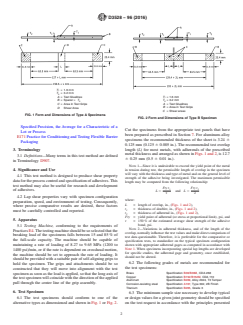
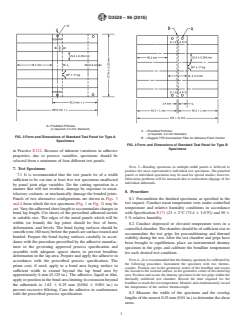
FIG. 1 Form and Dimensions of Type A Specimens
FIG. 2 Form and Dimensions of Type B Specimen
Specified Precision, the Average for a Characteristic of a
Cut the specimens from the appropriate test panels that have
Lot or Process
been prepared as prescribed in Section 7. For aluminum-alloy
E171 Practice for Conditioning and Testing Flexible Barrier
specimens the recommended thickness of the sheet is 3.24 6
Packaging
0.125 mm (0.125 6 0.005 in.). The recommended test overlap
length (L) for most metals, with adherends of the prescribed
3. Terminology
metal thickness and arranged as shown in Figs. 1 and 2, is 12.7
3.1 Definitions—Many terms in this test method are defined
6 0.25 mm (0.5 6 0.01 in.).
in Terminology D907.
NOTE 1—Since it is undesirable to exceed the yield point of the metal
4. Significance and Use
in tension during test, the permissible length of overlap in the specimen
will vary with the thickness and type of metal and on the general level of
4.1 This test method is designed to produce shear property
strength of the adhesive being investigated. The maximum permissible
datafortheprocesscontrolandspecificationofadhesives.This
length may be computed from the following relationship:
test method may also be useful for research and development
Fty t Fty t
1 2
of adhesives.
L 5 and L 5
τ 2
4.2 Lap shear properties vary with specimen configuration
where:
preparation, speed, and environment of testing. Consequently,
L = length of overlap, in., (Figs. 1 and 2),
where precise comparative results are desired, these factors
t = thickness of doubler, in., (Figs. 1 and 2),
must be carefully controlled and reported.
t = thickness of adherend in., (Figs. 1 and 2),
Fty = yield point of adherend (or stress at proportional limit), psi, and
5. Apparatus
τ = 150 % of the estimated average shear strength of the adhesive
bond, psi.
5.1 Testing Machine, conforming to the requirements of
NOTE 2—Variations in adherend thickness, and of the length of the
PracticesE4.Thetestingmachineshouldbesoselectedthatthe
overlap, normally influence the test values and make direct comparison of
breaking load of the specimens falls between 15 and 85 % of
test data questionable. Therefore, it is preferable for the comparative or
the full-scale capacity. The machine should be capable of
specification tests, to standardize on the typical specimen configuration
maintaining a rate of loading of 8.27 to 9.65 MPa (1200 to shown with appropriate adherend gages as computed in accordance with
Note 1. When specimens incorporating special lap lengths are developed
1400 psi)/min, or if the rate is dependent on crosshead motion,
for specific studies, the adherend gage and geometry, once established,
the machine should be set to approach the rate of loading. It
should not be altered.
should be provided with a suitable pair of self-aligning grips to
6.2 The following grades of metals are recommended for
hold the specimen. The grips and attachments should be so
the test specimens:
constructed that they will move into alignment with the test
Brass Specification B36/B36M, CDA 268
specimen as soon as the load is applied, so that the long axis of
Copper Specification B152/B152M, CDA 110
thetestspecimenwillcoincidewiththedirectionoftheapplied
Aluminum Specification B209, Alloy 2024, T3 Temper
pull through the center line of the grip assembly.
Corrosion-resisting steel Specification A167, Type 302, 2B Finish
Titanium Specification B265, Grade 3
6. Test Specimen
6.3 The minimum sample size necessary to develop typical
6.1 The test specimens should conform to one of the or design values for a given joint geometry should be specified
alternative types as dimensioned and shown in Fig. 1 or Fig. 2. on the test request in accordance with the principles
...