


EN 16807:2016
(Main)Liquid petroleum products - Bio-lubricants - Criteria and requirements of bio-lubricants and bio-based lubricants
Liquid petroleum products - Bio-lubricants - Criteria and requirements of bio-lubricants and bio-based lubricants
This European Standard specifies the term bio-lubricant and minimum requirements for all kinds of bio-lubricants and bio-based lubricants, while e.g. the EEL [4] refers to specific bio-lubricant families.
This European Standard also briefly describes relevant test method needs with respect to the characterization of bio-lubricants. It presents recommendation for related standards in the field of biodegradability, product functionality and the amount of different renewable raw materials and/or different bio-based contents used during manufacturing of such bio-lubricants forming one product group.
WARNING — Not all potential risks for the environment can be addressed by this standard.
Flüssige Mineralöl-Erzeugnisse - Bio-Schmierstoffe - Kriterien und Anforderungen für Bio-Schmierstoffe und biobasierte Schmierstoffe
Diese Europäische Norm legt den Begriff Bio-Schmierstoff und Mindestanforderungen an alle Arten von Bio Schmierstoffen und biobasierten Schmierstoffen fest, während sich z. B. die EEL [4] auf bestimmte Familien von Bio-Schmierstoffen bezieht.
Diese Europäische Norm beschreibt darüber hinaus kurz die benötigten wesentlichen Prüfverfahren in Zusammenhang mit der Charakterisierung von Bio-Schmierstoffen. Sie enthält Empfehlungen für zugehörige Normen im Bereich der biologischen Abbaubarkeit, der Funktionalität des Produktes und der Menge unterschiedlicher nachwachsender Rohstoffe bzw. unterschiedlicher biobasierter Gehälter, die bei der Herstellung derartiger Bio-Schmierstoffe verwendet werden, die eine Produktgruppe bilden.
WARNUNG - In dieser Norm können nicht sämtliche potentiellen Risiken für die Umwelt behandelt werden.
Produits pétroliers liquides - Bio-lubrifiants - Critères et exigences sur les bio-lubrifiants et lubrifiants d'origines biologiques
La présente Norme européenne définit le terme bio-lubrifiant ainsi que les exigences minimales applicables à tous les types de bio-lubrifiants et lubrifiants d'origine biologique, tandis que d'autres documents, tels que l'EEL[4] par exemple, se rapportent à des familles bien précises de bio-lubrifiants.
La présente Norme européenne décrit également brièvement les besoins relatifs à la méthode d'essai pertinente pour ce qui concerne la caractérisation des bio-lubrifiants. Elle propose des recommandations pour les normes connexes dans le domaine de la biodégradabilité, la fonctionnalité du produit ainsi que la quantité de matières premières renouvelables différentes et/ou de différents composants d'origine biologique utilisés pendant la fabrication des bio-lubrifiants formant un groupe de produits.
AVERTISSEMENT: Tous les risques potentiels pour l'environnement ne peuvent être traités dans cette norme.
Tekoči naftni proizvodi - Biomaziva - Kriteriji in zahteve za biomaziva in maziva na biološki osnovi
Ta evropski standard določa izraz biomazivo ter minimalne zahteve za vse vrste biomaziv in maziv na biološki osnovi, medtem ko se npr. znak EEL [1] nanaša na določene družine biomaziv. Poleg tega ta evropski standard na kratko opisuje ustrezne potrebe preskusnih metod v zvezi s karakterizacijo biomaziv. Podaja priporočilo za z njim povezane standarde na področju biorazgradljivosti, funkcionalnost proizvoda ter količino različnih obnovljivih surovin in/ali različnih snovi na biološki osnovi, ki se uporabljajo pri proizvodnji takih biomaziv, ki sestavljajo eno skupino proizvodov.
General Information
- Status
- Published
- Publication Date
- 11-Oct-2016
- Withdrawal Date
- 29-Apr-2017
- Technical Committee
- CEN/TC 19 - Petroleum products, lubricants and related products
- Drafting Committee
- CEN/TC 19/WG 33 - Bio-lubricants
- Current Stage
- 9093 - Decision to confirm - Review Enquiry
- Start Date
- 27-Sep-2022
- Completion Date
- 14-Apr-2025
Overview
EN 16807:2016 - Liquid petroleum products: Bio-lubricants is a European Standard published by CEN that defines the term bio-lubricant / bio-based lubricant and sets minimum, horizontally‑applicable requirements for all kinds of bio-lubricants. The standard clarifies expectations for biodegradability, bio-based content and aquatic toxicity, and outlines relevant test method needs and related standards. It is intended to reduce market confusion around the “bio-” prefix and to support consistent, measurable claims about environmental performance.
Key topics and technical requirements
- Terminology and scope
- Establishes a clear definition of bio-lubricant / bio-based lubricant applicable across lubricant families.
- Minimum criteria
- Specifies requirements relating to bio-based content, biodegradability, ecotoxicity (aquatic toxicity) and fit-for-purpose performance for final formulated products.
- Test methods & characterization
- Recommends testing approaches for:
- Biodegradation (e.g., OECD/ISO style CO2 or O2 respirometry tests)
- Ecotoxicity (algae, daphnia, fish acute tests such as EN ISO 8692, 6341, 7346-1)
- Bio‑based carbon content (radiocarbon 14C method per CEN/TS 16640)
- Includes Annex A (informative) on 14C content methods and Annex B (normative) on lubricant application groups.
- Recommends testing approaches for:
- Sampling and mixture testing
- Emphasises testing of final formulations (mixtures), reflecting the end-user perspective, while noting this complements chemical-level assessments in regulatory frameworks.
- Limitations
- Warns that EN 16807:2016 cannot address all potential environmental risks and is positioned as minimum horizontal requirements (Ecolabels or product-specific standards may set stricter criteria).
Practical applications and users
Who uses EN 16807:2016:
- Lubricant manufacturers developing and marketing bio-lubricants or hybrid bio-based products.
- Test laboratories implementing recommended biodegradability, ecotoxicity and 14C methods.
- Procurement teams / public purchasers specifying environmentally preferable lubricants.
- OEMs and end users (hydraulics, turbines, gearboxes, greases, metalworking, engine oils, machine-tool lubricants) requiring validated environmental claims.
- Regulators and ecolabel schemes aligning product definitions and consumer information.
Benefits:
- Provides consistent language for eco-friendly lubricant claims, aids compliance, and improves market transparency for sustainable and bio-based lubricants.
Related standards
EN 16807:2016 references and complements standards such as:
- CEN/TS 16640 (radiocarbon method for bio-based carbon)
- EN ISO 9408 / 9439 / 14593 (biodegradability tests)
- EN ISO 6341, 8692, 7346-1 (aquatic toxicity tests)
- ISO/EN lubricant family standards (hydraulics, greases, turbines, engine oils)
Keywords: EN 16807:2016, bio-lubricants, bio-based lubricants, biodegradability, aquatic toxicity, bio-based content, CEN, lubricant test methods, eco-friendly lubricants, renewable raw materials.



Frequently Asked Questions
EN 16807:2016 is a standard published by the European Committee for Standardization (CEN). Its full title is "Liquid petroleum products - Bio-lubricants - Criteria and requirements of bio-lubricants and bio-based lubricants". This standard covers: This European Standard specifies the term bio-lubricant and minimum requirements for all kinds of bio-lubricants and bio-based lubricants, while e.g. the EEL [4] refers to specific bio-lubricant families. This European Standard also briefly describes relevant test method needs with respect to the characterization of bio-lubricants. It presents recommendation for related standards in the field of biodegradability, product functionality and the amount of different renewable raw materials and/or different bio-based contents used during manufacturing of such bio-lubricants forming one product group. WARNING — Not all potential risks for the environment can be addressed by this standard.
This European Standard specifies the term bio-lubricant and minimum requirements for all kinds of bio-lubricants and bio-based lubricants, while e.g. the EEL [4] refers to specific bio-lubricant families. This European Standard also briefly describes relevant test method needs with respect to the characterization of bio-lubricants. It presents recommendation for related standards in the field of biodegradability, product functionality and the amount of different renewable raw materials and/or different bio-based contents used during manufacturing of such bio-lubricants forming one product group. WARNING — Not all potential risks for the environment can be addressed by this standard.
EN 16807:2016 is classified under the following ICS (International Classification for Standards) categories: 75.100 - Lubricants, industrial oils and related products. The ICS classification helps identify the subject area and facilitates finding related standards.
EN 16807:2016 is associated with the following European legislation: Standardization Mandates: M/430. When a standard is cited in the Official Journal of the European Union, products manufactured in conformity with it benefit from a presumption of conformity with the essential requirements of the corresponding EU directive or regulation.
You can purchase EN 16807:2016 directly from iTeh Standards. The document is available in PDF format and is delivered instantly after payment. Add the standard to your cart and complete the secure checkout process. iTeh Standards is an authorized distributor of CEN standards.
Standards Content (Sample)
2003-01.Slovenski inštitut za standardizacijo. Razmnoževanje celote ali delov tega standarda ni dovoljeno.Flüssige Mineralöl-Erzeugnisse - Bio-Schmierstoffe - Kriterien und Anforderungen an Bio-Schmierstoffe und bio-basierte SchmierstoffeProduits pétroliers liquides - Bio-lubrifiants - Critere et exigences de bio-lubrifiants et lubrifiant en basse biologiqueLiquid petroleum products - Bio-lubricants - Criteria and requirements of bio-lubricants and bio-based lubricants75.100MazivaLubricants, industrial oils and related products27.190Biološki viri in drugi alternativni viri energijeBiological sources and alternative sources of energyICS:Ta slovenski standard je istoveten z:EN 16807:2016SIST EN 16807:2016en,de01-december-2016SIST EN 16807:2016SLOVENSKI
STANDARD
EUROPEAN STANDARD NORME EUROPÉENNE EUROPÄISCHE NORM
EN 16807
October
t r s x ICS
y wä s r r English Version
Liquid petroleum products æ Bioælubricants æ Criteria and requirements of bioælubricants and bioæbased lubricants Produits pétroliers liquides æ Bioælubrifiants æ Critères et exigences sur les bioælubrifiants et lubrifiants d 5origines biologiques
Flüssige MineralölæErzeugnisse æ BioæSchmierstoffe æ Kriterien und Anforderungen für BioæSchmierstoffe und bioæbasierte Schmierstoffe This European Standard was approved by CEN on
t x May
t r s xä
egulations which stipulate the conditions for giving this European Standard the status of a national standard without any alterationä Upætoædate lists and bibliographical references concerning such national standards may be obtained on application to the CENæCENELEC Management Centre or to any CEN memberä
translation under the responsibility of a CEN member into its own language and notified to the CENæCENELEC Management Centre has the same status as the official versionsä
CEN members are the national standards bodies of Austriaá Belgiumá Bulgariaá Croatiaá Cyprusá Czech Republicá Denmarká Estoniaá Finlandá Former Yugoslav Republic of Macedoniaá Franceá Germanyá Greeceá Hungaryá Icelandá Irelandá Italyá Latviaá Lithuaniaá Luxembourgá Maltaá Netherlandsá Norwayá Polandá Portugalá Romaniaá Slovakiaá Sloveniaá Spainá Swedená Switzerlandá Turkey and United Kingdomä
EUROPEAN COMMITTEE FOR STANDARDIZATION COMITÉ EUROPÉEN DE NORMALISATION EUROPÄISCHES KOMITEE FÜR NORMUNG
CEN-CENELEC Management Centre:
Avenue Marnix 17,
B-1000 Brussels
t r s x CEN All rights of exploitation in any form and by any means reserved worldwide for CEN national Membersä Refä Noä EN
s x z r yã t r s x ESIST EN 16807:2016
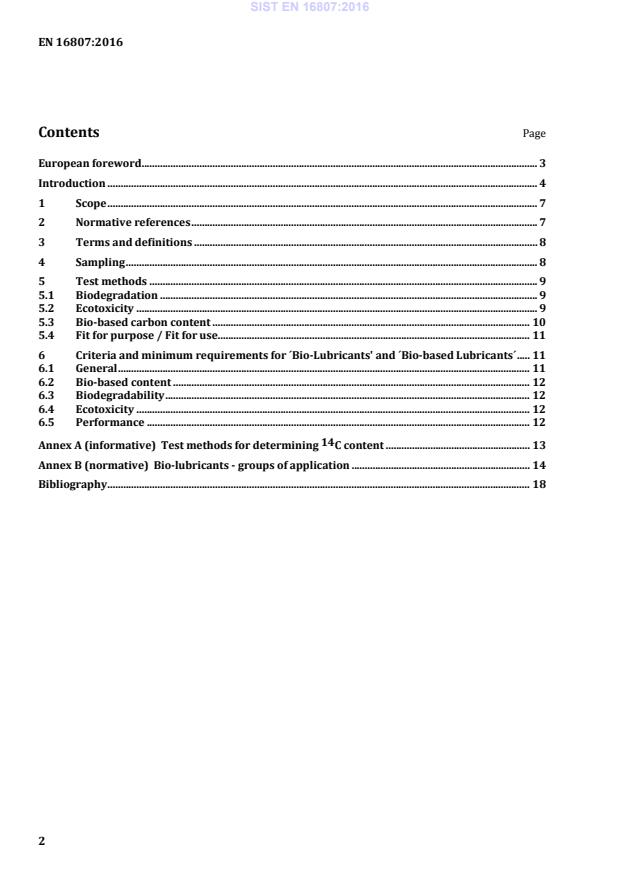
Test methods for determining 14C content . 13 Annex B (normative)
Bio-lubricants - groups of application . 14 Bibliography . 18
April 2017. Attention is drawn to the possibility that some of the elements of this document may be the subject of patent rights. CEN shall not be held responsible for identifying any or all such patent rights. This document has been prepared under a mandate given to CEN by the European Commission and the European Free Trade Association. Mandate M/430 covers the development of European standards for bio-lubricants in relation to bio-based product aspects. It has been prepared by CEN/TC 19/WG 33 “Bio-Lubricants”, the secretariat of which is held by DIN. According to the CEN-CENELEC Internal Regulations, the national standards organisations of the following countries are bound to implement this European Standard: Austria, Belgium, Bulgaria, Croatia, Cyprus, Czech Republic, Denmark, Estonia, Finland, Former Yugoslav Republic of Macedonia, France, Germany, Greece, Hungary, Iceland, Ireland, Italy, Latvia, Lithuania, Luxembourg, Malta, Netherlands, Norway, Poland, Portugal, Romania, Slovakia, Slovenia, Spain, Sweden, Switzerland, Turkey and the United Kingdom. SIST EN 16807:2016
Tri-methylol-propane-trioleate (TMP-O) Biodegradablea and
bio-basedb Non-renewable Biodegradablea Di-isotridecyl-adipate (DITA) Biodegradablea Renewable Inherently or
non biodegradable Hydrocarbons from process
“Biomass-to-Liquid” (BtL) Bio-basedb Non-renewable Non biodegradable White oil for foodgrade lubricants Biocompatible a According to OECD 301[5]. b According to EN 16575. NOTE In addition, consideration of soil dwelling organisms could be reflected in a future edition. Even if in a more general approach “environmentally compatible lubricants” can be seen under additional aspects, up to a comprehensive Life Cycle Assessment (LCA), this European Standard focuses on the term bio-lubricant, which comprises requirements regarding biodegradability, aquatic toxicity, content of biomass and performance. SIST EN 16807:2016
...
SIST EN 16807:2016 문서는 생물 유체 및 생물 기반 윤활유에 대한 기준과 요구 사항을 명시하며, 생물 유체와 관련된 다양한 측면을 다룬다. 이 표준은 생물 유체의 정의와 최소 요구 사항을 설정하여, 업계에서 생물 유체의 품질 및 성능 기준을 일관되게 유지할 수 있도록 돕는다. 표준의 강점 중 하나는 생물 유체의 다양성을 포괄적으로 반영하고 있다는 점이다. EN 16807:2016은 생물 유체와 생물 기반 윤활유의 특정 요구 조건을 명확하게 해 주며, 이는 제조업체가 환경 친화적인 제품을 개발하고 인증받는 데 있어 중요한 기반이 된다. 또한, 이 표준은 생물 유체의 생분해성 및 제품 기능성과 관련된 추가 표준 추천을 제공하여, 사용자들이 관련 산업 내에서 요구되는 기준을 충족할 수 있도록 돕는다. 특히, 생물 유체의 제조에 사용되는 다양한 재생 가능 원료의 양 및 생물 기반 함량에 대한 명확한 지침이 제시되어, 제조업체가 친환경적인 원료를 적극적으로 사용하도록 장려한다. 이는 지속 가능한 개발 목표 달성에 기여하며, 환경 보호와 산업 발전 간의 균형을 유지하는 데 중요한 역할을 한다. 다만, 이 문서는 환경에 대한 모든 잠재적 위험을 다루고 있지 않다는 경고가 필요하며, 사용자들은 이를 인지하고 추가적인 환경 평가를 수행하는 것이 중요하다. 이러한 점에서 SIST EN 16807:2016은 생물 유체와 생물 기반 윤활유의 품질 기준을 설정하는 데 있어 매우 유용하며, 지속 가능한 산업 발전을 위한 필수적인 기준으로 자리 잡고 있다.
La norme SIST EN 16807:2016 aborde de manière exhaustive les produits pétroliers liquides et les bio-lubrifiants, en définissant clairement le terme « bio-lubrifiant » et en établissant des exigences minimales pour toutes les catégories de bio-lubrifiants et de lubrifiants d'origine bio. L'étendue de cette norme est cruciale dans un contexte où la durabilité et le respect de l'environnement sont de plus en plus prioritaires pour les industries utilisant des lubrifiants. Parmi les points forts de cette norme, on trouve sa capacité à fournir des recommandations sur les standards associés, y compris ceux portant sur la biodégradabilité, la fonctionnalité des produits et la quantité de matières premières renouvelables utilisées lors de la fabrication de ces bio-lubrifiants. Cela permet non seulement d'assurer une conformité réglementaire, mais aussi de faire progresser le développement de produits plus respectueux de l'environnement. En outre, la norme inclut une description sommaire des méthodes d'essai nécessaires pour caractériser les bio-lubrifiants, ce qui facilite l'évaluation de la qualité des produits sur le marché. Cela représente un atout majeur pour les fabricants cherchant à prouver la performance et l'innocuité de leurs bio-lubrifiants. Cependant, il est essentiel de noter un avertissement contenu dans la norme : elle ne peut pas couvrir tous les risques potentiels pour l'environnement. Cette réserve souligne l'importance d'une compréhension approfondie des impacts environnementaux associés à l'utilisation des bio-lubrifiants, et incite à une vigilance continue dans leur évaluation. En conclusion, la norme SIST EN 16807:2016 est un document fondamental qui offre un cadre important pour le développement et l'évaluation des bio-lubrifiants, établissant des critères pertinents dans un marché en constante évolution vers des solutions plus durables.
Die Norm EN 16807:2016 bietet eine umfassende Grundlage für die Klassifizierung und Bewertung von Bio-Schmierstoffen und biobasierten Schmierstoffen. Der Umfang dieser Norm ist entscheidend, da sie klare Definitionen und Mindestanforderungen für alle Arten von Bio-Schmierstoffen festlegt, wodurch eine einheitliche Basis für Hersteller und Anwender geschaffen wird. Eine der Stärken dieser Norm liegt in ihrer Fähigkeit, die Anforderungen an Bio-Schmierstoffe zu spezifizieren, was besonders in Zeiten steigender Umweltbewusstsein von großer Bedeutung ist. Die klare Definition des Begriffs „Bio-Schmierstoff“ trägt zur Vermeidung von Missverständnissen bei und ermöglicht eine gezielte Entwicklung und Vermarktung ökologisch nachhaltiger Produkte. Darüber hinaus bietet die EN 16807:2016 Empfehlungen zu relevanten Prüfmethoden, die notwendig sind, um die Eigenschaften von Bio-Schmierstoffen zu charakterisieren. Dies unterstützt nicht nur die Hersteller bei der Qualitätskontrolle, sondern auch die Verbraucher darin, fundierte Entscheidungen zu treffen. Die Betrachtung der biologischen Abbaubarkeit, der Produktfunktionalität sowie der verwendeten nachwachsenden Rohstoffe und der verschiedenen biobasierten Inhaltsstoffe während der Herstellung fördert die Entwicklung hochwertiger und umweltfreundlicher Produkte. Die Norm hat jedoch auch ihre Grenzen; sie weist darauf hin, dass nicht alle potenziellen Risiken für die Umwelt in ihrer Struktur behandelt werden können. Dies ist ein wichtiger Punkt, der die Notwendigkeit weiterer Forschung und Regulierung im Bereich der Bio-Schmierstoffe unterstreicht. Insgesamt ist die EN 16807:2016 eine grundlegende Norm, die sowohl für die Industrie als auch für die Verbraucher von großer Relevanz ist und dazu beiträgt, die Standards im Bereich von Bio-Schmierstoffen und biobasierten Schmierstoffen zu heben.
SIST EN 16807:2016は、液体石油製品に関連するバイオ潤滑油およびバイオベースの潤滑油に関する重要な基準を提供しています。この標準は、バイオ潤滑油の定義と、すべての種類のバイオ潤滑油およびバイオベースの潤滑油に対する最小要件を規定しており、特にEEL [4]が具体的なバイオ潤滑油ファミリーに言及している点が特徴的です。 この標準の重要な強みは、バイオ潤滑油に関する特性評価に必要な関連試験方法についての簡潔な説明が含まれていることです。さらに、バイオ潤滑油の製造に使用される再生可能原材料やバイオベース成分の量、ならびに生分解性や製品機能性に関連する標準への推奨事項が提示されています。こうした要素は、バイオ潤滑油およびバイオベースの潤滑油がどのように製造され評価されるべきかの指針として重要です。 ただし、この標準は環境に対するすべての潜在的リスクに対処するものではないことに注意が必要です。したがって、バイオ潤滑油の使用に際しては、他の補完的な基準やガイドラインを考慮することが求められます。この標準は、環境に配慮した製品の開発を進める上での信頼性の高い基盤を提供し、今後の研究や実装においてもその有用性が期待されます。
The EN 16807:2016 standard serves as a pivotal document in the realm of liquid petroleum products, specifically focusing on bio-lubricants. Its comprehensive scope encompasses the definition of bio-lubricants and establishes minimum requirements applicable to all varieties of bio-lubricants and bio-based lubricants. By delineating these criteria, the standard fosters a clear understanding of what constitutes a bio-lubricant, while also highlighting the nuances involved in different families of bio-lubricants as referenced in related documents such as the EEL. One of the key strengths of EN 16807:2016 is its attention to standardization in characterization methods for bio-lubricants. The standard outlines the essential test methods that are crucial in assessing the qualities of bio-lubricants, thereby facilitating consistent evaluation and comparison across the industry. This focus on characterization not only aids manufacturers in meeting compliance but also enhances product integrity and consumer trust. Additionally, the standard addresses important aspects concerning biodegradability, product functionality, and the sustainability of renewable raw materials utilized in the production of bio-lubricants. By providing comprehensive recommendations for related standards, EN 16807:2016 promotes a cohesive framework that supports the continuous development and improvement of bio-lubricants and bio-based lubricants. Moreover, while the document effectively outlines a range of criteria, it also contains a cautionary note regarding potential environmental risks that may not be fully covered by the standard. This acknowledgment underlines the ongoing need for vigilance and research in the field, ensuring that stakeholders remain aware of the broader implications associated with bio-lubricant application and usage. Overall, the EN 16807:2016 standard is highly relevant for manufacturers, researchers, and regulators alike, as it not only sets the foundation for bio-lubricant classification but also encourages proactive measures in sustainability and environmental responsibility within the lubricants industry.
Questions, Comments and Discussion
Ask us and Technical Secretary will try to provide an answer. You can facilitate discussion about the standard in here.
Loading comments...