

EN 1239:2011
(Main)Adhesives - Freeze-thaw stability
- Abstract
This European Standard specifies a method for the evaluation of the freeze-thaw stability of adhesives, their basic constituents and related products.
This test has no significance if the sample does not freeze under the test conditions.
- Status
- Published
- Publication Date
- 19-Apr-2011
- Withdrawal Date
- 30-Oct-2011
- Technical Committee
- CEN/TC 193 - Adhesives
- Current Stage
- 9093 - Decision to confirm - Review Enquiry
- Start Date
- 12-Jul-2023
- Completion Date
- 21-Oct-2026

Overview
EN 1239:2011 - "Adhesives - Freeze‑thaw stability" is a CEN European Standard that specifies a laboratory method to evaluate the freeze‑thaw stability of adhesives, their basic constituents and related products. The procedure assesses whether an adhesive withstands selected freezing temperatures and repeated freeze‑thaw cycles without visible coagulation or unacceptable changes in viscosity. Note: the test is not meaningful if the sample does not freeze under the chosen test conditions.
Key topics and technical requirements
- Test principle: measure initial viscosity, subject a 200 ± 5 ml sample in a sealed cylindrical container to a freeze period (16 h) at a selected temperature (−5, −10, −15 or −20 °C), then thaw at (23 ± 1) °C for 8 h. Repeat up to three cycles if no visible coagulum forms. Measure final viscosity and inspect appearance.
- Pass/fail criteria: no visible, indispersible coagulum and a viscosity change not exceeding the manufacturer’s specification limits.
- Classification format: expressed as "freeze temperature / number of cycles" (e.g., -10 °C/3 cycles).
- Apparatus & control:
- Cylindrical container (approx. 90 mm × 60 mm ID) with airtight lid.
- Test chamber controllable to (−5 ± 1) °C, (−10 ± 1) °C, (−15 ± 1) °C or (−20 ± 1) °C.
- Thermometer accuracy ±0.5 °C; viscometer per EN 12092 for viscosity measurement.
- Sampling & preparation: follow EN ISO 15605 and EN 1067 for representative sampling and sample conditioning.
- Reporting: include reference to EN 1239, adhesive identification, freeze temperature, initial and final viscosities, test result and classification, any deviations, and test date.
Applications and who uses it
- Manufacturers of adhesives and adhesive components - for product development, stability screening and routine quality control.
- Independent testing laboratories - to deliver standardized freeze‑thaw stability reports for clients.
- Procurement, specification writers and OEMs - to set storage/transportation requirements and acceptance criteria.
- R&D and formulation teams - to compare formulations and select freeze‑resistant chemistries.
- Regulatory/quality assurance teams - to document performance claims and support conformity across Europe.
Related standards
- EN 12092 - Determination of viscosity (referenced viscometer method)
- EN 923 - Adhesives terms and definitions
- EN 1067 - Examination and preparation of samples
- EN ISO 15605 - Sampling of adhesives
Keywords: EN 1239:2011, freeze‑thaw stability, adhesives, freeze‑thaw cycles, viscosity test, CEN standard, adhesive testing, viscometer, sample preparation.
Relations
- Effective Date
- 23-Apr-2011
- Effective Date
- 28-Jan-2026
- Effective Date
- 28-Jan-2026
- Effective Date
- 28-Jan-2026
- Effective Date
- 28-Jan-2026
Get Certified
Connect with accredited certification bodies for this standard

DIN CERTCO
DIN Group product certification.

Smithers Quality Assessments
US management systems and product certification.
Sponsored listings
Frequently Asked Questions
EN 1239:2011 is a standard published by the European Committee for Standardization (CEN). Its full title is "Adhesives - Freeze-thaw stability". This standard covers: This European Standard specifies a method for the evaluation of the freeze-thaw stability of adhesives, their basic constituents and related products. This test has no significance if the sample does not freeze under the test conditions.
This European Standard specifies a method for the evaluation of the freeze-thaw stability of adhesives, their basic constituents and related products. This test has no significance if the sample does not freeze under the test conditions.
EN 1239:2011 is classified under the following ICS (International Classification for Standards) categories: 83.180 - Adhesives. The ICS classification helps identify the subject area and facilitates finding related standards.
EN 1239:2011 has the following relationships with other standards: It is inter standard links to EN 1239:1998, EN 1067:2005, EN ISO 15605:2004, EN 12092:2001, EN 923:2005+A1:2008. Understanding these relationships helps ensure you are using the most current and applicable version of the standard.
EN 1239:2011 is available in PDF format for immediate download after purchase. The document can be added to your cart and obtained through the secure checkout process. Digital delivery ensures instant access to the complete standard document.
Standards Content (Sample)
2003-01.Slovenski inštitut za standardizacijo. Razmnoževanje celote ali delov tega standarda ni dovoljeno.Klebstoffe - Gefrier-Auftau-StabilitätAdhésifs - Stabilité au gel-dégelAdhesives - Freeze-thaw stability83.180LepilaAdhesivesICS:Ta slovenski standard je istoveten z:EN 1239:2011SIST EN 1239:2011en,fr,de01-julij-2011SIST EN 1239:2011SLOVENSKI
STANDARDSIST EN 1239:19991DGRPHãþD
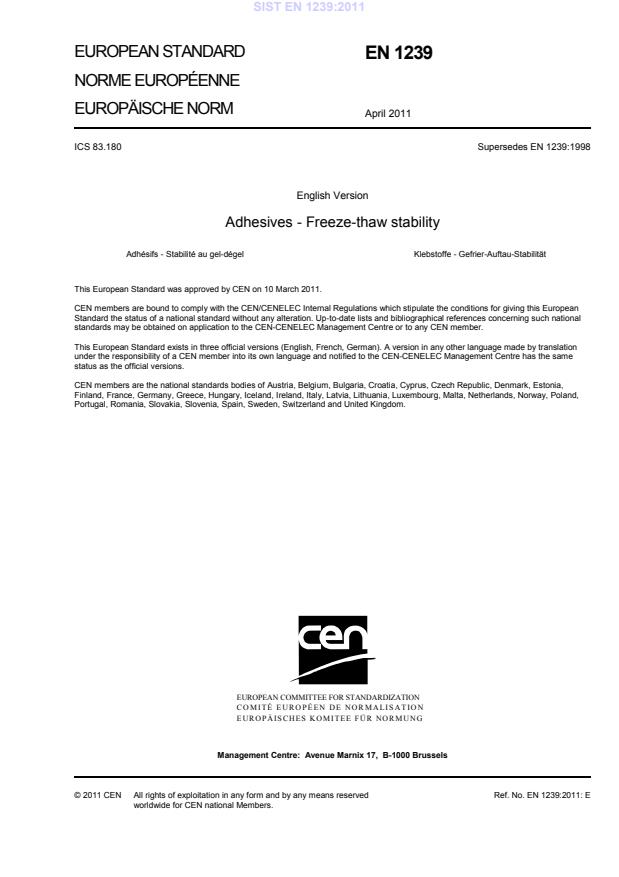
EUROPEAN STANDARD NORME EUROPÉENNE EUROPÄISCHE NORM
EN 1239
April 2011 ICS 83.180 Supersedes EN 1239:1998English Version
Adhesives - Freeze-thaw stability
Adhésifs - Stabilité au gel-dégel
Klebstoffe - Gefrier-Auftau-Stabilität This European Standard was approved by CEN on 10 March 2011.
CEN members are bound to comply with the CEN/CENELEC Internal Regulations which stipulate the conditions for giving this European Standard the status of a national standard without any alteration. Up-to-date lists and bibliographical references concerning such national standards may be obtained on application to the CEN-CENELEC Management Centre or to any CEN member.
This European Standard exists in three official versions (English, French, German). A version in any other language made by translation under the responsibility of a CEN member into its own language and notified to the CEN-CENELEC Management Centre has the same status as the official versions.
CEN members are the national standards bodies of Austria, Belgium, Bulgaria, Croatia, Cyprus, Czech Republic, Denmark, Estonia, Finland, France, Germany, Greece, Hungary, Iceland, Ireland, Italy, Latvia, Lithuania, Luxembourg, Malta, Netherlands, Norway, Poland, Portugal, Romania, Slovakia, Slovenia, Spain, Sweden, Switzerland and United Kingdom.
EUROPEAN COMMITTEE FOR STANDARDIZATION
COMITÉ EUROPÉEN DE NORMALISATION EUROPÄISCHES KOMITEE FÜR NORMUNG
Management Centre:
Avenue Marnix 17,
B-1000 Brussels © 2011 CEN All rights of exploitation in any form and by any means reserved worldwide for CEN national Members. Ref. No. EN 1239:2011: ESIST EN 1239:2011
...