

EN 1994-1-2:2026/prA1
(Amendment)Eurocode 4 - Design of composite steel and concrete structures - Part 1-2: Structural fire design
- Abstract
(1) EN 1994-1-2 gives rules for the design of steel-concrete composite structures for the accidental design situation of fire exposure. It only identifies differences from, or supplements to, rules for normal temperature design.
(2) EN 1994-1-2 only applies to structures, or parts of structures, that are within the scope of EN1994-1-1 and are designed accordingly.
- Status
- Not Published
- Publication Date
- 23-Nov-2027
- Technical Committee
- CEN/TC 250 - Structural Eurocodes
- Current Stage
- 4020 - Submission to enquiry - Enquiry
- Start Date
- 17-Sep-2026
- Due Date
- 30-Oct-2026
- Completion Date
- 17-Sep-2026

EN 1994-1-2:2026/prA1 is a CEN draft amendment to Eurocode 4, Part 1-2. It updates the structural fire design rules for steel-concrete composite structures in the accidental fire situation, for use by designers, checking engineers, specifiers and others responsible for fire-resistant composite structures.
This draft amendment modifies EN 1994-1-2:2026. It is intended to be read with EN 1994-1-1 and the related execution, material, product and fire-test standards used in composite steel and concrete design.
What does EN 1994-1-2:2026/prA1 specify?
EN 1994-1-2:2026/prA1 specifies amendments to the fire design rules for steel-concrete composite structures. The scope is fire exposure in the accidental design situation, and the document only adds to or differs from the rules for normal temperature design.
EN 1994-1-2:2026/prA1 applies only to structures, or parts of structures, that are within the scope of EN 1994-1-1 and are designed accordingly. The amendment also makes clear that the document is used together with EN 1090-1, EN 1991 (all parts) and EN 1994-1-1.
The amendment is organised as modifications to the introduction, Clause 1 to Clause 8, Annex B to Annex I, the addition of Annex J, and updates to the bibliography.
| Annex | What it covers |
|---|---|
| B | Fire resistance of unprotected composite slabs |
| C | Sagging and hogging moment resistance of a steel beam connected to a slab and exposed from underneath |
| D | Bending moment resistance of a partially encased steel beam connected to a slab and exposed to fire |
| E | Axial buckling resistance about the weak axis of a partially encased composite column exposed to fire |
| F | Concrete filled hollow sections exposed to the standard temperature-time curve |
| G | Composite floors under tensile membrane action |
| H | Sagging moment resistance of a shallow floor beam exposed to fire |
| I | Beams with large web openings exposed to fire |
| J | Temperatures of a fire protected steel section connected to a composite slab with profiled steel sheeting |
What are the key requirements of EN 1994-1-2:2026/prA1?
EN 1994-1-2:2026/prA1 tightens the applicability of the fire design models and adds a new temperature model for a specific protected beam-and-slab arrangement. In practice, the amendment helps users choose the right method for the member type, material grade and concrete class before design checks are carried out.
Scope and design basis
Clause 1 extends the scope to steel-concrete composite structures that have a loadbearing function, a separating function, an insulation function, or a combination of these. It also states that, where the term steel is used, carbon steel is meant and stainless steel is not addressed.
Clause 4 updates the basis of design so that, where a relevant clause does not say otherwise, the verification methods in the document may be used for any type of fire exposure covered by the standard. It also keeps the role of the National Annex for values such as the fire design partial factor.
Material properties and tabulated data
Clause 5 updates the material-property rules for steel and concrete at elevated temperature, including additions for physically based fire scenarios. For steel grades above S500, an approximation is allowed under the stated conditions, which matters when a project uses higher-strength steel and needs a justified temperature-dependent stress-strain model.
Clause 6 limits the tabulated design data to specific material ranges. The tabulated data in Tables 6.1 to 6.7 apply to beams and columns with structural steel grades S235 to S460, reinforcement steel grades not above B500, and normal weight concrete of strength classes C20/25 to C50/60.
Simplified methods
Clause 7 narrows the use of the simplified methods to defined member types and material ranges. For composite slabs and beams, the simplified methods are limited to structural steel grades S235 to S460, reinforcement steel grades not above B500, and normal weight concrete C20/25 to C50/60 or lightweight concrete L20/22 to L50/55.
Clause 7 also points to test evidence in EN 1365-2 as an alternative in one of the slab rules. That matters where a project has test data and wants to support a design route beyond the pure calculation path.
For columns, the simplified methods are restricted to structural steel grades S235 to S460, reinforcement steel grades not above B500, and normal weight concrete C20/25. Clause 7 also adds a requirement on transverse bars used for composite action, linking their spacing to EN 1992-1-2.
Advanced methods and Annex J
Clause 8 clarifies the advanced-design workflow by separating thermal response, internal force effects and mechanical verification more clearly. It also states that calculation results can refer to temperatures, deformations and fire resistance times, which is important when the output is used for reporting or performance checks rather than only for a pass or fail result.
Annex J is the major new technical addition. It gives an informative model for fire protected steel sections connected to composite slabs with profiled steel sheeting exposed to standard fire from underneath. The model is limited to I-shaped hot-rolled or welded sections in the stated arrangement, with voids not filled, a protected section except on the top flange, a standard fire resistance up to 120 min, and a bottom flange temperature of at least 450 °C.
What terms does EN 1994-1-2:2026/prA1 define?
- National Annex - the national document that may select permitted values where EN 1994-1-2 leaves choices open.
- Physically based fire scenario - a fire scenario used in the material-property rules where heating and cooling phases are treated explicitly.
- Standard fire curve - the reference fire exposure used in several annex models and in Annex J.
- Thermal response model - the part of advanced design that calculates temperature development inside structural members.
- Loadbearing function - the ability of the composite member to carry structural load in fire conditions.
- Separating function - the ability of the assembly to separate one side of a fire from the other.
- Insulation function - the ability to limit temperature rise on the unexposed side.
- Contour encasement fire protection material - the fire protection system used in Annex J around the steel section, except on the top flange.
Who uses EN 1994-1-2:2026/prA1?
EN 1994-1-2:2026/prA1 is used by structural engineers, fire engineers, checking engineers, and manufacturers of composite floors, beams and columns. It is also relevant to specifiers, clients, and authorities that need to compare a proposed composite solution against the fire design rules.
In practice, users apply it when they need to select a design method, check a member in fire, decide whether a tabulated or simplified method is allowed, or verify a more advanced calculation for a protected beam, slab, column or beam with openings.
What changed in EN 1994-1-2:2026/prA1 from the previous edition?
EN 1994-1-2:2026/prA1 modifies EN 1994-1-2:2026 and adds a new informative Annex J. The amendment also revises the scope, terms and definitions, basis of design, material properties, tabulated design data, simplified design methods, advanced design methods, and the application limits of Annexes B to I.
It also makes editorial and technical corrections in formulas, symbols, references and annex wording. Several annexes are aligned with EN 1994-1-1:2026, and the bibliography is updated with new or revised references.
Which standards are used with EN 1994-1-2:2026/prA1?
| Standard | Contribution |
|---|---|
| EN 1994-1-1 | Normal temperature design basis for composite steel and concrete structures |
| EN 1090-1 | Execution-related framework used together with the Eurocode |
| EN 1991 (all parts) | Actions and thermal actions used with the fire design rules |
| EN 1991-1-2:2024 | Fire actions and fire exposure rules referenced in the clauses and annexes |
| EN 1991-1-1:2025 | Basis used in the physically based material-property provisions |
| EN 1992-1-2:2023 | Referenced for requirements on transverse bars and related fire provisions |
| EN 1365-2 | Fire resistance test evidence for floors and roofs |
| EN ISO 14713-2 | Corrosion protection guidance referenced in the bibliography |
| EN 1991-1-7:2025 | Referenced in the bibliography for accidental actions |
What does the EN 1994-1-2:2026/prA1 document contain?
EN 1994-1-2:2026/prA1 contains clause-by-clause amendments, revised symbols and definitions, and updated limits on when each method may be used. It also updates the tabulated design data rules and the simplified calculation methods for slabs, beams, columns, floors and beams with openings.
The annexes contain calculation models, formulas, checks and supporting figures for fire resistance, moment resistance, buckling resistance, membrane action and temperature development. Annex J adds formulas and tables for protected steel sections with profiled steel sheeting, including reduced hot-gas temperature, top flange temperature and bottom flange temperature adjustment.
For design work, the document provides the technical structure needed to choose between tabulated, simplified and advanced methods, and to support fire design checks with member-specific calculation models.
Relations
- Effective Date
- 24-Jun-2026
Get Certified
Connect with accredited certification bodies for this standard

DIBt (Deutsches Institut für Bautechnik)
German Institute for Building Technology.
DIN CERTCO
DIN Group product certification.

Aboma Certification B.V.
Specialized in construction, metal, and transport sectors.
Sponsored listings
Frequently Asked Questions
EN 1994-1-2:2026/prA1 is a draft published by the European Committee for Standardization (CEN). Its full title is "Eurocode 4 - Design of composite steel and concrete structures - Part 1-2: Structural fire design". This standard covers: (1) EN 1994-1-2 gives rules for the design of steel-concrete composite structures for the accidental design situation of fire exposure. It only identifies differences from, or supplements to, rules for normal temperature design. (2) EN 1994-1-2 only applies to structures, or parts of structures, that are within the scope of EN1994-1-1 and are designed accordingly.
(1) EN 1994-1-2 gives rules for the design of steel-concrete composite structures for the accidental design situation of fire exposure. It only identifies differences from, or supplements to, rules for normal temperature design. (2) EN 1994-1-2 only applies to structures, or parts of structures, that are within the scope of EN1994-1-1 and are designed accordingly.
EN 1994-1-2:2026/prA1 is classified under the following ICS (International Classification for Standards) categories: 91.010.30 - Technical aspects. The ICS classification helps identify the subject area and facilitates finding related standards.
EN 1994-1-2:2026/prA1 has the following relationships with other standards: It is inter standard links to EN 1994-1-2:2026. Understanding these relationships helps ensure you are using the most current and applicable version of the standard.
EN 1994-1-2:2026/prA1 is available in PDF format for immediate download after purchase. The document can be added to your cart and obtained through the secure checkout process. Digital delivery ensures instant access to the complete standard document.
Standards Content (Sample)
SLOVENSKI STANDARD
01-november-2026
Evrokod 4 - Projektiranje sovprežnih konstrukcij iz jekla in betona - 1-2. del:
Projektiranje konstrukcij za požarno varnost
Eurocode 4 - Design of composite steel and concrete structures - Part 1-2: Structural fire
design
Eurocode 4 - Bemessung und Konstruktion von Verbundtragwerken aus Stahl und Beton
- Teil 1-2: Tragwerksbemessung für den Brandfall
Eurocode 4 - Calcul des structures mixtes acier-béton - Partie 1-2 : Calcul du
comportement au feu
Ta slovenski standard je istoveten z: EN 1994-1-2:2026/prA1
ICS:
13.220.50 Požarna odpornost Fire-resistance of building
gradbenih materialov in materials and elements
elementov
91.010.30 Tehnični vidiki Technical aspects
91.080.13 Jeklene konstrukcije Steel structures
91.080.40 Betonske konstrukcije Concrete structures
2003-01.Slovenski inštitut za standardizacijo. Razmnoževanje celote ali delov tega standarda ni dovoljeno.
DRAFT
EUROPEAN STANDARD
EN 1994-1-2:2026
NORME EUROPÉENNE
EUROPÄISCHE NORM
prA1
September 2026
ICS
English Version
Eurocode 4 - Design of composite steel and concrete
structures - Part 1-2: Structural fire design
Eurocode 4 - Calcul des structures mixtes acier-béton - Eurocode 4 - Bemessung und Konstruktion von
Partie 1-2 : Calcul du comportement au feu Verbundtragwerken aus Stahl und Beton - Teil 1-2:
Tragwerksbemessung für den Brandfall
This draft amendment is submitted to CEN members for enquiry. It has been drawn up by the Technical Committee CEN/TC 250.
This draft amendment A1, if approved, will modify the European Standard EN 1994-1-2:2026. If this draft becomes an
amendment, CEN members are bound to comply with the CEN/CENELEC Internal Regulations which stipulate the conditions for
inclusion of this amendment into the relevant national standard without any alteration.
This draft amendment was established by CEN in three official versions (English, French, German). A version in any other
language made by translation under the responsibility of a CEN member into its own language and notified to the CEN-CENELEC
Management Centre has the same status as the official versions.
CEN members are the national standards bodies of Austria, Belgium, Bulgaria, Croatia, Cyprus, Czech Republic, Denmark, Estonia,
Finland, France, Germany, Greece, Hungary, Iceland, Ireland, Italy, Latvia, Lithuania, Luxembourg, Malta, Netherlands, Norway,
Poland, Portugal, Republic of North Macedonia, Romania, Serbia, Slovakia, Slovenia, Spain, Sweden, Switzerland, Türkiye and
United Kingdom.
Recipients of this draft are invited to submit, with their comments, notification of any relevant patent rights of which they are
aware and to provide supporting documentation.
Warning : This document is not a European Standard. It is distributed for review and comments. It is subject to change without
notice and shall not be referred to as a European Standard.
EUROPEAN COMMITTEE FOR STANDARDIZATION
COMITÉ EUROPÉEN DE NORMALISATION
EUROPÄISCHES KOMITEE FÜR NORMUNG
CEN-CENELEC Management Centre: Rue de la Science 23, B-1040 Brussels
© 2026 CEN All rights of exploitation in any form and by any means reserved Ref. No. EN 1994-1-2:2026/prA1:2026 E
worldwide for CEN national Members.
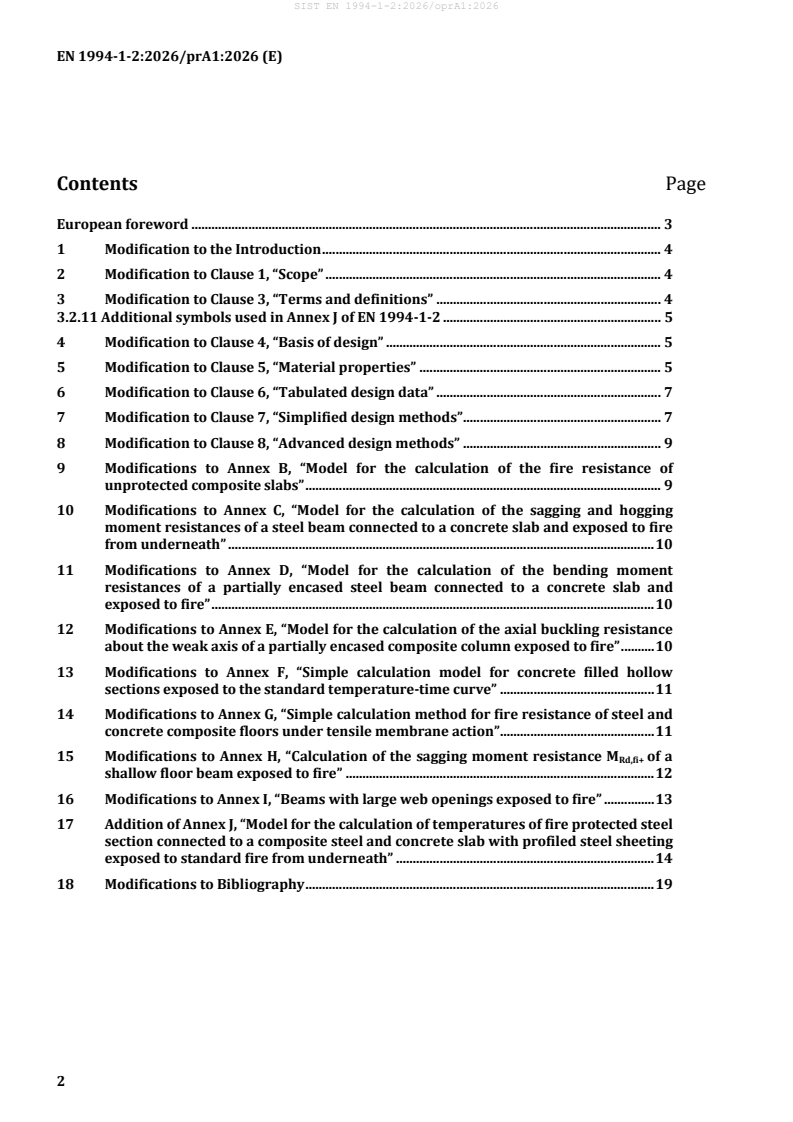
Contents Page
European foreword . 3
1 Modification to the Introduction . 4
2 Modification to Clause 1, “Scope” . 4
3 Modification to Clause 3, “Terms and definitions” . 4
3.2.11 Additional symbols used in Annex J of EN 1994-1-2 . 5
4 Modification to Clause 4, “Basis of design” . 5
5 Modification to Clause 5, “Material properties” . 5
6 Modification to Clause 6, “Tabulated design data” . 7
7 Modification to Clause 7, “Simplified design methods” . 7
8 Modification to Clause 8, “Advanced design methods” . 9
9 Modifications to Annex B, “Model for the calculation of the fire resistance of
unprotected composite slabs” . 9
10 Modifications to Annex C, “Model for the calculation of the sagging and hogging
moment resistances of a steel beam connected to a concrete slab and exposed to fire
from underneath” . 10
11 Modifications to Annex D, “Model for the calculation of the bending moment
resistances of a partially encased steel beam connected to a concrete slab and
exposed to fire” . 10
12 Modifications to Annex E, “Model for the calculation of the axial buckling resistance
about the weak axis of a partially encased composite column exposed to fire” . 10
13 Modifications to Annex F, “Simple calculation model for concrete filled hollow
sections exposed to the standard temperature-time curve” . 11
14 Modifications to Annex G, “Simple calculation method for fire resistance of steel and
concrete composite floors under tensile membrane action” . 11
15 Modifications to Annex H, “Calculation of the sagging moment resistance M of a
Rd,fi+
shallow floor beam exposed to fire” . 12
16 Modifications to Annex I, “Beams with large web openings exposed to fire” . 13
17 Addition of Annex J, “Model for the calculation of temperatures of fire protected steel
section connected to a composite steel and concrete slab with profiled steel sheeting
exposed to standard fire from underneath” . 14
18 Modifications to Bibliography . 19
European foreword
This document (EN 1994-1-2:2026/prA1:2026) has been prepared by Technical Committee CEN/TC 250
“Structural Eurocodes”, the secretariat of which is held by BSI. CEN/TC 250 is responsible for all
Structural Eurocodes and has been assigned responsibility for structural and geotechnical design matters
by CEN.
This document is currently submitted to the CEN Enquiry
This document will supersede EN 1994-1-2:2026.
NOTE Some modifications are purely editorial corrections to improve the quality of the document and these
will not be tagged in the consolidated publication, as noted after the modification.
The first generation of EN Eurocodes was published between 2002 and 2007. This document forms part
of the second generation of the Eurocodes, which have been prepared under Mandate M/515 issued to
CEN by the European Commission and the European Free Trade Association.
The Eurocodes have been drafted to be used in conjunction with relevant execution, material, product
and test standards, and to identify requirements for execution, materials, products and testing that are
relied upon by the Eurocodes.
The Eurocodes recognise the responsibility of each Member State and have safeguarded their right to
determine values related to regulatory safety matters at national level through the use of National
Annexes.
1 Modification to the Introduction
0.5 Add “Annex J” to the list of informative annexes in the paragraph: National choice is allowed in EN 1994-
1-2 on the application of the following informative annexes, in alphabetical order.
2 Modification to Clause 1, “Scope”
1.1 Add a new paragraph (2): “This document applies to steel-concrete composite structures required to
fulfil a loadbearing function, separating function, insulation function or all of them.”
1.1 Add a new paragraph (3): “This document gives principles and application rules for the design of
structures for specified requirements in respect of the aforementioned functions and the levels of
performance.”
1.1 Add a new paragraph (5): “In this document, carbon steel is meant when the term steel is used.
Stainless steel is not addressed.”
1.1 Renumber paragraph (2) to paragraph (4).
1.2(1) Replace “The assumptions of EN 1990 apply, along with:
with
“In addition to the general assumptions of EN 1990-1, the following assumptions apply:” and renumber
this paragraph to paragraph (2).
1.2 Add a new paragraph (1): “This document is intended to be used in conjunction with EN 1090-1, EN
1991 (all parts) and EN 1994-1-1.”
3 Modification to Clause 3, “Terms and definitions”
3.2.1.2 (after correction of numbering) Add the following latin lower case letters in alphanumerical
order:
“
k reduction factor for the slope of the linear elastic range during the cooling phase of a
E,cooling
physically based fire scenario;
k reduction factor for the slope of the linear elastic range during the heating phase of a
E,heating
physically based fire scenario;
k reduction factor for the proportional limit during the cooling phase of a physically based
p,cooling
fire scenario;
k reduction factor for the proportional limit during the heating phase of a physically based
p,heating
fire scenario;
k reduction factor for the proportional limit at the steel temperature θ reached at time t;
p,q a
k reduction factor the yield strength during the cooling phase of a physically based fire
y,cooling
scenario;
ky,heating reduction factor the yield strength during the heating phase of a physically based fire
scenario;
“
3.2.11 (after correction of numbering) Add a new section 3.2.11 for additional symbols used in Annex J of
EN 1994-1-2, as follows:
“
3.2.11 Additional symbols used in Annex J of EN 1994-1-2
3.2.11.1 Latin lower-case letters
a coefficient for modification of the temperature of the bottom flange
θ
3.2.11.2 Greek upper-case letters
factor for assessing gas temperature inside the voids formed between
Φ
void
the top side of the steel section and the profiled steel sheeting
3.2.11.3 Greek lower-case letters
temperature of the bottom flange assuming that the section is protected on the whole
θ
perimeter
θ modified temperature of the bottom flange
1,m
temperature of the top flange of the steel section partially covered by the profiled
θ
steel sheeting of the composite steel and concrete slab
“
4 Modification to Clause 4, “Basis of design”
4.1(1) Delete the whole clause.
4.2(2) Delete the whole clause.
4.2(3) Delete the whole clause.
4.5(1) Replace “Note 1” with “NOTE The value of γ is 1,0 unless the National Annex gives a different
M,fi
value.”
4.6(4) Replace with “If not specified in the relevant clauses, the verification methods given in this
document may be applied for all types of fire exposure.”.
4.6(5) Replace “(2)” with “4.6(2)” to read: “The following design methods may be used in order to satisfy
4.6 (2)”.
4.6(5) In the second bullet, delete “and” to read: “use of simplified design methods for specific types of
members, see Clause 7;”.
4.7(2) Replace “6.3.2(4) of EN 1991-1-2:2024” with “EN 1991-1-2:2024, 6.3.2(4)”.
4.8(4) Replace “(1)” with “4.8(1)” to read: “As an alternative to 4.8(1), the reactions at supports…”.
5 Modification to Clause 5, “Material properties”
5.3.1.1(1), Formula (5.27) Add symbol “≤” for the formula to read:
“
860 °C < θ ≤ 1 200 °C
a
(5.27)
“
5.3.1.2 Add a new paragraph (6) after Table 5.3:
(6) For steel grades higher than S500 and thermal actions according to EN 1991-1-1:2025, 5.3 (physically
based) the stress-strain relationship given in Figure 5.6 may be used as an approximation if the reduction
factors according to Table 5.3 were modified as follows:
k = k ,
E,θ,heating E,θ
k = k and
y,θ,heating y,θ
k = k
p,θ,heating p,θ
k = g (θ )∙k ,
E,θ,cooling E,θ a,u E,θ
k = g (θ )∙k and
y,θ,cooling y,θ a,u y,θ
k = g (θ )∙k
p,θ,cooling p,θ a,u p,θ
with:
θ ≤ 600 °C: g (θ ) = 1,0
a,u E,θ a,u
θ > 600 °C: g (θ ) = 1,4 − 0,65∙ θ /1 000
a,u E,θ a,u a,u
and:
θ ≤ 500 °C: g (θ ) = g (θ ) = 1,0
a,u y,θ a,u p,θ a,u
> 500 °C: g (θ ) = g (θ ) = 1,75 − 1,55∙ θ /1 000
θa,u y,θ a,u p,θ a,u a,u
but:
k ≥ k (θ )
i,θ,cooling i,θ a,u
where
θ is the maximum steel temperature of the heating phase of a physically based fire scenario
a,u
and
k , k and k are reduction factors for material properties according to 5.3.1.2(3).
E,θ y,θ p,θ
5.3.1.2, Table 5.2 Replace “ε ” with “ε ” in the formula of the table to read:
av,θ ay,θ
“
𝑐𝑐
𝑎𝑎 =�𝜀𝜀 −𝜀𝜀 ��𝜀𝜀 −𝜀𝜀 + �
𝑎𝑎𝑦𝑦,𝜃𝜃 𝑎𝑎𝑝𝑝,𝜃𝜃 𝑎𝑎𝑦𝑦,𝜃𝜃 𝑎𝑎𝑝𝑝,𝜃𝜃
𝐸𝐸
𝑎𝑎,𝜃𝜃
“
5.3.1.3, Table 5.4 Replace “f ” with “f ”, “f ” with “f ” and “f ” with “f ” in the table to read:
av,θ sy,θ av sy ap,θ sp,θ
“
𝑓𝑓 𝑓𝑓
𝑠𝑠𝑦𝑦,𝜃𝜃 𝑠𝑠𝑝𝑝,𝜃𝜃
𝑘𝑘 = and 𝑘𝑘 =
𝑦𝑦,𝜃𝜃 𝑝𝑝,𝜃𝜃
𝑓𝑓 𝑓𝑓
𝑠𝑠𝑦𝑦 𝑠𝑠𝑦𝑦
“
5.3.2.2(2), Second bullet Replace “ε ” with “ε ”.
cu,θ c1,θ
5.3.2.2(5) Replace “The values of the the ε and ε for lightweight aggregate concrete should be based
c1,θ cu1,θ
on testing.” with “The values of parameters defining the mechanical properties for lightweight aggregate
concrete should be based on testing.“
5.3.2.2(10), replace Figure 5.7 to change “ε ” with “ε ”
cu1,θ c1,θ
5.3.2.2(10) replace “εcu1,θ” with “εc1,θ” in the formula and text to read:
“
𝜀𝜀
c,è⎡ ⎤
� �
𝜀𝜀
⎢ ⎥
c1,è
𝜎𝜎 =𝑓𝑓 3
c,è c,è⎢ ⎥
𝜀𝜀
c,è⎢ ⎥
�2 +� ��
𝜀𝜀
c1,è⎣ ⎦
𝑓𝑓
c,è
𝑘𝑘 =
c,è
𝑓𝑓
𝑐𝑐
�to be chosen according to the values of Table 5.5
and 𝜀𝜀
c1,è
“
6 Modification to Clause 6, “Tabulated design data”
6.1 Add a new paragraph (5):
“Tabulated design data given in Tables 6.1 to 6.7 apply to beams and columns with structural steel grades
S235 to S460, reinforcement steel grades not above B500 and normal weight concrete of strength classes
C20/25 to C50/60.”
6.2(3), Second bullet Replace “e ” with “t ” and “e ” with “t ”.
f f w w
7 Modification to Clause 7, “Simplified design methods”
7.1(1) Delete “They shall give safe-sided results compared to relevant tests or advanced design methods.
“
7.2 Add a new paragraph (2):
“The simplified design methods described in 7.3 and 7.4 shall only be used for composite slabs and beams
with structural steel grades S235 to S460, reinforcement steel grades not above B500 and normal weight
concrete of strength classes C20/25 to C50/60 or lightweight concrete of strength classes L20/22 to
L50/55.”
7.2(3), Definitions to Formula (7.1) Replace “𝛼𝛼 ” and the corresponding definition “is the coefficient
slab
that allows the assumption of the rectangular stress block when designing slabs, 𝛼𝛼 = 0,85 the same
slab
value may be used for beams” with “𝛼𝛼 ” and the corresponding definition “is the coefficient calibrated
slab
by experimental tests for the plastic resistance of slabs to bending; 𝛼𝛼 = 0,85 and the same value may
slab
be used for beams”.
7.2 Renumber paragraphs (2) to (6) after insertion of new paragraph (2).
7.3.1(6) NOTE add a new sentence “Alternatively, test evidence (EN 1365-2) can be used.”
7.4.1.2.1(3), Definition to Formula (7.6) Replace “𝜀𝜀 ” and the corresponding definition “is the emissivity
f
of the fire according to EN 1991-1-2:2024, 5.1(6)”
with
“𝜀𝜀 ” and the corresponding definition “is the emissivity of the fire according to EN 1991-1-2:2024, 5.1(9)”.
f
7.4.2.1.3(1) Delete paragraph (1) and renumber following paragraphs.
7.4.2.2.3(1), Formulae (7.17) and (7.18) Delete the dots for multiplication between factors.
7.4.2.2.3(1), Formula (7.17) Replace “with P as obtained from FprEN 1994-1-1:2025, Formula (8.25)”
Rd
with “with P as obtained from EN 1994-1-1:2026, Formula (8.23)”.
Rd
7.4.2.2.3(1), Formula (7.18) Replace “with P as obtained from FprEN 1994-1-1:2025, Formula (8.26)
Rd
and where values of k and k are taken from Tables 5.2 and 5.4 respectively”
u,θ c,θ
with
“with P as obtained from EN 1994-1-1:2026, Formula (8.24) and where values of k and k are taken
Rd u,θ c,θ
from Tables 5.3 and 5.5 respectively”.
7.4.2.4(11), Formula (7.20) Replace
“where
is the load level of the plate (or flange) under transverse bending
𝜂𝜂
=𝑚𝑚 /𝑚𝑚
𝐸𝐸𝑑𝑑,𝑓𝑓𝑖𝑖 𝑝𝑝𝑙𝑙,𝑅𝑅𝑑𝑑,𝜃𝜃
m is the design transverse bending moment per unit length [kN.m/m] of the bottom plate (or
Ed,fi
flange) under fire conditions
mpl,Rd,θ is the plastic bending resisting moment per unit length [kN.m/m] of the bottom plate (or
flange) at temperature θ.
“
with
“
𝜂𝜂 =𝑚𝑚 /𝑚𝑚 ≤ 1 (7.21)
𝐸𝐸𝑑𝑑,𝑓𝑓𝑖𝑖 𝑝𝑝𝑙𝑙,𝑅𝑅𝑑𝑑,𝜃𝜃
where
mEd,fi is the design transverse bending moment per unit length of the bottom plate (or flange)
under fire conditions
m is the plastic bending resisting moment per unit length of the bottom plate (or flange) at
pl,Rd,θ
temperature θ.
“
And renumber Formulae (7.21) to (7.26)
7.4.2.4(12) Replace “the influence of transversal shear on reduction of yield strength of the bottom flange
(or plate) should be taken into account”
with
“appropriate methods should be used to take into account the influence of transverse shear on reduction
of the yield strength of the bottom flange (or plate)”.
7.4.2.4 Add a new paragraph (16): “If composite action is provided by means of transverse bars designed
according to EN 1994-1-1:2026, I.4.3.3, the axis distance of the transverse bars should satisfy the
requirements stated in column 3 of EN 1992-1-2:2023, Table 6.10.”
7.4.2.4(16) Replace “designed according to FprEN 1994-1-1:2025, I.3.3.3” with “designed according to
EN 1994-1-1:2026, I.4.3.3”.
7.4.2.4(16) Delete “NOTE”.
7.5.1 Add a new paragraph (2):
“The simplified design methods described in this subclause shall only be used for columns with structural
steel grades S235 to S460, reinforcement steel grades not above B500 and normal weight concrete of
strength classes C20/25.”
7.5.1 Renumber paragraphs after integration of new paragraph (2).
7.5.1(4), Formula (7.24) Replace “𝜑𝜑 𝑘𝑘 𝐸𝐸 𝐼𝐼 ” with “𝜑𝜑 𝑘𝑘 𝐸𝐸 𝐼𝐼 ” for the formula to read:
s,θ,i E,θ,i s,i s,θ,i s,θ,j E,θ,j s,j s,θ,j
“
𝑓𝑓
𝑝𝑝 c,θ,k
𝑚𝑚 𝑛𝑛
(𝐸𝐸𝐼𝐼) =∑ �𝜑𝜑 𝑘𝑘 𝐸𝐸 𝐼𝐼 � +∑ �𝜑𝜑 𝑘𝑘 𝐸𝐸 𝐼𝐼 � +∑ �𝜑𝜑 � �𝐼𝐼 � (7.24)
eff,fi 𝑖𝑖=1 a,θ,i E,θ,i
...