


CEN/TS 17073:2020
(Main)Postal services - Interfaces for cross border parcels
Postal services - Interfaces for cross border parcels
This document will specify the interface between the e-merchant (any commercial customer sending parcels) and the first logistic operator, including both public and private carriers. For the application of this document, a cross border parcel is a parcel crossing a border into and within Europe.
The interface composed on two items:
- the physical label attached on the parcel: contents, sizes, minimum requirements to guarantee the quality and efficiency of the logistic process (sorting, delivery).
- the electronic exchanges between the sender and the logistic operator with the description of the data to be provided, the forma of the exchanges.
While designated operators of UPU have drawn up business requirements using proprietary standards and related data components, online merchants have developed open, not‐for‐profit standards for final delivery which are integrated into their existing supply chain management environment.
The document aims to specify the interface between the e‐merchant (any commercial customer sending parcels) and the first logistic operator composed by incorporating the 3 elements:
- physical label attached to the parcel with information for item identification;
- electronic exchanges between the sender and the logistic operator concerning parcels dispatch;
- data needed for various delivery chain parts, in particular final delivery to the recipient, in order to facilitate exchange between the item‐specific identifiers.
NOTE 1 The last element enables the growth of integrated, data‐driven systems which support highly efficient and customer‐driven cross‐border ecommerce. This reflects the current trend to B‐to‐B‐to‐C delivery solutions in the European and international cross border e‐commerce markets. Delivery from original source to final consumer can be split over more than one service provider.
NOTE 2 C‐to‐B‐to‐B‐to‐C solutions will be an extension, in particular when returns are specified. The “first C” would indicate that consumers wishing to return items, or induct items themselves, will be able to print labels following the fundamentals specified in this standard.
E‐merchant exchange data with logistic operators (i.e. the postal operators, but not limited to those designated to fulfil the rights and obligations of UPU member countries) to help, simplify and enable the consequential logistic and transactional tasks. The establishment of common definitions and electronic formats, safeguards the reliability and decreases the overall costs by avoiding software development costs, multiple printing equipment, over‐labelling during the process, and the manual sorting. reliability and decreases the overall costs by avoiding software development costs, multiple printing equipment, over‐labelling during the process, and the manual sorting.
Postalische Dienstleistungen - Schnittstellen für grenzüberschreitende Pakete
Dieses Dokument legt die Schnittstelle zwischen dem Onlinehändler (jedem gewerblichen Kunden, der Pakete versendet) und dem ersten Logistikunternehmen fest, was sowohl öffentliche als auch private Spediteure einschließt. Für die Anwendung dieses Dokuments ist ein grenzüberschreitendes Paket ein Paket, das eine Grenze nach Europa hinein oder innerhalb von Europa überschreitet.
Die Schnittstelle besteht aus zwei Komponenten:
- das auf dem Paket angebrachte physische Etikett mit Angaben zu Inhalten, Abmessungen und Mindestanforderungen zur Sicherstellung von Qualität und Effizienz des Logistikprozesses (Sortierung, Zustellung);
- der elektronische Austausch zwischen dem Absender und dem Logistikunternehmen mit Nennung der bereitzustellenden Daten sowie dem Format für den Datenaustausch.
Während benannte Postbetreiber innerhalb des WPV geschäftliche Vorgaben auf der Grundlage von proprietären Standards und dazugehörigen Datenelementen erarbeitet haben, haben Onlinehändler offene, nicht gewinnorientierte Standards für die Endzustellung entwickelt und in ihre bestehende Supply Chain Umgebung eingebunden.
ANMERKUNG 1 Das Datenelement ermöglicht die Verbreitung von integrierten, datenbasierten Systemen, welche wiederum den Weg ebnen für einen höchst effizienten und kundenorientierten grenzüberschreitenden Onlinehandel. Dies trägt dem derzeitigen Trend hin zu B2B2C Zustellungen im grenzüberschreitenden europaweiten und globalen Onlinehandel Rechnung. An der Zustellung vom ursprünglichen Absender zum Endempfänger können mehrere Dienstleister beteiligt sein.
ANMERKUNG 2 C2B2B2C Lösungen stellen eine Erweiterung dar, insbesondere, wenn es um Retouren geht. Das „erste C“ steht dafür, dass Kunden, die eine Sendung zurückschicken oder selbst einliefern wollen, in der Lage sind, Versandetiketten nach den in diesem Standard beschriebenen Grundlagen drucken können.
Onlinehändler tauschen Daten mit Logistikdienstleistern aus (z. B. Postbetreiber, wobei dies nicht auf jene beschränkt ist, die benannt wurden, die Rechte und Pflichten der WPV Mitgliedsländer zu erfüllen), um so dazu beizutragen, die daraus folgenden Logistik und Transaktionsaufgaben zu vereinfachen und zu ermöglichen. Die Einführung allgemeingültiger Definitionen und elektronischer Formate sichert die Verlässlichkeit und verringert die Gesamtkosten durch Vermeidung von Ausgaben für Softwareentwicklungen, von mehreren Druckern und Zubehörgeräten, von Überetikettieren während des Prozesses sowie von manuellem Sortieren.
Poštne storitve - Vmesniki za pakete v čezmejnem prometu
General Information
- Status
- Published
- Publication Date
- 18-Feb-2020
- Technical Committee
- CEN/TC 331 - Postal services
- Drafting Committee
- CEN/TC 331/WG 3 - Automatic identification of items - Addresses
- Current Stage
- 9093 - Decision to confirm - Review Enquiry
- Start Date
- 17-Nov-2023
- Completion Date
- 14-Apr-2025
Relations
- Effective Date
- 13-Dec-2017
- Effective Date
- 24-Jun-2020
Overview
CEN/TS 17073:2020 - Postal services: Interfaces for cross border parcels defines the standardized interface between the e‑merchant (any commercial shipper) and the first logistic operator (public or private carrier) for parcels crossing borders into and within Europe. The Technical Specification covers both the physical parcel label (layout, content, dimensions, materials) and the electronic exchanges (data elements and formats) required to support efficient cross‑border parcel handling, tracking and final delivery.
Key topics and technical requirements
- Parcel label content and zones: Mandatory and conditional data elements (sender/addressee, product identifier, service level, item identifier) and their placement (header, sender, addressee, instruction and item‑identifier zones).
- Label dimensions and print quality: Layout, minimum sizes and print quality considerations to support reliable machine sorting and barcode reading.
- Item identifiers and barcodes: Requirements for item‑specific identifiers and barcode placement to ensure interoperability across multiple service providers.
- Electronic exchanges: Data to be exchanged between e‑merchant and logistic operator (dispatch data, item identifiers, delivery instructions) to enable data‑driven logistics operations.
- Label materials and symbols: Guidance on durable label materials and standard instruction icons for operational handling.
- Data protection & addressing: Notes on GDPR for personal data printed on labels and reference to standardized postal address templates (EN ISO 19160‑4).
- Interoperability focus: Aims to reduce over‑labelling, manual sorting and software duplication by standardizing definitions and formats.
Applications and who uses it
- E‑merchants and marketplaces: To print compliant labels and send required electronic dispatch data to carriers.
- Postal operators, couriers and CEP providers: To accept, process and hand over cross‑border parcels with consistent label and data expectations.
- Logistics software vendors / WMS / OMS: To integrate standard data formats and label templates into shipping modules.
- Label manufacturers and printers: To produce labels that meet dimension, material and barcode quality requirements.
- Standards bodies and policymakers: To harmonize cross‑border parcel flows and support Digital Single Market objectives.
Practical outcomes include improved scan/read rates, fewer exceptions, lower handling costs, streamlined handovers between providers and better tracking for customers.
Related standards
- EN ISO 19160‑4 (postal addressing)
- ISO/IEC 15459‑1 (unique identification)
- ISO/IEC 15415 & EN ISO/IEC 15416 (barcode print quality)
- ISO 15394 (shipping/receiving label symbols)
- References to UPU and GS1 practices are noted in informative annexes for interoperability.


Frequently Asked Questions
CEN/TS 17073:2020 is a technical specification published by the European Committee for Standardization (CEN). Its full title is "Postal services - Interfaces for cross border parcels". This standard covers: This document will specify the interface between the e-merchant (any commercial customer sending parcels) and the first logistic operator, including both public and private carriers. For the application of this document, a cross border parcel is a parcel crossing a border into and within Europe. The interface composed on two items: - the physical label attached on the parcel: contents, sizes, minimum requirements to guarantee the quality and efficiency of the logistic process (sorting, delivery). - the electronic exchanges between the sender and the logistic operator with the description of the data to be provided, the forma of the exchanges. While designated operators of UPU have drawn up business requirements using proprietary standards and related data components, online merchants have developed open, not‐for‐profit standards for final delivery which are integrated into their existing supply chain management environment. The document aims to specify the interface between the e‐merchant (any commercial customer sending parcels) and the first logistic operator composed by incorporating the 3 elements: - physical label attached to the parcel with information for item identification; - electronic exchanges between the sender and the logistic operator concerning parcels dispatch; - data needed for various delivery chain parts, in particular final delivery to the recipient, in order to facilitate exchange between the item‐specific identifiers. NOTE 1 The last element enables the growth of integrated, data‐driven systems which support highly efficient and customer‐driven cross‐border ecommerce. This reflects the current trend to B‐to‐B‐to‐C delivery solutions in the European and international cross border e‐commerce markets. Delivery from original source to final consumer can be split over more than one service provider. NOTE 2 C‐to‐B‐to‐B‐to‐C solutions will be an extension, in particular when returns are specified. The “first C” would indicate that consumers wishing to return items, or induct items themselves, will be able to print labels following the fundamentals specified in this standard. E‐merchant exchange data with logistic operators (i.e. the postal operators, but not limited to those designated to fulfil the rights and obligations of UPU member countries) to help, simplify and enable the consequential logistic and transactional tasks. The establishment of common definitions and electronic formats, safeguards the reliability and decreases the overall costs by avoiding software development costs, multiple printing equipment, over‐labelling during the process, and the manual sorting. reliability and decreases the overall costs by avoiding software development costs, multiple printing equipment, over‐labelling during the process, and the manual sorting.
This document will specify the interface between the e-merchant (any commercial customer sending parcels) and the first logistic operator, including both public and private carriers. For the application of this document, a cross border parcel is a parcel crossing a border into and within Europe. The interface composed on two items: - the physical label attached on the parcel: contents, sizes, minimum requirements to guarantee the quality and efficiency of the logistic process (sorting, delivery). - the electronic exchanges between the sender and the logistic operator with the description of the data to be provided, the forma of the exchanges. While designated operators of UPU have drawn up business requirements using proprietary standards and related data components, online merchants have developed open, not‐for‐profit standards for final delivery which are integrated into their existing supply chain management environment. The document aims to specify the interface between the e‐merchant (any commercial customer sending parcels) and the first logistic operator composed by incorporating the 3 elements: - physical label attached to the parcel with information for item identification; - electronic exchanges between the sender and the logistic operator concerning parcels dispatch; - data needed for various delivery chain parts, in particular final delivery to the recipient, in order to facilitate exchange between the item‐specific identifiers. NOTE 1 The last element enables the growth of integrated, data‐driven systems which support highly efficient and customer‐driven cross‐border ecommerce. This reflects the current trend to B‐to‐B‐to‐C delivery solutions in the European and international cross border e‐commerce markets. Delivery from original source to final consumer can be split over more than one service provider. NOTE 2 C‐to‐B‐to‐B‐to‐C solutions will be an extension, in particular when returns are specified. The “first C” would indicate that consumers wishing to return items, or induct items themselves, will be able to print labels following the fundamentals specified in this standard. E‐merchant exchange data with logistic operators (i.e. the postal operators, but not limited to those designated to fulfil the rights and obligations of UPU member countries) to help, simplify and enable the consequential logistic and transactional tasks. The establishment of common definitions and electronic formats, safeguards the reliability and decreases the overall costs by avoiding software development costs, multiple printing equipment, over‐labelling during the process, and the manual sorting. reliability and decreases the overall costs by avoiding software development costs, multiple printing equipment, over‐labelling during the process, and the manual sorting.
CEN/TS 17073:2020 is classified under the following ICS (International Classification for Standards) categories: 03.240 - Postal services; 35.240.69 - IT applications in postal services. The ICS classification helps identify the subject area and facilitates finding related standards.
CEN/TS 17073:2020 has the following relationships with other standards: It is inter standard links to CEN/TS 17073:2017, CEN/TS 17073:2020/AC:2020. Understanding these relationships helps ensure you are using the most current and applicable version of the standard.
CEN/TS 17073:2020 is associated with the following European legislation: EU Directives/Regulations: 97/67/EC; Standardization Mandates: M/548. When a standard is cited in the Official Journal of the European Union, products manufactured in conformity with it benefit from a presumption of conformity with the essential requirements of the corresponding EU directive or regulation.
You can purchase CEN/TS 17073:2020 directly from iTeh Standards. The document is available in PDF format and is delivered instantly after payment. Add the standard to your cart and complete the secure checkout process. iTeh Standards is an authorized distributor of CEN standards.
Standards Content (Sample)
SLOVENSKI STANDARD
01-april-2020
Nadomešča:
SIST-TS CEN/TS 17073:2017
Poštne storitve - Vmesniki za pakete v čezmejnem prometu
Postal services - Interfaces for cross border parcels
Postalische Dienstleistungen - Schnittstellen für grenzüberschreitende Pakete
Ta slovenski standard je istoveten z: CEN/TS 17073:2020
ICS:
03.240 Poštne storitve Postal services
35.240.69 Uporabniške rešitve IT pri IT applications in postal
poštnih storitvah services
2003-01.Slovenski inštitut za standardizacijo. Razmnoževanje celote ali delov tega standarda ni dovoljeno.
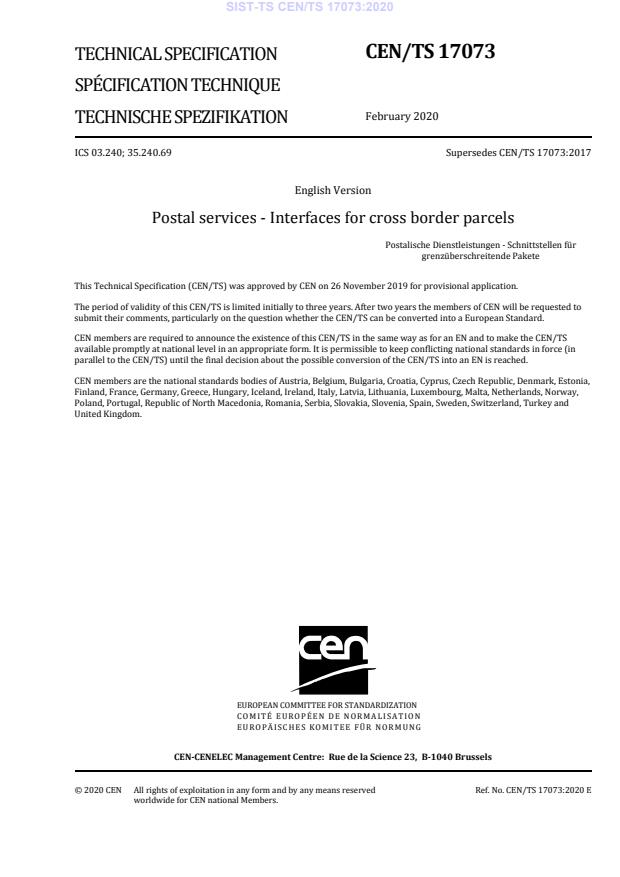
CEN/TS 17073
TECHNICAL SPECIFICATION
SPÉCIFICATION TECHNIQUE
February 2020
TECHNISCHE SPEZIFIKATION
ICS 03.240; 35.240.69 Supersedes CEN/TS 17073:2017
English Version
Postal services - Interfaces for cross border parcels
Postalische Dienstleistungen - Schnittstellen für
grenzüberschreitende Pakete
This Technical Specification (CEN/TS) was approved by CEN on 26 November 2019 for provisional application.
The period of validity of this CEN/TS is limited initially to three years. After two years the members of CEN will be requested to
submit their comments, particularly on the question whether the CEN/TS can be converted into a European Standard.
CEN members are required to announce the existence of this CEN/TS in the same way as for an EN and to make the CEN/TS
available promptly at national level in an appropriate form. It is permissible to keep conflicting national standards in force (in
parallel to the CEN/TS) until the final decision about the possible conversion of the CEN/TS into an EN is reached.
CEN members are the national standards bodies of Austria, Belgium, Bulgaria, Croatia, Cyprus, Czech Republic, Denmark, Estonia,
Finland, France, Germany, Greece, Hungary, Iceland, Ireland, Italy, Latvia, Lithuania, Luxembourg, Malta, Netherlands, Norway,
Poland, Portugal, Republic of North Macedonia, Romania, Serbia, Slovakia, Slovenia, Spain, Sweden, Switzerland, Turkey and
United Kingdom.
EUROPEAN COMMITTEE FOR STANDARDIZATION
COMITÉ EUROPÉEN DE NORMALISATION
EUROPÄISCHES KOMITEE FÜR NORMUNG
CEN-CENELEC Management Centre: Rue de la Science 23, B-1040 Brussels
© 2020 CEN All rights of exploitation in any form and by any means reserved Ref. No. CEN/TS 17073:2020 E
worldwide for CEN national Members.
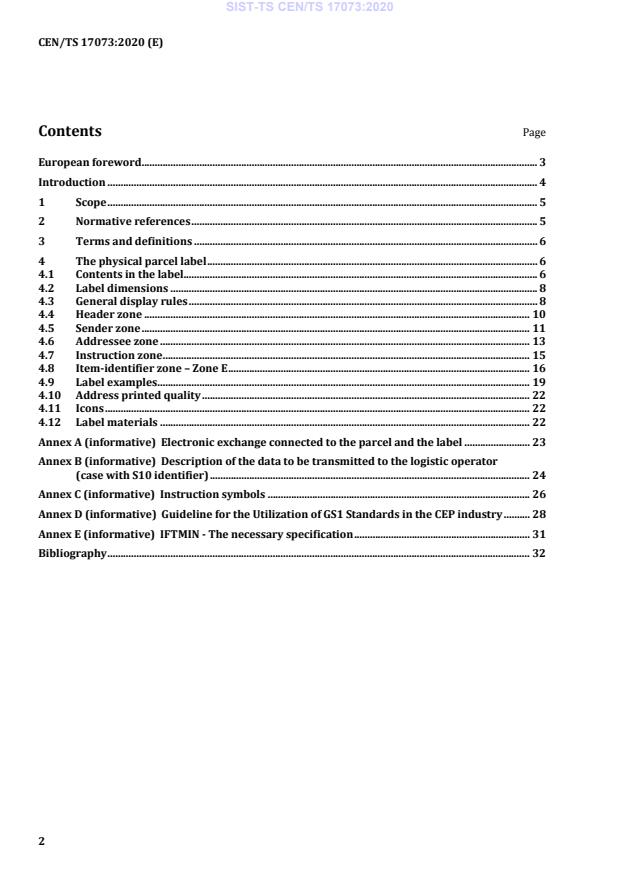
Contents Page
European foreword . 3
Introduction . 4
1 Scope . 5
2 Normative references . 5
3 Terms and definitions . 6
4 The physical parcel label . 6
4.1 Contents in the label. 6
4.2 Label dimensions . 8
4.3 General display rules . 8
4.4 Header zone . 10
4.5 Sender zone . 11
4.6 Addressee zone . 13
4.7 Instruction zone . 15
4.8 Item-identifier zone – Zone E . 16
4.9 Label examples . 19
4.10 Address printed quality . 22
4.11 Icons . 22
4.12 Label materials . 22
Annex A (informative) Electronic exchange connected to the parcel and the label . 23
Annex B (informative) Description of the data to be transmitted to the logistic operator
(case with S10 identifier) . 24
Annex C (informative) Instruction symbols . 26
Annex D (informative) Guideline for the Utilization of GS1 Standards in the CEP industry . 28
Annex E (informative) IFTMIN - The necessary specification . 31
Bibliography . 32
European foreword
This document (CEN/TS 17073:2020) has been prepared by Technical Committee CEN/TC 331 “Postal
services”, the secretariat of which is held by NEN.
Attention is drawn to the possibility that some of the elements of this document may be the subject of
patent rights. CEN shall not be held responsible for identifying any or all such patent rights.
This document supersedes CEN/TS 17073:2017.
In comparison with the previous edition, the most significant technical modifications are new
descriptions of the item identifier barcodes and their location in the item-identifier zone (Zone E).
Updates are also made for the layout, dimensions and content of the parcel label as well as new
requirements added for label materials. Informative Annex A has been removed since requirements for
addresses can be found in EN ISO 19160-4, and informative Annex E Data capture at source (EDI) has
been removed since it was considered out of scope.
According to the CEN/CENELEC Internal Regulations, the national standards organisations of the
following countries are bound to announce this Technical Specification: Austria, Belgium, Bulgaria,
Croatia, Cyprus, Czech Republic, Denmark, Estonia, Finland, France, Germany, Greece, Hungary, Iceland,
Ireland, Italy, Latvia, Lithuania, Luxembourg, Malta, Netherlands, Norway, Poland, Portugal, Republic of
North Macedonia, Romania, Serbia, Slovakia, Slovenia, Spain, Sweden, Switzerland, Turkey and the United
Kingdom.
Introduction
Using new communication and information technologies, postal operators move beyond what is
traditionally regarded their core postal business. They are meeting higher customer expectations,
expanding the range of products and value-added services and use electronic advanced data for
interconnecting global networks.
Standardized processes in operations and communication are the foundation for effective postal
operations. The Technical Committee CEN/TC 331 “Postal Services” maintains and develops a growing
number of standards to improve the exchange of Postal item related information between postal
operators. One of the leading aims is to promote the compatibility of CEN/TC331 standardization efforts
with those of the Universal Postal Union and its international initiatives and standardization undertaken
by the wider postal service stakeholders.
The European Commission has identified the completion of the Digital Single Market (DSM) as one of its
10 political priorities, which was adopted on the 6 May 2015, with 16 initiatives to be delivered by the
end of 2016.
The Digital Single Market Strategy is built on three pillars which the first goal is to improve the access for
consumers and businesses to digital goods and services across Europe, including e-commerce selling
channel. E-commerce has significant potential for contributing to economic growth and employment.
Through this Roadmap, the Commission aimed to ensure quick improvements in parcel delivery.
The Commission's Communication on e-commerce and online services identifies the delivery of goods
purchased online as one of the top five priorities to boost e-commerce and its importance has been
reiterated by the Council of the European Union and the European Parliament. Delivery is indeed critical
as it has a substantial impact on facilitating e-commerce trade and is a key element for building trust
between sellers and buyers.
Under the framework of the Union Work program for European standardization for 2015, requesting for
a focus on the cross border parcel services to emphasize the development of this market with a specific
focus on the small and medium size e-merchants by easing the use of cross border shipments by
simplifying the initial interface, improving the track and trace event management if different logistics
operators involved in the delivery chain, improving the integration with software solutions commonly
used by e-merchant.
In response to the ever-growing need for more effective and integrated cross-border e-commerce
solutions, designated Postal Operators in Europe have developed “E-Commerce Interconnect” using
proprietary specifications and standards, such as a UPU Standard, adopted in February 2016 on “Postal-
item label”.
E-commerce associations, courier-, express- and postal services in Europe came together to bridge
between proprietary specifications and non-for-profit solutions, already used by the wider European e-
commerce community for supply chain management, to standardize delivery chain management, so that
all (including the UPU designated operators representing the UPU member states) can use the same
standard.
1 Scope
This document will specify the interface between the e-merchant (any commercial customer sending
parcels) and the first logistic operator, including both public and private carriers. For the application of
this document, a cross border parcel is a parcel crossing a border into and within Europe.
The interface is composed of two items:
— the physical label attached on the parcel: contents, sizes, minimum requirements to guarantee the
quality and efficiency of the logistic process (sorting, delivery).
— the electronic exchanges between the sender and the logistic operator with the description of the
data to be provided, the format of the exchanges.
While designated operators of UPU have drawn up business requirements using proprietary standards
and related data components, online merchants have developed open, not-for-profit standards for final
delivery which are integrated into their existing supply chain management environment.
NOTE 1 The data element enables the growth of integrated, data-driven systems which support highly efficient
and customer-driven cross-border ecommerce. This reflects the current trend to B-to-B-to-C delivery solutions in
the European and international cross border e-commerce markets. Delivery from original source to final consumer
can be split over more than one service provider.
NOTE 2 C-to-B-to-B-to-C solutions will be an extension, in particular when returns are specified. The “first C”
would indicate that consumers wishing to return items, or induct items themselves, will be able to print labels
following the fundamentals specified in this standard.
E-merchants exchange data with logistic operators (i.e. the postal operators, but not limited to those
designated to fulfil the rights and obligations of UPU member countries) to help, simplify and enable the
consequential logistic and transactional tasks. The establishment of common definitions and electronic
formats safeguards the reliability and decreases the overall costs by avoiding software development
costs, multiple printing equipment, over-labelling during the process, and the manual sorting.
2 Normative references
The following documents, in whole or in part, are normatively referenced in this document and are
indispensable for its application. For dated references, only the edition cited applies. For undated
references, the latest edition of the referenced document (including any amendments) applies.
EN ISO 19160-4, Addressing - Part 4: International postal address components and template language (ISO
19160-4)
ISO/IEC 15459-1, Information technology — Automatic identification and data capture techniques —
Unique identification — Part 1: Individual transport units
ISO/IEC 15415, Information technology — Automatic identification and data capture techniques — Bar
code symbol print quality test specification — Two-dimensional symbols
EN ISO/IEC 15416, Information technology — Automatic identification and data capture techniques — Bar
code print quality test specification — Linear symbols (ISO/IEC 15416)
ISO 15394, Packaging — Bar code and two-dimensional symbols for shipping, transport and receiving labels
3 Terms and definitions
For the purposes of this document, the following terms and definitions apply.
ISO and IEC maintain terminological databases for use in standardization at the following addresses:
— IEC Electropedia: available at http://www.electropedia.org/
— ISO Online browsing platform: available at http://www.iso.org/obp
Note 1 to entry: UPU/designated operator specific terminology used in this document, are defined in the UPU
Standards glossary, in documents referred to in Normative References and in the Bibliography.
3.1
cross border parcel
parcel crossing a border into and within Europe
3.2
document
letter-post, parcel-post, express or courier item consisting of any piece of written, drawn, printed or
digital information, excluding objects of merchandise
3.3
good
letter-post, parcel-post, express or courier item consisting of any tangible and movable object other than
money, including objects of merchandise, which does not fall under the definition of “document”
3.4
parcel
postal item containing goods with or without commercial value, other than an item of correspondence,
with a weight not exceeding 31,5 kg
[SOURCE: Cross border parcel delivery services regulation (EU 2018/644)]
3.5
postal item
an item addressed in the final form in which it is to be carried by a postal service provider.
In addition to items of correspondence, such items also include for instance books, catalogues,
newspapers, periodicals and postal parcels containing merchandise with or without commercial value
[SOURCE: Postal Services Directive; Directive 97/67/EC amended by Directive 2002/39/EC and
Directive 2008/6/EC]
4 The physical parcel label
4.1 Contents in the label
Parcel labels include both fixed and variable data. Table 1 lists the contents in the label, a description of
the information, and whether the data are mandatory or conditional. Mandatory information is always
required. Conditional information should be supplied if it is available. The format of the content, i.e. its
length, is also given.
NOTE 1 Personal Data printed on the label is covered by the REGULATION (EU) 2016/679 OF THE EUROPEAN
PARLIAMENT AND OF THE COUNCIL of 27 April 2016 on the protection of natural persons with regard to the
processing of personal data and on the free movement of such data, and repealing Directive 95/46/EC (General
Data Protection Regulation or GDPR). This can require the prior consent of Data Subjects to the processing of their
personal data for the purpose of delivering the parcels.
NOTE 2 The format is to facilitate IT systems: an.26 means up to 26 alphanumeric characters (the leading dots
indicating a variable length); an13 means 13 alphanumeric characters, fixed length.
Table 1 — Contents in the label
Information Description Mandatory (M)/ Format
content Conditional (C)
Product identifier Name of the product or service offered by the first C an.26
operator to the customer
Postal service Name or logo of the agreement under which the C name:
item is processed and following which financial an.26
settlements are made between the sending
operator and the receiving operator
Origin operator Name or logo of the origin operator (sending postal, M name:
express, courier operator) that holds the contract an.35
with the customer who orders the shipment of
goods using a service offered by the origin operator
Service level Name or logo of the service level in accordance with C name:
indicator which the item shall be processed an.30
EXAMPLE priority; non-priority or other terms
as specified in a bi- or multi-lateral agreements,
service level agreements, etc. If there is a special
service level it should be stated.
Sender name Identification of the sender, specified using the data M see 4.5.7
elements defined in 4.5.7
Sender address The full address of the sender, including the M See 4.5.7
country specified using the data elements defined
in 4.5.7
Sender telephone Sender’s telephone number C an.35
number
Sender customer Sender’s customer account number, as defined and C an.17
account number registered by the origin operator.
Sender email Email address or addresses of the sender C See 4.5.6
address
Addressee name Identification of the addressee, specified using the M see 4.5.7
data elements defined in 4.5.7
Addressee address The full address of the addressee, including the M see 4.5.7
country, specified using the data elements defined
in 4.5.7
Addressee telephone Addressee’s telephone number C an.35
number
Addressee email Email address or addresses of the recipient C See 4.6.6
address
Information Description Mandatory (M)/ Format
content Conditional (C)
Instructions Applicable operational instructions, delivery C see
options and product features, represented with Annex B
logos as defined in Annex B
Item identifier Item identifier (ISO/IEC 15459 or UPU S10) a an.13
M
Unique identification of the item as defined by
ISO/IEC 15459-1 (the licence plate standard) or by
UPU S10.
Additional barcode Additional barcode as defined by e.g. proprietary C an.20
carrier coding for e.g. sorting and routing of parcels.
a
The UPU S10 Item identifier is mandatory for postal items within the UPU network, as specified in the UPU treaties
and conventions.
4.2 Label dimensions
All dimensions provided in this specification are in millimetres (mm).
The dimensions below correspond to a standard A6 label.
Table 2 — Size of the label
Parameter Value
Height 148 mm
Width 105 mm
NOTE The size described is a guidance. Companies can choose to use a larger size, however comply with the
general display rules.
The label shall not be larger than the parcel side to which it is affixed.
4.3 General display rules
4.3.1 Label text font
Apart from the header, all text included in the parcel label shall be presented using a single text font.
The following fonts shall be permitted: Lucida Console, Verdana, Courier New, FreeSans Gothic, Batang,
Monospace, and Helvetica.
1)
The preferred font is FreeSans . The font shall be normal (“roman” / “upright”) and not italic or inclined,
underlined, or written in white on a black background (inversed).
4.3.2 Colours
Apart from the header, all text, symbols and barcodes shall be printed using black ink on a white
background.
Other colours are permitted for the conditional (optional) data/information in the header section.
1)
FreeSans is an open outline font that can be freely downloaded from the Internet.
4.3.3 Label zones
The parcel label comprises five defined zones (from the top of the label to the bottom): A to E. Zones A, B,
C and E are divided into sub-zones (see Figure 1 below):
a) header zone (A0, A1, A2, A3);
b) sender zone (B0, B1, B2, B3);
c) addressee zone (C0, C1, C2);
d) instruction zone;
e) item identifier zone (E1, E2).
NOTE 1 Figure 1 is not to scale.
NOTE 2 The zone sizes are suggested as a guidance. Companies can choose to use a different and larger size,
however comply with the general display rules.
Figure 1 — Layout of parcel label
4.3.4 Zone contents
The table below lists the zones and sub-zones and indicates the information content represented in each
of them.
Table 3 — Zones and sub-zones and their information content
Zone Information content Mandatory (M)/
Conditional (C)
A0 Origin operator M
A1 Product identifier C
A2 Network identifier C
A3 Service level indicator C
B0 Sender name M
B1 Sender address M
B2 Sender telephone number C
B3 Sender customer account number and/or sender C
Email
C0 Addressee name M
C1 Addressee address M
C2 Addressee telephone number C
C3 Addressee Email C
D Instructions C
E1 Item identifier (ISO/IEC 15459 or UPU S10 SSCC) a, b, c
M
E2 Additional barcode as defined by e.g. proprietary b
C
carrier coding for e.g. sorting and routing of parcels.
a
An UPU Item identifier is mandatory for postal items within the UPU network, as specified in the
UPU treaties and conventions. In this case, no other barcode than the UPU identifier for the
identification of an item may be required (see § 4.8).
b
The positions of the item identifier and the additional carrier barcode may be inverted (i.e. the
item identifier printed in zone E2 and the carrier barcode printed in zone E1) depending on carrier
process and specific requirements (see § 4.8).
c Unique identification (SSCC) of the item is based on the company prefix of the shipper (GCP) as
defined by GS1.
4.4 Header zone
4.4.1 General
The header (zone A) shall be positioned at the top of the label and can contain information on the origin
operator (name or logo), product identifier, the service level applied, as well as an indication of the postal
network used to process the item.
4.4.2 Header dimensions – zone A
The dimensions of the header are listed in Table 4.
Table 4 — Header dimensions– zone A
Characteristic Value
Height Up to 25 mm
Width 105 mm
Position On top of the label, above the sender section (zone
B)
Line border thickness above and below 0,2 mm
4.5 Sender zone
4.5.1 General
The sender zone (zone B) shall be positioned below the header zone and shall contain information on the
sending party. The text “FROM” shall be displayed in capitals and oriented vertically. The address of the
sender shall be to the right of the text “FROM”. Addresses shall be submitted either as a set of meaningful
EN ISO 19160-4 components, or as a set of address lines, or as a combination of elements and lines.
4.5.2 Sender zone dimensions – zone B
The dimensions of the sender zone are listed in Table 5.
Table 5 — Sender zone dimensions - zone B
Characteristic Value
Height up to 30 mm
Width 105 mm
Position Below the header section (zone A)
Line border thickness above and below 0,2 mm
4.5.3 FROM indicator
Table 6 — FROM indicator
Characteristic Value
Orientation Vertical
Text font size 11 pt
Text specification Bold
Width 10 mm
Minimum space between text and line border 2,5 mm
4.5.4 Address of sender – zone B0 and B1
Table 7 — Zone B0 and B1
Characteristic Value
Width 95 mm
Address block The address shall be presented in block,
without any white lines
If optional lines are not used, white (blank)
lines shall not appear in the address block.
Addresses shall be represented following the
specifications at Annex A.
Minimum text font size 7 pt
Line border thickness 0,2 mm
Minimum space between text and borders 0,8 mm
4.5.5 Sender telephone number – zone B2
If available, the sender telephone number should be included in the sender zone, preceded by a
“telephone symbol” and positioned in the upper-right or bottom-right corner of the zone.
Table 8 — Sender telephone number - zone B2
Characteristic Value
Font size 7 pt
Telephone symbol
Telephone symbol dimensions 5 mm x 5 mm
Telephone number International telephone number represented in
accordance with ITU-T Recommendation E.123.
Example: +22 607 123 4567
Position Upper-right or bottom-right corner, aligned right.
(See also Table 9)
4.5.6 Customer account number and / or sender Email – zone B3
If available, the customer account number of the sender should be included below the sender telephone
number.
The sender e-mail address may also be provided in this zone. If both the customer account and e-mail
address are provided, the account is on the first line and the e-mail address on the second line. If multiple
e-mail addresses are provided, each is displayed on a new line. If an e-mail address is long, it may span
over several lines to ensure it does not overlap with the name or address. If it spans over several lines,
no special character (such as “-”) is used at the end of a line to indicate that information continues on the
next line.
The customer account number should be preceded by an explanatory text such as “account” or “Cust
Acct”.
Table 9 — Customer account number - zone B3
Characteristic Value
Font size 7 pt
Customer account The customer account number should be preceded
by an explanatory text such as “account”:.).
Email address Email address of the sender
Example: standards@cen.eu
Position Upper-right or bottom-right corner, below the
sender telephone number, aligned right
4.5.7 Requirements for rendering of addresses on item labels
Address
...
기사 제목: CEN/TS 17073:2020 - 우편 서비스 - 국경을 넘나드는 소포를 위한 인터페이스 기사 내용: 이 문서는 e-상인(소포를 보내는 상업 고객)와 첫 번째 물류 운영자 간의 인터페이스를 명시합니다. 이는 공공 및 사설 택배사를 포함합니다. 이 문서의 적용 대상은 유럽 내에서 국경을 넘나는 소포를 말합니다. 인터페이스는 두 가지 항목으로 구성됩니다: - 소포에 첨부된 물리적 라벨: 내용물, 크기, 물류 프로세스(정렬, 배달)의 품질과 효율을 보장하기 위한 최소 요구 사항. - 발송자와 물류 운영자 간의 전자 교환: 제공해야 하는 데이터와 교환 형식에 대한 설명. UPU의 지정한 운영자들은 프로프라이어터리 표준과 관련된 데이터 구성 요소를 사용하여 비즈니스 요구 사항을 작성했지만, 온라인 상인들은 기존 공급망 관리 환경에 통합된 비영리 표준을 개발했습니다. 이 문서의 목적은 소포를 보내는 상업 고객과 첫 번째 물류 운영자 간의 인터페이스를 구체화하는 것입니다. 이를 위해 다음 3 가지 요소를 통합하였습니다: - 물품 식별을 위한 소포에 첨부된 물리적 라벨 - 소포 발송에 관한 발송자와 물류 운영자 간의 전자 교환 - 각 배송 과정에서 필요한 데이터, 특히 최종 수신인에 대한 최종 배송을 위한 아이템별 식별자 사이의 교환을 용이하게 하기 위한 데이터. 노트 1: 마지막 요소는 통합된 데이터 기반 시스템을 지원하여 효율적이고 고객 중심의 국가 간 전자상거래를 촉진합니다. 이는 유럽과 국제 국경을 넘나는 전자상거래 시장에서 B-B-C 배송 솔루션에 대한 현재 추세를 반영합니다. 원본 소스에서 최종 소비자에게까지 배송이 여러 서비스 공급자를 거쳐 분할될 수 있습니다. 노트 2: 반환이 지정된 경우 C-B-B-C 솔루션을 확장합니다. "첫 번째 C"는 물품을 반환하거나 소포를 직접 발송하려는 소비자가 이 표준에서 지정된 기본 사항에 따라 라벨을 인쇄할 수 있음을 나타냅니다. e-상인은 물류 운영자(UPU 회원국의 의무 이행을 위해 지정된 것에 한정되지 않음)와 교환하여 물류 및 거래 작업을 돕고 단순화하는 데이터를 교환합니다. 일반적인 정의와 전자 형식을 확립함으로써 소프트웨어 개발 비용, 다양한 인쇄 장비, 과정 중의 초과 라벨링, 수동 정렬 등을 피함으로써 신뢰성을 보장하고 전체 비용을 감소시킵니다.
CEN/TS 17073:2020 is a document that specifies the interface between e-merchants (commercial customers sending parcels) and the first logistic operator for cross-border parcels in Europe. The interface consists of a physical label attached to the parcel and electronic exchanges between the sender and the logistic operator. The document aims to facilitate efficient and customer-driven cross-border e-commerce by providing standardized data exchanges and item identification. This standard can also support C-to-B-to-B-to-C solutions, including returns. By establishing common definitions and electronic formats, it reduces costs and improves reliability by eliminating the need for software development, multiple printing equipment, over-labeling, and manual sorting.
記事タイトル:CEN/TS 17073:2020 - 郵便サービス - 国境を越える小包のインターフェース 記事内容:この文書は、e-マーチャント(小包を送る商業顧客)と最初の物流オペレーターとのインターフェースを指定します。これには公共および民間の運送業者が含まれます。この文書の適用対象は、ヨーロッパ内で国境を越える小包を指します。 インターフェースは、以下の2つの要素で構成されています: - 小包に添付される物理ラベル:内容、サイズ、物流プロセス(仕分け、配送)の品質と効率を保証するための最低要件。 - 送信者と物流オペレーターとの間の電子的なやり取り:提供されるデータと交換の形式の説明。 UPUの指定オペレーターは、独自の標準と関連するデータコンポーネントを使用してビジネス要件を作成していますが、オンラインのマーチャントは既存のサプライチェーン管理環境に統合された非営利のオープンスタンダードを開発しています。 この文書は、小包を送る商業顧客と最初の物流オペレーターの間のインターフェースを具体化することを目的としています。これは以下の3つの要素を組み合わせて構成されています: - 小包に添付されるアイテムの識別情報のための物理的なラベル - 小包の発送に関する送信者と物流オペレーター間の電子的なやり取り - 特に最終的な配送先である受取人へのさまざまな配送チェーン部分で必要なデータを交換するためのデータ 注1:最後の要素は、高効率で顧客志向の国境を越える電子商取引をサポートする統合されたデータ駆動型システムの成長を可能にします。これは、ヨーロッパおよび国際的な国境を越える電子商取引市場でのB-B-C配送ソリューションへの現在のトレンドを反映しています。元のソースから最終消費者への配送は、複数のサービスプロバイダーを介して分割される場合があります。 注2:返品が指定されている場合、C-B-B-Cソリューションを拡張することができます。 "最初のC"は、アイテムを返品したり、アイテムを直接送信することを希望する消費者が、この規格で指定された基本事項に従ってラベルを印刷できることを示しています。 e-マーチャントは、物流オペレーター(UPU加盟国の権利と義務を果たすために指定されたものに限定されないが)とデータをやり取りし、物流およびトランザクションのタスクを支援し、簡素化します。共通の定義と電子的な形式を確立することで、ソフトウェア開発コスト、複数の印刷機器、プロセス中の過剰なラベリング、手作業による仕分けなどを排除し、信頼性を向上させ、全体的なコストを削減します。
Questions, Comments and Discussion
Ask us and Technical Secretary will try to provide an answer. You can facilitate discussion about the standard in here.
Loading comments...