

EN 15316-4-4:2017
(Main)Energy performance of buildings - Method for calculation of system energy requirements and system efficiencies - Part 4-4: Heat generation systems, building-integrated cogeneration systems, Module M8-3-4, M8-8-4, M8-11-4
- Abstract
This European standard defines a method for the performance assessment of building-integrated cogeneration units by the calculation of the electricity production, useful heat output and recoverable losses. Such units are commonly known as micro or small scale cogeneration, or micro or small scale CHP.
A building-integrated cogeneration, is a cogeneration unit installed to supply space heating, domestic hot water and possibly cooling within a building. It could operate as the only heating/cooling appliance of the building or in combination with other heat generators, such as boilers or electrical chillers. Unlike district heating systems, where heat and electricity are generated at central plants and transmitted through networks to a number of remote buildings, a building-integrated cogeneration unit produces useful heat for uses within the building. The electricity produced by the integrated cogeneration unit may be used within the building or may be exported.
This standard deals with heat generators for heating or for combined domestic hot water and heating services.
The calculation is based on the performance characteristics of the units, defined in product standards, and on operation conditions such the needed heat output.
Table 1 shows the relative position of this standard within the set of EPB standards in the context of the modular structure as set out in prEN ISO 52000 1.
NOTE 1 In prCEN ISO/TR 52000 2 the same table can be found, with, for each module, the numbers of the relevant EPB standards and accompanying technical reports that are published or in preparation.
NOTE 2 The modules represent EPB standards, although one EPB standard may cover more than one module and one module may be covered by more than one EPB standard, for instance a simplified and a detailed method respectively. See also Clause 2 and Tables A.1 and B.1.
- Status
- Published
- Publication Date
- 25-Apr-2017
- Withdrawal Date
- 30-Oct-2017
- Technical Committee
- CEN/TC 228 - Heating systems in buildings
- Current Stage
- 9060 - Closure of 2 Year Review Enquiry - Review Enquiry
- Start Date
- 02-Dec-2022
- Completion Date
- 02-Dec-2022

Overview
EN 15316-4-4:2017 is a CEN European standard for the energy performance of buildings focused on building‑integrated cogeneration systems (micro and small‑scale CHP / mCHP). It defines a method to calculate electricity production, useful heat output and recoverable losses for cogeneration units installed to supply space heating, domestic hot water (DHW) and potentially cooling within a single building. The standard is part of the modular EPB (Energy Performance of Buildings) set and covers Modules M8-3-4, M8-8-4, M8-11-4.
Key topics and requirements
- Performance assessment method: Calculation procedure to determine system energy requirements and system efficiencies for building‑integrated CHP based on product performance data and operating conditions.
- Outputs: Annual or time‑step based estimates of electricity produced, useful thermal output and recoverable thermal losses.
- Input data sources: Uses product standard characteristics (e.g., declared efficiencies) and building heat demand / load profiles to model operation.
- Calculation approach: Load‑profile based method with defined time steps and procedures to match CHP output to building heating and DHW needs.
- Scope of equipment: Applies to CHP appliances commonly called micro‑CHP, including fuel cell, internal combustion engine, Stirling, microturbine and ORC technologies (as described in the standard).
- Templates and defaults: Normative template in Annex A (mandatory choices) and informative default choices in Annex B facilitate consistent application and national adaptations.
- Quality assurance: Provisions for quality control and compliance checks to ensure reliable assessment and traceability.
- Regulatory use: Intended to support EPBD and EED implementation; regulators may set mandatory national choices or data sheets.
Applications and who uses it
- Energy assessors and consultants calculating building system energy performance.
- HVAC and CHP system designers performing sizing and integration studies.
- Manufacturers and product testers using declared product data for performance reporting.
- Building owners, facility managers and installers evaluating on‑site cogeneration feasibility and expected energy yields.
- Regulators and certification bodies adopting consistent methods for building energy codes and incentives.
Related standards
- EN 15316‑1 (General framework for system energy calculations)
- EN ISO 52000‑1 (Overarching EPB assessment)
- EN 50465 (Gas appliances - small CHP appliances)
- EN ISO 7345, ISO 3046‑1 (relevant definitions and engine test methods)
Keywords: EN 15316-4-4:2017, building-integrated cogeneration, micro CHP, energy performance of buildings, system energy requirements, system efficiencies, EPB standards, CEN.
Relations
- Effective Date
- 03-May-2017
- Effective Date
- 25-Aug-2026
- Effective Date
- 28-Jan-2026
- Effective Date
- 28-Jan-2026
- Effective Date
- 28-Jan-2026
- Effective Date
- 28-Jan-2026
- Effective Date
- 28-Jan-2026
- Effective Date
- 28-Jan-2026
- Effective Date
- 28-Jan-2026
- Effective Date
- 28-Jan-2026
- Effective Date
- 28-Jan-2026
- Effective Date
- 28-Jan-2026
Get Certified
Connect with accredited certification bodies for this standard

DIBt (Deutsches Institut für Bautechnik)
German Institute for Building Technology.
DIN CERTCO
DIN Group product certification.

Aboma Certification B.V.
Specialized in construction, metal, and transport sectors.
Sponsored listings
Frequently Asked Questions
EN 15316-4-4:2017 is a standard published by the European Committee for Standardization (CEN). Its full title is "Energy performance of buildings - Method for calculation of system energy requirements and system efficiencies - Part 4-4: Heat generation systems, building-integrated cogeneration systems, Module M8-3-4, M8-8-4, M8-11-4". This standard covers: This European standard defines a method for the performance assessment of building-integrated cogeneration units by the calculation of the electricity production, useful heat output and recoverable losses. Such units are commonly known as micro or small scale cogeneration, or micro or small scale CHP. A building-integrated cogeneration, is a cogeneration unit installed to supply space heating, domestic hot water and possibly cooling within a building. It could operate as the only heating/cooling appliance of the building or in combination with other heat generators, such as boilers or electrical chillers. Unlike district heating systems, where heat and electricity are generated at central plants and transmitted through networks to a number of remote buildings, a building-integrated cogeneration unit produces useful heat for uses within the building. The electricity produced by the integrated cogeneration unit may be used within the building or may be exported. This standard deals with heat generators for heating or for combined domestic hot water and heating services. The calculation is based on the performance characteristics of the units, defined in product standards, and on operation conditions such the needed heat output. Table 1 shows the relative position of this standard within the set of EPB standards in the context of the modular structure as set out in prEN ISO 52000 1. NOTE 1 In prCEN ISO/TR 52000 2 the same table can be found, with, for each module, the numbers of the relevant EPB standards and accompanying technical reports that are published or in preparation. NOTE 2 The modules represent EPB standards, although one EPB standard may cover more than one module and one module may be covered by more than one EPB standard, for instance a simplified and a detailed method respectively. See also Clause 2 and Tables A.1 and B.1.
This European standard defines a method for the performance assessment of building-integrated cogeneration units by the calculation of the electricity production, useful heat output and recoverable losses. Such units are commonly known as micro or small scale cogeneration, or micro or small scale CHP. A building-integrated cogeneration, is a cogeneration unit installed to supply space heating, domestic hot water and possibly cooling within a building. It could operate as the only heating/cooling appliance of the building or in combination with other heat generators, such as boilers or electrical chillers. Unlike district heating systems, where heat and electricity are generated at central plants and transmitted through networks to a number of remote buildings, a building-integrated cogeneration unit produces useful heat for uses within the building. The electricity produced by the integrated cogeneration unit may be used within the building or may be exported. This standard deals with heat generators for heating or for combined domestic hot water and heating services. The calculation is based on the performance characteristics of the units, defined in product standards, and on operation conditions such the needed heat output. Table 1 shows the relative position of this standard within the set of EPB standards in the context of the modular structure as set out in prEN ISO 52000 1. NOTE 1 In prCEN ISO/TR 52000 2 the same table can be found, with, for each module, the numbers of the relevant EPB standards and accompanying technical reports that are published or in preparation. NOTE 2 The modules represent EPB standards, although one EPB standard may cover more than one module and one module may be covered by more than one EPB standard, for instance a simplified and a detailed method respectively. See also Clause 2 and Tables A.1 and B.1.
EN 15316-4-4:2017 is classified under the following ICS (International Classification for Standards) categories: 91.140.10 - Central heating systems. The ICS classification helps identify the subject area and facilitates finding related standards.
EN 15316-4-4:2017 has the following relationships with other standards: It is inter standard links to EN 15316-4-4:2007, ISO 3046-1:2002, EN ISO 52000-1:2017, EN 16054:2012, EN 15316-1:2017, EN ISO 7345:2018, CEN/TR 15316-6-7:2017, CEN/TR 15232-2:2016, EN 15232-1:2017, EN 16947-1:2017, EN 15232:2012, EN 15603:2008. Understanding these relationships helps ensure you are using the most current and applicable version of the standard.
EN 15316-4-4:2017 is associated with the following European legislation: EU Directives/Regulations: 2010/31/EU; Standardization Mandates: M/480. When a standard is cited in the Official Journal of the European Union, products manufactured in conformity with it benefit from a presumption of conformity with the essential requirements of the corresponding EU directive or regulation.
EN 15316-4-4:2017 is available in PDF format for immediate download after purchase. The document can be added to your cart and obtained through the secure checkout process. Digital delivery ensures instant access to the complete standard document.
Standards Content (Sample)
2003-01.Slovenski inštitut za standardizacijo. Razmnoževanje celote ali delov tega standarda ni dovoljeno.Energetische Bewertung von Gebäuden - Verfahren zur Berechnung der Energieanforderungen und Nutzungsgrade der Anlagen - Teil 4-4: Wärmeerzeugungssysteme, gebäudeintegrierte KWK-Anlagen, Modul M8-3-4, M8-8-4, M8-11-4Performance énergétique des bâtiments - Méthode de calcul des besoins énergétiques et des rendements des systèmes - Partie 4-4 : Systèmes de génération de chaleur, systèmes de cogénération intégrés au bâtiment, Module M8-3-4, M8-8-4, M8-11-4Energy performance of buildings - Method for calculation of system energy requirements and system efficiencies - Part 4-4: Heat generation systems, building-integrated cogeneration systems, Module M8-3-4, M8-8-4, M8-11-491.140.10Sistemi centralnega ogrevanjaCentral heating systemsICS:Ta slovenski standard je istoveten z:EN 15316-4-4:2017SIST EN 15316-4-4:2018en,fr,de01-maj-2018SIST EN 15316-4-4:2018SLOVENSKI
STANDARDSIST EN 15316-4-4:20071DGRPHãþD
EUROPEAN STANDARD NORME EUROPÉENNE EUROPÄISCHE NORM
EN 15316-4-4
April
t r s y ICS
{ sä s v rä s r Supersedes EN
s w u s xæ væ vã t r r yEnglish Version
Energy performance of buildings æ Method for calculation of system energy requirements and system efficiencies æ Part
væ vã Heat generation systemsá buildingæintegrated cogeneration systemsá Module M zæ uæ vá M zæ zæ vá M zæ s sæ v Performance énergétique des bâtiments æ Méthode de calcul des besoins énergétiques et des rendements des systèmes æ Partie
væ v ã Systèmes de génération de chaleurá systèmes de cogénération intégrés au bâtimentá Module M zæ uæ vá M zæ zæ vá M zæ s sæ v
Energetische Bewertung von Gebäuden æ Verfahren zur Berechnung der Energieanforderungen und Nutzungsgrade der Anlagen æ Teil
væ vã Wärmeerzeugungssystemeá gebäudeintegrierte KWKæAnlagená Modul M zæ uæ vá M zæ zæ vá M zæ s sæ v This European Standard was approved by CEN on
t y February
t r s yä
egulations which stipulate the conditions for giving this European Standard the status of a national standard without any alterationä Upætoædate lists and bibliographical references concerning such national standards may be obtained on application to the CENæCENELEC Management Centre or to any CEN memberä
translation under the responsibility of a CEN member into its own language and notified to the CENæCENELEC Management Centre has the same status as the official versionsä
CEN members are the national standards bodies of Austriaá Belgiumá Bulgariaá Croatiaá Cyprusá Czech Republicá Denmarká Estoniaá Finlandá Former Yugoslav Republic of Macedoniaá Franceá Germanyá Greeceá Hungaryá Icelandá Irelandá Italyá Latviaá Lithuaniaá Luxembourgá Maltaá Netherlandsá Norwayá Polandá Portugalá Romaniaá Serbiaá Slovakiaá Sloveniaá Spainá Swedená Switzerlandá Turkey and United Kingdomä
EUROPEAN COMMITTEE FOR STANDARDIZATION COMITÉ EUROPÉEN DE NORMALISATION EUROPÄISCHES KOMITEE FÜR NORMUNG
CEN-CENELEC Management Centre:
Avenue Marnix 17,
B-1000 Brussels
t r s y CEN All rights of exploitation in any form and by any means reserved worldwide for CEN national Membersä Refä Noä EN
s w u s xæ væ vã t r s y ESIST EN 15316-4-4:2018
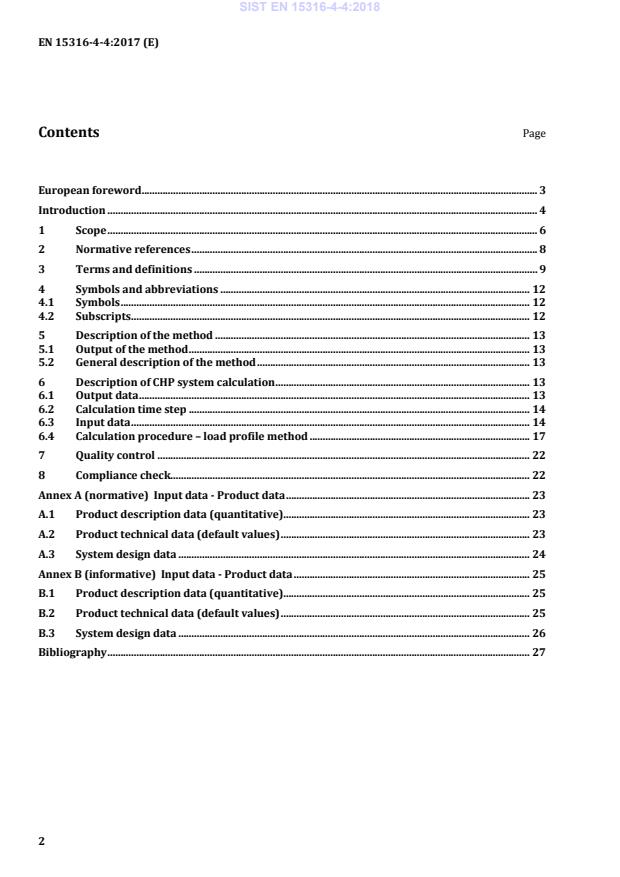
European foreword . 3 Introduction . 4 1 Scope . 6 2 Normative references . 8 3 Terms and definitions . 9 4 Symbols and abbreviations . 12 4.1 Symbols . 12 4.2 Subscripts . 12 5 Description of the method . 13 5.1 Output of the method . 13 5.2 General description of the method . 13 6 Description of CHP system calculation . 13 6.1 Output data . 13 6.2 Calculation time step . 14 6.3 Input data . 14 6.4 Calculation procedure – load profile method . 17 7 Quality control . 22 8 Compliance check. 22 Annex A (normative)
Input data - Product data . 23 A.1 Product description data (quantitative). 23 A.2 Product technical data (default values) . 23 A.3 System design data . 24 Annex B (informative)
Input data - Product data . 25 B.1 Product description data (quantitative). 25 B.2 Product technical data (default values) . 25 B.3 System design data . 26 Bibliography . 27
— the individual user will apply the standard to assess the energy performance of a building, and thereby use the choices made by the regulators. Topics addressed in this standard can be subject to public regulation. Public regulation on the same topics can override the default values in Annex B of this standard. Public regulation on the same topics can even, for certain applications, override the use of this standard. Legal requirements and choices are in general not published in standards but in legal documents. In order to avoid double publications and difficult updating of double documents, a national annex may refer to the legal texts where national choices have been made by public authorities. Different national annexes or national data sheets are possible, for different applications.
1 Directive 2010/31/EU of the European Parliament and of the Council of 19 May 2010 on the energy performance of buildings (recast). 2 Directive 2012/27/EU of the European Parliament and of the Council of 25 October 2012 on energy efficiency. SIST EN 15316-4-4:2018
shows the relative position of this standard within the set of EPB standards in the context of the modular structure as set out in EN ISO 52000-1. NOTE 1 In CEN ISO/TR 52000-2 the same table can be found, with, for each module, the numbers of the relevant EPB standards and accompanying technical reports that are published or in preparation. NOTE 2 The modules represent EPB standards, although one EPB standard may cover more than one module and one module may be covered by more than one EPB standard, for instance a simplified and a detailed method respectively. See also Clause 2 and Tables A.1 and B.1. SIST EN 15316-4-4:2018
Building (as such) Technical Building Systems
Descriptions
Descriptions
Descriptions Heating Cooling Ventilation Humidification Dehumidification Domestic Hot water Lighting Building automation and control Electricity production sub1
M1 sub1 M2 sub1
M3 M4 M5 M6 M7 M8 M9 M10 M11 1 General
1 General 1 General 15316–1
15316–1
2 Common terms and definitions; symbols, units and subscripts
2 Building Energy Needs 2 Needs
12831–3 ?
3 Applications
3 (Free) Indoor Conditions without
Systems 3 Maximum Load and Power 12831–1
12831–3
4 Ways to Express Energy Performance
4 Ways to Express Energy Performance 4 Ways to Express Energy Performance 15316–1
15316–1
5 Building Functions and Building Boundaries
5 Heat Transfer by Transmission 5 Emission and control 15316–2 15316–2
6 Building Occupancy and Operating Conditions
6 Heat Transfer by Infiltration and Ventilation 6 Distribution and control 15316–3 15316–3
15316–3
7 Aggregation of Energy Services and Energy Carriers
7 Internal Heat Gains 7 Storage and control 15316–5
15316–5 15316–4-3
8 Building Partitioning
8 Solar Heat Gains 8 Generation
8–1 Combustion boilers 15316–4-1
15316–4-1
8–2 Heat pumps 15316–4-2 15316–4-2
15316–4-2
8–3 Thermal solar Photovoltaics 15316–4-3
15316–4-3
15316–4-3
8–4 On-site cogeneration 15316–4-4
15316–4-4
15316–4-4
8–5 District heating and cooling 15316–4-5 15316–4-5
15316–4-5
8–6 Direct electrical heater 15316–4-9
15316–4-9
8–7 Wind turbines
15316–4-10
8–8 Radiant heating, stoves 15316–4-8
9 Calculated Energy Performance
9 Building Dynamics (thermal mass) 9 Load dispatching and operating conditions 15316–1
10 Measured Energy Performance
10 Measured Energy Performance 10 Measured Energy Performance 15378–3
15378–3
11 Inspection
11 Inspection 11 Inspection 15378–1
15378–1
12 Ways to Express Indoor Comfort
12 – 12 BMS
13 External Environment Conditions
14 Economic Calculation 15459–1
NOTE The shaded modules are not applicable. SIST EN 15316-4-4:2018
...