

EN 15632-2:2010
(Main)District heating pipes - Pre-insulated flexible pipe systems - Part 2: Bonded plastic service pipes - Requirements and test methods
General Information
- Abstract
This European Standard provides requirements and test methods for flexible, pre-insulated, directly buried heating pipes with plastics service pipes and bonding between the layers of the pipes.
This European Standard is valid for maximum operating temperatures of 95 °C and maximum operating pressures up to 10 bar for a design lifetime of at least 30 years.
This European Standard does not cover surveillance systems.
NOTE For higher temperatures or for the transport of other fluids, for example potable water, additional requirements and testing is needed. Such requirements are not specified in this European Standard.
- Status
- Withdrawn
- Publication Date
- 02-Feb-2010
- Withdrawal Date
- 29-Sep-2026
- Technical Committee
- CEN/TC 107 - Pre-fabricated district heating pipe systems
- Drafting Committee
- CEN/TC 107/WG 10 - Flexible pipe systems for district heating
- Current Stage
- 9960 - Withdrawal effective - Withdrawal
- Start Date
- 17-Dec-2014
- Completion Date
- 30-Sep-2026



Relations
- Effective Date
- 22-Oct-2014
- Effective Date
- 25-Aug-2026
- Effective Date
- 09-Feb-2026
- Effective Date
- 28-Jan-2026
- Effective Date
- 28-Jan-2026
- Effective Date
- 28-Jan-2026
- Effective Date
- 28-Jan-2026
- Effective Date
- 28-Jan-2026
- Effective Date
- 28-Jan-2026
- Effective Date
- 28-Jan-2026
- Effective Date
- 28-Jan-2026
- Effective Date
- 28-Jan-2026
- Effective Date
- 28-Jan-2026
- Effective Date
- 28-Jan-2026
- Effective Date
- 28-Jan-2026
Get Certified
Connect with accredited certification bodies for this standard

Institut za varilstvo d.o.o. (Welding Institute)
Slovenia's leading welding institute since 1952. ISO 3834, EN 1090, pressure equipment certification, NDT personnel, welder qualification. Only IIW Au
Sponsored listings
Frequently Asked Questions
EN 15632-2:2010 is a standard published by the European Committee for Standardization (CEN). Its full title is "District heating pipes - Pre-insulated flexible pipe systems - Part 2: Bonded plastic service pipes - Requirements and test methods". This standard covers: This European Standard provides requirements and test methods for flexible, pre-insulated, directly buried heating pipes with plastics service pipes and bonding between the layers of the pipes. This European Standard is valid for maximum operating temperatures of 95 °C and maximum operating pressures up to 10 bar for a design lifetime of at least 30 years. This European Standard does not cover surveillance systems. NOTE For higher temperatures or for the transport of other fluids, for example potable water, additional requirements and testing is needed. Such requirements are not specified in this European Standard.
This European Standard provides requirements and test methods for flexible, pre-insulated, directly buried heating pipes with plastics service pipes and bonding between the layers of the pipes. This European Standard is valid for maximum operating temperatures of 95 °C and maximum operating pressures up to 10 bar for a design lifetime of at least 30 years. This European Standard does not cover surveillance systems. NOTE For higher temperatures or for the transport of other fluids, for example potable water, additional requirements and testing is needed. Such requirements are not specified in this European Standard.
EN 15632-2:2010 is classified under the following ICS (International Classification for Standards) categories: 23.040.01 - Pipeline components and pipelines in general; 23.040.07 - Pipeline and its parts for district heat. The ICS classification helps identify the subject area and facilitates finding related standards.
EN 15632-2:2010 has the following relationships with other standards: It is inter standard links to EN 15632-2:2010+A1:2014, ISO 10147:2004, ISO 17455:2005, EN ISO 21003-2:2008, EN ISO 15875-3:2025, EN ISO 15876-3:2017, EN ISO 15876-5:2017, EN 13501-3:2005+A1:2009, EN ISO 15875-5:2003, EN ISO 15876-2:2017, EN ISO 15876-1:2017, EN ISO 15875-1:2025, EN 15632-1:2009, EN ISO 15875-2:2003, EN 15632-3:2010. Understanding these relationships helps ensure you are using the most current and applicable version of the standard.
EN 15632-2:2010 is available in PDF format for immediate download after purchase. The document can be added to your cart and obtained through the secure checkout process. Digital delivery ensures instant access to the complete standard document.
Standards Content (Sample)
2003-01.Slovenski inštitut za standardizacijo. Razmnoževanje celote ali delov tega standarda ni dovoljeno.Cevi za daljinsko ogrevanje - Izolirani gibki cevni sistemi - 2. del: Vezani cevni sistemi iz polimernih materialov - Zahteve in preskusne metodeFernwärmerohre - Werkmäßig gedämmte flexible Rohrsysteme - Teil 2: Verbundrohrsysteme mit Mediumrohren aus Kunststoff - Anforderungen und PrüfungenTuyaux de chauffage urbain - Systèmes de tuyaux flexibles préisolés - Partie 2: Système bloqué avec tube de service en plastique - Prescriptions et méthodes d'essaiDistrict heating pipes - Pre-insulated flexible pipe systems - Part 2: Bonded plastic service pipes - Requirements and test methods91.140.10Sistemi centralnega ogrevanjaCentral heating systems23.040.20Cevi iz polimernih materialovPlastics pipesICS:Ta slovenski standard je istoveten z:EN 15632-2:2010SIST EN 15632-2:2010en,fr01-april-2010SIST EN 15632-2:2010SLOVENSKI
STANDARD
EUROPEAN STANDARD NORME EUROPÉENNE EUROPÄISCHE NORM
EN 15632-2
February 2010 ICS 23.040.01 English Version
District heating pipes - Pre-insulated flexible pipe systems - Part 2: Bonded plastic service pipes - Requirements and test methods
Tuyaux de chauffage urbain -Systèmes de tuyaux flexibles préisolés - Partie 2: Système bloqué avec tube de service en plastique - Prescriptions et méthodes d'essai
Fernwärmerohre - Werkmäßig gedämmte flexible Rohrsysteme - Teil 2: Verbundrohrsysteme mit Mediumrohren aus Kunststoff - Anforderungen und Prüfungen This European Standard was approved by CEN on 10 December 2009.
CEN members are bound to comply with the CEN/CENELEC Internal Regulations which stipulate the conditions for giving this European Standard the status of a national standard without any alteration. Up-to-date lists and bibliographical references concerning such national standards may be obtained on application to the CEN Management Centre or to any CEN member.
This European Standard exists in three official versions (English, French, German). A version in any other language made by translation under the responsibility of a CEN member into its own language and notified to the CEN Management Centre has the same status as the official versions.
CEN members are the national standards bodies of Austria, Belgium, Bulgaria, Croatia, Cyprus, Czech Republic, Denmark, Estonia, Finland, France, Germany, Greece, Hungary, Iceland, Ireland, Italy, Latvia, Lithuania, Luxembourg, Malta, Netherlands, Norway, Poland, Portugal, Romania, Slovakia, Slovenia, Spain, Sweden, Switzerland and United Kingdom.
EUROPEAN COMMITTEE FOR STANDARDIZATION
COMITÉ EUROPÉEN DE NORMALISATION EUROPÄISCHES KOMITEE FÜR NORMUNG
Management Centre:
Avenue Marnix 17,
B-1000 Brussels © 2010 CEN All rights of exploitation in any form and by any means reserved worldwide for CEN national Members. Ref. No. EN 15632-2:2010: ESIST EN 15632-2:2010
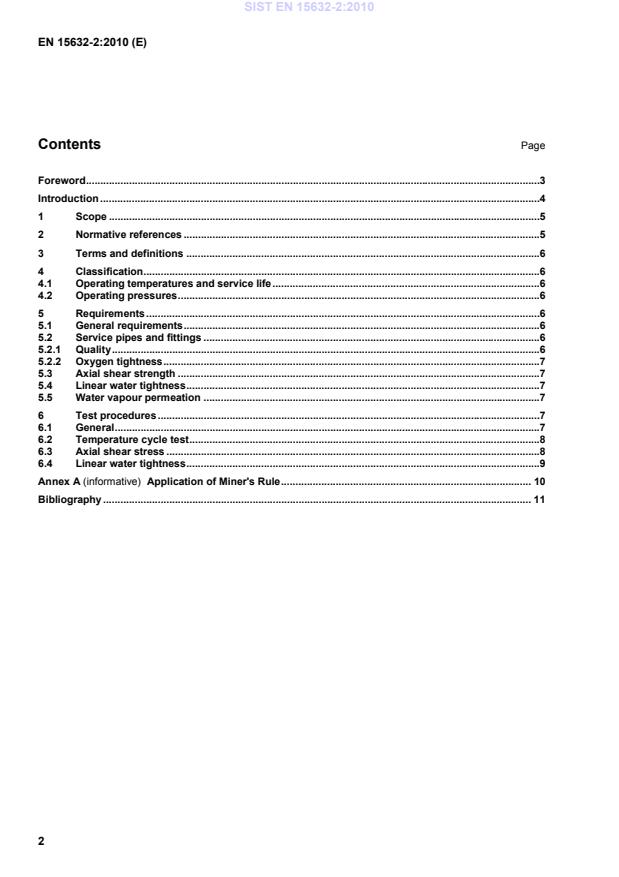
Application of Miner's Rule . 10Bibliography . 11 SIST EN 15632-2:2010
1 Scope This European Standard provides requirements and test methods for flexible, pre-insulated, directly buried heating pipes with plastics service pipes and bonding between the layers of the pipes. This European Standard is valid for maximum operating temperatures of 95 °C and maximum operating pressures up to 10 bar for a design lifetime of at least 30 years. This European Standard does not cover surveillance systems. NOTE For higher temperatures or for the transport of other fluids, for example potable water, additional requirements and testing is needed. Such requirements are not specified in this European Standard. 2 Normative references The following referenced documents are indispensable for the application of this document. For dated references, only the edition cited applies. For undated references, the latest edition of the referenced document (including any amendments) applies. EN 15632-1:2009, District heating pipes – Pre-insulated flexible pipe systems – Part 1: Classification, general requirements and test methods EN I
...