

EN 1015-17:2000
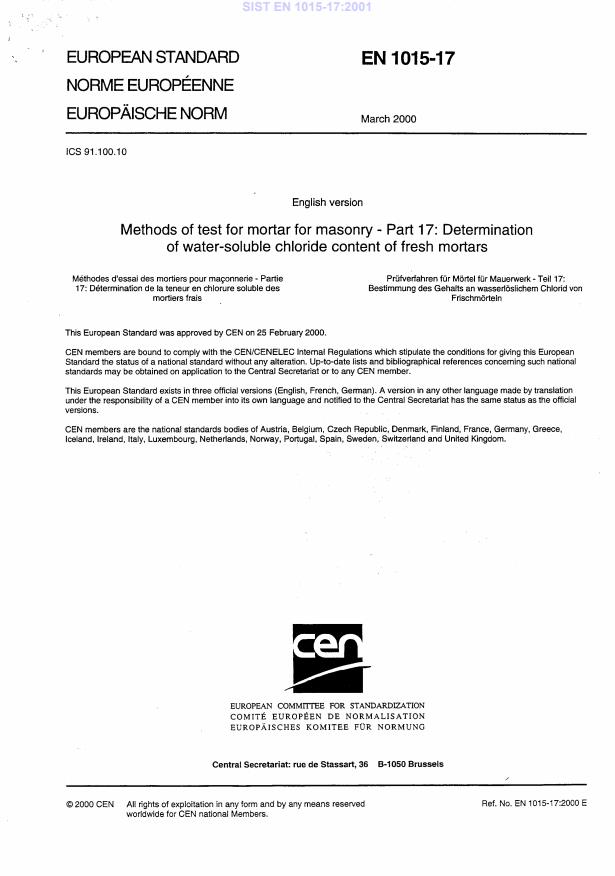
(Main)Methods of test for mortar for masonry - Part 17: Determination of water-soluble chloride content of fresh mortars
- Abstract
This European Standard specifies a method for determining the water-soluble chloride content of fresh mortars.
- Status
- Published
- Publication Date
- 21-Mar-2000
- Technical Committee
- CEN/TC 125 - Masonry
- Drafting Committee
- CEN/TC 125/WG 4 - Test methods
- Current Stage
- 9093 - Decision to confirm - Review Enquiry
- Start Date
- 23-Jan-2025
- Completion Date
- 14-Oct-2026

Overview
EN 1015-17:2000 is a European Standard published by CEN that specifies a method for the determination of water-soluble chloride content of fresh mortars for masonry. The standard applies to fresh mortar samples and provides a harmonized approach for assessing chloride levels that can affect masonry durability and long-term performance. It is classified under ICS 91.100.10 (Cement. Gypsum. Lime. Mortar).
Key Topics
This part of the EN 1015 series focuses on technical requirements and procedures related to chloride measurement in fresh masonry mortars. Key topics include:
- Scope and applicability - defines that the method is for fresh (unhardened) mortars destined for masonry use.
- Sampling and sample preparation - principles for representative sampling of fresh mortar batches (importance of minimizing contamination and preserving sample integrity).
- Determination principle - a laboratory method for quantifying the amount of water-soluble chloride present in the fresh mortar.
- Expression of results - how chloride content is to be reported (typical reporting in mass or concentration terms, and indication of sample condition and units).
- Quality and reporting requirements - documentation of test conditions, sample identification, and conformity with the test method to ensure reproducibility and traceability.
- Terminology and definitions - clarifies terms such as “water-soluble chloride” and “fresh mortar” to ensure consistent interpretation.
(Note: EN 1015-17:2000 specifies the method but does not itself set chloride limit values for design or acceptance.)
Applications
EN 1015-17:2000 is practical for stakeholders who need consistent, comparable measurements of chloride content in fresh mortars:
- Mortar manufacturers - quality control to monitor chloride levels in production batches.
- Testing laboratories - standardized method for routine analytical testing and verification.
- Construction contractors and site QC teams - pre-installation checks to prevent chloride-induced problems in masonry.
- Specifiers, architects, and structural engineers - ensuring materials meet project durability requirements and avoid corrosion risks for embedded metal.
- Regulatory and conformity assessment bodies - reference method for compliance testing and certification.
Related Standards
- EN 1015 series (methods of test for mortar for masonry) - other parts address sampling, mixing, and mechanical tests.
- Standards on chloride limits for concrete/masonry may be referenced by designers and regulators when interpreting results.
Keywords: EN 1015-17:2000, water-soluble chloride, fresh mortars, mortar test method, masonry durability, CEN, chloride content testing.
Relations
- Refers
ISO 384:1978 - Laboratory glassware — Principles of design and construction of volumetric glassware - Effective Date
- 25-Aug-2026
- Effective Date
- 28-Jan-2026
- Effective Date
- 28-Jan-2026
- Effective Date
- 28-Jan-2026
- Refers
EN 998-1:2016 - Specification for mortar for masonry - Part 1: Rendering and plastering mortar - Effective Date
- 28-Jan-2026
- Effective Date
- 28-Jan-2026
- Effective Date
- 28-Jan-2026
- Effective Date
- 28-Jan-2026
- Effective Date
- 28-Jan-2026
- Effective Date
- 28-Jan-2026
- Effective Date
- 28-Jan-2026
- Effective Date
- 22-Dec-2008
Get Certified
Connect with accredited certification bodies for this standard

DIBt (Deutsches Institut für Bautechnik)
German Institute for Building Technology.
DIN CERTCO
DIN Group product certification.

Aboma Certification B.V.
Specialized in construction, metal, and transport sectors.
Sponsored listings
Frequently Asked Questions
EN 1015-17:2000 is a standard published by the European Committee for Standardization (CEN). Its full title is "Methods of test for mortar for masonry - Part 17: Determination of water-soluble chloride content of fresh mortars". This standard covers: This European Standard specifies a method for determining the water-soluble chloride content of fresh mortars.
This European Standard specifies a method for determining the water-soluble chloride content of fresh mortars.
EN 1015-17:2000 is classified under the following ICS (International Classification for Standards) categories: 91.100.10 - Cement. Gypsum. Lime. Mortar. The ICS classification helps identify the subject area and facilitates finding related standards.
EN 1015-17:2000 has the following relationships with other standards: It is inter standard links to ISO 384:1978, EN 1015-2:1998, EN 1015-3:1999, EN 14392:2007, EN 998-1:2016, EN 998-2:2010, EN 998-2:2016, EN 1504-6:2006, EN 1504-3:2005, EN 1996-2:2024, EN 1996-2:2006, EN 1015-17:2000/A1:2004. Understanding these relationships helps ensure you are using the most current and applicable version of the standard.
EN 1015-17:2000 is associated with the following European legislation: EU Directives/Regulations: 305/2011, 89/106/EEC; Standardization Mandates: M/116, M/128. When a standard is cited in the Official Journal of the European Union, products manufactured in conformity with it benefit from a presumption of conformity with the essential requirements of the corresponding EU directive or regulation.
EN 1015-17:2000 is available in PDF format for immediate download after purchase. The document can be added to your cart and obtained through the secure checkout process. Digital delivery ensures instant access to the complete standard document.
Standards Content (Sample)
2003-01.Slovenski inštitut za standardizacijo. Razmnoževanje celote ali delov tega standarda ni dovoljeno.Prüfverfahren für Mörtel für Mauerwerk - Teil 17: Bestimmung des Gehalts an wasserlöslichem Chlorid von FrischmörtelnMéthodes d'essai des mortiers pour maçonnerie - Partie 17: Détermination de la teneur en chlorure soluble des mortiers fraisMethods of test for mortar for masonry - Part 17: Determination of water-soluble chloride content of fresh mort
...