


EN ISO 3262-15:2023
(Main)Extenders - Specifications and methods of test - Part 15: Vitreous silica (ISO 3262-15:2023)
Extenders - Specifications and methods of test - Part 15: Vitreous silica (ISO 3262-15:2023)
This document specifies requirements and corresponding methods of test for vitreous silica.
Füllstoffe - Anforderungen und Prüfverfahren - Teil 15: Kieselglasmehl (ISO 3262-15:2023)
Dieses Dokument legt Anforderungen und die entsprechenden Prüfverfahren für Kieselglasmehl fest.
Matières de charge - Spécifications et méthodes d’essai - Partie 15: Silice vitreuse (ISO 3262-15:2023)
Le présent document spécifie les exigences relatives à la silice vitreuse ainsi que les méthodes d’essai correspondantes.
Polnila - Specifikacije in preskusne metode - 15. del: Kremenovo steklo (ISO 3262-15:2023)
Ta del standarda ISO 3262 določa zahteve in ustrezne preskusne metode za kremenovo steklo.
General Information
- Status
- Published
- Publication Date
- 06-Jun-2023
- Technical Committee
- CEN/TC 298 - Pigments and extenders
- Drafting Committee
- CEN/TC 298 - Pigments and extenders
- Current Stage
- 6060 - Definitive text made available (DAV) - Publishing
- Start Date
- 07-Jun-2023
- Completion Date
- 07-Jun-2023
Relations
- Effective Date
- 18-Jan-2023
- Effective Date
- 09-Feb-2026
- Effective Date
- 09-Feb-2026
- Effective Date
- 09-Feb-2026
- Effective Date
- 09-Feb-2026
- Effective Date
- 28-Jan-2026
- Effective Date
- 28-Jan-2026
- Effective Date
- 28-Jan-2026
- Effective Date
- 28-Jan-2026
- Effective Date
- 28-Jan-2026
- Effective Date
- 28-Jan-2026
- Consolidated By
ISO 3262-15:2023 - Extenders — Specifications and methods of test — Part 15: Vitreous silica - Effective Date
- 12-Feb-2026
Overview
EN ISO 3262-15:2023 – Extenders – Specifications and Methods of Test – Part 15: Vitreous Silica is an international standard developed by CEN and ISO for specifying the requirements and testing methods for vitreous silica used as an extender. Vitreous silica, a non-crystalline form of silica, is widely used in industrial applications, particularly as a functional filler in paints, varnishes, plastics, and related materials. This standard ensures consistency in quality and performance by defining properties, test procedures, and compliance benchmarks for both main grades of vitreous silica: quartz glass and fused silica.
Key Topics
- Grades of Vitreous Silica: The standard distinguishes between two grades:
- Grade A (quartz glass): Transparent, typically made from molten rock crystal.
- Grade B (fused silica): Opaque, produced from molten silica sand with inherent gas bubbles.
- Essential Requirements: Specifies minimum and maximum content limits for key constituents such as silica, quartz, cristobalite, volatile matter, and matter soluble in water.
- Testing Methods: Provides detailed testing protocols for:
- Silica content determination
- Quartz and cristobalite content (using X-ray diffraction)
- Volatile matter and loss on ignition
- Water solubility and pH value
- Particle size distribution and residue analysis
- Oil absorption and resistivity of aqueous extracts
- Sampling: Outlines methodologies for collecting representative samples as per ISO 15528.
- Reporting: Specifies elements to be included in test reports, ensuring traceability and compliance.
Applications
Vitreous silica tested and specified according to EN ISO 3262-15 is particularly valued for its stability, chemical purity, and functional properties as an extender or filler. Common applications include:
- Paints and coatings: Used to enhance durability, control rheology, and improve optical properties.
- Plastics and polymers: Acts as a reinforcing filler, improving mechanical strength and thermal stability.
- Industrial ceramics and refractories: Applied where high purity and resistance to thermal shock are essential.
- Adhesives and sealants: Enhances viscosity and bond strength.
- Electronics and optics: Utilized in high-performance components for its low thermal expansion and high transparency (particularly Grade A).
Adherence to this standard assures manufacturers, suppliers, and users that vitreous silica meets internationally recognized criteria for composition, performance, and reliability.
Related Standards
EN ISO 3262-15:2023 references and is used in conjunction with several other international standards relevant to pigments and extenders, including:
- ISO 787 Series: General methods of test for pigments and extenders (various parts for determining volatile matter, solubility, oil absorption, pH, resistivity, etc.)
- ISO 3262-1: Introduction and general test methods for extenders
- ISO 8130-13: Particle size analysis by laser diffraction for coating powders
- ISO 15528: Sampling procedures for paints, varnishes, and raw materials
- ISO 18451-1: Terminology for pigments, dyestuffs, and extenders
These standards collectively support quality assurance, enable regulatory compliance, and facilitate international trade in materials based on consistent, transparent criteria.
Keywords: EN ISO 3262-15:2023, vitreous silica, extender, quartz glass, fused silica, pigment extenders, international standard, testing methods, material specifications, industrial fillers, paints, coatings, plastics, ceramics, quality standards.

Frequently Asked Questions
EN ISO 3262-15:2023 is a standard published by the European Committee for Standardization (CEN). Its full title is "Extenders - Specifications and methods of test - Part 15: Vitreous silica (ISO 3262-15:2023)". This standard covers: This document specifies requirements and corresponding methods of test for vitreous silica.
This document specifies requirements and corresponding methods of test for vitreous silica.
EN ISO 3262-15:2023 is classified under the following ICS (International Classification for Standards) categories: 87.060.10 - Pigments and extenders. The ICS classification helps identify the subject area and facilitates finding related standards.
EN ISO 3262-15:2023 has the following relationships with other standards: It is inter standard links to EN ISO 3262-15:2000, ISO 787-5:1980, ISO 3696:1987, ISO 787-2:2021, ISO 8130-13:2019, EN ISO 17201-6:2022, EN 13001-3-5:2025, CEN/TS 15867:2009, EN 14420-7:2022/AC:2023, EN ISO 22718:2015/A1:2022, EN 1177:2018+AC:2019/FprA1, ISO 3262-15:2023. Understanding these relationships helps ensure you are using the most current and applicable version of the standard.
EN ISO 3262-15:2023 is available in PDF format for immediate download after purchase. The document can be added to your cart and obtained through the secure checkout process. Digital delivery ensures instant access to the complete standard document.
Standards Content (Sample)
SLOVENSKI STANDARD
01-oktober-2023
Nadomešča:
SIST EN ISO 3262-15:2001
Polnila - Specifikacije in preskusne metode - 15. del: Kremenovo steklo (ISO 3262-
15:2023)
Extenders - Specifications and methods of test - Part 15: Vitreous silica (ISO 3262-
15:2023)
Füllstoffe - Anforderungen und Prüfverfahren - Teil 15: Kieselglasmehl (ISO 3262-
15:2023)
Matières de charge - Spécifications et méthodes d’essai - Partie 15: Silice vitreuse (ISO
3262-15:2023)
Ta slovenski standard je istoveten z: EN ISO 3262-15:2023
ICS:
87.060.10 Pigmenti in polnila Pigments and extenders
2003-01.Slovenski inštitut za standardizacijo. Razmnoževanje celote ali delov tega standarda ni dovoljeno.
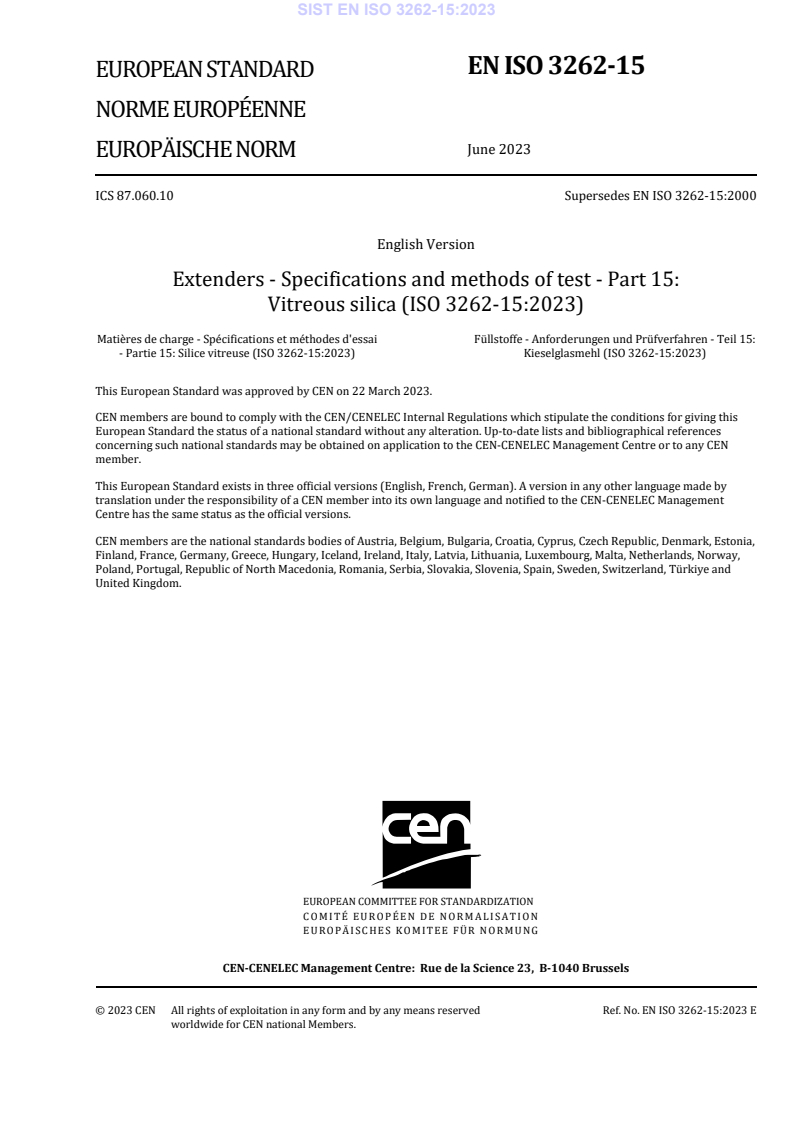
EN ISO 3262-15
EUROPEAN STANDARD
NORME EUROPÉENNE
June 2023
EUROPÄISCHE NORM
ICS 87.060.10 Supersedes EN ISO 3262-15:2000
English Version
Extenders - Specifications and methods of test - Part 15:
Vitreous silica (ISO 3262-15:2023)
Matières de charge - Spécifications et méthodes d'essai Füllstoffe - Anforderungen und Prüfverfahren - Teil 15:
- Partie 15: Silice vitreuse (ISO 3262-15:2023) Kieselglasmehl (ISO 3262-15:2023)
This European Standard was approved by CEN on 22 March 2023.
CEN members are bound to comply with the CEN/CENELEC Internal Regulations which stipulate the conditions for giving this
European Standard the status of a national standard without any alteration. Up-to-date lists and bibliographical references
concerning such national standards may be obtained on application to the CEN-CENELEC Management Centre or to any CEN
member.
This European Standard exists in three official versions (English, French, German). A version in any other language made by
translation under the responsibility of a CEN member into its own language and notified to the CEN-CENELEC Management
Centre has the same status as the official versions.
CEN members are the national standards bodies of Austria, Belgium, Bulgaria, Croatia, Cyprus, Czech Republic, Denmark, Estonia,
Finland, France, Germany, Greece, Hungary, Iceland, Ireland, Italy, Latvia, Lithuania, Luxembourg, Malta, Netherlands, Norway,
Poland, Portugal, Republic of North Macedonia, Romania, Serbia, Slovakia, Slovenia, Spain, Sweden, Switzerland, Türkiye and
United Kingdom.
EUROPEAN COMMITTEE FOR STANDARDIZATION
COMITÉ EUROPÉEN DE NORMALISATION
EUROPÄISCHES KOMITEE FÜR NORMUNG
CEN-CENELEC Management Centre: Rue de la Science 23, B-1040 Brussels
© 2023 CEN All rights of exploitation in any form and by any means reserved Ref. No. EN ISO 3262-15:2023 E
worldwide for CEN national Members.
Contents Page
European foreword . 3
European foreword
This document (EN ISO 3262-15:2023) has been prepared by Technical Committee ISO/TC 256
"Pigments, dyestuffs and extenders" in collaboration with Technical Committee CEN/TC 298 “Pigments
and extenders” the secretariat of which is held by DIN.
This European Standard shall be given the status of a national standard, either by publication of an
identical text or by endorsement, at the latest by December 2023, and conflicting national standards
shall be withdrawn at the latest by December 2023.
Attention is drawn to the possibility that some of the elements of this document may be the subject of
patent rights. CEN shall not be held responsible for identifying any or all such patent rights.
This document supersedes EN ISO 3262-15:2000.
Any feedback and questions on this document should be directed to the users’ national standards
body/national committee. A complete listing of these bodies can be found on the CEN website.
According to the CEN-CENELEC Internal Regulations, the national standards organizations of the
following countries are bound to implement this European Standard: Austria, Belgium, Bulgaria,
Croatia, Cyprus, Czech Republic, Denmark, Estonia, Finland, France, Germany, Greece, Hungary, Iceland,
Ireland, Italy, Latvia, Lithuania, Luxembourg, Malta, Netherlands, Norway, Poland, Portugal, Republic of
North Macedonia, Romania, Serbia, Slovakia, Slovenia, Spain, Sweden, Switzerland, Türkiye and the
United Kingdom.
Endorsement notice
The text of ISO 3262-15:2023 has been approved by CEN as EN ISO 3262-15:2023 without any
modification.
INTERNATIONAL ISO
STANDARD 3262-15
Second edition
2023-05
Extenders — Specifications and
methods of test —
Part 15:
Vitreous silica
Matières de charge — Spécifications et méthodes d’essai —
Partie 15: Silice vitreuse
Reference number
ISO 3262-15:2023(E)
ISO 3262-15:2023(E)
© ISO 2023
All rights reserved. Unless otherwise specified, or required in the context of its implementation, no part of this publication may
be reproduced or utilized otherwise in any form or by any means, electronic or mechanical, including photocopying, or posting on
the internet or an intranet, without prior written permission. Permission can be requested from either ISO at the address below
or ISO’s member body in the country of the requester.
ISO copyright office
CP 401 • Ch. de Blandonnet 8
CH-1214 Vernier, Geneva
Phone: +41 22 749 01 11
Email: copyright@iso.org
Website: www.iso.org
Published in Switzerland
ii
ISO 3262-15:2023(E)
Contents Page
Foreword .iv
1 Scope . 1
2 Normative references . 1
3 Terms and definitions . 1
4 Requirements and test methods . 2
5 Sampling . 2
6 Determination of silica content . 3
6.1 Reagents . 3
6.2 Apparatus . 3
6.3 Procedure . 3
6.4 Expression of results . . 3
7 Test report . 4
iii
ISO 3262-15:2023(E)
Foreword
ISO (the International Organization for Standardization) is a worldwide federation of national standards
bodies (ISO member bodies). The work of preparing International Standards is normally carried out
through ISO technical committees. Each member body interested in a subject for which a technical
committee has been established has the right to be represented on that committee. International
organizations, governmental and non-governmental, in liaison with ISO, also take part in the work.
ISO collaborates closely with the International Electrotechnical Commission (IEC) on all matters of
electrotechnical standardization.
The procedures used to develop this document and those intended for its further maintenance are
described in the ISO/IEC Directives, Part 1. In particular, the different approval criteria needed for the
different types of ISO document should be noted. This document was drafted in accordance
...
Questions, Comments and Discussion
Ask us and Technical Secretary will try to provide an answer. You can facilitate discussion about the standard in here.
Loading comments...