

EN 1559-3:2026
(Main)Founding - Technical conditions of delivery - Part 3: Additional requirements for cast iron castings
- Abstract
This document specifies the additional technical delivery conditions for castings made from all cast iron materials.
This document applies to iron castings produced in sand or permanent moulds or by centrifugal casting, continuous casting or investment casting.
- Status
- Not Published
- Publication Date
- 20-Oct-2026
- Technical Committee
- CEN/TC 190 - Foundry technology
- Current Stage
- 6055 - CEN Ratification completed (DOR) - Publishing
- Start Date
- 14-Sep-2026
- Due Date
- 29-Jun-2027
- Completion Date
- 14-Sep-2026

EN 1559-3:2026 is a CEN document that gives additional technical delivery conditions for castings made from all cast iron materials. It complements EN 1559-1 and tells purchasers and foundries what to agree on for order information, welding, inspection, surface condition and other casting conditions. It applies to iron castings produced in sand or permanent moulds, by centrifugal casting, continuous casting or investment casting.
What does EN 1559-3:2026 specify?
EN 1559-3:2026 specifies the extra delivery conditions for all cast iron materials and is intended to be used together with EN 1559-1. It covers what the purchaser must state, how welding is controlled, how casting requirements are agreed, and how inspection and surface acceptance are handled.
The document is organized into these main clauses:
- Clause 4 - Information to be supplied by the purchaser
- Clause 5 - Designations
- Clause 6 - Manufacture
- Clause 7 - Requirements
- Clause 8 - Inspection
- Clause 9 - Marking
- Clause 10 - Packaging and surface protection
- Clause 11 - Complaints
| Annex | What it covers |
|---|---|
| Annex A | Guidelines for acceptance criteria for outer and inner conditions using non-destructive testing |
| Annex B | Guidelines for acceptance criteria for surface condition using visual check |
| Annex C | Significant technical changes compared with the previous edition |
What are the key requirements of EN 1559-3:2026?
EN 1559-3:2026 focuses on what must be agreed before production starts, how welding is authorized, and how inspection criteria are set. In practice, it is a contract and quality-control document as much as a casting specification.
Purchaser information and ordering
Clause 4.1 requires the relevant wall thickness to be given in the order. That matters because wall thickness affects how the casting is made and how it is checked.
Clause 4.2 allows the enquiry and order to include items such as as-cast condition, special or subsequent heat treatment, stress relieving, coating intentions, machining sequence for ausferritic spheroidal graphite cast iron castings, and formation of test units. This helps avoid later disputes about what state the casting should be delivered in.
Designation and material identity
Clause 5 requires cast iron designations to follow EN 1560. For users, this means the material grade must be identified with the standard designation system, not just described in general terms.
Manufacture and welding
Clause 6.2 requires welding to be carried out by a qualified welder, with procedures qualified to EN ISO 15614-3 and based on EN 1011-8. Production welding is only allowed by written agreement between the manufacturer and the purchaser. That makes repair and finishing welding a controlled part of the order, not an informal shop practice.
Requirements for the casting
Clause 7 covers chemical composition, mechanical properties, other properties, casting condition and mass. The mass can be calculated from the density given in the applicable material standard, so the buyer and manufacturer can use the same basis for ordering and checking.
Clause 7.3.3 sets out non-destructive testing (NDT) for outer and inner conditions and ties the methods to Table 1. The permitted methods are liquid penetrant testing (PT), magnetic particle testing (MT), ultrasonic testing (UT) and radiographic testing (RT), with the relevant general-principles and test-condition standards named for each. Different acceptance criteria may be applied to different areas of the same casting, such as marked zones and unmarked areas.
Clause 7.3.3.4 and Annex B deal with surface roughness and visual surface condition. The roughness level and acceptance level are to be agreed, which matters when the surface will be machined, sealed, coated or inspected visually.
Test units, inspection and disposition
Clause 8 covers inspection documents, test unit formation, sample selection, retests, invalid test handling, sorting and reprocessing. This is the part that turns the order requirements into an inspection plan and defines how nonconforming castings are handled.
What terms does EN 1559-3:2026 define?
- Cast iron materials - The material family covered by EN 1559-3:2026, including the cast irons listed in the introduction.
- Non-destructive testing (NDT) - Testing methods used to find discontinuities without damaging the casting, such as PT, MT, UT and RT.
- Test unit - The group of castings taken together for inspection and sampling.
- Marked zone - A drawing-defined area of a casting where special acceptance criteria apply.
- Acceptance level - The specified level used to judge surface roughness or surface irregularities.
- Discontinuity class - The classification used in Annex A for surface and internal discontinuities.
- Production welding - Welding carried out during production, only by written agreement between manufacturer and purchaser.
Who uses EN 1559-3:2026?
EN 1559-3:2026 is used by foundries, purchasers, quality managers, buyers, inspection staff and welding personnel in the iron casting supply chain. They use it when writing orders, choosing weld repair rules, defining NDT and visual acceptance levels, and agreeing test units and inspection documents. It is especially relevant when a casting order needs clear delivery conditions rather than a general material description.
What changed in EN 1559-3:2026 from the previous edition?
EN 1559-3:2026 will supersede EN 1559-3:2011. Annex C lists the significant technical changes, including:
- the title changed to "Founding - Technical conditions of delivery - Part 3: Additional requirements for cast iron castings"
- Clause 2 was updated
- Table 1 references were updated, including replacements such as EN 571-1 by EN ISO 3452-1 and EN 444 by EN ISO 5579
- Table A.1 had its third column removed
- Clause A.5 was removed
- the bibliography was updated
- throughout the document, wording was updated to refer to the corresponding clause in EN 1559-1
Which standards are used with EN 1559-3:2026?
EN 1559-3:2026 relies on these referenced standards:
- EN 1559-1 - the general technical delivery conditions that this part complements
- EN 1560 - the designation system for cast iron material symbols and material numbers
- EN 287-6 - qualification testing of welders for fusion welding of cast irons
- EN 1011-8 - welding recommendations for cast irons
- EN ISO 15614-3 - welding procedure qualification for non-alloyed and low-alloyed cast irons
- EN 1369 - magnetic particle testing of foundings
- EN 1370 - examination of surface condition and the acceptance levels used for surface roughness and irregularities
- EN 1371-1 and EN ISO 3452-1 - liquid penetrant testing for castings and general principles
- EN 12680-3 and EN ISO 16810 - ultrasonic testing for spheroidal graphite cast iron castings and general ultrasonic principles
- EN 12681-1 and EN 12681-2 - radiographic testing by film and digital detector techniques
- EN 14784-1 and EN ISO 16371-2 - industrial computed radiography with storage phosphor imaging plates
- EN ISO 5579 - radiographic testing of metallic materials using film and X- or gamma rays
- EN ISO 9934-1 - magnetic particle testing general principles
The foreword also places this part in the EN 1559 series with EN 1559-2, EN 1559-4, EN 1559-5 and EN 1559-6 for other casting materials.
What does the EN 1559-3:2026 document contain?
EN 1559-3:2026 contains purchaser-information rules, welding requirements, delivery-condition requirements, inspection provisions and marking, packaging and complaints clauses. It also contains Table 1 for non-destructive test methods, Annex A for discontinuity acceptance guidance, Annex B for visual surface-condition guidance, and Annex C for the technical changes from EN 1559-3:2011.
The annexes are informative and are used to help parties specify acceptance criteria rather than to reproduce the criteria in the body of the contract.
Relations
- Effective Date
- 02-Feb-2023
Get Certified
Connect with accredited certification bodies for this standard

Element Materials Technology
Materials testing and product certification.

Inštitut za kovinske materiale in tehnologije
Institute of Metals and Technology. Materials testing, metallurgical analysis, NDT.
Sponsored listings
Frequently Asked Questions
EN 1559-3:2026 is a draft published by the European Committee for Standardization (CEN). Its full title is "Founding - Technical conditions of delivery - Part 3: Additional requirements for cast iron castings". This standard covers: This document specifies the additional technical delivery conditions for castings made from all cast iron materials. This document applies to iron castings produced in sand or permanent moulds or by centrifugal casting, continuous casting or investment casting.
This document specifies the additional technical delivery conditions for castings made from all cast iron materials. This document applies to iron castings produced in sand or permanent moulds or by centrifugal casting, continuous casting or investment casting.
EN 1559-3:2026 is classified under the following ICS (International Classification for Standards) categories: 77.140.80 - Iron and steel castings. The ICS classification helps identify the subject area and facilitates finding related standards.
EN 1559-3:2026 has the following relationships with other standards: It is inter standard links to EN 1559-3:2011. Understanding these relationships helps ensure you are using the most current and applicable version of the standard.
EN 1559-3:2026 is available in PDF format for immediate download after purchase. The document can be added to your cart and obtained through the secure checkout process. Digital delivery ensures instant access to the complete standard document.
Standards Content (Sample)
SLOVENSKI STANDARD
oSIST prEN 1559-3:2025
01-december-2025
Livarstvo - Tehnični dobavni pogoji - 3. del: Dodatne zahteve za litoželezne ulitke
Founding - Technical conditions of delivery - Part 3: Additional requirements for iron
castings
Gießereiwesen - Technische Lieferbedingungen - Teil 3: Zusätzliche Anforderungen an
Eisengussstücke
Fonderie - Conditions techniques de fourniture - Partie 3: Spécifications
complémentaires pour les pièces moulées en fonte
Ta slovenski standard je istoveten z: prEN 1559-3
ICS:
77.140.80 Železni in jekleni ulitki Iron and steel castings
oSIST prEN 1559-3:2025 en,fr,de
2003-01.Slovenski inštitut za standardizacijo. Razmnoževanje celote ali delov tega standarda ni dovoljeno.
oSIST prEN 1559-3:2025
oSIST prEN 1559-3:2025
DRAFT
EUROPEAN STANDARD
prEN 1559-3
NORME EUROPÉENNE
EUROPÄISCHE NORM
September 2025
ICS 77.140.80 Will supersede EN 1559-3:2011
English Version
Founding - Technical conditions of delivery - Part 3:
Additional requirements for iron castings
Fonderie - Conditions techniques de fourniture - Partie Gießereiwesen - Technische Lieferbedingungen - Teil
3: Spécifications complémentaires pour les pièces 3: Zusätzliche Anforderungen an Eisengussstücke
moulées en fonte
This draft European Standard is submitted to CEN members for enquiry. It has been drawn up by the Technical Committee
CEN/TC 190.
If this draft becomes a European Standard, CEN members are bound to comply with the CEN/CENELEC Internal Regulations
which stipulate the conditions for giving this European Standard the status of a national standard without any alteration.
This draft European Standard was established by CEN in three official versions (English, French, German). A version in any other
language made by translation under the responsibility of a CEN member into its own language and notified to the CEN-CENELEC
Management Centre has the same status as the official versions.
CEN members are the national standards bodies of Austria, Belgium, Bulgaria, Croatia, Cyprus, Czech Republic, Denmark, Estonia,
Finland, France, Germany, Greece, Hungary, Iceland, Ireland, Italy, Latvia, Lithuania, Luxembourg, Malta, Netherlands, Norway,
Poland, Portugal, Republic of North Macedonia, Romania, Serbia, Slovakia, Slovenia, Spain, Sweden, Switzerland, Türkiye and
United Kingdom.
Recipients of this draft are invited to submit, with their comments, notification of any relevant patent rights of which they are
aware and to provide supporting documentation.
Warning : This document is not a European Standard. It is distributed for review and comments. It is subject to change without
notice and shall not be referred to as a European Standard.
EUROPEAN COMMITTEE FOR STANDARDIZATION
COMITÉ EUROPÉEN DE NORMALISATION
EUROPÄISCHES KOMITEE FÜR NORMUNG
CEN-CENELEC Management Centre: Rue de la Science 23, B-1040 Brussels
© 2025 CEN All rights of exploitation in any form and by any means reserved Ref. No. prEN 1559-3:2025 E
worldwide for CEN national Members.
oSIST prEN 1559-3:2025
prEN 1559-3:2025 (E)
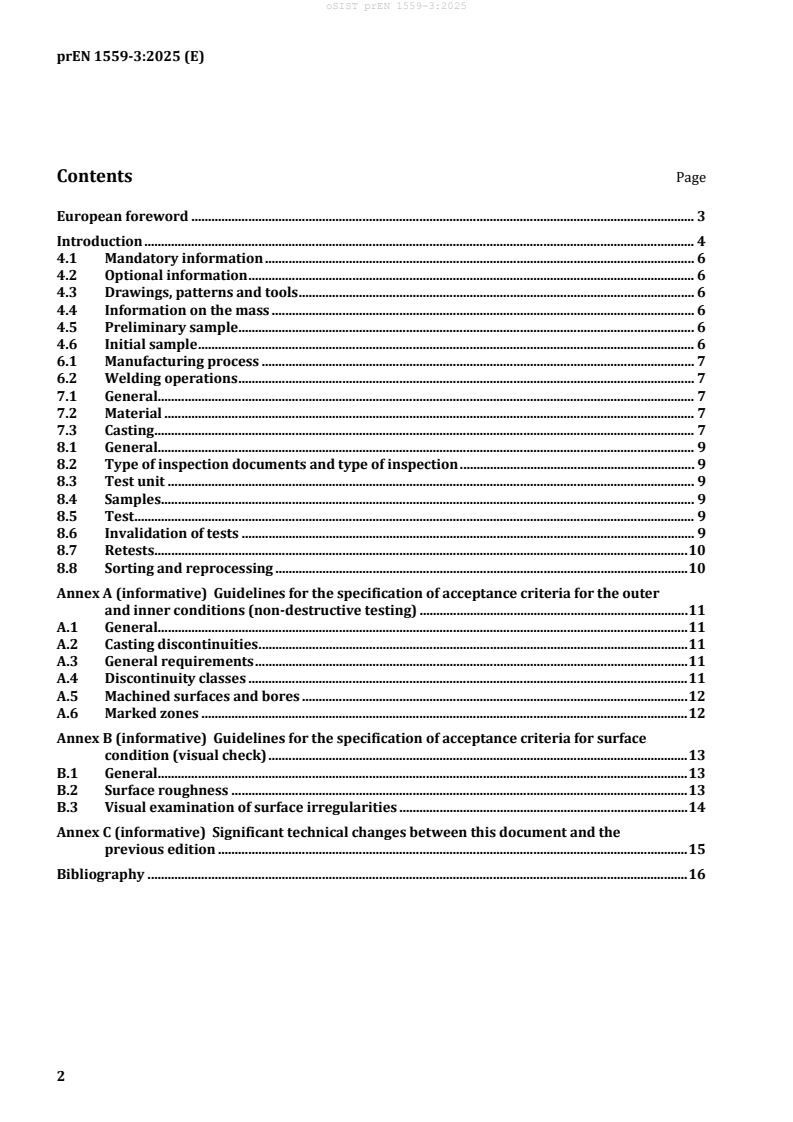
Contents Page
European foreword . 3
Introduction . 4
4.1 Mandatory information . 6
4.2 Optional information . 6
4.3 Drawings, patterns and tools . 6
4.4 Information on the mass . 6
4.5 Preliminary sample . 6
4.6 Initial sample . 6
6.1 Manufacturing process . 7
6.2 Welding operations . 7
7.1 General. 7
7.2 Material . 7
7.3 Casting . 7
8.1 General. 9
8.2 Type of inspection documents and type of inspection . 9
8.3 Test unit . 9
8.4 Samples . 9
8.5 Test . 9
8.6 Invalidation of tests . 9
8.7 Retests . 10
8.8 Sorting and reprocessing . 10
Annex A (informative) Guidelines for the specification of acceptance criteria for the outer
and inner conditions (non-destructive testing) . 11
A.1 General. 11
A.2 Casting discontinuities . 11
A.3 General requirements . 11
A.4 Discontinuity classes . 11
A.5 Machined surfaces and bores . 12
A.6 Marked zones . 12
Annex B (informative) Guidelines for the specification of acceptance criteria for surface
condition (visual check) . 13
B.1 General. 13
B.2 Surface roughness . 13
B.3 Visual examination of surface irregularities . 14
Annex C (informative) Significant technical changes between this document and the
previous edition . 15
Bibliography . 16
oSIST prEN 1559-3:2025
prEN 1559-3:2025 (E)
European foreword
This document (prEN 1559-3:2025) has been prepared by Technical Committee CEN/TC 190 “Foundry
technology”, the secretariat of which is held by DIN.
This document is currently submitted to the CEN Enquiry.
This document will supersede EN 1559-3:2011.
The significant technical changes with respect to EN 1559-3:2011 are given in Annex C, Table C.1.
This document is one of a series of European Standards for technical delivery conditions for castings. The
other standards in this series are:
EN 1559-1, Founding - Technical conditions of delivery - Part 1: General
EN 1559-2, Founding - Technical conditions of delivery - Part 2: Additional requirements for steel castings
EN 1559-4, Founding - Technical conditions of delivery - Part 4: Additional requirements for aluminium
alloy castings
EN 1559-5, Founding - Technical conditions of delivery - Part 5: Additional requirements for magnesium
alloy castings
EN 1559-6, Founding - Technical conditions of delivery - Part 6: Additional requirements for zinc alloy
castings
oSIST prEN 1559-3:2025
prEN 1559-3:2025 (E)
Introduction
CEN/TC 190 “Foundry Technology” has prepared a series of material standards covering the following
cast irons:
— grey cast irons [1];
— malleable cast irons [2];
— spheroidal graphite cast irons [3];
— ausferritic spheroidal graphite cast irons [4];
— abrasion resistant cast irons [5];
— austenitic cast irons [7];
— compacted (vermicular) graphite cast irons [8];
— low alloyed ferritic spheroidal graphite cast irons for elevated temperature applications [9].
In order to assist manufacturers and purchasers to prepare proper contractual arrangements and
prevent misunderstanding, CEN/TC 190 approved the preparation of a series of standards covering
technical delivery conditions. These have been prepared as separate parts.
This document covers the additional technical delivery conditions for all the cast iron materials, e.g.
optional information, manufacturing process, welding operation, additional requirements regarding the
condition of the casting, test methods.
This document cannot be used alone for compiling a specification for ordering and supplying iron
castings, but as a complement to EN 1559-1.
oSIST prEN 1559-3:2025
prEN 1559-3:2025 (E)
1 Scope
This document specifies the additional technical delivery conditions for castings made from all cast iron
materials.
This document applies to iron castings produced in sand or permanent moulds or by centrifugal casting,
continuous casting or investment casting.
2 Normative references
The following documents are referred to in the text in such a way that some or all of their content
constitutes requirements of this document. For dated references, only the edition cited applies. For
undated references, the latest edition of the referenced document (including any amendments) applies.
EN 287-6, Qualification test of welders - Fusion welding - Part 6: Cast irons
EN 1011-8, Welding - Recommendations for welding of metallic materials - Part 8: Welding of cast irons
EN 1369, Founding - Magnetic particle testing
EN 1370, Founding - Examination of surface condition
EN 1371-1, Founding - Liquid penetrant testing- Part 1: Sand, gravity die and low pressure die castings
EN 1559-1, Founding - Technical conditions of delivery - Part 1: General
EN 1560, Founding - Designation system for cast iron - Material symbols and material numbers
EN 12680-3, Founding - Ultrasonic testing - Part 3: Spheroidal graphite cast iron castings
EN 12681-1, Founding - Radiographic testing - Part 1: Film techniques
EN 12681-2, Founding - Radiographic testing - Part 2: Techniques with digital detectors
EN 14784-1, Non-destructive testing - Industrial computed radiography with storage phosphor imaging
plates - Part 1: Classification of systems
EN ISO 3452-1, Non-destructive testing - Penetrant testing - Part 1: General principles (ISO 3452-1)
EN ISO 5579, Non-destructive testing - Radiographic testing of metallic materials using film and X- or
gamma rays - Basic rules (ISO 5579)
EN ISO 9934-1, Non-destructive testing - Magnetic particle testing - Part 1: General principles (ISO 9934-1)
EN ISO 15614-3, Specification and qualification of welding procedures for metallic materials - Welding
procedure test - Part 3: Fusion welding of non-alloyed and low-alloyed cast irons (ISO 15614-3)
EN ISO 16371-2, Non-destructive testing - Industrial computed radiography with storage phosphor
imaging plates - Part 2: General principles for testing of metallic materials using X-rays and gamma rays
(ISO 16371-2)
EN ISO 16810, Non-destructive testing - Ultrasonic testing - General principles (ISO 16810)
oSIST prEN 1559-3:2025
prEN 1559-3:2025 (E)
3 Terms and definitions
For the purposes of this document, the terms and definitions given in EN 1559-1 and of the applicable
material standard apply.
ISO and IEC maintain terminology databases for use in standardization at the following addresses:
— ISO Online browsing platform: available at https://www.iso.org/obp/
— IEC Electropedia: available at https://www.electropedia.org/
4 Information to be supplied by the purchaser
4.1 Mandatory information
Requirements shall be met in accordance with the corresponding clause in EN 1559-1.
The relevant wall thickness shall be given in the order.
4.2 Optional information
Where applicable, the enquiry and order shall include other details, such as requirements for
a) an as-cast condition;
NOTE Heat treatment of malleable cast irons or ausferritic spheroidal graphite cast irons is a function of the
material and is at the discretion of the manufacturer to achieve the desired mechanical properties.
b) special or subsequent heat treatment if required (together with the heat-treatment conditions);
c) heat treatment for stress relieving; it shall be agreed upon between the manufacturer and the
purchaser;
d) intentions to enamel, galvanize, plate, etc. the castings;
e) sequence of machin
...