

EN 13499:2003
(Main)Thermal insulation products for buildings - External thermal insulation composite systems (ETICS) based on expanded polystyrene - Specification
- Abstract
This European Standard specifies the requirements for factory made products for external thermal insulation composite systems (ETICS) based on expanded polystyrene, delivered as a kit, and used as thermal insulation for buildings.
The standard describes product characteristics and includes procedures for testing, marking and labelling.
ETICS are applied to external surfaces of new or existing walls and/or soffits to improve the thermal insulation. ETICS include special fittings (base profiles, corner profiles, etc.) to connect them to adjacent building structures (apertures, corners, parapets, etc.). ETICS give protection against weathering and improve the appearance of the buildings. They do not contribute the stability of the wall and/or soffits on which they are installed.
The standard covers systems where the thermal insulation material is required for the load transfer to the substrate.
This standard covers systems with a declared thermal resistance equal to or greater than 1 m²×K/W.
The requirements from national regulations concerning the mechanical resistance and stability of ETICS should be taken into account.
This standard does not cover the strength between the ETICS and the building surface to which it shall be fixed, i. e. the substrate.
- Status
- Published
- Publication Date
- 26-Aug-2003
- Technical Committee
- CEN/TC 88 - Thermal insulating materials and products
- Drafting Committee
- CEN/TC 88/WG 18 - External thermal insulation composite systems
- Current Stage
- 9060 - Closure of 2 Year Review Enquiry - Review Enquiry
- Start Date
- 02-Sep-2026
- Completion Date
- 02-Sep-2026

Overview
EN 13499:2003 - published by CEN - defines requirements for factory-made kits for External Thermal Insulation Composite Systems (ETICS) based on expanded polystyrene (EPS). The standard covers product characteristics, testing procedures, marking and labelling for ETICS delivered as complete systems used to improve the thermal insulation of external walls and soffits. EN 13499:2003 applies to ETICS with a declared thermal resistance ≥ 1 m²·K/W and to systems where the insulation material contributes to load transfer to the substrate.
Key topics and requirements
- System scope: Complete, system-specific kits including EPS boards, adhesive, mechanical fixings, base coats with reinforcement, reinforcement meshes, and finishing materials.
- Thermal performance: Declaration of thermal resistance and conductivity in accordance with building insulation calculation standards.
- Mechanical properties: Requirements and test procedures for mechanical resistance and stability of system components (e.g., tensile bond strength of adhesives and base coats; pull-off resistance for mechanically fixed systems).
- Durability and weathering: Tests for liquid water permeability, resistance to impact and penetration, water-vapour permeability, and finishing coat adhesion.
- Reaction to fire: Classification and test methods for reaction to fire (referenced fire tests and classifications).
- Quality control and conformity: Factory production control (normative Annex A) and conformity evaluation procedures.
- Marking & labelling: Mandatory information on accompanying documents and labels for all kit components.
- Limitations: EN 13499:2003 does not cover the strength between the ETICS and the building substrate itself; national regulations governing mechanical resistance and stability must be observed.
Applications
- External insulation of new and existing building façades and soffits.
- Energy-efficiency retrofit projects and new-build thermal envelope design.
- Systems that provide weather protection and aesthetic finishes while improving thermal performance.
- Use cases where EPS-based ETICS are specified for declared thermal resistance ≥ 1 m²·K/W.
Who uses this standard
- System manufacturers and component suppliers (EPS boards, adhesives, meshes, finishing coats).
- Architects and façade designers specifying ETICS for thermal upgrade and compliance.
- Installers and contractors implementing ETICS kits on-site.
- Testing laboratories performing the referenced mechanical, durability and fire tests.
- Regulators and certification bodies assessing conformity with European requirements.
Related standards
EN 13499 references and aligns with related EN/ISO standards used for testing and product definitions, for example:
- EN 13163 (EPS product specification)
- EN 13494 / EN 13495 / EN 13496 / EN 13497 / EN 13498 (ETICS test methods)
- EN 13501-1 (reaction to fire classification)
- EN ISO 10456, EN ISO 6946 (thermal values and calculations)
Keywords: EN 13499:2003, ETICS EPS, external thermal insulation, expanded polystyrene, building insulation standard, CEN, thermal resistance.
Relations
- Effective Date
- 09-Feb-2026
- Effective Date
- 04-Feb-2026
- Effective Date
- 28-Jan-2026
- Effective Date
- 28-Jan-2026
- Effective Date
- 28-Jan-2026
- Effective Date
- 28-Jan-2026
- Effective Date
- 28-Jan-2026
- Effective Date
- 28-Jan-2026
- Effective Date
- 28-Jan-2026
- Effective Date
- 28-Jan-2026
- Refers
EN ISO 1182:2020 - Reaction to fire tests for products - Non-combustibility test (ISO 1182:2020) - Effective Date
- 28-Jan-2026
- Effective Date
- 28-Jan-2026
- Effective Date
- 28-Jan-2026
- Effective Date
- 28-Jan-2026
- Effective Date
- 28-Jan-2026
Get Certified
Connect with accredited certification bodies for this standard

DIBt (Deutsches Institut für Bautechnik)
German Institute for Building Technology.
DIN CERTCO
DIN Group product certification.

Aboma Certification B.V.
Specialized in construction, metal, and transport sectors.
Sponsored listings
Frequently Asked Questions
EN 13499:2003 is a standard published by the European Committee for Standardization (CEN). Its full title is "Thermal insulation products for buildings - External thermal insulation composite systems (ETICS) based on expanded polystyrene - Specification". This standard covers: This European Standard specifies the requirements for factory made products for external thermal insulation composite systems (ETICS) based on expanded polystyrene, delivered as a kit, and used as thermal insulation for buildings. The standard describes product characteristics and includes procedures for testing, marking and labelling. ETICS are applied to external surfaces of new or existing walls and/or soffits to improve the thermal insulation. ETICS include special fittings (base profiles, corner profiles, etc.) to connect them to adjacent building structures (apertures, corners, parapets, etc.). ETICS give protection against weathering and improve the appearance of the buildings. They do not contribute the stability of the wall and/or soffits on which they are installed. The standard covers systems where the thermal insulation material is required for the load transfer to the substrate. This standard covers systems with a declared thermal resistance equal to or greater than 1 m²×K/W. The requirements from national regulations concerning the mechanical resistance and stability of ETICS should be taken into account. This standard does not cover the strength between the ETICS and the building surface to which it shall be fixed, i. e. the substrate.
This European Standard specifies the requirements for factory made products for external thermal insulation composite systems (ETICS) based on expanded polystyrene, delivered as a kit, and used as thermal insulation for buildings. The standard describes product characteristics and includes procedures for testing, marking and labelling. ETICS are applied to external surfaces of new or existing walls and/or soffits to improve the thermal insulation. ETICS include special fittings (base profiles, corner profiles, etc.) to connect them to adjacent building structures (apertures, corners, parapets, etc.). ETICS give protection against weathering and improve the appearance of the buildings. They do not contribute the stability of the wall and/or soffits on which they are installed. The standard covers systems where the thermal insulation material is required for the load transfer to the substrate. This standard covers systems with a declared thermal resistance equal to or greater than 1 m²×K/W. The requirements from national regulations concerning the mechanical resistance and stability of ETICS should be taken into account. This standard does not cover the strength between the ETICS and the building surface to which it shall be fixed, i. e. the substrate.
EN 13499:2003 is classified under the following ICS (International Classification for Standards) categories: 91.100.60 - Thermal and sound insulating materials. The ICS classification helps identify the subject area and facilitates finding related standards.
EN 13499:2003 has the following relationships with other standards: It is inter standard links to ISO 1887:1995, EN ISO 11925-2:2026, EN 13820:2003, EN ISO 4628-2:2016, EN ISO 1716:2018, EN ISO 9229:2020, EN 13495:2019, EN 13497:2018+A1:2021, EN ISO 29768:2022, EN 13163:2012+A2:2016, EN ISO 1182:2020, EN 1062-11:2002, EN 13501-1:2018, EN ISO 4628-4:2016, EN 13172:2024. Understanding these relationships helps ensure you are using the most current and applicable version of the standard.
EN 13499:2003 is available in PDF format for immediate download after purchase. The document can be added to your cart and obtained through the secure checkout process. Digital delivery ensures instant access to the complete standard document.
Standards Content (Sample)
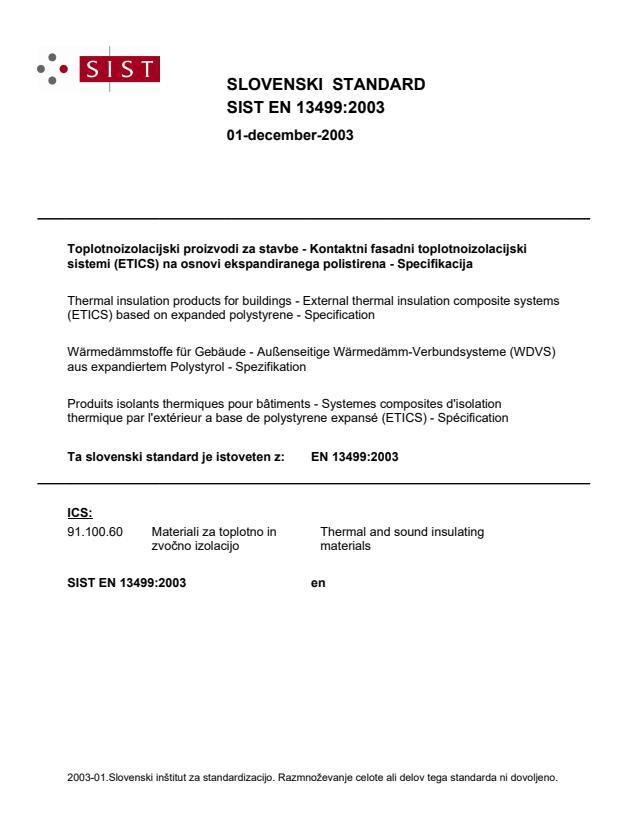
2003-01.Slovenski inštitut za standardizacijo. Razmnoževanje celote ali delov tega standarda ni dovoljeno.Toplotnoizolacijski proizvodi za stavbe - Kontaktni fasadni toplotnoizolacijski sistemi (ETICS) na osnovi ekspandiranega polistirena - SpecifikacijaWärmedämmstoffe für Gebäude - Außenseitige Wärmedämm-Verbundsysteme (WDVS) aus expandiertem Polystyrol - SpezifikationProduits isolants thermiques pour bâtiments - Systemes composites d'isolation thermique par l'extérieur a base de polystyrene expansé (ETICS) - SpécificationThermal insulation products for buildings - External thermal insulation composite systems (ETICS) based on expanded polystyrene - Specification91.100.60Thermal and sound insulating materialsICS:Ta slovenski standard je istoveten z:EN 13499:2003SIST EN 13499:2003en01-december-2003SIST EN 13499:2003SLOVENSKI
STANDARD
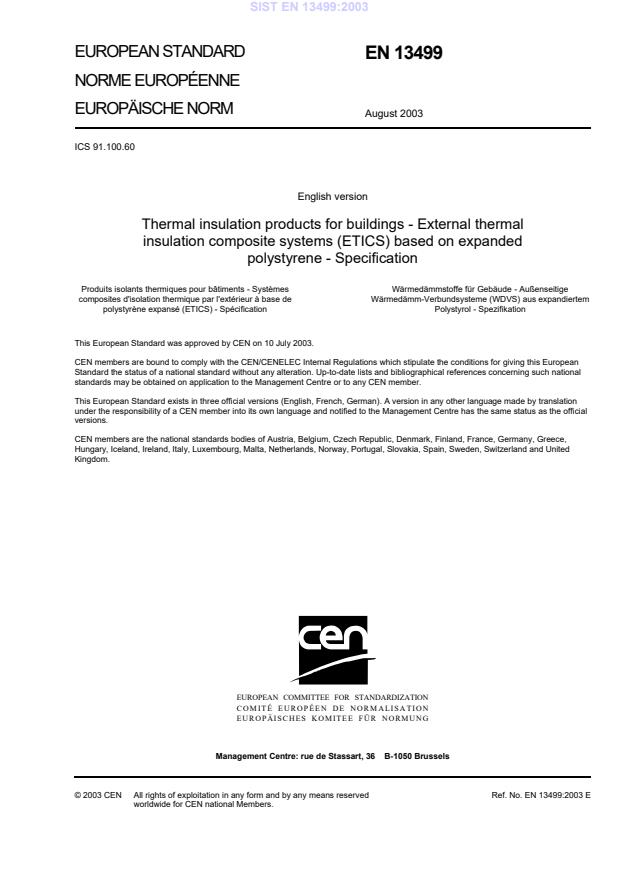
EUROPEAN STANDARDNORME EUROPÉENNEEUROPÄISCHE NORMEN 13499August 2003ICS 91.100.60English versionThermal insulation products for buildings - External thermalinsulation composite systems (ETICS) based on expandedpolystyrene - SpecificationProduits isolants thermiques pour bâtiments - Systèmescomposites d'isolation thermique par l'extérieur à base depolystyrène expansé (ETICS) - SpécificationWärmedämmstoffe für Gebäude - AußenseitigeWärmedämm-Verbundsysteme (WDVS) aus expandiertemPolystyrol - SpezifikationThis European Standard was approved by CEN on 10 July 2003.CEN members are bound to comply with the CEN/CENELEC Internal Regulations which stipulate the conditions for giving this EuropeanStandard the status of a national standard without any alteration. Up-to-date lists and bibliographical references concerning such nationalstandards may be obtained on application to the Management Centre or to any CEN member.This European Standard exists in three official versions (English, French, German). A version in any other language made by translationunder the responsibility of a CEN member into its own language and notified to the Management Centre has the same status as the officialversions.CEN members are the national standards bodies of Austria, Belgium, Czech Republic, Denmark, Finland, France, Germany, Greece,Hungary, Iceland, Ireland, Italy, Luxembourg, Malta, Netherlands, Norway, Portugal, Slovakia, Spain, Sweden, Switzerland and UnitedKingdom.EUROPEAN COMMITTEE FOR STANDARDIZATIONCOMITÉ EUROPÉEN DE NORMALISATIONEUROPÄISCHES KOMITEE FÜR NORMUNGManagement Centre: rue de Stassart, 36
B-1050 Brussels© 2003 CENAll rights of exploitation in any form and by any means reservedworldwide for CEN national Members.Ref. No. EN 13499:2003 ESIST EN 13499:2003
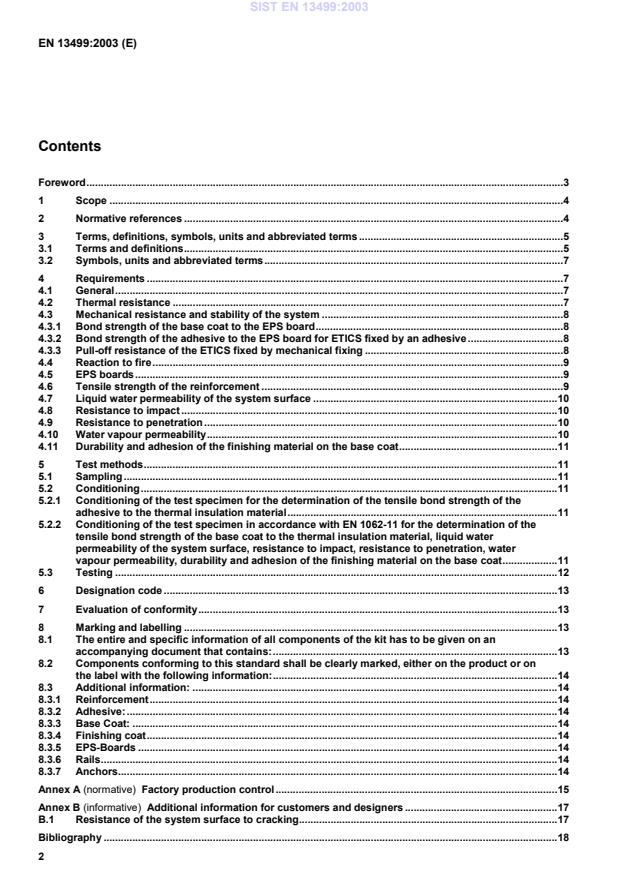
Factory production control.15Annex B (informative)
Additional information for customers and designers.17B.1Resistance of the system surface to cracking.17Bibliography.18SIST EN 13499:2003
...