

EN 15416-3:2007
(Main)Adhesives for load bearing timber structures other than phenolic and aminoplastic - Test methods - Part 3: Creep deformation test at cyclic climate conditions with specimens loaded in bending shear
- Abstract
This European standard specifies a method for determining the creep deformation of bonded specimens loaded in bending shear. It is applicable to adhesives used in load-bearing timber structures.
It is suitable for the following applications:
a) for assessing the compliance of adhesives to prEN 15425 Adhesives, One component polyurethane, for load bearing timber structures - Classification and performance requirements;
b) for assessing the suitability and quality of adhesives for load-bearing timber structures.
This test is intended primarily to obtain performance data for the classification of adhesives for load bearing timber structures according to their suitability for use in defined climatic environments. This method is not intended to provide numerical design data and does not necessarily represent the performance of the bonded member in service. It is not applicable for assessing the suitability of adhesives for the manufacture of wood-based panels
- Status
- Withdrawn
- Publication Date
- 13-Nov-2007
- Withdrawal Date
- 16-Feb-2010
- Technical Committee
- CEN/TC 193 - Adhesives
- Drafting Committee
- CEN/TC 193/SC 1/WG 4 - Tests for 'Novel' load bearing adhesives for wood
- Current Stage
- 9960 - Withdrawal effective - Withdrawal
- Start Date
- 17-Feb-2010
- Completion Date
- 17-Feb-2010

Relations
- Effective Date
- 18-Jan-2023
- Effective Date
- 28-Jan-2026
Get Certified
Connect with accredited certification bodies for this standard

DIN CERTCO
DIN Group product certification.

Smithers Quality Assessments
US management systems and product certification.
Sponsored listings
Frequently Asked Questions
EN 15416-3:2007 is a standard published by the European Committee for Standardization (CEN). Its full title is "Adhesives for load bearing timber structures other than phenolic and aminoplastic - Test methods - Part 3: Creep deformation test at cyclic climate conditions with specimens loaded in bending shear". This standard covers: This European standard specifies a method for determining the creep deformation of bonded specimens loaded in bending shear. It is applicable to adhesives used in load-bearing timber structures. It is suitable for the following applications: a) for assessing the compliance of adhesives to prEN 15425 Adhesives, One component polyurethane, for load bearing timber structures - Classification and performance requirements; b) for assessing the suitability and quality of adhesives for load-bearing timber structures. This test is intended primarily to obtain performance data for the classification of adhesives for load bearing timber structures according to their suitability for use in defined climatic environments. This method is not intended to provide numerical design data and does not necessarily represent the performance of the bonded member in service. It is not applicable for assessing the suitability of adhesives for the manufacture of wood-based panels
This European standard specifies a method for determining the creep deformation of bonded specimens loaded in bending shear. It is applicable to adhesives used in load-bearing timber structures. It is suitable for the following applications: a) for assessing the compliance of adhesives to prEN 15425 Adhesives, One component polyurethane, for load bearing timber structures - Classification and performance requirements; b) for assessing the suitability and quality of adhesives for load-bearing timber structures. This test is intended primarily to obtain performance data for the classification of adhesives for load bearing timber structures according to their suitability for use in defined climatic environments. This method is not intended to provide numerical design data and does not necessarily represent the performance of the bonded member in service. It is not applicable for assessing the suitability of adhesives for the manufacture of wood-based panels
EN 15416-3:2007 is classified under the following ICS (International Classification for Standards) categories: 83.180 - Adhesives. The ICS classification helps identify the subject area and facilitates finding related standards.
EN 15416-3:2007 has the following relationships with other standards: It is inter standard links to EN 15416-3:2007+A1:2010, EN 13353:2008+A1:2011. Understanding these relationships helps ensure you are using the most current and applicable version of the standard.
EN 15416-3:2007 is associated with the following European legislation: EU Directives/Regulations: 305/2011, 89/106/EEC; Standardization Mandates: M/127. When a standard is cited in the Official Journal of the European Union, products manufactured in conformity with it benefit from a presumption of conformity with the essential requirements of the corresponding EU directive or regulation.
EN 15416-3:2007 is available in PDF format for immediate download after purchase. The document can be added to your cart and obtained through the secure checkout process. Digital delivery ensures instant access to the complete standard document.
Standards Content (Sample)
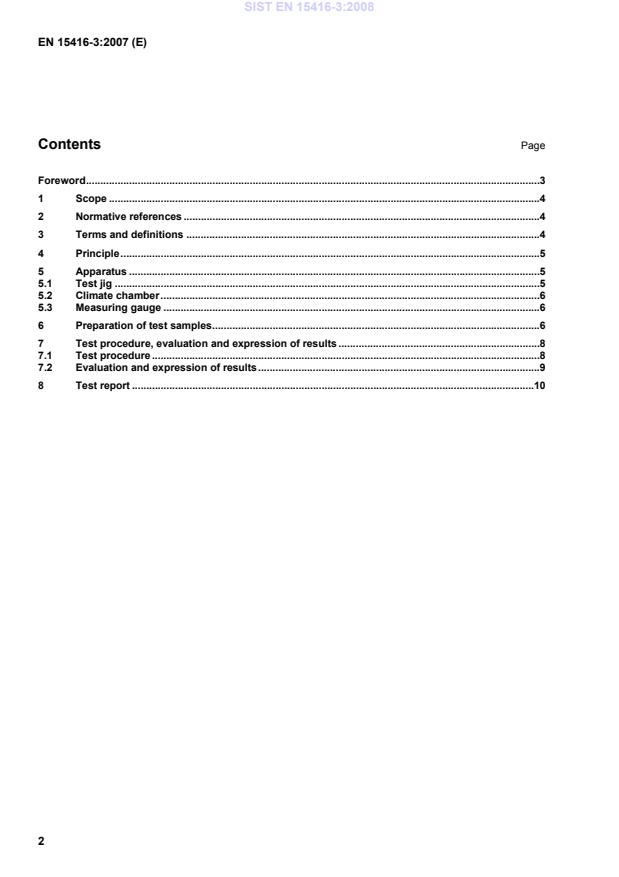
2003-01.Slovenski inštitut za standardizacijo. Razmnoževanje celote ali delov tega standarda ni dovoljeno.Klebstoffe für tragende Holzbauteile - Prüfverfahren - Teil 3: Prüfung der Kriechverformung unter zyklischen Klimabedingungen an Prüfkörpern bei Biege-ScherbeanspruchungAdhésifs pour structures portantes en bois - Méthodes d'essai - Partie 3 : Essai de déformation par fluage dans des conditions climatiques cycliques avec des éprouvettes chargées en cisaillement par flexionAdhesives for load bearing timber structures - Test methods - Part 3: Creep deformation test at cyclic climate conditions with speciments loaded in bending shear91.080.20Lesene konstrukcijeTimber structures83.180LepilaAdhesivesICS:Ta slovenski standard je istoveten z:EN 15416-3:2007SIST EN 15416-3:2008en,fr,de01-februar-2008SIST EN 15416-3:2008SLOVENSKI
STANDARD
EUROPEAN STANDARDNORME EUROPÉENNEEUROPÄISCHE NORMEN 15416-3November 2007ICS 83.180 English VersionAdhesives for load bearing timber structures - Test methods -Part 3: Creep deformation test at cyclic climate conditions withspeciments loaded in bending shearAdhésifs pour structures portantes en bois - Méthodesd'essai - Partie 3 : Essai de déformation par fluage dansdes conditions climatiques cycliques avec des éprouvetteschargées en cisaillement par flexionKlebstoffe für tragende Holzbauteile - Prüfverfahren - Teil 3:Prüfung der Kriechverformung unter zyklischenKlimabedingungen an Prüfkörpern bei Biege-ScherbeanspruchungThis European Standard was approved by CEN on 23 September 2007.CEN members are bound to comply with the CEN/CENELEC Internal Regulations which stipulate the conditions for giving this EuropeanStandard the status of a national standard without any alteration. Up-to-date lists and bibliographical references concerning such nationalstandards may be obtained on application to the CEN Management Centre or to any CEN member.This European Standard exists in three official versions (English, French, German). A version in any other language made by translationunder the responsibility of a CEN member into its own language and notified to the CEN Management Centre has the same status as theofficial versions.CEN members are the national standards bodies of Austria, Belgium, Bulgaria, Cyprus, Czech Republic, Denmark, Estonia, Finland,France, Germany, Greece, Hungary, Iceland, Ireland, Italy, Latvia, Lithuania, Luxembourg, Malta, Netherlands, Norway, Poland, Portugal,Romania, Slovakia, Slovenia, Spain, Sweden, Switzerland and United Kingdom.EUROPEAN COMMITTEE FOR STANDARDIZATIONCOMITÉ EUROPÉEN DE NORMALISATIONEUROPÄISCHES KOMITEE FÜR NORMUNGManagement Centre: rue de Stassart, 36
B-1050 Brussels© 2007 CENAll rights of exploitation in any form and by any means reservedworldwide for CEN national Members.Ref. No. EN 15416-3:2007: ESIST EN 15416-3:2008
It is suitable for the following applications:
a) for assessing the compliance of adhesives to prEN 15425 Adhesives, One component polyurethane, for load bearing timber structures - Classification and performance requirements; b) for assessing the suitability and quality of adhesives for load-bearing timber structures. This test is intended primarily to obtain performance data for the classification of adhesives for load bearing timber structures according to their suitability for use in defined climatic environments. This method is not intended to provide numerical design data and does not necessarily represent the performance of the bonded member in service. It is not applicable for assessing the suitability of adhesives for the manufacture of wood-based panels 2 Normative references The following referenced documents are indispensable for the application of this document. For dated references, only the edition cited applies. For undated references, the latest edition of the referenced document (including any amendments) applies. EN 301, Adhesives, phenolic and aminoplastic, for load-bearing timber structures - Classification and performance requirements EN 923:2005, Adhesives - Terms and definitions prEN 15425, Adhesives - One component polyurethane for load bearing timber structures - Classification and performance requirements 3 Terms and definitions For the purposes of this document, the terms and definitions given in EN 923:2005 and the following apply. 3.1 relative creep value, kdef(t) time-dependent increase of the deformation of one specimen NOTE By means of the deflection w(t) and the initial deflection w(0), the relative creep value is calculated using the following formula: 1)0()()(−=wtwtkdef
(1) where
w(t) is the deflection at times t;
w (0) is the initial deflection immediately after initial loading, measured 1 min after the loading of the individual specime
...