

EN 302-8:2023+A1:2026
(Main + Amendment)Adhesives for load-bearing timber structures - Test methods - Part 8: Static load test of multiple bond line specimens in compression shear
- Abstract
This document specifies a method of determining the ability of adhesive bonds to resist static load. It is applicable to adhesives used in load bearing timber structures.
It is applicable for the following applications:
a) for assessing the compliance of adhesives according to EN 301, EN 15425, EN 16254, EN 17334 and EN 17418;
b) for assessing the suitability and quality of adhesives for load-bearing timber structures;
c) for assessing the effect on the bond strength resulting from constant load at different climate conditions.
This method is intended primarily to obtain performance data for the classification of adhesives for load bearing timber structures according to their suitability for use in defined climatic environments.
This method is not intended to provide data for structural design and does not necessarily represent the performance of the bonded member in service.
- Status
- Published
- Publication Date
- 02-Jun-2026
- Technical Committee
- CEN/TC 193 - Adhesives
- Drafting Committee
- CEN/TC 193/SC 1/WG 4 - Tests for 'Novel' load bearing adhesives for wood
- Current Stage
- 6060 - Definitive text made available (DAV) - Publishing
- Start Date
- 03-Jun-2026
- Due Date
- 06-Oct-2027
- Completion Date
- 03-Jun-2026

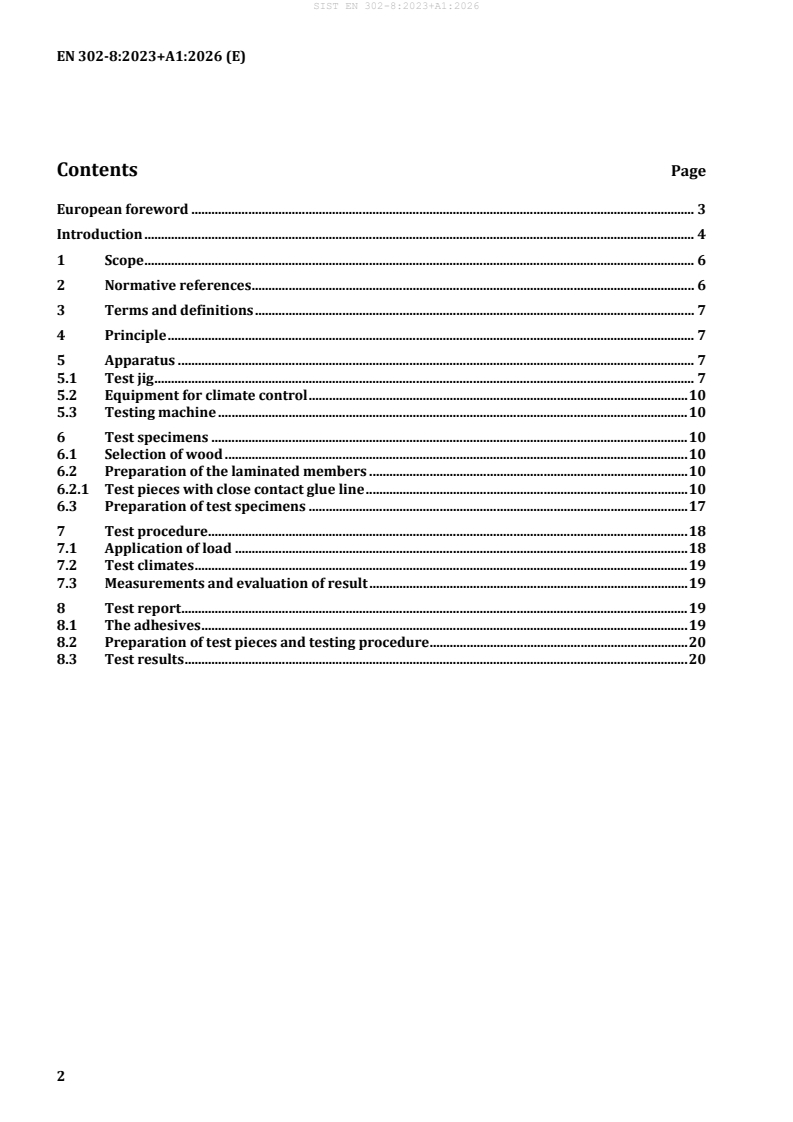
EN 302-8:2023+A1:2026 is a CEN European Standard for testing adhesives used in load-bearing timber structures. It specifies a static load test on multiple bond line specimens in compression shear, so the results can be used to assess adhesive performance under controlled climatic conditions.
The standard is aimed at manufacturers, test laboratories, certifiers, and quality personnel who need comparable performance data for adhesive classification, compliance checks, or product suitability. It is a test method, not a structural design rule, and the results are not automatically the same as the behavior of a bonded member in service.
What does EN 302-8:2023+A1:2026 specify?
EN 302-8:2023+A1:2026 specifies a method for determining how adhesive bonds resist static load in load-bearing timber structures. The document is organized into Clauses 1 to 8: Scope, Normative references, Terms and definitions, Principle, Apparatus, Test specimens, Test procedure, and Test report.
The scope covers three main uses: checking compliance with adhesive standards such as EN 301, EN 15425, EN 16254, EN 17334 and EN 17418; assessing adhesive suitability and quality; and examining how constant load affects bond strength in different climates. The method is intended to generate performance data for classification in defined climatic environments, not for structural design.
What are the key requirements of EN 302-8:2023+A1:2026?
EN 302-8:2023+A1:2026 requires bonded specimens to be loaded in compression shear and exposed to a defined sequence of climates. The important point for users is that the test combines mechanical loading with climate exposure, so the adhesive is assessed under conditions that can accelerate or reveal loss of performance.
Principle, apparatus, and loading
Clause 4 states that bonded test pieces are subjected to a constant compression shear load through three different climates, and that failures and deformation are recorded after the final climate cycle. In practice, this means the test is not a simple one-time strength check - it is a sustained-load assessment with environmental conditioning.
Clause 5 defines the test jig, climate-control equipment, and testing machine. The jig uses plates, rods, and a spring, and the climate equipment must maintain the specified temperature and humidity conditions. If longer rods are used, distance blocks with parallel contact faces are needed, so the load stays aligned and the specimen is not distorted by the fixture.
The loading step requires a compression load of 3 870 N to be reached in 1 to 2 minutes. Climate treatment must begin within 30 minutes after the last sample is loaded. For users, that timing matters because delays can change the load history before exposure starts.
Test specimens and wood selection
Clause 6 requires untreated beech wood, Fagus sylvatica L., with a density of 700 kg/m3 at 12 % moisture content. The wood must be straight-grained and free from knots and visible defects, and the annual-ring angle to the bonding surface must be within the specified range. This controls variability so that the adhesive, rather than poor wood quality, drives the result.
The standard provides two specimen preparation routes for close contact glue lines and thick glue lines. For close contact glue lines, the document uses layered assemblies with spacers that are later removed. For thick glue lines, Method A uses spacer frames of 0.5 mm, 1 mm, or 2 mm, while Method B uses a solid wood middle layer with a two-step bonding and grooving process.
Method B also requires re-bonding with a PRF-adhesive of the specified type. That matters because the method is designed to create a controlled thick glue line while keeping the final specimen geometry consistent from test to test.
Final specimen geometry and marking
Clause 6.3 trims the bonded assembly to the final specimen width and then cuts the bonded zones so that each specimen contains multiple glue lines for axial compression loading. The specimens are marked with a razor blade before testing so that slippage can be measured after unloading. In practice, those marks provide a reference for detecting small deformations that are not visible by eye.
Climate cycle, observation, and evaluation
Clause 7 requires a climate cycle with three consecutive 14-day periods. The first climate is selected from the set 1a to 1d, and the other two climates are fixed. The specimens are checked at least once a week for failures, and after 42 days the rigs are unloaded.
If at least five specimens remain intact, the standard requires slippage to be measured immediately after unloading to the nearest 0.01 mm and the mean value to be calculated. For a laboratory, this means the test result is not only pass or fail - it also includes deformation data that help compare adhesives.
Test reporting
Clause 8 specifies what the report must identify about the adhesive, the wood, the bonding procedure, the timing of preparation and testing, the nominal glue-line thickness, the test results, the climate at failure if relevant, and the method used for measuring slippage. This allows the result to be traced back to the exact material and test conditions used.
What terms does EN 302-8:2023+A1:2026 define?
- Glue line - the adhesive layer between the wood members.
- Thick glue line - a glue line with nominal thickness between 0.5 mm and 2.0 mm at the time of bonding.
- Close contact glue line - a glue line with a maximum thickness of 0.1 mm.
- Climate [20/65] - the conditioning environment used in the method, meaning 20 °C and 65 % relative humidity.
- Slippage - the measured deformation across the razor blade marks after the specimen is unloaded.
- Load-bearing timber structures - the application area for the adhesives tested by this document.
Who uses EN 302-8:2023+A1:2026?
EN 302-8:2023+A1:2026 is used by adhesive manufacturers, testing laboratories, certification bodies, and timber-structure quality teams. Manufacturers use it to support product classification and to check whether an adhesive performs as required for load-bearing timber applications.
It is also relevant to buyers and specifiers who need evidence of adhesive performance under controlled climate conditions. The standard supports compliance assessment against EN 301, EN 15425, EN 16254, EN 17334, and EN 17418, but it is not a design standard for the bonded structure itself.
What changed in EN 302-8:2023+A1:2026 from the previous edition?
EN 302-8:2023+A1:2026 supersedes EN 302-8:2023 and includes Amendment 1. The foreword also states the main changes made in EN 302-8:2023 compared with EN 302-8:2017:
- test pieces with bond line thicknesses of 0.5 mm, 1 mm, and 2 mm were added
- Clause 8, Test report, was deleted in that edition
- the Bibliography was deleted in that edition
Which standards are used with EN 302-8:2023+A1:2026?
The normative references used by EN 302-8:2023+A1:2026 are EN 301, EN 384:2016+A2:2022, EN 923, EN 15425, EN 16254, EN 17334, and EN 17418. EN 923 supplies the terminology base, EN 384 is used for wood density determination, and the adhesive product standards identify the adhesive families that can be assessed by this test method.
The introduction also places this standard within the wider EN 302 and EN 15416 test-method families for adhesives for load-bearing timber structures. Those companion parts cover other properties such as tensile shear strength, delamination, assembly time, pressing time, working life, creep, and open assembly time.
What does the EN 302-8:2023+A1:2026 document contain?
EN 302-8:2023+A1:2026 contains figures for the test jig and specimen geometry, a climate-cycle table, and detailed specimen-preparation routes for close contact and thick glue lines. It also gives the loading setup, the climate exposure sequence, and the post-test measurement of slippage.
The document is written as a laboratory procedure, so most of its content is practical: how to build the specimen, how to load it, how long to condition it, and what to record. For users, that makes the standard directly useful for comparative testing, product qualification, and quality control reports.
Relations
- Effective Date
- 18-Mar-2026
- Effective Date
- 24-Jun-2026
- Effective Date
- 24-Jun-2026
- Effective Date
- 18-Mar-2026
- Effective Date
- 24-Jun-2026
- Effective Date
- 24-Jun-2026
- Effective Date
- 18-Mar-2026
- Effective Date
- 18-Mar-2026
- Effective Date
- 18-Mar-2026
- Effective Date
- 18-Mar-2026
- Effective Date
- 18-Mar-2026
- Effective Date
- 18-Mar-2026
- Effective Date
- 18-Mar-2026
- Effective Date
- 18-Mar-2026
Get Certified
Connect with accredited certification bodies for this standard

DIN CERTCO
DIN Group product certification.

Smithers Quality Assessments
US management systems and product certification.
Sponsored listings
Frequently Asked Questions
EN 302-8:2023+A1:2026 is a standard published by the European Committee for Standardization (CEN). Its full title is "Adhesives for load-bearing timber structures - Test methods - Part 8: Static load test of multiple bond line specimens in compression shear". This standard covers: This document specifies a method of determining the ability of adhesive bonds to resist static load. It is applicable to adhesives used in load bearing timber structures. It is applicable for the following applications: a) for assessing the compliance of adhesives according to EN 301, EN 15425, EN 16254, EN 17334 and EN 17418; b) for assessing the suitability and quality of adhesives for load-bearing timber structures; c) for assessing the effect on the bond strength resulting from constant load at different climate conditions. This method is intended primarily to obtain performance data for the classification of adhesives for load bearing timber structures according to their suitability for use in defined climatic environments. This method is not intended to provide data for structural design and does not necessarily represent the performance of the bonded member in service.
This document specifies a method of determining the ability of adhesive bonds to resist static load. It is applicable to adhesives used in load bearing timber structures. It is applicable for the following applications: a) for assessing the compliance of adhesives according to EN 301, EN 15425, EN 16254, EN 17334 and EN 17418; b) for assessing the suitability and quality of adhesives for load-bearing timber structures; c) for assessing the effect on the bond strength resulting from constant load at different climate conditions. This method is intended primarily to obtain performance data for the classification of adhesives for load bearing timber structures according to their suitability for use in defined climatic environments. This method is not intended to provide data for structural design and does not necessarily represent the performance of the bonded member in service.
EN 302-8:2023+A1:2026 is classified under the following ICS (International Classification for Standards) categories: 83.180 - Adhesives. The ICS classification helps identify the subject area and facilitates finding related standards.
EN 302-8:2023+A1:2026 has the following relationships with other standards: It is inter standard links to EN 302-8:2023, EN 923:2015, EN 384:2016+A2:2022, EN 16254:2023, EN 301:2023+A1:2026, EN 15425:2023+A1:2026, EN 17418:2021, EN 16254:2013+A1:2016, EN 17334:2021, EN 15425:2008, EN 301:2023, EN 16254:2013, EN 15425:2023, EN 301:2017. Understanding these relationships helps ensure you are using the most current and applicable version of the standard.
EN 302-8:2023+A1:2026 is available in PDF format for immediate download after purchase. The document can be added to your cart and obtained through the secure checkout process. Digital delivery ensures instant access to the complete standard document.
Standards Content (Sample)
SLOVENSKI STANDARD
01-julij-2026
Lepila za nosilne lesene konstrukcije - Preskusne metode - 8. del: Preskus statične
obremenitve preskušancev z več lepljenimi spoji pri tlačni strižni obremenitvi
(vključno z dopolnilom A1)
Adhesives for load-bearing timber structures - Test methods - Part 8: Static load test of
multiple bond line specimens in compression shear
Klebstoffe für tragende Holzbauteile - Prüfverfahren - Teil 8: Statische
Belastungsprüfung an Prüfkörpern mit mehreren Klebfugen bei Druck-
Scherbeanspruchung
Adhésifs pour structures portantes en bois - Méthodes d'essai - Partie 8 : Essai de
charge statique d'éprouvettes à joints de colle multiples en cisaillement par compression
Ta slovenski standard je istoveten z: EN 302-8:2023+A1:2026
ICS:
83.180 Lepila Adhesives
91.080.20 Lesene konstrukcije Timber structures
2003-01.Slovenski inštitut za standardizacijo. Razmnoževanje celote ali delov tega standarda ni dovoljeno.
EN 302-8:2023+A1
EUROPEAN STANDARD
NORME EUROPÉENNE
June 2026
EUROPÄISCHE NORM
ICS 83.180 Supersedes EN 302-8:2023
English Version
Adhesives for load-bearing timber structures - Test
methods - Part 8: Static load test of multiple bond line
specimens in compression shear
Adhésifs pour structures portantes en bois - Méthodes Klebstoffe für tragende Holzbauteile - Prüfverfahren -
d'essai - Partie 8 : Essai de charge statique Teil 8: Statische Belastungsprüfung an Prüfkörpern mit
d'éprouvettes à joints de colle multiples en cisaillement mehreren Klebfugen bei Druck-Scherbeanspruchung
par compression
This European Standard was approved by CEN on 18 December 2022 and includes Amendment 1 approved by CEN on 3 April
2026.
CEN members are bound to comply with the CEN/CENELEC Internal Regulations which stipulate the conditions for giving this
European Standard the status of a national standard without any alteration. Up-to-date lists and bibliographical references
concerning such national standards may be obtained on application to the CEN-CENELEC Management Centre or to any CEN
member.
This European Standard exists in three official versions (English, French, German). A version in any other language made by
translation under the responsibility of a CEN member into its own language and notified to the CEN-CENELEC Management
Centre has the same status as the official versions.
CEN members are the national standards bodies of Austria, Belgium, Bulgaria, Croatia, Cyprus, Czech Republic, Denmark, Estonia,
Finland, France, Germany, Greece, Hungary, Iceland, Ireland, Italy, Latvia, Lithuania, Luxembourg, Malta, Netherlands, Norway,
Poland, Portugal, Republic of North Macedonia, Romania, Serbia, Slovakia, Slovenia, Spain, Sweden, Switzerland, Türkiye and
United Kingdom.
EUROPEAN COMMITTEE FOR STANDARDIZATION
COMITÉ EUROPÉEN DE NORMALISATION
EUROPÄISCHES KOMITEE FÜR NORMUNG
CEN-CENELEC Management Centre: Rue de la Science 23, B-1040 Brussels
© 2026 CEN All rights of exploitation in any form and by any means reserved Ref. No. EN 302-8:2023+A1:2026 E
worldwide for CEN national Members.
Contents Page
European foreword . 3
Introduction . 4
1 Scope . 6
2 Normative references . 6
3 Terms and definitions . 7
4 Principle . 7
5 Apparatus . 7
5.1 Test jig . 7
5.2 Equipment for climate control . 10
5.3 Testing machine . 10
6 Test specimens . 10
6.1 Selection of wood . 10
6.2 Preparation of the laminated members . 10
6.2.1 Test pieces with close contact glue line . 10
6.3 Preparation of test specimens . 17
7 Test procedure . 18
7.1 Application of load . 18
7.2 Test climates . 19
7.3 Measurements and evaluation of result . 19
8 Test report . 19
8.1 The adhesives . 19
8.2 Preparation of test pieces and testing procedure . 20
8.3 Test results . 20
European foreword
This document (EN 302-8:2023+A1:2026) has been prepared by Technical Committee CEN/TC 193
“Adhesives”, the secretariat of which is held by UNE.
This European Standard shall be given the status of a national standard, either by publication of an
identical text or by endorsement, at the latest by December 2026, and conflicting national standards
shall be withdrawn at the latest by December 2026.
Attention is drawn to the possibility that some of the elements of this document may be the subject of
patent rights. CEN shall not be held responsible for identifying any or all such patent rights.
This document includes Amendment 1 approved by CEN on 3 April 2026.
This document supersedes !EN 302-8:2023".
The start and finish of text introduced or altered by amendment is indicated in the text by tags !".
The main changes in EN 302-8:2023 compared to the previous edition EN 302-8:2017 are listed below:
a) test of test pieces with bond line thickness 0,5 mm, 1 mm and 2 mm has been included in the
document;
b) Clause 8 Test report has been deleted;
c) the Bibliography has been deleted.
Any feedback and questions on this document should be directed to the users’ national standards body.
A complete listing of these bodies can be found on the CEN website.
According to the CEN-CENELEC Internal Regulations, the national standards organisations of the
following countries are bound to implement this European Standard: Austria, Belgium, Bulgaria,
Croatia, Cyprus, Czech Republic, Denmark, Estonia, Finland, France, Germany, Greece, Hungary, Iceland,
Ireland, Italy, Latvia, Lithuania, Luxembourg, Malta, Netherlands, Norway, Poland, Portugal, Republic of
North Macedonia, Romania, Serbia, Slovakia, Slovenia, Spain, Sweden, Switzerland, Türkiye and the
United Kingdom.
Introduction
This document is one of a series dealing with adhesives for use with timber structures, and is published
in support of the EN 1995 series, Eurocode 5: Design of timber structures. The series consists of five
classification and performance requirements for adhesives for load-bearing timber structures, phenolic
and aminoplastic adhesives (EN 301), one component polyurethane adhesives (EN 15425), emulsion
polymer isocyanate adhesives (EN 16254), two component epoxy and polyurethane adhesives for glued
in rods (EN 17334) and for on-site repair of cracked timber structures (EN 17418) and all together
twelve test methods (EN 302-1, EN 302-2, EN 302-3, EN 302-4, EN 302-5, EN 302-6, EN 302-7,
EN 302-8, EN 15416-1, EN 15416-3, EN 15416-4 and EN 15416-5).
These European Standards have the following titles:
EN 301, Adhesives, phenolic and aminoplastic, for load-bearing timber structures — Classification and
performance requirements
EN 302, Adhesives for load-bearing timber structures — Test methods:
— Part 1: Determination of longitudinal tensile shear strength
— Part 2: Determination of resistance to delamination
— Part 3: Determination of the effect of acid damage to wood fibres by temperature and humidity
cycling on the transverse tensile strength
— Part 4: Determination of the effects of wood shrinkage on the shear strength
— Part 5: Determination of maximum assembly time under referenced conditions
— Part 6: Determination of the minimum pressing time under referenced conditions
— Part 7: Determination of the working life under referenced conditions
— Part 8: Static load test of multiple bond line specimens in compression shear
EN 15416, Adhesives for load bearing timber structures other than phenolic and aminoplastic — Test
methods:
— Part 1: Long-term tension load test perpendicular to the bond line at varying climate conditions with
specimens perpendicular to the glue line (Glass house test)
— Part 3: Creep deformation test at cyclic climate conditions with specimens loaded in bending shear
— Part 4: Determination of open assembly time under referenced conditions
— Part 5: Determination of minimum pressing time under referenced conditions
EN 15425, Adhesives — One component polyurethane (PUR) for load-bearing timber structures —
Classification and performance requirements
EN 16254, Adhesives — Emulsion polymer isocyanate (EPI) for load-bearing timber structures —
Classification and performance requirements
EN 17334, Glued-in rods in glued structural timber products — Testing, requirements and bond shear
strength classification
EN 17418, Two-component epoxy and polyurethane adhesives for on-site repair of cracked timber
structures — Testing, requirements and repair strength verification
Safety statement
Persons using this document should be familiar with the normal laboratory practice, if applicable. This
document cannot address all of the safety problems, if any, associated with its use. It is the
responsibility of the user to establish appropriate safety and health practices and to ensure compliance
with any regulatory conditions.
Environmental statement
It is understood that some of the material permitted in this document may have negative environmental
impact. As technological advantages lead to better alternatives for these materials, they will be
eliminated from this document to the extent possible.
At the end of the test, it is recommended that the users of this document take care to carry out an
appropriate disposal of the wastes, according to local regulation.
1 Scope
This document specifies a method of determining the ability of adhesive bonds to resist static load. It is
applicable to adhesives used in load bearing timber structures.
It is applicable for the following applications:
a) for assessing the compliance of adhesives according to EN 301, EN 15425, EN 16254, EN 17334 and
EN 17418;
b) for assessing the suitability and quality of adhesives for load-bearing timber structures;
c) for assessing the effect on the bond strength resulting from constant load at different climate
conditions.
This method is intended primarily to obtain performance data for the classification of adhesives for load
bearing timber structures according to their suitability for use in defined climatic environments.
This method is not intended to provide data for structural design and does not necessarily represent
the performance of the bonded member in service.
2 Normative references
The following documents are referred to in the text in such a way that some or all of their content
constitutes requirements of this document. For dated references, only the edition cited applies. For
undated references, the latest edition of the referenced document (including any amendments) applies.
EN 301, Adhesives, phenolic and aminoplastic, for load-bearing timber structures — Classification and
performance requirements
EN 384:2016+A2:2022, Structural timber — Determination of characteristic values of mechanical
properties and density
EN 923, Adhesives — Terms and definitions
EN 15425, Adhesives — One component polyurethane (PUR) for load-bearing timber structures —
Classification and performance requirements
EN 16254, Adhesives — Emulsion polymerized isocyanate (EPI) for load-bearing timber structures —
Classification and performance requirements
EN 17334, Glued-in rods in glued structural timber products — Testing, requirements and bond shear
strength classification
EN 17418, Two-component epoxy and polyurethane adhesives for on-site repair of cracked timber
structures — Testing, requirements and repair strength verification
3 Terms and definitions
For the purposes of this document, the terms and definitions given in EN 923 and the following apply.
ISO and IEC maintain terminology databases for use in standardization at the following addresses:
— ISO Online browsing platform: available at https://www.iso.org/obp
— IEC Electropedia: available at https://www.electropedia.org/
3.1
glue line
adhesive layer between the wood members
3.2
thick glue line
glue line of nominal thickness in the range of 0,5 mm to 2,0 mm at the time of bonding
Note 1 to entry: Thick glue lines are achieved by using spacers, grooves or similar devices when two plain
members are glued together.
3.3
close contact glue line
glue line of thickness maximum 0,1 mm
Note 1 to entry: Close contact glue line can be achieved by pressing together two plane wood members with a
clamping pressure of (0,8 ± 0,1) N/mm without additional grooves, spacers or similar devices.
4 Principle
Bonded test pieces are subjected to a constant compression shear load under a series of three different
climates. Number of failures and the amount of deformation is measured after the end of the last
climate cycle.
5 Apparatus
5.1 Test jig
The test equipment is shown in Figure 1 and Figure 2.
Dimensions in millimetres
Key
1 top plate
2 spacer plate
3 base plate
4 tension rod
5 centre rod
Figure 1 — Test jig
Dimensions in millimetres
Key
1 top plate 4 tension rod (the given lengths are minimum values)
2 spacer plate 5 centre rod (the given length is a minimum value)
3 base plate
Figure 2 — Nominal dimensions of plates and rods
If longer rods are used, distance blocks need to be placed on top and/or under the specimen. The
distance blocks shall be prepared in such a way that the two contact surfaces, between the distance
block and the jig and between the distance block and the specimen, are parallel. Dimension of distance
blocks: at least 48 mm × 51 mm × 10 mm.
NOTE 1 Blocks produced from several pieces of plywood bonded together have been found suitable.
The spring shall have the following characteristics:
— outside diameter (unloaded): 105 mm;
— end fix: both ends fixed and grounded;
— free length: 320 mm;
— compre
...