

EN 301:2023+A1:2026
(Main + Amendment)Adhesives, phenolic and aminoplastic, for load-bearing timber structures - Classification and performance requirements
- Abstract
This document establishes a classification for phenolic and aminoplastic polycondensation adhesives according to their suitability for use for load-bearing timber products in defined climatic exposure conditions, and specifies performance requirements for such adhesives for the factory manufacture or factory-like manufacturing conditions of load-bearing timber products only.
This document only specifies the performance of an adhesive for use in an environment corresponding to the defined conditions.
The performance requirements of this document are applicable to the adhesive only, not to the manufacturing timber products. This document does not cover the performance of adhesives for on-site gluing (except for factory-like conditions) or the production of wood-based panels, except solid wood panels, or modified and stabilized wood with considerably reduced swelling and shrinkage properties, e.g. acetylated wood, heat treated wood and polymer impregnated wood.
This document is primarily intended for use by adhesive manufacturers and for use in timber products bonded with adhesives, to assess or control the quality of adhesives. The requirements are applicable to the type testing of the adhesives. Production control activities are outside the scope of this document.
Adhesives meeting the requirements of this document are adequate for use in load-bearing timber products, provided that the bonding process has been carried out according to an appropriate product standard.
- Status
- Published
- Publication Date
- 05-Oct-2027
- Technical Committee
- CEN/TC 193 - Adhesives
- Drafting Committee
- CEN/TC 193/SC 1/WG 8 - Revision of EN 301 and EN 302
- Current Stage
- 6060 - Definitive text made available (DAV) - Publishing
- Start Date
- 03-Jun-2026
- Due Date
- 06-Oct-2027
- Completion Date
- 06-Oct-2027

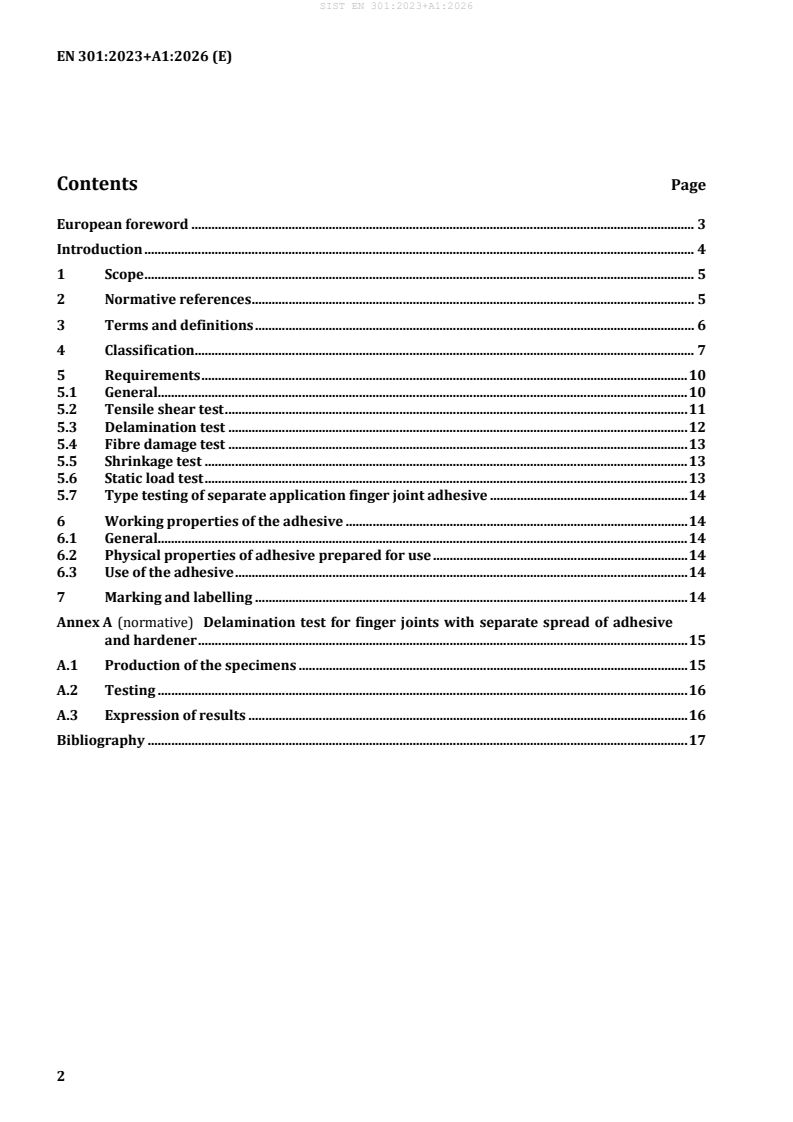
EN 301:2023+A1:2026 is a CEN European Standard for phenolic and aminoplastic adhesives used in load-bearing timber structures. It classifies these polycondensation adhesives for defined climatic exposure conditions and sets performance requirements for factory manufacture or factory-like manufacturing of load-bearing timber products.
The document is aimed mainly at adhesive manufacturers and at people who assess or control adhesive quality for timber products. Its requirements apply to the adhesive itself, not to the timber product, and they are used for type testing rather than production control.
What does EN 301:2023+A1:2026 specify?
EN 301:2023+A1:2026 specifies how to classify phenolic and aminoplastic adhesives for structural timber use, and which performance tests they must pass for the intended service class and application area. The standard focuses on adhesive performance in defined climatic conditions and on factory or factory-like bonding conditions.
The scope is limited to adhesives for load-bearing timber products. It covers adhesive performance only, not the performance of the finished timber product, and it excludes on-site gluing except where factory-like conditions apply.
The document is organized into:
- Clause 1 - Scope
- Clause 2 - Normative references
- Clause 3 - Terms and definitions
- Clause 4 - Classification
- Clause 5 - Requirements
- Clause 6 - Working properties of the adhesive
- Clause 7 - Marking and labelling
- Annex A - Normative delamination test for finger joints with separate spread of adhesive and hardener
| Annex | What it covers |
|---|---|
| Annex A | Specimen production, testing, and result expression for the delamination test on finger joints with separate spread of adhesive and hardener |
What are the key requirements of EN 301:2023+A1:2026?
EN 301:2023+A1:2026 classifies adhesives into Type I and Type II, and into application areas GP, FJ and GF. Type I is for service classes 1, 2 and 3, while Type II is for service class 1 only. In practice, that tells a buyer or manufacturer where the adhesive can be used in service.
Classification and designation
Clause 4 defines the designation code. It combines type, application area, maximum test or use temperature, and whether the adhesive is for mixed application or separate application of adhesive and hardener. The code is important because it links the product claim to the exact test regime.
Performance testing
Clause 5 requires testing of ready-for-use glue mixes against the specified methods. The main tests are tensile shear, delamination, fibre damage, shrinkage and static load. In practice, this means the adhesive must be verified under the same type of conditions it will face in service.
Material-specific test pieces
The standard assigns specific wood species to the tests. Beech is used for tensile shear and static load, Norway spruce for delamination, fibre damage and shrinkage, and beech again for gap filling adhesives in the fibre damage test. This matters because the wood species affects the result.
Separate application and mix ratio control
Where adhesive and hardener are applied separately, extra delamination and fibre damage testing is required. Adhesive systems used with a range of hardener dosage must be tested at the lowest and highest mixing ratios. For finger joint adhesives with separate application, Clause 5.7 adds a production-unit check for curing.
Low pH and modification cases
The fibre damage test applies only when the adhesive mix, or one separately applied component, has a low pH. Clause 5 also gives reduced re-testing for small modifications of an adhesive that already complies with EN 301. That helps manufacturers control change without repeating the full test set.
Working properties and marking
Clause 6 covers working properties that may be required by member states or product standards, including viscosity, pH, assembly time, working life, pressing time, temperature limits and pressure. Clause 7 requires each trade unit to be labelled with the trade name, batch number and shelf life, and the adhesive type must be shown on the label or in the technical data sheet.
What terms does EN 301:2023+A1:2026 define?
- aminoplastic resin - A thermosetting synthetic resin made by condensation of amino or amide groups with aldehydes.
- phenolic resin - A thermosetting synthetic resin made by condensation of a phenol with an aldehyde.
- polycondensation adhesive - An adhesive mixture made from a resin formed by polymerization with elimination of water, usually with a hardener.
- service class 1 - Climatic conditions typical of indoor use, with humidity only occasionally above 65 %.
- service class 2 - Climatic conditions typical of covered exterior use, with humidity only occasionally above 85 %.
- service class 3 - Climatic conditions with higher moisture content than service class 2, typically exterior use.
- glue line - The adhesive layer between the wood members.
- close contact glue line - A glue line of maximum 0,1 mm thickness.
Who uses EN 301:2023+A1:2026?
EN 301:2023+A1:2026 is used by adhesive manufacturers, test laboratories, and quality control teams working with load-bearing timber products. It is also relevant for timber product manufacturers who need to select or check an adhesive for structural use.
In practice, users apply it to type testing, product classification, and technical documentation for bonded timber structures. Buyers and specifiers use it to understand whether an adhesive is intended for a given service class, joint type and manufacturing method.
What changed in EN 301:2023+A1:2026 from the previous edition?
EN 301:2023+A1:2026 supersedes EN 301:2023 and includes Amendment 1 approved by CEN on 3 April 2026.
Compared with EN 301:2017, the document states these significant technical changes:
- Table 2 was updated so that the 2 mm glue line condition uses EN 302-3 with beech in the test.
- Gap filling adhesives are now tested under EN 302-8 with a 1 mm glue line.
- Clause 5.1 now includes a test using representative samples of preservative treated Scots pine or Silver fir, which also covers preservative treated Norway spruce.
Which standards are used with EN 301:2023+A1:2026?
| Standard | Contribution |
|---|---|
| EN 302-1 | Tensile shear strength test for load-bearing timber adhesives |
| EN 302-2 | Delamination resistance test |
| EN 302-3 | Fibre damage test after temperature and humidity cycling |
| EN 302-4 | Shrinkage effects on shear strength |
| EN 302-8 | Static load test in compression shear |
| EN 408 | Bending and other physical/mechanical checks for the finger joint production test |
| EN 923 | Basic adhesive terminology used in the document |
| EN 1245 | pH determination for adhesive mix or components |
| EN 12092 | Dynamic viscosity of adhesive prepared for use |
| EN 13183-2 | Moisture content measurement by electrical resistance |
| EN 13183-3 | Moisture content measurement by capacitance |
| EN 302-5 | Maximum assembly time under referenced conditions |
| EN 302-6 | Minimum pressing time under referenced conditions |
| EN 302-7 | Working life under referenced conditions |
| EN 1995-1-1:2004 | Service classes for timber structures referenced in the terms and introduction |
What does the EN 301:2023+A1:2026 document contain?
EN 301:2023+A1:2026 contains classification tables, a test matrix for each adhesive class, and detailed requirements for the main performance tests. It also covers how to deal with separate application of adhesive and hardener, including additional tests for finger joint use.
Annex A gives the full procedure for delamination testing of finger joints with separate spread of adhesive and hardener. It covers specimen preparation, cycling in boiling and cold water, drying, measurement, and calculation of delamination as a percentage.
The document also includes guidance on working properties that may need to be declared in some markets, and a marking and labelling clause for trade units. For engineering and quality work, these sections tell users what to test, what to record, and what to show on product documentation.
Relations
- Effective Date
- 18-Mar-2026
- Effective Date
- 22-Jul-2026
- Effective Date
- 22-Jul-2026
- Effective Date
- 24-Jun-2026
- Effective Date
- 24-Jun-2026
- Effective Date
- 24-Jun-2026
- Effective Date
- 24-Jun-2026
- Effective Date
- 24-Jun-2026
- Effective Date
- 24-Jun-2026
- Effective Date
- 18-Mar-2026
- Effective Date
- 18-Mar-2026
- Effective Date
- 18-Mar-2026
- Effective Date
- 18-Mar-2026
- Effective Date
- 18-Mar-2026
- Effective Date
- 18-Mar-2026
Get Certified
Connect with accredited certification bodies for this standard

DIN CERTCO
DIN Group product certification.

Smithers Quality Assessments
US management systems and product certification.
Sponsored listings
Frequently Asked Questions
EN 301:2023+A1:2026 is a standard published by the European Committee for Standardization (CEN). Its full title is "Adhesives, phenolic and aminoplastic, for load-bearing timber structures - Classification and performance requirements". This standard covers: This document establishes a classification for phenolic and aminoplastic polycondensation adhesives according to their suitability for use for load-bearing timber products in defined climatic exposure conditions, and specifies performance requirements for such adhesives for the factory manufacture or factory-like manufacturing conditions of load-bearing timber products only. This document only specifies the performance of an adhesive for use in an environment corresponding to the defined conditions. The performance requirements of this document are applicable to the adhesive only, not to the manufacturing timber products. This document does not cover the performance of adhesives for on-site gluing (except for factory-like conditions) or the production of wood-based panels, except solid wood panels, or modified and stabilized wood with considerably reduced swelling and shrinkage properties, e.g. acetylated wood, heat treated wood and polymer impregnated wood. This document is primarily intended for use by adhesive manufacturers and for use in timber products bonded with adhesives, to assess or control the quality of adhesives. The requirements are applicable to the type testing of the adhesives. Production control activities are outside the scope of this document. Adhesives meeting the requirements of this document are adequate for use in load-bearing timber products, provided that the bonding process has been carried out according to an appropriate product standard.
This document establishes a classification for phenolic and aminoplastic polycondensation adhesives according to their suitability for use for load-bearing timber products in defined climatic exposure conditions, and specifies performance requirements for such adhesives for the factory manufacture or factory-like manufacturing conditions of load-bearing timber products only. This document only specifies the performance of an adhesive for use in an environment corresponding to the defined conditions. The performance requirements of this document are applicable to the adhesive only, not to the manufacturing timber products. This document does not cover the performance of adhesives for on-site gluing (except for factory-like conditions) or the production of wood-based panels, except solid wood panels, or modified and stabilized wood with considerably reduced swelling and shrinkage properties, e.g. acetylated wood, heat treated wood and polymer impregnated wood. This document is primarily intended for use by adhesive manufacturers and for use in timber products bonded with adhesives, to assess or control the quality of adhesives. The requirements are applicable to the type testing of the adhesives. Production control activities are outside the scope of this document. Adhesives meeting the requirements of this document are adequate for use in load-bearing timber products, provided that the bonding process has been carried out according to an appropriate product standard.
EN 301:2023+A1:2026 is classified under the following ICS (International Classification for Standards) categories: 83.180 - Adhesives. The ICS classification helps identify the subject area and facilitates finding related standards.
EN 301:2023+A1:2026 has the following relationships with other standards: It is inter standard links to EN 301:2023, EN 13183-3:2005, EN 13183-2:2002, EN 302-2:2023, EN 923:2015, EN 408:2010+A1:2012, EN 1245:2011, EN 302-8:2023+A1:2026, EN 12092:2001, EN 302-4:2023, EN 302-3:2023, EN 302-1:2023, EN 131-2:2010+A2:2017, EN 15416-3:2007+A1:2010, EN 385:2001. Understanding these relationships helps ensure you are using the most current and applicable version of the standard.
EN 301:2023+A1:2026 is available in PDF format for immediate download after purchase. The document can be added to your cart and obtained through the secure checkout process. Digital delivery ensures instant access to the complete standard document.
Standards Content (Sample)
Contents
- Introduction
- 1 Scope
- 2 Normative references
- 3 Terms and definitions
- 3.1 aminoplastic resin
- 3.2 phenolic resin
- 3.3 polycondensation adhesive
- 3.4 service class 1
- 3.5 service class 2
- 3.6 service class 3
- 3.7 glue line
- 3.8 thick glue line
- 3.9 close contact glue line
- 4 Classification
- 5 Requirements
- 5.1 General
- 5.2 Tensile shear test
- 5.3 Delamination test
- 5.4 Fibre damage test
- 5.5 Shrinkage test
- 5.6 Static load test
- 5.7 Type testing of separate application finger joint adhesive
- 6 Working properties of the adhesive
- 6.1 General
- 6.2 Physical properties of adhesive prepared for use
- 6.3 Use of the adhesive
- 7 Marking and labelling
- Annex A
- Bibliography
Introduction
This document is one of a series of standards dealing with phenolic and aminoplastic adhesives for use with timber structures, and is published in support of product standards for load-bearing timber structures in connection with EN 1995-1-1, Eurocode 5: Design of timber structures — Part 1-1:
General — Common rules and rules for buildings.
The series consists of:
- one standard for classification and performance requirements (EN 301);
- six test methods (EN 302-1, EN 302-2, EN 302-3, EN 302-4, EN 302-8 and Annex A of this document) used to assess the performance of adhesives after specified heat and humidity treatments; and
- three test methods (EN 302-5, EN 302-6 and EN 302-7) to characterize the working properties of the adhesive.
SAFETY STATEMENT Persons using this document should be familiar with the normal laboratory practice, if applicable. This document cannot address all of the safety problems, if any, associated with its use. It is the responsibility of the user to establish appropriate safety and health practices and to ensure compliance with any regulatory conditions.
ENVIRONMENTAL STATEMENT It is understood that some of the material permitted in this standard may have a negative environmental impact. As technological advantages lead to acceptable alternatives for these materials, they will be eliminated from this standard to the greatest extent possible. At the end of the test, the user of the standard should take care to carry out an appropriate disposal of the wastes, according to local regulations.
SIST EN 301:2023+A1:2026 EN 301:2023+A1:2026 (E)
1 Scope
This document establishes a classification for phenolic and aminoplastic polycondensation adhesives according to their suitability for use for load-bearing timber products in defined climatic exposure conditions, and specifies performance requirements for such adhesives for the factory manufacture or factory-like manufacturing conditions of load-bearing timber products only. This document only specifies the performance of an adhesive for use in an environment corresponding to the defined conditions.
The performance requirements of this document are applicable to the adhesive only, not to the manufacturing timber products. This document does not cover the performance of adhesives for on-site gluing (except for factory-like conditions) or the production of wood-based panels, except solid wood panels, or modified and stabilized wood with considerably reduced swelling and shrinkage properties, e.g. acetylated wood, heat treated wood and polymer impregnated wood. This document is primarily intended for use by adhesive manufacturers and for use in timber products bonded with adhesives, to assess or control the quality of adhesives. The requirements are applicable to the type testing of the adhesives. Production control activities are outside the scope of this document. Adhesives meeting the requirements of this document are adequate for use in load-bearing timber products, provided that the bonding process has been carried out according to an appropriate product standard.
2 Normative references
The following documents are referred to in the text in such a way that some or all of their content constitutes requirements of this document. For dated references, only the edition cited applies. For undated references, the latest edition of the referenced document (including any amendments) applies. EN 302-1, Adhesives for load-bearing timber structures — Test methods — Part 1: Determination of longitudinal tensile shear strength EN 302-2, Adhesives for load-bearing timber structures — Test methods — Part 2: Determination of resistance to delamination EN 302-3, Adhesives for load-bearing timber structures — Test methods — Part 3: Determination of the effect of acid damage to wood fibres by temperature and humidity cycling on the transverse tensile strength EN 302-4, Adhesives for load-bearing timber structures — Test methods — Part 4: Determination of the effects of wood shrinkage on the shear strength EN 302-8, Adhesives for load-bearing timber structures — Test methods — Part 8: Static load test of multiple bond line specimens in compression shear EN 408, Timber structures — Structural timber and glued laminated timber — Determination of some physical and mechanical properties EN 923, Adhesives — Terms and definitions EN 1245, Adhesives — Determination of pH EN 12092, Adhesives — Determination of viscosity
SIST EN 301:2023+A1:2026 EN 301:2023+A1:2026 (E) EN 13183-2, Moisture content of a piece of sawn timber — Part 2: Estimation by electrical resistance method EN 13183-3, Moisture content of a piece of sawn timber — Part 3: Estimation by capacitance method
3 Terms and definitions
For the purposes of this document, the terms and definitions given in EN 923 and the following apply. ISO and IEC maintain terminology databases for use in standardization at the following addresses:
- ISO Online browsing platform: available at https://www.iso.org/obp
- IEC Electropedia: available at https://www.electropedia.org/
3.1 aminoplastic resin
thermosetting synthetic resin derived from a condensation reaction of the –NH groups or –NH groups
of amines or amides with aldehydes
3.2 phenolic resin
thermosetting synthetic resin derived from a condensation reaction of a phenol with an aldehyde
3.3 polycondensation adhesive
adhesive mixture made from a resin formed by a polymerization reaction involving the elimination of water, usually with a hardener Note 1 to entry: Such adhesives usually also contain extenders and/or fillers.
3.4 service class 1
climatic conditions characterized by a moisture content in the materials corresponding to a temperature of 20 °C and the relative humidity of the surrounding air only exceeding 65 % for a few weeks per year Note 1 to entry: In service class 1, which comprises typical indoor conditions, the average moisture content in most softwoods will not exceed 12 %.
[SOURCE: EN 1995-1-1:2004, 2.3.1.3, modified – Indoor conditions have been added in Note 1 to entry.]
3.5 service class 2
climatic conditions characterized by a moisture content in the materials corresponding to a temperature of 20 °C and the relative humidity of the surrounding air only exceeding 85 % for a few weeks per year Note 1 to entry: In service class 2, to which most covered exterior conditions belong, the average moisture content in most softwoods will not exceed 20 %.
[SOURCE: EN 1995-1-1:2004, 2.3.1.3 modified – Covered exterior conditions have been added in Note 1 to entry.]
SIST EN 301:2023+A1:2026 EN 301:2023+A1:2026 (E)
3.6 service class 3
climatic conditions leading to higher moisture contents than in service class 2 Note 1 to entry: Exterior conditions typically belong to service class 3. [SOURCE: EN 1995-1-1:2004, 2.3.1.3, modified – Note 1 to entry has been added.]
3.7 glue line
adhesive layer between the wood members
3.8 thick glue line
glue line of nominal thickness in the range of 0,3 mm to 2,0 mm at the time of bonding Note 1 to entry: Thick glue lines are achieved by using spacers, grooves or similar devices when two plain members are glued together.
3.9 close contact glue line
glue line of thickness maximum 0,1 mm Note 1 to entry: Close contact glue line can be achieved by pressing together two plane wood members with a
clamping pressure of (0,8 ± 0,1) N/mm without additional grooves, spacers or similar devices.
4 Classification
Adhesives (General purpose, Finger jointing or Gap filling) for structural purposes shall produce joints of such strength and durability that the integrity of the bond is maintained in the assigned service class throughout the expected life of the structure.
Two types of adhesive, I and II, are classified according to their suitability for use in different climatic conditions:
- Type Ι to be used in service classes 1, 2 and 3.
- Type ΙΙ to be used in service class 1 only.
These two types of adhesive are further divided into three application area according to the end use:
- General-purpose adhesive (GP) to be used for glue lines between laminations, for finger joints in laminations and structural timber, and for large finger joints; - Finger jointing adhesive (FJ) to be used for finger jointing of laminations and structural timber only; - Gap filling adhesive (GF) to be used for fibre parallel gluing, e.g. glue lines between glulam components of block-glued glulam and for large finger joints. Gap filling adhesives are in addition classified as application area GP and FJ in mixed application without further testing. NOTE The definition of “General purpose” and “Type” can be different in other standards.
SIST EN 301:2023+A1:2026 EN 301:2023+A1:2026 (E) Table 1 specifies the thirteen adhesive classes for which this document is applicable to and their designation codes. The designation code consist of:
- type: Ι or ΙΙ; - application: GP, FJ or GF; - maximum test temperature in degrees Celsius: 70 or 90 for type Ι, or maximum use temperature in degrees Celsius: 50 for type ΙΙ; - use: M for mixed application, and S for separate application of adhesive and hardener. All application areas and use shall be part of the designation code. EXAMPLE Designation code EN 301 I 70 GP 0,6M and designation code EN 301 I 70 FJ 0,1S, if classified as general purpose adhesive for mixed application and classified as finger joint adhesive for separate application. Table 1 — Adhesive classes Adhesive class Max. glue line Max. test Service thickness Application area c a temp. classes (Designation code) Test Use °C mm mm Face lamination and finger jointing for general
...