

FprEN 16640
(Main)Bio-based products - Bio-based carbon content - Determination of the bio-based carbon content using the radiocarbon method
- Abstract
This document specifies a method for the determination of the bio-based carbon content in products, based on the 14C content measurement.
This document also specifies three test methods to be used for the determination of the 14C content from which the bio-based carbon content is calculated:
— method A: Liquid scintillation-counter (LSC);
— method B: Accelerator mass spectrometry (AMS); and
— method C: Saturated-absorption cavity ring-down (SCAR) spectroscopy.
The bio-based carbon content is expressed by a fraction of sample mass or as a fraction of the total carbon content. This calculation method is applicable to any product containing carbon, including bio-composites.
NOTE This document does not provide the methodology for the calculation of the biomass content of a sample, see EN 16785 1 and EN 16785 2.
- Status
- Not Published
- Publication Date
- 05-May-2027
- Technical Committee
- CEN/TC 411 - Bio-based products
- Drafting Committee
- CEN/TC 411/WG 3 - Bio-based content
- Current Stage
- 4599 - Dispatch of FV draft to CMC - Finalization for Vote
- Start Date
- 30-Sep-2026
- Due Date
- 18-Feb-2026
- Completion Date
- 18-Feb-2026

FprEN 16640 is a draft European Standard from CEN for determining bio-based carbon content in products by radiocarbon measurement. It specifies three test methods - liquid scintillation-counter (LSC), accelerator mass spectrometry (AMS), and saturated-absorption cavity ring-down (SCAR) spectroscopy - for laboratories, producers, suppliers, purchasers, authorities, and inspection organizations working with carbon-containing products, including bio-composites.
What does FprEN 16640 specify?
FprEN 16640 specifies how to determine the bio-based carbon content of a product from its C content, measured by radiocarbon analysis. The standard covers any product containing carbon and expresses the result either as a fraction of sample dry mass or as a fraction of the total carbon content.
The document is organized into clauses for scope, references, terms, symbols, principle, C determination, calculation, performance characteristics, and test reporting. Its annexes then separate the supporting sampling guidance, the conversion of sample carbon to CO2, and the three measurement methods.
| Annex | What it covers |
|---|---|
| Annex A | Informative sampling procedures for different product types |
| Annex B | Normative conversion of sample carbon to a suitable sample for C determination |
| Annex C | Normative Method A - Liquid scintillation-counter (LSC) |
| Annex D | Normative Method B - Accelerator mass spectrometry (AMS) |
| Annex E | Normative Method C - Saturated-absorption cavity ring-down (SCAR) |
| Annex F | Informative performance characteristics |
| Annex G | Informative AMS-SCAR intercomparison measurements |
What are the key requirements of FprEN 16640?
FprEN 16640 ties the bio-based carbon result to measured C content and requires the measurement chain to be handled consistently from sampling to reporting. In practice, that means the sample must be representative, the carbon must be converted properly, the chosen measurement method must be followed, and the final result must be reported with the basis and precision statement.
Sampling and sample handling
Clause 6.3 requires samples to be representative of the material or product and their quantity or mass to be established accurately. Annex A gives sampling procedures for solids, liquids, and gases, with product-specific standards listed as guidance. For a buyer or laboratory, this matters because a non-representative sample can give a result that does not reflect the product lot.
Conversion of carbon to CO2
Clause 6.4 and Annex B require the carbon present in the sample to be converted to CO2 by complete combustion. Annex B allows combustion in a calorimetric bomb, a tube furnace, or a laboratory-scale combustion apparatus, and it also covers how the CO2 is collected for the chosen test method. This step matters because incomplete oxidation or poor CO2 collection affects the radiocarbon measurement.
Choice of measurement method
Clause 6.2 and Annexes C, D, and E define three methods:
- Method A - LSC, which measures beta decay indirectly through scintillation counting.
- Method B - AMS, which measures carbon isotopes directly.
- Method C - SCAR, which measures CO by infrared absorption of the C-containing isotopologue.
The method choice affects equipment, turnaround time, and sample preparation. Clause 5 and the annexes show that LSC is more demanding on sample mass and counting time, AMS is the most sensitive for small samples, and SCAR is based on high-purity CO2 and a dedicated spectroscopic setup.
Reference materials and validation checks
Clause 6.5 requires use of a fossil reference material for the 0 % bio-based carbon fraction and oxalic acid standard reference material NIST SRM 4990c for validation of the 100 % bio-based carbon fraction. Blank samples are also used to check for leakage or background effects. In practice, these controls anchor the measurement scale and show whether the laboratory setup is behaving correctly.
Calculation of bio-based carbon content
Clause 7 explains two calculation paths. For Method A, the bio-based carbon content by dry mass is calculated from the measured C activity and the total carbon content of the sample. For Methods B and C, the standard also allows calculation as a fraction of the total carbon content from the measured pMC value, without separately determining total carbon content.
This distinction matters because some laboratories only need the radiocarbon fraction, while others need the bio-based carbon content expressed against dry mass. Clause 7.2 also says the 100 % bio-based carbon reference value is taken from ASTM D6866, unless another value is supported by evidence for the bio-based part of the material.
Reporting and traceability
Clause 9 requires the test report to identify the document used, the sample and laboratory, the sample preparation and storage conditions, the method applied, the conversion method, the result basis, the precision statement, and any deviations or additional operations. For routine quality control, this is the part that makes the result traceable and usable in declarations, audits, and purchasing decisions.
What terms does FprEN 16640 define?
- Bio-based carbon content - the amount of carbon in a product that is derived from biomass, expressed either by sample dry mass or as a fraction of total carbon.
- Percentage modern carbon (pMC) - the standardized measure of radiocarbon abundance used to compare a sample with the oxalic acid reference standard.
- Organic material - carbon-containing material in which carbon is bonded in chains, rings, or three-dimensional structures.
- Laboratory sample - the sub-quantity taken from a sample for testing.
- Sample preparation - all actions needed to obtain representative analysis samples or test portions from the original sample.
- Total carbon content (TC) - the total carbon present in the dry sample, used in the calculation path for bio-based carbon by dry mass.
- Accelerator mass spectrometry (AMS) - the method that measures carbon isotopes directly.
- Saturated-absorption cavity ring-down (SCAR) - the spectroscopic method used to determine the C content in CO2.
Who uses FprEN 16640?
FprEN 16640 is written for laboratories that measure bio-based carbon content, and for producers, suppliers, and purchasers who need a common way to declare or verify bio-based content. It is also useful for authorities and inspection organizations that check product claims or certification evidence.
The introduction places it in the bio-based products area covered by CEN/TC 411, with typical applications in paper, board, chemicals, materials, composites, insulation materials, and other products derived wholly or partly from biomass. In practice, the standard supports testing, product declaration, supplier verification, and third-party inspection.
What changed in FprEN 16640 from the previous edition?
FprEN 16640 supersedes EN 16640:2017. The European foreword states three significant technical changes:
- SCAR has been added as a new method, with an annex comparing SCAR to AMS.
- The beta-ionization (BI) method has been removed.
- The reference value for 100 % bio-based carbon is now taken from an ASTM standard.
Which standards are used with FprEN 16640?
The normative references in FprEN 16640 are:
- EN 16575 - provides the vocabulary used for bio-based products.
- ASTM D6866 - provides the radiocarbon-based test-method basis referenced for determining bio-based content and the 100 % bio-based carbon reference value.
The document also points readers to:
- EN 16785-1
- EN 16785-2
These are named in the scope note for determining biomass content, which is a different calculation topic from the bio-based carbon content covered here.
What does the FprEN 16640 document contain?
FprEN 16640 contains a principle section, a calculation framework, and method-specific annexes for LSC, AMS, and SCAR. It also includes an informative annex on sampling, a normative annex on carbon-to-CO2 conversion, and an informative annex on performance characteristics.
The document provides comparison tables for the three methods, worked examples of the calculations, and reporting requirements for test results. It also includes performance evidence from round-robin and intercomparison studies, including an AMS-SCAR comparison, so users can judge method behavior and agreement in practice.
Relations
- Effective Date
- 15-May-2024
Get Certified
Connect with accredited certification bodies for this standard

BSI Group
BSI (British Standards Institution) is the business standards company that helps organizations make excellence a habit.

Bureau Veritas
Bureau Veritas is a world leader in laboratory testing, inspection and certification services.

DNV
DNV is an independent assurance and risk management provider.
Sponsored listings
Frequently Asked Questions
FprEN 16640 is a draft published by the European Committee for Standardization (CEN). Its full title is "Bio-based products - Bio-based carbon content - Determination of the bio-based carbon content using the radiocarbon method". This standard covers: This document specifies a method for the determination of the bio-based carbon content in products, based on the 14C content measurement. This document also specifies three test methods to be used for the determination of the 14C content from which the bio-based carbon content is calculated: — method A: Liquid scintillation-counter (LSC); — method B: Accelerator mass spectrometry (AMS); and — method C: Saturated-absorption cavity ring-down (SCAR) spectroscopy. The bio-based carbon content is expressed by a fraction of sample mass or as a fraction of the total carbon content. This calculation method is applicable to any product containing carbon, including bio-composites. NOTE This document does not provide the methodology for the calculation of the biomass content of a sample, see EN 16785 1 and EN 16785 2.
This document specifies a method for the determination of the bio-based carbon content in products, based on the 14C content measurement. This document also specifies three test methods to be used for the determination of the 14C content from which the bio-based carbon content is calculated: — method A: Liquid scintillation-counter (LSC); — method B: Accelerator mass spectrometry (AMS); and — method C: Saturated-absorption cavity ring-down (SCAR) spectroscopy. The bio-based carbon content is expressed by a fraction of sample mass or as a fraction of the total carbon content. This calculation method is applicable to any product containing carbon, including bio-composites. NOTE This document does not provide the methodology for the calculation of the biomass content of a sample, see EN 16785 1 and EN 16785 2.
FprEN 16640 is classified under the following ICS (International Classification for Standards) categories: 13.020.55 - Biobased products; 71.040.40 - Chemical analysis; 83.040.01 - Raw materials for rubber and plastics in general. The ICS classification helps identify the subject area and facilitates finding related standards.
FprEN 16640 has the following relationships with other standards: It is inter standard links to EN 16640:2017. Understanding these relationships helps ensure you are using the most current and applicable version of the standard.
FprEN 16640 is associated with the following European legislation: Standardization Mandates: M/492. When a standard is cited in the Official Journal of the European Union, products manufactured in conformity with it benefit from a presumption of conformity with the essential requirements of the corresponding EU directive or regulation.
FprEN 16640 is available in PDF format for immediate download after purchase. The document can be added to your cart and obtained through the secure checkout process. Digital delivery ensures instant access to the complete standard document.
Standards Content (Sample)
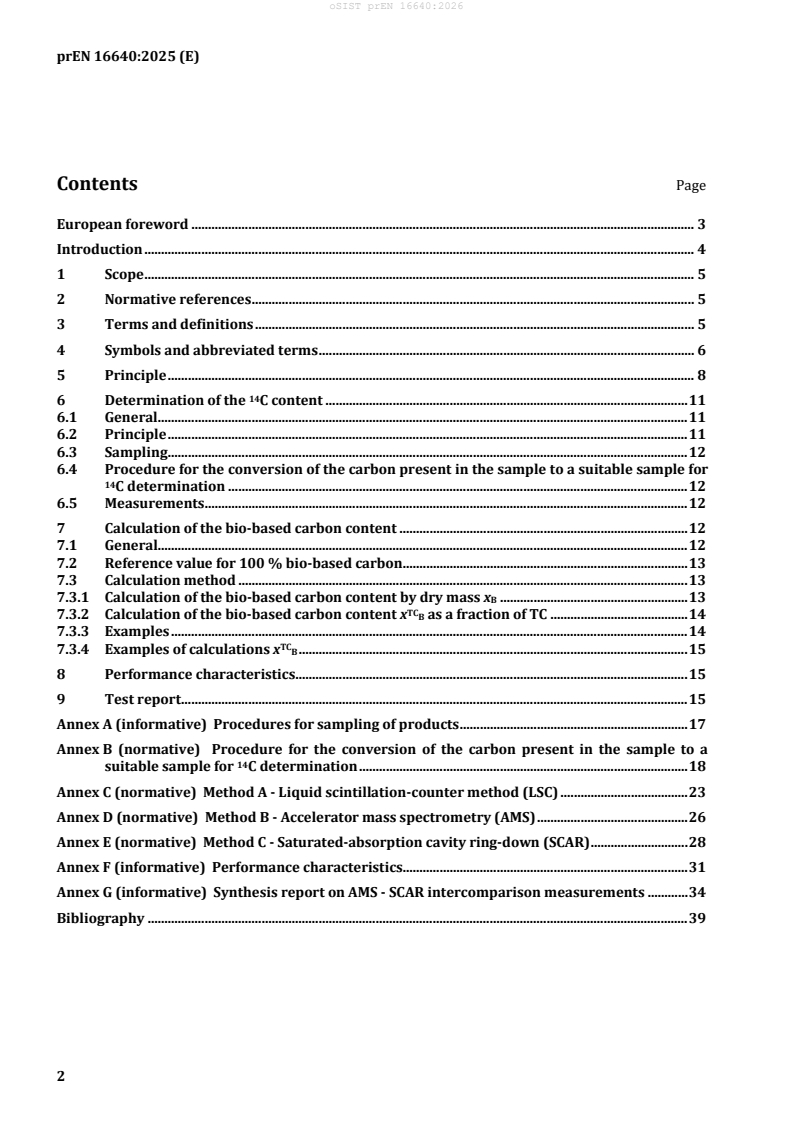
Contents
- Introduction
- 1 Scope
- 2 Normative references
- 3 Terms and definitions
- 3.1 organic material
- 3.2 isotope abundance
- 3.3 percentage modern carbon
- 3.4 laboratory sample
- 3.5 sample
- 3.6 sample preparation
- 3.7 beta particle
- 4 Symbols and abbreviated terms
- 14 S 14 S
- 14 C value (in pMC) of the investigated CO sample
- 5 Principle
- 6 Determination of the C content
- 6.1 General
- 6.2 Principle
- 6.3 Sampling
- 6.4 Procedure for the conversion of the carbon present in the sample to a suitable
- 6.5 Measurements
- 7 Calculation of the bio-based carbon content
- 7.1 General
- 7.2 Reference value for 100 % bio-based carbon
- 7.3 Calculation method
- 8 Performance characteristics
- 9 Test report
- Annex A
- Annex B
- Annex C
- Annex D
- Annex E
- Annex F
- 1 Water-based paint
- 2 Sun lotion component
- 3 Sun lotion component
- 4 Wheat straw panel
- 5 Biodiesel
- 6 Biogas
- 7 Emulsion granules (in sample 8)
- 8 Cosmetic emulsion
- 9 Multi-layer package film
- 10 Bio-based paint
- 11 Water binder
- 12 Particle board, wood-based
- 1 National metrological institute
- 2 Private analytical laboratory
- 3 Oil company
- 4 Private analytical laboratory
- 5 Private AMS facility
- 6 Institute for nuclear research
- 7 Chemical company
- 8 AMS laboratory
- Annex G
- Bibliography
Introduction
Bio-based products from forestry and agriculture have a long history of application, such as paper, board and various chemicals and materials. The last decades have seen the emergence of new bio-based products in the market. Some of the reasons for the increased interest lie in the benefits of bio-based products in relation to the depletion of fossil resources and climate change. Bio-based products can also provide additional product functionalities. These developments have triggered a wave of innovation with the development of knowledge and technologies allowing new transformation processes and product development.
Acknowledging the need for common standards for bio-based products, the European Commission issued
mandate M/492 , resulting in a series of standards developed by CEN/TC 411 during 2012-2017, with a focus on bio-based products other than food, feed and biomass for energy applications. The previous version of this document (EN 16640:2017) was developed under the mandate, but this revised version was developed after the expiration of the mandate, upon the initiative of the stakeholders in CEN/TC 411. The standards of CEN/TC 411 “Bio-based products” provide a common basis on the following aspects:
- common terminology;
- bio-based content determination;
- life cycle assessment (LCA);
- sustainability aspects; and
- declaration tools.
It is important to understand what the term bio-based product covers and how it is being used. The term ‘bio-based’ means 'derived from biomass'. Bio-based products (bottles, insulation materials, wood and wood products, paper, solvents, chemical intermediates, composite materials, etc.) are products which are wholly or partly derived from biomass. It is essential to characterize the amount of biomass contained in the product by, for instance, its bio-based content or bio-based carbon content. The bio-based content of a product does not provide information on its environmental impact or sustainability, which can be assessed through LCA and sustainability criteria. In addition, transparent and unambiguous communication within bio-based value chains is facilitated by a harmonized framework for certification and declaration.
This document has been developed with the aim to specify the method for the determination of bio-based
carbon content in bio-based products using the C method. This method is based on the analytical test methods used for the determination of the age of objects containing carbon. This document provides the reference test methods for laboratories, producers, suppliers and purchasers of bio-based product materials and products. It can be also useful for authorities and inspection organizations.
Part of the research leading to the previous version of this document has been performed under the European Union Seventh Framework Programme (see https://www.biobasedeconomy.eu/research/kbbpps/).
The analytical test methods specified in this document are compatible with those described in ASTM D6866.
A mandate is a standardization task embedded in European trade laws. Mandate M/492 was addressed to the European Standardization bodies, CEN, CENELEC and ETSI, for the development of horizontal European Standards for bio-based products.
oSIST prEN 16640:2026 prEN 16640:2025 (E)
1 Scope
This document specifies a method for the determination of the bio-based carbon content in products,
based on the C content measurement.
This document also specifies three test methods to be used for the determination of the C content from which the bio-based carbon content is calculated:
- method A: Liquid scintillation-counter (LSC); - method B: Accelerator mass spectrometry (AMS); and - method C: Saturated-absorption cavity ring-down (SCAR) spectroscopy. The bio-based carbon content is expressed by a fraction of sample mass or as a fraction of the total carbon content. This calculation method is applicable to any product containing carbon, including biocomposites. NOTE This document does not provide the methodology for the calculation of the biomass content of a sample, see EN 16785-1 and EN 16785-2.
2 Normative references
The following documents are referred to in the text in such a way that some or all of their content constitutes requirements of this document. For dated references, only the edition cited applies. For undated references, the latest edition of the referenced document (including any amendments) applies. EN 16575, Bio-based products - Vocabulary ASTM D6866, Standard Test Methods for Determining the Biobased Content of Solid, Liquid, and Gaseous Samples Using Radiocarbon Analysis
3 Terms and definitions
For the purposes of this document, the terms and definitions given in EN 16575 and the following apply. ISO and IEC maintain terminology databases for use in standardization at the following addresses:
- ISO Online browsing platform: available at https://www.iso.org/obp/
- IEC Electropedia: available at https://www.electropedia.org/
3.1 organic material
material containing carbon-based compound in which the element carbon is attached to other carbon atoms, hydrogen, oxygen, or other elements in a chain, ring, or three-dimensional structure
3.2 isotope abundance
fraction of atoms of a particular isotope of an element
3.3 percentage modern carbon
pMC
normalized and standardized value for the amount of the C isotope in a sample, calculated relative to
the standardized and normalized C isotope amount of oxalic acid standard reference material NIST SRM 4990c
oSIST prEN 16640:2026 prEN 16640:2025 (E) Note 1 to entry: In 2020, the value of 100 % bio-based carbon was set at (100,0 ± 0,5) pMC. Note 2 to entry: SRM 4990c, is the trade name of product supplied by the US National Institute of Standards and Technology. This information is given for the convenience of users of this document and does not constitute an endorsement by CEN of this product. Equivalent products may be used if they can be shown to lead to the same results.
3.4 laboratory sample
sub-quantity of a sample suitable for laboratory tests
3.5 sample
quantity of material, representative of a larger quantity for which the property is to be determined
3.6 sample preparation
all the actions taken to obtain representative analysis samples or test portions from the original sample
3.7 beta particle
electron emitted during radioactive decay
4 Symbols and abbreviated terms
For the purposes of this document, the following symbols and abbreviations apply:
13 13 δ standardized value for isotope fractionation δ = - 0,025 (relative to VPDB) N N
measured isotope fractionation value of the sample. It is obtained by measuring the δ sample 13 12 13 12 C/ C ratio of the sample, relative to the measured C/ C ratio of a reference standard with known isotope fractionation value related to VPDB
standardized isotope fractionation value of the oxalic acid reference standard (HOx-II, δ OX 2
SRM 4990c). δ = - 0,0176 (relative to VPDB).
OX 2
14 S 14 S
a standardized and normalized C amount of the measured sample; a ⋅=100% pMC N N
14 S normalized C signal (isotope concentration or activity) of the measured sample A N
14 0 standardized and normalized C amount of the primary reference standard, oxalic acid A RN (HOx-II, SRM 4990c).
measured C signal (isotope concentration or activity) of the sample A sample
measured C signal (isotope concentration or activity) of the background sample/blank A bg
sample sample, measured in the same batch as the sample and represents the background C signal of the measured samples
measured (average) C signal (isotope concentration or activity) of oxalic acid reference A OX 2 standard samples (HOx-II, SRM 4990c), measured in the same batch as the unknown samples
oSIST prEN 16640:2026 prEN 16640:2025 (E)
measured (average) C signal (isotope concentration or activity) of background samples, A bg OX 2 which represent the background signal of the measured oxalic acid reference standard (HOx-II, SRM 4990c), measured in the same batch as the oxalic acid samples
C carbon isotope with an atomic mass of 14
14 C value (in pMC) of the investigated CO sample
measured 2 C sampleC AMS accelerator mass spectrometry ASD absolute standard deviation Bq bequerel (disintegrations per second) C carbon cpm counts per minute dpm disintegrations per minute
F C content of the sample, expressed in pMC LLD lower limit of detection LSC liquid scintillation counter or liquid scintillation counting m dry mass of a sample expressed in grams
N number of counted beta-decayed C atoms measuring efficiency of the used measurement technique η meas PE polyethylene PLA polylactic acid pMC percentage of modern carbon REF reference value, expressed in pMC, of 100 % bio-based carbon depending on the origin of organic carbon RMS root-mean-square RSD relative standard deviation SCAR saturated-absorption cavity ring-down t duration of the measurement TC total carbon x bio-based carbon content by mass, expressed as a percentage of the mass of the sample B (dry) TC x total carbon content, expressed as a percentage of the mass of the sample (dry) TC bio-based carbon content by total carbon content, expressed as a percentage of the total
B carbon content
oSIST prEN 16640:2026 prEN 16640:2025 (E)
5 Principle
The C is present in products is originating from recent atmospheric CO . Due to its radioactive decay, it
is almost absent from fossil products older than 40 000 years. The C content can thus be considered as a tracer of products recently synthesized from atmospheric CO and particularly of recently produced
bio-based products.
The determination of the bio-based carbon content is based on the measurement of C in bio-based products, which allows the calculation of the bio-based carbon fraction.
Extensive experience in C determination and reference samples is available from dating of archaeological objects, on which the three methods described in this document are based:
- Method A: Liquid scintillation-counter (LSC); - Method B: Accelerator mass spectrometry (AMS); - Method C: Saturated-absorption cavity ring-down (SCAR) spectroscopy. NOTE The corresponding sampling methods are described in Annex A. The advantages and disadvantages of these test methods are given in Table 1. In particular, the typical representative values of the absolute standard deviation (ASD) and the relative standard deviation (RSD), for 1h-long measurement of a modern sample (F = 100 pMC), are given, together with their dependence
on the C-level in the sample (F). For all methods, both ASD and RSD scale with 1/√t, where t is the duration of the measurement. Based on the above general scaling laws, the typical range of measurement duration for practical use is also reported, together with the typical required carbon mass. Table 1 — Advantages and disadvantages of the methods Method Additional ASD RSD Duration needed Typical Equipment requests for measurement carbon costs mass needed Method A - Normal 5 pMC 10 % 2 h to 24 h > 1g Low (LSC) laboratory ∝ √F ∝ 1/√F - Large installation Method B 0,3 pMC 0,3 % - Graphite 10 min to 30 min < 1 mg High (AMS) ∝ √F ∝ 1/√F conversion a device - Normal laboratory Method C 1 pMC 1 % 1 mg to 10 min to 6 h Intermediate (SCAR) constant ∝ 1/F 10 mg - Gas purification device a A few years ago, compact new AMS equipment became available. In a number of cases, no graphite conversion is required anymore.
For method A (LSC) a low-level counter shall be used. The statistical scattering of the radioactive decay sets a limit for method A. Indeed, since this method relies on counting, its precision is ruled by Poisson
statistics and depends on the C level. The statistical uncertainty scales as sqrt(N), where N is the number 14 14 of counted beta-decayed C atoms. Since the C level in the sample (F) is proportional to N, the absolute statistical uncertainty (ASD) will scale also with √F, and consequently the RSD will scale with 1/√F.
oSIST prEN 16640:2026 prEN 16640:2025 (E) Moreover, this method needs a purified carbon dioxide, otherwise nitrogen oxides from the combustion in the calorific bomb will result in counting losses by quenching and adulteration of the cocktail in case of LSC measurement. When using method A, samples with low bio-based carbon content (<10 %) can only be measured with sufficient precision using the benzene conversion procedure or, if applicable, direct LSC measurement, as described in B.4.3.
Since method B relies on counting C ions, its uncertainty is ruled by Poisson statistics, similarly to method A.
For method C (SCAR), differently from methods A and B, the absolute precision (ASD) is independent of
the C level, as it depends only on the fixed instrumental sensitivity of the SCAR spectroscopic technique.
Moreover, the carbon dioxide shall be sufficiently pure to avoid systematic errors in the C measurement. In particular, an overall purity from non-interfering gases of > 99,9 % is required. A few molecules (e.g. N O and SO ) can directly interfere with the measurement, and their mole fraction shall be kept below 2 2 the level of a few part-per-billion. Commercial elemental analysers are available ensuring a combusted CO gas with these purity levels.
Especially for methods A and C, the duration needed for measurement spans over quite wide ranges, since it is related to the required measurement precision. Actually, in the best case of statistical uncertainty ruled by white noise, the precision always scales as 1/√ (t), where t is the averaging time. NOTE Table 1 allows to quickly retrieve a rough estimate of the expected ASD and RSD for a measurement of a
given duration (t) on a sample with a given C level (F). Four practical examples (see Tables 2 to 5) are reported below, showing longer and shorter measurement times and samples with higher and lower pMC. Table 2 — Example 1: 30 min-long measurement of a 5 pMC sample
LSC AMS SCAR ASD @ 100 pMC - 1h 5 pMC 0,3 pMC 1 pMC scaling factor for F √(5 pMC/100 pMC) = 0,22 1 scaling factor for t 1/√(1/2) = 1,4 5 pMC × 0,22 × 1,4 = 0,3 pMC × 0,22 × 1,4 = 1 pMC × 1 × 1,4 = Resulting ASD 1,5 pMC 0,092 pMC 1,4 pMC 1,5 pMC / 5 pMC = 0,092 pMC / 5 pMC = 1,4 pMC / 5 pMC = Resulting RSD 30 % 1,8 % 28 %
oSIST prEN 16640:2026 prEN 16640:2025 (E) Table 3 — Example 2: 2 h-long measurement of a 5 pMC sample LSC AMS SCAR ASD @ 100 pMC - 1h 5 pMC 0,3 pMC 1 pMC scaling factor for F √(5 pMC/100 pMC) = 0,22 1 scaling factor for t 1/√2 = 0,71 5 pMC × 0,22 × 0,71 = 0,3 pMC × 0,22 × 0,71 = 1 pMC × 1 × 0,71 = Resulting ASD 0,078 pMC 0,47 pMC 0,71 pMC 0,078 pMC / 5 pMC = 0,47 pMC / 5 pMC = 0,71 pMC / 5 pMC = Resulting RSD 16 % 0,94 % 14 % Table 4 — Example 3: 30 min-long measurement of a 75 pMC sample
LSC AMS SCAR ASD @ 100 pMC - 1h 5 pMC 0,3 pMC 1 pMC scaling factor for F √(75 pMC/100 pMC) = 0,87 1 scaling factor for t 1/√(1/2) = 1,4 5 pMC × 0,87 × 1,4 = 0,3 pMC × 0,87 × 1,4 = 1 pMC × 1 × 1,4 = Resulting ASD 6,1 pMC 0,37 pMC 1,4 pMC 6,1 pMC / 75 pMC = 0,37 pMC / 75 pMC = 1,4 pMC / 75 pMC = Resulting RSD 8,1 % 0,49 % 1,9 %
oSIST prEN 16640:2026 prEN 16640:2025 (E) Table 5 — Example 4: 2 h-long measurement of a 75 pMC sample
LSC AMS SCAR ASD @ 100 pMC - 1h 5 pMC 0,3 pMC 1 pMC scaling factor for F √(75 pMC/100 pMC) = 0,87 1 scaling factor for t 1/√2 = 0,71 5 pMC × 0,87 × 0,71 = 0,3 pMC × 0,87 × 0,71 = 1 pMC × 1 × 0,71 = Resulting ASD 3,1 pMC 0,18 pMC 0,71 pMC 3,1 pMC / 75 pMC = 0,18 pMC / 75 pMC = 0,71 pMC / 75 pMC = Resulting RSD 4,1 % 0,25 % 0,95 %
6 Determination of the C content
6.1 General
A general sample preparation and three test methods for the determination of the C content are described in this document. With this modular approach, it will be possible for laboratories with standard 14 14 equipment to prepare samples for the C content and determine the C content with own equipment or
to outsource the determination of the C content to laboratories that are specialized in this technique.
For the collection of the C content from the sample, generally accepted methods for the conversion of the carbon present in the sample to CO are described in Annex B.
For the measurement of the C content, two methods (LSC and AMS) that are already generally accepted as methods for the determination of the age of objects are selected. A third method (SCAR) is also selected, which has been specifically developed for the purpose of bio-based carbon measurements.
6.2 Principle
The amount of bio-based carbon in the bio-based product is proportional to its C content. Complete combustion (see Annex B) shall comply with the requirements of the subsequent measurement
of the C content. It shall ensure the quantitative recovery of all carbon present in the sample as CO in
order to yield valid results.
This measurement shall be carried out according to one of the three following methods:
- Method A: Liquid scintillation counter (LSC): indirect determination of the isotope abundance of C, through its emission of beta particles (interaction with scintillation molecules), in accordance with Annex C;
- Method B: Accelerator mass spectrometry (AMS): direct determination of the isotope abundance of
C, in accordance with Annex D; or
oSIST prEN 16640:2026 prEN 16640:2025 (E) - Method C: Saturated-absorption cavity ring-down (SCAR) spectroscopy: indirect determination of the 14 14 isotope abundance of C, through absorption of infrared photons from CO molecules, in
accordance with Annex E.
6.3 Sampling
In Annex A sampling methods for products that are mentioned in the scope are given. For any sampling procedure, the samples shall be representative of the material or product and the quantity or mass of the sample shall be accurately established.
6.4 Procedure for the conversion of the carbon present in the sample to a suitable
sample for C determination
The conversion of the carbon present in the sample to a suitable sample for the determination of the C content shall be carried out according to Annex B.
6.5 Measurements
The measurement of the C content of the sample shall be performed according to one of the methods as described in Annexes C, D and E.
When CO captured in an absorption solution is sent to specialized laboratories, this shall be stored in a
way that no CO from air can enter the absorption solution. A check on the leak of CO from air shall be 2 2 performed by preparing laboratory blanks during the sampling stage. For the determination of the 0 % bio-based carbon fraction the combustion of a fossil reference material (such as coal or ancient Kauri wood) shall be used.
NOTE There are several certified reference materials available, e.g. IAEA-C1 and IAEA-C9. For validation of the 100 % bio-based carbon fraction, oxalic acid standard reference material NIST SRM 4990c shall be used. Mixing reference material NIST 4990c with a known amount of fossil combustion aid improves its combustion behaviour, as oxalic acid is difficult to combust due to its low calorific value. For routine checks, a fresh wood sample calibrated against the standard reference material is sufficient.
7 Calculation of the bio-based carbon content
7.1 General
The calculation of the bio-based carbon content includes the following steps:
TC a) the determination of the total carbon content of the sample, x , expressed as a percentage of the total dry mass (for method A);
b) the calculation of the bio-based carbon content by mass, x , using the C content value, determined B by calculation from one of the test methods specified in 7.3, and applying the correction factors detailed in 7.2 (for method A); TC c) the calculation of the bio-based carbon content as a fraction of the total carbon content, x (see B 7.3.2) (for methods A, B and C).
oSIST prEN 16640:2026 prEN 16640:2025 (E)
...