

EN 13564-1:2002
(Main)Anti-flooding devices for buildings - Part 1: Requirements
General Information
- Abstract
This part of this European Standard specifies types and requirements for materials, performance, design, construction and marking for factory made anti-flooding devices for faecal and/or non-faecal waste water for use in drainage systems of buildings, or within the curtilage of buildings, operated under gravity.
- Status
- Published
- Publication Date
- 09-Jul-2002
- Technical Committee
- CEN/TC 165 - Waste water engineering
- Drafting Committee
- CEN/TC 165/WG 11 - Waste fittings
- Current Stage
- 9093 - Decision to confirm - Review Enquiry
- Start Date
- 09-Jun-2022
- Completion Date
- 30-Sep-2026
- Directive
- 305/2011 - Regulation (eu) No 305/2011 of the European Parliament and of the Council of 9 march 2011 laying down harmonised conditions for the marketing of construction products and repealing council directive 89/106/eecOJ Ref: C, C 259 OJ Date: 08-Aug-2014
89/106/EEC - Construction productsOJ Ref: C, C 139, C 319, C 320 OJ Date: 20-Dec-2002

Overview
EN 13564-1:2002 - "Anti-flooding devices for buildings - Part 1: Requirements" is a CEN European Standard that defines types, materials, performance, design, construction, marking and documentation for factory-made anti-flooding (backflow prevention) devices used in building drainage systems operating under gravity. It covers devices for faecal and non-faecal waste water installed in pipes, waste fittings or floor gullies, and supports CE marking and conformity assessment under the Construction Products Directive.
Key topics and technical requirements
- Device types (0–5): classification by design and intended use - e.g. types 0–3 for inline pipe devices, types 4–5 for devices incorporated in waste fittings/floor gullies; type 3 includes devices actuated by external energy.
- Materials & temperature resistance: materials must withstand domestic wastewater; types 0–3 up to 75 °C, types 4–5 up to 93 °C. Non-corrosion-resistant materials must be protected.
- Performance & hydraulics:
- Automatic closure must operate when backflow occurs and allow normal flow when backflow stops.
- General low-flow opening: device must open at an upstream water depth of 50% of pipe diameter (or max 50 mm); types 0–2 have a special requirement to open at minimum 70% of internal diameter.
- Moving parts clearance: minimum 0.05 × DN (in mm) and not less than 6 mm for outlets > DN100.
- Leakage limit: ≤ 0.5 L per test cycle (specified test methods in Part 2).
- Type‑specific performance:
- Type 3 - automatic closure powered externally; must begin closing by a backflow level of 100 mm, close within 60 s, retain ≥90% cross-sectional area when open, indicate closed position (optical/acoustic) even on power failure.
- Types 0–2 - body must retain ≥90% cross-sectional area; body and covers watertight to 0.5 bar.
- Construction & serviceability: smooth internal surfaces, limited invert steps (≤ 6 mm), detachable or in-situ dismantlable moving parts, rodding/cleaning access.
- Marking & documentation: devices must be durably marked (EN 13564, manufacturer, type, flow direction, nominal outlet size, manufacture date) and supplied with illustrated installation, operation and maintenance instructions.
- Durability, quality control & conformity: product deemed durable if requirements met; quality control per Part 3; Annex ZA links clauses to CE marking and conformity assessment.
Applications
- Prevention of internal flooding and sewer backflow in residential, commercial and public buildings.
- Use in gravity drainage systems: inline backflow valves, integrated floor gullies, sanitary appliance waste fittings.
- Relevant where protection against faecal and/or non‑faecal wastewater backflow is required.
Who uses this standard
- Manufacturers and designers of anti-flooding devices and floor gullies
- Building services engineers, plumbing specifiers and architects
- Installers, maintenance teams and test agencies
- Certification bodies and regulators assessing conformity and CE marking
Related standards
- EN 12056-1 (gravity drainage systems inside buildings)
- prEN 13564-2 (test methods) and prEN 13564-3 (quality control)
- EN 1253-1 (gullies), EN 476 (component requirements), prEN 274-1 (waste fittings)
- ISO 228-1 (thread dimensions)
Keywords: EN 13564-1, anti-flooding devices, backflow prevention, building drainage, CE marking, floor gullies, drainage systems, waste water protection.
Relations
- Effective Date
- 25-Aug-2026
- Effective Date
- 28-Jan-2026
- Effective Date
- 28-Jan-2026
- Effective Date
- 28-Jan-2026
- Effective Date
- 28-Jan-2026
- Effective Date
- 28-Jan-2026
- Effective Date
- 28-Jan-2026
- Effective Date
- 28-Jan-2026
- Effective Date
- 28-Jan-2026
- Referred By
EN 16941-1:2024 - On-site non-potable water systems - Part 1: Systems for the use of rainwater - Effective Date
- 28-Jan-2026
- Referred By
EN 16941-1:2018 - On-site non-potable water systems - Part 1: Systems for the use of rainwater - Effective Date
- 28-Jan-2026
Get Certified
Connect with accredited certification bodies for this standard

DIBt (Deutsches Institut für Bautechnik)
German Institute for Building Technology.
DIN CERTCO
DIN Group product certification.

Aboma Certification B.V.
Specialized in construction, metal, and transport sectors.
Sponsored listings
Frequently Asked Questions
EN 13564-1:2002 is a standard published by the European Committee for Standardization (CEN). Its full title is "Anti-flooding devices for buildings - Part 1: Requirements". This standard covers: This part of this European Standard specifies types and requirements for materials, performance, design, construction and marking for factory made anti-flooding devices for faecal and/or non-faecal waste water for use in drainage systems of buildings, or within the curtilage of buildings, operated under gravity.
This part of this European Standard specifies types and requirements for materials, performance, design, construction and marking for factory made anti-flooding devices for faecal and/or non-faecal waste water for use in drainage systems of buildings, or within the curtilage of buildings, operated under gravity.
EN 13564-1:2002 is classified under the following ICS (International Classification for Standards) categories: 91.140.80 - Drainage systems. The ICS classification helps identify the subject area and facilitates finding related standards.
EN 13564-1:2002 has the following relationships with other standards: It is inter standard links to ISO 228-1:2000, EN 1253-2:2015, EN 13564-2:2002, EN 476:2022, EN 1253-2:2003, EN 274-1:2002, EN 13564-3:2003, EN 12056-1:2000, EN 16941-2:2021, EN 16941-1:2024, EN 16941-1:2018. Understanding these relationships helps ensure you are using the most current and applicable version of the standard.
EN 13564-1:2002 is associated with the following European legislation: EU Directives/Regulations: 305/2011, 89/106/EEC; Standardization Mandates: M/118. When a standard is cited in the Official Journal of the European Union, products manufactured in conformity with it benefit from a presumption of conformity with the essential requirements of the corresponding EU directive or regulation.
EN 13564-1:2002 is available in PDF format for immediate download after purchase. The document can be added to your cart and obtained through the secure checkout process. Digital delivery ensures instant access to the complete standard document.
Standards Content (Sample)
2003-01.Slovenski inštitut za standardizacijo. Razmnoževanje celote ali delov tega standarda ni dovoljeno.Anti-flooding devices for buildings - Part 1: RequirementsClapets anti-retour pour les bâtiments - Partie 1.2 : SpécificationsRückstauverschlüsse für Gebäude - Teil 1: AnforderungenTa slovenski standard je istoveten z:EN 13564-1:2002SIST EN 13564-1:2002en91.140.80ICS:SLOVENSKI
STANDARDSIST EN 13564-1:200201-december-2002
EUROPEAN STANDARDNORME EUROPÉENNEEUROPÄISCHE NORMEN 13564-1July 2002ICS 91.140.80English versionAnti-flooding devices for buildings - Part 1: RequirementsClapets anti-retour pour les bâtiments - Partie 1:SpécificationsRückstauverschlüsse für Gebäude - Teil 1: AnforderungenThis European Standard was approved by CEN on 10 May 2002.CEN members are bound to comply with the CEN/CENELEC Internal Regulations which stipulate the conditions for giving this EuropeanStandard the status of a national standard without any alteration. Up-to-date lists and bibliographical references concerning such nationalstandards may be obtained on application to the Management Centre or to any CEN member.This European Standard exists in three official versions (English, French, German). A version in any other language made by translationunder the responsibility of a CEN member into its own language and notified to the Management Centre has the same status as the officialversions.CEN members are the national standards bodies of Austria, Belgium, Czech Republic, Denmark, Finland, France, Germany, Greece,Iceland, Ireland, Italy, Luxembourg, Malta, Netherlands, Norway, Portugal, Spain, Sweden, Switzerland and United Kingdom.EUROPEAN COMMITTEE FOR STANDARDIZATIONCOMITÉ EUROPÉEN DE NORMALISATIONEUROPÄISCHES KOMITEE FÜR NORMUNGManagement Centre: rue de Stassart, 36
B-1050 Brussels© 2002 CENAll rights of exploitation in any form and by any means reservedworldwide for CEN national Members.Ref. No. EN 13564-1:2002 E
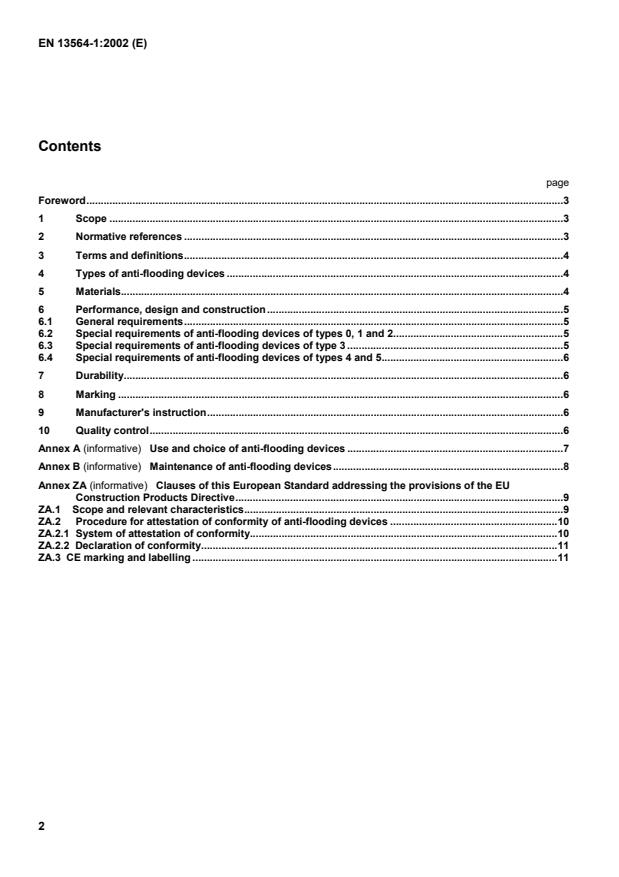
Use and choice of anti-flooding devices.7Annex B (informative)
Maintenance of anti-flooding devices.8Annex ZA (informative)
Clauses of this European Standard addressing the provisions of the EUConstruction Products Directive.9ZA.1
Scope and relevant characteristics.9ZA.2 Procedure for attestation of conformity of anti-flooding devices.10ZA.2.1System of attestation of conformity.10ZA.2.2
Declaration of conformity.11ZA.3
CE marking and labelling.11
...