

EN 71-19:2024
(Main)Safety of toys - Part 19: Migration of bisphenol A from toy materials
- Abstract
This document specifies requirements and a test method for migration of bisphenol A from toy materials. This document is applicable to toys intended for use by children under 36 months or other toys intended to be placed in the mouth.
NOTE The European Commission Guidance Document No 11 on the Application of Directive 2009/48/EC on the Safety of Toys [3] provides guidelines to help on the classification of toys intended for children under 36 months of age or of 36 months and over.
- Status
- Published
- Publication Date
- 17-Dec-2024
- Technical Committee
- CEN/TC 52 - Safety of toys
- Drafting Committee
- CEN/TC 52/WG 15 - Appendix C test methods
- Current Stage
- 6060 - Definitive text made available (DAV) - Publishing
- Start Date
- 18-Dec-2024
- Due Date
- 28-Aug-2024
- Completion Date
- 18-Dec-2024

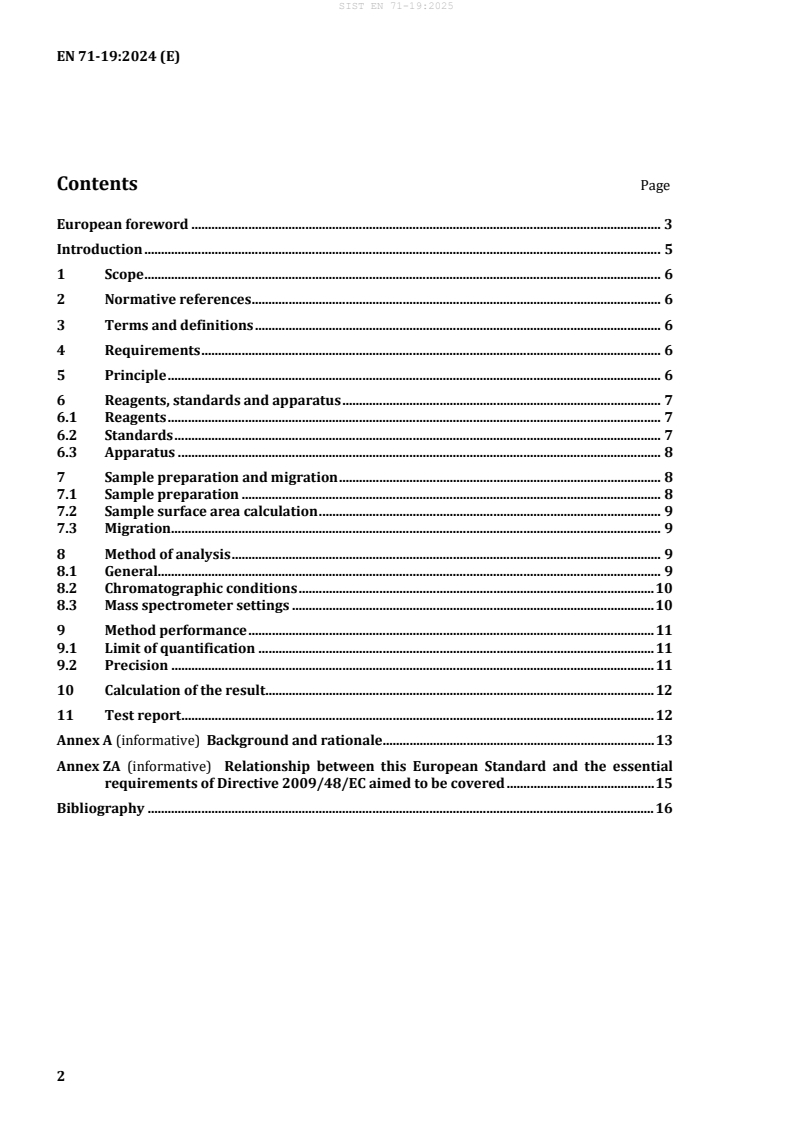
Overview - EN 71-19:2024 (Safety of toys: migration of bisphenol A)
EN 71-19:2024 is a CEN European standard that specifies requirements and a test method for the migration of bisphenol A (BPA) from toy materials. It applies to toys intended for children under 36 months and to any toy likely to be placed in the mouth. The standard implements the limit value in Directive 2009/48/EC (as amended by Commission Directive (EU) 2017/898) and provides a laboratory procedure to check compliance.
Key topics and technical requirements
- Limit value: Migration of BPA shall not exceed 0.04 mg/l when tested according to EN 71-19.
- Simulant and conditions: Uses purified water as the simulant; migration performed by shaking the sample at 37 °C for 3 hours.
- Sample preparation: Test toys uncut where possible; sample surface area considerations and cutting rules (typical sample surface ~5.0 ± 0.5 cm²; max total 10 cm² for whole toys).
- Analytical method: Quantification by liquid chromatography–tandem mass spectrometry (LC‑MS/MS) using multiple reaction monitoring (MRM). Internal standards (e.g., deuterated BPA) and calibration solutions are specified.
- Apparatus and reagents: Specifies horizontal shaker, narrow-neck laboratory bottle, 0.2 µm membrane filters (non-adsorptive), C18 reversed-phase LC columns and analytical-grade reagents (methanol, purified water).
- Performance and reporting: Clauses on limit of quantification, precision, calculation of results and required content for the test report.
- Supporting information: Annex A gives background and rationale; Annex ZA maps the standard to the essential requirements of the toy safety Directive.
Practical applications and users
Who uses EN 71-19:2024:
- Toy manufacturers and material suppliers - to design and verify materials meet BPA migration limits.
- Test laboratories - to implement the specified migration procedure and LC‑MS/MS analysis for certification and compliance testing.
- Regulatory authorities and market surveillance bodies - to assess conformity with EU toy safety requirements.
- Product safety and quality teams - to include BPA migration testing in routine safety assessments for chewable or mouthable toys and early-age products.
Practical value:
- Provides a harmonized, reproducible method for verifying BPA migration.
- Helps ensure toys placed in the mouth or used by infants comply with EU chemical safety limits.
- Supports market access by aligning testing to the EN 71 series and Directive 2009/48/EC.
Related standards
EN 71-19 is part of the EN 71 series (Safety of toys). Related parts of interest include:
- EN 71-1 (Mechanical and physical properties)
- EN 71-3 (Migration of certain elements)
- EN 71-10 / 11 (Organic chemical compounds - sample preparation & methods)
- Other EN 71 parts covering chemical, microbiological and physical hazards relevant to toy safety.
Keywords: EN 71-19:2024, bisphenol A, BPA migration, toy safety, LC‑MS/MS, Directive 2009/48/EC, children under 36 months.
Relations
- Effective Date
- 28-Jan-2026
- Effective Date
- 10-Feb-2026
- Effective Date
- 28-Jan-2026
- Effective Date
- 28-Jan-2026
- Effective Date
- 28-Jan-2026
- Effective Date
- 28-Jan-2026
- Effective Date
- 28-Jan-2026
- Effective Date
- 28-Jan-2026
- Effective Date
- 28-Jan-2026
- Effective Date
- 28-Jan-2026
- Effective Date
- 28-Jan-2026
- Effective Date
- 28-Jan-2026
- Effective Date
- 28-Jan-2026
- Effective Date
- 28-Jan-2026
- Effective Date
- 28-Jan-2026
Frequently Asked Questions
EN 71-19:2024 is a standard published by the European Committee for Standardization (CEN). Its full title is "Safety of toys - Part 19: Migration of bisphenol A from toy materials". This standard covers: This document specifies requirements and a test method for migration of bisphenol A from toy materials. This document is applicable to toys intended for use by children under 36 months or other toys intended to be placed in the mouth. NOTE The European Commission Guidance Document No 11 on the Application of Directive 2009/48/EC on the Safety of Toys [3] provides guidelines to help on the classification of toys intended for children under 36 months of age or of 36 months and over.
This document specifies requirements and a test method for migration of bisphenol A from toy materials. This document is applicable to toys intended for use by children under 36 months or other toys intended to be placed in the mouth. NOTE The European Commission Guidance Document No 11 on the Application of Directive 2009/48/EC on the Safety of Toys [3] provides guidelines to help on the classification of toys intended for children under 36 months of age or of 36 months and over.
EN 71-19:2024 is classified under the following ICS (International Classification for Standards) categories: 97.190 - Equipment for children. The ICS classification helps identify the subject area and facilitates finding related standards.
EN 71-19:2024 has the following relationships with other standards: It is inter standard links to EN ISO 3696:1995, CEN/CLC Guide 14:2009, EN ISO 10256-2:2024, EN 1176-2:2017+AC:2019, EN 12503-4:2016, EN 1176-2:2017, EN 958:2017, EN 958:2024, EN 12767:2019, EN 892:2012+A3:2023, EN 12492:2025, EN 892:2012+A1:2016, CEN/TS 17342:2019, EN 17950:2024, EN 1621-3:2018. Understanding these relationships helps ensure you are using the most current and applicable version of the standard.
EN 71-19:2024 is associated with the following European legislation: EU Directives/Regulations: 2009/48/EC; Standardization Mandates: M/445, M/589, M/XXX. When a standard is cited in the Official Journal of the European Union, products manufactured in conformity with it benefit from a presumption of conformity with the essential requirements of the corresponding EU directive or regulation.
EN 71-19:2024 is available in PDF format for immediate download after purchase. The document can be added to your cart and obtained through the secure checkout process. Digital delivery ensures instant access to the complete standard document.
Standards Content (Sample)
SLOVENSKI STANDARD
01-julij-2025
Varnost igrač - 19. del: Migracija bisfenola A iz materialov za igrače
Safety of toys - Part 19: Migration of bisphenol A from toy materials
Sicherheit von Spielzeug - Teil 19: Migration von Bisphenol A aus Spielzeugmaterial
Sécurité des jouets - Partie 19 : Migration du bisphénol A depuis les matériaux-jouets
Ta slovenski standard je istoveten z: EN 71-19:2024
ICS:
97.200.50 Igrače Toys
2003-01.Slovenski inštitut za standardizacijo. Razmnoževanje celote ali delov tega standarda ni dovoljeno.
EN 71-19
EUROPEAN STANDARD
NORME EUROPÉENNE
December 2024
EUROPÄISCHE NORM
ICS 97.190
English Version
Safety of toys - Part 19: Migration of bisphenol A from toy
materials
Sécurité des jouets - Partie 19 : Migration du bisphénol Sicherheit von Spielzeug - Teil 19: Migration von
A depuis les matériaux-jouets Bisphenol A aus Spielzeugmaterial
This European Standard was approved by CEN on 1 December 2024.
CEN members are bound to comply with the CEN/CENELEC Internal Regulations which stipulate the conditions for giving this
European Standard the status of a national standard without any alteration. Up-to-date lists and bibliographical references
concerning such national standards may be obtained on application to the CEN-CENELEC Management Centre or to any CEN
member.
This European Standard exists in three official versions (English, French, German). A version in any other language made by
translation under the responsibility of a CEN member into its own language and notified to the CEN-CENELEC Management
Centre has the same status as the official versions.
CEN members are the national standards bodies of Austria, Belgium, Bulgaria, Croatia, Cyprus, Czech Republic, Denmark, Estonia,
Finland, France, Germany, Greece, Hungary, Iceland, Ireland, Italy, Latvia, Lithuania, Luxembourg, Malta, Netherlands, Norway,
Poland, Portugal, Republic of North Macedonia, Romania, Serbia, Slovakia, Slovenia, Spain, Sweden, Switzerland, Türkiye and
United Kingdom.
EUROPEAN COMMITTEE FOR STANDARDIZATION
COMITÉ EUROPÉEN DE NORMALISATION
EUROPÄISCHES KOMITEE FÜR NORMUNG
CEN-CENELEC Management Centre: Rue de la Science 23, B-1040 Brussels
© 2024 CEN All rights of exploitation in any form and by any means reserved Ref. No. EN 71-19:2024 E
worldwide for CEN national Members.
Contents Page
European foreword . 3
Introduction . 5
1 Scope . 6
2 Normative references . 6
3 Terms and definitions . 6
4 Requirements . 6
5 Principle . 6
6 Reagents, standards and apparatus . 7
6.1 Reagents . 7
6.2 Standards . 7
6.3 Apparatus . 8
7 Sample preparation and migration . 8
7.1 Sample preparation . 8
7.2 Sample surface area calculation . 9
7.3 Migration . 9
8 Method of analysis . 9
8.1 General. 9
8.2 Chromatographic conditions . 10
8.3 Mass spectrometer settings . 10
9 Method performance . 11
9.1 Limit of quantification . 11
9.2 Precision . 11
10 Calculation of the result. 12
11 Test report . 12
Annex A (informative) Background and rationale . 13
Annex ZA (informative) Relationship between this European Standard and the essential
requirements of Directive 2009/48/EC aimed to be covered . 15
Bibliography . 16
European foreword
This document (EN 71-19:2024) has been prepared by Technical Committee CEN/TC 52 “Safety of toys”,
the secretariat of which is held by DS.
This European Standard shall be given the status of a national standard, either by publication of an
identical text or by endorsement, at the latest by June 2025, and conflicting national standards shall be
withdrawn at the latest by June 2025.
Attention is drawn to the possibility that some of the elements of this document may be the subject of
patent rights. CEN shall not be held responsible for identifying any or all such patent rights.
This document has been prepared under a standardization request addressed to CEN by the European
Commission. The Standing Committee of the EFTA States subsequently approves these requests for its
Member States.
For the relationship with EU Legislation, see informative Annex ZA, which is an integral part of this
document.
Additional information on the background and rationale for various requirements are given in Annex A.
th
This document constitutes the 19 part of the EN 71 series of standards on safety of toys.
EN 71, Safety of toys, consists of the following parts:
— Part 1: Mechanical and physical properties;
— Part 2: Flammability;
— Part 3: Migration of certain elements;
— Part 4: Experimental sets for chemistry and related activities;
— Part 5: Chemical toys (sets) other than experimental sets;
— Part 7: Finger paints — Requirements and test methods;
— Part 8: Activity toys for domestic use;
— Part 10: Organic chemical compounds — Sample preparation and extraction;
— Part 11: Organic chemical compounds — Methods of analysis;
— Part 12: N-Nitrosamines and N-nitrosatable substances;
— Part 13: Olfactory board games, cosmetic kits and gustative games;
— Part 14: Trampolines for domestic use;
— Part 15: Formamide in foam toy materials (content) (under development);
— Part 16: Certain chlorinated phosphorus flame retardants (TCEP, TCPP, TDCP) in toy materials (under
development);
— Part 17: Certain isothiazolinones (MIT, CIT, BIT) in aqueous toy materials (under development);
— Part 18: Phenol in aqueous (content) and polymeric (migration) toy materials;
— Part 19: Migration of bisphenol A from toy materials (this document);
— Part 20: Microbiological safety of toys containing accessible aqueous media (under development).
It is up to the user of the standard to determine whether or not a toy is included in the scope of several of
the above parts of the EN 71 series, and to apply each applicable standard accordingly. Normative
references from one part of the EN 71 series to another, are therefore normally not provided in the
individual parts.
NOTE 1 In addition to the above parts of EN 71, the following deliverables have been published:
— CEN/TR 15071, Safety of toys — National translations of warnings and instructions for use in the EN 71
series;
— the CEN/TR 15371 series, Safety of toys — Interpretations;
— CEN/TR 16918, Safety of toys — Children's mouthing behaviour in contact with toys;
— CEN/TR 17695, Safety of toys — Mechanical and physical properties — Guidance on categorisation of
projectile toys within EN 71-1;
— CEN/TS 17973, Safety of toys — Categorization of slime type materials; and
— CEN ISO/TR 8124-8, Safety of toys — Part 8: Age determination — First age grade for the appropriate
play of toys (ISO/TR 8124-8).
NOTE 2 Words in italics (apart from document titles) are defined in Clause 3 (Terms and definitions).
Any feedback and questions on this document should be directed to the users’ national standards body.
A complete listing of these bodies can be found on the CEN website.
According to the CEN-CENELEC Internal Regulations, the national standards organisations of the
following countries are bound to implement this European Standard: Austria, Belgium, Bulgaria, Croatia,
Cyprus, Czech Republic, Denmark, Estonia, Finland, France, Germany, Greece, Hungary, Iceland, Ireland,
Italy, Latvia, Lithuania, Luxembourg, Malta, Netherlands, Norway, Poland, Portugal, Republic of North
Macedonia, Romania, Serbia, Slovakia, Slovenia, Spain, Sweden, Switzerland, Türkiye and the United
Kingdom.
Introduction
According to article 46 of Directive 2009/48/EC on the safety of toys [1] the “Commission may adopt
specific limit values for chemicals used in toys intended for use by children under 36 months or in other
toys intended to be placed in the mouth”.
In May 2017, the European Commission amended Appendix C to Annex II to this Directive accordingly
and adopted a specific limit value for bisphenol A in toys (see Commission Directive (EU) 2017/898 [2]).
This document provides a test method to check compliance with this limit value.
WARNING — The application of the test method specified in this document can involve hazardous
materials, operations and equipment. The document does not purport to address all of the safety or
environmental problems associated with its use.
1 Scope
This document specifies requirements and a test method for migration of bisphenol A from toy materials.
This document is applicable to toys intended for use by children under 36 months or other toys intended
to be placed in the mouth.
NOTE The European Commission Guidance Document No 11 on the Application of Directive 2009/48/EC on
the Safety of Toys [3] provides guidelines to help on the classification of toys intended for children under 36 months
of age or of 36 months and over.
2 Normative references
The following documents are referred to in the text in such a way that some or all of their content
constitutes requirements of this document. For dated references, only the edition cited applies. For
undated references, the latest edition of the referenced document (including any amendments) applies.
EN ISO 3696:1995, Water for analytical laboratory use — Specification and test methods (ISO 3696:1987)
3 Terms and definitions
For the purposes of this document, the following terms and definitions apply.
ISO and IEC maintain terminology databases for use in standardization at the following addresses:
— ISO Online browsing platform: available at https://www.iso.org/obp/
— IEC Electropedia: available at https://www.electropedia.org/
3.1
sample
part of the toy material subject to testing
Note 1 to entry: A sample can consist of more than one material if the materials cannot be separated (e.g. coatings
on a base material).
4 Requirements
Migration of bisphenol A from toy materials shall not exceed 0,04 mg/l when tested according to the
method specified in this document.
NOTE This limit corresponds to the limit value specified in Directive 2009/48/EC [1] which was introduced by
Commission Directive (EU) 2017/898 [2].
5 Principle
The migration of bisphenol A from toy material is tested by using water as simulant. Migration conditions
are shaking the sample at 37 °C for 3 h. The migration solution is analysed using a liquid chromatography
system coupled with a tandem mass spectrometer (LC-MS/MS) in multiple reaction monitoring (MRM)
mode.
NOTE More information on selection of simulant and migration conditions can be found in Clause A.1.
6 Reagents, standards and apparatus
6.1 Reagents
Unless otherwise specified, all reagents shall be at least analytical grade. Reagents shall be stored as
specified by the supplier.
6.1.1 Methanol (CAS No. 67-56-1)
6.1.2 Purified water, conforming to at least grade 3 of EN ISO 3696:1995.
6.2 Standards
The following calibration standard and internal standard can either be neat substances or solutions of
known purity. Standards shall be stored as specified by the supplier.
The scheme for preparing the calibration solutions may be modified as long as the calibration solutions
correspond to those specified in 6.2.4.4.
6.2.1 Calibration standard
Bisphenol A (CAS No. 80-05-7) (BPA).
6.2.2 Internal standard
Bisphenol A-d16 (CAS No. 96210-87-6) (d16-BPA), bisphenol A-d14 (CAS No. 120155-79-5) or
bisphenol A-d8 (CAS No. 92739-58-7) (d8-BPA).
6.2.3 Internal standard solutions
6.2.3.1 Internal standard stock solution
Prepare a stock solution containing the internal standard (6.2.2) in methanol (6.1.1) at a concentration
of 1 000 mg/l.
6.2.3.2 Internal standard intermediate solution
Prepare the internal standard intermediate solution by diluting the internal standard stock solution
(6.2.3.1) with methanol (6.1.1) to a concentration of 10 mg/l internal standard.
6.2.4 Calibration standard solutions
6.2.4.1 Calibration standard stock solution
Prepare a stock solution containing BPA (6.2.1) in methanol (6.1.1) at a concentration of 1 000 mg/l.
6.2.4.2 Calibration standard intermediate solution 1
Prepare the calibration standard intermediate solution 1 by diluting the calibration standard stock
solution (6.2.4.1) with water (6.1.2) to a concentration of 5 mg/l BPA.
6.2.4.3 Calibration standard intermediate solution 2
Prepare the calibration standard intermediate solution 2 by diluting the calibration standard
intermediate solution 1 (6.2.4.2) with water (6.1.2) to a concentration of 0,5 mg/l BPA.
6.2.4.4 Calibration solutions
Prepare at least five calibration solutions by diluting the calibration standard intermediate solution 2
(6.2.4.3) with water (6.1.2). The BPA concentrations of the calibration solutions shall range from
0,005 mg/l to 0,5 mg/l. Transfer 1 ml of each calibration solution in a LC vial and add 10 µl of the internal
standard intermediate solution (6.2.3.2) to each calibration solution. Close the vials and shake to
homogenize the solutions.
NOTE The calibration range can be extended by using additional calibration solutions.
6.3 Apparatus
Standard laboratory equipment and the following shall be used.
6.3.1 Horizontal shaker, capable of maintaining a temperature of (37 ± 2) °C and 150 (±10) strokes
per minute.
EXAMPLE This can be a horizontal shaker placed in an oven, an incubator with a permanently installed shaker
or a shaking water bath.
6.3.2 Laboratory round bottle, narrow neck, with screw cap, with a concave (curved inward) bottom,
nominal volume 250 ml.
EXAMPLE GL 45 Laboratory Bottle, clear, with screw cap and pouring ring, PP, blue, capacity 250 ml, diameter
70 mm, height 143 mm.
NOTE When the bottom of the bottle is not totally flat (e.g. concave), it is usually ensured that flat samples are
not sticking to the bottom and are therefore wetted from both sides.
6.3.3 Membrane filter with a pore size of 0,2 µm.
The membrane filters used shall not adsorb the analyte.
EXAMPLE Membrane filter made from PET have been shown to be suitable.
6.3.4 Liquid chromatography system coupled with a tandem mass spectrometer (LC-MS/MS),
equipped with electrospray ionization (ESI) or atmospheric pressure chemical ionization (APCI).
6.3.5 Analytical reversed phase LC column, C18
1)
EXAMPLE Macherey und Nagel, EC 100/4.6 Nucleodur C18 Gravity 1,8 µm
7 Sample preparation and
...