

EN 1993-1-6:2025/prA1
(Amendment)Eurocode 3 - Design of steel structures - Part 1-6: Strength and stability of shell structures
- Abstract
1.1 Scope
(1) EN 199316 provides rules for the structural design of plated steel structures that have the form of a shell of revolution (axisymmetric shell).
(2) This document is applicable to unstiffened fabricated axisymmetric shells formed from isotropic rolled plates using both algebraic and computational procedures, and to stiffened axisymmetric shells with different wall constructions using computational procedures. It also
applies to associated circular or annular plates and to beam section rings and stringer stiffeners where they form part of the complete shell structure. The general computational procedures are applicable to all shell forms.
(3) This document does not apply to manufactured shells or to shell panels or to elliptical shell forms, except that its computational procedures are applicable to all shell structures. This document does not apply to structures under seismic or other dynamic loading. It does not cover the aspects of leakage of stored liquids or solids.
(4) Cylindrical and conical panels are not explicitly covered by this document. However, the provisions of 9.8 can be used provided that appropriate boundary conditions are taken into account.
(5) This document defines the characteristic and design values of the resistance of the structure.
(6) This document is concerned with the requirements for design against the ultimate limit states of:
— plastic failure;
— cyclic plasticity;
— buckling;
— fatigue.
(7) Overall equilibrium of the structure (sliding, uplifting, overturning) is not included in this document. Special considerations for specific applications are included in the relevant application parts of EN 1993.
(8) Detailed formulae for the simple calculation of unstiffened cylinders, cones and spherical domes are given in the Annexes.
(9) Provisions for simple calculations on specific stiffened shell types are given in EN 199341.
(10) This document is intended for application to steel shell structures. Where no standard exists for shell structures made of other metals, including high strength steels, the provisions of this document are applicable provided the appropriate material properties of the metal are taken into account.
(11) The provisions of this document are intended to be applied within the temperature ranges defined in the relevant EN 1993 application parts.
(12) Where no application part defines a different range, this document applies to structures within the following limits:
— design metal temperatures lie within the range −50 °C to +100 °C, except when using the special provisions given in 5.1;
— radius to thickness ratios (r/t) within the range 50 to 2 000;
— manufactured circular hollow sections according to EN 10210 and EN 10219 are outside the scope of this document and are covered by EN 199311.
However, if no other provisions are available, the rules of this document are useful for manufactured circular hollow sections. In
particular, this document is applicable to the design of manufactured piles (see EN 19935) provided the imperfections and tolerance requirements of EN 19935 are adopted in place of those specified in this document, and where no other standard covers the specific pile geometry.
NOTE 1 Experimental and theoretical data relating to manufactured circular hollow sections were not considered when this document was drafted. The application of this document to such structures therefore remains the responsibility of the user.
NOTE 2 The stress design rules of this document can be rather conservative if applied to some geometries and loading conditions for relatively thickwalled shells.
NOTE 3 Thinner shells than r/t = 2 000 can be treated using these provisions but the provisions have not been verified for such thin shells.
NOTE 4 The maximum temperature is restricted so that the influence of creep can be ignored where high temperature creep effects are not covered by the relevant application part.
[...]
- Status
- Not Published
- Publication Date
- 13-Aug-2028
- Technical Committee
- CEN/TC 250 - Structural Eurocodes
- Drafting Committee
- CEN/TC 250/SC 3/WG 6 - Evolution of EN 1993-1-6 - Shell structures
- Current Stage
- 4020 - Submission to enquiry - Enquiry
- Start Date
- 17-Sep-2026
- Due Date
- 30-Nov-2026
- Completion Date
- 17-Sep-2026

EN 1993-1-6:2025/prA1 is a CEN draft amendment to EN 1993-1-6:2025, Eurocode 3 - Part 1-6 for the strength and stability of shell structures. It updates the design rules for axisymmetric steel shell structures, with a focus on buckling checks, tolerance assessment, and calculation methods.
What does EN 1993-1-6:2025/prA1 specify?
EN 1993-1-6:2025/prA1 specifies amendments to the existing shell-structure Eurocode part rather than a new design topic. It revises references, clarifies how some checks are carried out, and corrects formulae and definitions used in the buckling-related clauses and annexes.
The draft amendment is organized into changes to the whole document, the Introduction, Clause 2 on normative references, Clause 5 on materials and geometry, Clause 6 on structural analysis, Clause 9 on the buckling limit state, and Annexes A, D and E.
| Annex | What it covers |
|---|---|
| Annex A | Membrane theory stresses in unstiffened shells |
| Annex D | Formulae for buckling resistance of unstiffened shells using stress design |
| Annex E | Formulae for buckling resistance of unstiffened shells using reference resistance design |
What are the key requirements of EN 1993-1-6:2025/prA1?
EN 1993-1-6:2025/prA1 mainly tightens how shell buckling is checked and how several calculation steps are written. In practice, it affects how engineers read tolerances, select analysis methods, and apply the amended formulae in Annex D and Annex E.
Reference and basis-of-design updates
- Throughout the document, references to EN 1990 are updated to EN 1990-1, and dated references are updated to EN 1990-1:2023+A1:2026 where applicable. This keeps the shell rules aligned with the newer basis-of-design part that governs actions and combinations.
Buckling-limit-state clarifications
- Subclause 9.4.1 clarifies that, when laser scanning is used for buckling-relevant tolerances on the unloaded structure, the peak evaluated amplitude for each tolerance type is checked against the relevant tolerance limit. In practice, the survey result itself becomes the key value for acceptance.
- Subclause 9.4.5 clarifies the thickness to use for a meridional gauge when a dimple tolerance check crosses a weld, using the thinner plate thickness. That matters where adjoining plates have different thicknesses.
- Clause 9.8.2 replaces the figure that defines buckling resistance from a GMNIA analysis. This updates the way nonlinear analysis results are interpreted when deriving resistance.
Annex D and Annex E calculation changes
- Annex D corrects several symbols and formulae for buckling resistance using stress design, including the treatment of shear-related coefficients and imperfection amplitude. If you calculate unstiffened-shell buckling resistance this way, the amended equations are the ones to follow.
- Annex D.5.3.4.2 revises the method for the minimum stiffness of a top ring in a stepped wall shell and gives revised guidance for when LBA analysis or GNA analysis should be used. This affects ring sizing and the analysis route selected for certain shell proportions.
- Annex E adds the shell cross-sectional area to the definitions used in reference resistance design. That supports the formulae by making the area term explicit.
Annex A correction
- Annex A includes a correction to a membrane theory stress table for unstiffened shells. This affects table reading during stress evaluation, even though Annex A is informative.
What terms does EN 1993-1-6:2025/prA1 define?
- Axisymmetric shell - A shell of revolution used as the main structural form in this document.
- Unstiffened shell - A shell without stiffeners, for which the document gives algebraic and computational design routes.
- Stiffened axisymmetric shell - A shell with rings, stringers, or other stiffening parts, handled here mainly by computational procedures.
- LS3 - The buckling limit state used in Clause 9.
- GMNIA - The nonlinear analysis route referenced for determining buckling resistance from deformation and load-factor response.
- LBA analysis - The analysis method named in Annex D for certain ring checks at low L/r values.
- GNA analysis - The analysis method named in Annex D for certain ring checks at high L/r values.
Who uses EN 1993-1-6:2025/prA1?
EN 1993-1-6:2025/prA1 is used by structural engineers, shell designers, and analysts working on steel shell structures. It is also relevant to reviewers and quality staff checking buckling calculations, tolerance checks, and finite-element-based assessments.
Typical users include:
- designers of unstiffened fabricated axisymmetric shells
- engineers checking stiffened shell structures with rings or stringers
- analysts using computational procedures for shell verification
- teams assessing laser-scanned tolerances on completed unloaded structures
- designers applying the shell rules to manufactured piles where no more specific standard covers the geometry
What changed in EN 1993-1-6:2025/prA1 from the previous edition?
EN 1993-1-6:2025/prA1 amends EN 1993-1-6:2025. The main changes stated by CEN are clarifications on laser-scanning tolerance evaluation, the thickness used for a meridional gauge across a weld, the minimum stiffness of a top ring in a stepped wall shell, and several wording and typing corrections.
Which standards are used with EN 1993-1-6:2025/prA1?
- EN 1990-1 - The basis of structural and geotechnical design for new structures, used for the updated normative references.
- EN 1993-1-14 - Design assisted by finite element analysis, cited where shell geometry and material provisions point to finite-element-based design work.
- EN 1993-5 - Piling, used as the companion part for manufactured piles when this shell document is applied to pile geometry not otherwise covered.
- EN 1993-1-11 - Tension components, named in the scope note for manufactured circular hollow sections, which are covered there instead of here.
- EN 10210 and EN 10219 - Product standards named for manufactured circular hollow sections that are outside the stated scope of this shell part.
What does the EN 1993-1-6:2025/prA1 document contain?
The document contains amendment text that updates the Introduction, clause references, and selected design rules in Clause 9. It also revises formulae and definitions in Annex D and Annex E, and corrects a table in Annex A.
Its content is mostly technical clarification rather than new design theory. The amended parts are aimed at practical shell design work such as buckling verification, ring stiffness checks, and tolerance assessment.
Relations
- Effective Date
- 10-Jun-2026
Get Certified
Connect with accredited certification bodies for this standard

DIBt (Deutsches Institut für Bautechnik)
German Institute for Building Technology.
DIN CERTCO
DIN Group product certification.

Aboma Certification B.V.
Specialized in construction, metal, and transport sectors.
Sponsored listings
Frequently Asked Questions
EN 1993-1-6:2025/prA1 is a draft published by the European Committee for Standardization (CEN). Its full title is "Eurocode 3 - Design of steel structures - Part 1-6: Strength and stability of shell structures". This standard covers: 1.1 Scope (1) EN 199316 provides rules for the structural design of plated steel structures that have the form of a shell of revolution (axisymmetric shell). (2) This document is applicable to unstiffened fabricated axisymmetric shells formed from isotropic rolled plates using both algebraic and computational procedures, and to stiffened axisymmetric shells with different wall constructions using computational procedures. It also applies to associated circular or annular plates and to beam section rings and stringer stiffeners where they form part of the complete shell structure. The general computational procedures are applicable to all shell forms. (3) This document does not apply to manufactured shells or to shell panels or to elliptical shell forms, except that its computational procedures are applicable to all shell structures. This document does not apply to structures under seismic or other dynamic loading. It does not cover the aspects of leakage of stored liquids or solids. (4) Cylindrical and conical panels are not explicitly covered by this document. However, the provisions of 9.8 can be used provided that appropriate boundary conditions are taken into account. (5) This document defines the characteristic and design values of the resistance of the structure. (6) This document is concerned with the requirements for design against the ultimate limit states of: — plastic failure; — cyclic plasticity; — buckling; — fatigue. (7) Overall equilibrium of the structure (sliding, uplifting, overturning) is not included in this document. Special considerations for specific applications are included in the relevant application parts of EN 1993. (8) Detailed formulae for the simple calculation of unstiffened cylinders, cones and spherical domes are given in the Annexes. (9) Provisions for simple calculations on specific stiffened shell types are given in EN 199341. (10) This document is intended for application to steel shell structures. Where no standard exists for shell structures made of other metals, including high strength steels, the provisions of this document are applicable provided the appropriate material properties of the metal are taken into account. (11) The provisions of this document are intended to be applied within the temperature ranges defined in the relevant EN 1993 application parts. (12) Where no application part defines a different range, this document applies to structures within the following limits: — design metal temperatures lie within the range −50 °C to +100 °C, except when using the special provisions given in 5.1; — radius to thickness ratios (r/t) within the range 50 to 2 000; — manufactured circular hollow sections according to EN 10210 and EN 10219 are outside the scope of this document and are covered by EN 199311. However, if no other provisions are available, the rules of this document are useful for manufactured circular hollow sections. In particular, this document is applicable to the design of manufactured piles (see EN 19935) provided the imperfections and tolerance requirements of EN 19935 are adopted in place of those specified in this document, and where no other standard covers the specific pile geometry. NOTE 1 Experimental and theoretical data relating to manufactured circular hollow sections were not considered when this document was drafted. The application of this document to such structures therefore remains the responsibility of the user. NOTE 2 The stress design rules of this document can be rather conservative if applied to some geometries and loading conditions for relatively thickwalled shells. NOTE 3 Thinner shells than r/t = 2 000 can be treated using these provisions but the provisions have not been verified for such thin shells. NOTE 4 The maximum temperature is restricted so that the influence of creep can be ignored where high temperature creep effects are not covered by the relevant application part. [...]
1.1 Scope (1) EN 199316 provides rules for the structural design of plated steel structures that have the form of a shell of revolution (axisymmetric shell). (2) This document is applicable to unstiffened fabricated axisymmetric shells formed from isotropic rolled plates using both algebraic and computational procedures, and to stiffened axisymmetric shells with different wall constructions using computational procedures. It also applies to associated circular or annular plates and to beam section rings and stringer stiffeners where they form part of the complete shell structure. The general computational procedures are applicable to all shell forms. (3) This document does not apply to manufactured shells or to shell panels or to elliptical shell forms, except that its computational procedures are applicable to all shell structures. This document does not apply to structures under seismic or other dynamic loading. It does not cover the aspects of leakage of stored liquids or solids. (4) Cylindrical and conical panels are not explicitly covered by this document. However, the provisions of 9.8 can be used provided that appropriate boundary conditions are taken into account. (5) This document defines the characteristic and design values of the resistance of the structure. (6) This document is concerned with the requirements for design against the ultimate limit states of: — plastic failure; — cyclic plasticity; — buckling; — fatigue. (7) Overall equilibrium of the structure (sliding, uplifting, overturning) is not included in this document. Special considerations for specific applications are included in the relevant application parts of EN 1993. (8) Detailed formulae for the simple calculation of unstiffened cylinders, cones and spherical domes are given in the Annexes. (9) Provisions for simple calculations on specific stiffened shell types are given in EN 199341. (10) This document is intended for application to steel shell structures. Where no standard exists for shell structures made of other metals, including high strength steels, the provisions of this document are applicable provided the appropriate material properties of the metal are taken into account. (11) The provisions of this document are intended to be applied within the temperature ranges defined in the relevant EN 1993 application parts. (12) Where no application part defines a different range, this document applies to structures within the following limits: — design metal temperatures lie within the range −50 °C to +100 °C, except when using the special provisions given in 5.1; — radius to thickness ratios (r/t) within the range 50 to 2 000; — manufactured circular hollow sections according to EN 10210 and EN 10219 are outside the scope of this document and are covered by EN 199311. However, if no other provisions are available, the rules of this document are useful for manufactured circular hollow sections. In particular, this document is applicable to the design of manufactured piles (see EN 19935) provided the imperfections and tolerance requirements of EN 19935 are adopted in place of those specified in this document, and where no other standard covers the specific pile geometry. NOTE 1 Experimental and theoretical data relating to manufactured circular hollow sections were not considered when this document was drafted. The application of this document to such structures therefore remains the responsibility of the user. NOTE 2 The stress design rules of this document can be rather conservative if applied to some geometries and loading conditions for relatively thickwalled shells. NOTE 3 Thinner shells than r/t = 2 000 can be treated using these provisions but the provisions have not been verified for such thin shells. NOTE 4 The maximum temperature is restricted so that the influence of creep can be ignored where high temperature creep effects are not covered by the relevant application part. [...]
EN 1993-1-6:2025/prA1 is classified under the following ICS (International Classification for Standards) categories: 91.010.30 - Technical aspects; 91.080.13 - Steel structures. The ICS classification helps identify the subject area and facilitates finding related standards.
EN 1993-1-6:2025/prA1 has the following relationships with other standards: It is inter standard links to EN 1993-1-6:2025. Understanding these relationships helps ensure you are using the most current and applicable version of the standard.
EN 1993-1-6:2025/prA1 is associated with the following European legislation: Standardization Mandates: M/515. When a standard is cited in the Official Journal of the European Union, products manufactured in conformity with it benefit from a presumption of conformity with the essential requirements of the corresponding EU directive or regulation.
EN 1993-1-6:2025/prA1 is available in PDF format for immediate download after purchase. The document can be added to your cart and obtained through the secure checkout process. Digital delivery ensures instant access to the complete standard document.
Standards Content (Sample)
SLOVENSKI STANDARD
01-november-2026
Evrokod 3 - Projektiranje jeklenih konstrukcij - 1-6. del: Trdnost in stabilnost
lupinastih konstrukcij
Eurocode 3 - Design of steel structures - Part 1-6: Strength and stability of shell
structures
Eurocode 3 - Bemessung und Konstruktion von Stahlbauten - Teil 1-6: Festigkeit und
Stabilität von Schalen
Eurocode 3 - Calcul des structures en acier - Partie 1-6: Résistance et stabilité des
structures en coque
Ta slovenski standard je istoveten z: EN 1993-1-6:2025/prA1
ICS:
91.010.30 Tehnični vidiki Technical aspects
91.080.13 Jeklene konstrukcije Steel structures
2003-01.Slovenski inštitut za standardizacijo. Razmnoževanje celote ali delov tega standarda ni dovoljeno.
DRAFT
EUROPEAN STANDARD
EN 1993-1-6:2025
NORME EUROPÉENNE
EUROPÄISCHE NORM
prA1
September 2026
ICS 91.010.30; 91.080.13
English Version
Eurocode 3 - Design of steel structures - Part 1-6: Strength
and stability of shell structures
Eurocode 3 - Calcul des structures en acier - Partie 1-6: Eurocode 3 - Bemessung und Konstruktion von
Résistance et stabilité des structures en coque Stahlbauten - Teil 1-6: Festigkeit und Stabilität von
Schalen
This draft amendment is submitted to CEN members for enquiry. It has been drawn up by the Technical Committee CEN/TC 250.
This draft amendment A1, if approved, will modify the European Standard EN 1993-1-6:2025. If this draft becomes an
amendment, CEN members are bound to comply with the CEN/CENELEC Internal Regulations which stipulate the conditions for
inclusion of this amendment into the relevant national standard without any alteration.
This draft amendment was established by CEN in three official versions (English, French, German). A version in any other
language made by translation under the responsibility of a CEN member into its own language and notified to the CEN-CENELEC
Management Centre has the same status as the official versions.
CEN members are the national standards bodies of Austria, Belgium, Bulgaria, Croatia, Cyprus, Czech Republic, Denmark, Estonia,
Finland, France, Germany, Greece, Hungary, Iceland, Ireland, Italy, Latvia, Lithuania, Luxembourg, Malta, Netherlands, Norway,
Poland, Portugal, Republic of North Macedonia, Romania, Serbia, Slovakia, Slovenia, Spain, Sweden, Switzerland, Türkiye and
United Kingdom.
Recipients of this draft are invited to submit, with their comments, notification of any relevant patent rights of which they are
aware and to provide supporting documentation.
Warning : This document is not a European Standard. It is distributed for review and comments. It is subject to change without
notice and shall not be referred to as a European Standard.
EUROPEAN COMMITTEE FOR STANDARDIZATION
COMITÉ EUROPÉEN DE NORMALISATION
EUROPÄISCHES KOMITEE FÜR NORMUNG
CEN-CENELEC Management Centre: Rue de la Science 23, B-1040 Brussels
© 2026 CEN All rights of exploitation in any form and by any means reserved Ref. No. EN 1993-1-6:2025/prA1:2026 E
worldwide for CEN national Members.
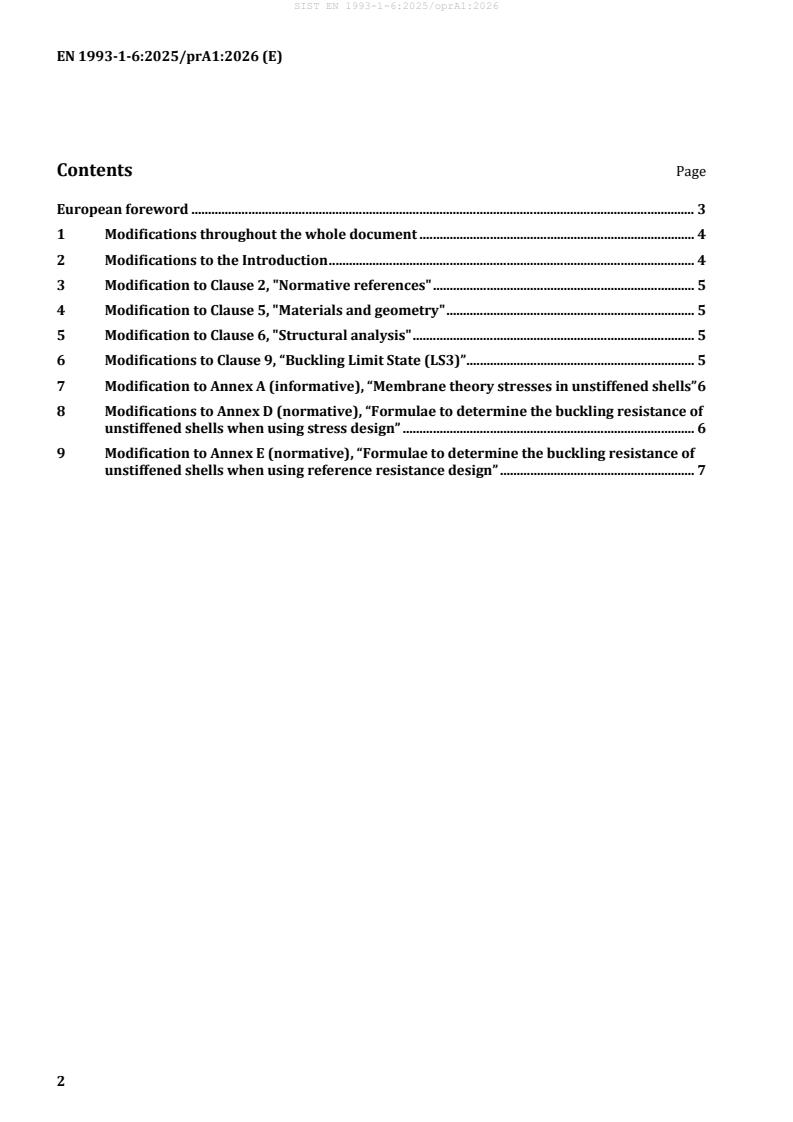
Contents Page
European foreword . 3
1 Modifications throughout the whole document . 4
2 Modifications to the Introduction . 4
3 Modification to Clause 2, "Normative references" . 5
4 Modification to Clause 5, "Materials and geometry" . 5
5 Modification to Clause 6, "Structural analysis" . 5
6 Modifications to Clause 9, “Buckling Limit State (LS3)” . 5
7 Modification to Annex A (informative), “Membrane theory stresses in unstiffened shells” 6
8 Modifications to Annex D (normative), “Formulae to determine the buckling resistance of
unstiffened shells when using stress design” . 6
9 Modification to Annex E (normative), “Formulae to determine the buckling resistance of
unstiffened shells when using reference resistance design” . 7
European foreword
This document (EN 1993-1-6:2025/prA1:2026) has been prepared by Technical Committee CEN/TC 250
“Structural Eurocodes”, the secretariat of which is held by BSI. CEN/TC 250 is responsible for all
Structural Eurocodes and has been assigned responsibility for structural and geotechnical design matters
by CEN.
This document is currently submitted to the CEN Enquiry.
This document will amend EN 1993-1-6:2025.
NOTE Some modifications are purely editorial corrections to improve the quality of the document and these
will not be tagged in the consolidated publication, as noted after the modification.
The following main changes to EN 1993-1-6:2025 are included in the amendment:
— clarification on the interpretation of buckling-relevant tolerances obtained with laser scanning of the
complete unloaded structure (subclause 9.4.1),
— clarification on thickness to be associated with a meridional gauge where dimple tolerance check is
being done across a weld (subclause 9.4.5),
— correction of the method to determine the minimum stiffness of a top ring in a stepped wall shell
(subclause D.5.3.4.2),
— correction of several wordings and typing errors throughout the document.
The first generation of EN Eurocodes was published between 2002 and 2007. This document forms part
of the second generation of the Eurocodes, which have been prepared under Mandate M/515 issued to
CEN by the European Commission and the European Free Trade Association.
The Eurocodes have been drafted to be used in conjunction with relevant execution, material, product
and test standards, and to identify requirements for execution, materials, products and testing that are
relied upon by the Eurocodes.
The Eurocodes recognize the responsibility of each Member State and have safeguarded their right to
determine values related to regulatory safety matters at national level through the use of National
Annexes.
1 Modifications throughout the whole document
Replace “EN 1990:2023” with “EN 1990-1:2023+A1:2026” throughout the text when a dated referenc
...