

EN 303-5:2021
(Main)Heating boilers - Part 5: Heating boilers for solid fuels, manually and automatically stoked, nominal heat output of up to 500 kW - Terminology, requirements, testing and marking
General Information
- Abstract
1.1 General
This European Standard applies to heating boilers including safety devices up to a nominal heat output of 500 kW which are designed for the burning of solid fuels only and are operated according to the instructions of the boiler manufacturer.
This European Standard deals with significant hazards, hazardous situations and events relevant to heating boilers used as intended and under the conditions foreseen by the manufacturer (see Clause 4).
The boilers may operate under natural draught or forced draught. The stoking may work manually or automatically.
The boilers may operate under room sealed conditions in case of supervised under pressure in the combustion chamber.
The boilers may operate in condensing condition.
NOTE This European Standard deals with boilers which are both within and outside of the scope of the Machinery
Directive 2006/42/EC.
This European Standard contains requirements and test methods for safety, combustion quality, operating characteristics, marking and maintenance of heating boilers and secondary emission reduction appliances and efficiency improvement appliances. It also covers all external equipment that influences the safety systems (e.g. back burning safety device, integral fuel hopper).
This European Standard covers only boilers that include burners as a unit. The standard applies to the combination of a boiler body with a solid fuel burner according to EN 15270 as a unit only when the whole unit is tested in accordance with this European Standard.
Heating boilers in accordance with this European Standard are designed for central heating installations where the heat carrier is water and the maximum allowable temperature is 110 °C, and which can operate at a maximum allowable operating pressure of 6 bars. For heating boilers with a built-in or attached water heater (storage or continuous flow heater), this European Standard only applies to those parts of the water heater which are necessarily subject to the operating conditions of the heating boiler (heating part).
This European Standard does not apply to:
heating boilers and other heating appliances which are also designed for the direct heating of the place of installation;
cooking appliances;
the design and construction of external fuel storage and transportation devices prior to the safety devices of the boiler;
room sealed applications above a nominal heat output > 70 kW or operated with positive pressure in the combustion chamber or operated under natural draught;
This European Standard specifies the necessary terminology for solid fuel heating boilers, the control and safety related requirements, the design requirements, the technical heating requirements (taking into account the environmental requirements) and testing, as well as the marking requirements.
This European Standard is not applicable to heating boilers which are tested before the date of its publication as an EN (European Standard).
1.2 Fuels
These boilers may burn either fossil fuels, biogenic fuels or other fuels such as peat, as specified for their use by the boiler manufacturer, in accordance with the requirements of this European Standard.
Solid fuels included in this European Standard are categorised as follows.
1.2.1 Biogenic fuels
Biomass in a natural state, in the form of:
Adaptation to new fuels standards and consideration of new fuels standards in preparation.
A log wood with moisture content w ≤ 25 %, according to EN 14961-5;
B1 chipped wood (wood chipped by machine, usually up to a maximum length of 15 cm) with moisture content from w 15 % to w 35 %, according to EN 14961-4;
B2 chipped wood as under B1, except with moisture content w > 35 %;
C1 compressed wood (e.g. pellets without additives, made of wood and/or bark particles; natural binding agents such as molasses, vegetable paraffins and starch are permitted), pellets according to EN 14961-2;
(...)
- Status
- Withdrawn
- Publication Date
- 06-Apr-2021
- Withdrawal Date
- 29-Sep-2026
- Technical Committee
- CEN/TC 57 - Central heating boilers
- Drafting Committee
- CEN/TC 57/WG 1 - Central heating boilers for solid fuels
- Current Stage
- 9960 - Withdrawal effective - Withdrawal
- Start Date
- 09-Nov-2022
- Completion Date
- 30-Sep-2026
- Directive
- 2006/42/EC - Directive 2006/42/EC of the European Parliament and of the Council of 17 May 2006 on machinery, and amending Directive 95/16/EC (recast)OJ Ref: L, L 115 OJ Date: 13-Apr-2022



Relations
- Effective Date
- 14-Apr-2021
- Effective Date
- 18-Jan-2023
- Effective Date
- 25-Mar-2026
- Effective Date
- 25-Mar-2026
- Effective Date
- 25-Mar-2026
- Effective Date
- 09-Feb-2026
- Effective Date
- 09-Feb-2026
- Effective Date
- 09-Feb-2026
- Effective Date
- 09-Feb-2026
- Effective Date
- 09-Feb-2026
- Effective Date
- 09-Feb-2026
- Effective Date
- 09-Feb-2026
- Effective Date
- 09-Feb-2026
- Effective Date
- 09-Feb-2026
- Effective Date
- 09-Feb-2026
Get Certified
Connect with accredited certification bodies for this standard

DIBt (Deutsches Institut für Bautechnik)
German Institute for Building Technology.
DIN CERTCO
DIN Group product certification.

Aboma Certification B.V.
Specialized in construction, metal, and transport sectors.
Sponsored listings
Frequently Asked Questions
EN 303-5:2021 is a standard published by the European Committee for Standardization (CEN). Its full title is "Heating boilers - Part 5: Heating boilers for solid fuels, manually and automatically stoked, nominal heat output of up to 500 kW - Terminology, requirements, testing and marking". This standard covers: 1.1 General This European Standard applies to heating boilers including safety devices up to a nominal heat output of 500 kW which are designed for the burning of solid fuels only and are operated according to the instructions of the boiler manufacturer. This European Standard deals with significant hazards, hazardous situations and events relevant to heating boilers used as intended and under the conditions foreseen by the manufacturer (see Clause 4). The boilers may operate under natural draught or forced draught. The stoking may work manually or automatically. The boilers may operate under room sealed conditions in case of supervised under pressure in the combustion chamber. The boilers may operate in condensing condition. NOTE This European Standard deals with boilers which are both within and outside of the scope of the Machinery Directive 2006/42/EC. This European Standard contains requirements and test methods for safety, combustion quality, operating characteristics, marking and maintenance of heating boilers and secondary emission reduction appliances and efficiency improvement appliances. It also covers all external equipment that influences the safety systems (e.g. back burning safety device, integral fuel hopper). This European Standard covers only boilers that include burners as a unit. The standard applies to the combination of a boiler body with a solid fuel burner according to EN 15270 as a unit only when the whole unit is tested in accordance with this European Standard. Heating boilers in accordance with this European Standard are designed for central heating installations where the heat carrier is water and the maximum allowable temperature is 110 °C, and which can operate at a maximum allowable operating pressure of 6 bars. For heating boilers with a built-in or attached water heater (storage or continuous flow heater), this European Standard only applies to those parts of the water heater which are necessarily subject to the operating conditions of the heating boiler (heating part). This European Standard does not apply to: heating boilers and other heating appliances which are also designed for the direct heating of the place of installation; cooking appliances; the design and construction of external fuel storage and transportation devices prior to the safety devices of the boiler; room sealed applications above a nominal heat output > 70 kW or operated with positive pressure in the combustion chamber or operated under natural draught; This European Standard specifies the necessary terminology for solid fuel heating boilers, the control and safety related requirements, the design requirements, the technical heating requirements (taking into account the environmental requirements) and testing, as well as the marking requirements. This European Standard is not applicable to heating boilers which are tested before the date of its publication as an EN (European Standard). 1.2 Fuels These boilers may burn either fossil fuels, biogenic fuels or other fuels such as peat, as specified for their use by the boiler manufacturer, in accordance with the requirements of this European Standard. Solid fuels included in this European Standard are categorised as follows. 1.2.1 Biogenic fuels Biomass in a natural state, in the form of: Adaptation to new fuels standards and consideration of new fuels standards in preparation. A log wood with moisture content w ≤ 25 %, according to EN 14961-5; B1 chipped wood (wood chipped by machine, usually up to a maximum length of 15 cm) with moisture content from w 15 % to w 35 %, according to EN 14961-4; B2 chipped wood as under B1, except with moisture content w > 35 %; C1 compressed wood (e.g. pellets without additives, made of wood and/or bark particles; natural binding agents such as molasses, vegetable paraffins and starch are permitted), pellets according to EN 14961-2; (...)
1.1 General This European Standard applies to heating boilers including safety devices up to a nominal heat output of 500 kW which are designed for the burning of solid fuels only and are operated according to the instructions of the boiler manufacturer. This European Standard deals with significant hazards, hazardous situations and events relevant to heating boilers used as intended and under the conditions foreseen by the manufacturer (see Clause 4). The boilers may operate under natural draught or forced draught. The stoking may work manually or automatically. The boilers may operate under room sealed conditions in case of supervised under pressure in the combustion chamber. The boilers may operate in condensing condition. NOTE This European Standard deals with boilers which are both within and outside of the scope of the Machinery Directive 2006/42/EC. This European Standard contains requirements and test methods for safety, combustion quality, operating characteristics, marking and maintenance of heating boilers and secondary emission reduction appliances and efficiency improvement appliances. It also covers all external equipment that influences the safety systems (e.g. back burning safety device, integral fuel hopper). This European Standard covers only boilers that include burners as a unit. The standard applies to the combination of a boiler body with a solid fuel burner according to EN 15270 as a unit only when the whole unit is tested in accordance with this European Standard. Heating boilers in accordance with this European Standard are designed for central heating installations where the heat carrier is water and the maximum allowable temperature is 110 °C, and which can operate at a maximum allowable operating pressure of 6 bars. For heating boilers with a built-in or attached water heater (storage or continuous flow heater), this European Standard only applies to those parts of the water heater which are necessarily subject to the operating conditions of the heating boiler (heating part). This European Standard does not apply to: heating boilers and other heating appliances which are also designed for the direct heating of the place of installation; cooking appliances; the design and construction of external fuel storage and transportation devices prior to the safety devices of the boiler; room sealed applications above a nominal heat output > 70 kW or operated with positive pressure in the combustion chamber or operated under natural draught; This European Standard specifies the necessary terminology for solid fuel heating boilers, the control and safety related requirements, the design requirements, the technical heating requirements (taking into account the environmental requirements) and testing, as well as the marking requirements. This European Standard is not applicable to heating boilers which are tested before the date of its publication as an EN (European Standard). 1.2 Fuels These boilers may burn either fossil fuels, biogenic fuels or other fuels such as peat, as specified for their use by the boiler manufacturer, in accordance with the requirements of this European Standard. Solid fuels included in this European Standard are categorised as follows. 1.2.1 Biogenic fuels Biomass in a natural state, in the form of: Adaptation to new fuels standards and consideration of new fuels standards in preparation. A log wood with moisture content w ≤ 25 %, according to EN 14961-5; B1 chipped wood (wood chipped by machine, usually up to a maximum length of 15 cm) with moisture content from w 15 % to w 35 %, according to EN 14961-4; B2 chipped wood as under B1, except with moisture content w > 35 %; C1 compressed wood (e.g. pellets without additives, made of wood and/or bark particles; natural binding agents such as molasses, vegetable paraffins and starch are permitted), pellets according to EN 14961-2; (...)
EN 303-5:2021 is classified under the following ICS (International Classification for Standards) categories: 91.140.10 - Central heating systems. The ICS classification helps identify the subject area and facilitates finding related standards.
EN 303-5:2021 has the following relationships with other standards: It is inter standard links to EN 303-5:2012, EN 303-5:2021+A1:2022, ISO 7005-2:1988, ISO 857-2:2005, ISO 7005-3:1988, EN IEC 61000-6-2:2019, EN IEC 60730-2-9:2019/A1:2019, EN 60335-1:2012/A11:2014, EN 60335-1:2012, EN IEC 60730-2-9:2019, EN 60335-2-102:2016, EN 60730-2-5:2015/A1:2019, EN 60335-1:2012/A14:2019, EN 60730-1:2016/A1:2019, EN 60335-1:2012/A1:2019. Understanding these relationships helps ensure you are using the most current and applicable version of the standard.
EN 303-5:2021 is associated with the following European legislation: EU Directives/Regulations: 2006/42/EC, 2015/1187, 2015/1189, 811/2013, 813/2013; Standardization Mandates: M/396, M/535, M/551. When a standard is cited in the Official Journal of the European Union, products manufactured in conformity with it benefit from a presumption of conformity with the essential requirements of the corresponding EU directive or regulation.
EN 303-5:2021 is available in PDF format for immediate download after purchase. The document can be added to your cart and obtained through the secure checkout process. Digital delivery ensures instant access to the complete standard document.
Standards Content (Sample)
SLOVENSKI STANDARD
01-julij-2021
Nadomešča:
SIST EN 303-5:2012
Kotli za gretje - 5. del: Kotli na trdna goriva z ročnim in samodejnim polnjenjem z
nazivno močjo do 500 kW - Terminologija, zahteve, preskušanje in označevanje
Heating boilers - Part 5: Heating boilers for solid fuels, manually and automatically
stoked, nominal heat output of up to 500 kW - Terminology, requirements, testing and
marking
Heizkessel - Teil 5: Heizkessel für feste Brennstoffe, manuell und automatisch beschickte
Feuerungen, Nennwärmeleistung bis 500 kW - Begriffe, Anforderungen, Prüfungen und
Kennzeichnung
Chaudières de chauffage - Partie 5 : Chaudières spéciales pour combustibles solides, à
chargement manuel et automatique, puissance utile inférieure ou égale à 500 kW -
Définitions, exigences, essais et marquage
Ta slovenski standard je istoveten z: EN 303-5:2021
ICS:
91.140.10 Sistemi centralnega Central heating systems
ogrevanja
97.100.30 Grelniki na trdo gorivo Solid fuel heaters
2003-01.Slovenski inštitut za standardizacijo. Razmnoževanje celote ali delov tega standarda ni dovoljeno.
EN 303-5
EUROPEAN STANDARD
NORME EUROPÉENNE
April 2021
EUROPÄISCHE NORM
ICS 91.140.10 Supersedes EN 303-5:2012
English Version
Heating boilers - Part 5: Heating boilers for solid fuels,
manually and automatically stoked, nominal heat output of
up to 500 kW - Terminology, requirements, testing and
marking
Chaudières de chauffage - Partie 5 : Chaudières Heizkessel - Teil 5: Heizkessel für feste Brennstoffe,
spéciales pour combustibles solides, à chargement manuell und automatisch beschickte Feuerungen,
manuel et automatique, puissance utile inférieure ou Nennwärmeleistung bis 500 kW - Begriffe,
égale à 500 kW - Définitions, exigences, essais et Anforderungen, Prüfungen und Kennzeichnung
marquage
This European Standard was approved by CEN on 15 February 2021.
CEN members are bound to comply with the CEN/CENELEC Internal Regulations which stipulate the conditions for giving this
European Standard the status of a national standard without any alteration. Up-to-date lists and bibliographical references
concerning such national standards may be obtained on application to the CEN-CENELEC Management Centre or to any CEN
member.
This European Standard exists in three official versions (English, French, German). A version in any other language made by
translation under the responsibility of a CEN member into its own language and notified to the CEN-CENELEC Management
Centre has the same status as the official versions.
CEN members are the national standards bodies of Austria, Belgium, Bulgaria, Croatia, Cyprus, Czech Republic, Denmark, Estonia,
Finland, France, Germany, Greece, Hungary, Iceland, Ireland, Italy, Latvia, Lithuania, Luxembourg, Malta, Netherlands, Norway,
Poland, Portugal, Republic of North Macedonia, Romania, Serbia, Slovakia, Slovenia, Spain, Sweden, Switzerland, Turkey and
United Kingdom.
EUROPEAN COMMITTEE FOR STANDARDIZATION
COMITÉ EUROPÉEN DE NORMALISATION
EUROPÄISCHES KOMITEE FÜR NORMUNG
CEN-CENELEC Management Centre: Rue de la Science 23, B-1040 Brussels
© 2021 CEN All rights of exploitation in any form and by any means reserved Ref. No. EN 303-5:2021 E
worldwide for CEN national Members.
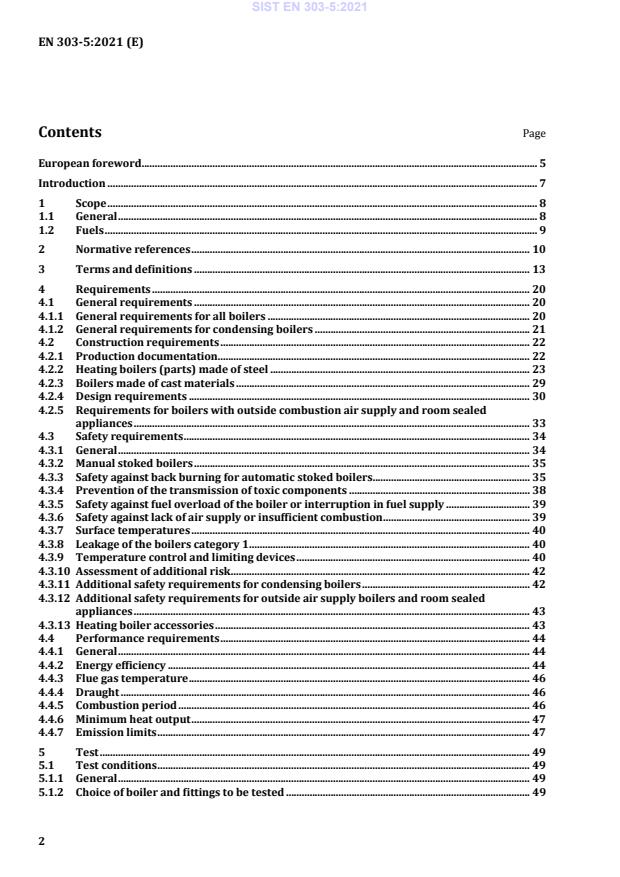
Contents Page
European foreword . 5
Introduction . 7
1 Scope . 8
1.1 General . 8
1.2 Fuels . 9
2 Normative references . 10
3 Terms and definitions . 13
4 Requirements . 20
4.1 General requirements . 20
4.1.1 General requirements for all boilers . 20
4.1.2 General requirements for condensing boilers . 21
4.2 Construction requirements . 22
4.2.1 Production documentation. 22
4.2.2 Heating boilers (parts) made of steel . 23
4.2.3 Boilers made of cast materials . 29
4.2.4 Design requirements . 30
4.2.5 Requirements for boilers with outside combustion air supply and room sealed
appliances . 33
4.3 Safety requirements . 34
4.3.1 General . 34
4.3.2 Manual stoked boilers . 35
4.3.3 Safety against back burning for automatic stoked boilers. 35
4.3.4 Prevention of the transmission of toxic components . 38
4.3.5 Safety against fuel overload of the boiler or interruption in fuel supply . 39
4.3.6 Safety against lack of air supply or insufficient combustion . 39
4.3.7 Surface temperatures . 40
4.3.8 Leakage of the boilers category 1 . 40
4.3.9 Temperature control and limiting devices . 40
4.3.10 Assessment of additional risk . 42
4.3.11 Additional safety requirements for condensing boilers . 42
4.3.12 Additional safety requirements for outside air supply boilers and room sealed
appliances . 43
4.3.13 Heating boiler accessories . 43
4.4 Performance requirements . 44
4.4.1 General . 44
4.4.2 Energy efficiency . 44
4.4.3 Flue gas temperature . 46
4.4.4 Draught . 46
4.4.5 Combustion period . 46
4.4.6 Minimum heat output . 47
4.4.7 Emission limits . 47
5 Test . 49
5.1 Test conditions . 49
5.1.1 General . 49
5.1.2 Choice of boiler and fittings to be tested . 49
5.1.3 Condition of the boiler . 50
5.1.4 Type test . 50
5.2 Measuring instruments and methods . 50
5.3 Test fuel . 51
5.4 Pressure test for boilers of sheet or sheet metal of non-ferrous metal . 54
5.4.1 Tests to be carried out before production . 54
5.4.2 Test during production. 54
5.5 Pressure test for boilers of cast iron or non-ferrous metals . 55
5.5.1 Test to be carried out before production . 55
5.5.2 Test during production. 55
5.6 Conducting the boiler performance test . 56
5.6.1 General . 56
5.6.2 Setting up the test rig . 56
5.6.3 Measured quantities . 57
5.6.4 Test method and test duration . 58
5.7 Determination of the heat output and the efficiency of the boiler . 58
5.7.1 Method for the measurement of the heat output . 58
5.7.2 Determining the nominal heat output . 59
5.7.3 Determining the minimum heat output . 59
5.7.4 Verification of nominal heat output with condensation . 60
5.7.5 Verification of the minimum continuous heat output with condensation . 60
5.7.6 Determination of the boiler efficiency (direct method) . 60
5.7.7 Electrical consumption . 60
5.8 Determination of the emission values . 61
5.8.1 Heating boiler with manual stoking . 61
5.8.2 Heating boiler with automatic stoking . 61
5.9 Calculation . 61
5.9.1 Boiler heat output . 61
5.9.2 The heat input . 61
5.9.3 Boiler efficiency . 61
5.9.4 Emissions . 63
5.10 Determination of the waterside resistance. 64
5.11 Surface temperature. 64
5.12 Verification of condensate . 65
5.13 Function check of the temperature controller and safety temperature limiter at the
boiler . 65
5.14 Function test for the rapidly disconnectable firing system. 65
5.15 Function test on the device for dissipating excess heat (partly or non-disconnectable
firing system) . 66
5.16 Selected tests to demonstrate functional safety . 66
5.16.1 General . 66
5.16.2 Safety test of consequences of fuel overload and effect of a blockage of the fuel
supply . 67
5.16.3 Loss of combustion air supply. 67
5.16.4 Resistance to thermal conductance . 67
5.16.5 Additional tests for alternative verification of the safety against back burning . 68
5.16.6 Test for gas side leakage . 68
5.17 Check of safety for condensing operation . 69
5.18 Additional checks of the safety for boilers with outside combustion air supply . 69
5.18.1 Test of leakage rates . 69
5.18.2 Temperature at combustion air connector . 69
5.18.3 Functional safety and design limits caused by recirculation of flue gas into the
combustion air supply . 69
6 Test report and other documents . 69
7 Marking . 70
7.1 General . 70
7.2 Information on the boiler plate . 71
7.3 Boiler plate requirements . 71
8 Technical documentation, supplied with boiler . 71
8.1 General . 71
8.2 Technical information and installation instructions . 71
8.3 Operating instructions . 74
Annex A (informative) Manual measurement of particles in the gas flow, gravimetric
determination of particle load with filter systems . 75
Annex B (normative) Design criteria for solutions to prevent back burning . 78
Annex C (informative) Installation of boilers with combustion air supply from outside the
building . 84
Annex D (informative) Recommended limits for substances of content of the condensate . 86
Annex E (informative) Recommended analytical methods . 87
Annex F (informative) Calculation methods . 88
F.1 Calculation of seasonal space heating energy efficiency . 88
F.2 Calculation of Energy Efficiency Index (EEI) . 90
F.3 Seasonal space heating emissions. 90
Annex G (normative) Calculation methods for recirculation influence . 92
Annex ZA (informative) Relationship between this European Standard and the essential
requirements of Directive2006/42/EC aimed to be covered . 93
Annex ZB (informative) Relationship between this European Standard and the ecodesign
requirements of Commission Regulation (EU) [2015/1189] [L 193] aimed to be
covered. 95
Annex ZC (informative) Relationship between this European Standard and the energy
labelling requirements of Commission Delegated Regulation (EU) [2015/1187]
[L 193] aimed to be covered . 96
Bibliography . 97
European foreword
This document (EN 303-5:2021) has been prepared by Technical Committee CEN/TC 57 “Central
heating boilers”, the secretariat of which is held by DIN.
This European Standard shall be given the status of a national standard, either by publication of an
identical text or by endorsement, at the latest by October 2021, and conflicting national standards shall
be withdrawn at the latest by October 2021.
Attention is drawn to the possibility that some of the elements of this document may be the subject of
patent rights. CEN shall not be held responsible for identifying any or all such patent rights.
This document supersedes EN 303-5:2012.
This document has been prepared under a mandate given to CEN by the European Commission and the
European Free Trade Association and supports essential requirements of EU Directive(s).
For relationship with EU Directive(s), see informative Annex ZA, ZB and ZC, which is an integral part of
this document.
In comparison with EN 303-5:2012, the following technical changes have been made:
— the scope was extended to condensing boilers with a heat output of ≤ 500 kW;
— the scope was extended to boilers with outside combustion air supply at a heat output of ≤ 100 kW;
— requirements for materials, weld joints and wall thicknesses have been revised and adapted to
condensing and room sealed operations;
— general and electrical safety requirements have been revised and adapted to condensing and room
sealed applications;
— tests were revised and new tests for condensing boilers, outside combustion air supply, secondary
emission reduction systems and safety requirements were added;
— Annexes were re-structured;
— Consideration was given to the essential requirements of the Machinery Directive 2006/42/EC and
REGULATION (EU) 2015/1189 (Eco-design) and COMMISSION REGULATION (EU) 2015/1187
(Energy labelling).
The following structure is intended for the European Standards for heating boilers:
— EN 303-1, Heating boilers ― Part 1: Heating boilers with forced draught burners ― Terminology,
general requirements, testing and marking;
— EN 303-2, Heating boilers ― Part 2: Heating boilers with forced draught burners ― Special
requirements for boilers with atomizing oil burners;
— EN 303-3, Heating boilers ― Part 3: Gas-fired central heating boilers ― Assembly comprising a boiler
body and a forced draught burner;
— EN 303-4, Heating boilers ― Part 4: Heating boilers with forced draught burners ― Special
requirements for boilers with forced draught oil burners with outputs up to 70 kW and a maximum
operating pressure of 3 bar ― Terminology, special requirements, testing and marking;
— EN 303-5, Heating boilers ― Part 5: Heating boilers for solid fuels, manually and automatically stoked,
nominal heat output of up to 500 kW ― Terminology, requirements, testing and marking;
— EN 303-6, Heating boilers ― Part 6: Heating boilers with forced draught burners ― Specific
requirements for the domestic hot water operation of combination boilers with atomizing oil burners
of nominal heat input not exceeding 70 kW;
— EN 303-7, Heating boilers ― Part 7: Gas-fired central heating boilers equipped with a forced draught
burner of nominal heat output not exceeding 1 000 kW;
— EN 304, Heating boilers ― Test code for heating boilers for atomizing oil burners.
According to the CEN-CENELEC Internal Regulations, the national standards organisations of the
following countries are bound to implement this European Standard: Austria, Belgium, Bulgaria,
Croatia, Cyprus, Czech Republic, Denmark, Estonia, Finland, France, Germany, Greece, Hungary, Iceland,
Ireland, Italy, Latvia, Lithuania, Luxembourg, Malta, Netherlands, Norway, Poland, Portugal, Republic of
North Macedonia, Romania, Serbia, Slovakia, Slovenia, Spain, Sweden, Switzerland, Turkey and the
United Kingdom.
Introduction
This document is a type-C standard as stated in EN ISO 12100:2010.
The machinery concerned, and the extent to which hazards, hazardous situations and hazardous events
are covered, are indicated in the scope of this document.
This document does deal with boilers which are within the Scope Machinery Directive and boilers that
are outside of the Scope Machinery Directive.
The manufacturer is responsible for identifying all additional hazards outside of the scope of this
document.
When provisions of this type-C standard are different from those which are stated in type-A or -B
standards, the provisions of this type-C standard take precedence over the provisions of the other
standards, for machines that have been designed and built according to the provisions of this type-C
standard.
1 Scope
1.1 General
This document applies to heating boilers including safety devices up to a nominal heat output of
500 kW which are designed for the burning of solid fuels only and are operated according to the
instructions supplied with the boiler and misuse reasonably foreseeable by the manufacturer.
This document applies also for solid fuel boilers taking the combustion air from outside the building
and room sealed appliances.
This document does deal with significant hazards, hazardous situations and events relevant to heating
boilers used as intended and under the conditions specified in the technical documentation of the boiler
(see Clause 4).
The boilers may operate under natural draught or forced draught. The fuel feed may work manually or
automatically. The boilers may operate in non-condensing operation or condensing operation.
NOTE 1 This document does deal with boilers which are within the scope of the Machinery Directive
2006/42/EC or outside of the scope of the Machinery Directive 2006/42/EC (manual stoked natural draught
boiler).
NOTE 2 There is a risk of freezing condensate in the condensate drainage at low temperatures.
This document contains requirements and test methods for safety, combustion performance, operating
characteristics, marking and maintenance of heating boilers. It also covers all external equipment that
influences the safety systems (e.g. back burning safety device, integral fuel hopper).
This document covers only boilers that include burners as a unit. The document applies to the
combination of a boiler body with a solid fuel burner according to EN 15270:2007 as a unit only when
the whole unit is tested in accordance with this document.
Heating boilers in accordance with this document are designed for central heating installations where
the heat carrier is water and the maximum allowable temperature is 110 °C, and which can operate at a
maximum allowable operating pressure of 6 bars. For heating boilers with a built-in or attached water
heater (storage or continuous flow heater), this document only applies to those parts of the water
heater which are necessarily subject to the operating conditions of the heating boiler (heating part).
This document does not apply to:
— heating boilers and other heating appliances which are also designed for the direct heating of the
place of installation, also according to the European regulation 2015/1185/EU;
— cooking appliances;
— the design and construction of external fuel storage and transportation devices prior to the safety
devices of the boiler;
— manual stoked straw bale boilers;
— CHP appliances (combined heat and power).
This document specifies the necessary terminology for solid fuel heating boilers, the control and safety
related requirements, the design requirements, the technical heating requirements (considering the
environmental requirements) and testing, as well as the marking requirements.
This document is not applicable to heating boilers which are tested before the date of its publication as
an EN (European Standard).
For evaluation of the requirements of this document test results of former versions of the standard may
be used if applicable.
NOTE 3 This document can be used as a reference for boilers > 500 kW for safety evaluation.
This document does deal with all significant machine hazards, hazardous situations and events relevant
to solid fuel boilers, when they are used as intended and under conditions of misuse which are
reasonably foreseeable, except noise hazards.
NOTE 4 The document contains requirements regarding noise but not in its full extent to cover the Essential
Health and Safety Requirements (EHSR, Annex I of the Machinery Directive 2006/42/EC).
1.2 Fuels
These boilers may burn either fossil fuels, biogenic fuels or other fuels such as peat, as specified for
their use in the technical documentation, in accordance with the requirements of this document.
Solid fuels included in this document are categorized as follows.
Biogenic fuels
Biomass in a natural state, in the form of:
— log wood with moisture content ≤ M25, according to EN ISO 17225-5:2014;
— chipped wood ≤ M35 with moisture content from M15 to M35, according to EN ISO 17225-4:2014;
— chipped wood > M35 with moisture content exceeding M35, according to EN ISO 17225-4:2014;
— wood pellets according to EN ISO 17225-2:2014;
— wood briquettes according to EN ISO 17225-3:2014;
— sawdust with moisture content ≤ M20;
— sawdust with moisture content M20 to M50;
— sawdust with moisture content ≤ M20 is dangerous against back burning;
— non-woody biomass, such as straw, miscanthus, reeds, kernels and grains according to
EN ISO 17225-6:2014.
Fossil fuels
— a bituminous coal;
— b brown coal;
— c coke;
— d anthracite.
Other solid fuels
— Other solid fuels such as peat or processed fuels according to EN ISO 17225-1:2014.
2 Normative references
The following documents are referred to in the text in such a way that some or all of their content
constitutes requirements of this document. For dated references, only the edition cited applies. For
undated references, the latest edition of the referenced document (including any amendments) applies.
EN 303-1:2017, Heating boilers - Part 1: Heating boilers with forced draught burners - Terminology,
general requirements, testing and marking
EN 304:2017, Heating boilers - Test code for heating boilers for atomizing oil burners
EN 1561:2011, Founding - Grey cast irons
EN 1563:2018, Founding - Spheroidal graphite cast irons
EN 10204:2004, Metallic products - Types of inspection documents
EN 10226-1:2004, Pipe threads where pressure tight joints are made on the threads - Part 1: Taper
external threads and parallel internal threads - Dimensions, tolerances and designation
EN 10226-3:2005, Pipes threads where pressure tight joint are made on the threads - Part 3: Verification
by means of limit gauges
EN 12619:2013, Stationary source emissions - Determination of the mass concentration of total gaseous
organic carbon - Continuous flame ionisation detector method
EN 12828:2012+A1:2014, Heating systems in buildings - Design for water-based heating systems
EN 13284-1:2017, Stationary source emissions - Determination of low range mass concentration of dust -
Part 1: Manual gravimetric method
EN 13384-1:2015+A1:2019, Chimneys - Thermal and fluid dynamic calculation methods - Part 1:
Chimneys serving one combustion appliance
EN 13501-1:2018, Fire classification of construction products and building elements - Part 1:
Classification using data from reaction to fire tests
EN 14597:2012, Temperature control devices and temperature limiters for heat generating systems
EN 14789:2017, Stationary source emissions - Determination of volume concentration of oxygen -
Standard reference method: Paramagnetism
EN 14792:2017, Stationary source emissions - Determination of mass concentration of nitrogen oxides -
Standard reference method: chemiluminescence
EN 15058:2017, Stationary source emissions - Determination of the mass concentration of carbon
monoxide - Standard reference method: non-dispersive infrared spectrometry
EN 15259:2007, Air quality - Measurement of stationary source emissions - Requirements for
measurement sections and sites and for the measurement objective, plan and report
EN 15270:2007, Pellet burners for small heating boilers - Definitions, requirements, testing, marking
EN 15456:2008, Heating boilers - Electrical power consumption for heat generators - System boundaries -
Measurements
EN 60335-1:2012, Household and similar electrical appliances - Safety - Part 1: General requirements
(IEC 60335-1:2012)
EN 60335-2-102:2016, Household and similar electrical appliances - Safety - Part 2-102: Particular
requirements for gas, oil and solid-fuel burning appliances having electrical connections (IEC 60335-2-
102:2004, modified)
EN 60730-1:2016, Automatic electrical controls - Part 1: General requirements (IEC 60730-
1:2013/COR1:2014)
EN 60730-2-5:2015, Automatic electrical controls - Part 2-5: Particular requirements for automatic
electrical burner control systems (IEC 60730-2-5:2013)
EN IEC 60730-2-9:2019, Automatic electrical controls - Part 2-9: Particular requirements for temperature
sensing control (IEC 60730-2-9:2015)
EN IEC 61000-6-2:2019, Electromagnetic compatibility (EMC) - Part 6-2: Generic standards - Immunity
standard for industrial environments (IEC 61000-6-2:2016)
EN 61000-6-3:2007, Electromagnetic compatibility (EMC) - Part 6-3: Generic standards - Emission
standard for residential, commercial and light-industrial environments (IEC 61000-6-3:2006)
EN ISO 228-1:2003, Pipe threads where pressure-tight joints are not made on the threads - Part 1:
Dimensions, tolerances and designation (ISO 228-1:2000)
EN ISO 228-2:2003, Pipe threads where pressure-tight joints are not made on the threads - Part 2:
Verification by means of limit gauges (ISO 228-2:1987)
EN ISO 4063:2010, Welding and allied processes - Nomenclature of processes and reference numbers
(ISO 4063:2009, Corrected version 2010-03-01)
EN ISO 6506-1:2014, Metallic materials - Brinell hardness test - Part 1: Test method (ISO 6506-1:2014)
EN ISO 9606-1:2017, Qualification testing of welders - Fusion welding - Part 1: Steels (ISO 9606-1:2012
including Cor 1:2012 and Cor 2:2013)
EN ISO 9606-2:2004, Qualification test of welders - Fusion welding - Part 2: Aluminium and aluminium
alloys (ISO 9606-2:2004)
EN ISO 12100:2010, Safety of machinery - General principles for design - Risk assessment and risk
reduction (ISO 12100:2010)
As impacted by EN 60335-1:2012/A11:2014, EN 60335-1:2012/A13:2017, EN 60335-1:2012/A14:2019,
EN 60335-1:2012/A1:2019 and EN 60335-1:2012/A2:2019.
As impacted by EN 60730-1:2016/A1:2019.
As impacted by EN 60730-2-5:2015/A1:2019 and EN 60730-2-5:2015/A2:2021.
As impacted by EN IEC 60730-2-9:2019/A1:2019 and EN IEC 60730-2-9:2019/A2:2020.
As impacted by EN 61000-6-3:2007/A1:2011/AC:2012.
EN ISO 13732-1:2008, Ergonomics of the thermal environment - Methods for the assessment of human
responses to contact with surfaces - Part 1: Hot surfaces (ISO 13732-1:2006)
EN ISO 13919-1:2019, Electron and laser-beam welded joints - Requirements and recommendations on
quality levels for imperfections - Part 1: Steel, nickel, titanium and their alloys (ISO 13919-1:2019)
EN ISO 13919-2:2021, Electron and laser-beam welded joints - Requirements and recommendations on
quality levels for imperfections - Part 2: Aluminium, magnesium and their alloys and pure copper
(ISO 13919-2:2021)
EN ISO 14120:2015, Safety of machinery - Guards - General requirements for the design and construction
of fixed and movable guards (ISO 14120:2015)
EN ISO 15609-4:2009, Specification and qualification of welding procedures for metallic materials -
Welding procedure specification - Part 4: Laser beam welding (ISO 15609-4:2009)
EN ISO 15614-11:2002, Specification and qualification of welding procedures for metallic materials -
Welding procedure test - Part 11: Electron and laser beam welding (ISO 15614-11:2002)
EN ISO 17225-1:2014, Solid biofuels - Fuel specifications and classes - Part 1: General requirements
(ISO 17225-1:2014)
EN ISO 17225-2:2014, Solid biofuels - Fuel specifications and classes - Part 2: Graded wood pellets
(ISO 17225-2:2014)
EN ISO 17225-3:2014, Solid biofuels - Fuel specifications and classes - Part 3: Graded wood briquettes
(ISO 17225-3:2014)
EN ISO 17225-4:2014, Solid biofuels - Fuel specifications and classes - Part 4: Graded wood chips
(ISO 17225-4:2014)
EN ISO 17225-5:2014, Solid biofuels - Fuel specifications and classes - Part 5: Graded firewood
(ISO 17225-5:2014)
EN ISO 17225-6:2014, Solid biofuels - Fuel specifications and classes - Part 6: Graded non-woody pellets
(ISO 17225-6:2014)
EN ISO 17225-7:2014, Solid biofuels - Fuel specifications and classes - Part 7: Graded non-woody
briquettes (ISO 17225-7:2014)
EN ISO 18135:2017, Solid Biofuels - Sampling (ISO 18135:2017)
EN ISO 20023:2018, Solid biofuels - Safety of solid biofuel pellets - Safe handling and storage of wood
pellets in residential and other small-scale applications (ISO 20023:2018)
CEN/TS 15883:2009, Residential solid fuel burning appliances - Emission test methods
ISO 857-2:2005, Welding and allied processes — Vocabulary — Part 2: Soldering and brazing processes
and related terms
ISO 7005-1:2011, Pipe flanges — Part 1: Steel flanges for industrial and general service piping systems
ISO 7005-2:1988, Metallic flanges — Part 2: Cast iron flanges
ISO 7005-3:1988, Metallic flanges — Part 3: Copper alloy and composite flanges
3 Terms and definitions
For the purposes of this document, the terms and definitions given in EN 303-1:2017, and the following
apply.
ISO and IEC maintain terminological databases for use in standardization at the following addresses:
• IEC Electropedia: available at http://www.electropedia.org/
• ISO Online browsing platform: available at https://www.iso.org/obp
3.1
maximum allowable operating pressure
highest pressure at which the boiler can be operated safely
Note 1 to entry: The maximum operating pressure is less than the test pressure and the type test pressure.
3.2
test pressure
pressure to which all boilers and their parts are subjected during production at the manufacturers plant
or during setting up by the installer
3.3
type test pressure
pressure to which the heating boilers and their parts are first subjected before the start of mass
production
3.4
maximum allowable temperature
maximum allowable water temperature of the heating boiler limited by safety devices
3.5
operating temperature
temperature range at which the boiler can be operated under normal operating conditions, according to
the setting on the boiler water temperature controller and the manufacturer's specifications
3.6
heat output
P
usable heat delivered to water output by a boiler per unit time in accordance with the requirements of
this document
Note 1 to entry: The heat output data for solid fuel boilers are the average values over a related test period
which are established in accordance with the requirements of this document.
3.7
nominal heat output
P
N
continuous heat output at nominal load as average related to the test duration specified in the technical
documentation for a specific fuel in accordance with the requirements of this document
3.8
minimum heat output
P
min
minimum heat output which is maintained automatically by the control device specified by the
manufacturer for each type of fuel in accordance with the requirements of this document
Note 1 to entry: The minimum heat output can be achieved in intermittent operation.
3.9
minimum continuous heat output
P
minC
minimum continuous heat output which is maintained automatically by the control device specified by
the manufacturer for each type of fuel in accordance with the requirements of this document
3.10
heat output range
range of output between minimum and nominal to which the boiler can be adjusted and meets the
requirements of this document
Note 1 to entry: The heat output range lies between nominal heat output and minimum heat output.
3.11
partial load operation
operating condition/state of the boiler where the heat output is less than the nominal heat output and
which is reached using an automatic control device
3.12
intermittent operation
operating condition/state in which boiler heat output is controlled by the automatic connecting and
disconnecting of the combustion air and/or fuel supply
3.13
heat input
Q
B
amount of heat per unit time which is supplied to the heating boiler by the fuel based on its net calorific
value NCV or its gross calorific value GCV
3.14
boiler efficiency
η
K
ratio of the delivered useful heat output to the heat input, expressed in percentage
P
Note 1 to entry: η × 100 %
K
Q
B
3.15
draught
pressure differential between the static air pressure in the place of installation and the static pressure
of the exhaust gases (flue gas measuring section)
=
3.16
gas side resistance
difference in pressure that exists between the combustion chamber and the flue gas outlet of the boiler
(flue gas measuring section)
3.17
gas side tightness
tightness of the hopper, combustion chamber, flue ways and the boiler sections traversed by the flue
gas in relation to the place of installation
3.18
exit flue temperature
temperature measured at the flue exit of the boiler (flue gas measuring section)
3.19
water side resistance
pressure loss in the
...