

prEN 13794
(Main)Respiratory protective devices - Self-contained closed-circuit devices for escape - Requirements, testing and marking
- Abstract
This European Standard specifies minimum requirements for self-contained closed-circuit breathing RPDs for escape (short: oxygen escape RPD):
- chemical oxygen type,
- Potassium superoxide (KO2),
- Sodium chlorate (NaClO3) and
- compressed oxygen type.
This European Standard does not apply to RPD for work and rescue and to diving apparatus.
Laboratory and practical performance tests are included for the assessment of compliance with the requirements.
- Status
- Not Published
- Publication Date
- 25-Apr-2016
- Technical Committee
- CEN/TC 79 - Respiratory protective devices
- Drafting Committee
- CEN/TC 79/WG 6 - Self-contained breathing apparatus
- Current Stage
- 3098 - Decision to reject - Consensus building
- Start Date
- 13-Oct-2015
- Completion Date
- 07-Oct-2026
- Mandate
- M/PPE - PPE
- Mandate
- M/XXX - M/XXX

Overview
prEN 13794 is a CEN draft European Standard that specifies minimum requirements, testing and marking for self-contained closed-circuit breathing apparatus intended for escape (oxygen escape RPD). The scope covers chemical oxygen systems (including potassium superoxide KO2 and sodium chlorate NaClO3 types) and compressed oxygen types. The standard excludes RPDs intended for work, rescue or diving. Laboratory and practical performance tests are integral to the assessment of conformity.
This standard is intended to support regulatory compliance and to provide manufacturers, test laboratories and purchasers with a clear framework for safety, design and performance verification of closed-circuit escape devices.
Key Topics
- Scope and classification: Defines types and classes of oxygen escape RPDs and the intended applications covered by the standard.
- Design and materials: Requirements for construction, corrosion resistance, oxygen compatibility and skin compatibility to reduce hazards in escape scenarios.
- Performance testing: Laboratory performance tests and practical performance (escape) tests to verify rated working duration, oxygen supply performance, carbon dioxide control and inhaled gas conditions across operating ranges.
- Mechanical and environmental tests: Shock, vibration, temperature and humidity preconditioning to ensure reliability in real-world escape conditions.
- Breathing interface and valves: Requirements for respiratory interfaces, inhalation/exhalation valves, relief valves, breathing hoses and leaktightness when in ready-for-use configuration.
- Marking and information: Mandatory marking and manufacturer-supplied information to support correct use, training and maintenance.
Applications
prEN 13794 is primarily relevant to:
- Manufacturers of closed-circuit oxygen escape devices looking to demonstrate compliance with European requirements.
- Test laboratories performing laboratory and practical performance verification for escape RPDs.
- Procurement teams in industries where rapid escape is required (mining, tunnelling, industrial facilities) seeking certified escape breathing apparatus.
- Trainers and safety officers who develop escape procedures and user training based on standardized performance criteria.
Practical value: The standard helps ensure that escape RPDs deliver predictable, tested performance under mechanical, thermal and use conditions representative of emergency evacuations.
Related Standards
Relevant normative references cited in prEN 13794 include (non-exhaustive):
- EN 134:1998 - Respiratory protective devices: nomenclature of components
- EN 136:1998 - Full face masks: requirements, testing, marking
- EN 13274 series - Methods of test (practical performance, breathing resistance, flame, climatic conditions)
Annexes in prEN 13794 provide additional requirements for underground use, guidance for training, calculation aids and the relationship to EU Regulation 2016/425. For procurement and compliance workflows, align device selection, marking and training with the requirements defined in this standard.
Relations
- Effective Date
- 16-Jan-2013
Get Certified
Connect with accredited certification bodies for this standard

CIS Institut d.o.o.
Personal Protective Equipment (PPE) certification body. Notified Body NB-2890 for EU Regulation 2016/425 PPE.

Kiwa BDA Testing
Building and construction product certification.
Kmetijski inštitut Slovenije
Agricultural Institute of Slovenia. Soil testing, plant health, agricultural product analysis.
Sponsored listings
Frequently Asked Questions
prEN 13794 is a draft published by the European Committee for Standardization (CEN). Its full title is "Respiratory protective devices - Self-contained closed-circuit devices for escape - Requirements, testing and marking". This standard covers: This European Standard specifies minimum requirements for self-contained closed-circuit breathing RPDs for escape (short: oxygen escape RPD): - chemical oxygen type, - Potassium superoxide (KO2), - Sodium chlorate (NaClO3) and - compressed oxygen type. This European Standard does not apply to RPD for work and rescue and to diving apparatus. Laboratory and practical performance tests are included for the assessment of compliance with the requirements.
This European Standard specifies minimum requirements for self-contained closed-circuit breathing RPDs for escape (short: oxygen escape RPD): - chemical oxygen type, - Potassium superoxide (KO2), - Sodium chlorate (NaClO3) and - compressed oxygen type. This European Standard does not apply to RPD for work and rescue and to diving apparatus. Laboratory and practical performance tests are included for the assessment of compliance with the requirements.
prEN 13794 is classified under the following ICS (International Classification for Standards) categories: 13.340.30 - Respiratory protective devices. The ICS classification helps identify the subject area and facilitates finding related standards.
prEN 13794 has the following relationships with other standards: It is inter standard links to EN 13794:2002. Understanding these relationships helps ensure you are using the most current and applicable version of the standard.
prEN 13794 is associated with the following European legislation: EU Directives/Regulations: 2016/425, 2016/797/EU, 2016/797/EU, 2016/797/EU, 2016/797/EU, 2016/797/EU, 89/686/EEC; Standardization Mandates: M/031, M/571, M/PPE, M/XXX. When a standard is cited in the Official Journal of the European Union, products manufactured in conformity with it benefit from a presumption of conformity with the essential requirements of the corresponding EU directive or regulation.
prEN 13794 is available in PDF format for immediate download after purchase. The document can be added to your cart and obtained through the secure checkout process. Digital delivery ensures instant access to the complete standard document.
Standards Content (Sample)
SLOVENSKI STANDARD
01-marec-2021
Oprema za varovanje dihal - Samoreševalni avtonomni dihalni aparat z zaprtim
krogom - Zahteve, preskušanje in označevanje
Respiratory protective devices - Self-contained closed-circuit breathing apparatus for
escape - Requirements, testing and marking
Atemschutzgeräte ¿ Isoliergeräte für Selbstrettung ¿ Anforderungen, Prüfung,
Kennzeichnung
Appareils de protection respiratoire - Appareils isolants autonomes à circuit fermé pour
l'évacuation - Exigences, essais, marquage
Ta slovenski standard je istoveten z: prEN 13794
ICS:
13.340.30 Varovalne dihalne naprave Respiratory protective
devices
2003-01.Slovenski inštitut za standardizacijo. Razmnoževanje celote ali delov tega standarda ni dovoljeno.
DRAFT
EUROPEAN STANDARD
NORME EUROPÉENNE
EUROPÄISCHE NORM
January 2021
ICS 13.340.30 Will supersede EN 13794:2002
English Version
Respiratory protective devices - Self-contained closed-
circuit breathing apparatus for escape - Requirements,
testing and marking
Appareils de protection respiratoire - Appareils Atemschutzgeräte ¿ Isoliergeräte für Selbstrettung ¿
isolants autonomes à circuit fermé pour l'évacuation - Anforderungen, Prüfung, Kennzeichnung
Exigences, essais, marquage
This draft European Standard is submitted to CEN members for enquiry. It has been drawn up by the Technical Committee
CEN/TC 79.
If this draft becomes a European Standard, CEN members are bound to comply with the CEN/CENELEC Internal Regulations
which stipulate the conditions for giving this European Standard the status of a national standard without any alteration.
This draft European Standard was established by CEN in three official versions (English, French, German). A version in any other
language made by translation under the responsibility of a CEN member into its own language and notified to the CEN-CENELEC
Management Centre has the same status as the official versions.
CEN members are the national standards bodies of Austria, Belgium, Bulgaria, Croatia, Cyprus, Czech Republic, Denmark, Estonia,
Finland, France, Germany, Greece, Hungary, Iceland, Ireland, Italy, Latvia, Lithuania, Luxembourg, Malta, Netherlands, Norway,
Poland, Portugal, Republic of North Macedonia, Romania, Serbia, Slovakia, Slovenia, Spain, Sweden, Switzerland, Turkey and
United Kingdom.
Recipients of this draft are invited to submit, with their comments, notification of any relevant patent rights of which they are
aware and to provide supporting documentation.
Warning : This document is not a European Standard. It is distributed for review and comments. It is subject to change without
notice and shall not be referred to as a European Standard.
EUROPEAN COMMITTEE FOR STANDARDIZATION
COMITÉ EUROPÉEN DE NORMALISATION
EUROPÄISCHES KOMITEE FÜR NORMUNG
CEN-CENELEC Management Centre: Rue de la Science 23, B-1040 Brussels
© 2021 CEN All rights of exploitation in any form and by any means reserved Ref. No. prEN 13794:2021 E
worldwide for CEN national Members.
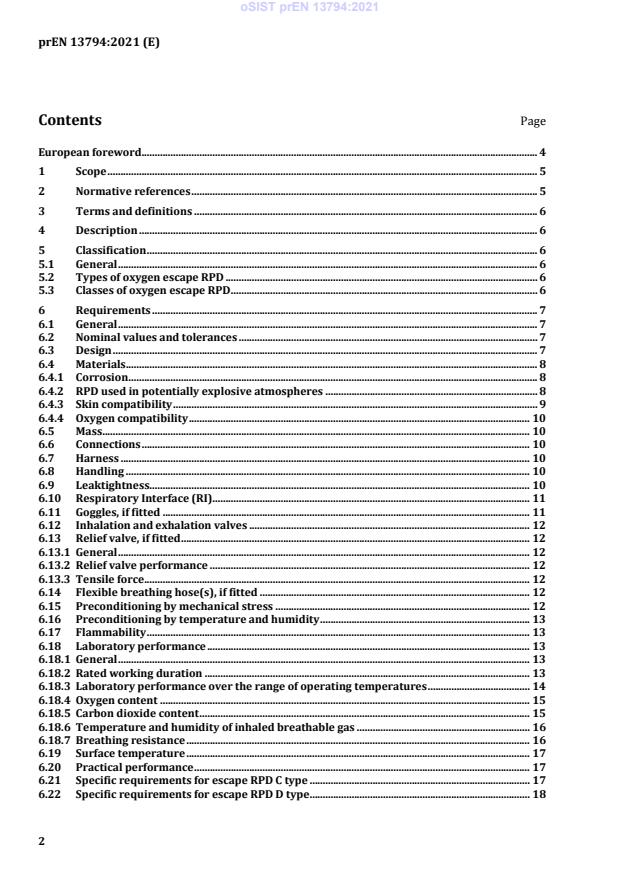
Contents Page
European foreword . 4
1 Scope . 5
2 Normative references . 5
3 Terms and definitions . 6
4 Description . 6
5 Classification . 6
5.1 General . 6
5.2 Types of oxygen escape RPD . 6
5.3 Classes of oxygen escape RPD . 6
6 Requirements . 7
6.1 General . 7
6.2 Nominal values and tolerances . 7
6.3 Design . 7
6.4 Materials . 8
6.4.1 Corrosion . 8
6.4.2 RPD used in potentially explosive atmospheres . 8
6.4.3 Skin compatibility . 9
6.4.4 Oxygen compatibility . 10
6.5 Mass . 10
6.6 Connections . 10
6.7 Harness . 10
6.8 Handling . 10
6.9 Leaktightness . 10
6.10 Respiratory Interface (RI) . 11
6.11 Goggles, if fitted . 11
6.12 Inhalation and exhalation valves . 12
6.13 Relief valve, if fitted . 12
6.13.1 General . 12
6.13.2 Relief valve performance . 12
6.13.3 Tensile force . 12
6.14 Flexible breathing hose(s), if fitted . 12
6.15 Preconditioning by mechanical stress . 12
6.16 Preconditioning by temperature and humidity . 13
6.17 Flammability . 13
6.18 Laboratory performance . 13
6.18.1 General . 13
6.18.2 Rated working duration . 13
6.18.3 Laboratory performance over the range of operating temperatures . 14
6.18.4 Oxygen content . 15
6.18.5 Carbon dioxide content . 15
6.18.6 Temperature and humidity of inhaled breathable gas . 16
6.18.7 Breathing resistance . 16
6.19 Surface temperature . 17
6.20 Practical performance . 17
6.21 Specific requirements for escape RPD C type . 17
6.22 Specific requirements for escape RPD D type . 18
6.22.1 Protection against particulate matter . 18
6.22.2 High and medium pressure parts . 18
6.22.3 High, medium and low pressure connections . 18
6.22.4 Gas cylinders . 18
6.22.5 Gas cylinder seal . 18
6.22.6 Gas cylinder seal connection . 18
6.22.7 Pressure reducer . 19
6.22.8 Pressure indicator . 19
6.22.9 Oxygen supply . 19
6.23 Oxygen supply for escape RPD K type . 20
6.24 Leaktightness for escape RPD K type and C type . 20
7 Testing . 20
7.1 General . 20
7.2 Inspection . 22
7.3 Leaktightness . 23
7.3.1 Leaktightness of the carrying container . 23
7.3.2 Leaktightness of the RPD in ready for use configuration . 23
7.4 Mechanical strength . 23
7.4.1 Shock . 23
7.4.2 Vibration . 23
7.5 Resistance to temperature . 24
7.5.1 Pre-conditioning . 24
7.5.2 Low temperature practical performance test . 24
7.6 Laboratory performance tests . 25
7.7 Surface temperature . 28
7.8 Breathing resistance . 29
7.9 Tensile force . 29
7.10 Oxygen supply . 29
7.11 Practical performance . 29
7.11.1 General . 29
7.11.2 Escape tests . 29
7.11.3 Testing of oxygen content, carbon dioxide content and temperature of inhaled gas . 30
7.12 Flow measurement. 30
7.13 Pull Force . 30
8 Marking . 31
9 Information supplied by the manufacturer . 31
Annex A (normative) Additional requirements and methods of testing for RPD designed for
underground use . 34
Annex B (informative) Guideline for training RPD . 35
Annex C (informative) Calculation of the volume flow (V) using the mass flow (m) . 37
Annex ZA (informative) Relationship between this European Standard and the essential
health and safety requirements of Regulation 2016/425/EU [2016 OJ L81] aimed to
be covered . 38
Bibliography . 40
European foreword
This document (prEN 13794:2020) has been prepared by Technical Committee CEN/TC 79
“Respiratory protective devices”, the secretariat of which is held by DIN.
This document is currently submitted to the CEN Enquiry.
This document will supersede EN 13794:2002.
This document has been prepared under a standardization request given to CEN by the European
Commission and the European Free Trade Association, and supports essential requirements of
EU Directive(s).
For relationship with EU Directive, see informative Annex ZA, which is an integral part of this
document.
1 Scope
This document specifies minimum requirements for self-contained closed-circuit breathing RPD for
escape (short: oxygen escape RPD)
a) chemical oxygen type
— potassium superoxide (KO ),
— sodium chlorate (NaClO ) and
b) compressed oxygen type.
This document does not apply to RPD for work and rescue and to diving apparatus.
Laboratory and practical performance tests are included for the assessment of compliance with the
requirements.
2 Normative references
The following documents are referred to in the text in such a way that some or all of their content
constitutes requirements of this document. For dated references, only the edition cited applies. For
undated references, the latest edition of the referenced document (including any amendments) applies.
EN 134:1998, Respiratory protective devices - Nomenclature of components
EN 136:1998, Respiratory protective devices - Full face masks - Requirements, testing, marking
EN 13274-1:2001, Respiratory protective devices - Methods of test - Part 1: Determination of inward
leakage and total inward leakage
EN 13274-2:2019, Respiratory protective devices - Methods of test - Part 2: Practical performance tests
EN 13274-3:2002, Respiratory protective devices - Methods of test - Part 3: Determination of breathing
resistance
EN 13274-4:2020, Respiratory protective devices - Methods of test - Part 4: Flame test
EN 13274-5:2001, Respiratory protective devices - Methods of test - Part 5: Climatic conditions
EN ISO 16321-1:-, Eye and face protection for occupational use - Part 1: General requirements (ISO/FDIS
16321-1:2020)
EN ISO 16972:2020, Respiratory protective devices - Vocabulary and graphical symbols(ISO 16972:2020)
EN ISO 18526-3:2020, Eye and face protection - Test methods - Part 3: Physical and mechanical
properties (ISO 18526-3:2020)
ISO 80079-36:2016, Explosive atmospheres — Part 36: Non-electrical equipment for explosive
atmospheres — Basic method and requirements
Under preparation. Stage at time of publication: FprEN ISO 16321-1:2020
3 Terms and definitions
For the purposes of this document, the following terms and definitions given in EN ISO 16972:2020,
EN 134:1998 and the following apply.
3.1
quick start system
mechanism which activates the generation or flow of breathable gas whilst opening the container or by
pulling the facepiece
3.2
ready for use configuration
complete respiratory protective device, which may not be fully assembled, but is in a state which allows
the immediate start of the donning procedure as described by the manufacturer
4 Description
An oxygen escape RPD is designed and constructed so that exhaled breathing gas is ducted from the
facepiece into a circuit which contains a cartridge and a breathing bag where it is available for re-
breathing. The cartridge contains chemicals which absorb exhaled carbon dioxide and - in case of a KO
RPD - humidity and generates also oxygen.
In case of a NaClO RPD, a chemical oxygen source (NaClO candle) generates the oxygen to be needed.
3 3
In case of a compressed oxygen RPD, oxygen is fed into the circuit at a suitable point by means of a
constant flow device or by a lung governed demand valve or by a suitable combination of both.
The breathing gas flow may be of the pendulum or loop type and excess gas is ejected to the surrounded
atmosphere via a relief valve.
5 Classification
5.1 General
Oxygen escape RPD are classified according to their oxygen source and rated working duration in types
and classes.
RPD intended to be carried on a person, machine or vehicle shall be classified as “M”, otherwise it shall
be classified as “R”.
5.2 Types of oxygen escape RPD
— Type C NaClO RPD;
— Type D Compressed oxygen RPD;
— Type K KO RPD.
5.3 Classes of oxygen escape RPD
Oxygen escape RPD classes are defined by rated working duration with increments of 5 min up to and
including duration of 30 min and thereafter in steps of 10 min.
The minimum class has a rated working duration of 5 min and is class 5.
The classes are assessed by the requirements of 6.18.2.1.
6 Requirements
6.1 General
All test samples specified in the related test clauses shall meet the relevant requirements.
Where it is required in a specific clause, the manufacturer shall declare that a risk assessment e.g. a
Failure Modes and Effect Analysis (FMEA) concerning these specific requirements has been conducted.
NOTE Further information is given in EN 60812 [1].
6.2 Nominal values and tolerances
Unless otherwise specified, the values stated in this document are expressed as nominal values. Except
for temperature limits, values which are not stated as maxima or minima shall be subject to a tolerance
of ± 5 %. Unless otherwise specified, the ambient conditions for testing shall be between 16°C and 32°C
and (50 ± 30) % relative humidity. Any temperature limits specified shall be subject to an accuracy
of ± 1°C.
6.3 Design
The RPD shall be designed so as not to interfere with work activities when being carried. It shall be used
in accordance with the information supplied by the manufacturer.
The surface of any part of the RPD likely to be in contact with the wearer shall be free from sharp edges,
burrs and no protruding parts, that can be caught on projections in narrow passages, or by moving
parts.
Check in accordance with 7.2 and test in accordance with 7.11
The RPD shall be so designed and constructed as to prevent ingress of external atmosphere within the
limits specified in this document.
Testing shall be performed in accordance with 7.3.
The RPD shall be so designed as to prevent that saliva or condensate to interfere with the function of
the RPD or cause any harmful effect to the wearer.
Check in accordance with 7.2 and test in accordance with 7.11.
The RPD shall be so designed to prevent the chemical used in the RPD entering the wearer's respiratory
tract.
No migration to the RI of any powdered chemical shall be possible.
After pre-conditioning in accordance with 7.4, check in accordance with 7.3 using a cotton pad with
chemical reagent which reacts with KO powder e.g. phenolphthalein.
It shall not be possible to initiate a quick start system inadvertently, if fitted.
It shall not be possible to don the RPD without initiating the quick start system, if fitted.
For RPD designed for underground use, the additional requirements specified in Annex A shall be
fulfilled.
Test in accordance with Annex A.
RPD shall be designed in such a way to minimize the risk to be caught up. Special mechanism or
carrying methods can be used to minimize the risk.
The manufacturer shall supply a declaration that this was addressed by a risk assessment, e.g. a FMEA.
If a training RPD is available, it shall be clearly distinguishable from the working RPD and shall be
marked as such and explained in the information supplied by the manufacturer.
If a training RPD is available, it shall follow the general guidelines in Annex B.
WARNING —Training RPD according to Annex B are not Personal Protective Equipment and therefore,
they shall never be used in hazardous conditions.
Check in accordance with 7.2.
6.4 Materials
6.4.1 Corrosion
The carrying container and the locking system, where present, shall be adequately protected against
corrosion.
The manufacturer shall supply a declaration that this was addressed by a risk assessment, e.g. a FMEA.
The materials used shall be able to withstand temperatures and mechanical stress to be expected whilst
being carried on the person as well as being stored on machines and vehicles.
Check in accordance with 7.2 and test in accordance with 7.4, 7.5.1 and 7.11.
6.4.2 RPD used in potentially explosive atmospheres
6.4.2.1 General
If the RPD is intended to be used in potentially explosive atmospheres the RPD shall be marked
accordingly.
6.4.2.2 Exposed components
RPD intended to be used in potentially explosive atmospheres shall not have exposed unprotected
metal components manufactured from Aluminium, Magnesium, Titanium, Zirconium or their alloys
containing such proportions of these metals which, on impact with rusted iron or steel, are likely to
produce sparks capable of igniting flammable gas/air mixtures.
The manufacturer shall supply a declaration that this was addressed by a risk assessment, e.g. a FMEA.
Check in accordance with 7.2.
6.4.2.3 Antistatic properties
RPD and exposed components in the ready for use packaging and during the donning of the RPD and in
the donned configuration shall be tested in accordance with ISO 80079-36:2016. Testing by charging
with a DC high voltage power supply (ISO 80079-36:2016, D.4.2.3,) can be excluded, as long as highly
efficient charge generating mechanisms (fast separation processes, e.g. films moving over rollers, drive
belts, loading arm operation and bulk hydrocarbon transfer) are unlikely to be present. A warning shall
be given in the information supplied by the manufacturer.
Exposed components are those that can be touched, during use, by the exposed surface identification
probe given in Figure 1.
Dimensions in millimetres
Key
1 surface, corrugated at the discretion of the manufacturer
Figure 1 — Exposed surface identification probe
6.4.2.4 Use of RPD in potentially explosive atmospheres
If in the information supplied by the manufacturer the RPD is claimed that it can be used in potentially
explosive atmospheres it shall comply with the IEC Ex Certified Equipment Program.
6.4.3 Skin compatibility
Materials which come into direct contact with the wearer's skin shall not be known to be likely to cause
irritation or any other adverse effect to health.
The manufacturer shall supply a declaration that this was addressed by a risk assessment, e.g. a FMEA.
Check in accordance with 7.2.
6.4.4 Oxygen compatibility
Materials that can come into contact with oxygen shall not cause an oxygen ignition.
The manufacturer shall supply a declaration that this was addressed by a risk assessment, e.g. a FMEA.
RPD using oxygen generating chemicals shall be known not to ignite or combust due to the elevated
temperatures of the RPD (caused by the exothermic chemical reaction) as a result of intended use.
The manufacturer shall supply a declaration that this was addressed by a risk assessment, e.g. a FMEA.
Check in accordance with 7.2.
6.5 Mass
The mass of the RPD in the donned configuration during escape shall not exceed 5 kg.
The mass of the complete RPD including carrying container shall not exceed 5 kg when designed to be
carried.
Check in accordance with 7.2.
6.6 Connections
If the manufacturer claims that parts of the RPD needs to be maintained during lifetime, then the design
and construction of the RPD shall permit its components to be easily disassembled for cleaning,
inspecting and testing. If demountable connections are used to achieve this, they shall be easily
connected and secured, preferably by hand.
Any means for sealing used shall be retained in position when the connection(s) is (are) disconnected
during normal maintenance.
Check in accordance with 7.2.
6.7 Harness
The RPD in use shall have a harness, or other means of support, so that the wearers' hands are left free,
when the RPD is in use.
Any harness shall be designed to allow quick, easy and correct donning of the RPD without assistance.
Check in accordance with 7.2 and test in accordance with 7.11.
6.8 Handling
The RPD shall be capable of being donned and simply put into operation without undue exertion under
difficult conditions, e.g. in the dark and in restricted spaces.
The design of the RPD container shall be such that it cannot be opened inadvertently.
If the RPD has been opened this shall be obvious by inspection.
Check in accordance with 7.2 and test in accordance with 7.11.
6.9 Leaktightness
One RPD in ready for use configuration and preconditioned in accordance with 6.14 and 6.15 shall be
tested.
The RPD in ready for use configuration shall be leak tight so that the pressure change does not exceed
0,3 mbar within 1 min.
Testing shall be performed in accordance with 7.3.2, carrying container opened and, if applicable, be
removed but without the quick start system activated.
6.10 Respiratory Interface (RI)
Two RPD in ready for use configuration and preconditioned in accordance with 6.14 and 6.15 shall be
tested.
The RI shall be either a mouthpiece assembly or a full face mask and shall be attached to the RPD in
such a way that the connection shall withstand a pull force of 50 N for 10 s.
Testing shall be performed in accordance with 7.13.
Type D- RPD with a lung governed demand valve shall be fitted with a full face mask.
The mouthpiece assembly shall have two teeth bites and a permanently attached nose clip.
The mouthpiece assembly shall ensure reliable sealing and shall not be able to block inadvertently the
breathing circuit when the RPD is in operation.
The mouthpiece assembly shall be fitted with an adjustable or self-adjusting head harness if it is likely
that an undue load is exerted on the wearer's mouth.
The nose clip shall provide an airtight seal of the nose. It shall be flexible attached to the mouthpiece
assembly so that, when fitting the mouthpiece, the wearer's attention is automatically drawn to the
nose clip.
Check in accordance with 7.2 and test in accordance with 7.11.
If a full face mask is used as a RI the following requirements shall be met:
— the full face mask shall be provided with an adjustable or self-adjusting head harness;
— the requirements of EN 136:1998, 7.11.1 and 7.11.3.1 shall be met.
The lens of the full face mask shall meet the requirements for eyepieces and visors of EN 136:1998,
7.14, except the requirement for the field of vision.
Check in accordance with 7.2 and test in accordance with 7.11 and EN 136:1998, 8.3, 8.11, 8.13 and
8.18.
The field of vision shall be sufficient to allow escape and tested in accordance with 7.11.
The face seal leakage of the full face mask shall be tested separately and shall meet the requirements of
EN 136:1998, 7.20, when tested in accordance with EN 13274-1:2001.
6.11 Goggles, if fitted
If the RPD is used with goggles, then the lenses of the goggles shall be protected against fogging. The
head straps of the goggles shall be flexible and easy to adjust or self-adjusting.
The goggles shall be attached to the RPD to prevent loss when opening the carrying container. The
goggles shall not interfere with the donning of the RPD.
Check in accordance with 7.2 and test in accordance with 7.11.
After the test for mechanical strength of the eyepiece(s) in accordance with EN 136:1998, 8.11, the
goggles shall not be damaged in any way that can make it ineffective or cause injury to the wearer.
Check in accordance with 7.2 and test in accordance with 7.11.
The leaktightness of the two goggles shall meet the requirements of EN ISO 16321-1:-, 7.18, when
tested in accordance with EN ISO 18526-3:2020, 6.14.
6.12 Inhalation and exhalation valves
The valves shall function correctly in all orientations.
Testing shall be performed in accordance with 7.11.
6.13 Relief valve, if fitted
6.13.1 General
The relief valve, if fitted, shall be protected by means of coverage to prevent mechanical damage.
Testing shall be performed in accordance with 7.11.
6.13.2 Relief valve performance
RPD in ready for use configuration and preconditioned in accordance with 6.14 and 6.15 shall be tested.
A relief valve shall open properly irrespective of the orientation of the RPD.
The relief valve shall prevent over pressurization.
Testing shall be performed in accordance with 7.8.
6.13.3 Tensile force
Three RPD in ready for use configuration and preconditioned in accordance with 6.14 and 6.15 shall be
tested.
The connection between the relief valve housing and the attachment part shall withstand an axial
tensile force of 50 N.
After the test the RPD shall still be leaktight as specified in 6.9.
Testing shall be performed in accordance with 7.9.
6.14 Flexible breathing hose(s), if fitted
The breathing hose(s) shall be flexible and non-kinking. The breathing hose(s) shall permit free head
movement and shall not restrict or close-off the gas supply under chin or arm pressure during practical
performance tests.
Testing shall be performed in accordance with 7.11.
The connections shall withstand an axial tensile force of 50 N.
Two RPD in ready for use configuration and preconditioned in accordance with 6.15 and 6.16shall be
tested.
Testing shall be performed in accordance with 7.9.
6.15 Preconditioning by mechanical stress
The complete RPD classified as “M” shall be subjected to shock and vibration test in three orthogonal
orientated axes as specified in 7.4.1 and 7.4.2.
The orientation of the axes shall be agreed between manufacturer and test house.
Testing shall be performed in accordance with 7.3.1.
For RPD designed for underground use, additional requirements shall be fulfilled and the test methods
specified in A.1, as an alternative, shall be used.
6.16 Preconditioning by temperature and humidity
RPD shall be temperature pre-conditioned in accordance with 7.6.1 and after being allowed to return to
room temperature the carrying container shall not show substantial deteriorations (severe
deformations, cracks, etc.).
Check in accordance with 7.2 and test in accordance 7.3.1.
6.17 Flammability
One RPD in ready-for-use configuration non-preconditioned shall be examined and those parts deemed
to be of an exposed nature during normal use shall be tested in accordance with EN 13274-4:2020,
Clause 8, Method 3.
Components shall be considered to be flame resistant if they do not burn or if they are self-
extinguishing within 5 s after removal from the test flame.
After the test the RPD shall still be leaktight as specified in 6.9.
Testing shall be performed in accordance with 7.3.2 and EN 13274-4:2020, Clause 8, Method 3.
6.18 Laboratory performance
6.18.1 General
A warning detectable by the user shall be given before the O concentration drops below 17 % and/or
the CO concentration exceeds a volume fraction of 5 %, e.g. an increased breathing resistance of
35 mbar, or a means to breathe ambient air automatically shall be provided.
6.18.2 Rated working duration
6.18.2.1 Rated working duration at 35 l/min
For the assessment of rated working duration one RPD shall be tested at room temperature and at a
ventilation rate of 35 l/min for the duration defined for its class.
After the RPD is being preconditioned by temperature and humidity in accordance with 6.16, followed
by preconditioning by mechanical stress in accordance with 6.15, testing shall be performed in
accordance with 7.6.
Setting of the breathing simulator and the addition of CO to the exhaled air are given in Table 2.
The RPD shall meet the requirements for oxygen content (6.18.4), carbon dioxide content (6.18.5),
temperature and humidity (6.18.6) and breathing resistance (6.18.7) during the rated working duration
time.
6.18.2.2 Working duration at 10 l/min
To confirm the rated working duration; for type D RPD, with lung governed demand valves and for type
K RPD, chemical oxygen (KO ), the duration of the RPD shall be at least three times longer when tested
at a ventilation rate of 10 l/min.
Settings of the breathing simulator and the addition of CO to the exhaled air are given in Table 2.
Testing shall be performed in accordance with 7.6 after the RPD is being preconditioned by
temperature and humidity 6.16, followed by preconditioning by mechanical stress 6.15.
The RPD shall meet the requirements for oxygen content (6.18.4), carbon dioxide content (6.18.5),
temperature and humidity (6.18.6) and breathing resistance (6.18.7) during three times the rated
working duration time.
The test shall be continued for three times the working duration of the device.
6.18.3 Laboratory performance over the range of operating temperatures
After the RPD is being preconditioned by temperature and humidity in accordance with 6.16, followed
by preconditioning by mechanical stress in accordance with 6.15 testing shall be performed in
accordance with 7.6 at the following temperatures:
One RPD shall be equilibrated for a minimum of 4 h at (23 ± 2)°C and tested at (23 ± 2)°C.
+4 +4
One RPD shall be equilibrated for a minimum of 4 h at −5 °C and tested at −5 °C.
0 0
One RPD shall be equilibrated for a minimum of 4 h at (60 ± 2) °C and tested at (60 ± 2) °C. At this
temperature the inhalation temperature shall not be assessed. Testing shall be performed at 35 l/min,
70 l/min and 10 l/min, according to the regimes as given in Table 1, depending on the rated working
duration of the RPD. Settings of the breathing simulator and the addition of CO to the exhaled air are
given in Table 2.
For RPD with a rated working duration of 20 min and above (see Table 1) one RPD is tested at each
temperature.
For RPD with a rated working duration of 10 min or 15 min (see Table 1) two RPD are tested at each
temperature.
For RPD with a rated working duration of 5 min (see Table 1) three RPD are tested at each temperature
The RPD shall meet the requirements for oxygen content (6.18.4), carbon dioxide content (6.18.5),
temperature and humidity (6.18.6) and breathing resistance (6.18.7).
Table 1 — Regimes for laboratory performance test in relation to the rated working duration
Setting of the breathing simulator
RPD with a
rated
From start From 6th From 11th From 16th
remaining
working
to 5th to 10th to 15th to 20th
test time
duration of
minute minute minute minute
20 min and
35 l/min 70 l/min 35 l/min 10 l/min
above
35 l/min 70 l/min
10 min or
15 min
35 l/min 10 l/min
35 l/min
35 l/min
a
5 min
70 l/min
10 l/min
a
Minimum requirement at 70 l/min is 2 min
Table 2 — Test conditions: Setting of breathing simulator, addition of CO to the exhaled air and
removal of oxygen (BTPS)
Tidal Removal of
Input of carbon
Minute Frequenc
volume oxygen (BTPS)
a
volume y
dioxide
(BTPS)
l/min cycles/mi l g/min g/min
n
(10 ± 0,3) 8 1,25 0,696 0,69 0,50
(35 ± 0,7) 20 1,75 1,274 2,72 1,98
(70 ± 1,4) 30 2,33 3,609 6,05 4,40
a
For conversion to ml/min see Annex C.
Any peak values resulting from the switching of the test equipment from one flow rate setting to the
next shall not be considered as a failure and shall not be assessed.
Tests shall be terminated when
— a warning detectable by the user is activated, e.g. the inhalation resistance exceeds 35 mbar or
— ambient air is made available, or
— the CO content exceeds 5 %.
6.18.4 Oxygen content
During the first 3 min after the start of the test, the oxygen content shall not be lower than 17 % by
volume at any time.
After the first 3 min the oxygen content shall not be lower than 19,5 % by volume at any time.
Testing shall be performed in accordance with 7.6.
6.18.5 Carbon dioxide content
For RPD with a rated working duration of 5 min, 10 min or 15 min the carbon dioxide content shall not
exceed 3,0 % by volume at any time during the working duration, specified in 6.18.2.1 and 6.18.2.2.
For RPD with a rated working duration longer than 15 min:
— the carbon dioxide content shall not exceed 3,0 % by volume at any time during the working
duration, specified in 6.18.2.1 and 6.18.2.2.
— the carbon dioxide content averaged shall not exceed 1,5 % by volume during the working
duration, specified in 6.18.2.1 and 6.18.2.2.
During the laboratory performance test specified in 6.18.3 the CO content shall not exceed 5 % by
volume at any time during the test. Peaks caused by switching from one flow rate to the other shall not
be taken into account.
Testing shall be performed in accordance with 7.6.
6.18.6 Temperature and humidity of inhaled breathable gas
When tested in accordance with 7.6, the temperature and humidity limits shall be on or below the curve
given in Figure 2, Key 1.
Key
Y relative humidity
X inhalation temperature
1 temperature and humidity limit for inhaled breathable gas
Figure 2 — Allowable inhalation temperature at relative humidity levels
6.18.7 Breathing resistance
6.18.7.1 Breathing resistance at 10 l/min and 35 l/min
For RPD with a rated working duration of up to and including 30 min, at any point in the rated working
duration the sum of the inhalation and exhalation resistances shall not exceed 16 mbar and the
maximum individual breathing resistance for inhalation or exhalation shall not exceed 10 mbar when
tested in the normal wearing position.
For RPD with a rated working duration of more than 30 min, at any point in the rated working duration
the sum of the inhalation and exhalation resistances shall not exceed 13 mbar and the maximum
individual breathing resistance for inhalation or exhalation shall not exceed 7,5 mbar when tested in
the normal wearing position.
Testing shall be performed in accordance with 7.6 at each specified temperature using
EN 13274-3:2002, Method 2.
6.18.7.2 Breathing resistance at 70 l/min
For RPD of all rated working durations the breathing resistance for inhalation as well as for exhalation
shall n
...