

EN 1501-1:2021
(Main)Refuse collection vehicles - General requirements and safety requirements - Part 1: Rear loaded refuse collection vehicles
General Information
- Abstract
This document applies to rear loaded refuse collection vehicles (RCV), as defined in 3.2.
This document deals with all significant hazards, hazardous situations and events relevant to the rear loaded RCV, when it is used as intended and under conditions of misuse which are reasonably foreseeable by the manufacturer, throughout its foreseeable lifetime, as defined in Clause 4.
This document is applicable to the design and construction of the rear loaded RCV so as to ensure that it is fit for its function and can be operated, adjusted and maintained during its entire lifetime. It is not applicable to the end of life of the rear loaded RCV.
This document describes and defines the safety requirements of rear loaded RCVs excluding the interface tailgate/discharge door with the lifting device(s) and the lifting device(s) as illustrated in Figure A.1.
Safety requirements for the lifting device(s) and the interface with the tailgate/discharge door are defined in prEN 1501-5. Safety requirements for loader cranes are defined in EN 12999.
This European Standard is not applicable to:
- operation in severe conditions, e.g. extreme environmental conditions such as:
- below -25 °C and above +40 °C temperatures;
- tropical environment;
- wind velocity in excess of 75 km/h;
- contaminating environment;
- corrosive environment;
- operation in potentially explosive atmospheres;
- handling of loads the nature of which could lead to dangerous situations (e.g. hot refuses, acids and bases, radioactive materials, contaminated refuse, especially fragile loads, explosives);
- operation on ships.
This document is not applicable to machinery which is manufactured before the date of publication of this document by CEN.
- Status
- Published
- Publication Date
- 30-Mar-2021
- Withdrawal Date
- 30-Mar-2022
- Technical Committee
- CEN/TC 183 - Waste management
- Current Stage
- 6060 - Definitive text made available (DAV) - Publishing
- Start Date
- 31-Mar-2021
- Due Date
- 16-Dec-2019
- Completion Date
- 31-Mar-2021
- Directive
- 2006/42/EC - Directive 2006/42/EC of the European Parliament and of the Council of 17 May 2006 on machinery, and amending Directive 95/16/EC (recast)OJ Ref: L, L 115 OJ Date: 13-Apr-2022

Overview
EN 1501-1:2021 specifies general and safety requirements for rear loaded refuse collection vehicles (RCVs). The standard addresses all significant hazards, hazardous situations and events relevant to rear loaded RCVs when used as intended and under reasonably foreseeable misuse throughout their foreseeable lifetime (excluding end‑of‑life). It is focused on the design and construction needed to ensure RCVs are fit for function, safe to operate, maintainable and verifiable.
The document excludes the safety interface of tailgate/discharge door with lifting device(s) (covered by prEN 1501‑5) and loader cranes (covered by EN 12999). It is not applicable for operation in severe environments (below ‑25 °C or above +40 °C, tropical, corrosive or contaminating atmospheres, wind >75 km/h), potentially explosive atmospheres, handling inherently dangerous loads (radioactive, acids, hot refuse, explosives), operation on ships, or to machinery manufactured before the publication date.
Key topics and technical requirements
- Risk assessment & hazard listing: identification of significant hazards and danger zones specific to rear loading operation.
- Compaction and hopper safety: requirements for compaction mechanisms, hopper interaction, guide flaps and guards.
- Discharge systems: safety for tailgate/discharge door operation and emptying procedures (note: Lifting device interface excluded).
- Control systems & interlocks: safety circuits, emergency stops, two‑hand controls, remote control considerations and overload protection.
- Hydraulic, pneumatic and electrical systems: safe design, wiring, position sensors and energy interruption safeguards.
- Riding provisions: requirements for operator footboards, handles, cab access and safe riding on the rear of the vehicle.
- Monitoring & warnings: CCTV, communication systems, working lights and audible/visual warnings.
- Maintenance & verification: procedures to prevent unexpected start‑up, safe access for maintenance, inspection doors and cleaning.
- Stability, vibration and noise: requirements for lateral/front axle stability, vibration limits and noise control; includes verification and measurement guidance.
- Documentation & marking: instruction handbook, maintenance instructions, spare parts list and data sheet requirements.
Key annexes provide normative details on interfaces, open/closed footboard systems, danger‑zone scenarios, volumes and illuminated areas.
Applications and who uses this standard
SIST EN 1501‑1:2021 is used by:
- RCV manufacturers and designers to ensure compliant vehicle design and construction
- Fleet managers and municipal waste operators for procurement and compliance checks
- Safety engineers, test laboratories and conformity assessors for verification and type testing
- Regulators and technical authorities to reference safety requirements for roadworthy refuse vehicles
Adoption improves operational safety, reduces incident risk during collection cycles and supports regulatory compliance in waste management fleets.
Related standards
- EN 1501 series (Parts 2, 3, 4, 5) - side/front loaded RCVs, noise test code and lifting devices
- prEN 1501‑5 - safety requirements for lifting device(s) and interface with tailgate/discharge door
- EN 12999 - safety requirements for loader cranes
Keywords: EN 1501-1:2021, rear loaded refuse collection vehicles, RCV safety requirements, waste management vehicle standards, refuse vehicle design.
Relations
- Effective Date
- 07-Apr-2021
- Effective Date
- 25-Aug-2026
- Effective Date
- 09-Feb-2026
- Effective Date
- 09-Feb-2026
- Effective Date
- 09-Feb-2026
- Effective Date
- 09-Feb-2026
- Effective Date
- 09-Feb-2026
- Effective Date
- 09-Feb-2026
- Effective Date
- 28-Jan-2026
- Effective Date
- 28-Jan-2026
- Effective Date
- 28-Jan-2026
- Effective Date
- 28-Jan-2026
- Effective Date
- 28-Jan-2026
- Effective Date
- 28-Jan-2026
- Effective Date
- 28-Jan-2026
Get Certified
Connect with accredited certification bodies for this standard

TÜV Rheinland
TÜV Rheinland is a leading international provider of technical services.

TÜV SÜD
TÜV SÜD is a trusted partner of choice for safety, security and sustainability solutions.

DEKRA Certification Inc.
DEKRA US certification services.
Sponsored listings
Frequently Asked Questions
EN 1501-1:2021 is a standard published by the European Committee for Standardization (CEN). Its full title is "Refuse collection vehicles - General requirements and safety requirements - Part 1: Rear loaded refuse collection vehicles". This standard covers: This document applies to rear loaded refuse collection vehicles (RCV), as defined in 3.2. This document deals with all significant hazards, hazardous situations and events relevant to the rear loaded RCV, when it is used as intended and under conditions of misuse which are reasonably foreseeable by the manufacturer, throughout its foreseeable lifetime, as defined in Clause 4. This document is applicable to the design and construction of the rear loaded RCV so as to ensure that it is fit for its function and can be operated, adjusted and maintained during its entire lifetime. It is not applicable to the end of life of the rear loaded RCV. This document describes and defines the safety requirements of rear loaded RCVs excluding the interface tailgate/discharge door with the lifting device(s) and the lifting device(s) as illustrated in Figure A.1. Safety requirements for the lifting device(s) and the interface with the tailgate/discharge door are defined in prEN 1501-5. Safety requirements for loader cranes are defined in EN 12999. This European Standard is not applicable to: - operation in severe conditions, e.g. extreme environmental conditions such as: - below -25 °C and above +40 °C temperatures; - tropical environment; - wind velocity in excess of 75 km/h; - contaminating environment; - corrosive environment; - operation in potentially explosive atmospheres; - handling of loads the nature of which could lead to dangerous situations (e.g. hot refuses, acids and bases, radioactive materials, contaminated refuse, especially fragile loads, explosives); - operation on ships. This document is not applicable to machinery which is manufactured before the date of publication of this document by CEN.
This document applies to rear loaded refuse collection vehicles (RCV), as defined in 3.2. This document deals with all significant hazards, hazardous situations and events relevant to the rear loaded RCV, when it is used as intended and under conditions of misuse which are reasonably foreseeable by the manufacturer, throughout its foreseeable lifetime, as defined in Clause 4. This document is applicable to the design and construction of the rear loaded RCV so as to ensure that it is fit for its function and can be operated, adjusted and maintained during its entire lifetime. It is not applicable to the end of life of the rear loaded RCV. This document describes and defines the safety requirements of rear loaded RCVs excluding the interface tailgate/discharge door with the lifting device(s) and the lifting device(s) as illustrated in Figure A.1. Safety requirements for the lifting device(s) and the interface with the tailgate/discharge door are defined in prEN 1501-5. Safety requirements for loader cranes are defined in EN 12999. This European Standard is not applicable to: - operation in severe conditions, e.g. extreme environmental conditions such as: - below -25 °C and above +40 °C temperatures; - tropical environment; - wind velocity in excess of 75 km/h; - contaminating environment; - corrosive environment; - operation in potentially explosive atmospheres; - handling of loads the nature of which could lead to dangerous situations (e.g. hot refuses, acids and bases, radioactive materials, contaminated refuse, especially fragile loads, explosives); - operation on ships. This document is not applicable to machinery which is manufactured before the date of publication of this document by CEN.
EN 1501-1:2021 is classified under the following ICS (International Classification for Standards) categories: 43.160 - Special purpose vehicles. The ICS classification helps identify the subject area and facilitates finding related standards.
EN 1501-1:2021 has the following relationships with other standards: It is inter standard links to EN 1501-1:2011+A1:2015, ISO 7000:2019, EN 61496-1:2013, EN 61310-1:2008, EN 60529:1991/A2:2013, EN 60529:1991/A1:2000, EN 60204-1:2018, EN 60529:1991, EN 894-4:2010, EN 894-2:1997+A1:2008, EN ISO 7731:2008, EN ISO 13850:2015, EN 547-2:1996+A1:2008, EN 547-1:1996+A1:2008, EN ISO 13854:2019. Understanding these relationships helps ensure you are using the most current and applicable version of the standard.
EN 1501-1:2021 is associated with the following European legislation: EU Directives/Regulations: 2006/42/EC; Standardization Mandates: M/396. When a standard is cited in the Official Journal of the European Union, products manufactured in conformity with it benefit from a presumption of conformity with the essential requirements of the corresponding EU directive or regulation.
EN 1501-1:2021 is available in PDF format for immediate download after purchase. The document can be added to your cart and obtained through the secure checkout process. Digital delivery ensures instant access to the complete standard document.
Standards Content (Sample)
SLOVENSKI STANDARD
01-junij-2021
Nadomešča:
SIST EN 1501-1:2011+A1:2015
Vozila za zbiranje odpadkov - Splošne in varnostne zahteve - 1. del: Vozila za
zbiranje odpadkov z nakladanjem zadaj
Refuse collection vehicles - General requirements and safety requirements - Part 1: Rear
loaded refuse collection vehicles
Abfallsammelfahrzeuge - Allgemeine Anforderungen und Sicherheitsanforderungen - Teil
1: Hecklader
Véhicules de collecte de déchets - Exigences générales et exigences de sécurité - Partie
1 : Véhicules de collecte de déchets à chargement arrière
Ta slovenski standard je istoveten z: EN 1501-1:2021
ICS:
13.030.40 Naprave in oprema za Installations and equipment
odstranjevanje in obdelavo for waste disposal and
odpadkov treatment
43.160 Vozila za posebne namene Special purpose vehicles
2003-01.Slovenski inštitut za standardizacijo. Razmnoževanje celote ali delov tega standarda ni dovoljeno.
EN 1501-1
EUROPEAN STANDARD
NORME EUROPÉENNE
March 2021
EUROPÄISCHE NORM
ICS 43.160 Supersedes EN 1501-1:2011+A1:2015
English Version
Refuse collection vehicles - General requirements and
safety requirements - Part 1: Rear loaded refuse collection
vehicles
Véhicules de collecte de déchets - Exigences générales Abfallsammelfahrzeuge - Allgemeine Anforderungen
et exigences de sécurité - Partie 1 : Véhicules de und Sicherheitsanforderungen - Teil 1: Hecklader
collecte de déchets à chargement arrière
This European Standard was approved by CEN on 15 February 2021.
CEN members are bound to comply with the CEN/CENELEC Internal Regulations which stipulate the conditions for giving this
European Standard the status of a national standard without any alteration. Up-to-date lists and bibliographical references
concerning such national standards may be obtained on application to the CEN-CENELEC Management Centre or to any CEN
member.
This European Standard exists in three official versions (English, French, German). A version in any other language made by
translation under the responsibility of a CEN member into its own language and notified to the CEN-CENELEC Management
Centre has the same status as the official versions.
CEN members are the national standards bodies of Austria, Belgium, Bulgaria, Croatia, Cyprus, Czech Republic, Denmark, Estonia,
Finland, France, Germany, Greece, Hungary, Iceland, Ireland, Italy, Latvia, Lithuania, Luxembourg, Malta, Netherlands, Norway,
Poland, Portugal, Republic of North Macedonia, Romania, Serbia, Slovakia, Slovenia, Spain, Sweden, Switzerland, Turkey and
United Kingdom.
EUROPEAN COMMITTEE FOR STANDARDIZATION
COMITÉ EUROPÉEN DE NORMALISATION
EUROPÄISCHES KOMITEE FÜR NORMUNG
CEN-CENELEC Management Centre: Rue de la Science 23, B-1040 Brussels
© 2021 CEN All rights of exploitation in any form and by any means reserved Ref. No. EN 1501-1:2021 E
worldwide for CEN national Members.
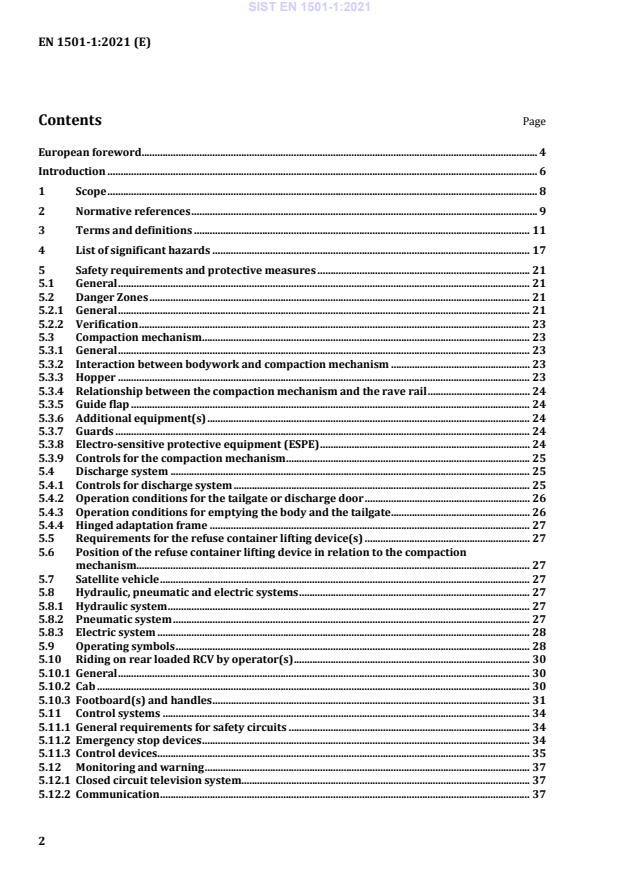
Contents Page
European foreword . 4
Introduction . 6
1 Scope . 8
2 Normative references . 9
3 Terms and definitions . 11
4 List of significant hazards . 17
5 Safety requirements and protective measures . 21
5.1 General . 21
5.2 Danger Zones . 21
5.2.1 General . 21
5.2.2 Verification . 23
5.3 Compaction mechanism . 23
5.3.1 General . 23
5.3.2 Interaction between bodywork and compaction mechanism . 23
5.3.3 Hopper . 23
5.3.4 Relationship between the compaction mechanism and the rave rail . 24
5.3.5 Guide flap . 24
5.3.6 Additional equipment(s) . 24
5.3.7 Guards . 24
5.3.8 Electro-sensitive protective equipment (ESPE) . 24
5.3.9 Controls for the compaction mechanism . 25
5.4 Discharge system . 25
5.4.1 Controls for discharge system . 25
5.4.2 Operation conditions for the tailgate or discharge door . 26
5.4.3 Operation conditions for emptying the body and the tailgate . 26
5.4.4 Hinged adaptation frame . 27
5.5 Requirements for the refuse container lifting device(s) . 27
5.6 Position of the refuse container lifting device in relation to the compaction
mechanism. 27
5.7 Satellite vehicle . 27
5.8 Hydraulic, pneumatic and electric systems . 27
5.8.1 Hydraulic system . 27
5.8.2 Pneumatic system . 27
5.8.3 Electric system . 28
5.9 Operating symbols . 28
5.10 Riding on rear loaded RCV by operator(s) . 30
5.10.1 General . 30
5.10.2 Cab . 30
5.10.3 Footboard(s) and handles . 31
5.11 Control systems . 34
5.11.1 General requirements for safety circuits . 34
5.11.2 Emergency stop devices . 34
5.11.3 Control devices . 35
5.12 Monitoring and warning . 37
5.12.1 Closed circuit television system. 37
5.12.2 Communication . 37
5.12.3 Warnings . 37
5.13 Electrical components . 39
5.13.1 General . 39
5.13.2 Protective interlocks . 39
5.13.3 Two-hand operating controls . 39
5.13.4 Overload protection . 39
5.13.5 Energy interruption . 39
5.13.6 Position sensors . 39
5.13.7 Terminals and wire connections. 39
5.13.8 Electric cables and wiring harness . 39
5.13.9 Working lights . 40
5.14 Requirements for maintenance . 40
5.14.1 Unexpected start-up . 40
5.14.2 Raised tailgate or discharge door or tilting body . 40
5.14.3 Access and inspection door(s) . 40
5.14.4 Cleaning . 40
5.15 Stability and driving security . 40
5.15.1 General . 40
5.15.2 Stability in container lifting mode . 41
5.15.3 Stability in discharging mode . 41
5.15.4 Lateral stability . 41
5.15.5 Minimum front axle mass . 41
5.16 Exhaust pipe . 41
5.17 Ventilation of the body . 41
5.18 Vibration . 41
5.18.1 Hand-arm vibration . 41
5.18.2 Whole-body vibration . 41
5.18.3 Uncertainty of vibration measurements . 42
5.19 Noise control . 42
6 Verification . 43
7 Information for use . 43
7.1 Instruction handbook . 43
7.2 Maintenance . 45
7.3 Spare parts list . 46
7.4 Data sheet . 46
7.5 Marking . 46
Annex A (normative) Description of interfaces and systems . 47
Annex B (normative) Open and closed systems – Footboard(s) . 50
Annex C (normative) Basic scenarios of different danger zones . 60
Annex D (informative) Volumes . 70
Annex E (informative) Illuminated areas . 71
Annex ZA (informative) Relationship between this European Standard and the essential
requirements of EU Directive 2006/42/EC aimed to be covered . 72
Bibliography . 77
European foreword
This document (EN 1501-1:2021) has been prepared by Technical Committee CEN/TC 183 “Waste
management”, the secretariat of which is held by DIN.
This European Standard shall be given the status of a national standard, either by publication of an
identical text or by endorsement, at the latest by September 2021 and conflicting national standards
shall be withdrawn at the latest by March 2022.
Attention is drawn to the possibility that some of the elements of this document may be the subject of
patent rights. CEN shall not be held responsible for identifying any or all such patent rights.
This document supersedes EN 1501-1:2011+A1:2015.
This document has been prepared under a standardization request given to CEN by the European
Commission and the European Free Trade Association, and supports essential requirements of
EU Directive(s).
For relationship with EU Directive(s), see informative Annex ZA, which is an integral part of this
document.
The main changes compared to the previous edition are listed below:
— document has been completely revised and partially restructured;
— European foreword and Introduction have been updated;
— Clause 1, Scope, has been slightly revised and clarified;
— Clause 2, Normative references, have been updated;
— in Clause 3 new terms and definitions have been added and others revised;
— Table 1 has been updated;
— Table 2 “Basic scenarios and applicable danger zones” and a completely new Annex C with multiple
figures of danger zones has been added;
— previous Annex C “Technical file” has been deleted;
— requirements on footboards and handles (5.10.3), reversing (5.10.3.4.3), remote controls (5.11.3.5),
monitoring and warning (5.12), stability (5.15), noise control (5.19) and many more have been
revised or added;
— new Annex E “Illuminated areas” has been added;
— Annex ZA has been updated.
EN 1501 consists of the following parts under the general title Refuse collection vehicles — General
requirements and safety requirements:
— Part 1: Rear loaded refuse collection vehicles (this part);
— Part 2: Side loaded refuse collection vehicles;
— Part 3: Front loaded refuse collection vehicles;
— Part 4: Noise test code for refuse collection vehicles;
— Part 5: Lifting devices for refuse collection vehicles.
This document will be enforced at the same time as EN 1501-5:2021 and applied whenever the RCV is
fitted with a lifting device.
For combinations of a rear loaded refuse collection vehicle with side and/or front loading capability the
corresponding clauses of EN 1501-2:2021, EN 1501-3:2021 and EN 1501-5:2021 apply.
This document has been prepared under a standardization request given to CEN by the European
Commission and the European Free Trade Association, and supports essential requirements of
EU Directive(s).
For relationship with EU Directive(s), see informative Annex ZA, which is an integral part of this
document.
According to the CEN-CENELEC Internal Regulations, the national standards organizations of the
following countries are bound to implement this European Standard: Austria, Belgium, Bulgaria,
Croatia, Cyprus, Czech Republic, Denmark, Estonia, Finland, France, Germany, Greece, Hungary, Iceland,
Ireland, Italy, Latvia, Lithuania, Luxembourg, Malta, Netherlands, Norway, Poland, Portugal, Republic of
North Macedonia, Romania, Serbia, Slovakia, Slovenia, Spain, Sweden, Switzerland, Turkey and the
United Kingdom.
Introduction
This document is a type-C standard as stated in EN ISO 12100:2010.
This document is of relevance, in particular, for the following stakeholder groups representing the
market players with regard to machinery safety:
— machine manufacturers (small, medium and large enterprises);
— health and safety bodies (regulators, accident prevention organisations, market surveillance etc.).
Others can be affected by the level of machinery safety achieved with the means of the document by the
above-mentioned stakeholder groups:
— machine users/employers (small, medium and large enterprises);
— machine users/employees (e.g. trade unions, organisations for people with special needs);
— service providers, e.g. for maintenance (small, medium and large enterprises);
— consumers (in case of machinery intended for use by consumers).
The above-mentioned stakeholder groups have been given the possibility to participate at the drafting
process of this document.
The machinery concerned and the extent to which hazards, hazardous situations or hazardous events
are covered are indicated in the scope of this document.
When requirements of this type-C standard are different from those which are stated in type-A or type-
B standards, the requirements of this type-C standard take precedence over the requirements of the
other standards for machines that have been designed and built according to the requirements of this
type-C standard.
This document is intended for careful consideration by designers, manufacturers, suppliers and users of
rear loaded RCVs.
This document should be read in conjunction with EN 1501-5:2021 developed for lifting devices which
are compatible with the refuse collection vehicle specified in this document.
While producing this document it was assumed that:
— for RCV the requirements of road traffic regulations apply. Where road traffic regulations are in
conflict with the provisions of this standard, the road regulations have priority;
— due to the European regulations on the approval of vehicles for use on public roads, the
requirements of UN/ECE R10:2019 for an RCV with regard to EMC applies. Therefore, EMC is not
further considered in this standard;
— the guidelines issued by the chassis manufacturer have been taken into account;
— chassis related safety items are handled by the chassis manufacturer according to their state of the
art and in compliance with the public road regulations;
— the guidelines of the lifting device manufacturer have been taken into account;
— based on measurements of different types of RCV hand-arm vibrations are in general lower than
2,5 m/s ;
— based on measurements on different types of RCV whole body vibrations are in general lower than
0,5 m/s ;
— components without specific requirements are designed in accordance with the usual engineering
practice and calculation codes, including all failure modes, of sound mechanical and electrical
construction and made of materials of adequate strength and of suitable quality;
— components are kept in good repair and working order, so that the required characteristics remain
despite wear and tear;
— harmful materials, such as asbestos, are not used as part of the rear loaded RCV;
— only persons who have been appropriately trained will operate the rear loaded RCV.
1 Scope
This document applies to rear loaded refuse collection vehicles (RCV), as defined in 3.2.
This document deals with all significant hazards, hazardous situations and events relevant to the rear
loaded RCV, when it is used as intended and under conditions of misuse which are reasonably
foreseeable by the manufacturer, throughout its foreseeable lifetime, as defined in Clause 4.
This document is applicable to the design and construction of the rear loaded RCV so as to ensure that it
is fit for its intended function and can be operated, cleaned (including unblocking), adjusted and
maintained during its entire lifetime. It is not applicable to the end of life of the rear loaded RCV.
This document describes and defines the safety requirements of rear loaded RCVs excluding the
interface tailgate/discharge door with the lifting device(s) and the lifting device(s) itself and excluding
loader cranes, which could be mounted on the RCV.
Safety requirements for the lifting device(s) and the interface with the tailgate/discharge door are
defined in EN 1501-5:2021.
Safety requirements for loader cranes are defined in EN 12999:2020. Additional specific requirements
to loader cranes installed on RCVs are defined in EN 1501-5:2021.
This document also applies to compactors, operated on a truck for collecting purposes.
This document is not applicable to:
— operation in severe conditions, e.g. extreme environmental conditions such as:
— below −20 °C and above +40 °C temperatures;
— tropical environment;
— wind velocity in excess of 75 km/h;
— contaminating environment;
— corrosive environment;
— operation in potentially explosive atmospheres;
— handling of loads the nature of which could lead to dangerous situations (e.g. hot refuses, acids and
bases, radioactive materials, contaminated refuse, especially fragile loads, explosives);
— operation on ships.
This document is not applicable to machinery which is manufactured before the date of publication of
this document by CEN.
2 Normative references
The following documents are referred to in the text in such a way that some or all of their content
constitutes requirements of this document. For dated references, only the edition cited applies. For
undated references, the latest edition of the referenced document (including any amendments) applies.
EN 547-1:1996+A1:2008, Safety of machinery - Human body measurements - Part 1: Principles for
determining the dimensions required for openings for whole body access into machinery
EN 547-2:1996+A1:2008, Safety of machinery - Human body measurements - Part 2: Principles for
determining the dimensions required for access openings
EN 894-1:1997+A1:2008, Safety of machinery - Ergonomics requirements for the design of displays and
control actuators - Part 1: General principles for human interactions with displays and control actuators
EN 894-2:1997+A1:2008, Safety of machinery - Ergonomics requirements for the design of displays and
control actuators - Part 2: Displays
EN 894-3:2000+A1:2008, Safety of machinery - Ergonomics requirements for the design of displays and
control actuators - Part 3: Control actuators
EN 894-4:2010, Safety of machinery - Ergonomics requirements for the design of displays and control
actuators - Part 4: Location and arrangement of displays and control actuators
EN 1501-4:2007, Refuse collection vehicles and their associated lifting devices - General requirements and
safety requirements - Part 4: Noise test code for refuse collection vehicles
EN 1501-5:2021, Refuse collection vehicles - General requirements and safety requirements - Part 5:
Lifting devices for refuse collection vehicles
EN 60204-1:2018, Safety of machinery - Electrical equipment of machines - Part 1: General requirements
(IEC 60204-1:2016, modified)
1)
EN 60529:1991 , Degrees of protection provided by enclosures (IP Code) (IEC 60529:1989)
EN 61310-1:2008, Safety of machinery - Indication, marking and actuation - Part 1: Requirements for
visual, acoustic and tactile signals (IEC 61310-1:2007)
EN 61496-1:2013, Safety of machinery - Electro-sensitive protective equipment - Part 1: General
requirements and tests (IEC 61496-1:2012)
2)
EN ISO 374-1:2016 , Protective gloves against dangerous chemicals and micro-organisms - Part 1:
Terminology and performance requirements for chemical risks (ISO 374-1:2016)
EN ISO 4413:2010, Hydraulic fluid power - General rules and safety requirements for systems and their
components (ISO 4413:2010)
EN ISO 4414:2010, Pneumatic fluid power - General rules and safety requirements for systems and their
components (ISO 4414:2010)
1) As impacted by EN 60529:1991/A1:2000 and EN 60529:1991/A2:2013.
2) As impacted by EN ISO 374-1:2016/A1:2018.
EN ISO 7731:2008, Ergonomics - Danger signals for public and work areas - Auditory danger signals (ISO
7731:2003)
EN ISO 12100:2010, Safety of machinery - General principles for design - Risk assessment and risk
reduction (ISO 12100:2010)
EN ISO 13732-1:2008, Ergonomics of the thermal environment - Methods for the assessment of human
responses to contact with surfaces - Part 1: Hot surfaces (ISO 13732-1:2006)
EN ISO 13849-1:2015, Safety of machinery - Safety-related parts of control systems - Part 1: General
principles for design (ISO 13849-1:2015)
EN ISO 13849-2:2012, Safety of machinery - Safety-related parts of control systems - Part 2: Validation
(ISO 13849-2:2012)
EN ISO 13850:2015, Safety of machinery - Emergency stop function - Principles for design (ISO
13850:2015)
EN ISO 13854:2019, Safety of machinery - Minimum gaps to avoid crushing of parts of the human body
(ISO 13854:2017)
EN ISO 13855:2010, Safety of machinery - Positioning of safeguards with respect to the approach speeds
of parts of the human body (ISO 13855:2010)
EN ISO 13857:2019, Safety of machinery - Safety distances to prevent hazard zones being reached by
upper and lower limbs (ISO 13857:2019)
EN ISO 14118:2018, Safety of machinery - Prevention of unexpected start-up (ISO 14118:2017)
EN ISO 14120:2015, Safety of machinery - Guards - General requirements for the design and construction
of fixed and movable guards (ISO 14120:2015)
IEC 60417:2002, [online database], Graphical symbols for use on equipment
ISO 7000:2019, Graphical symbols for use on equipment — Registered symbols
3 Terms and definitions
For the purposes of this document, the terms and definitions given in EN ISO 12100:2010 and the
following apply.
ISO and IEC maintain terminological databases for use in standardization at the following addresses:
— ISO Online browsing platform: available at https://www.iso.org/obp
— IEC Electropedia: available at http://www.electropedia.org/
3.1
refuse collection vehicle
RCV
vehicle used for the collection and transportation of refuse (e. g. household refuse, bulky refuse,
recyclable materials) based on loading via refuse containers or by hand
Note 1 to entry: Most of the time it consists of a chassis or rigid chassis onto which a bodywork is mounted.
Sometimes it can also be a truck and trailer combination.
Note 2 to entry: A RCV is a special purpose vehicle according to 2007/46/EC Annex II, Part A, 5.8.
3.2
rear loaded RCV
RCV, in which refuse is loaded into the body from the rear
Note 1 to entry: In rear loaded RCVs refuse is transferred manually or mechanically from the rear rave rail into
a hopper. A compaction mechanism, if fitted, then transfers and compacts the refuse from the hopper into a fixed
or interchangeable body of the rear loaded RCV. To discharge, either the body is tilted, rotated or an ejection
device is used.
3.3
cab
enclosure mounted on the chassis in front of the bodywork where the operator drives and controls the
RCV and where other potential operator(s) can sit
3.4
bodywork
assembly of all components fitted on the chassis of the RCV which includes the body itself
Note 1 to entry: The bodywork can be fixed or interchangeable. The bodywork also includes either a
compaction mechanism, a lifting device or (a) footboard(s) or any combination of the three.
3.5
body
part of the bodywork in which the collected refuse is transported
Note 1 to entry: It may be fixed or interchangeable or rotate as part of the compaction mechanism.
Note 2 to entry: To discharge the collected refuse, the body is either tilted or rotated or an ejection system is
used.
Note 3 to entry: See 3 in Figure A.1 and 1 in Figure A.2.
3.6
discharge mode
sequence of operations to empty the RCV
3.7
tailgate
rear part of the bodywork connected to the body incorporating a compaction mechanism
Note 1 to entry: It is designed to be opened to discharge the collected refuse from the body
3.8
discharge door
part of the bodywork, connected to the body without compaction mechanism
Note 1 to entry: It is designed to be opened to discharge the collected refuse.
3.9
hopper
part of the bodywork where waste is emptied manually or charged mechanically
3.10
capacity of the hopper
volume of non-compacted refuse the hopper contains, measured in cubic metres rounded off to one
decimal place, when the compaction mechanism is in its fully retracted position
Note 1 to entry: See V in Figure D.1.
Note 2 to entry: The additional volume created by the guide flap is V3 of Figure D.1.
3.11
loading edge
perimeter of the loading opening
Note 1 to entry: See Figure A.2 and Figures B.1, B.2 and B.3.
3.12
rave rail
lowest fixed limit of the loading edge or nearest edge in relation to the position of the operator
Note 1 to entry: See Figures B.1, B.2 and B.3.
3.13
guide flap
removable or foldable extension to the rave rail
Note 1 to entry: See Figure A.2 and Figure B.2.
3.14
manual mode
mechanism achieving either each movement or each sequence of movements by a hold-to-run
command
Note 1 to entry: Each sequence of movements means two or more movements in one sequence.
3.15
semi-automatic mode
mechanism achieving either each movement or each sequence of movements by a manual pulse start
command
Note 1 to entry: A sequence of movements means two or more movements in one sequence.
3.16
automatic mode
mechanism achieving a sequence of movements by a pulse start command
3.17
compaction mechanism
mechanism used to compact and/or transfer refuse from the hopper into the body
Note 1 to entry: See for example Figures A.2 and A.3.
3.18
open and closed systems
distinct configurations of the compaction mechanism in relation to its accessibility for the operator
3.18.1
open system
configuration where the operator can reach the hazardous area of the compaction mechanism from the
level on which the operator is standing
Note 1 to entry: See Figures B.1 and B.2 ground or footboard(s) when fitted.
3.18.2
closed system
configuration where the operator cannot reach the hazardous area of the compaction mechanism from
the level on which the operator is standing
Note 1 to entry: See Figures B.2 and B.3 ground or footboard(s) when fitted.
3.19
discharge system
mechanism and movement for emptying the body
EXAMPLE Ejection plate, rotating drum, tipping system, walking floor.
3.19.1
ejection plate
means of emptying the body by moving the ejection device to the rear after opening the tailgate or the
discharge door if needed
3.19.2
rotating drum
means of emptying of the body by rotation of the drum after opening the tailgate or the discharge door
if needed
3.19.3
tipping
means of emptying of the body by tilting the body after opening the tailgate or the discharge door if
needed
3.20
designated refuse container
refuse container, compatible with the lifting device and the combination of the body, the hopper and the
compaction mechanism of the RCV
[SOURCE: EN 1501-5:2021, 3.15]
3.21
lifting device
mechanism fitted onto the RCV for loading refuse into the hopper of the body
[SOURCE: EN 1501-5:2021, 3.2]
3.22
interchangeable refuse container lifting device
refuse container lifting device designed to be capable of being fitted on different designated RCVs
provided with one standard interface
Note 1 to entry: Standard interfaces can have mechanical, pneumatic, hydraulic, electrical, dimensional and
functional aspects.
[SOURCE: EN 1501-5:2021, 3.2.1.5]
3.23
interface
connections between two parts and/or systems of the RCV
3.23.1
interface with the lifting device(s)
provisions for power supply, controls and mechanical devices to ensure safe connections between the
tailgate or discharge door and its lifting device(s)
Note 1 to entry: See 8 in Figure A.1.
3.23.2
interface chassis-bodywork
provisions for power supply, controls and mechanical devices to ensure safe connections between the
bodywork and the chassis
Note 1 to entry: See 7 in Figure A.1.
3.24
danger zone
zone within and/or around machinery in which a person may be exposed to a potential risk to their
health or safety
Note 1 to entry: See Annex C.
3.25
operator
person trained to operate the RCV
3.26
working station
location where the RCV is operated during normal use
Note 1 to entry: Inspection, cleaning and maintenance are excluded.
[SOURCE: EN 1501-5:2021, 3.25]
3.27
footboard
platform situated at the rear of the rear loaded RCV on which the operator(s) can stand for riding
Note 1 to entry: See Figure A.3 and Figures B.5 to B.8.
3.28
travel movement
unrestricted motorised movement of the RCV
3.29
satellite vehicle
designated refuse collection vehicle that can discharge its collected refuse directly into an RCV
3.30
mounting frame for refuse container lifting devices
framework used to fit the interchangeable or demountable refuse container lifting device on the RCV
Note 1 to entry: The mounting frame is provided as a fixed opening, a demountable frame, or a swivel hinged
frame.
[SOURCE: EN 1501-5:2021, 3.4]
3.31
transport position
designated position of the equipment during travel movement and all elements of the vehicle are in a
position as defined by the manufacturer
3.32
operation position
designated position of the equipment during operation as defined by the manufacturer
3.33
interlocked guard
guard associated with an interlocking device so that, together with the control system of the machine,
the following functions are performed:
— the hazardous machine functions “covered” by the guard cannot operate until the guard is closed;
— if the guard is opened while hazardous machine functions are operating, a stop command is given,
and
— when the guard is closed, the hazardous machine functions “covered” by the guard can operate (the
closure of the guards does not by itself start the hazardous machine functions)
Note 1 to entry: EN ISO 14119:2013 gives detailed provisions.
[SOURCE: EN ISO 12100:2010, 3.27.4]
3.34
hold-to-run control device
control device which initiates and maintains machine functions only as long as the manual control
(actuator) is actuated
[SOURCE: EN ISO 12100:2010, 3.28.3]
3.35
access door
door in the bodywork for maintenance purpose
3.36
refuse container lifting device
mechanism fitted onto an RCV for emptying designated refuse containers
Note 1 to entry: Refuse container lifting devices other than specified in EN 12999:2020.
[SOURCE: EN 1501-5:2021, 3.2.1]
3.37
loader crane
power driven crane, designed for being attached to a chassis, comprising a column, which slews about a
base, and a boom system which is attached onto the top of the column, designed to be fitted on a
commercial vehicle (including trailer) with a significant residual load carrying capability, and being
designed for loading and unloading the vehicle as well as for other duties as specified by the
manufacturer in the operator's manual
Note 1 to entry: Loader cranes are considered as subcategories of lifting device in this standard.
EN 1501-5:2021 gives additional requirements applicable to those kinds of lifting device.
[SOURCE: EN 12999:2020, 3.1.1— lexically modified]
3.38
locking system
mechanism which locks the pick-up system of the designated refuse container to the refuse container
lifting device for emptying purpose
[SOURCE: EN 1501-5:2021, 3.7]
3.39
loading zone
area where a container, bag or other refuse is loaded
3.40
masking
limitation of detectability of the test object by a physical obstacle
3.41
chassis-ready signal
signal given by the chassis allowing the body to start operation
3.42
general safe stop
GSS
safety related stop function to stop hazardous movements of the controlled machines in order to reach
an off-state
Note 1 to entry: A GSS is not an emergency stop.
[SOURCE: EN 62745:2017, 4.7.3.3]
3.43
emergency stop
EMS
safety related stop function to stop hazardous movements of the controlled machines in order to reach
an off-state which is available at any time
Note 1 to entry: The emergency stop is defined in EN ISO 13850:2015.
[SOURCE: EN 62745:2017, 4.7.3.4]
4 List of significant hazards
This clause contains all the significant hazards, risk areas and hazardous situations and events as far as
they are dealt with in this document, identified by risk assessment performed according to
EN ISO 12100:2010 as significant for this type of machinery and which require action to eliminate or
reduce the risk.
The verification methods to be used to demonstrate conformity include:
— V visual inspection verifies the required features of the components;
— T test/check verifies that the features provided perform their function in such a way that the
3)
requirement is met;
3) Some tests may be replaced by calculations using simulation technology.
— M measurement verifies that requirements are met to the specified limits;
— D drawings and/or calculations verify that the design characteristics of the components provided
meet the requirements. Documents and instructions for use are available.
Table 1 — List of significant hazards
Reference in this
N° Significant hazard Hazardous situation Verification
European Standard
Crushing
Trapping between loading edge
1 5.7 D, T, V
and satellite vehicle
Trapping
Tipping of the RCV when the
2 Crushing 5.14.2, 5.15 D
tailgate/discharge door is lifted
Tipping of the RCV when the
3 Crushing 5.15 D, T
refuse container is lifted
Unexpected opening of the
4 Crushing, shock, impact 5.4 D
discharge door or tailgate
Crushing or trapping by the
Crushing
compaction mechanism by 5.3.3.2, 5.3.5, 5.3.6,
5 D, M, T, V
falling into hopper during 5.3.7, 5.3.9.1, 5.11.3.2
Trapping
operation
Crushing or shearing between
Crushing
6 compaction mechanism and the 5.3.3.2, 5.3.9.2 D, M, T, V
Shearing
hopper or the body
Crushing or shearing of
operator(s)between discharge
Crushing
7 door/tailgate and body when 5.4.1.3.2, 5.4.2 D, M, T, V
Shearing
tailgate/discharge door is being
lowered
Crushing between open
laterally hinged adaptation
8 Crushing frame and body when it is 5.4.4 D, T, V
unintentionally closed (e.g. by
wind)
Crushing or shearing by the
Crushing
9 ejection plate at the end of the 5.4.3 D, T, V
Trapping
emptying of the body
Crushi
...