


EN 16143:2013
(Main)Petroleum products - Determination of content of Benzo(a)pyrene (BaP) and selected polycyclic aromatic hydrocarbons (PAH) in extender oils - Procedure using double LC cleaning and GC/MS analysis
Petroleum products - Determination of content of Benzo(a)pyrene (BaP) and selected polycyclic aromatic hydrocarbons (PAH) in extender oils - Procedure using double LC cleaning and GC/MS analysis
This European Standard specifies a procedure for the determination of the content of benzo[a]pyrene (BaP) in extender oils which are commonly used in the rubber industry for the production of tyres or parts of tyres. The method also yields the sum of the eight individual polycyclic aromatic hydrocarbons (PAHs) listed in Table 1.
The procedure has been tested and verified for the PAHs listed in Table 1 (those required by the European Commission [1]) and additional PAHs as listed in Table A.2.
Analysis of other PAHs is possible in principle, but sufficient quality assurance performed by the user is necessary to secure the analysis.
The application range for this method is from approximately 4 mg/kg to approximately 15 mg/kg for the eight individual PAHs and from approximately 0,5 mg/kg to approximately 2 mg/kg for BaP.
NOTE 1 The intended working range for this method is in the 0,1 mg/kg to 15 mg/kg range. For the lower levels precision has not yet been established.
NOTE 2 For the purposes of this European Standard, the term "% (m/m)" is used to represent the mass fraction (...).
(...)
Mineralölerzeugnisse - Bestimmung des Gehaltes an Benzo(a)pyren (BaP) und ausgewählten polycyclischen Kohlenwasserstoffen (PAKs) in Extenderölen - Verfahren mittels doppelter LC-Vorreinigung und GC/MS-Analyse
Diese Europäische Norm legt ein Verfahren zur Bestimmung des Gehaltes an Benzo[a]pyren (BaP) in Extenderölen fest, die in der Gummiindustrie üblicherweise zur Produktion von Reifen oder Reifenteilen benutzt werden. Dieses Verfahren ergibt auch die Summe der acht einzelnen polycyclischen Kohlenwasserstoffe (PAKs), die in der Tabelle 1 enthalten sind.
Dieses Verfahren wurde für die von der Europäischen Kommission [1] geforderten PAKs in Tabelle 1 und die zusätzlichen PAKs in Tabelle A.2 geprüft und verifiziert.
Die Bestimmung anderer PAKs ist grundsätzlich möglich, eine hinreichende Qualitätskontrolle durch den Anwender ist jedoch zur Absicherung der Analyse erforderlich.
Der Anwendungsbereich dieser Methode reicht von 4 mg/kg bis etwa 15 mg/kg für die acht einzelnen PAKs und von 0,5 mg/kg bis etwa 2 mg/kg für BaP.
ANMERKUNG 1 Der beabsichtigte Arbeitsbereich für diese Methode liegt von 0,1 mg/kg bis 15 mg/kg. Für die unteren Ebenen wurde jedoch keine Präzision ermittelt.
ANMERKUNG 2 Für den Zweck dieser Europäischen Norm wird zur Angabe des Massenanteils einer Substanz () der Ausdruck „% (m/m)“ verwendet.
Produits petroliers - Détermination de la teneur en Benzo(a)pyrène (BaP) et en certains hydrocarbures aromatiques polycycliques (HAP) dans les huiles de dilution - Méthode par double purification chromatographique en phase liquide et par GC/MS
La présente Norme européenne prescrit une méthode de détermination de la teneur en benzo[a]pyrène (BaP)
dans les huiles de dilution couramment utilisées dans l’industrie de l’élastomère pour la production des
pneumatiques ou de parties de pneumatiques. Cette méthode permet aussi de déterminer la teneur totale en
les huit hydrocarbures aromatiques polycycliques (HAP) figurant dans le Tableau 1.
Cette procédure a été testée et vérifiée pour les HAP du Tableau 1 (ceux spécifiés par la Commission
européenne [1]) et du Tableau 2 pour d’autres HAP.
NOTE 1 L’analyse d’autres HAP est en principe possible mais il est nécessaire que l’utilisateur mette en place une
assurance qualité suffisante pour sécuriser l’analyse.
Le domaine d’application pour cette méthode est d’environ 4 mg/kg à environ 15 mg/kg pour les huit HAP
individuels et d’environ 0,5 mg/kg à environ 2 mg/kg pour le BaP.
NOTE 2 Cette méthode peut être appliquée sur des échantillons dont la teneur est de 0,1 mg/kg à 15 mg/kg. Cependant,
pour les faibles teneurs, les valeurs de fidélité n’ont pas encore été établies.
NOTE 3 Pour les besoins du présent document, le terme «% (m/m)» représente la fraction massique (ω).
Naftni proizvodi - Določevanje benzo(a)pirena (BaP) in izbranih policikličnih aromatskih ogljikovodikov (PAO) v polnilnih oljih - Postopek uporabe dvojnega LC-čiščenja in analize GC/MS
Ta evropski standard določa postopek za določevanje benzo(a)pirena (BaP) v polnilnih oljih, ki se pogosto uporabljajo v gumarski industriji za izdelavo pnevmatik ali delov pnevmatik. S to metodo dobimo tudi vsoto osmih posameznih policikličnih aromatskih ogljikovodikov (PAH), ki so navedeni v preglednici 1. Postopek je bil preskušen in preverjen za policiklične aromatske ogljikovodike, ki so navedeni v preglednici 1 (tisti, ki jih zahteva Evropska komisija [1]) in dodatne policiklične aromatske ogljikovodike, ki so navedeni v preglednici A.2. Analiza drugih policikličnih aromatskih ogljikovodikov je načeloma mogoča, vendar mora pri tem uporabnik zagotoviti zadostno kakovost, da zaščiti analizo. Obseg uporabe za to metodo je od približno 4 mg/kg do približno 15 mg/kg za osem posameznih policikličnih aromatskih ogljikovodikov in od približno 0,5 mg/kg do približno 2 mg/kg za benzo(a)piren. OPOMBA 1 Predviden delovni obseg za to metodo je od 0,1 mg/kg do 15 mg/kg. Natančnost postopka za nižje stopnje še ni določena. OPOMBA 2 V tem evropskem standardu je uporabljena oznaka »% (m/m)« in pomeni delež mase (ω).
General Information
- Status
- Published
- Publication Date
- 12-Feb-2013
- Withdrawal Date
- 30-Aug-2013
- Technical Committee
- CEN/TC 19 - Petroleum products, lubricants and related products
- Drafting Committee
- CEN/TC 19/WG 9 - Chromatographic test methods
- Current Stage
- 9093 - Decision to confirm - Review Enquiry
- Start Date
- 27-Dec-2018
- Completion Date
- 14-Apr-2025
Overview
EN 16143:2013 (CEN) defines a validated laboratory procedure for measuring benzo[a]pyrene (BaP) and selected polycyclic aromatic hydrocarbons (PAHs) in extender oils used in the rubber and tyre industry. The method uses a double liquid‑chromatography (LC) clean‑up (silica and Sephadex LH‑20) followed by GC/MS analysis (Selected Ion Monitoring, SIM) for identification and quantification. The standard targets the eight PAHs required by the European Commission (including BaP) and provides working ranges and quality‑assurance requirements for trace analysis.
Key topics and technical requirements
- Analytes: benzo[a]pyrene (BaP) plus seven other PAHs listed in Table 1 (e.g., BaA, BbFA, BkFA, BjFA, CHR, BeP, DBahA).
- Sample preparation: example procedure uses ≈70 mg sample dissolved in n‑pentane and spiked with internal standards; rigorous blank checks for contamination are required.
- Clean‑up: two sequential LC steps - silica column followed by Sephadex LH‑20 - to remove complex oil matrix before GC/MS.
- Instrumental analysis: GC coupled to mass spectrometer operated in SIM mode; typical GC parameters are given (e.g., 30 m × 0.25 mm × 0.25 μm column, 5 % phenyl‑methylpolysiloxane stationary phase, oven program up to 300 °C).
- Standards and QA: use of deuterated or 13C‑labelled internal standards, certified master standards, injection standards; precision assessed by inter‑laboratory studies.
- Detection/application ranges: method-tested range approximately 4–15 mg/kg for the sum of the eight PAHs and 0.5–2 mg/kg for BaP; intended working range 0.1–15 mg/kg (precision at lower end not fully established).
- Practical notes: the method requires experienced laboratories due to complex matrix effects, potential peak overlaps (benzofluoranthene isomers) and contamination risks from glassware/solvents.
Applications and users
EN 16143:2013 is intended for:
- Analytical and environmental laboratories performing PAH quantification in petroleum‑based extender oils.
- Tyre and rubber manufacturers doing incoming raw‑material QC to ensure compliance.
- Regulatory bodies and conformity assessment for enforcement of EU restrictions on PAHs in extender oils (linked to Directive 2005/69/EC).
- Product safety and R&D teams evaluating formulation changes or alternative extender oils.
Benefits include reliable BaP and PAH quantification for regulatory compliance, batch quality control, and risk assessment-provided laboratories follow the standard’s QA/precision guidance.
Related standards and references
- EN ISO 3170 / EN ISO 3171 (sampling of petroleum liquids)
- CEN inter‑laboratory precision guidance (EN ISO 4259 referenced in the standard)
- EU Directive 2005/69/EC (restrictions on PAHs in extender oils)
Keywords: EN 16143:2013, Benzo(a)pyrene, BaP, PAH analysis, extender oils, GC/MS, double LC cleaning, tyre industry, CEN standard, analytical method, regulatory compliance.



Frequently Asked Questions
EN 16143:2013 is a standard published by the European Committee for Standardization (CEN). Its full title is "Petroleum products - Determination of content of Benzo(a)pyrene (BaP) and selected polycyclic aromatic hydrocarbons (PAH) in extender oils - Procedure using double LC cleaning and GC/MS analysis". This standard covers: This European Standard specifies a procedure for the determination of the content of benzo[a]pyrene (BaP) in extender oils which are commonly used in the rubber industry for the production of tyres or parts of tyres. The method also yields the sum of the eight individual polycyclic aromatic hydrocarbons (PAHs) listed in Table 1. The procedure has been tested and verified for the PAHs listed in Table 1 (those required by the European Commission [1]) and additional PAHs as listed in Table A.2. Analysis of other PAHs is possible in principle, but sufficient quality assurance performed by the user is necessary to secure the analysis. The application range for this method is from approximately 4 mg/kg to approximately 15 mg/kg for the eight individual PAHs and from approximately 0,5 mg/kg to approximately 2 mg/kg for BaP. NOTE 1 The intended working range for this method is in the 0,1 mg/kg to 15 mg/kg range. For the lower levels precision has not yet been established. NOTE 2 For the purposes of this European Standard, the term "% (m/m)" is used to represent the mass fraction (...). (...)
This European Standard specifies a procedure for the determination of the content of benzo[a]pyrene (BaP) in extender oils which are commonly used in the rubber industry for the production of tyres or parts of tyres. The method also yields the sum of the eight individual polycyclic aromatic hydrocarbons (PAHs) listed in Table 1. The procedure has been tested and verified for the PAHs listed in Table 1 (those required by the European Commission [1]) and additional PAHs as listed in Table A.2. Analysis of other PAHs is possible in principle, but sufficient quality assurance performed by the user is necessary to secure the analysis. The application range for this method is from approximately 4 mg/kg to approximately 15 mg/kg for the eight individual PAHs and from approximately 0,5 mg/kg to approximately 2 mg/kg for BaP. NOTE 1 The intended working range for this method is in the 0,1 mg/kg to 15 mg/kg range. For the lower levels precision has not yet been established. NOTE 2 For the purposes of this European Standard, the term "% (m/m)" is used to represent the mass fraction (...). (...)
EN 16143:2013 is classified under the following ICS (International Classification for Standards) categories: 75.100 - Lubricants, industrial oils and related products. The ICS classification helps identify the subject area and facilitates finding related standards.
EN 16143:2013 is associated with the following European legislation: Standardization Mandates: M/413. When a standard is cited in the Official Journal of the European Union, products manufactured in conformity with it benefit from a presumption of conformity with the essential requirements of the corresponding EU directive or regulation.
You can purchase EN 16143:2013 directly from iTeh Standards. The document is available in PDF format and is delivered instantly after payment. Add the standard to your cart and complete the secure checkout process. iTeh Standards is an authorized distributor of CEN standards.
Standards Content (Sample)
2003-01.Slovenski inštitut za standardizacijo. Razmnoževanje celote ali delov tega standarda ni dovoljeno.ROLFLNOLþQLKMineralölerzeugnisse - Bestimmung des Gehaltes an Benzo(a)pyren (BaP) und ausgewählten polycyclischen Kohlenwasserstoffen (PAH) in Extenderölen - Verfahren mittels doppelter LC-Vorreinigung und GC/MS-AnalyseProduits petroliers - Détermination de la teneur en Benzo(a)pyrene (BaP) et polcyclic hydrocarbons aromatique selective en huiles extender - Méthodes par spectrométrie d'absorption atomique (SAA)Petroleum products - Determination of content of Benzo(a)pyrene (BaP) and selected polycyclic aromatic hydrocarbons (PAH) in extender oils - Procedure using double LC cleaning and GC/MS analysis75.100MazivaLubricants, industrial oils and related productsICS:Ta slovenski standard je istoveten z:EN 16143:2013SIST EN 16143:2013en,de01-april-2013SIST EN 16143:2013SLOVENSKI
STANDARD
EUROPEAN STANDARD NORME EUROPÉENNE EUROPÄISCHE NORM
EN 16143
February 2013 ICS 75.100 English Version
Petroleum products - Determination of content of Benzo(a)pyrene (BaP) and selected polycyclic aromatic hydrocarbons (PAH) in extender oils - Procedure using double LC cleaning and GC/MS analysis
Produits petroliers - Détermination de la teneur en Benzo(a)pyrène (BaP) et en certains hydrocarbures aromatiques polycycliques (HAP) dans les huiles de dilution - Méthode
par double purification chromatographique en phase liquide
et par GC/MS
Mineralölerzeugnisse - Bestimmung des Gehaltes an Benzo(a)pyren (BaP) und ausgewählten polycyclischen Kohlenwasserstoffen (PAKs) in Extenderölen - Verfahren mittels doppelter LC-Vorreinigung und GC/MS-Analyse This European Standard was approved by CEN on 14 December 2012.
CEN members are bound to comply with the CEN/CENELEC Internal Regulations which stipulate the conditions for giving this European Standard the status of a national standard without any alteration. Up-to-date lists and bibliographical references concerning such national standards may be obtained on application to the CEN-CENELEC Management Centre or to any CEN member.
This European Standard exists in three official versions (English, French, German). A version in any other language made by translation under the responsibility of a CEN member into its own language and notified to the CEN-CENELEC Management Centre has the same status as the official versions.
CEN members are the national standards bodies of Austria, Belgium, Bulgaria, Croatia, Cyprus, Czech Republic, Denmark, Estonia, Finland, Former Yugoslav Republic of Macedonia, France, Germany, Greece, Hungary, Iceland, Ireland, Italy, Latvia, Lithuania, Luxembourg, Malta, Netherlands, Norway, Poland, Portugal, Romania, Slovakia, Slovenia, Spain, Sweden, Switzerland, Turkey and United Kingdom.
EUROPEAN COMMITTEE FOR STANDARDIZATION
COMITÉ EUROPÉEN DE NORMALISATION EUROPÄISCHES KOMITEE FÜR NORMUNG
Management Centre:
Avenue Marnix 17,
B-1000 Brussels © 2013 CEN All rights of exploitation in any form and by any means reserved worldwide for CEN national Members. Ref. No. EN 16143:2013: ESIST EN 16143:2013
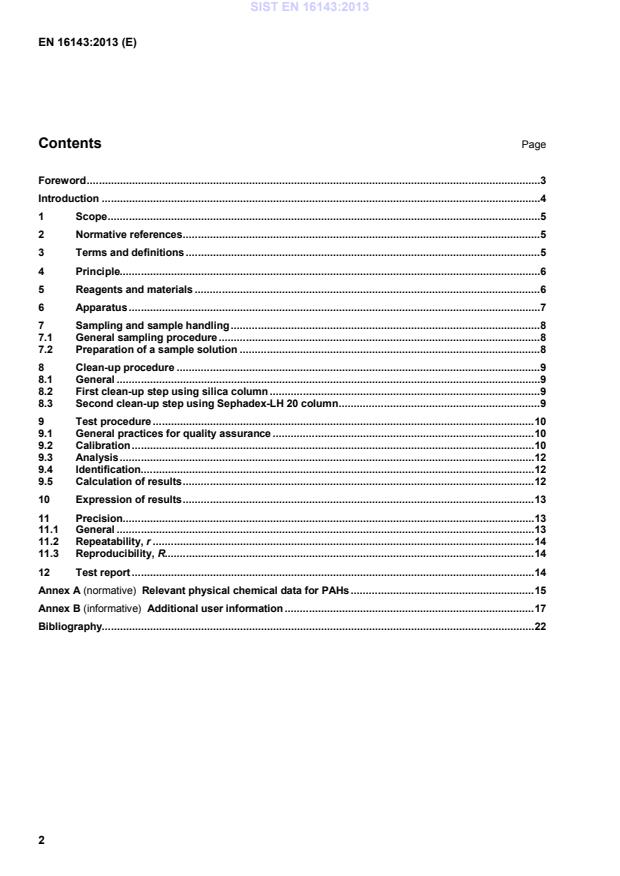
Relevant physical chemical data for PAHs . 15 Annex B (informative)
Additional user information . 17 Bibliography. 22
The complexity of the sample preparation steps and subsequent GC-MS analysis showed that laboratories need sufficient expertise to properly perform the analyses described in this document. Therefore, only a limited number of laboratories were able to participate in and contribute to the Round Robin test conducted by CEN/TC 19. In consideration of the progression of the standardization project, no additional time or resources were left e.g. to conduct additional Round Robin Tests, and the test method therefore is produced in its actual form. Further experience in the future may lead to improved precision and a more comprehensive scope. SIST EN 16143:2013
The procedure has been tested and verified for the PAHs listed in Table 1 (those required by the European Commission [1]) and additional PAHs as listed in Table A.2.
Analysis of other PAHs is possible in principle, but sufficient quality assurance performed by the user is necessary to secure the analysis.
The application range for this method is from approximately 4 mg/kg to approximately 15 mg/kg for the eight individual PAHs and from approximately 0,5 mg/kg to approximately 2 mg/kg for BaP. NOTE 1 The intended working range for this method is in the 0,1 mg/kg to 15 mg/kg range. For the lower levels precision has not yet been established. NOTE 2 For the purposes of this European Standard, the term “% (m/m)” is used to represent the mass fraction (). Table 1 — List of individual PAHs in extender oils Name of PAH Abbreviation CAS Registry number benzo(a)pyrene BaP 50-32-8 benzo(e)pyrene BeP 192-97-2 benzo(a)anthracene BaA 56-55-3 chrysene CHR 218-01-9 benzo(b)fluoranthene BbFA 205-99-2 benzo(j)fluoranthene BjFA 205-82-3 benzo(k)fluoranthene BkFA 207-08-9 dibenzo(a,h)anthracene DBahA 53-70-3 See Table A.1 for additional data on some PAH.
2 Normative references The following documents, in whole or in part, are normatively referenced in this document and are indispensable for its application. For dated references, only the edition cited applies. For undated references, the latest edition of the referenced document (including any amendments) applies. EN ISO 3170, Petroleum liquids — Manual sampling (ISO 3170) EN ISO 3171, Petroleum liquids — Automatic pipeline sampling (ISO 3171) 3 Terms and definitions For the purposes of this document, the following terms and definitions apply. SIST EN 16143:2013
1) Sephadex® is the trade name of a product supplied by GE Healthcare Bio-Sciences AB, SE-751 84 Uppsala. This information is given for the convenience of users of this European Standard and does not constitute an endorsement by CEN of the product named. Equivalent products may be used if they can be shown to lead to the same results. SIST EN 16143:2013
When a high resolution type mass spectrometer is used, the second step of the cleaning procedure (see 8.3) can be by-passed if the desired detection limits can be met. 6.2 Gas chromatographic columns. Fused silica type capillary columns with dimensions are listed in Table 2. A commonly used liquid phase is 5 % phenyl-methylpolysiloxane of 0,25 µm film thickness. Other columns of comparable or improved performance can also be used, such as a strongly recommended DB-5ms column
(5 % phenyl-methylpolysiloxane). SIST EN 16143:2013
Stationary phase 5 % phenyl-methylpolysiloxane Oven initial temperature 60 °C Initial time 2 min Temperature program 5 °C/min to 300 °C, hold for 12 min Injection according to Grob, splitless Injection temperature 275 °C to 300 °C Temperature transfer line 275 °C to 300 °C MS Detector temperature
according to the instrument manufacturer Injection volume 1 µl to 3 µl Carrier gas Helium, with a linear velocity of 40 cm/sec
Depending on chromatographic conditions (e.g. column length), it can happen that the different benzofluoranthene isomers co-elute. In these cases, determining the sum of the three isomers rather than reporting each isomer separately should be considered. Another alternative would be to use longer GC-columns (60 m instead of 30 m). See B.2 for further advice on the peak overlap of the isomers. Ferrules used shall not contain more than 40 % graphite (a suitable ferrule is made of 60 % polyimide and 40 % graphite) to decrease the risk that PAHs are absorbed. 6.3 Sample concentrator, typically a rotary evaporator or similar digital evaporator device. 7 Sampling and sample handling 7.1 General sampling procedure Samples shall be taken according to EN ISO 3170 or EN ISO 3171, as well as in accordance with the requirements of national standards or regulations for the sampling of the product under test.
If samples are not tested immediately, they shall be stored tightly sealed and in a cool and dark place. It shall be secured that glassware is thoroughly cleaned and that all new materials that may come into contact with the sample are checked by blank analysis that they give no interference. NOTE Interferences which can affect the results can occur due to contaminations from glassware, solvents and other materials that can come into contact with the sample. Such interferences will form an artefact or will increase the detector baseline. Interferences can also come from components in samples that co-elute with the specific PAHs of interest. 7.2 Preparation of a sample solution Approximately 70 mg of the sample is introduced to the nearest 0,1 mg into a 5 ml volumetric flask (5.9) and dissolved in 2 ml n-pentane (5.1.3). Before the sample clean-up, the sample solution is spiked with internal standard. The concentration of internal standard shall be adjusted such that it is in the same range as the expected PAHs in the sample. SIST EN 16143:2013
For quantification a second cleaning step shall be performed on Sephadex LH20 (5.2.2) or equivalent. These procedures are strongly recommended in order to make sure the samples are cleaned thoroughly before analysing them by GC-MS. 8.2 First clean-u
...
The EN 16143:2013 standard provides a comprehensive and methodical approach to assessing the content of benzo[a]pyrene (BaP) and selected polycyclic aromatic hydrocarbons (PAHs) in extender oils, which are critical in the rubber industry, particularly for tyre production. This European Standard specifies a detailed procedure using double liquid chromatography (LC) followed by gas chromatography-mass spectrometry (GC/MS) analysis, ensuring precise detection and quantification of these harmful compounds. One of the notable strengths of this standard is its rigorous testing and validation of the PAH analysis, which includes both the mandatory PAHs as outlined by the European Commission and additional PAHs that are commonly of concern. The explicit mention of the working range for each substance, particularly the established limits for BaP and the individual PAHs, underlines its practical applicability in the industry. The defined application range significantly aids manufacturers in aligning their products with safety regulations and environmental standards. Additionally, the standard's flexibility regarding the analysis of other PAHs-contingent upon user quality assurance-highlights its relevance for various research and industrial contexts. The inclusion of clear notes on the intended working range for lower levels of detection emphasizes the document’s commitment to transparency and reliability in analytical results. Ultimately, the EN 16143:2013 standard stands out due to its robust methodology and thorough verification processes, making it an essential reference for entities engaged in environmental safety and compliance monitoring within the rubber sector.
EN 16143:2013標準は、延伸油に含まれるベンゾ(a)ピレン(BaP)および選定された多環芳香族炭化水素(PAH)の含有量を測定するための手順を規定しています。この標準は、主にタイヤやタイヤの部品を生産するためのゴム産業で使用される延伸油に関するものです。特に、表1に示された8種類の多環芳香族炭化水素の合計も算出することができ、環境及び公衆衛生に対する影響を評価する上で重要な役割を果たしています。 この手順は、表1にリストされたEUの要求するPAHに対してテストおよび検証されており、追加のPAHに関する対応も可能です。ユーザーによる十分な品質保証が必要になる場合がありますが、その他のPAHについても原則として分析を行うことができます。使用範囲は、8種類のPAHについては約4 mg/kgから約15 mg/kg、BaPについては約0.5 mg/kgから約2 mg/kgとされていますが、実際の作業範囲は0.1 mg/kgから15 mg/kgの範囲であることが意図されています。 この標準の強みは、特定の産業ニーズに応じた明確な手順と、関連する化学物質の包括的な分析が可能な点です。延伸油の安全性を確保するため、業界での実装が進んでいます。また、標準化により、異なる施設間での結果の比較が容易になり、品質管理の向上が期待されます。EN 16143:2013は、環境基準に従った製品の確保や健康リスク評価において重要な基準といえるでしょう。このような標準は、特に製造業における持続可能な開発を促進するための基盤となります。
표준 EN 16143:2013은 고무 산업에서 타이어 및 타이어 부품 생산에 일반적으로 사용되는 확장 오일의 벤조[a]피렌(BaP) 및 선택된 다환 방향족 탄화수소(PAH)의 함량을 결정하는 절차를 규정하고 있습니다. 이 표준은 수명이 긴 고무 제품의 안전성을 확보하기 위해 필요한 검사를 수행하는 데 필수적인 역할을 합니다. 이 표준의 강점 중 하나는 다양한 PAH의 개별 및 총 함량을 동시에 분석할 수 있다는 점입니다. 표준은 8종의 PAH를 포함하고 있는 테이블 1에 명시된 PAH뿐만 아니라 추가 PAH에 대해서도 검증된 분석 방법을 제공합니다. 이를 통해 소재의 품질과 안전성을 강화하며, 이는 고무 산업 내에서 필수적으로 요구되는 품질 기준을 만족하는 데 기여할 수 있습니다. EN 16143:2013의 적용 범위는 약 4 mg/kg에서 15 mg/kg의 PAH 및 0.5 mg/kg에서 2 mg/kg의 BaP 범위에 이릅니다. 특히, 이 표준에서 제시된 근무 범위인 0.1 mg/kg에서 15 mg/kg는 다양한 오일 샘플에서의 정확한 측정이 가능하도록 하며, 이는 사용자에게 더욱 신뢰할 수 있는 데이터 제공을 보장합니다. 다른 PAH의 분석도 원칙적으로 가능하나, 사용자가 충분한 품질 보증을 수행해야 함을 강조하고 있습니다. 종합적으로 EN 16143:2013은 고무 산업의 건강 및 환경 규정 준수를 위한 필수 지침이며, 벤조[a]피렌과 다환 방향족 탄화수소의 정확한 측정 방법을 통해 제품의 안전성을 확보하고 있습니다. 이러한 점에서 이 표준은 관련 산업에 있어 매우 중요하고 실질적인 가치를 지니고 있습니다.
Questions, Comments and Discussion
Ask us and Technical Secretary will try to provide an answer. You can facilitate discussion about the standard in here.
Loading comments...