

EN 16357:2013
(Main)Carbonate liming materials - Determination of reactivity - Automatic titration method with citric acid
- Abstract
This European Standard specifies a method for the determination of the reactivity of calcium carbonate and calcium magnesium carbonate liming materials. It assesses the speed and effectiveness of their neutralising potential by automatic titration with citric acid.
This method is applicable only to liming materials with a maximum particle size of 6,3 mm determined according to EN 12948.
NOTE For marble dolomite (BET procedure according to ISO 9277 below 500 m2/kg), see EN 14984.
- Status
- Published
- Publication Date
- 06-Aug-2013
- Technical Committee
- CEN/TC 260 - Fertilizers and liming materials
- Drafting Committee
- CEN/TC 260/WG 3 - Liming materials
- Current Stage
- 9093 - Decision to confirm - Review Enquiry
- Start Date
- 05-Jun-2025
- Completion Date
- 21-Oct-2026

Overview - EN 16357:2013 (CEN)
EN 16357:2013 specifies a laboratory method for determining the reactivity of carbonate liming materials (calcium carbonate and calcium–magnesium carbonate) by an automatic titration method with citric acid. The procedure assesses the speed and effectiveness of a liming material’s neutralising potential by measuring citric acid consumption under controlled pH conditions. The method applies to samples with a maximum particle size of 6.3 mm (EN 12948) and uses a partial reaction over a fixed time (15 minutes) at pH 4.5 (pH stat).
Key topics and technical requirements
- Principle: Limited decomposition of carbonate by citric acid; titration under stable pH (pH stat) and measurement of citric acid consumed in a set time.
- Apparatus: automatic motor-driven burette/titrator with pH electrode, pH stat programme, propeller or magnetic stirring, suitable beakers and balance. Burette must deliver small accurate steps (modern titrators meet this).
- Reagents: mono-hydrated citric acid (solution ca. 457.17 g/L prepared and used within specified storage limits), analytical-grade water, defoamer, pH buffers (pH 4 and pH 7).
- Sample size & preparation:
- Typical test portion: 5.0 g (±0.2 g) “as received”.
- For coarser or heterogeneous materials (>1 mm or non-representative), prepare fraction-wise and use 10 g test portion (Annex A).
- Moisture should be recorded (EN 12048) and sample preparation per EN 1482-2.
- Calibration & quality control: pH electrode calibration with pH 4 and pH 7 buffers, electrode response time check, verification with a reference precipitated calcium carbonate (PCC) where applicable.
- Outputs: citric-acid based reactivity value, neutralising value correction, and MgO content determination; precision and reproducibility data are provided in Clause 9.
Applications and who uses it
- Practical uses:
- Quality control of liming materials and fertilizers.
- Comparative evaluation of neutralising speed (reactivity) for agronomic performance.
- Regulatory compliance testing and product labelling.
- Primary users:
- Fertilizer and liming material manufacturers.
- Independent testing laboratories and conformity assessment bodies.
- Agricultural extension services, soil scientists, agronomists and regulatory agencies.
Related standards
- EN 12948 - Liming materials: determination of size distribution (max particle size reference).
- EN 1482-2 - Sampling and sample preparation for fertilizers and liming materials.
- EN 12048 - Moisture determination for fertilizers/liming materials.
- EN 14984 - Specific guidance for marble dolomite (BET < 500 m2/kg).
- EN ISO 3696 - Water for analytical laboratory use.
Keywords: EN 16357:2013, carbonate liming materials, reactivity, automatic titration, citric acid, pH stat, neutralising value, liming materials testing.
Relations
- Effective Date
- 12-Feb-2026
- Effective Date
- 28-Jan-2026
- Effective Date
- 28-Jan-2026
- Effective Date
- 28-Jan-2026
- Refers
EN 12945:2014+A1:2016 - Liming materials - Determination of neutralizing value - Titrimetric methods - Effective Date
- 28-Jan-2026
- Effective Date
- 28-Jan-2026
- Effective Date
- 28-Jan-2026
- Effective Date
- 28-Jan-2026
- Effective Date
- 28-Jan-2026
- Effective Date
- 28-Jan-2026
Get Certified
Connect with accredited certification bodies for this standard

Control Union Certifications
Global certification for agriculture and sustainability.

ECOCERT
Organic and sustainability certification.

FSC International
Forest Stewardship Council certification.
Sponsored listings
Frequently Asked Questions
EN 16357:2013 is a standard published by the European Committee for Standardization (CEN). Its full title is "Carbonate liming materials - Determination of reactivity - Automatic titration method with citric acid". This standard covers: This European Standard specifies a method for the determination of the reactivity of calcium carbonate and calcium magnesium carbonate liming materials. It assesses the speed and effectiveness of their neutralising potential by automatic titration with citric acid. This method is applicable only to liming materials with a maximum particle size of 6,3 mm determined according to EN 12948. NOTE For marble dolomite (BET procedure according to ISO 9277 below 500 m2/kg), see EN 14984.
This European Standard specifies a method for the determination of the reactivity of calcium carbonate and calcium magnesium carbonate liming materials. It assesses the speed and effectiveness of their neutralising potential by automatic titration with citric acid. This method is applicable only to liming materials with a maximum particle size of 6,3 mm determined according to EN 12948. NOTE For marble dolomite (BET procedure according to ISO 9277 below 500 m2/kg), see EN 14984.
EN 16357:2013 is classified under the following ICS (International Classification for Standards) categories: 65.080 - Fertilizers. The ICS classification helps identify the subject area and facilitates finding related standards.
EN 16357:2013 has the following relationships with other standards: It is inter standard links to ISO 22146:2018, EN 12048:1996, EN 1482-2:2024, EN 12948:2010, EN 12945:2014+A1:2016, EN ISO 3696:1995, EN ISO 13766-1:2018, EN 14069:2025, EN 14069:2017, EN 17816:2023. Understanding these relationships helps ensure you are using the most current and applicable version of the standard.
EN 16357:2013 is available in PDF format for immediate download after purchase. The document can be added to your cart and obtained through the secure checkout process. Digital delivery ensures instant access to the complete standard document.
Standards Content (Sample)
2003-01.Slovenski inštitut za standardizacijo. Razmnoževanje celote ali delov tega standarda ni dovoljeno.Carbonatische Kalke - Bestimmung der Reaktivität - Automatisches Titrationsverfahren mit CitronensäureAmendements minéraux basiques carbonatés - Détermination de la réactivité - Méthode par titration automatique à l'acide citriqueCarbonate liming materials - Determination of reactivity - Automatic titration method with citric acid65.080GnojilaFertilizersICS:Ta slovenski standard je istoveten z:EN 16357:2013SIST EN 16357:2013en,fr,de01-oktober-2013SIST EN 16357:2013SLOVENSKI
STANDARD
EUROPEAN STANDARD NORME EUROPÉENNE EUROPÄISCHE NORM
EN 16357
August 2013 ICS 65.080 English Version
Carbonate liming materials - Determination of reactivity - Automatic titration method with citric acid
Amendements minéraux basiques carbonatés - Détermination de la réactivité - Méthode par titration automatique à l'acide citrique
Carbonatische Kalke - Bestimmung der Reaktivität - Automatisches Titrationsverfahren mit Citronensäure This European Standard was approved by CEN on 29 June 2013.
CEN members are bound to comply with the CEN/CENELEC Internal Regulations which stipulate the conditions for giving this European Standard the status of a national standard without any alteration. Up-to-date lists and bibliographical references concerning such national standards may be obtained on application to the CEN-CENELEC Management Centre or to any CEN member.
This European Standard exists in three official versions (English, French, German). A version in any other language made by translation under the responsibility of a CEN member into its own language and notified to the CEN-CENELEC Management Centre has the same status as the official versions.
CEN members are the national standards bodies of Austria, Belgium, Bulgaria, Croatia, Cyprus, Czech Republic, Denmark, Estonia, Finland, Former Yugoslav Republic of Macedonia, France, Germany, Greece, Hungary, Iceland, Ireland, Italy, Latvia, Lithuania, Luxembourg, Malta, Netherlands, Norway, Poland, Portugal, Romania, Slovakia, Slovenia, Spain, Sweden, Switzerland, Turkey and United Kingdom.
EUROPEAN COMMITTEE FOR STANDARDIZATION
COMITÉ EUROPÉEN DE NORMALISATION EUROPÄISCHES KOMITEE FÜR NORMUNG
Management Centre:
Avenue Marnix 17,
B-1000 Brussels © 2013 CEN All rights of exploitation in any form and by any means reserved worldwide for CEN national Members. Ref. No. EN 16357:2013: ESIST EN 16357:2013
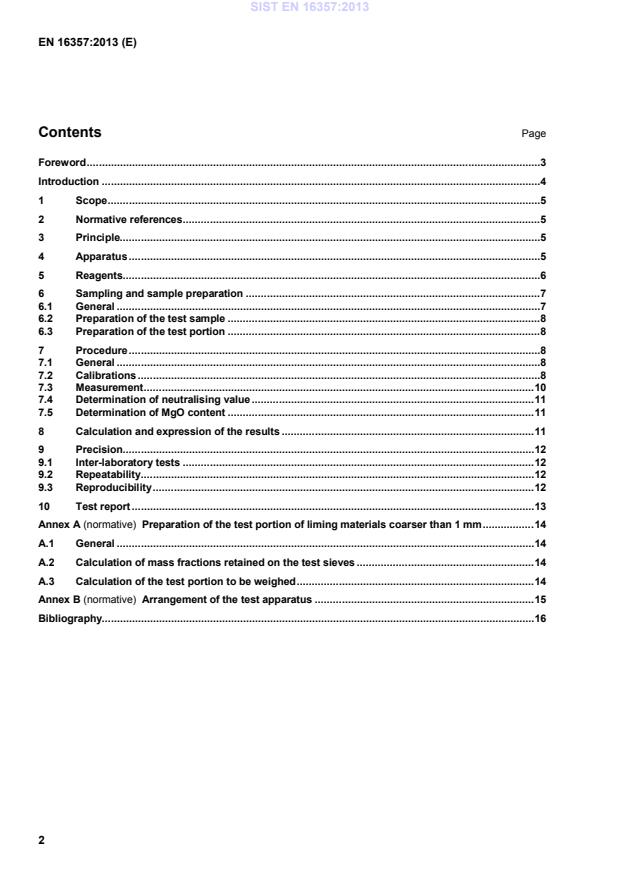
Preparation of the test portion of liming materials coarser than 1 mm . 14 A.1 General . 14 A.2 Calculation of mass fractions retained on the test sieves . 14 A.3 Calculation of the test portion to be weighed . 14 Annex B (normative)
Arrangement of the test apparatus . 15 Bibliography. 16
= 457,17 g/l. Preferably, use a fresh home-made solution as described below. Under these conditions, the solution concentration is conventionally supposed to be equal to the necessary one, ca = 457,17 g pure citric acid per litre. SIST EN 16357:2013
is the added mass of mono hydrated citric acid (5.2), in grams; 192,14 is the molar mass of anhydrous citric acid, in grams; 210,14 is the molar mass of mono hydrated citric acid, in grams. 5.4 Calcium carbonate, precipitated (or PCC), mass fraction, w(CaCO3) at least 99 %. Commercial PCC for analysis is granted for its chemical characteristics. However, physical characteristics are not granted. As reactivity depends on fineness, even for PCC, it is essential to take as a reference a highly reactive PCC, such as commercial PCC from VWR / Prolabo / BDH, reference GPR, Rectapur, Ref 22296.294, Molar mass 100,09 1), which will consume 15 ml after 15 min. This PCC was used in the ring test before launching measurements. By experience, some PCC do not meet this requirement. See also the note in 7.2.6. 5.5 Silicone defoamer. 5.6 Standard buffer solution, pH 4 (commercial solution, pH 4,01). NOTE This solution has a limited lifetime. 5.7 Standard buffer solution, pH 7 (commercial solution, pH 6,98). NOTE This solution has a limited lifetime. 6 Sampling and sample preparation 6.1 General Sampling is not part of the methods specified in this document. A recommended sampling method is given in EN 1482-1. Sample preparation shall be carried out in accordance with EN 1482-2.
1) This substance is an example of a suitable product available commercially. This information is given for the convenience of users of this European Standard and does not constitute an endorsement by CEN of this product. SIST EN 16357:2013
...