

EN 13953:2026
(Main)LPG equipment and accessories - Pressure relief valves for transportable refillable cylinders for Liquefied Petroleum Gas (LPG)
- Abstract
This document specifies the design, testing and marking requirements for spring loaded pressure relief valves (PRV), for use in liquefied petroleum gas (LPG) cylinders of water capacity of 0,5 l up to and including 150 l.
These PRVs can be either an integral part of a cylinder valve (see EN ISO 14245 [4] and EN ISO 15995 [5]) or a separate device.
- Status
- Published
- Publication Date
- 21-Oct-2026
- Technical Committee
- CEN/TC 286 - Liquid gas equipment and accessories
- Current Stage
- 6060 - Definitive text made available (DAV) - Publishing
- Start Date
- 28-Oct-2026
- Due Date
- 22-Oct-2026
- Completion Date
- 22-Oct-2026

EN 13953 is a CEN standard for spring-loaded pressure relief valves (PRVs) used on transportable refillable LPG cylinders. It specifies design, testing and marking requirements for cylinders with water capacity from 0,5 l up to and including 150 l, whether the PRV is integral with a cylinder valve or a separate device. The document is aimed at valve manufacturers, cylinder manufacturers, test laboratories, and technical buyers who need to check LPG safety devices for service conditions and conformity testing.
What does EN 13953:2026 specify?
EN 13953:2026 specifies requirements for spring-loaded PRVs for liquefied petroleum gas (LPG) cylinders. It covers the valve as a safety device, the tests used to qualify the design, the production checks applied to manufactured valves, and the marking and documentation needed for use and traceability.
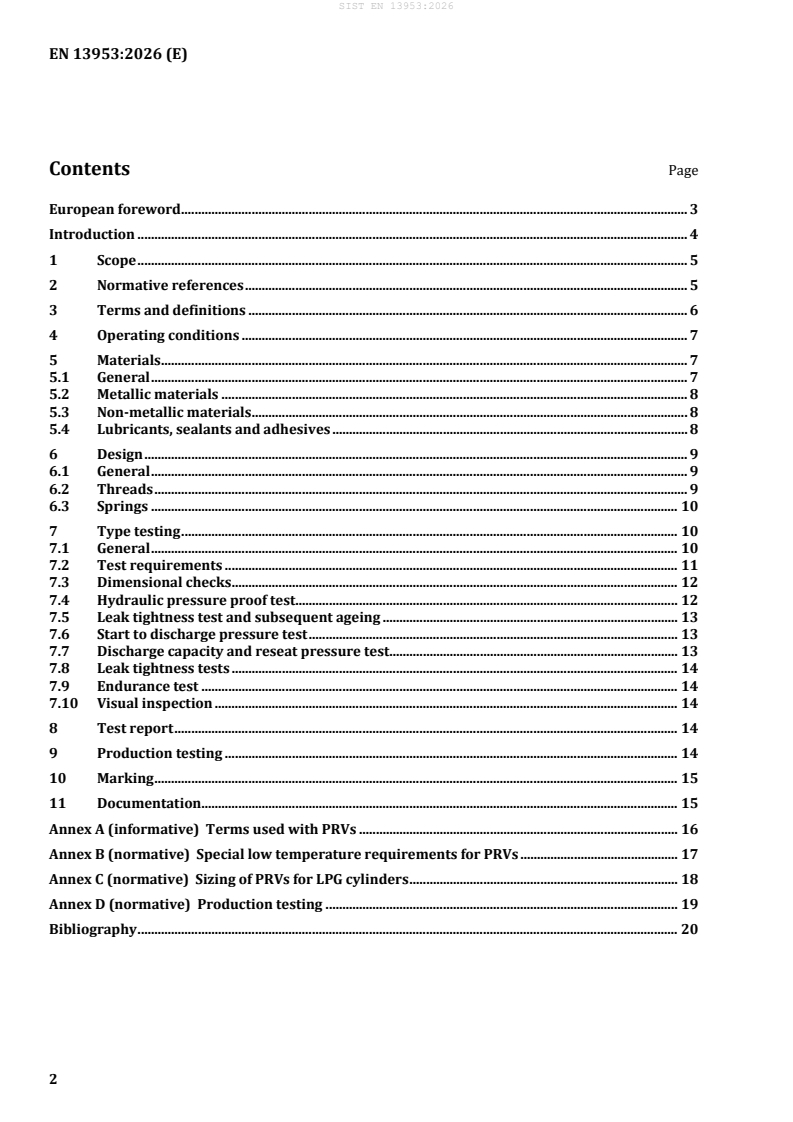
The document is organized into clauses 1 to 11 and four annexes. Annex A is informative and explains PRV terms graphically, while Annexes B, C and D are normative and set special low-temperature requirements, PRV sizing, and production testing.
| Annex | What it covers |
|---|---|
| Annex A | Terms used with PRVs, with a figure showing start to discharge pressure, reseat pressure, pop action and flow rating pressure |
| Annex B | Special low-temperature requirements for PRVs used below -20 °C |
| Annex C | Sizing of PRVs for LPG cylinders |
| Annex D | Production testing for each PRV and each PRV batch |
What are the key requirements of EN 13953:2026?
EN 13953:2026 sets requirements for materials, design, type testing, production testing, marking and documentation. In practice, this means the standard does not just describe the valve - it also defines how to prove that the valve works, how to size it for the cylinder, and what information must be kept with it.
Operating conditions and application range
EN 13953:2026 requires PRVs to be suitable for a minimum operating temperature of -20 °C and a maximum operating temperature of 65 °C. For more severe European conditions, the PRV must also be suitable for -40 °C and meet Annex B.
For cylinders above 7,5 l water capacity, the PRV must operate with pop action. That matters because larger cylinders need a valve that opens quickly and predictably under overpressure.
Materials and compatibility
EN 13953:2026 requires all materials in contact with LPG to be chemically and physically compatible with LPG and to meet EN ISO 11114-1 and EN ISO 11114-2. Metallic parts must have adequate strength, and spring materials must be stainless steel with the stated chromium and nickel content.
Non-metallic parts in LPG contact must not distort, harden, swell or stick in a way that affects operation. Rubber materials must meet EN 549 for gas, lubricant, ageing, compression, ozone and liquid-phase exposure, with a specific mass-change allowance stated in this document. In practice, this is about avoiding leakage, loss of function and premature aging in real LPG service.
Design features that affect safe operation
EN 13953:2026 requires the sealing element carrier to be metallic with a minimum melting point of 450 °C, and the design must guide and secure the sealing element so it cannot come loose in service. Means must also be provided to lock or seal the PRV against tampering, and adhesive is not allowed for that purpose.
If the PRV is fitted with a protection disc or cap against foreign matter, that protection must not be displaced unintentionally except by discharge from the valve. Where liquid off-take conditions could submerge the PRV, an internal tube to the vapour space is required. This is important because installation details can change how the valve vents and reseats.
Pressure setting, sizing and threads
EN 13953:2026 requires the nominal set pressure to be between 1,0 MPa and 3,0 MPa, as chosen by the valve manufacturer. The required nominal discharge capacity for the cylinder must be calculated according to Annex C.
End connections for direct cylinder fitting must use either a taper thread or a parallel thread with a sealing and securing method. Where a vent extension or discharge pipe is used, the valve must be arranged so that the connection can be made to the PRV body.
Type testing and performance limits
EN 13953:2026 requires type testing in accordance with clause 7 and Table 1, using air or nitrogen unless otherwise stated. The tests include dimensional checks, hydraulic pressure proof, leak tightness, start to discharge pressure, discharge capacity and reseat pressure, endurance cycling and visual inspection.
The performance limits are practical acceptance checks: start to discharge pressure must stay within the stated tolerance of nominal set pressure, reseat pressure must remain at or above 70 % of nominal set pressure, leak rate must not exceed 15 cm³/h, and the valve must withstand endurance cycling without losing those values. In plain terms, the valve must open where intended, close again properly, and keep working after repeated operation.
Marking and records
EN 13953:2026 requires marking on the valve body, including manufacturer identity, type number, date code, nominal set pressure, nominal discharge capacity, the -40 °C marking where relevant, and EN 13953 or EN when the PRV is not integral with the cylinder valve. Clause 11 also requires drawings, material specifications, certificates, fitting information, use conditions and compatibility evidence to be available for testing.
These records matter because the valve’s approval depends on the design version, the materials used and the intended service conditions.
What terms does EN 13953:2026 define?
- Liquefied petroleum gas (LPG) - A low-pressure liquefied gas made mainly of propane, propene, butane, butane isomers and butene, assigned to specific UN numbers.
- Pressure relief valve (PRV) - A self-closing valve that discharges vapour automatically at a predetermined pressure.
- Nominal set pressure - The pressure at which the PRV is set to start discharging.
- Start to discharge pressure - The inlet pressure where steady bubbles first appear at the outlet through the water-seal test method.
- Pop action - Rapid opening of the sealing element until the PRV is fully open.
- Reseat pressure - The inlet pressure where the sealing element seals again after pop action.
- Flow rating pressure - The inlet pressure used when measuring discharge capacity.
- Standard temperature and pressure (STP) - 15,6 °C and 1,013 bar absolute, used for discharge capacity reporting.
Who uses EN 13953:2026?
EN 13953:2026 is used by PRV manufacturers, LPG cylinder and cylinder-valve manufacturers, test laboratories, and conformity assessment bodies. It is also relevant to quality managers, design engineers, and buyers who need to specify or verify valves for LPG cylinders.
In practice, these users rely on it for design approval, prototype testing, production inspection, material selection, marking checks and documentation control. It also helps suppliers of springs, seals, sealants and metallic materials understand the performance expectations for components used in PRVs.
What changed in EN 13953:2026 from the previous edition?
EN 13953:2026 will supersede EN 13953:2020. The document states these major changes:
- addition of the water capacity range in the scope
- addition of requirements for rubber material
- change to the nominal set pressure
- clarification of the discharge capacity test
- clarification of the endurance test
Which standards are used with EN 13953:2026?
EN 13953:2026 uses several referenced standards for materials, testing and related valve work:
- EN 549 - provides requirements for rubber materials used for seals and diaphragms in gas equipment.
- EN 751-1, EN 751-2, EN 751-3 - cover sealing materials for threaded joints.
- EN 837-1 - gives requirements for Bourdon tube pressure gauges used in testing.
- EN 12164, EN 12165, EN 12420 - cover copper and copper alloy product forms used for metallic components.
- EN 13906-1 - supports the design of compression springs.
- EN ISO 11114-1 and EN ISO 11114-2 - cover material compatibility with gas contents for metallic and non-metallic materials.
- ISO 2859-1:1999 - sets the sampling procedures used for production batch inspection.
- EN ISO 14245 and EN ISO 15995 - are referenced for cylinder valves when the PRV is integral with the cylinder valve.
- EN ISO 13341 - gives guidance on fitting valves to gas cylinders.
- CEN/TS 16765 - is cited for environmental considerations in LPG equipment standards.
What does the EN 13953:2026 document contain?
EN 13953:2026 contains a complete test and qualification structure for PRVs, including the sequence of type tests in Table 1 and the acceptance criteria linked to each test. It also includes a graphical explanation of PRV terms in Annex A and a low-temperature procedure in Annex B.
Annex C gives the sizing formula for the required nominal discharge capacity of a valve for a cylinder, which is used when selecting or specifying the PRV. Annex D sets the production testing scheme, including setting, leak testing, batch sampling and rejection rules. The document also requires a written test report and a defined set of design and material records, which makes it usable for type approval, production control and technical file review.
Relations
- Effective Date
- 11-Sep-2024
- Effective Date
- 04-Nov-2026
Get Certified
Connect with accredited certification bodies for this standard

Institut za varilstvo d.o.o. (Welding Institute)
Slovenia's leading welding institute since 1952. ISO 3834, EN 1090, pressure equipment certification, NDT personnel, welder qualification. Only IIW Au
Sponsored listings
Frequently Asked Questions
EN 13953:2026 is a standard published by the European Committee for Standardization (CEN). Its full title is "LPG equipment and accessories - Pressure relief valves for transportable refillable cylinders for Liquefied Petroleum Gas (LPG)". This standard covers: This document specifies the design, testing and marking requirements for spring loaded pressure relief valves (PRV), for use in liquefied petroleum gas (LPG) cylinders of water capacity of 0,5 l up to and including 150 l. These PRVs can be either an integral part of a cylinder valve (see EN ISO 14245 [4] and EN ISO 15995 [5]) or a separate device.
This document specifies the design, testing and marking requirements for spring loaded pressure relief valves (PRV), for use in liquefied petroleum gas (LPG) cylinders of water capacity of 0,5 l up to and including 150 l. These PRVs can be either an integral part of a cylinder valve (see EN ISO 14245 [4] and EN ISO 15995 [5]) or a separate device.
EN 13953:2026 is classified under the following ICS (International Classification for Standards) categories: 23.060.40 - Pressure regulators. The ICS classification helps identify the subject area and facilitates finding related standards.
EN 13953:2026 has the following relationships with other standards: It is inter standard links to EN 13953:2020, EN 14912:2015. Understanding these relationships helps ensure you are using the most current and applicable version of the standard.
EN 13953:2026 is associated with the following European legislation: EU Directives/Regulations: 2008/68/EC; Standardization Mandates: M/TDG. When a standard is cited in the Official Journal of the European Union, products manufactured in conformity with it benefit from a presumption of conformity with the essential requirements of the corresponding EU directive or regulation.
EN 13953:2026 is available in PDF format for immediate download after purchase. The document can be added to your cart and obtained through the secure checkout process. Digital delivery ensures instant access to the complete standard document.
Standards Content (Sample)
Contents
- Introduction
- 1 Scope
- 2 Normative references
- 3 Terms and definitions
- 3.1 liquefied petroleum gas
- 3.2 pressure relief valve
- 3.3 nominal set pressure
- 3.4 start to discharge pressure
- 3.5 pop action
- 3.6 reseat pressure
- 3.7 flow rating pressure
- 3.8 discharge capacity
- 3.9 nominal discharge capacity
- 3.10 sealing element
- 3.11 valve seat
- 3.12 cylinder valve
- 3.13 leak tightness
- 3.14 Standard Temperature and Pressure
- 4 Operating conditions
- 5 Materials
- 5.1 General
- 5.2 Metallic materials
- 5.3 Non-metallic materials
- 5.4 Lubricants, sealants and adhesives
- 6 Design
- 6.1 General
- 6.2 Threads
- 6.3 Springs
- 7 Type testing
- 7.1 General
- 7.2 Test requirements
- 7.3 Dimensional checks
- 7.4 Hydraulic pressure proof test
- 7.5 Leak tightness test and subsequent ageing
- 7.6 Start to discharge pressure test
- 7.7 Discharge capacity and reseat pressure test
- 7.8 Leak tightness tests
- 7.9 Endurance test
- 7.10 Visual inspection
- 8 Test report
- 9 Production testing
- 10 Marking
- 11 Documentation
- Annex A
- Annex B
- Annex C
- Annex D
- Bibliography
Introduction
This document calls for the use of substances and procedures that may be injurious to health and/or the environment if adequate precautions are not taken. It refers only to technical suitability. It does not absolve the user from their legal obligations at any stage.
Protection of the environment is a key political issue in Europe and elsewhere, for CEN/TC 286 this is covered in CEN/TS 16765 [2], which should be read in conjunction with this document. It has been assumed in the drafting of this document that the execution of its provisions is entrusted to appropriately qualified and experienced people.
All pressures are gauge pressures unless otherwise stated.
In this document, the unit bar is used, due to its universal use in the field of technical gases. It should, however, be noted that bar is not an SI unit, and that the corresponding SI unit for pressure is Pa 5 5 2 (1 bar = 10 Pa = 10 N/m ).
NOTE This document requires measurement of material properties, dimensions and pressures. All such measurements are subject to a degree of uncertainty due to tolerances in measuring equipment, etc. It may be beneficial to refer to the leaflet “measurement uncertainty leaflet” SP INFO 2000 27 [3].
SIST EN 13953:2026 EN 13953:2026 (E)
1 Scope
This document specifies the design, testing and marking requirements for spring loaded pressure relief valves (PRV), for use in liquefied petroleum gas (LPG) cylinders of water capacity of 0,5 l up to and including 150 l.
These PRVs can be either an integral part of a cylinder valve (see EN ISO 14245 [4] and EN ISO 15995 [5]) or a separate device.
2 Normative references
The following documents are referred to in the text in such a way that some or all of their content constitutes requirements of this document. For dated references, only the edition cited applies. For undated references, the latest edition of the referenced document (including any amendments) applies. EN 549, Rubber materials for seals and diaphragms for gas appliances and gas equipment EN 751-1, Sealing materials for metallic threaded joints in contact with 1st, 2nd and 3rd family gases and hot water — Part 1: Anaerobic jointing compounds EN 751-2, Sealing materials for metallic threaded joints in contact with 1st, 2nd and 3rd family gases and hot water — Part 2: Non-hardening jointing compounds EN 751-3, Sealing materials for metallic threaded joints in contact with 1st, 2nd and 3rd family gases and hot water — Part 3: Unsintered PTFE tapes and PTFE strings EN 837-1, Pressure gauges — Part 1: Bourdon tube pressure gauges — Dimensions, metrology, requirements and testing EN 12164, Copper and copper alloys — Rod for free machining purposes EN 12165, Copper and copper alloys — Wrought and unwrought forging stock EN 12420, Copper and copper alloys — Forgings EN 13906-1, Cylindrical helical springs made from round wire and bar — Calculation and design — Part 1:
Compression springs EN ISO 11114-1, Gas cylinders — Compatibility of cylinder and valve materials with gas contents — Part 1:
Metallic materials (ISO 11114-1) EN ISO 11114-2, Gas cylinders — Compatibility of cylinder and valve materials with gas contents — Part 2:
Non-metallic materials (ISO 11114-2) ISO 2859-1:2026, Sampling procedures for inspection by attributes — Part 1: Sampling schemes indexed by acceptance quality limit (AQL) for lot-by-lot inspection
SIST EN 13953:2026 EN 13953:2026 (E)
3 Terms and definitions
For the purposes of this document, the following terms and definitions apply. ISO and IEC maintain terminology databases for use in standardization at the following addresses:
- IEC Electropedia: available at https://www.electropedia.org/
- ISO Online browsing platform: available at https://www.iso.org/obp/
3.1 liquefied petroleum gas
LPG low pressure liquefied gas composed of one or more light hydrocarbons which are assigned to UN 1011, UN 1075, UN 1965, UN 1969 or UN 1978 only and which consists mainly of propane, propene, butane, butane isomers, butene with traces of other hydrocarbon gases
3.2 pressure relief valve
PRV self-closing valve which automatically, without the assistance of any energy other than that of the vapour concerned, discharges vapour at a predetermined pressure
3.3 nominal set pressure
predetermined pressure of the pressure relief valve at which the valve is set to start to discharge
3.4 start to discharge pressure
inlet pressure at which a steady stream of bubbles appear at the outlet of a pressure relief valve through a water seal of not more than 50 mm water column, or other equivalent method
3.5 pop action
rapid opening of the pressure relief valve sealing element so that the pressure relief valve is fully open, resulting from an increase of inlet pressure creating a sudden increase in force and compression of the spring
3.6 reseat pressure
inlet pressure at which the sealing element effects a seal with the valve seat after the valve has been subjected to pop action
3.7 flow rating pressure
inlet pressure at which the discharge capacity is measured
3.8 discharge capacity
capacity at the flow rating pressure of a pressure relief valve expressed in m /min of free air at STP
3.9 nominal discharge capacity
minimum discharge capacity at the flow rating pressure expressed in m /min of free air at STP rounded down to one decimal place
SIST EN 13953:2026 EN 13953:2026 (E)
3.10 sealing element
non-metallic resilient component which affects a seal by contact with the valve seat
3.11 valve seat
normally raised area of the valve body on to which the sealing element effects a seal
3.12 cylinder valve
primary shutoff device intended for liquid filling and liquid or vapour service fitted to LPG cylinders Note 1 to entry: The valve can also include additional devices e.g. liquid level indicator, excess flow device, pressure relief valve, sediment tube, non-return valve and eduction tube.
3.13 leak tightness
resistance to leakage to atmosphere across the valve seat or any other pressure containing component when the valve is closed
3.14 Standard Temperature and Pressure
STP 15,6 °C (288,7 K), 1,013 bar absolute (0,101 3 MPa absolute)
4 Operating conditions
4.1 Terms used with PRVs are described graphically in Annex A (see Figure A.1). 4.2 Valves designed in accordance with this document shall be suitable for:
- a minimum operating temperature of −20 °C;
- a minimum operating temperature of −40 °C for those parts of Europe where valves are subject to more severe temperature conditions. The material and design shall be shown to be satisfactory for operations under these conditions and shall meet the requirements of Annex B. Where the PRV is integral with a cylinder valve suitable for temperature of −40 °C, the PRV shall also be designed and tested for a temperature of −40 °C; and
- a maximum operating temperature of 65 °C.
5 Materials
5.1 General
5.1.1 Materials in contact with LPG shall be physically and chemically compatible with LPG under all normal operating conditions for which the valve is intended and shall meet the requirements in accordance with EN ISO 11114-1 and EN ISO 11114-2.
5.1.2 Materials for valve components shall be selected to give adequate strength in service. Consideration should be given to all modes of failure including atmospheric corrosion, brass dezincification, stress corrosion, impact or material failure.
SIST EN 13953:2026 EN 13953:2026 (E) 5.1.3 Alternative materials to those listed in 5.2 are not precluded, providing they can be shown to be equivalent.
5.2 Metallic materials
5.2.1 Hot stamped brass shall be non-porous and shall be suitable for machining or other processes. Sand-cast brass shall not be used.
Leaded brass shall be CW614N in accordance with EN 12164 or CW617N in accordance with EN 12420 or EN 12165.
Cold drawn brass rods up to 45 mm wide in cross-section shall only be used after heat treatment and testing for internal cracking. Cold drawn brass rods greater than 45 mm wide in cross-section shall not be used.
Components produced from stamping brass shall not exhibit cold shuts, also known as folds, or surface defects such as a crack which may lead to leakage or component failure. 5.2.2 Springs shall be manufactured from stainless steel wire and shall contain not less than 16 % chromium and not less than 6 % nickel.
5.3 Non-metallic materials
Non-metallic materials in contact with LPG shall be compatible with LPG and shall not fail during the valve service life. They shall not distort, harden, swell or adhere to the body or seat face to such an extent as to impair the function of the valve.
Non-metallic materials which are exposed to UV shall be UV resistant. Rubber materials in contact with LPG, for temperatures of –20 °C (−40 °C for low temperature applications) to + 65 °C, shall meet the requirements of EN 549 for resistance to:
a) a gas (n-pentane test); b) lubricants; c) ageing; d) compression; e) ozone (where the material is exposed to the atmosphere during its service life); f) condensate/liquid phase of combustible gases (liquid B test). As a deviation from the 20 % change in mass after immersion permissible in Table 3 of EN 549:2019+A2:2024, a 25 % change in mass after immersion is permitted.
5.4 Lubricants, sealants and adhesives
Lubricants, sealants and adhesives, which can be in direct contact with LPG and are used on operating threads and seals, shall be compatible with LPG and not interfere with the operation of the valve. Sealants shall comply with the requirements of EN 751-1, EN 751-2 or EN 751-3.
SIST EN 13953:2026 EN 13953:2026 (E)
6 Design
6.1 General
6.1.1 PRVs for cylinders of a water capacity greater than 7,5 l shall be designed to operate with a pop action.
...