

EN 1993-1-10:2025/prA1
(Amendment)Eurocode 3 - Design of steel structures - Part 1-10: Material toughness and through-thickness properties
- Abstract
1.1 Scope of EN 1993-1-10
(1) EN 1993-1-10 specifies rules for the selection of steel grades and qualities related to fracture toughness to avoid brittle fracture.
NOTE Steel quality is also known as (Charpy) subgrade.
(2) EN 1993-1-10 specifies rules to specify through thickness properties for welded elements to reduce the risk of lamellar tearing.
(3) EN 1993-1-10 specifies additional toughness requirements for specific cases to ensure upper shelf toughness in relation to design ultimate resistance in tension and seismic design.
(4) EN 1993-1-10 specifies rules for structural steels as listed in EN 1993-1-1. This document applies to steel grades S235 to S700.
(5) EN 1993-1-10 specifies rules that apply to the selection of parent material only.
(6) EN 1993-1-10 specifies rules that apply to steel materials covered by EN 1993-1-1:2022, 5.1(3), provided that each individual piece of steel is tested in accordance with the requirements of EN 1993 1 1:2022, 5.2.1 and EN 1090-2:2018+A1:2024, 5.1.
(7) This document does not apply to material salvaged from existing steelwork subjected to fatigue or fire.
1.2 Assumptions
(1) Unless specifically stated, EN 1990, EN 1991 (all parts) and the other relevant parts of EN 1993-1 (all parts) apply.
(2) The design methods given in EN 1993-1-10 are applicable if:
- the execution quality is as specified in EN 1090-2 or EN 1090-4, and
- the construction materials and products used are as specified in the relevant parts of EN 1993 (all parts), or in the relevant material and product specifications.
- Status
- Not Published
- Publication Date
- 30-Sep-2027
- Technical Committee
- CEN/TC 250 - Structural Eurocodes
- Current Stage
- 4060 - Closure of enquiry - Enquiry
- Start Date
- 20-Aug-2026
- Due Date
- 30-Nov-2026
- Completion Date
- 20-Aug-2026

EN 1993-1-10:2025/prA1 is a CEN draft amendment to Eurocode 3, Part 1-10. EN 1993-1-10:2025/prA1 covers how to choose steel quality for fracture toughness and how to specify through-thickness properties so that steel structures are less likely to fail by brittle fracture or lamellar tearing. It is aimed at structural designers, fabricators, quality managers and buyers who need to select or specify steel for welded structural work.
What does EN 1993-1-10:2025/prA1 specify?
EN 1993-1-10:2025/prA1 modifies the rules for selecting steel grades and qualities, with the scope limited to parent material for structural steels from S235 to S700. It also updates the rules for through-thickness properties in welded elements and the special cases where extra toughness is needed.
The document applies to steels listed in EN 1993-1-1 and to materials covered by EN 1993-1-1:2022, 5.1(3), when each individual piece is tested to the cited execution and material provisions. It does not apply to material salvaged from existing steelwork after fatigue or fire.
| Part of the document | What it covers |
|---|---|
| Clause 1 | Scope and assumptions |
| Clause 3 | Terms, definitions and symbols |
| Clause 4 | Selection of materials to avoid brittle fracture |
| Clause 5 | Avoidance of lamellar tearing by through-thickness properties |
| Annex A | Specific rules for gusset plates with cut-outs in spade details |
What are the key requirements of EN 1993-1-10:2025/prA1?
EN 1993-1-10:2025/prA1 keeps the main design logic in Clause 4 and Clause 5, then adjusts the wording, references and tables that support day-to-day material selection. In practice, it tells you what to check before choosing a steel grade and when extra through-thickness properties are needed.
- Clause 4 links steel quality to the design situation. It uses steel properties, member characteristics and applied stresses to decide toughness quality. For the reader, this means the steel choice is not generic - it depends on the actual element, loading and temperature conditions.
- Clause 4.2.1 and 4.2.2 use a flowchart and tabulated thickness limits. The amended text refers to maximum permissible element thickness values and to Execution Classes (EXC). In practice, thicker parts or more demanding execution classes may need a tougher steel quality.
- Clause 4.2.2.3 ties the rules to classified constructional details for the nominal stress method. This matters when joints or details are assessed by detail category rather than by a simple member check.
- Clause 4.3 adds toughness quality for special cases. The document keeps additional toughness requirements for situations linked to upper shelf toughness, design ultimate resistance in tension and seismic design. This is the part to consult when ordinary toughness selection is not enough.
- Clause 4.4 covers welding in cold-formed zones. The amendment relaxes a previous restriction for steel grades up to S460 and keeps conditions for welding in cold-formed zones and for cold-formed hollow sections according to EN 10219. This affects fabrication planning and weld location decisions.
- Clause 5 addresses lamellar tearing through through-thickness properties. It uses tables and comments to specify when a Z-value or similar through-thickness requirement is needed. That tells the purchaser or specifier when to order extra through-thickness performance for welded parts.
- Annex A gives special rules for gusset plates with cut-outs in spade details. It links material selection to plate geometry and design force, which is useful for detailed connection design.
What terms does EN 1993-1-10:2025/prA1 define?
EN 1993-1-10:2025/prA1 uses a small set of technical terms that drive the material selection rules.
- Brittle fracture - a sudden fracture mode that the document tries to avoid by selecting adequate steel toughness.
- Lamellar tearing - cracking in the thickness direction of welded elements, reduced by specifying through-thickness properties.
- Through-thickness properties - material properties through the plate thickness that help resist lamellar tearing.
- Parent material - the base steel itself, which is the material covered by this document.
- Execution Classes (EXC) - execution quality classes used when applying the toughness and thickness rules.
- Upper shelf toughness - the toughness region used when checking performance for tension and seismic cases.
- Nominal stress method - a classification approach used for certain constructional details.
- Charpy subgrade - the steel quality level linked to Charpy impact toughness.
Who uses EN 1993-1-10:2025/prA1?
EN 1993-1-10:2025/prA1 is used by structural engineers, steelwork designers, fabricators and purchasing teams involved in welded steel structures. It is also relevant to quality managers who need to document toughness selection, through-thickness requirements and execution conditions before fabrication starts.
What changed in EN 1993-1-10:2025/prA1 from the previous edition?
EN 1993-1-10:2025/prA1 is a draft amendment to EN 1993-1-10:2025. The main changes listed are the removal of a former restriction on material choice for welding in cold-formed zones for steel grades up to S460, plus technical and editorial corrections to improve clarity and usability.
Which standards are used with EN 1993-1-10:2025/prA1?
EN 1993-1-10:2025/prA1 is used together with several companion standards.
- EN 1990-1 - provides the basis for structural and geotechnical design, including the action combinations used in the material-selection logic.
- EN 1991 (all parts) - provides actions used in design situations.
- Other relevant parts of EN 1993 - provide the wider steel design framework that this part supports.
- EN 1993-1-1:2022 - supplies the structural steel grades and the testing-related provisions named in the scope.
- EN 1090-2:2018+A1:2024 and EN 1090-4 - provide execution quality requirements used for applying the design methods.
- EN 10219 - is referenced for cold-formed hollow sections in the welding rules.
- EN 1993-1-9 - is one of the companion Eurocode 3 parts referenced when constructional details are discussed.
What does the EN 1993-1-10:2025/prA1 document contain?
EN 1993-1-10:2025/prA1 contains the amendment text for the whole document, then updates to the foreword, introduction, scope, terms, Clause 4, Clause 5 and Annex A. Clause 4 includes a selection flowchart, formulas and tables for toughness-related steel choice, while Clause 5 includes the procedure and tables for through-thickness properties.
Annex A contains specific rules for gusset plates with cut-outs in spade details, including figures, a design-force formula and several tables. The document also updates terminology, references and notes so that the selection rules can be read consistently with the rest of Eurocode 3.
Relations
- Effective Date
- 20-Jan-2026
Get Certified
Connect with accredited certification bodies for this standard

DIBt (Deutsches Institut für Bautechnik)
German Institute for Building Technology.
DIN CERTCO
DIN Group product certification.

Aboma Certification B.V.
Specialized in construction, metal, and transport sectors.
Sponsored listings
Frequently Asked Questions
EN 1993-1-10:2025/prA1 is a draft published by the European Committee for Standardization (CEN). Its full title is "Eurocode 3 - Design of steel structures - Part 1-10: Material toughness and through-thickness properties". This standard covers: 1.1 Scope of EN 1993-1-10 (1) EN 1993-1-10 specifies rules for the selection of steel grades and qualities related to fracture toughness to avoid brittle fracture. NOTE Steel quality is also known as (Charpy) subgrade. (2) EN 1993-1-10 specifies rules to specify through thickness properties for welded elements to reduce the risk of lamellar tearing. (3) EN 1993-1-10 specifies additional toughness requirements for specific cases to ensure upper shelf toughness in relation to design ultimate resistance in tension and seismic design. (4) EN 1993-1-10 specifies rules for structural steels as listed in EN 1993-1-1. This document applies to steel grades S235 to S700. (5) EN 1993-1-10 specifies rules that apply to the selection of parent material only. (6) EN 1993-1-10 specifies rules that apply to steel materials covered by EN 1993-1-1:2022, 5.1(3), provided that each individual piece of steel is tested in accordance with the requirements of EN 1993 1 1:2022, 5.2.1 and EN 1090-2:2018+A1:2024, 5.1. (7) This document does not apply to material salvaged from existing steelwork subjected to fatigue or fire. 1.2 Assumptions (1) Unless specifically stated, EN 1990, EN 1991 (all parts) and the other relevant parts of EN 1993-1 (all parts) apply. (2) The design methods given in EN 1993-1-10 are applicable if: - the execution quality is as specified in EN 1090-2 or EN 1090-4, and - the construction materials and products used are as specified in the relevant parts of EN 1993 (all parts), or in the relevant material and product specifications.
1.1 Scope of EN 1993-1-10 (1) EN 1993-1-10 specifies rules for the selection of steel grades and qualities related to fracture toughness to avoid brittle fracture. NOTE Steel quality is also known as (Charpy) subgrade. (2) EN 1993-1-10 specifies rules to specify through thickness properties for welded elements to reduce the risk of lamellar tearing. (3) EN 1993-1-10 specifies additional toughness requirements for specific cases to ensure upper shelf toughness in relation to design ultimate resistance in tension and seismic design. (4) EN 1993-1-10 specifies rules for structural steels as listed in EN 1993-1-1. This document applies to steel grades S235 to S700. (5) EN 1993-1-10 specifies rules that apply to the selection of parent material only. (6) EN 1993-1-10 specifies rules that apply to steel materials covered by EN 1993-1-1:2022, 5.1(3), provided that each individual piece of steel is tested in accordance with the requirements of EN 1993 1 1:2022, 5.2.1 and EN 1090-2:2018+A1:2024, 5.1. (7) This document does not apply to material salvaged from existing steelwork subjected to fatigue or fire. 1.2 Assumptions (1) Unless specifically stated, EN 1990, EN 1991 (all parts) and the other relevant parts of EN 1993-1 (all parts) apply. (2) The design methods given in EN 1993-1-10 are applicable if: - the execution quality is as specified in EN 1090-2 or EN 1090-4, and - the construction materials and products used are as specified in the relevant parts of EN 1993 (all parts), or in the relevant material and product specifications.
EN 1993-1-10:2025/prA1 is classified under the following ICS (International Classification for Standards) categories: 91.010.30 - Technical aspects; 91.080.13 - Steel structures. The ICS classification helps identify the subject area and facilitates finding related standards.
EN 1993-1-10:2025/prA1 has the following relationships with other standards: It is inter standard links to EN 1993-1-10:2025. Understanding these relationships helps ensure you are using the most current and applicable version of the standard.
EN 1993-1-10:2025/prA1 is available in PDF format for immediate download after purchase. The document can be added to your cart and obtained through the secure checkout process. Digital delivery ensures instant access to the complete standard document.
Standards Content (Sample)
SLOVENSKI STANDARD
01-julij-2026
Evrokod 3: Projektiranje jeklenih konstrukcij - 1-10. del: Izbira kakovosti jekla
glede na žilavost in lamelarni lom
Eurocode 3 - Design of steel structures - Part 1-10: Material toughness and through-
thickness properties
Eurocode 3 - Bemessung und Konstruktion von Stahlbauten - Teil 1-10:
Stahlsortenauswahl im Hinblick auf Bruchzähigkeit und Eigenschaften in Dickenrichtung
Eurocode 3 - Calcul des structures en acier - Partie 1-10 : Ténacité du matériau et
propriétés dans le sens de l'épaisseur
Ta slovenski standard je istoveten z: EN 1993-1-10:2025/prA1
ICS:
91.010.30 Tehnični vidiki Technical aspects
91.080.13 Jeklene konstrukcije Steel structures
2003-01.Slovenski inštitut za standardizacijo. Razmnoževanje celote ali delov tega standarda ni dovoljeno.
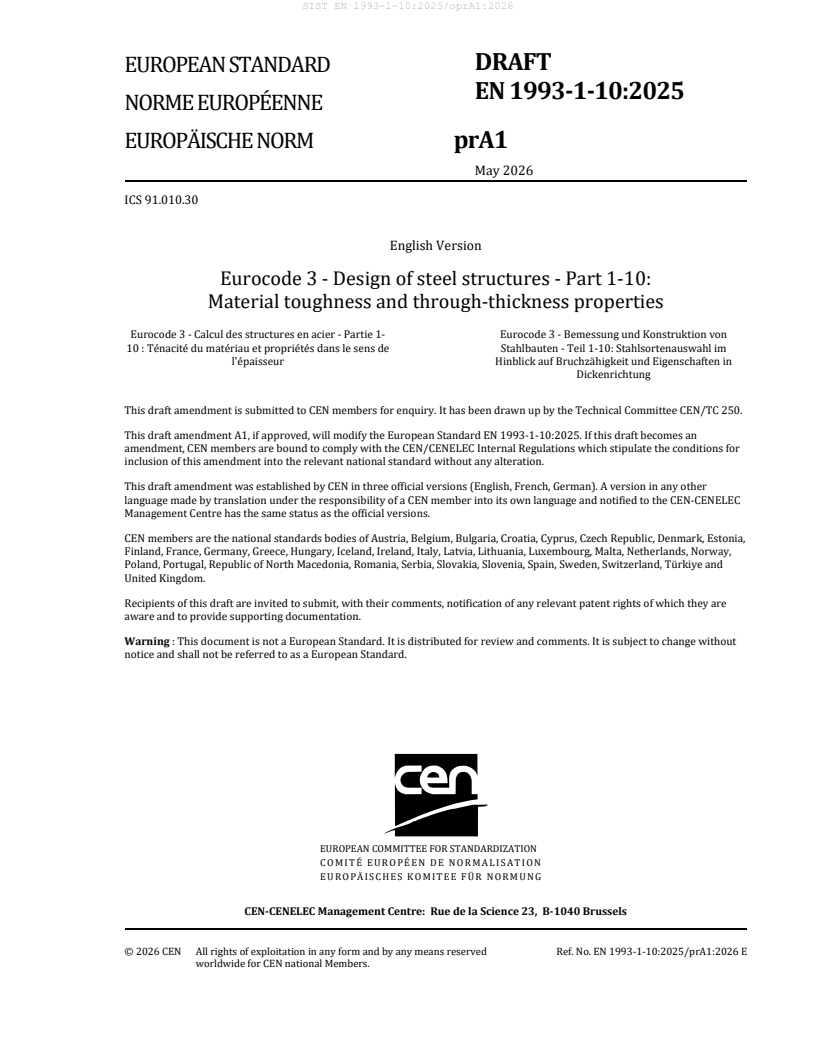
DRAFT
EUROPEAN STANDARD
EN 1993-1-10:2025
NORME EUROPÉENNE
EUROPÄISCHE NORM
prA1
May 2026
ICS 91.010.30
English Version
Eurocode 3 - Design of steel structures - Part 1-10:
Material toughness and through-thickness properties
Eurocode 3 - Calcul des structures en acier - Partie 1- Eurocode 3 - Bemessung und Konstruktion von
10 : Ténacité du matériau et propriétés dans le sens de Stahlbauten - Teil 1-10: Stahlsortenauswahl im
l'épaisseur Hinblick auf Bruchzähigkeit und Eigenschaften in
Dickenrichtung
This draft amendment is submitted to CEN members for enquiry. It has been drawn up by the Technical Committee CEN/TC 250.
This draft amendment A1, if approved, will modify the European Standard EN 1993-1-10:2025. If this draft becomes an
amendment, CEN members are bound to comply with the CEN/CENELEC Internal Regulations which stipulate the conditions for
inclusion of this amendment into the relevant national standard without any alteration.
This draft amendment was established by CEN in three official versions (English, French, German). A version in any other
language made by translation under the responsibility of a CEN member into its own language and notified to the CEN-CENELEC
Management Centre has the same status as the official versions.
CEN members are the national standards bodies of Austria, Belgium, Bulgaria, Croatia, Cyprus, Czech Republic, Denmark, Estonia,
Finland, France, Germany, Greece, Hungary, Iceland, Ireland, Italy, Latvia, Lithuania, Luxembourg, Malta, Netherlands, Norway,
Poland, Portugal, Republic of North Macedonia, Romania, Serbia, Slovakia, Slovenia, Spain, Sweden, Switzerland, Türkiye and
United Kingdom.
Recipients of this draft are invited to submit, with their comments, notification of any relevant patent rights of which they are
aware and to provide supporting documentation.
Warning : This document is not a European Standard. It is distributed for review and comments. It is subject to change without
notice and shall not be referred to as a European Standard.
EUROPEAN COMMITTEE FOR STANDARDIZATION
COMITÉ EUROPÉEN DE NORMALISATION
EUROPÄISCHES KOMITEE FÜR NORMUNG
CEN-CENELEC Management Centre: Rue de la Science 23, B-1040 Brussels
© 2026 CEN All rights of exploitation in any form and by any means reserved Ref. No. EN 1993-1-10:2025/prA1:2026 E
worldwide for CEN national Members.
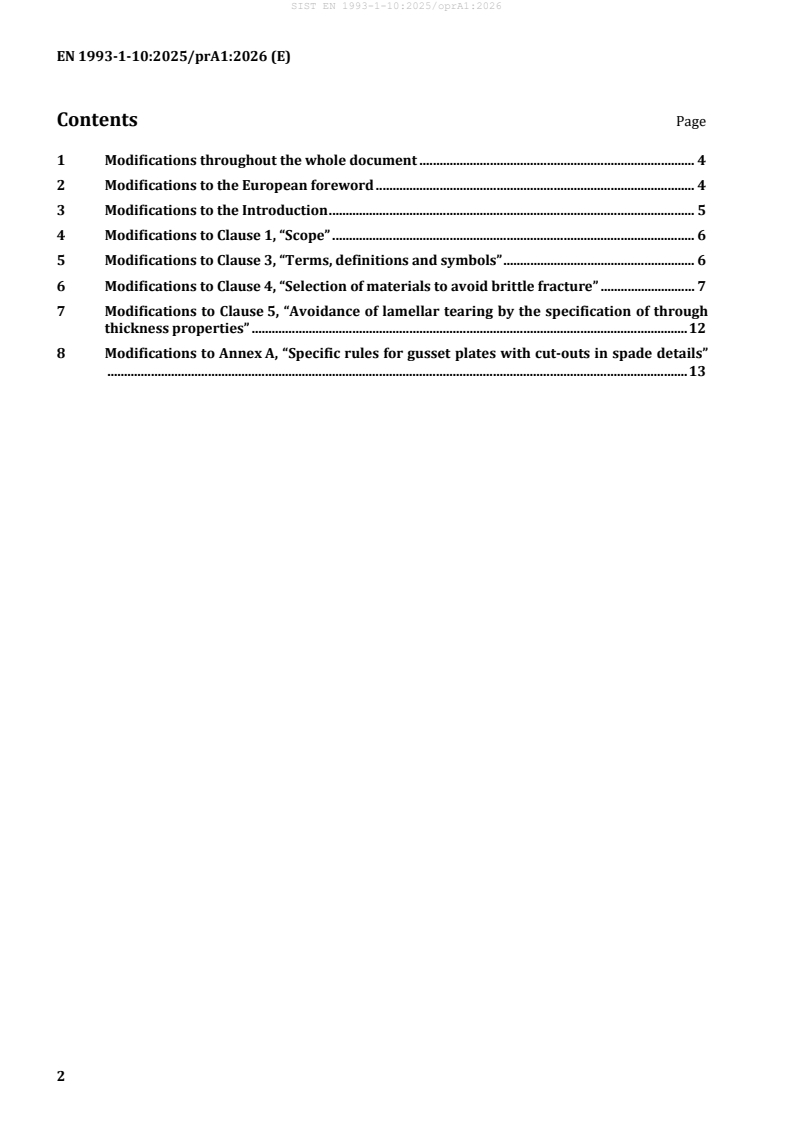
Contents Page
1 Modifications throughout the whole document . 4
2 Modifications to the European foreword . 4
3 Modifications to the Introduction . 5
4 Modifications to Clause 1, “Scope” . 6
5 Modifications to Clause 3, “Terms, definitions and symbols” . 6
6 Modifications to Clause 4, “Selection of materials to avoid brittle fracture” . 7
7 Modifications to Clause 5, “Avoidance of lamellar tearing by the specification of through
thickness properties” . 12
8 Modifications to Annex A, “Specific rules for gusset plates with cut-outs in spade details”
............................................................................................................................................................................. 13
European foreword
This document (EN 1993-1-10:2025/prA1:2026) has been prepared by Technical Committee
CEN/TC 250 “Structural Eurocodes”, the secretariat of which is held by BSI. CEN/TC 250 is responsible
for all Structural Eurocodes and has been assigned responsibility for structural and geotechnical design
matters by CEN.
This document is an amendment to EN 1993-1-10:2025 and is currently submitted to the CEN Enquiry.
The following main changes to EN 1993-1-10:2025 are included in the amendment:
— A restriction of the rules for the choice of material in case of welding in cold formed zones for steel
grades up to S460 was skipped, based on recent research works and publications.
— This amendment corrects technical and editorial points in EN 1993-1-10:2025 to increase the clarity
and user friendliness.
The first generation of EN Eurocodes was published between 2002 and 2007. This document forms part
of the second generation of the Eurocodes, which have been prepared under Mandate M/515 issued to
CEN by the European Commission and the European Free Trade Association.
The Eurocodes have been drafted to be used in conjunction with relevant execution, material, product
and test standards, and to identify requirements for execution, materials, products and testing that are
relied upon by the Eurocodes.
The Eurocodes recognize the responsibility of each Member State and have safeguarded their right to
determine values related to regulatory safety matters at national level through the use of National
Annexes.
1 Modifications throughout the whole document
Add “-1:2023+A1:2026” to the reference “EN 1990” in Clause 2 and update throughout the text when a
dated reference is given.
Add part number “-1” to the reference “EN 1990” and update throughout the text when an undated reference
is given.
2 Modifications to the European foreword
First bullet:
• Replace “application” with “scope”.
• Replace “non-standard” with “include”.
Second bullet:
• Add “material” before “selection”.
• Delete “of a design”.
• Replace “introduced” with “included”.
Third bullet:
• Delete “the possibility to consider”.
• Replace “execution classes” with “Execution Classes”.
• Add “(EXC) for the material selection” after “execution classes”.
• Delete “in design” before “procedure”.
• Replace “(4.12, 4.2.2, 4.2.2.2, 4.2.2.3, 4.3)” with “(4.2, 4.3)”.
Fourth bullet:
• Replace “(4.2.1)” with “(4.2)”.
Fifth bullet:
• Replace “(4.2.1)” with “(4.2.2)”.
Sixth bullet:
• Replace “(4.2.2.2)” with “(4.2.3)”.
Seventh bullet:
• Replace “former tabulated values mainly derived for bridge design given in former Table 2.1 are
related to Execution Classes EXC3 and EXC4 and transferred to new Table 4.2 (4.2.2.2)” with “the
maximum permissible values of element thickness given in Table 2.1 of EN 1993-1-10:2005 were
developed for bridge structures; this information has been transferred to Table 4.2 and related to
EXC3 and EXC4;”.
Eighth bullet:
• Replace “new tabulated values have been introduced related” with “the maximum permissible values
of element thickness”.
• Replace “see” with “are given in”.
Ninth bullet:
• Replace “new design rules for” with “construction”.
• Add “those given in” before “EN 1993-1-9”.
• Replace “have been” with “are”.
Eleventh bullet:
• Replace “material related” with “the”.
• Replace “shifted” with “transferred”.
• Delete “subclause” before “4.4”.
Twelfth bullet:
• Replace “dealing with” with “addressing”.
3 Modifications to the Introduction
0.1 Replace “— New parts are under development, e.g. Eurocode for design of structural glass”
with “— EN 19100 Eurocode 10 — Design of glass structures”.
0.1 Add the following new list item: “— New parts are under development, e.g. Eurocode for design of
fibre-polymer composite structures and for design of tensioned membrane structures”.
0.2 Replace in the first paragraph the reference to EN 1990 with “EN 1990-1 — Basis of structural and
geotechnical design — Part 1: New structures”.
0.2 Replace the list of the various parts of EN 1993 with:
“EN 1993-1-1, Eurocode 3 — Design of Steel Structures — Part 1-1: General rules and rules for buildings;
EN 1993-1-2, Eurocode 3 — Design of Steel Structures — Part 1-2: Structural fire design;
EN 1993-1-3, Eurocode 3 — Design of Steel Structures — Part 1-3: Cold-formed members and sheeting;
NOTE Cold-formed hollow sections supplied according to EN 10219 (all parts) are covered in EN 1993-1-1.
EN 1993-1-4, Eurocode 3 — Design of Steel Structures — Part 1-4: Stainless steel structures;
EN 1993-1-5, Eurocode 3 — Design of Steel Structures — Part 1-5: Plated structural elements;
EN 1993-1-6, Eurocode 3 — Design of Steel Structures — Part 1-6: Strength and stability of shell structures;
EN 1993-1-7, Eurocode 3 — Design of Steel Structures — Part 1-7: Plate assemblies with elements under
transverse loads;
EN 1993-1-8, Eurocode 3 — Design of Steel Structures — Part 1-8: Joints;
EN 1993-1-9, Eurocode 3 — Design of Steel Structures — Part 1-9: Fatigue;
EN 1993-1-10, Eurocode 3 — Design of Steel Structures — Part 1-10: Material toughness and through-
thickness properties;
EN 1993-1-11, Eurocode 3 — Design of Steel Structures — Part 1-11: Tension components;
EN 1993-1-12, Eurocode 3 — Design of Steel Structures — Part 1-12: Additional rules for steel grades up to
S960;
EN 1993-1-13, Eurocode 3 — Design of Steel Structures — Part 1-13: Beams with large web openings;
EN 1993-1-14, Eurocode 3 — Design of Steel Structures — Part 1-14: Design assisted by finite element
analysis;
EN 1993-2, Eurocode 3 — Design of Steel Structures — Part 2: Bridges;
EN 1993-3, Eurocode 3 — Design of Steel Structures — Part 3: Towers, masts and chimneys;
EN 1993-4-1, Eurocode 3 — Design of Steel Structures — Part 4-1: Silos;
EN 1993-4-2, Eurocode 3 — Design of Steel Structures — Part 4-2: Tanks;
EN 1993-5, Eurocode 3 — Design of Steel Structures — Part 5: Piling;
EN 1993-6, Eurocode 3 — Design of Steel Structures — Part 6: Crane supporting structures;
EN 1993-7, Eurocode 3 — Design of Steel Structures — Part 7: Sandwich panels (under preparation).”.
0.3 Delete “general design”.
0.3 Add “(i)” after “rules for”.
0.3 Replace “to avoid” with “(ii) prevention of”.
0.3 Add “in welded elements” after “lamellar tearing”.
0.5 Add “notes to” between “through” and “the following clauses” in 0.5.
4 Modifications to Clause 1, “Scope”
1.1(2) Replace “specifies” with “provides”.
1.1(2) Add “for all steel grades from S235 up to and including S700” after “lamellar tearing”.
1.1(5) Replace “specifies” with “gives”.
1.1(6) Replace “EN 1993-1-10 specifies rules that” with “The provisions in this document”.
1.1(6) Add “s” to steel after “applies to”.
1.1(6) Replace “materials” with “complying with the requirements of”.
1.1(6) Replace “covered by” with “5.1(3) of”.
1.1(6) Delete “5.1 (3)” after “EN 1993-1-1:2022,”.
1.1(6) Replace “the requirements” with “5.2.1”.
1.1(6) Replace “5.2.1 and” with “or 5.1 of”.
1.1(6) Delete “, 5.1” after “EN 1090-2:2018”.
5 Modifications to Clause 3, “Terms, definitions and symbols”
3.1.2 Delete “showing the relationship KV(T)” and replace “in which” with “where”.
3.1.3 Replace “in which” with “where” and swap the whole content of 3.1.3 with 3.1.2.
3.1.4, Figure 3.1, NOTE 1, Add “The” before “Charpy” and replace “an explanation” with “the definition”.
3.1.5 Replace “at which” with “where”.
3.1.8 Replace “modified” with “adjusted”, add “,” after “strain rates” and add ”,” after “cold forming”.
3.1.9 Delete “pr” before “EN 1991-1-5”.
3.1.10 Replace “bound” with “chemically bonded”.
3.2
• For ∆T replace “shift” with “adjustment”,
ε
• For ∆T replace “shift” with “adjustment”,
ε, cf
• For ΔT replace “shift” with “adjustment”.
σ
6 Modifications to Clause 4, “Selection of materials to avoid brittle fracture”
4 Replace in the title of Clause 4 “materials” with “steel quality”.
4.1(1) Replace in the first line “materials” with
...