

FprEN 12697-10
(Main)Bituminous mixtures - Test methods - Part 10: Compactability
- Abstract
This document describes three test methods for characterizing the compactability of a bituminous mixture, by the relation between its density or void content and the compaction energy applied to it, using an impact (Marshall) compactor, gyratory compactor, or a vibratory compactor.
This document applies to bituminous mixtures, both those prepared in laboratory and those resulting sampled from plant produced mixtures. The results of the test method serve to supplement the results of mixture design.
- Status
- Not Published
- Publication Date
- 03-Jan-2027
- Technical Committee
- CEN/TC 227 - Road materials
- Drafting Committee
- CEN/TC 227/WG 1 - Bituminous mixtures
- Current Stage
- 5020 - Submission to Vote - Formal Approval
- Start Date
- 10-Sep-2026
- Due Date
- 09-Feb-2026
- Completion Date
- 10-Sep-2026

Overview
FprEN 12697-10: Bituminous Mixtures - Test Methods - Part 10: Compactability is a European standard developed by CEN/TC 227, specifying procedures for assessing the compactability of bituminous mixtures. Compactability reflects a mixture’s ability to achieve density under mechanical effort, which is crucial for the durability and performance of asphalt used in road construction. This standard outlines three distinct laboratory procedures, using impact (Marshall), gyratory, and vibratory compactors, to evaluate the relationship between compaction energy and density or void content. Applicable to both laboratory-prepared and plant-produced mixtures, the methods supplement mixture design processes by providing objective data on how asphalt will perform during compaction.
Key Topics
Compactability Testing Methods:
- Impact Compaction (Marshall): Conducted with either multiple specimens at varying compaction energies or with a single specimen measured for thickness reduction.
- Gyratory Compaction: Monitors change in density or void content with respect to the number of gyrations.
- Vibratory Compaction: Assesses density change over defined periods of vibration.
Test Parameters:
- Bulk Density and Void Content: Fundamental characteristics influencing pavement performance.
- Compaction Resistance: Indicates how much energy is required for a mixture to reach a certain density.
- Repeatability and Reproducibility: Ensures reliability of test outcomes across laboratories.
- Data Expression: Results are plotted as density (or voids) versus compaction energy, aiding comparative analysis.
Standardized Reporting:
- Detailed test report requirements enhance transparency and traceability.
- Inclusion of testing conditions, compaction parameters, and graphical data presentation is mandated.
Applications
Road Construction Quality Assurance:
Applying the compactability test methods from FprEN 12697-10 ensures bituminous mixtures meet required compaction standards, directly impacting pavement durability and performance.Mixture Design Optimization:
By supplementing traditional mix design with compactability data, designers can adjust aggregate grading, binder content, or additives to improve field compaction outcomes, reducing the risk of premature pavement distress.Industrial Production Control:
The methods apply to both laboratory and plant-mixed asphalts, supporting quality control in both R&D and full-scale production. This assists in maintaining consistency between trial batches and final product delivered to the site.Specification Compliance:
Demonstrating compliance with EN standards is critical for contractors and suppliers bidding for European infrastructure projects. Documented compactability results provide confidence to clients and regulators.
Related Standards
FprEN 12697-10 operates within a family of standards for bituminous mixtures. Key related standards include:
- EN 12697-5: Maximum density determination
- EN 12697-6: Bulk density measurement
- EN 12697-8: Void characteristics of specimens
- EN 12697-30: Specimen preparation using the impact compactor
- EN 12697-31: Specimen preparation using the gyratory compactor
- EN 12697-32: Laboratory vibratory compaction methods
Together, these standards provide a comprehensive toolkit for testing, designing, and validating bituminous mixtures intended for road construction and other infrastructural applications across Europe.
Practical Value
Integrating FprEN 12697-10 methods into routine practice delivers several advantages:
- Improved pavement longevity by validating mixture compactability before field placement.
- Reduced variability between laboratory and on-site compaction, minimizing risks of premature failures.
- Consistent documentation to support regulatory submissions and project quality audits.
- Enhanced competitiveness for contractors adhering to the latest European standardization requirements for bituminous mixtures.
By adopting FprEN 12697-10, engineers and labs can ensure accurate, repeatable, and trustworthy evaluation of asphalt compactability, supporting long-term infrastructure performance.
Relations
- Effective Date
- 28-Jan-2026
- Effective Date
- 28-Jan-2026
- Effective Date
- 28-Jan-2026
- Effective Date
- 28-Jan-2026
- Effective Date
- 21-Feb-2024
Get Certified
Connect with accredited certification bodies for this standard

Zavod za gradbeništvo Slovenije (ZAG) - Inšpekcija
ZAG inspection body for construction products, structures, and materials.
Sponsored listings
Frequently Asked Questions
FprEN 12697-10 is a draft published by the European Committee for Standardization (CEN). Its full title is "Bituminous mixtures - Test methods - Part 10: Compactability". This standard covers: This document describes three test methods for characterizing the compactability of a bituminous mixture, by the relation between its density or void content and the compaction energy applied to it, using an impact (Marshall) compactor, gyratory compactor, or a vibratory compactor. This document applies to bituminous mixtures, both those prepared in laboratory and those resulting sampled from plant produced mixtures. The results of the test method serve to supplement the results of mixture design.
This document describes three test methods for characterizing the compactability of a bituminous mixture, by the relation between its density or void content and the compaction energy applied to it, using an impact (Marshall) compactor, gyratory compactor, or a vibratory compactor. This document applies to bituminous mixtures, both those prepared in laboratory and those resulting sampled from plant produced mixtures. The results of the test method serve to supplement the results of mixture design.
FprEN 12697-10 is classified under the following ICS (International Classification for Standards) categories: 93.080.20 - Road construction materials. The ICS classification helps identify the subject area and facilitates finding related standards.
FprEN 12697-10 has the following relationships with other standards: It is inter standard links to EN ISO/ASTM 52908:2023, CEN ISO/ASTM TS 52949:2025, EN ISO/ASTM 52935:2023, EN ISO/ASTM 52904:2024, EN 12697-10:2017. Understanding these relationships helps ensure you are using the most current and applicable version of the standard.
FprEN 12697-10 is available in PDF format for immediate download after purchase. The document can be added to your cart and obtained through the secure checkout process. Digital delivery ensures instant access to the complete standard document.
Standards Content (Sample)
SLOVENSKI STANDARD
01-marec-2025
Bitumenske zmesi - Preskusne metode - 10. del: Zgostljivost
Bituminous mixtures - Test methods - Part 10: Compactability
Asphalt - Prüfverfahren - Teil 10: Verdichtbarkeit
Mélanges bitumineux - Méthodes d'essai - Partie 10 : Compactabilité
Ta slovenski standard je istoveten z: prEN 12697-10
ICS:
93.080.20 Materiali za gradnjo cest Road construction materials
2003-01.Slovenski inštitut za standardizacijo. Razmnoževanje celote ali delov tega standarda ni dovoljeno.
DRAFT
EUROPEAN STANDARD
prEN 12697-10
NORME EUROPÉENNE
EUROPÄISCHE NORM
January 2025
ICS 93.080.20 Will supersede EN 12697-10:2017
English Version
Bituminous mixtures - Test methods - Part 10:
Compactability
Mélanges bitumineux - Méthodes d'essai - Partie 10 : Asphalt - Prüfverfahren - Teil 10: Verdichtbarkeit
Compactabilité
This draft European Standard is submitted to CEN members for enquiry. It has been drawn up by the Technical Committee
CEN/TC 227.
If this draft becomes a European Standard, CEN members are bound to comply with the CEN/CENELEC Internal Regulations
which stipulate the conditions for giving this European Standard the status of a national standard without any alteration.
This draft European Standard was established by CEN in three official versions (English, French, German). A version in any other
language made by translation under the responsibility of a CEN member into its own language and notified to the CEN-CENELEC
Management Centre has the same status as the official versions.
CEN members are the national standards bodies of Austria, Belgium, Bulgaria, Croatia, Cyprus, Czech Republic, Denmark, Estonia,
Finland, France, Germany, Greece, Hungary, Iceland, Ireland, Italy, Latvia, Lithuania, Luxembourg, Malta, Netherlands, Norway,
Poland, Portugal, Republic of North Macedonia, Romania, Serbia, Slovakia, Slovenia, Spain, Sweden, Switzerland, Türkiye and
United Kingdom.
Recipients of this draft are invited to submit, with their comments, notification of any relevant patent rights of which they are
aware and to provide supporting documentation.
Warning : This document is not a European Standard. It is distributed for review and comments. It is subject to change without
notice and shall not be referred to as a European Standard.
EUROPEAN COMMITTEE FOR STANDARDIZATION
COMITÉ EUROPÉEN DE NORMALISATION
EUROPÄISCHES KOMITEE FÜR NORMUNG
CEN-CENELEC Management Centre: Rue de la Science 23, B-1040 Brussels
© 2025 CEN All rights of exploitation in any form and by any means reserved Ref. No. prEN 12697-10:2025 E
worldwide for CEN national Members.
prEN 12697-10:2024 (E)
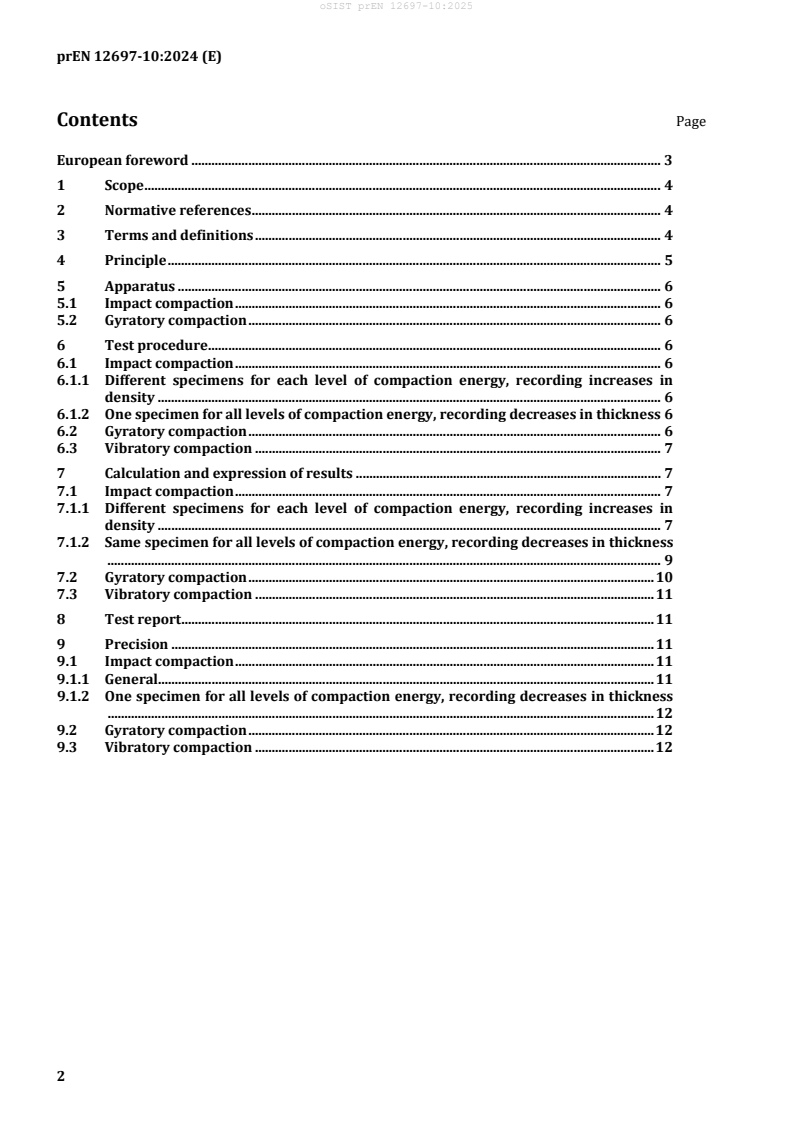
Contents Page
European foreword . 3
1 Scope . 4
2 Normative references . 4
3 Terms and definitions . 4
4 Principle . 5
5 Apparatus . 6
5.1 Impact compaction . 6
5.2 Gyratory compaction . 6
6 Test procedure . 6
6.1 Impact compaction . 6
6.1.1 Different specimens for each level of compaction energy, recording increases in
density . 6
6.1.2 One specimen for all levels of compaction energy, recording decreases in thickness 6
6.2 Gyratory compaction . 6
6.3 Vibratory compaction . 7
7 Calculation and expression of results . 7
7.1 Impact compaction . 7
7.1.1 Different specimens for each level of compaction energy, recording increases in
density . 7
7.1.2 Same specimen for all levels of compaction energy, recording decreases in thickness
..................................................................................................................................................................... 9
7.2 Gyratory compaction . 10
7.3 Vibratory compaction . 11
8 Test report . 11
9 Precision . 11
9.1 Impact compaction . 11
9.1.1 General. 11
9.1.2 One specimen for all levels of compaction energy, recording decreases in thickness
................................................................................................................................................................... 12
9.2 Gyratory compaction . 12
9.3 Vibratory compaction . 12
prEN 12697-10:2024 (E)
European foreword
This document (prEN 12697-10:2024) has been prepared by Technical Committee CEN/TC 227 “Road
materials”, the secretariat of which is held by BSI.
This document is currently submitted to the CEN Enquiry.
This document will supersede EN 12697-10:2017.
prEN 12697-10:2024 includes the following significant technical changes with respect to
EN 12697-10:2017:
— [European Foreword] deletion of paragraph: “The applicability of this European Standard is
described in the product standards for bituminous materials.”;
— [Clause 2] the titles for test methods corrected by deletion of “for hot mix asphalt”;
— [5.1.2] amended to read: “mm with a maximum permissible error of 0,1 mm.”
— [5.1.3] amended to read: “Slide calliper rule, capable to measure the thickness of the specimen to
the nearest 0,1 mm with a maximum permissible error of 0,2 mm.”
— [6.1.2] 2nd paragraph clarified;
— [Clause 8] information to be included in the test report amended.
A list of all parts in the EN 12697 series can be found on the CEN website: www.cencenelec.eu
prEN 12697-10:2024 (E)
1 Scope
This document describes three test methods for characterizing the compactability of a bituminous mix,
by the relation between its density or void content and the compaction energy applied to it, using an
impact (Marshall) compactor, gyratory compactor, or a vibratory compactor.
This document applies to bituminous mixtures, both those prepared in laboratory and those resulting
sampled from plant produced mixtures. The results of the test method serve to supplement the results of
mixture design.
2 Normative references
The following documents are referred to in the text in such a way that some or all of their content
constitutes requirements of this document. For dated references, only the edition cited applies. For
undated references, the latest edition of the referenced document (including any amendments) applies.
EN 12697-5, Bituminous mixtures — Test methods— Part 5: Determination of the maximum density
EN 12697-6, Bituminous mixtures — Test methods— Part 6: Determination of bulk density of bituminous
specimens
EN 12697-8, Bituminous mixtures — Test methods— Part 8: Determination of void characteristics of
bituminous specimens
EN 12697-30, Bituminous mixtures — Test methods— Part 30: Specimen preparation by impact compactor
EN 12697-31, Bituminous mixtures — Test methods— Part 31: Specimen preparation by gyratory
compactor
EN 12697-32, Bituminous mixtures — Test methods— Part 32: Laboratory compaction of bituminous
mixtures by vibratory compactor
3 Terms and definitions
For the purposes of this document, the following terms and definitions apply.
ISO and IEC maintain terminology databases for use in standardization at the following addresses:
— ISO Online browsing platform: available at https://www.iso.org/obp/
— IEC Electropedia: available at https://www.electropedia.org/
3.1
compactability
K, k
ability of an asphalt mixture to be compacted (K when evaluated by gyratory compaction and k when
evaluated by vibratory compaction)
Note 1 to entry: High values of K and k will indicate a mixture for which less compaction energy is required to
obtain a given void content decrease.
prEN 12697-10:2024 (E)
3.2
compaction resistance
C, T
resistance of an asphalt mixture to being compacted (C when evaluated by impact compaction of several
specimens with varied compaction energy and T when evaluated by impact compaction of one specimen
while measuring its thickness)
Note 1 to entry: High values of C and T will indicate a mixture for which high compaction energy is required to
obtain a given void content decrease.
4 Principle
The bituminous mixture is compacted at a prescribed temperature with varying compaction energies
using one of three optional types of compaction methods:
a) impact compaction
b) gyratory compaction
c) vibratory compaction.
Two methods of monitoring the compactability can be applied:
— Method 1: two or more specimen are compacted with different amounts of compaction energy and
their densities are measured.
— Method 2: one specimen is used and its increase in density during the compaction process is
determined from its decrease in thickness.
The following Table 1 defines the compaction type to use depending of the compactness of tracking
method and gives the clause of test procedure.
Table 1 — Compaction type
Procedure clause according to
compaction method
impact gyratory vibratory
Compaction of specimens with carried compaction energy 6.1.1 n. a. 6.3
Measurement of specimen thickness during compaction 6.1.2 6.2 n. a.
A graph is drawn of density (or voids content) against compaction energy. When the impact compaction
is used, the compaction energy is characterized by the number of blows, when the gyratory compaction
is used, by the number of gyrations and when the vibratory compactor is used, by the duration in seconds.
A mathematical formula is derived from the experimental results, the parameters of which formula
characterize the compactability of the bituminous mixture.
prEN 12697-10:2024 (E)
5 Apparatus
5.1 Impact compaction
5.1.1 Marshall compactor shall be in accordance with EN 12697-30.
5.1.2 Measuring device for automatically recording the thickness of the specimen after each blow of
compaction with a maximum permissible error of 0,1 mm.
5.1.3 Slide calliper rule with a maximum permissible error of 0,1 mm.
5.2 Gyratory compaction
5.2.1 Gyratory compactor shall be in accordance with EN 12697-31.
5.3.1 Vibratory compactor shall be in accordance with EN 12697-32.
6 Test procedure
6.1 Impact compaction
6.1.1 Different specimens for each level of compaction energy, recording increases i
...